Maurice Druon ha sabido narrar como ningún otro las historias secretas, las pasiones y las debilidades de ese periodo turbio de la historia de Europa en este tercer volumen de la saga «Los Reyes Malditos». Los venenos de la corona resucita los conflictos, odios, intrigas y crímenes que plagaron el reinado de dieciocho meses de Luis X. El desgraciado destino de la hermosa Clemencia de Hungría, llamada a ser reina de Francia y repentinamente viuda; los destinos truncados del joven lombardo Guccio Baglioni y de María Cressay, cuyos amores debieron enfrentarse a las prohibiciones sociales; los destinos violentos de la condesa Mahaut de Artois y de su sobrino Roberto, separados por un odio acérrimo, y, por fin, el trágico destino del rey Luis X, que en pocos meses lleva la obra del Rey de Hierro al borde de su destrucción. En Junio de 1316, el rey muere envenenado. Es la primera vez en tres siglos que un monarca de Francia fallece sin dejar heredero varón.
Maurice Druon was born in Paris. He is the nephew of the writer Joseph Kessel, with whom he wrote the Chant des Partisans, which, with music composed by Anna Marly, was used as an anthem by the French Resistance during the Second World War.
In 1948 he received the Prix Goncourt for his novel Les grandes familles. On December 8, 1966, he was elected to the 30th seat of the Académie française, succeeding Georges Duhamel.
While his scholarly writing earned him a seat at the Académie, he is best known for a series of seven historical novels published in the 1950s under the title Les Rois Maudits (The Accursed Kings).
He was Minister of Cultural Affairs in 1973 and 1974 in Pierre Messmer's cabinet, and a deputy of Paris from 1978 to 1981.
La maldición de los capetos avanza. Menos de un año después de ascender al trono, Luis X "El Obstinado", hijo mayor de Felipe "El Hermoso", fallece en extrañas circunstancias. La sospecha del veneno planea sobre la corte.
Tras más de 300 años, un rey francés muere sin descendencia masculina. Pero en principio no parece que vaya a haber problema en este terreno. Clemencia, la nueva esposa de Luis, tras deshacerse de la infiel Margarita (se marcó un Enrique VIII, aunque mucho me temo que los reyes venían haciendo esto desde el principio de los tiempos ante la imposibilidad de divorcio, si las intrigas vaticanas no concedían la nulidad), queda embarazada. También hay dos hermanos menores de Luis, Felipe y Carlos, en la línea sucesoria, que parecen que apuntalan el futuro de la dinastía.......aunque no hay nada seguro nunca y más con una maldición de por medio.
Las intrigas recorren el breve reinado de este rey, manipulado por los nobles y su familia, poco querido por el pueblo, con un reinado funesto marcado por las revueltas nobiliarias, desgracias, malas cosechas y el hambre del vulgo. En menos de un año ha deshecho la mayoría de las leyes promulgadas por su padre en pos de un poder central más fuerte y una nobleza debilitada. El sistema administrativo y recaudatorio también es historia y los nobles campan por sus fueros a la antigua usanza. ¿Alguien decidió que no merecía la pena que este personaje siguiera en el trono, ante las abundantes alternativas disponibles?
Druon nos cuenta la historia, las leyendas y los cotilleos. El tono general es bueno, pero para mi gusto sobra la sub-trama que cuenta los líos amorosos de Guccio Baglioni con una chica de la pequeña nobleza, Maria de Cressay. Guccio es descendientes de Lombardos, banqueros de origen toscano afincados en Francia, a los que recurren continuamente nobles y reyes en busca de financiación...hasta que me enteré de la historia del hijo póstumo de Luis, Juan I. La leyenda de su cambio en la cuna por un tal Gianinno, hijo de Guccio.....todo cuadra ahora.
La verdad es que no me da para 5 estrellas, pero son entretenidos, cortitos y muy instructivos.
On the third volume of the saga of The Accursed Kings, the demise of the Capet dynasty continues, even if the various personalities did not know it yet.
The subtitles to each volume already indicate the episode that will be developed. Poison. And therefore death of the first of the accursed three sons of Philippe IV, Louis X (1289-1316).
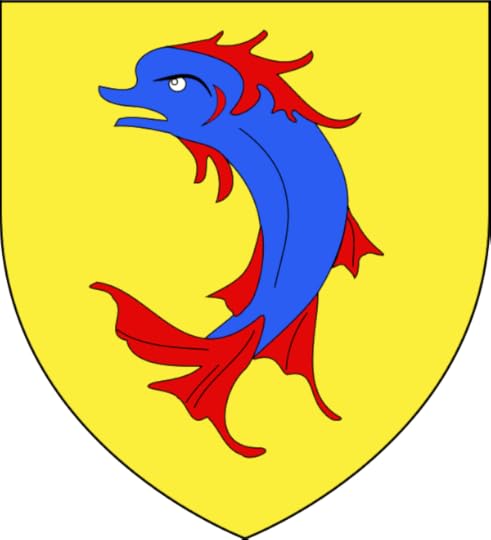
In general, Druon follows rather closely the historical events, and his factual content is supplemented by the generous use of the footnotes, which I do not want to miss for anything in the world, since they are almost the best part of reading his series. In particular, I was grateful for the one on the Dauphiné, from which I finally learnt why the heir to the French crown was called le Dauphin. I remember the first time I heard that term and how baffled I was. Watching as a child a televised version of a Spanish realist novel, Fortunata y Jacinta, Volumen I, the term (el Delfín - in Spanish but adapted from the French), was used for the heir of one of the families in the novel. I could not understand the weird use of the word. When the Dauphiné, originally part of the Holy Roman Empire, was incorporated into the French crown it was on the condition that the eldest son would be called Le Dauphin. As a child I would have loved to see their coat of arms, and would have understood things better.
I have also learnt what it is meant y messe aride (arid or barren mass) – the mass which is celebrated in the seas. Out of fear of rough weather and of the passengers vomited, a special liturgy without communion would be the kind performed on board. Or I have improved my French, knowledge of old French by learning that the word d’ost derives from the Latin for enemy and by then it referred to the royal army.
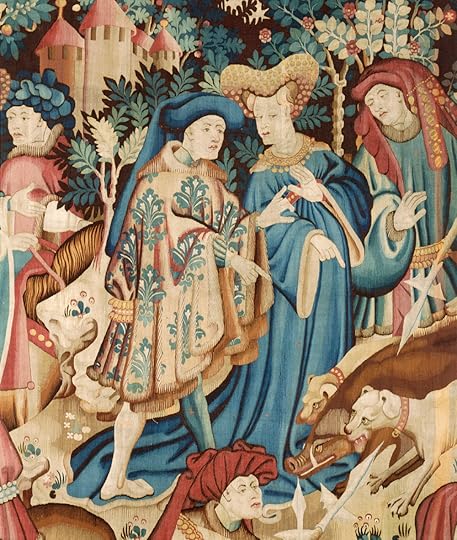
The note on tapestries inevitably would hold my attention. Druon maintains that the particular importance that the Artois region and the city of Arras in particular had in the making of exquisite tapestries, was thanks to the patronage of one of the personalities in the book, the Countess Mahout.
However, I could not entirely agree with another note. Dante is presented by Druon as a Ghibelline, when by the end of the 13C, the Ghibellines were out of the picture in the Sicilian dispute. Although Dante extolled a hypothetical role for the Emperor in pacifying and unifying Italy in his The Divine Comedy, he was a Guelf, a white Guelf. The conflict that brought his exile from Florence when the Pope and the Black Guelfs expelled him (and thanks to which he wrote his masterpiece).
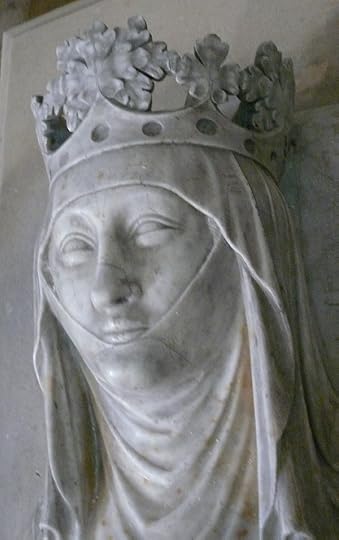
Anyway, apart from the footnotes, this novel offers a highly entertaining way for becoming familiarized with the events and circumstances surrounding the short reign of Louis X. Once his first, and adulterous, wife was out of the world, he could marry Clementia of Hungary. This episode invites to do a complementary review of the complex politics unfolding in Italy at the time and o learn who this Clementia was (a daughter of Charles Martel of Anjou, a personal friend of Dante).
Charles Martel of Anjou
In the novel we also see how not just short but also ineffective reign Louis’s was. He undid a few of the positive reforms of his father (unification of the currency) and tried to regain control of Flanders, unsuccessfully.
The fictional element is to be found mostly in the ancillary love stories, and on taking not only the most dramatic interpretation of any sudden death, but also of giving us with full certainty who the assassin was. If Margaret of Burgundy was strangled in the previous volume by, Louis was poisoned in this one.
I will not say who Druon’s murderers were, because that would be a Spoiler to the fiction he has so craftily constructed. While the actual deaths are not Spoilers – they are history.
Ah, Mahaut of Artois! I’ll never understand why you are not better known as one of the greatest villains of literature! You will stop at nothing to defeat your nephew Robert and put your own lineage closer to the throne of France. Plotting, murder, witchcraft, nothing is too extreme for you!
I am such a huge fan of this series of historical novels about the Capetian line and the beginning of the Hundred Year war. The language is clean yet poetic, the intrigue so deliciously detailed and the characters larger than life. “The Poisoned Crown” has suffered bad reviews, and I disagree with them. I think things get particularly juicy in this installment of the Accursed Kings: it can feel a little slow at time, but keep in mind that Druon is also setting the reader up for the second half of the series… If you think Mahaut is vicious in this one, just wait for book 4!
Marguerite of Bourgogne is dead, so Louis X can finally remarry. He is, however, a deeply incompetent ruler that everyone tries to manipulate to their own ends. Cruel and impulsive, he starts a war with Flanders that puts a strain of the kingdom’s finance and only serves to show what a mess he is making of his father’s legacy. He marries the princess Clémence for his own satisfaction, but also to have a legitimate male heir, so that the daughter he had with Marguerite can be legally pushed away from the throne. But Louis having a son would spoil other people’s plans for the kingdom: Mahaut is especially convinced that her son-in-law, Philippe of Poitiers, would be the perfect man for his brother Louis’ job… In the meantime, our Lombard friend Guiccio Baglioni is desperate to get back to his lover Marie de Cressay, whom he vows to marry regardless of the social gap dividing them.
This installment obviously features a lot of Mahaut and Philippe, who are two of my favorite characters in this historical saga: the dialogue between them is especially clever and funny: they are both keen political minds and every word they say is loaded with meaning. Princess Clémence of Hungary is the kindest, most innocent character in this series: the poor dear has no idea what boat she got herself into… Louis is, of course, still the snivelling and immature little weasel I rolled my eyes at through the first two books. It’s probably a good thing his reign was so short!
“The Poisoned Crown” goes into very detailed historical explanations of the economy, legal systems, social hierarchies, so the reader can really feel the characters’ dilemmas and understand their actions better. I appreciate this attention to detail, but I can see how this would not suit readers who look for something very action-driven.
Regardless, fans of historical fictions owe themselves the pleasure of reading these books! I can’t wait to find a copy of the fourth installement!
4⭐ Me sigue gustando mucho esta serie, quizá en esta tercera entrega baja un poquito el nivel en cuanto a intrigas y trejemanejes pero aun así sigue siendo muy interesante. Conocer desde dentro gracias a todos los datos históricos que hay el Reino de Francia, sus luchas de poder, sus despropósitos, sus amoríos, etc, etc... y encima de la mano de Maurice Droun, es una delicia.
Sobre esta novela muy poquito de contar, pone el foco en el reinado de Luis X El Turbulento, un personaje con nulas capacidades para liderar unos de los reinos más importantes de la época y asesorado por otros personajes que solo piensan en su beneficio personal.
"Se hubiera podido tener piedad de él, por la compasión que siempre inspira la estupidez, si no hubiera sido el encargado de regir los destinos de Francia y de sus quince millones de almas... ... el gran defecto de este soberano, como gobernante, tal vez era tener su mente siempre ocupada en otra cuestión, y no en la debatida. Era incapaz de concentrar su atención, lo cual constituye la mayor ineptitud para el poder.
Pero Maurice Droun no se centra solo en este incompetente monarca, hay mas tramas y subtramas alrededor de la corte que enriquecen mucho la novela -y la serie- con personajes muy grises y muy bien trazados.
An excellent historical fiction about the struggle for the French crown. Philliph the Fair is dead. His son, Louis X the Hutin (Hutin can be read as "Quarller, Headstrong or Stubborn" in French), now rules. His first wife, Marguerite of Burgundy, has been killed while in prison for adultery. This was done because there is no Pope. This story takes place during the time of the Avignon Papacy where the Papal throne had moved to Avignon. Thus without an elected Pope there can be no annulment of the marriage. So Louis X has his wife killed so that he can marry his second wife- Princess Clemence of Hungary.
She enters this viper's nest of internal politics, as powerful Barons and high lords all seek to remove Louis X. An excellent look at the politics of the very powerful who ruled France. The cast of characters is stunning from the famous lines of France- Capet, Valois and other famous people like Cardinal Jacques Dueze (soon to be Pope John XXII). The proverbial game of thrones shows us that history can be every bit as exciting and treacherous as fiction. Sadly unlike his father, called the Iron King, the Hutin is weak and venal. In the face of foes like the Count of Artois and his wretched Aunt, the Lady Mahaut, the Hutin finds himself ina truly treacherous place.
A wonderful historical fiction novel about a violent and treacherous time where the great and powerful all seek the ultimate prize- the Crown of France.
En intriga y atmósfera histórica es sobresaliente. Y desde luego también en ritmo, con abrirla se lee sola. Los personajes son muy buenos (para quien como yo la lee como una novela, sin recordar nada de su tiempo histórico), y tan solo le habría pedido más trabajo formal y un punto más de profundidad psicológica, aunque el autor ha optado por la brevedad, lo que también es de agradecer. Como narración de acontecimientos es magnífica.
Esta tercera parte me ha gustado más que las dos anteriores, porque ha generado una estructura más trágica sobre las dos historias que avanzan en paralelo, un matrimonio de amor y en secreto con los problemas que conlleva, me han gustado mucho Guccio y María, y un matrimonio político y sus intrigas sucesorias. Una familia estupenda los Artois. Estos personajes los detesto, pero su narración es muy buena. Y no sólo como recreación histórica, también como retrato de la sociedad medieval.
De alguna manera esta dinámica va tomando forma de la propia estructura social y no solo de las conspiraciones. Aunque se intente controlar el destino, las circunstancias históricas, sociales y políticas son más fuertes.
"Los venenos de la Corona resucita, casi día a día, los conflictos, odios, intrigas y crímenes que plagaron el reinado de dieciocho meses de Luis X. Maurice Druon vuelve a entretejer los signos de las figuras que marcaron esa época turbulenta de Europa; el desgraciado destino de la hermosa Clemencia de Hungría, llamada a ser reina de Francia y repentinamente viuda; los destinos truncados del joven lombardo Guccio Baglioni y de María de Cressay, cuyos amores debieron enfrentarse a las prohibiciones sociales; los destinos violentos de la condesa de Mahaut de Artois y de su sobrino Roberto, separados por un odio acérrimo, y, por fin, el trágico destino del rey Luis X, que en pocos meses lleva la obra del Rey de Hierro al borde de su destrucción."
Pues tercer libro de la saga de Los Reyes Malditos. Sigue el enganche, sigue el disfrute. Me ha parecido un pelín más flojo que los dos anteriores pero solo un pelín.
Luis X consigue casarse con Clemencia de Hungría. No le ha hecho falta una anulación por parte de ningún Papa (que por otro lado sigue sin ser elegido en un cónclave que parece no tener fin); ya que ha quedado viudo de Margarita (qué casualidad). El caso que está emocionado con su nueva mujer. Una reina muy benévola que pronto llevará en su vientre un posible futuro heredero.
"Clemencia, para aquella princesa de veintidós años sin ninguna dote territorial y solamente rica por la reputación de su hermosura y virtud, acababa de lograr la más alta alianza, la boda más prestigiosa. Clemencia iba a ser reina de Francia. De esta manera la más olvidada por la suerte de las princesas de Anjou, recibía el más poderoso reino."
Luis X sigue gobernando sin rumbo, echando a perder todos los avances conseguidos por su padre Felipe el Hermoso. El pueblo sigue pasando hambre, la nobleza quiere más poder, los conflictos continúan, la maldición continúa,...
El rey muere en extrañas circunstancias, ¿sobre quién recaerá la regencia? Comienza la partida por el poder.
Poor King Louis X of France! This installment in The Accursed Kings saga only covers a year or so and focuses upon the politics of the throne and intrigue. As usual, Druon animates the tale with witty phrases and intense dialogue. Louis X, recently crowned king after his father Phillippe the Fair died after an enlightened reign, faces many problems right off the get go. The cardinals still have not settled upon a new Pope, (one several people are pushing for him to be friendly to the French throne), but with the death/murder of his imprisoned wife, he is finally free to marry the lovely Princess Clemence of Hungary.
To say Louis X is a bit of a twit would be an understatement; he seldom has an opinion of his own and is basically led via his nose by his advisors, most of which have their own interests in mind. The old Barons resented the reforms by Philippe the Fair, so Louis is advised to end them, which he does. Famine roams the countryside after a hard winter and rainy summer. The intrigue between Robert and his aunt the Countess Mahaut continues to heat up, with Richard wanting control of the county 'given' to his aunt via a lawsuit he feels was unjust. Mahaut, however, has her own ways! She is perhaps my favorite character of the tale-- strong, ruthless and cunning.
Poor Clemence! On her journey to France to wed Louis X, terrible weather besets the ship; an omen? Following a hasty wedding, Louis and Clemence travel to the new kings crowning. Finally, Druon also spends some time here with the Lombards. Guccio traveled with the new Queen from Naples and only wants to wed the lovely Marie; the problem being Marie is 'high born' and Guccio is a mere Lombard... Finally, we also have some Templar intrigue, but Druon only lightly touches this part of the tale. Good stuff and a nice set up for the next volume! 4 poisoned crowns!!
La maldición de Jacques de Molay sigue su curso, azotando implacablemente a los Capetos. El reinado de Luis X El Turbulento es de todo menos apacible. Mientras todos los avances hechos durante el gobierno de su padre, Felipe el Hermoso, son desechos, las mil y una revueltas nobiliarias que azotan una Francia famélica por las malas cosechas solo ponen de manifiesto lo ineficaz que es el rey para gobernar y como es manipulado a placer por consejeros y familiares. Al menos su ansiado matrimonio con Clemencia de Hungría parece ir bien después de la muerte por “causas naturales” de su anterior esposa, la adultera Margarita de Navarra. Pero las intrigas palaciegas que rodean el trono son tan implacables como sangrientas, y no perdonarán ni a las testas más importantes de Francia…
Y seguimos con la tercera entrega de “Los Reyes Malditos”, cuya lectura he disfrutado tanto como las dos entregas anteriores. Quizás a nivel literario este libro me haya parecido un poquito peor que los otros, pero es por la sensación que me ha dado de ser un libro bisagra, más, incluso, que la que me dió leyendo “ La Reina Estrangulada”, la novela anterior de la serie. Pero aún así ha sido una lectura que me he ventilado en tres días y que he disfrutado mucho, tan enganchada estoy ya a esta historia. Un disfrute que ha ido paralelo a la complejidad que ha cogido la trama poquito a poco. Cada una de las subhistorias que componen este relato desde su primera entrega ha ido entrelazándose más fuertemente con las demás con el paso del tiempo y de los libros. De ahí que todo se haya convertido en un sangriento entramado con el que los amantes de la historia medieval y los politiqueos no podemos dejar de disfrutar. Muestra complejidad del argumento es lo mucho, os lo aseguro, que me ha costado hacer la sinopsis del libro para esta reseña.
Druon sigue componiendo con pulso firme una obra perfectamente documentada y que fluye estupendamente, en la que las conspiraciones, la ambición y la historia tejen un tapiz de lo más colorido y variopinto. Los hilos que lo conforman son una serie de subtramas perfectamente, conectadas unas con otras y llenas de viveza, y unos personajes muy bien desarrollados y estructurados. Después de tres novelas se percibe que todo tiene un sentido perfectamente manejado por el autor, y se nota que todo esta destinado a desembocar hacia un mismo punto, aquel al que quiera llevarnos su autor (y que sin necesidad de buscarlo uno ve que no pinta bien para los Capeto, la verdad). Y todo lo hace Druon con una gran habilidad narrativa, valiéndose de una prosa directa, un trama en la que no paran de pasar cosas y que no deja descansar al lector, y de un tono en el que tienen cabida lo romántico y el drama (ya comenté en la reseña anterior que su forma de narrar y el carácter de su obra me recordaba mucho a los trabajos de Alexandre Dumas). Además, el que sea una saga de siete libros ayuda a que en unos se trabajen más ciertas cuestiones y a ciertos personajes, y otros quedan relegados los siguientes entregas. Creo que todo eso ayuda a que el lector no se haga lío y a dedicarle el tiempo que se merecen a los mil y un elementos que son esenciales para la trama.
Quizás en esta novela se note mucho más la tensión social que las anteriores. La hambruna, las rebeliones y la guerra hace que muchos están descontentos con el reinado de Luis el Turbulento, que ya sabemos que como rey no es ninguna maravilla. El soberano es incapaz de controlar a los vasallos de sus posesiones; con un Flandes en pie de guerra y una alta nobleza metida de lleno en sus baños de ambiciones, intrigas y sangres con la disputa por el Artrois como telón de fondo, que se enfrentan entre ellos ignorando las directrices reales ; más que dispuestos a hacer cualquier cosa por conseguir sus objetivos. Socialmente, nos encontramos la dicotomía de una baja nobleza campestre que no tienen ni para comer, ni para vestir decentemente, pero que vive más preocupados por las apariencias y por mantener su dignidad de rango; y de una burguesía con gran poder económico que controla la banca, pero que también busca, desesperadamente, el poder político y social que creen que les corresponde. Todos estos factores nos ayudan a construir un cuadro medieval, nítido y conciso, que nos permitirá no solo conocer las intrigas y cuestiones políticas y sociales de la época, también como era el día día de estos personajes, sus costumbres y su cotidianidad.
Otra cosa que también me gusta mucho es la forma en que Druon juega con los personajes, la forma en que les hace evolucionar según la situación a la que sea y también como a partir de eso demuestra todas las facetas que ese personaje puede albergar. Así, por ejemplo, es muy divertido ver el arco evolutivo de Clemencia de Hungría a raíz de su boda y su conversión en reina de Francia, como el personaje va perdiendo poco a poco su áurea de princesa de cuento de hadas a favor de algún matiz más oscuro y realista. O la manera en que se demuestra que a Luis X lo que le puede es, realmente, su falta de confianza en sí mismo, si bien esto tiene un tinte un tanto escabroso, como todo lo relacionado con este personaje. Las escenas del nuevo matrimonio la verdad es que son muy interesantes, por la forma en que el autor mueve y hace evolucionar a los dos personajes.De todas maneras, está condenada de antemano. Y es que todos sabemos que cuando un animalillo sale una tarta de bodas, ese matrimonio no va a salir bien (el que entendió, entendió😉). Aunque para mi este es el libro de la condesa Mahaut de Artrois. Mira que hay personajes interesantes en estos libros, pero esta mujer es tan maquiavélica y peligrosa y que es una delicia leer sobre ella de tan mala que es y como, libro a libro, va usando las cartas de las que puede disponer. Si no se las crea ella misma.
El final resulta impactante, y no hay que ser un lince para ver que todo el entramado, una vez más, va a dar un giro de 30 grados. En cierta forma, se siente como “ Los Venenos de la Corona” cerrase una suerte de trilogía dentro de la septología de “Los Reyes Malditos”. En los últimos capítulos de la novela se nos deja caer, como miguitas de pan, algunos puntos que prometen ser muy relevantes en las siguientes entregas, siendo parte integral de la trama de lo que sea que nos espera en las siguientes lecturas. Lo cual estoy deseando descubrir ya.
Las fichas de este juego de ajedrez se siguen moviendo. El rey Luis X contrae matrimonio con Clemencia de Hungría. Los nobles de Artois, bajo la conspiración de Roberto de Artois, crean la liga de los varones. Mahaut de Artois hace que su hija Juana sea perdonada y liberada por el príncipe Felipe. Las conspiraciones e intereses de Carlos de Valois siguen su marcha al interior de la corte. El rey Luis el Largo muere por causas de envenenamiento. ¿Quién será el nuevo protector del reino o el nuevo rey?
Este tercer libro de la saga mantiene el gran nivel de los primeros y crece la expectativa y la tensión en todos los aspectos de la trama, no solo en los más críticos sino en aquellos que parecido irrelevantes tendrán un peso fundamental mas adelante.
En “Los venenos de la corona” se pueden identificar rasgos más definidos en los protagonistas y destacan más ya sea por su empatía, desprecio o maldad, no hay reserva en sus intenciones; los signos de la tragedia siguen acentuándose, las maquinaciones de sus personajes son cada vez más peligrosas para ellos, para sus enemigos y para el reino.
Tengo que decir la lectura de esta saga ha sido increíble, cada avance de la historia está impecablemente narrado y siempre quieres saber más, los detalles del argumento, los personajes y la atmosfera hacen parte de un universo donde cada detalle está milimétricamente esculpido en la obra de arte que es la saga de Los reyes malditos.
4.5 estrellas: Excelente libro, la saga se pone cada vez mejor. Si les interesa conocer los libros que inspiraron las intrigas políticas que George R.R Martin presenta en Canción de Hielo y Fuego, entonces tienen que leer la saga de Los Reyes Malditos.
I really enjoy these books. They're full of corruption and intrigue. They're not particularly violent (except the first one, whoa), but the threat is always there. Just clawing beneath the surface, and the whole time, you, being an observer, are caught in this web of forethought malice. Then comes this glimmer of hope and peace from a really ugly situation from the last book. You become enamored by this beauty in a land of rot. And it's fragile, that beauty, that if anything happens to it, it might break you. Even though villainy triumphs many times, penance is cresting the hill. It will end, and someone else will rise to power. They may be corrupt, or they may be kind. Either way, I want to know what happens next. I know these books are a dramatization of what happened in the 14th century to Phillip the Fair's lineage, but a lot of this actually occurred. And that's insane. I really hope more people read these. This series is fantastic, I'm looking forward to the next one.
-A la maldición del Gran Maestre templario se lo ponen todo fácil para que se cumpla.-
Género. Novela histórica.
Lo que nos cuenta. En el libro Los venenos de la corona (publicación original: Les poisons de la couronne, 1956), Clemencia de Hungría parte de Nápoles hacia Francia para casarse con su rey viudo, Luis X, en una singladura complicada que parece anticipar las derivas del matrimonio. El rey, por su parte y en una muestra de su habitual comportamiento irreflexivo, comienza una guerra y trata de anular varias reformas realizadas por su padre sin pensar en las consecuencias sobre la debilitada tesorería del reino. Tercer libro de la serie Los reyes malditos.
¿Quiere saber más de este libro, sin spoilers? Visite:
Más culebroneo histórico en la Francia del siglo XIV. ¡Y ya nos hemos cargado a otro rey!
A la vez que se desarrollan y avanzan las tramas de personajes ya conocidos, nos centramos también en Margaery Tyrell... quiero decir, Clemencia de Hungría. En serio, no hay forma de convencerme de que GRR Martin no se basó en ella para construir a Margaery. Margaery es igual, pero en manipuladora (para bien). Clemencia, en cambio, es todo candor y amabilidad, pero esto no es una fachada, la muchacha va para santa.
No sé qué más decir de esta saga, salvo que para mí es como drogaína. Es facilísima de leer y siempre están pasando cosas. Sigo pensando que los personajes son más bien esquemáticos, pero a quién demonios le importa cuando los sucesos ocurren uno tras otro sin pausa.
Druon sigue tejiendo la endiablada tela que marca el fin de la prodigiosa dinastia de los capetos (al menos de los directos, antes de ser reemplazados por la rama Valois de la familia). En este tercer libro cuenta la historia de Louis X le Hutin. De los tres errores que hacen detestable la mayoría de la novela histórica, Druon evita limpiamento los dos primeros: el anacronismo (caso por ejemplo de "Los Pilares de la Tierra" en la que Ken Follet manda a una familia de hippies californianos a hacer como que viven en el año mil) y la incapacidad para novelar (caso de José Luis Corral que escribe con la misma elegancia con la que lo hace un perito de la policía judicial) pero me temo que cae, y con algún estrépito en el tercero: la toma de partido que llega a distorsionar la historia. Ni Louis le Hutin era el bobo solemne y zapatérico que dibuja Druon, ni el avance de las prerrogativas reales iniciado por Phillippe le Bel supuso el avance social que el autor asume. Con todo, una novela excelente que quizá hubiera ganado con un mayor equilibrio y con una nota explicativa que aclarara que el asesinato de Louis le Hutin es pura especulación.
This third of the series concentrates on the second half of Louis X's short reign. Druon's formula continues to make this a fun, light way of learning about the Capet dynasty but there are times where I yearned for more depth, political analysis and less historical soap opera.
Guiccio still manages to be practically everywhere and know everyone of importance; the king's new wife is a one-dimensional angel; and the struggle between Mahaut and Robert over Artois continues.
With poisonings, conspiracies, pregnancies, a secret marriage and now a contested succession the story never flags. Druon sticks closely to documented history (even apologises at one point for making crude note of the size of the king's penis but saying it's in the source he's using at this point so he can't leave it out!), it's just a shame he's no literary stylist. Still, I'm invested enough in the story to continue on to book 4.
Maurice Druon does a wonderful job, bringing the middle ages alive. I can see the knights in shining armor, battling for their countries, and the kings waging war, fighting to win. His fiction is so reality-based that I feel I am right there. I enjoyed this book very much, as I did the previous two in this series.
There seems to be a pattern in the first three books of Les Rois Maudits - they always end with the demise of a monarch. It was Philippe le Bel in The Iron King and his lascivious daughter-in-law Queen Marguerite in the immediate sequel. Here, Louis le Hutin makes his exit. One can only hope that this pattern is broken in the next book, seeing how young his prospective heirs are.
The appended family tree is the same as in the previous books, and so is not entirely helpful. I had to make my own chart to clearly see the familial relations between the royal family, the Valois, the Artois, and even the Neapolitan Anjous from which Queen Clemence came. One advice though: it isn't really that important. Just know that they all sprang from Louis VIII, Philippe IV's great-grandfather, and you're all good.
I can't care less about the Cressay side story, especially with Guccio revealing what a blackguard he is. However, it was intimated before that Marie would play an important part in the fate of the Capets, and at this stage one already gets an inkling of what it might be.
And la Comtesse Mahaut! I keep reading about her base cunning but the previous two books only showed her at her nadir, bested and disgraced. Here she made up for her defeats with an astounding act of audacious criminality.
Regarding the title of the book, I was thinking that it figuratively refers to the decadence and iniquity that the crown brings to all those who wear it. While that is unquestionably true, I now see how it can be interpreted rather more literally.
With the unfortunate reign of Louis X drawing to a close, one looks forward to the ascendance of the capable Philippe V. In the foreword, Druon reckons that he would be the only laudable ruler in the half-century after his father's demise. But first, there is the question of the late king's successor in utero. I'm looking forward to the next book.
Tome 3 de la série « les rois maudits » qui inspira la série de « Game of thrones » à G.R.R. Martin.
C’est toujours un délice! On continue l’aventure et les intrigues des rois de France. Enchevêtrée à la Grande Histoire, celle plus petite du personnage de Guccio, un banquier Toscan qui noue des amitiés avec la nouvelle reine de France - Clemence de Hongrie récemment mariée à Louis X dit « le Hutin ». Les jeux de pouvoir se dessinent et avec eux, dans l’ombre, les meurtres par empoissonnement et arrangement en secret. Le roman se termine sur un cliffhanger des plus insoutenables 😱
I'm still loving Druon's Spoiler-is-in-the-Title French Series, I never imagined the 'heroic' characters one winds up rooting for would be from Italy but here we are!
Clemence of Hungary. Clearly the 14th Century equivalent of a Hot Babe.
¡Buenísimo! Vamos a la mitad de la saga y ésto se pone cada vez mejor. Ya se fue un segundo rey en menos de dos años y las intrigas que se vienen van a estar al mayoreo. Pasamos inmediatamente a la cuarta parte.
Lai kā nu tur būtu, ir tik patīkami lasīt kārtīgu, klasisku vēsturisko romānu. Un gaužām žēl, ka tas arī viss, kas tika iztulkots. Bet autors vismaz ir žēlīgs pret ladītāju nebeidz ar "klifhangeru", viss var gan turpināties, gan beigties, jo tādi jau tie vēstures stāsti ir.
Very entertaining and informative French medieval historical fiction. I really liked the narrator's tongue in cheek voice and the layers of plots interconnected and differently affected by everyone's scheming and conniving (and worse!!!). Can't wait to get my hands on the next one.
Yet another SUPERB entry in the Accursed Kings series. Potentially my favorite yet!
Maurice Druon has mastered the formula of wrtiting intrigue, romance, and engrossing stories, all without action or battles. He also does it without being too explicit or gratutitous when dealing with the scandals or the romance.
Now, the Poisoned Crown essentially has 3 main plotlines: Clemence and her marriage to King Louis X; Guccio and his romantic struggles with Marie Cressay; and the backstabbing happening in the Artois family between Mahaut and Robert. All three were excellently handled and I never felt like one was going on for too long.
My personal favorite story was of Guccio and his desire to return to Marie, coupled with her family's distain for Guccio and their plots to marry of Marie. It was thrilling, soaring, heartbreaking, sweet, and everything in between. Just an excellently handled story all around.
I also loved the story with Clemence becoming Queen of France and her struggles with finding out who exactly her husband: King Louis X; really is. Clemence's purity of heart and her upstanding morality really balances with the brokenness of the court. Oh, if only Clemence could have been the wife of the King for longer, perhaps her influence on him would have done wonders for France. Her connection to Eudeline was particularly heartwarming.
The "weakest" plotline (and I put weakest in quotations because its still fantastic!) was the Artois story, pitting Mahaut against her nephew Robert. This storyline was standard intrigue, and seeing Robert's plots versus Mahaut's countermoves was interesting throughout.
Between Mahaut's character, and the character of Queen Marie of Hungary, I believe this is where George Martin got the idea for the character of the "Queen of Thorns" in Game of Thrones: Olenna Tyrell. While Marie has a very minor role, her machinations really remind me of Olenna's planning abilities, while the personality of Mahaut really reminded me of Olenna.
Druon also explores some themes about marriage, specifically about the value of having a good spouse who honestly loves God (this theme is obviously played out in the Clemence storyline).
The book has an ending that is abrupt (especially if you don't know the history of events unfolding), but it really sets up a hook for the next book.
Overall, I LOVED this book, and this series is cementing itself as a personal favorite. 9 out of 10!
Insisto este autor tiene una manera de escribir formidable! . A pesar de que me he quedado mas atrapada con el anterior, si es verdad que lo he leído mas rápido y aun teniendo muy poco tiempo para leer a diferencia de antes. Me encanta la historia de guccio y maria y muero x saber que pasa con ellos ( el trascurso de la historia pues el final se asume x la biografías). Una. Cosa que le aplaudo a druon es que a pesar de que se sabe el desenlase de algunos personajes el trajecto hacia ese mismo es tan interesantísimo y placentero y nada pesado en las descripciones si no todo lo contrario, son fascinantes y necesarias que te hacen un placer leerlo independientemente que sepas o no el final de los personajes. Otro de mis personajes favoritos es tolomei. Hombre sabio y bueno ( con sus seres amados) pero no x eso tonto y confiado. Astuto como un zorro y fiel a los suyos como un perro.
"The Creator was immensely wise and charitable when He forbade us knowledge of the future, while He has vouchsafed us the delights of memory and the enchantments of hope."
"The Poisoned Crown" upholds the level of the first two books in the series. Excellent storytelling sprinkled with profound truths about the execution of power, its difficulties and consequences. I'm so deep into the story I doubt that I will ever come out.