Penelope is vrouw, moeder en chirurg. Terwijl thuis haar dochter worstelt met de ablatief en met haar puberteit, redt Penelope levens in een veldhospitaal in Aleppo. Maar in de bikkelharde oorlogsrealiteit verliest ze ook patiënten, loopt ze trauma's op, en merkt ze dat ze haar roeping steeds moeilijker verzoend krijgt met haar gezin.
Ontroerend, ontwapenend en onderhoudend. Maar bovenal: door en door menselijk. Penelope is onmiskenbaar van de hand van Judith Vanistendael. Met zwierige stijl en kleurige aquarellen vertelt ze het verhaal van een alledaags gezin, van een mama, papa en dochter met hun demonen, eenzaamheid en verbondenheid.
Judith Vanistendael studeerde na de middelbare school een jaar in Berlijn aan de Hochschule der Künste. Vervolgens volgde ze Kunstwetenschappen aan de Universiteit van Gent en deed ze de opleiding Beeldverhaal aan de Hogeschool Sint Lukas. Ze illustreerde onder andere voor Querido en Malmberg en publiceerde korte verhalen in de striptijdschriften Ink, Demo en Zone 5300.
Penelope is a doctor who works in Syria for long stretches of time, to regularly return to her native Belgium. She is married, and has a young daughter.
[image error]
The book is about her two lives, one life in Syria as a physician, and more emphatically about her life as a mother and wife. Her husband is a famous poet, who completely supports his wife in her work. Her daughter is more focused on her father, although she is very happy to see her mother.
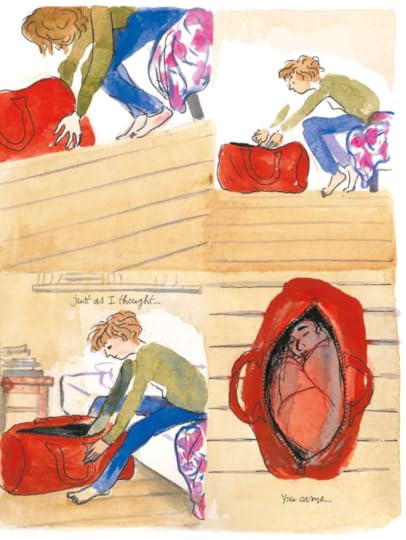
Penelope is confronted on her life choices by her mother and her sister, and she has brought back a part of her Syria-related trauma in the form of a tiny, silent red ghost girl, one of her child patients who has died. She is curled up in her luggage, and now and then appears, sitting on Penelope's shoulder. The girl never speaks, she is just.. there.
Because her direct family is largely accepting of her other life as surgeon, the questions regarding those life choices become much harder to answer. Is Penelope missing too much of her daughter's life? What does it mean to be a mother? What does it mean to be doctor in a war-torn country?
Here’s a question. You have the choice of taking care of your family who is suffering in your absence or taking care of other families who are suffering through the ravages of war? How do you deal with this?
The Two Lives of Penelope by Judith Vanistendael is about this conflict that arises when you’re governed by a higher purpose. It’s about Penelope, a surgeon who works with Doctors Without Borders and is posted to Syria during the war. She comes home for a few months, but her presence is clouded heavily by the impermanence of it. Everyone is unconsciously counting down the days before she needs to leave again and then it’s a period of worry until she returns. How does Penelope’s family take it? How does she herself take it?
The Two Lives of Penelope is exactly that. Penelope leads two very different lives. In one, she is a doctor, caring for wounded children, emotionally shattered by the scenes that greet her every day. She suffers from PTSD, emotional breakdowns, having to deal with the ghosts of war. The last is heartbreakingly shown in the illustrations where Penelope imagines the ghost of a girl she couldn’t save following her around.
In her parallel life, she is a daughter, wife, and mother. She has to deal with ‘problems’ like deciding which wine to pair with a dish or her daughter worrying about a Latin test.
There are many moments when the two worlds merge and Penelope is unable to reconcile with them.
“Sometimes you don’t understand why you are where you are… I have a daughter… She lives a charmed life here… While I’m growing and changing in your world, where the wounds of children her age are real, she’s all worked up about the ablative case.”
I think this was a very mature novel that beautifully showed the repercussions of war on not just the victims but those associated with it. Relationships are strained. Mental health suffers. There is brokenness all around. All of this is perfectly captured through watercolour-like illustrations which are a mix of dark, bold lines and fluid pastels.
A sombre, thoughtful read.
Many thanks to NetGalley and Europe Comics for the ARC.
Even moest ik wennen aan de tekenstijl zo na Hubert van Gijsemans gisteren, maar al snel had de schoonheid van de aquarellen mij veroverd en ging ik houden van Penelope. Penelope is vrouw, moeder van een 13-jarige dochter in België en al tien jaar chirurg in een veldhospitaal in Aleppo. In dit beeldverhaal (160 blz!) worstelt ze met de combinatie van deze twee werelden die zo ver uiteen liggen. Een hedendaags gelaagd verhaal over de diepe worsteling van Penelope, dat zich zowel zichtbaar als onder de oppervlakte afspeelt. Bijzonder knap uitgewerkt!
Zondag = graphic novel dag of toch zolang ik interessante graphic novels blijf vinden in de bib.
Het verhaal van Penelope die als arts in Syrië werkt, maar die voor een paar weken terug komt naar haar gezin en familie in België, raakte me wel. Ik kon de mom guilt zo voelen, want wat doe je als je als vrouw én moeder massa's ambities hebt en de wereld wil verbeteren, mensen wil helpen, maar tegelijk ook wel bij je gezin wil zijn? En wat als je dan keuzes moet maken? Keuzes die de maatschappij misschien niet altijd begrijpt...
Erg mooie GN over een vrouw met ambities en een kind die als arts werkt in Syrië. Zowel thuis als in haat gedachten moet ze vechten voor waar ze in gelooft en voor de keuzes die ze maakt.
Een GN over een chirurg die erachter komt dat het combineren van haar baan en haar gezin niet makkelijk is en dat ze ook langzamerhand dingen meeneemt uit Syrië. Traumatische dingen.
Ik wist niet precies waar het boek over zou gaan, maar ik wilde het toch proberen. De art zag er erg mooi uit dus ik wilde het maar al te graag lezen.
Het gaat dus over een chirurg die zowel in Brussel als in Syrië opereert probeert haar werkleven en haar thuisleven te combineren. Ik moet zeggen dat ik weinig sympathie had voor Penelope. Ik snap dat ze haar missie belangrijk vindt, ik snap dat het haar leven is om te helpen in een land als Syrië. Maar als je dat al 10 jaar doet, 10 jaar amper je gezin ziet omdat je steeds maanden en maanden weg bent dan moet je ook niet boos worden als mensen je er op wijzen of dat je man je vraagt of je thuiskomt en blijft (want hij mist je, hij is bezorgd, en hallo hij moet dus helemaal alleen voor het kind zorgen). En tja, sorry je kind zal vast van je houden, maar toch op een hele andere manier dan jij misschien wilt. Meer afstandelijk. Meer wetende dat je toch wel weer weg zal gaan. Ik vond het dan ook best creepy (net zoals haar kind dat vond) dat ze 's avonds een tijd op het bed van haar kind naar haar kind zat te staren. Um...
Je moet dan ook zeker niet proberen te doen alsof je nooit weg bent geweest, wat zij wel helaas doet. Terwijl haar man en haar dochter een ritme hebben gevonden in het leven zonder moeder, zonder vrouw. Ik vond het zo sneu voor de dochter trouwens. Ongesteld en dan oma moeten bellen die haar alles moest vertellen omdat moeders weg was en nooit er om heeft gegeven (want kom op je hebt toch wel eens een gesprekje hierover). :| Ik weet hoe ik me voelde die eerste keer ongesteld en ik wist al iets ervan. Het was eng, het was nieuw, het was verwarrend. Ik ben blij dat ik mijn moeder had toen.
Dus ja, sorry hoor. Again, ik vind het stoer en geweldig dat ze al dat werk doet, werk dat velen niet zullen doen vanwege het gevaar. MAAR. Je hebt ook een gezin. Je hebt ook een geliefde. Ik vond het trouwens wel sneu dat ze gewoon zonder dat iemand het wist telkens verdween en terugkwam. Lekker dan.
Mijn hart brak ook toen Kerstmis er bijna was en de dochter een recital had. Meteen werd er gevraagd of moeders er wel bij zou zijn. Nou dat zegt al genoeg over hoeveel Kerstmissen en verjaardagen en andere gebeurtenissen moeders heeft gemist.
Dus ja, Penelope Bleh. Maar, ondanks dat ik Penelope gewoon niet veel vond was het boek prachtig geschreven en vond ik de band tussen vader en dochter mooi. Je ziet gewoon dat ze een tweeheid zijn geworden toen moeders maar wegbleef. Je ziet dat vaders ondertussen goed weet hoe zijn dochter werkt en ook hoe ze samen moeten werken om het huishouden goed te laten werken. Ook de familie was mooi en ik vond het geweldig dat ze zo vaak samenkwamen en elkaar zo hielpen. Er voor elkaar waren.
De illustraties waren prachtig en creatief gedaan. Vooral het spook/de trauma die Penelope mee heeft genomen was erg hartverscheurend gedaan. Groeiend en slinkend. Soms groot, soms klein, afhangend van hoe Penelope zich voelde.
En het einde was ik zowel boos als verdrietig. Ik hoop trouwens wel dat Penelope hulp heeft gevonden want als je spoken mee thuis neemt gaat het niet goed. :(
Ik rate dit boek dan ook zo hoog vanwege de art, vanwege de bond tussen vader/dochter, de geweldige familie, en ook omdat het trauma dat Penelope heeft heel goed was geschreven. Als die allemaal er niet waren en het gewoon echt alleen Penelope was dan had ik het boek echt maar 0.5 sterren gerate. Misschien dat niet eens.
[I received an ARC ebook copy from NetGalley in exchange for my honest review. Thank you for the book!]
A graphic novel about a surgeon who finds out that combining her job and her family is not easy and that she is also gradually bringing things with her from Syria. Traumatic things. I wasn't sure what the book would be about, but I still wanted to try it. The art looked very nice (almost unique for a GN) so I was more than happy to read it.
It is therefore about a surgeon, Penelope, who operates in both Brussels and Syria, who tries to combine her work life and her home life. I have to say I had little to no sympathy for Penelope. I understand that she finds her mission important, that it is her life to help in a country like Syria, but if you have been doing that for 10 years, have barely seen your family for all this time because you always come and gone for months and months, then you shouldn't get angry when people point it out to you or if your husband asks you to come home and stay (because he miss you, he is concerned, and he has to take care of the child all by himself). And your child will love you, but in a completely different way than you might want. More distant. Knowing more that you will leave anyway. I thought it was quite creepy (just like her child thought) that she sat on her child's bed for a while, staring at her child in the evening. Um ...
You should definitely not try to pretend you never left, which she unfortunately does. While her husband and daughter have found a rhythm in life without a mother, without a wife. I thought it was so sad for the daughter by the way. Having her first period and then had to call grandma who had to tell her everything because mom was gone and never cared).
So yes, sorry. Again, I think it's cool and great that she's doing all that work, work that many won't do because of the danger. BUT. You also have a family. You also have a loved one. I thought it was sad that she just kept disappearing and coming back without anyone knowing. Well great.
My heart also broke when Christmas was almost here and the daughter had a recital. Immediately they were asked whether mothers would be there. Well that says enough about how many Christmases and birthdays and other events mom has missed.
But, even though I just didn't like Penelope much, the book was beautifully written and I liked the bond between father and daughter. You just see they became a duality when mothers stayed away. You can see that fathers now know very well how his daughter works and also how they should work together to make the household work well. The family was also beautiful and I loved that they got together so often and helped each other so much. Were there for each other.
The illustrations were beautifully and creatively done. Especially the ghost / trauma that Penelope took with her was very heartbreaking. Growing and dwindling. Sometimes big, sometimes small, depending on how Penelope felt. And in the end I was both angry and sad. By the way, I do hope that Penelope has found help because if you bring ghosts home, it is not going well.
Una madre que antes que nada es una mujer, una cirujana apasionada por su trabajo. Toda su vida tiene sentido solamente cuando está ayudando a gente que sufre la violencia de las guerras. Tiene una hija a la cual cuida su amoroso padre. La situación inversa la conocemos, la aceptamos, la normalizamos: un cirujano que deja constantemente su hogar para trabajar en Médicos sin fronteras ( por ejemplo) nadie lo juzga como un mal padre, al contrario, es un alma caritativa que salva gente, deja la comodidad de su hogar, la seguridad de su patria, es casi un héroe. Pero ¿si es una cirujana 👩🏼⚕️ la que lo hace? Este cómic narra esta historia: una devota cirujana, entregada totalmente a su carrera que pasa largas temporadas fuera, esas temporadas se van alargando. Muy bien contado e ilustrado. Un magnífico trabajo.
The first 100+ pages of this graphic novel are just a masterpiece! The art style is very emotional and it really felt like a true story. Just remember that you are at your most beautiful when you aren't wearing a mask!!!
Op een strak aangespannen koord probeert Penelope het evenwicht te bewaren. Aan de ene kant trekken haar familie en gezin met opgroeiende dochter aan haar mouw, aan de andere kant eist haar roeping als arts haar aanwezigheid in oorlogsgebied. Waar in de Griekse mythe Penelope geduldig op haar reizende echtgenoot Odysseus wacht, worden de rollen hier knap omgedraaid. De (niet altijd zo) subtiele hints naar de Griekse mythologie maken dit verhaal des te rijker.
Hartes Thema (Krieg, Trauma, Posttraumatische Belastungsstörung), umgesetzt in passendem Ton, häufig sprechen die (farblich wie stilistisch toll umgesetzten) Zeichnungen für sich.
Deze omkering van de Odyssee biedt een bikkelharde blik in het leven van een moeder, vrouw en dokter die er niet in slaagt helemaal terug te keren naar haar Ithaka. Een stomp in de maag.
“Werkelijk alles wat er in dit boek gebeurt, ligt onder de oppervlakte.”
Dat zei auteur Judith Vanistendael in een interview met De Morgen over De twee levens van Penelope. En dat maakt het boek ook zo treffend en ontroerend: het alledaagse benadrukt stilletjes wat er niet meer normaal is aan het dubbelleven van Penelope.
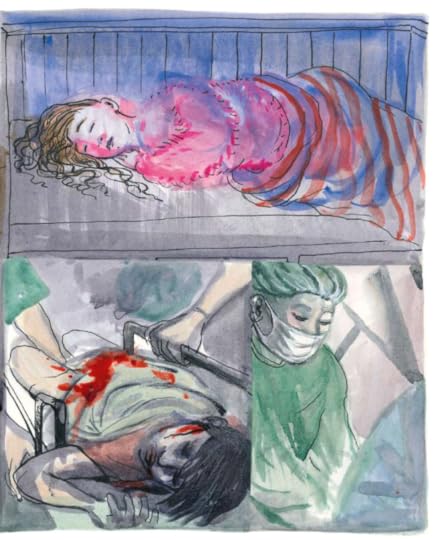
De graphic novel begint met een paar bladzijden op dezelfde dag, in verschillende plekken: Brussel, waar dochter Helena ligt te slapen en wakker schrikt van haar eerste menstruatie en haar oma moet bellen voor hulp; en Aleppo in oorlogstijd, waar Penelope tevergeefs een kind opereert dat het niet lijkt te overleven. Na deze paar bladzijden is de rest van het boek gesitueerd in Brussel, waar Penelope (na haar tweeëndertigste missie in tien jaar) naartoe is teruggekeerd naar man en tienerdochter.
Het mooie aan dit boek (wat ik als literatuurliefhebber graag zie bij boeken) is dat de boodschappen op en onder de oppervlakte allebei goed uit de verf komen. De gewone familietaferelen zetten de toon en laten al de ietwat gerafelde banden zien, maar als je naar de hints kijkt die Vanistendael in haar vertelling heeft gestrooid, worden de thema’s nog rauwer en duidelijker. (Als je niet van spoilers houdt moet je de volgende paragraaf overslaan).
Een paar voorbeelden. Helena vraagt haar moeder of ze thuis is met kerst (ofwel: dat is niet altijd een gegeven), en op de volgende bladzijde spreekt niemand uit (of zien ze het niet?) hoe haar keuze om Mariah Carey’s kerstknaller op te voeren eigenlijk diezelfde vraag in een popliedje is (met een uitroepteken in plaats van vraagteken). En als Penelope nog met haar hoofd bij de bommen en het bloed zit, jammert Helena om die moeilijke ablatieve naamval in Latijn: de naamval (volgens Wikipedia) waarmee “de persoon van wie iets uitgaat of de plaats waarvandaan men vertrekt werd aangegeven”.
Maar ook al ga je niet met een spreekwoordelijke loep de pagina’s af, dan ook is het een prachtig verhaal dat geweldig geïllustreerd is, en dat iets moois en nieuws te zeggen heeft over moederschap en thuiskomen, en nog veel, veel meer.
A doctor torn between humanitarian work & family responsibilities spends a holiday break at home on leave, & is confronted by the love, mundanity, & expectations of family life.
[What I liked:]
•The art is absolutely amazing. Evocative, detailed, sweeping, colorful. I love the style.
•The story is very relatable I think—the competing pressures of motherhood & career, fraught with sexist societal expectations & guilt.
•The family relationships portrayed are sweet & complex & rich & meaningful. It’s very well written with great character development.
[What I didn’t like as much:]
•The font of the text is a bit hard to read.
•I’m confused by the ending. I think I know what happens, but it’s not clear at all why, so it’s not a satisfying ending for me.
[I received an ARC ebook copy from NetGalley in exchange for my honest review. Thank you for the book!]
Hay maestría en la forma de narrar, demuestra toda la capacidad que tiene el cómic para transmitir historias, sentimientos, dudas, silencios y para dejar preguntas sin contestar.
Een verhaal over de tweestrijd van Penelope: hoort ze thuis, of bij de kinderen in Aleppo? Het is een complex vraagstuk dat zich niet laat vangen in zwart-witdenken. De stijl maakt het soms lastig te volgen wie wat zegt of denkt, maar draagt absoluut bij aan de emotionele lading van dit verhaal.
Die belgische Comicautorin und Zeichnerin Judith Vanistendael besuchte das Flüchtlingslager Moria auf Lesbos und veröffentlichte darüber eine Comicreportage, um auf die verheerende Lage vor Ort und das Versagen der Politik aufmerksam zu machen. Dort begegnete sie einer Ärztin, die sie zu ihrem Comic »Penelopes zwei Leben« inspirierte.
Dieser Comic zeigt auf beachtliche Weise das zerrissene Leben einer Ärztin auf, die sich dafür entschieden hat, Gutes zu tun und in Syrien Leben zu retten. Dafür lässt sie einen liebenden Ehemann und eine reizende Tochter in Brüssel zurück. Judith Vaninstendael zeigt anhand diverser alltäglicher Szenen den kontrastreichen Unterschied zwischen dem Alltag in Brüssel, wo ihre Tochter zum ersten Mal ihre Tage bekommt und bei Oma um Rat bittet, und Lager in Aleppo wo ihre Mutter Penelope um das Leben von oftmals jungen Menschen kämpft.
Der Name der Hauptprotagonistin Penelope kommt nicht von Ungefähr, Vanistendael spielt damit auf Homers Odyssee an, dreht zugleich die Geschichte kurzerhand um und stellt damit die gängigen Rollenbilder auf den Prüfstand.
Als Penelope nach Hause zurückkehrt, lassen sie die schrecklichen Verluste nicht mehr los und aufgrund ihrer häufigen Abwesenheit scheint sie keinen richtigen Platz im Brüssler Familienleben innezuhaben. Die Zerrissenheit der Mutter und Ärztin wird in den aquarellierten Bildern von Vanistendael überaus deutlich dargestellt und führt zu der bewegenden Frage, welches Handeln in einer solchen Situation richtig ist. Eine Antwort liefert die Autorin uns nicht direkt, allerdings lässt sie Penelope nochmals nach Syrien fliegen, da sie von ihrem unvollendeten Werk getrieben ist und zu Hause keine Ruhe findet.
Fazit
Die bewegende Geschichte einer Ärztin und Mutter die zwischen zwei Leben und dem starken Willen zu helfen zu bersten droht.
In this deeply moving graphic novel we meet Penelope who has two lives and she lives in two worlds. In one life Penelope is a wife, mother and a doctor, working in Belgian hospital. Her life is well ordered and peaceful. She spends her days with family, friends, her teen daughter and poet husband.
In her other life Penelope lives in a tent in war-torn Syria. She see the horrors of war everyday, injuries, broken bodies and dead children. Sometimes Penelope's two lives clash. She watches her teenage daughter shopping, fussing over her food and being a normal teenager. In Syria she sees the bloodied bodies of children and sometimes these images follow her home to Belgium.
This is a beautifully drawn graphic novel and it is haunting. As Penelope seeks to reconcile her life she struggles and questions what she should be doing. She is needed in Syria but she is needed at home in Belgium and so the push and pull of her two lives continues.
There is no answer to the questions that Penelope asks herself. All she sees is images. It is a dilemma that people might face in all kinds of situations. This story resonated with me because I work with seafarers (sailors) many of whom leave their families for up to 9mounths a year to work, sometimes longer and they question themselves, recognising the sacrifices they are making.
This story reminds us that there are no easy answers, just lives.
Copy provided by Europe Comics in exchange for an unbiased review.
This Belgian graphic novel tells the story of Penelope, a surgeon working with Doctors without Borders in Syria, who returns home to be with her daughter and husband. Comparing her life to that of Odysseus, she brings back the ghost of a Syrian girl with her, symbolising her trauma.
This duality of her life brings a lot of difficult situations to the surface throughout the novel. Penelope isn't there to see her daughter grow up but when she is called out for it, she lashes out. Because how could she when she is saving lives in Syria? The family relationships were rich and complex and meaningful.
The creative watercolour illustrations suited the loose flow of the story. As a Belgian myself I recognised the Belgian atmosphere and attitude.
I'd like to thank Europe Comics for providing this copy via Netgalley in exchange for an unbiased review.
Working as a surgeon in Aleppo, Penelope spends months at a time away from her husband and teenage daughter. She comes back home for Christmas and finds that, once again, her mother and sister are pressuring her to stay home for good. They can't understand Penelope's motivation.
What her loved ones don't know is that Penelope did not return home alone. She carries with her the memory of a child she was unable to help. The child haunts her so much, she decides to seek psychological help.
There are layers to this book including a whole section about masks that is telling in what it says about Penelope and how her husband and child see her. I know this is a graphic novel I'll remember for years to come.