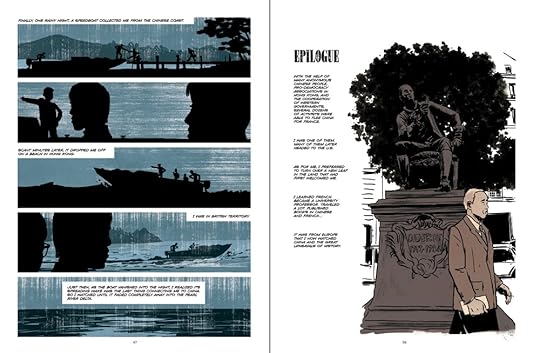
Follow the story of China's infamous June Fourth Incident -- otherwise known as the Tiananmen Square Massacre -- from the first-hand account of a young sociology teacher who witnessed it all.
Over 30 years ago, on April 15th, 1989, the occupation of Tiananmen Square began. As tens of thousands of students and concerned Chinese citizens took to the streets demanding political reforms, the fate of China's communist system was unknown. When reports of soldiers marching into Beijing to suppress the protests reverberated across Western airwaves, the world didn't know what to expect.
Lun Zhang was just a young sociology teacher then, in charge of management and safety service for the protests. Now, in this powerful graphic novel, Zhang pairs with French journalist and Asia specialist Adrien Gombeaud, and artist Ameziane, to share his unvarnished memory of this crucial moment in world history for the first time.
Providing comprehensive coverage of the 1989 protests that ended in bloodshed and drew global scrutiny, Zhang includes context for these explosive events, sympathetically depicting a world of discontented, idealistic, activist Chinese youth rarely portrayed in Western media. Many voices and viewpoints are on display, from Western journalists to Chinese administrators.
Describing how the hope of a generation was shattered when authorities opened fire on protestors and bystanders, Tiananmen 1989 shows the way in which contemporary China shaped itself.
A surprisingly dense and moving memoir of the Tiananmen Square uprising and subsequent massacre.
It basically is an illustrated monologue by Lun Zhang, a young sociology teacher who quickly took on an important role during the protests.
It certainly is wordy, which I personally didn't mind, but for some might be difficult. There is an attempt to make it more personal by having two students meet and fall in love, but they're basically only there in the background (and it feels a bit forced).
As with most history I read, I'm always confronted with how little I actually know about a subject, and the same happened here. To my surprise, I found my eyes welling up at the last chapter, concerning the massacre itself.
It's not the most dynamic of graphic novels, but if you can look past that, there is a lot there.
(Kindly received an ARC from IDW Publishing through Edelweiss)
This graphic novel looks at the protests in Tiananmen Square in 1989 from the viewpoint of Sun Zhang, one of the participants in the protest. The images are moving and remind readers of what happened then. However, the text relies a bit too much on narration, so there are blocks of text that make this a slog to read at times. Remember comic creators--show, don't tell.
A truly exhaustive look at the Tiananmen Square Massacre in the late 80s told through the eyes of a sociology teacher who witnessed it all occur. This story explores the ideas, visions, political climate of China before the event takes place and brilliantly conveys the desire for change that protesters wanted for their country.
▫️ TIANANMEN 1989: Our Shattered Hopes by Lun Zhang and Adrien Gombeaud, illustrated by Ameziane, tr. Edward Gauvin, 2020.
#Readtheworld21 📍China
TIANANMEN 1989 is a first-person account to the lead up and the tragic June 4th,1989 event in Beijing.
Zhang was a university student at the time, and involved in the pro-democracy movement, and underground book clubs and discussion groups. He uses his own story, along with other colleagues to weave a conglomerate character narrator who walks the reader through each day leading up to the Massacre date.
There is a detailed glossary of the people in the movement and the roles they played, as well as many of Zhang's personal effects, like the red scarves that the protestors wore to identify themselves, etc. Zhang, unlike many of his fellows who were murdered in Tiananmen Square, escaped Beijing via Hong Kong, and now lives in exile in France, working as a Professor of Sociology.
3/4/20 This was my first time actually reading about what happened at the Tiananmen Square. I can imagine that summarising such a complex history must have been incredibly hard, and although I didn't understand everything, I think this comic did a great job. Would definitely recommend it.
1989. When I think back to my feelings and state of mind--how naïve and idealistic I was!--when I first learned of the popular uprising at Tiananmen Square, I am impressed by the person I was, one who felt the world would never be the same. It was changing. For the better. But even with so much of what happened, even as we got glimpses of the brutal governmental crackdown, a better world, a more humane and rational world was definitely ahead of us. We were lulled with the fall the Berlin Wall and the Iron Curtain later that year. There was no questioning that the events in China gave others in the world courage. The events were related.
But reading this in 2021, as much as those events were pivotal in world history, it feels a bit empty. Is China really a better place? No question that the economy is better for hundreds of millions. But the events in Hong Kong, the ascendancy of fascist tendencies in places like Myanmar, Russia and the former Soviet states in the Caucuses and Central Asia, Israel, Brazil, and the United States somehow have me longing for the clear cut lines the Cold War created. OK, not really, but, then again, really.
Reading this skillfully crafted graphic comic recounting the events in Tiananmen Square, I realized, that although it was all about a particular historical event in China, it was about so much more. What occurred in China and the people whose lives ended in permanent exile, death, or debasement, the tragic consequences that came with actual engagement to stand up to a totalitarian state is sobering at best. It's a story about the fleeting nature of hope. It's a story that needs to be remembered and this short, intense book reminds us in just a few intense, tragic pages.
A passionate, auto-biographical graphic novel that narrates the events leading up to the Tienanmen massacre from the point of view of someone who was there in those days, as one of the student movement’s coordinators, and then spent the rest of his life in exile.
Beautiful art. Simple narration, first person, almost like a long monologue by the author.
“In the end, we did not fail”. We have to look history in the face and say that yes, you failed, I’m sorry. China is not a democracy yet. And, probably most important, today nothing seems to prove that it would be better off if it became one.
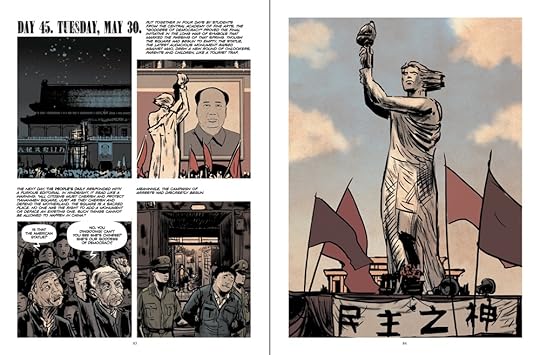
The book made me think of how much the history of the last 70 years has been shaped by TV, for the good and the bad. Especially when I saw the copy of the Statue of Liberty that the Tienanmen students had built. The influence that that box has had on our society and on our brains .... I think we tend to underestimate it.
How do you rate reality? Especially when it is an unspeakable tragedy we even now seem to be on the brink of frequently? We are bombarded with images of violence against protesters daily, and there are so many unseen others in places locked away from the world.
And so a man with a memory of such a place unburdens himself by telling his story, shorn of any rose coloured glasses. He dissects the sheer youth of the protestors, the palpable fear, and also the naivete, but above all the intense need for freedom- from constraints, and censorship, and cruelty.
There are obviously better academic and historical works out there. But this is Tiananmen from the eyes of someone who was there, and felt the hope and fear and loss of everyone on that square. Give it a read because what better way is there to understand how our pasts and futures are intertwined.
Thanks to NetGalley for this ARC! I got married on June 3, 1989. I woke up the next morning to . . . what happened on Tiananmen Square. I was a college student and I remember so intensely how I identified with the student protesters, and how horrifying what happened was--and yet how very different the world looked just a year later. I really enjoyed this graphic history of the protests narrated by an activist who was actually there. The events of 1989 shaped our world so much--I hope this excellent and accessible history reaches many of our young people who were not there then.
Wow. And to think that I was alive while this was happening. I do remember the images on the news, but how could I possibly understand the story behind the pictures I saw? I thought this was an excellent, moving personal history of the events surrounding the square.
(I'm not giving this a star rating, and that's on purpose.)
Tiananmen 1989 is the story of the massacre from the point of view of a sociology professor who was there and took a very active part in the protests. For someone like me, who grew up in an American school system where the only part of Tiananmen I know about is the picture of the man facing down the tanks, this book was highly enlightening. It provides not only a greater depth of understanding of what actually happened - and it was so much more than just one day! - but it also does its best to provide a historical and cultural context for why the protests were happening in the first place. I learned a LOT from this graphic novel.
Unfortunately, I think the educational aspect of this is where it fell flat for me. This reads more like a university lecture than it does an attempt to set this story in a way that would appeal to many. I found no reason whatsoever for this to be in graphic novel format. With so many words and the lecture-like quality of the writing, I don't think having it in image format did anything to elevate the story being told.
Granted, it's a good lecture. It lacks a bit of emotional resonance beyond the fact that so many lives were lost, because it's a lecture. I wish the writing had been a bit pared down, and that the emotional impact was felt more.
If you want a good first hand account of the context of what led up to Tiananmen, then this is a pretty decent starting point. Just temper your expectations a bit, realize this is a lecture that happens to have images attached, and appreciate it that way.
tl;dr: lib-washed simplification of a complex political moment in Chinese history, that delegitimises violence as an appropriate response to state repression, by only platforming nonviolent and reformist actors. Approach with extreme caution, and supplement with more honest accounts of Tianamen Square, that elaborate on the multivalence of political demands and actors.
—
A gorgeous graphic novel that feels both too dense and too sparse in its narration. It relies heavily on direct exposition (walls of text), yet gives too little historical context into the events that led up to Tianamen Square. Zhang doesn't elaborate what life was like under Mao's Cultural Revolution, nor why Deng's celebrated takeover turned bitter over the years. His characters are vivid, but there's not enough context to grasp their material struggles. The subsequent crackdowns, before and during Tianamen Square, end up resembling totalitarian tropes: censorship through police and military repression (imprisonment, torture, maiming, and murder of political dissidents, students, and supporters); and disinformation campaigns by state media (representation of nonviolent protestors as counter-revolutionary terrorists).
Zhang argues that the protestors at Tianamen weren't revolutionary, but reformist.* They didn't want to overthrow the state, they wanted to hold it accountable. It speaks volumes about the CCP that such a meek demand is met with tanks and open fire (by the People's Liberation Army of all things). The students at the square didn't even have weapons, and the worst act they committed was defacing a portrait of Mao.** Yet, the students pose a deeper threat to the CCP that Zhang either doesn't see or purposefully elides. The students may have been reformist in praxis, but they were revolutionary in ideals. They wanted true communism, the realisation of their education. They threw communist slogans back at the state and sang the internationale at night. The Beijing Autonomous Workers Federation, a group curiously absent from the book, called for workers' self-management. The threat of all nations communist-in-name-alone is that power truly does reside in the people. Hence the repression of such people, no matter how meek their claims appear.
—
*I've been doing some independent fact checking since finishing this, and Zhang has done a hell of a lot of historical revisionism to downplay the radical elements of the student movement. There were students outright calling for the overthrow of the CCP and, by extension, the ruling class of bureaucrats.
**Zhang has also downplayed the violent tactics of students. He didn't outright lie when he said the students in Tianamen Square were nonviolent, but there was violence outside of Tianamen Square and in other cities across China. Students and their supporters intercepted and ransacked buses filled with military weapons and supplies. There were roadblocks, rioting, beatings, and arson.
I find these distortions egregious. Zhang clearly wants to paint Tianamen Square as a peaceful protest for the liberalisation of China, but it was so much more than that. Yes, there were liberals in the free press and free market camps, but there were also socialists demanding the reinstitution of social services destroyed by economic liberalisation, and communists pushing for workplace democracy and revolution against an oppressive and nepotistic ruling class. Zhang avoids these complexities so he can position the student movement as an uwu peace parade. He stresses that police and soldiers sided with the students at various points during the occupation of Tianamen Square. Such moments matter of course. They speak to a shared grievance of life under the CCP, but by downplaying the conflicts between various social groups Zhang delegitimises violence as a form of appropriate resistance. Violence becomes the tool of the oppressor alone. This is naive at best and actively damaging at worst. It condemns an act that may be not only necessary for survival, but for change. Before soldiers began shooting, students threw rocks; after, they threw Molotov cocktails. Contrary to Zhang's depiction of the students as defenseless victims, they fought back, but only when provoked.
These stories matter, as much as the ones about solidarity and nonviolence, because they show us the organisation and courage of people pushed to the brink. Rather than pity them, we should respect them.
Originally published in French, this powerful graphic novel was published in English in 2020. It is a stunning revelation. The presentation uses a character-as-amanuensis to stand in for Mr. Zhang (see page 4), a strange self-censorship technique in a novel that is shockingly clear about the Tiananmen protests of 1989 and the Chinese Communist Party response.
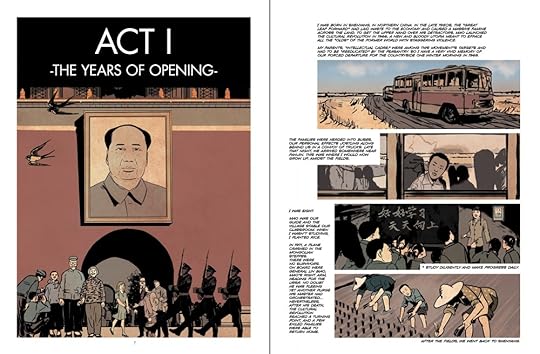
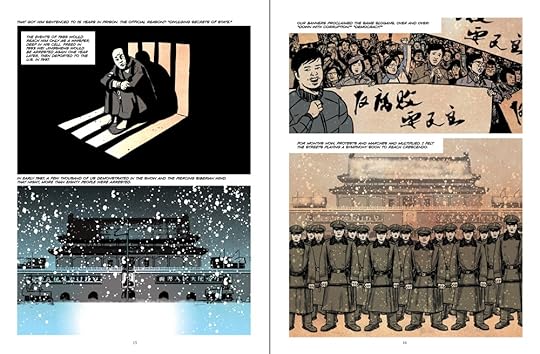
The text and illustration capture China in the late 1980’s. China was finding its footing after the mass trauma of the cultural revolution as Deng Xiao-Ping encouraged market reforms. In the broader context, Communism lost strongholds in Eastern Europe and Russia as the Cold War ended with American hegemony. All of this lead to greater openness to the West. Nascent ideas of democracy for China sprouted with spring and summer flowers, and all of this blossom formed the fragrance of HOPE that inspired the students who lead the movement. This clarion call of hope is tinged with melancholy for the reader because we know the history – even the subtitle proclaims, “Our Shattered Hopes.” Gombeaud, the Frenchman, writes empathically of Zhang’s nostalgia for China, for his youth, and even for the hope of democracy itself, drawing the reader into the struggle as we internalize the pain of Zhang’s exile to France. Photographs of artifacts and illustrations by Ameziane provide readers primary source information on what the students said and did. Introduction of key individuals, division of the narrative into a five-act drama (could this be made into a Chinese centric Les Miserables musical?!), and the Afterword are all exquisitely done in that they enliven the events, organize the timeline, and educate the reader. The Afterward is a wealth of context from Lin Zhang’s closing thoughts, to photographs of his artifacts, to a timeline of “The Chinese Century (1919-2019).”
From this emerges the passion: the students really thought they could triumph… but were willing to die in China or live in exile if they did not. They believed appeals to the tenants, stewardship, and benevolence of the Chinese Communist Party (CCP) would lead to velvet revolution as it had in Eastern Europe and Russia itself. They saw Communism grown old from totalitarianism, market failures, famines, and mass trauma events, gloaming in the turn of the earth. They saw free market democracy dawning, brilliantly flourishing in the sunshine of inalienable rights (see “Morning in America” Ronald Reagan, 1984). They thought it was morning in China, China’s time join the global community in the Pax Americana of government by people and for people.
The lament of Tiananmen 1989 (and Hong Kong 2019 and even events of the pandemic 2020) is that leaders of the world are more committed to their own power than either the will or prosperity of the people they govern (whether or not they are elected by the people). CCP’s answer to Tiananmen’s 1989 call was to silence the students, crush the rebellion, and hold off the advancing night. Now here we sit in 2020 and the forces of totalitarianism are rising again throughout the world, trying to make the suppression of night permanent, lead by China. Tiananmen 1989, published in France in 2019, could not be more prescient. The world needs to remember what made Communism old and freedom new in 1989. The conflict between the song of hope persists in hearts of men and women everywhere in opposition to the corruption of powerful rulers. This exchange between His disciples and Jesus comes to mind…
Mark 9 (NASB) “28 When He came into the house, His disciples began questioning Him privately, “Why could we not drive it out?” 29 And He said to them, “This kind cannot come out by anything but prayer.”
And so we continue in prayer for China, and all the people of the world, asking for God’s mercy and grace upon us, for the blessing of the freedom that comes from Him. This exceptional resource will remain a treasure of our home library for years to come. I’m thrilled to share it. Chinese history and the struggle with Communism are succinctly integrated through the compelling testimony of Lun Zhang, the sympathetic writing of Adrien Gombeaud, and the vivid illustration of Ameziane. Credit must also be given to the editor and publisher for the superb organization. Buy this book to read repeatedly and share widely.
The last words belong to Lun Zhang. He closes his Afterword with these paragraphs… “Thirty years later, China is once more at the crossroads of history, with reform reaching a tipping point. Faced with rising social tensions, the Party could have taken a new step by going back to the policy reform process interrupted by the 1989 massacre.
Alas, Xi Jinping chose to go even farther back in time toward authoritarian measures left over from Maoism. In the short term, these measures may seem effective on the surface. But deep down, they will only exacerbate problems that have remained unresolved for the last 30 years, at the risk of compromising the fate of the nation and threatening worldwide stability.
What we stood for in 1989 is now more pertinent than ever. If China intends to build a peaceful and prosperous future, if it truly wishes to recover its past glory, it must return to Tiananmen and make a fresh start.”
For a non-fiction narrative from a Chinese family partially transplanted to the United States, see Shanghai Faithful, Lin, 2017 https://www.goodreads.com/review/show...
"A regime that shoots its own youth has no future."
A powerful first-hand account of the Tiananmen Square Massacre, told from the memories of a survivor.
Being born two years after this event, I knew little about it. This harrowing graphic memoir is an eye-opening look at what really happened on the 4th of June in Beijing.
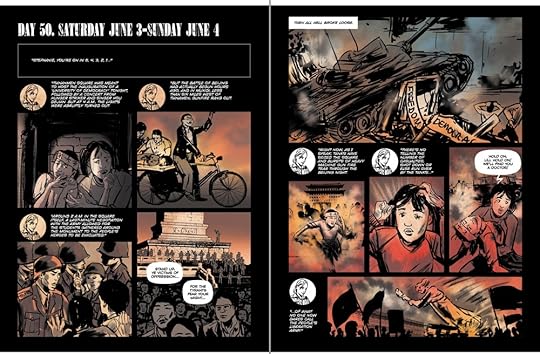
This real life story has touched me, upset me, and enraged me. That the Chinese government did such a thing to its youth is unspeakable. A hundred-thousand students with a dream of democracy gunned down in their thousands. Its despicable.
Throughout reading this, I felt a building sense of dread. The students began the protests with such hope for the future only to have it snatched away from them entirely.
This graphic memoir is informative, enlightening, and oddly encouraging. The world saw what happened in China that day, and the world didn't like it. China may be erasing history, covering up the events like they never happened, but the world will remember.
I highly recommend this book to anyone who wants to learn more about what happened on the 4th of June and the months leading up to it.
I'm so pleased I got the chance to read this for review. Thank you Netgalley and publishers for providing an arc for review.
This graphic novel tells the real story of Tiananmen Square and the student protests there as seen by a participant. It is full of detail and clarifies some misconceptions I had about the nature of the protests and the extent of participation of the citizens of Beijing. It also explains the timeline and its ramifications. It was not as I thought it was. The Communist regime took some of the images out of time and out of context to use as their own propaganda. He also fits it into the global timeline and we see other major changes like the freeing of Nelson Mandela and the breaking down of the Berlin Wall. All in all, this was a beautifully done book which I enjoyed very much.
“There were 100’000 of us marching when we reached Tiananmen. Where we joined a group of more than a million strong!”
The Tiananmen Massacre is another one of those events I have wanted to learn more about for years and Zhang’s graphic account is a really good place to start. This gives some really informative background and information to some of the main players on both sides, and gives the rest of the world some genuine insight into what was going on back in 1989 and what caused it in the first place.
Lun Zhang was Sociology professor when people in China began to demand democracy. The government was loosening up the economy but not the civic life. This is how he tried to achieve success with other students and professors. While we know it wasn't successful, this is a very moving story and Zhang points out other movements around the world 🌎that were successful. Drawings and dialog with narration provides a clear depiction of events.
Uma bela e fiel retrospectiva dos eventos da de Tiananmen, contadas por quem viveu o momento, no modelo de desenho-reportagem digno de Joe Sacco. Recomendo.
Ah good ol' Friday night read... This graphic novel gives a concise rendition of the weeks leading up to the Tianamen Square massacre in 1989. This was educational more than anything else. Although, it is of course impossible not to be appalled at the conclusion. It does not matter that you know it is coming. It really does not matter at all.
Strange to think that my parents were my age when this happened. Feels like it should be longer ago. And yet, in many ways, it is not even over.
I received an ARC through NetGalley from IDW Publishing. This graphic novel memoir is a first person account of the Tiananmen Square Massacre as told by a 26 year old Sociology Professor. In chronological order the story dramatically shows the student initiatives toward democracy that were tragically struck down on June 4, 1989 by firing on peaceful protestors that were demonstrating proactively. The deaths were massive. The art in this historical piece was blocky and dark. Also, so many names were discussed it made it hard to emotionally connect with key players. However, this made me want to dig in and do more research on the event, especially now in our political climate with the number of protests we’re seeing. A good introduction to a lesser discussed historical event.
Great book! I recommend it very much, regardless of whether you already know a lot about the Tiananmen-1989 events or want to learn about them from zero.
It’s a graphic non-fiction representation of the events, and I found this format both very complex and amazing for such a difficult subject. On the one hand, talking about China is always a challenge because we, “Westerners,” usually have problems with imagining and understanding even the most basic things about China, not to mention such large-scale and multi-layered historical events as Tiananmen-1989, and graphic visualization helps a lot here. On the other hand, you cannot just “draw pictures” here — you have to explain the background, the general political atmosphere, and what was happening beyond the personal experience of the key participants. I think that this book dealt with the challenge fabulously, allowing us not only to learn about this “Chinese Maidan” in a gradual and educational way, but also to see and feel how all this looked like for its immediate participants.
I cannot say that I now know EVERYTHING about Tiananmen-1989 — no, I still have a lot of questions, and I am sure that I did not notice/did not understand properly many important details I should have (and these Chinese names are confusing like hell!). However, this book is definitely a good start, and I am very happy that I discovered it.
You can see that there are three authors there: Lun Zhang, Adrien Gombeaud, and Améziane. Lun Zhang is the main author, and he is also our “guide” along the book who will comment on the events from different perspectives, including the most distanced one, from his today’s understanding of what was happening then. Lun Zhang was a young man in 1989, a sociology teacher, who became one of the key leaders of the student protest movement in Tiananmen. After the protest was repressed, he, like many other activists, was forced to flee China. He now lives in France and works as a professor of Chinese civilization. Adrien Gombeaud is a French journalist and Asia specialist who helped him to write/edit the text and make it as accessible to the Western public as possible, and Améziane is an artist who drew the comic strips. I think their collaboration was very efficient, and I liked both how this story was told (informatively and creatively enough simultaneously) and how it was represented visually (in a totally cool and stylish way).
It’s not an easy book — the events are complex and confusing by nature, and there is a lot of Chinese politics. The author tries his best to explain everything in simple terms and step by step, but it’s not something simplistic. It’s definitely not a book for kids/teenagers, although if some young adults are studying Tiananmen-1989 in detail, this book may be a good addition to their explorations.
I hope it will be translated into Ukrainian, because Ukrainians definitely would find a lot of common things with our “Maidans.” In fact, I think that Ukrainians are probably one of the best target audiences for this book, exactly because of our Maidans — we may be not acquainted with internal Chinese affairs, but there are some things there that are now universally understood by any Ukraninan much better than by European/American readers.
Memoir of the Tiananmen square movement. The Zhang was a leader in the movement and shares what he witnessed during the days of protest. Also provides context discussing the lead-up to, and aftermath of the protests (including the author's own escape to France via Hong Kong. Zhang suggests that the Tiananmen Spring represented a missed opportunity for the Chinese Communist Party to enact political reforms while they enacted economic reforms, but also that it may have inspired the later collapse of Communism in Europe. Tiananmen 1989 mentioned related protests and actions taking place elsewhere in Beijing, and also elsewhere in China, and I wished the book had said more about them, but I guess I should be looking for a more comprehensive history source. Tiananment 1989 is still a gripping memoir & a good intro to the events of Spring 1989.
2.5 stars While the illustrations are solid, neither the text nor the layout work very well in this graphic memoir. Placed against others in the genre such as Persepolis or Maus, Tiananmen 1989 feels overwritten, blocky, and cumbersome.
Historical graphic novels are some of my favorite kinds of graphic novels. This one is no exception. Reading about history that is rarely talked about in graphic form is a great way to learn more about the world.
I am not a fan of graphic novels but I had to read this book for one of my book clubs This a very important and brave book, and reading it now is important with all what is happening to the democracy in this country.