What do you think?
Rate this book


311 pages, Paperback
First published June 11, 2019
“There’s a good reason for terrifying the people at the top. Contrary to popular perception, most dictators are not overthrown by an angry populace marching in the streets. The vast majority are removed by insiders from the regime. The biggest risk to dictators is not the struggle between the privileged and the masses but a struggle among the elites” (130). [for more reading on this, here is Fifield’s source: The Politics of Authoritarian Rule by Milan W. Svolik, 2012]KJU disposed of many of the people who supported him, most famously his Uncle Jang—Jang Song Thaek. Uncle Jang was executed for a long list of crimes, one of which was dreaming the “wrong” dreams. Another powerful official was publicly killed by anti-aircraft guns. KJU’s message: no one is safe, no matter who you are. Not even family. (Although, my further thoughts on this are: if the officials closest to KJU believe that none of them is safe no matter how much they kiss his ass, then what do they have to lose by banding together and assassinating him? Even one man acting alone might be thanked, and the Kim family may even be grateful, knowing that their heads could potentially be on the block, blood relations be damned.) Another good example of this is the fairly recent very public assassination of KJU’s older half-brother Kim Jong Nam at Kuala Lumpur International Airport, which is covered in extensive detail in a chapter titled “The Unwanted Brother.” KJU arranged for his assassination publicly to show other family members and officials that he could get them anywhere, anytime. He also wanted to be rid of an older brother who was a threat to him because he was the first born son in a country that holds first born sons in special esteem.
“North Korea has long considered exhortations for reform to be tantamount to calling for regime change, given that the North Korean economy can’t just open up and allow a freer flow of information, money, and people without seriously loosening the Kim family’s grip on power” (279).So while the Trump administration pats itself on the back for making progress with NK because Trump and KJU shake hands and make kissy faces at each other over a banquet table, KJU is impishly grinning because he is manipulating Trump to get what he wants: recognition as a major power player on the international stage and the possible—if he plays Trump’s ego and stupidity just right—lifting of sanctions. And he’ll never give up his nukes. Never.
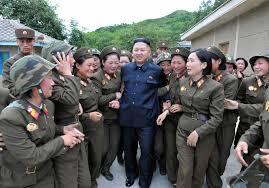
"From nearby Seoul to faraway Washington, DC, many government officials and analysts boldly predicted—sometime in whispers, sometimes in shouts—widespread instability, a mass exodus into China, a military coup, imminent collapse. Behind all the doom mongering was one shared thought: surely this regime couldn’t survive the transition to a third totalitarian leader called Kim, much less to a twentysomething who’d been educated at fancy European schools and had an obsession about the Chicago Bulls—a young man with no known military or government background..."