Lasciarsi accompagnare in un museo, ascoltare il racconto di una visita, appassionarsi a un’opera d’arte, condividere la bellezza e l’emozione di un luogo inaspettato. È quanto accade in questa originale celebrazione dei musei del mondo nelle parole di scrittrici e scrittori, attraversando il Prado di Madrid, il Musée Rodin a Parigi, la Frick Collection di New York, sino ai più insoliti e meno conosciuti come il cottage di William Wordsworth in Gran Bretagna o il museo degli ABBA a Stoccolma. Questi saggi personali e narrativi offrono le testimonianze di oltre venti autori e il loro tour nei musei che li hanno ispirati, ossessionati, intimoriti. Il risultato è un affascinante sguardo nella storia, nell’arte, nella letteratura, nella relazione tra gli artisti e la società che li circonda. Julian Barnes e il mistero della casa del silenzio di Sibelius a Järvenpää; Roddy Doyle e il «museo della gente comune» di New York, nei caseggiati del Lower East Side dove vivevano gli immigrati giunti in America dalla fine dell’Ottocento. E poi Ali Smith a Capri, nella Villa San Michele, Aminatta Forna e il Museo delle Relazioni Interrotte di Zagabria, dove si espongono gli oggetti personali donati da ex amanti e il racconto delle loro storie. E ancora il Musée de la Poupée a Parigi, quello della Letteratura a Odessa: ognuna di queste visite è anche una riflessione sul significato del museo come spazio di rappresentazione del mondo. Da alcuni anni l’istituzione museale è al centro di una rilettura critica e storiografica che ne celebra l’utopia della conoscenza, della conservazione del passato, il segno democratico di condivisione del sapere, o al contrario ne denuncia l’impianto elitario e autoritario che trasforma i musei in cattedrali aristocratiche che congelano la storia delle idee e della libertà artistica. La sensibilità letteraria degli scrittori raccolti in queste pagine sembra suscitare ulteriori riflessioni, ed esaltare il ruolo dell’immaginazione e della memoria; è un invito a mettersi in viaggio, a visitare sale e gallerie, ad aprirsi ancora una volta alla scoperta del mondo.
Una originale celebrazione dei musei del mondo, dal Prado di Madrid al Museo Rodin a Parigi alla Frick Collection di New York, sino ai più insoliti e meno conosciuti come il cottage di William Wordsworth in Gran Bretagna o il museo degli Abba a Stoccolma.
Many of us know of a magazine called The Economist, but I was unaware of its sister publication for the cultural set called Intelligent Life until reading the Preface to this magical little volume. Intelligent life, indeed: Somebody had the idea to invite a well-known writer each month to contribute a few thousand worlds on any museum they chose. The best of these essays, twenty-four of them, were gathered into a book and published in 2016, and reading them is time well spent. No matter your tastes in literature, you are likely to be a fan of at least some of the contributors, who comprise a varied menu including Ann Patchett, Ali Smith, Tim Winton, John Lanchester, Alan Hollinghurst and Roddy Doyle.
One story: Some things are priceless, including a gown made for the Queen of Hawaii back when Hawaii was a monarchy. This gown was woven from red and yellow feathers from a type of local beeeater bird, and craftsman, rather than killing the birds, would capture them, pluck a few feathers and send them on their way. The cape is truly priceless because this type of bird has since gone extinct. (Frank Cotrell-Boyce on the Pitt Rivers Museum, Oxford University.)
Few of the authors chose the large, well-known museums we're all familiar with. Unless, of course, you're already familiar with the Museum of Broken Relationships in Zagreb, Croatia. A couple, recently split up but apparently still on speaking terms, loaded the stuff from their respective post-split homes that reminded them of happier days and which they didn't want to look at any more, and loaded it into a van. But they couldn't bring themselves to part with these unhappy reminders, either. Somehow they arrived at the idea of driving around and collecting similar materials from other heartbroken couples around the city. Word got out, and the collection grew until it needed a home of its own. The items handing on the walls may not be particularly striking, but the placards alongside tell stories of heartbreak that many of us can relate to.
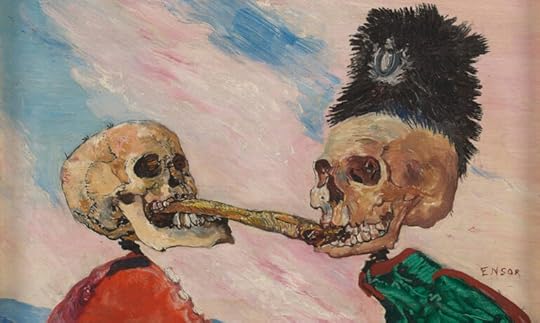
Being an ignorant backwater American, I was previously unfamiliar with the work of James Ensor, collected in Ostende's Ensorhuis.
James Ensor, "Two Skeletons Fighting Over a Pickled Herring"
John Burnside's meditative description both of the museum as well as the work of its honoree was one of the highlights of this book. Most of the essays focus on art, though there are a few natural history collections included, and of course the failed relationship entry mentioned supra. Oh, and the Abba museum in Stockholm. Tim Winton's essay, which is what led me to the book in the first place, was disappointing. But on the whole, this is a book that I enjoyed. For my art-loving friends, I can't recommended highly enough.
Have you ever taken a vacation and made sure to include a visit to a place or site that was mentioned in a book you read? I know I can’t be the only one! Over the years I’ve managed to cross a few things off my bucket list of places to visit … The Gardner Museum in Boston, The Cloisters, the Library, the Met and Central Park in NYC, The Art Institute in Chicago, and The Louvre and Versailles in Paris – yes – museums and galleries seem to be the theme of prominence. My travel bucket list just got a whole lot longer after reading this book (now if only my lottery numbers would hit). If this book is any indication they should definitely hire authors to write travelogues.
TREASURE PALACES – “GREAT WRITERS VISIT GREAT MUSEUMS” edited by Maggie Ferguson
When Tim de Lisle took over as editor of “Intelligent Life” magazine he was inspired by a museum trip with his children to publish a series of articles titled “Authors on Museums” in which “in each issue of Intelligent Life a distinguished writer – not an art critic – would return to a museum that had played some part in their life, and write about what they liked (or didn’t) about it, weaving in a thread of memoir.” There were some misses such as when “David Sedaris admitted that he wasn’t a museums kind of person, but a ‘gift shop and café kind of person’.”
In the stories selected for this book it is interesting to note that most of the museums the authors chose to revisit were small, often obscure, places that spoke to them on a personal level. The galleries and museums range, geographically, from New York City to Zagreb and from Stockholm to Australia. Each article is, of course, written in the first person and many have a conversational tone that made this non-fiction book very easy and most enjoyable to read. Each author’s reason for their choice of museum was as varied as the choices themselves. If you enjoy art galleries and museums or are an armchair traveler, like myself, this book is a must read. I promise you will have a few places to add to your personal bucket list as well.
So which ones in particular made my list?
The Lower East Side Tenement Museum (Roddy Doyle) The first article in the book is also the top pick on my revised bucket list. On the morning of October 1874 Mrs. Gumpertz’s husband left for work and never returned, leaving her with children to support and no income. The story was not uncommon in the tenements of 1800’s New York City. This museum stands as the tenement did then, when the landlord did not want the expense of doing necessary repairs and evicted all the residents. As the author explains, “That is why the Tenement Museum is so special and why I’m here for the third time in 15 years. No famous people lived here. But people did. It’s hard not to expect Mrs. Grumpertz to walk in and demand to know what I’m doing here, in their home. ‘Looking at your wallpaper would be the answer.’”
Everything is original and the walls tell the stories … “The life of the house is in the walls, behind the flaking paint and in the flaking paint.”
The Museum of Broken Relationships (Aminatta Forna) This museum is a collection of items donated by people who have lost their loves. A married man donated a shaving kit given to him by his 17-year old mistress in the 1980’s. When he donated the shaving kit he wrote a note that read, “I hope she doesn’t love me any more. I hope she doesn’t know she was the only person I ever loved.” The museum contains everything from stuffed animals and silk dresses to hats, books and a special pair of motorcycle boots donated by a young man who purchased them for his girlfriend Anna. He and Anna eventually broke up and over the years several other girls wore the boots on the back of his bike but in his mind those boots would always be “Anna’s boots”. Exchanging tokens of love is something we all do and all the best sources advise to get rid of those things if the relationship ends. Sometimes we just cannot bear to do that so why not give them a home in the “Museum of Broken Relationships”?
One article in this book moved me to tears; In Flanders Fields Museum, Ypres (Michael Morpurgo) so this museum is on my list of places I will probably never seek out, for the same reason I did not go to Ground Zero when I was in NYC and will not visit the 911 Memorial. I will not go to Auschwitz, nor the Holocaust Museum. As touchingly as Mr. Morpurgo wrote of the museum and its stories, and as much as I enjoy most aspects of history these museums are difficult to walk through. I did find myself at the memorial for the Oklahoma Bombing. It was incredible and it stays with me to this day, so many years later, and that’s why I won’t go back there or seek out Flanders Fields … the voices of the ghosts are too loud and haunt me for too long.
Other notable mentions?
Musee Rodin in Paris (Allison Pearson) Who has not seen at least a picture of Rodin’s famous “The Kiss”? Ms Pearson visits the museum 30 years after her first introduction to the statue, “Three decades on, I wonder what I saw in this monumental snog. It would sit perfectly in a Las Vegas chapel of lurve. Sometimes marble feels too smooth, too chilly for Rodin’s purposes; these days I am moved by the rougher and readier terracotta Kiss that sits in a modest glass case to one side of the original. Still, I owe that first Kiss. For a group of weary teenagers from the Midlands, here was remarkable news. Dead people had felt these things; and the living went on feeling them.” Explaining a scene from a movie in which Ingrid Bergman is overcome by looking at the agonized figures cast in the ashes of Pompeii Ms. Pearson explains “I recognized the expression on her face … What Vesuvius did by accident, Rodin did by design.”
Pitt Rivers Museum in Oxford (Frank Cotrell-Boyce) The first question every visitor asks when visiting the Pitts River for the first time is “where are the shrunken heads”. These heads are the star attraction even inspiring a scene in Harry Potter. The Pitts Rivers is a giant cabinet of curiosities. “Nowadays it’s well signposted and staffed. Back then it took a bit of nerve to step out of the soaring daylight of the National Museum into the shadows of the Pitt Rivers. A museum hidden, tucked inside a museum. Inside there were more doors to dare.”
The above were some of my personal favourites but all of those included in the book were wonderful. I borrowed this book from the library but it will definitely find its way onto my permanent bookshelf sometime in the future, if only to use as a reference when I accumulate enough Air Miles to take another amazing trip.
For anyone who loves museums of all kinds, any kind. Uneven of course: Allison Pearson's snotty, flippant take on the Musee Rodin was particularly irritating; Julian Barnes's elegiac visit to Sibelius's house was deeply touching, as was Michael Morpurgo's trudge through Ypres's tribute to Flanders fields. The writers (heavily skewed British) muse (pun intended) on the effects of a specific piece of art, how their feelings about museums have evolved over a lifetime, how a certain museum or artist shed light upon the writer's own history, how one person with a quirky passion creates a collection that speaks to visitors down the centuries and across the world. Some of us love the austere hush of traditional museums, some of us revel in weird installations, some think kids should be banned, others think they should be forcibly exposed. But I ended up wanting to visit nearly every museum in this book... well, maybe not the Abba Museum in Stockholm...
In a further attempt to clear out my toppling unsolicited TBR pile, I finally picked up Treasure Palaces edited by Maggie Fergusson last month. This is a series of essays by authors writing about the museums they treasure and it was published in December 2016.
Originally published as a series in Intelligent Life called 'Authors on Museums', writers were asked to return to a museum that had played a significant role in their life and write about the experience.
Maggie Fergusson took over the commissioning of the series after its establishment by Tim de Lisle, and at the end of the series a total of 38 essays had been published. Here Fergusson has curated the best 24, and I enjoyed reading them.
A particular highlight for me was Tim Winton's essay on the NGV (National Gallery of Victoria, Melbourne) entitled 'Spurned No Longer', which began with his first visit as a scruffy nine year old boy, initially refused entry because he was barefoot. The NGV was an icon for me in my teenage years, and I'd never have imagined living less than 500m from the grand entrance on St Kilda Road many years later.
What I did find interesting was the inclusion of art galleries in this collection of essays, which raised the question: "what's the difference between a gallery and museum?" A little online digging informed me that a gallery is where you can see the art with a view to purchasing it, which makes me wonder if the NGV is suitably named after all.
Another highlight in the collection was the essay by Aminatta Forna about The Museum of Broken Relationships, and not because I've been there, but because I've read about it.
Treasure Palaces edited by Maggie Fergusson was an enjoyable read, however it was often interrupted as I went to seek out the artworks being referenced within the essays. There are no photographs or images of exhibits included in the text and this would certainly have enhanced my reading experience if there had been.
Recommended for armchair travellers, art lovers, bookworms interested in learning about treasured authors and non fiction readers with an interest in art and science.
Treasure Palaces is a collection of essays about museums and galleries around the world written by prominent authors. I’ve been picking up and putting down this book, reading chapter by chapter, over the last couple of months.
Overall, it’s an enjoyable read and great for an “armchair vacation” during the pandemic.
My favourite piece, by Matthew Sweet, “Thank You for The Music,” is about the ABBA Museum in Stockholm. It seems generous to call this basement-full-of-ABBA-kitsch next to a ferry terminal a museum, but Sweet inserts the band’s story into Sweden’s national history in a really endearing way.
My main issue with the book is that photos of the museums and particular works are not included.
3.5 stars. I really enjoyed glimpsing into these galleries and museums and understanding why the narrating authors had formed attachments to them. I was keen to look them up online and view the buildings and artworks that were mentioned. Lots of my favourite authors visiting galleries in numerous countries- what could be better.
As a regular museum goer who hasn't been to any museum since the start of Covid-19 pandemic 25 months ago, Treasure Palaces, a collection of 24 essays about 24 museums, gives me an opportunity to be an armchair visitor visiting museums around the world: some old favorites, some new discoveries, some I will never set foot in, and some fascinating but probably out of reach (i.e. The National Museum of Afghanistan, Kabul, in Cool Under Fire by Rory Stewart).
Here is a list of my favorite essays:
Rodin's Sonnets in Stone by Allison Pearson (Musee Rodin, Paris) - There's Life in these Walls by Roddy Doyle (Tenement Museum in New York), - The Pity of War by Michael Morpurgo (Flanders Field Museum in Ypres, Belgium) - Cabinets of Wonder by Frank Cottrell-Boyce (Pitt Rivers Museum, Oxford) - The Wings of Capri by Ali Smith (Villa San Michele, Capri) - Love Bade Me Welcome by Ann Pratchett (The Harvard Museum of Natural history, Cambridge, MA) - The Odessaphiles by A.D. Miller (Odessa State Literary Museum, Odessa) - Sons and Mothers by John Burnside (Ensorhuis, Ostend) - Thank You for the Music by Matthew Sweet (ABBA: The Museum, Stockholm) - Agony to Ecstasy by John Lanchester (The Prado, Madrid) - The Museum of Heartbreak by Aminatta Forna (The Museum of Broken Relationships, Zagreb)
I liked this collection, although it's missing the photos that went with the columns originally. I haven't been to most of the museums, although a few of these are tempting. I can make due with a description of "The Museum of Broken Relationships."
I picked up this book quite unexpectedly from the library and enjoyed it very much. It gave me a yearning to visit more obscure museums. Paul Johnson in his history Art writes that his favorite way to view art is in private collections, one person’s art acquisitions throughout their life. It tells the story of a person, not just the art. Many of the museums in this book are just that, or began that way. I’ve added a new museum from this book to my list when we visit London later this year:The Sir John Ritblat Treasures Gallery, a museum of manuscripts!
Like any short essay collection by different authors, some of these essays spoke to me more than others.
I might be biased, but my favorite essays in this collection were the ones featuring museums I've visited before (the Tenement Museum, Museo dell'Opificio delle Pietre Dure, Harvard Museum of Natural History, and Boston MFA).
Overall, a fun collection, although I wish there was a broader range of types of museums included (like zoos or historic sites!)
Interesting articles on favourite museums/galleries originally published in the Economist's "Intelligent Life" colour supplement.
Like any of these things, some are more interesting than others. Did love the article on the Sir John Riblat Gallery at British Library, which is one of my favourite places to visit when in London.
A must read for any devotee of museums and art galleries.
A delightful little book in which various authors pick favorite museums (most are small and unknown although the Prado and the MFA make the list) and objects within them that are special to them. Gave me some good tips on places that I might want to visit.
I loved the idea of this book and enjoyed most of the pieces. Nice to be reminded about the treasures in the wider world now that travel is beginning to seem possible again.
“I defy anyone to see it, and not have it form part of their vision of an afterlife.”
Waves of nostalgia for the museums I’ve visited and lived - the Rodin, the Frick, the Tenement museum - swept over me on every page. It was the joy of seeing something you love through someone else’s eyes - someone who loves it equally but in a completely different and beautiful way than you. This book was a reminder that museums and their works come to life when they take on personal meaning rather than being viewed as a plethora of cultural and historical objects...
It was beautiful writing, as would be expected from the authors who contributed - the kind of writing that makes you pause and reread a sentence just so that the words flow over your tongue again; the kind of writing that makes you pause and contemplate the wonders described, the ideas proposed; the kind of writing that made me pause and long for that depth and creative power.
They were essays that took me back in time and let me remember the great museum visits of my life that aren’t catalogued here - the Klimt’s and the Miro’s, the Monet’s and the Chagall’s that have become part of who I am. Essays that reawakened the anticipation of knowing there is more beauty just waiting around the corner in places and museums I haven’t yet encountered...
As always, there are more things in heaven and earth than are dreamt of in my philosophies...and some of them are in museums...
so - you like to read, and the occasional museum is interesting as well? Well here you go - reviews of their favorite museums by some pretty good wordsmiths. I picked this up because Roddy Doyle provided one of the essays. I both found museums I'd like to visit as well as authors I'd like to read. As with most essay collections not everything was 'faaabulous' as they say, but all-in-all it was nice to read some different styles and see the museums through others eyes.
Treasure Palace is a book about museums. It’s a collection of essays from the lifestyle magazine of The Economist Group. The magazine invites famous writers to write for anything personal about a museum. There is no restriction on the contents. This theme is conceived by one of the editor in The Economist. They invite many writers and have published many articles for a period. The current literary editor Maggie Fergusson selects 24 articles she believes the most representative or excellent. The result is this delicate anthology.
I bought the hardback book during a bargain. The design is graceful. It appropriately reflects the theme very much. The contents are pretty good overall as I find each article brings the museums alive. There is a hand-drawn picture at the start of each chapter.
Most of the museums here are less well-known. These writers avoid the cliché like British Museum which is filled with descriptions already. They choose those that are not well-known to visitors yet full of wonders. Every writer uses unique writing style to introduce the place to readers. From personal memory to simply delineating the architecture, I find myself immersed in a beautiful world of wonders.
I would recommend everyone to search youtube video before reading each chapter. Jumping right into the article might puzzle you because you have no ‘idea’ what the place look like. It’s always good to make good use of modern technology and makes the reading experience better. The videos provide some insights or impressions about this museums, then you go inside with the writer. The writer is like tour guide who tells the stories about this place. Sometimes intimate flashback fills the space with emotions. This is the magic of words!
As a bonus benefit, I also find this book useful for me to know more English writers. It’s a little hard to ‘’organized’ searching for famous writers from Taiwan. (I mean literary writers, not bestsellers. I can search more ‘British writers’ of course, but it’ll be a bit lost without direction). Many writers in this collection are truly brilliant.
Overall, the articles are pretty high quality. I don’t think any is bad in fact. I enjoy roaming in Rodin Museum in Paris, strolling in the Ainola where Finnish musician Sibelius lived, exploring university museums of Oxford, dancing in ABBA museum in Stockholm, appreciating fine art in National Gallery of Victoria in Melbourne, and many more. These works are not only full of interesting knowledge but also thought provoking. It’s a great book for everyone, especially if you love art and travel. There is certainly something in for you!
A collection of essays about the authors’ favourite museums? What a wonderful idea! I am always ready to visit yet another museum, be it in books or in real life. I also appreciate the book’s focus on smaller museums. As the preface says, ”the most rewarding museum visit is one which involves communion between the viewer and a single object.” It’s possible to have this at the Louvre or other huge museums, but it is too easy to get greedy in such places, and then crawl out four hours later, hardly knowing what you have seen. Ahem.
There are 24 essays in this book. Many are wonderful, but I wished they were all equally memorable. Also, I was happy that I have my own memories and impressions of Musée Rodin in Paris, because Allison Pearson’s essay isn’t something I would recommend to people that haven’t been there. Anyway, here are my top 10, in order of appearance.
Roddy Doyle – The Lower East Side Tenement Museum, New York – so wonderfully humane!
Rory Stewart – The National Museum of Afghanistan, Kabul – the book was published in 2016; this is an amazing piece and it made me sad. I didn’t dare check what happened to the museum and what state it is in now.
Margaret Drabble – Museo dell’Opificio delle Pietre Dure, Florence – pure magic! Florence lived and breathed in these pages, too.
Ali Smith – Villa San Michele, Capri – Thank you for taking me to Capri, I feel blessed. ”...choreography of cloud and cliff”, I will remember these words.
Michael Morpugo – In Flanders Fields Museum, Ypres – I read this with a constant heartache. I think you should read it too, if your head-space allows.
Jacqueline Wlison – Musée de la Poupée, Paris – I am not fond of dolls, I never have been. I liked this for other reasons, such as ”humans doing nice things.”
Julian Barnes – Ainola, Finland (Jean Sibelius' home) – wonderful, I could hear both the music and the silence.
Ann Wroe – Dove Cottage, England, William Wordsworth’s home. - This piece is magical, and so is the poetry.
John Lanchester – Prado, Madrid – this is an essay that gave me jolts of happy recognition, even though my experiences are very different. When I think of Prado, there is only El Greco. Oh, and your parents were right, Mr Lanchester, there is no “perhaps” about it.
Andrew O’Hagan – Kelvingrove, Glasgow – ”…a great museum is not just a repository of treasures but an instigator of vision.”
Una bella sfida, sicuramente vinta. Ogni scrittore scelto dalla Fergusson propone la sua personale storia che la/lo lega a quel museo. Alcuni li conosco, di altri ho sentito parlare. Molti, naturalmente, mi erano totalmente sconosciuti. Di ognuno ho apprezzato la storia personale che lega lo scrittore al museo in questione. Molti non avrò mai il piacere di vederli. Per collocazione geografica in primis alcuni, altri perché sono in zone attraversate dal quel flagello di cui l'uomo sembra non potersi separare: le guerre. Chiudo con un ricordo personale, un piccolo museo che ho visitato più volte. Non molto lontano da casa questo lascito da lustro a una piccola città di provincia. In particolare mi piace ricordare la visita che feci con mia figlia un paio di anni fa. Margherita si era appena laureata (brillantemente) ed era ritornata a casa da Trieste, sede dei suoi studi. Stava vivendo il periodo dei colloqui di lavoro e delle scelte conseguenti. In una fredda mattina di febbraio le proposi di venirmi a recuperare dopo l'allenamento, di vistare il museo e poi di pranzare insieme. Fu una giornata che ricordo con piacere, il luogo ci permise di scambiarci idee che non sarebbero state possibili altrimenti. Finimmo pranzando fra gli studenti del vicino liceo, svagati e preoccupati il giusto per la fine del quadrimestre.
Il Museo Francesco Borgogna è un museo situato a Vercelli. Sorto per legato testamentario di Antonio Borgogna nel 1907, filantropo e collezionista d'arte, ospita una vasta collezione di pittura, scultura e arti decorative. Indirizzo: Via Antonio Borgogna, 4, 13100 Vercelli VC
If you, like me, are a ‘museum person’ and are raring for some armchair travels in these COVID times, this collection of essays from Intelligent Life magazine might just hit the spot. For me, a wander around a good art museum is a joyous, soul-fulfilling and eye-opening experience, and many of the writers in this anthology captured that feeling perfectly.
My one complaint is that the authors selected for this collection skewed white, male, British and old-ish (“I first came across this piece 40 years ago while reading art history at Oxford” is a sentence I swear I came across several times.) More diverse perspectives on more diverse art/history outside of the ‘European canon’ would have made this anthology shine. There were some essays with more eclectic subjects, and they were often some of my favourites. I felt genuinely moved by Roddy Doyle’s opening piece on the Lower East Side Tenement Museum, a slice of ordinary, messy life; and Jacqueline Wilson’s story of a doll museum in Paris and Matthew Sweet’s account of visiting ABBA: The Museum were both full of joy.
Lack of diversity aside, this is a lovely anthology to dip in and out of when you need a holiday from 2020.
A perfect book for a pandemic when we have all been stuck at home for months. This is a series of essays by known authors of their favorite museum or experience at a museum. A few were larger museums but most were the "off the beaten path" type which made for more enjoyable reading and discoveries. Now I have several museums I want to go visit when world wide travel is again available. Several reviews here bemoan the fact that there were no pictures. Yes, that would have been lovely...and I believe when these essays were published in The Economist they were actually accompanied by some pictures. But honestly if there were pictures (and there would need to be lots of full color glossy pictures) then this would likely be an expensive coffee table book (to pay for the reproduction rights of all the art). Hey, people..that is what your computer is for! Just go onto Google street view and walk around these buildings. Several museums have videos on YouTube shot with drones of the interior. And most museum websites had lovely pictures of the artwork discussed. You could put this book on your bedside table and read one essay a night and dive down the rabbit hole the next day. Lovely.
I expected more from this book. I've enjoyed reading the different essays but my architectural side craved more of a deeper spatial exploration of the different museums. However, the personal experiences did make me finish the book, and worth a read. I've enjoyed the essay about the National Museum of Afghanistan, the statement by the director of the museum about the destruction of a historical site got stuck in my head "It has been ordained that Afghanistan needs foreign currency and that the copper mine is the answer. Foreigners who would not contemplate dynamiting Westminster Abbey for a lithium store, or the Parthenon for tin, feel that destroying the last remains of one of the great lost civilization is justifiable if it produces income for the afghan exchequer. This is, after all, only Afghanistan". This statement was the strongest in that essay and it made me want to read more about the museum in Kabul. The museums that were in the book were unique and a couple of them got put on my visit list but I hoped that there were more diverse locations for the essays outside the western world.
AA.VV. Pezzi da museo. 22 collezioni straordinarie nel racconto di grandi scrittori. L'unica controindicazione alla lettura di questo libro, interessante come un saggio, intrigante come un romanzo, è che vi mangerete le mani per esservi persi delle chicche (se "ci siete stati") oppure per le frontiere ancora semi chiuse (se "ci dovete andare"). Tutto il resto è evasione- quella che vi regalano 22 autori anglosassoni del calibro di Ali Smith o di Roddy Doyle che vi accompagnano nei loro musei del cuore, che siano universalmente conosciuti, come il Prado o la Frick collection o roba per pochi intimi, come il Museo dei cuori infranti di Zagabria, quello degli Abba a Stoccolma o il Dove Cottage di Wordsworth, a Grasmere. Ciascuna di queste guide vi racconterà il suo "museo del cuore" intervallando ricordi personali alla descrizione degli ambienti o delle collezioni, nello stile che ce le ha fatte amare nelle vesti di scrittori e scrittrici. Un libro che è una chicca e che, in attesa di decidere dove sistemarlo, se fra i "viaggi" o fra l' "arte", per ora è fisso sul mio comodino. Il posto più giusto, a pensarci bene. Consigliato!
I never understood the appeal of armchair travel (until I mostly stayed home for two years), and then I read this. The authors take us to their favorite museums and for nearly all of them, I fee like I was there, too. I love the way museums charge up my brain and this book got me close to that feeling.
From the Introduction: "In the twenty-first century the best museums will create space for conversation, debate and the exchange of ideas, as well as for instruction."
Of New York City, author Don Paterson (unfamiliar to me) notes, "Irony is a whole dialect here...." His visit to the Frick makes me anxious to get back.
One of many things that draws Ann Patchett to Harvard's Museum of Natural History is the collection -- specimens they have had since the 19th century. She quotes a staff member: of the state of some of the mounts visitors say, "'It's disgraceful. Harvard needs to get a new rhinoceros!' Bur they don't understand, you can't just get a new rhinoceros. You have to fix the one you have." And that renews my fondness for museum people.
I checked it out for the Ali Smith piece, which is very typical of her writing and is a villa in Capri.
This unusual and satisfying survey delights with short essays written by fine writers talking about their favorite museums. Roddy Doyle leads with a look on the wonderful Lower East Side Tenement Museum, following which are astute, witty, and, often (especially in the case of John Burnside), personally revealing pieces on a range of museums including many not commonly covered, such as Wordsworth's Dove Cottage, the National Museum of Afghanistan, Villa San Michele in Capri, In Flanders Field Museum in Ypres, the Odessa State Literary Museum, the Museum of Broken Relationships in Zagreb, and ABBA: The Museum in Stockholm. All the writers are insightful, but my favorites are Michael Morpurgo, Aminatta Forna, Julian Barnes, Ann Patchett, Claire Messud, Matthew Sweet, Andrew O'Hagan, Tim Winton, and Alice Oswald. (Would be good to have another book or two covering Africa, South America, Asia, and the Middle East, with contributions from writers of those areas.)
It's not a bad book, but after reading The Scent of Flowers at Night, it pales in comparison. The majority of the essays collected here (they were originally published elsewhere) are by men. I also must have a defective copy because the Neil Gaiman essay is not in my copy at all. Ali Smith's essay was excellent as was Alice Oswell, mostly because both women seem to pick up on the idea of touch as being part of the desire of museums. Also a stand out essay was Jacqueline Wilson's about a doll museum in Paris. I've only really been to one of the museums in this collection, and strangely I didn't like that essay. The book is worth for the Smith, Oswell, and Wilson essays however.
Not all of the pieces were equally exciting, although it's worth noting that none of them were dreadfully dull. I think my favourite was the piece on the Frick, which I found to be the most humourous in the entire book (coincidentally, the Frick is also the only institution of those discussed in the book that I have visited, and I internally beat myself up quite a bit when reading about the Museum of Broken Relationships, which I missed the opportunity to see when it came to Toronto last year). This is a perfect book for those who feel a sudden gust of wanderlust sweep through and want to quench it. It was also a reminder of why I love art as much as I do and want to dedicate my life to it.
Great little book where each chapter is its own autonomous entry whereby authors describe their favorite museum and why. Most of the museums featured are small intimate places that may not be well known beyond local residents so it was fascinating to read about them as well as why they appeal to a given author. I'll definitely put several on my list to visit when I am in the respective cities and there were some I have already visited that presented new perspectives to entertain on future encounters. It is a great unique novel and each entry was wonderfully intimate and informative.
Ce livre m'a permis de voyager tout en restant dans le confort du bord de mon lac. J'adore aller visiter des musées, j'adore l'art, j'adore l'histoire et surtout j'adore le sentiment que les expositions me font vivre. Oui, je peux visiter en ligne des musées, mais ce n'est pas pareil que vivre la visite à travers les mots d'auteurs passionnés qui ont vécu des expériences dans ces musées. Ce livre m'a permis d'ouvrir mes horizons et de connaitre de nouveaux musées ( qui ont été définitivement ajoutés à ma liste ). Bref, pour voyager tout en restant dans votre chez-soi, ce livre est parfait.