

What do you think?

Comics and Stuff
Considers how comics display our everyday stuff--junk drawers, bookshelves, attics--as a way into understanding how we represent ourselves now
For most of their history, comics were widely understood as disposable--you read them and discarded them, and the pulp paper they were printed on decomposed over time. Today, comic books have been rebranded as graphic novels--clothbound high-gloss volumes that can be purchased in bookstores, checked out of libraries, and displayed proudly on bookshelves. They are reviewed by serious critics and studied in university classrooms. A medium once considered trash has been transformed into a respectable, if not elite, genre.
While the American comics of the past were about hyperbolic battles between good and evil, most of today's graphic novels focus on everyday personal experiences. Contemporary culture is awash with stuff. They give vivid expression to a culture preoccupied with the processes of circulation and appraisal, accumulation and possession. By design, comics encourage the reader to scan the landscape, to pay attention to the physical objects that fill our lives and constitute our familiar surroundings. Because comics take place in a completely fabricated world, everything is there intentionally. Comics are stuff; comics tell stories about stuff; and they display stuff.
When we use the phrase "and stuff" in everyday speech, we often mean something vague, something like "etcetera." In this book, stuff refers not only to physical objects, but also to the emotions, sentimental attachments, and nostalgic longings that we express--or hold at bay--through our relationships with stuff.
In Comics and Stuff, his first solo authored book in over a decade, pioneering media scholar Henry Jenkins moves through anthropology, material culture, literary criticism, and art history to resituate comics in the cultural landscape. Through over one hundred full-color illustrations, using close readings of contemporary graphic novels, Jenkins explores how comics depict stuff and exposes the central role that stuff plays in how we curate our identities, sustain memory, and make meaning. Comics and Stuff presents an innovative new way of thinking about comics and graphic novels that will change how we think about our stuff and ourselves.
For most of their history, comics were widely understood as disposable--you read them and discarded them, and the pulp paper they were printed on decomposed over time. Today, comic books have been rebranded as graphic novels--clothbound high-gloss volumes that can be purchased in bookstores, checked out of libraries, and displayed proudly on bookshelves. They are reviewed by serious critics and studied in university classrooms. A medium once considered trash has been transformed into a respectable, if not elite, genre.
While the American comics of the past were about hyperbolic battles between good and evil, most of today's graphic novels focus on everyday personal experiences. Contemporary culture is awash with stuff. They give vivid expression to a culture preoccupied with the processes of circulation and appraisal, accumulation and possession. By design, comics encourage the reader to scan the landscape, to pay attention to the physical objects that fill our lives and constitute our familiar surroundings. Because comics take place in a completely fabricated world, everything is there intentionally. Comics are stuff; comics tell stories about stuff; and they display stuff.
When we use the phrase "and stuff" in everyday speech, we often mean something vague, something like "etcetera." In this book, stuff refers not only to physical objects, but also to the emotions, sentimental attachments, and nostalgic longings that we express--or hold at bay--through our relationships with stuff.
In Comics and Stuff, his first solo authored book in over a decade, pioneering media scholar Henry Jenkins moves through anthropology, material culture, literary criticism, and art history to resituate comics in the cultural landscape. Through over one hundred full-color illustrations, using close readings of contemporary graphic novels, Jenkins explores how comics depict stuff and exposes the central role that stuff plays in how we curate our identities, sustain memory, and make meaning. Comics and Stuff presents an innovative new way of thinking about comics and graphic novels that will change how we think about our stuff and ourselves.
- GenresNonfictionAcademic
352 pages, Paperback
First published April 14, 2020
Ratings & Reviews
Friends & Following
Create a free account to discover what your friends think of this book!
Community Reviews
Displaying 1 - 9 of 9 reviews

April 12, 2020
"A cartoon is not an image taken from life. A cartoon is taken from memory. We are trying to distill the memory of an experience, not the experience itself."
"In short, comics are stuff; comics tell stories about stuff; and they display stuff."
An academic exploration of the meaning of 'stuff' (objects, both real and imaginary, both useful and useless) in comics and graphic novels, that has changed how I view said stuff in comics.
Henry Jenkins, scholar and professor at the University of South California, starts the book by trying to pin down what exactly is the definition of stuff - first in general, and then specifically in art and comic art. The following chapters dive deep into a set of comics of graphic novels, specifically chosen because they haven't been discussed as much in earlier literature.
The works Jenkins has chosen are Richard F. Outcault's Hogan's Alley (best know for the Yellow Kid), Mimi Pond's Over Easy, David Mazzucchelli's Asterios Polyp, Fabio Moon and Gabriel Ba's Daytripper, Bryan Talbot's Heart Of The Empire and Alice In Sunderland, several of Seth's books, Carol Tyler's Fab4 Mania and You'll Never Know trilogy (aka Soldier's Heart), several works by Kim Deitch, Emil Ferris' My Favorite Thing Is Monsters, Joyce Farmer's Special Exits, Roz Chast's Can't We Talk About Something More Pleasant, Derf Backderf's Trashed, and finally, Jeremy Love's Bayou.
Through analysing these works, Jenkins moves through various ways to see objects and what they could mean within the story of the work - from collections and collectors (Seth and Kim Deitch) to 'accumulators' like Bryan Talbot (who see worth in individual objects, while with collectors the whole is more than the parts), from imaginary collectors (Emil Ferris) to those who are trying to patch together personal history from objects (Carol Tyler), from those who are flooded and drowning in useless objects (Joyce Farmer and Roz Chast) to those dealing with inherently racist items (Jeremy Love).
Jenkins focuses mainly on comic art, but makes comparisons with painterly still life, collage art and curiosity cabinets. He also references many other works on the nature of things, including hoarding. I am not an academic myself, so take that into account, but if I have on real criticism of this book, it is that although it is interesting to see Jenkins throw as wide a net as possible, at times I did feel overwhelmed by yet another definition of stuff, another wave of definitions, drifting further and further away from comics and graphic novels, finding myself asking out loud "wait, why are we talking about this, again?".
The book is very well illustrated with reproductions from every work being discussed. It is a highly insightful work, not the easiest read perhaps, but I found it a real joy to read, widening my view on comic art in general. It has also saddled me with a huge list of comics and graphic novels I now can't wait to read.
"What do we do when we run out of shelf space , when all the closets are full, when we can’t afford any more storage units? Sooner or later, our stuff will engulf us."
(Kindly received an ARC from NYU Press through Netgalley)
"In short, comics are stuff; comics tell stories about stuff; and they display stuff."
An academic exploration of the meaning of 'stuff' (objects, both real and imaginary, both useful and useless) in comics and graphic novels, that has changed how I view said stuff in comics.
Henry Jenkins, scholar and professor at the University of South California, starts the book by trying to pin down what exactly is the definition of stuff - first in general, and then specifically in art and comic art. The following chapters dive deep into a set of comics of graphic novels, specifically chosen because they haven't been discussed as much in earlier literature.
The works Jenkins has chosen are Richard F. Outcault's Hogan's Alley (best know for the Yellow Kid), Mimi Pond's Over Easy, David Mazzucchelli's Asterios Polyp, Fabio Moon and Gabriel Ba's Daytripper, Bryan Talbot's Heart Of The Empire and Alice In Sunderland, several of Seth's books, Carol Tyler's Fab4 Mania and You'll Never Know trilogy (aka Soldier's Heart), several works by Kim Deitch, Emil Ferris' My Favorite Thing Is Monsters, Joyce Farmer's Special Exits, Roz Chast's Can't We Talk About Something More Pleasant, Derf Backderf's Trashed, and finally, Jeremy Love's Bayou.
Through analysing these works, Jenkins moves through various ways to see objects and what they could mean within the story of the work - from collections and collectors (Seth and Kim Deitch) to 'accumulators' like Bryan Talbot (who see worth in individual objects, while with collectors the whole is more than the parts), from imaginary collectors (Emil Ferris) to those who are trying to patch together personal history from objects (Carol Tyler), from those who are flooded and drowning in useless objects (Joyce Farmer and Roz Chast) to those dealing with inherently racist items (Jeremy Love).
Jenkins focuses mainly on comic art, but makes comparisons with painterly still life, collage art and curiosity cabinets. He also references many other works on the nature of things, including hoarding. I am not an academic myself, so take that into account, but if I have on real criticism of this book, it is that although it is interesting to see Jenkins throw as wide a net as possible, at times I did feel overwhelmed by yet another definition of stuff, another wave of definitions, drifting further and further away from comics and graphic novels, finding myself asking out loud "wait, why are we talking about this, again?".
The book is very well illustrated with reproductions from every work being discussed. It is a highly insightful work, not the easiest read perhaps, but I found it a real joy to read, widening my view on comic art in general. It has also saddled me with a huge list of comics and graphic novels I now can't wait to read.
"What do we do when we run out of shelf space , when all the closets are full, when we can’t afford any more storage units? Sooner or later, our stuff will engulf us."
(Kindly received an ARC from NYU Press through Netgalley)

February 10, 2021
Jenkins says you can read these chapters independently as if they were articles to themselves. That's only sort of true. Further, that COULD have been true and I think SHOULD have been true. Each chapter builds on the last, so there is an arch of the book that is a close textual analysis driven around-about various graphic novel oriented representations of "stuff."
In particular, the book begins with the obvious: "stuff" here is comic oriented account of materialism of daily life. Then he points to the fact that comics use "stuff" to curate and invest in memories. In doing so, a narrative becomes more interactive and allows for (dis)continuities that are subjective across readers. That is, comics account for authors' literal collecting habits of stuff as a semiotic reflexivity of memory itself which creates the comic based narrative. As such, this book offers some hot takes about affective investments in between the reader and the artist.
Because of this hinge of using media to explain the connections between the semiotic collections of iconic "stuff" and the affective/emotional quality of media in how we (the comic book reader) connect the dots, there is a way in which this book attempts to be an organic progression from Deleuze's work on media and memory. However, Jenkins appears to gloss over this by merely covering secondary scholarship on Deleuze without investing at all in the metaphysics he is pulling from, and it costs him dearly.
Jenkins takes a lot of delicate time to insist that there is an aesthetic of comics which requires our own memories entangled with the stuff of comics that gives a comic a subjectivity that is unique between every reader and comic. That said, I think this was a very inefficient way to express these thoughts. I think that Jenkins could have condensed a lot of these thoughts by taking from the visual rhetorical tactics of comic book designers in the way that Scott McCloud does and the way others have done, and condensed a lot of ideas very quickly. This could have been a 120 page book, and not lost a bit of (the important) information. (Let me be blunt about what's NOT important: Jenkins' history of comics to graphic novels, the consumerism related collecting, the masculinity of comics, and the way they include marginalized communities and interact with countercultural movements are merely token gestures to intersectional feminism without actually investing in these political interests or giving any substance to them. A simple Google search can show he clearly doesn't reference these histories properly.)
To return to my main critique however: this book opens with a set of theories, but does not carry through in using those theories directly throughout the book. I'm not sure I understand this tactic unless it is to give us the false impression that we aren't dealing with Deleuze's cinematic planes and Deleuzian (rather than Bergsonian) memory. Clearly we are dealing with these theories! Jenkins frames the book as such when he cites Deleuzian scholars such as Laura U. Marks and other new materialist media scholars, but he never uses these scholars' language. He mentions them briefly only to bury them quickly after without real investment. It tarnished this read for me that I was being teased with new theory. Really I was getting watered-down Deleuzian metaphysics lectured to me like a child by a communication theorist.
In summary, I think that it is IN SPITE OF the ethical disservice of so clearly pretending to be feminist and an anticapitalist in this book that he still manages to tie this book together is a (post-?)Deleuzian notion of mediated memory that extends Cinema to comics. And yet, for some reason, Jenkins decided to bury this argument after the first couple of chapters!
However, as a positive concept that he provides more clearly to me by way of analogy, he briefly ties the stuff in the comic panels to digital hypertext and explains how this is a somewhat useful analogy for practical consideration. With that, he teases us with perhaps the most novel part of the book, and then doesn't explore it any further. He almost explained Boys Club! He almost explained the development of Pepe as a radically anti-author, post-human comic-based memory! He almost extended comics to the new media of Internet Memes! BUT HE DIDN'T! WHY?!?! Of all things, should not this have been the absolute finale in the present moment?! For shame! What a squandered moment!
This wasn't the only time he teased new ideas like this, but in order to make use of these teasings, it is up to the reader to know they are there as they too will have to know what he's implicitly citing, because he doesn't hyperlink it for you. He forces you to do the extra work... seemingly just because he can. And that's annoying. In a sense, I can only imagine this book is going to come across as more confusing to many, and for those that think they know, Jenkins doesn't offer enough reference to older media theory for us to really ever know without reading between the lines subjectively. This book makes itself difficult to use either just to make our lives harder or because he is hiding which bits of this book that give away that the vast majority of his conclusive arguments are recontextualized summaries of other people's work.
From what I can tell, the main takeaway that I hadn't really figured out how to do for myself before this book was to more organically (rather than structurally) map connections across media formats such as Cinema, Still Life, and Comics. The most valuable part of this book to me aren't even about comics. It's about a methodology of synthesis in analysis across media that, frankly, should have naturally followed from the materialist psychology of James Gibson's "affordances" but of course Jenkins never cites that in order to make me make that connection myself... because he's being difficult for no good reason.
Seriously though, authors like Jenkins need to stop acting as if they're "anti-theory" theory. They're clearly just hiding behind mediocre attempts at practicing empiricism in order to pretend their personal theories are disjoint from "theory." (Get over yourselves, anti-theorists. You're doing precisely the theory you hate because of your allergy to "theory.") It's very self-indulgent academia, and only makes the work of understanding harder for other people. It's a dangerous academic game to do this. You WILL be misinterpreted if you do this... probably on purpose... and probably in a way you can't refute. Don't write this way. This book had such potential and lost itself to its own fetish with glorifying comics half-heartedly.
In particular, the book begins with the obvious: "stuff" here is comic oriented account of materialism of daily life. Then he points to the fact that comics use "stuff" to curate and invest in memories. In doing so, a narrative becomes more interactive and allows for (dis)continuities that are subjective across readers. That is, comics account for authors' literal collecting habits of stuff as a semiotic reflexivity of memory itself which creates the comic based narrative. As such, this book offers some hot takes about affective investments in between the reader and the artist.
Because of this hinge of using media to explain the connections between the semiotic collections of iconic "stuff" and the affective/emotional quality of media in how we (the comic book reader) connect the dots, there is a way in which this book attempts to be an organic progression from Deleuze's work on media and memory. However, Jenkins appears to gloss over this by merely covering secondary scholarship on Deleuze without investing at all in the metaphysics he is pulling from, and it costs him dearly.
Jenkins takes a lot of delicate time to insist that there is an aesthetic of comics which requires our own memories entangled with the stuff of comics that gives a comic a subjectivity that is unique between every reader and comic. That said, I think this was a very inefficient way to express these thoughts. I think that Jenkins could have condensed a lot of these thoughts by taking from the visual rhetorical tactics of comic book designers in the way that Scott McCloud does and the way others have done, and condensed a lot of ideas very quickly. This could have been a 120 page book, and not lost a bit of (the important) information. (Let me be blunt about what's NOT important: Jenkins' history of comics to graphic novels, the consumerism related collecting, the masculinity of comics, and the way they include marginalized communities and interact with countercultural movements are merely token gestures to intersectional feminism without actually investing in these political interests or giving any substance to them. A simple Google search can show he clearly doesn't reference these histories properly.)
To return to my main critique however: this book opens with a set of theories, but does not carry through in using those theories directly throughout the book. I'm not sure I understand this tactic unless it is to give us the false impression that we aren't dealing with Deleuze's cinematic planes and Deleuzian (rather than Bergsonian) memory. Clearly we are dealing with these theories! Jenkins frames the book as such when he cites Deleuzian scholars such as Laura U. Marks and other new materialist media scholars, but he never uses these scholars' language. He mentions them briefly only to bury them quickly after without real investment. It tarnished this read for me that I was being teased with new theory. Really I was getting watered-down Deleuzian metaphysics lectured to me like a child by a communication theorist.
In summary, I think that it is IN SPITE OF the ethical disservice of so clearly pretending to be feminist and an anticapitalist in this book that he still manages to tie this book together is a (post-?)Deleuzian notion of mediated memory that extends Cinema to comics. And yet, for some reason, Jenkins decided to bury this argument after the first couple of chapters!
However, as a positive concept that he provides more clearly to me by way of analogy, he briefly ties the stuff in the comic panels to digital hypertext and explains how this is a somewhat useful analogy for practical consideration. With that, he teases us with perhaps the most novel part of the book, and then doesn't explore it any further. He almost explained Boys Club! He almost explained the development of Pepe as a radically anti-author, post-human comic-based memory! He almost extended comics to the new media of Internet Memes! BUT HE DIDN'T! WHY?!?! Of all things, should not this have been the absolute finale in the present moment?! For shame! What a squandered moment!
This wasn't the only time he teased new ideas like this, but in order to make use of these teasings, it is up to the reader to know they are there as they too will have to know what he's implicitly citing, because he doesn't hyperlink it for you. He forces you to do the extra work... seemingly just because he can. And that's annoying. In a sense, I can only imagine this book is going to come across as more confusing to many, and for those that think they know, Jenkins doesn't offer enough reference to older media theory for us to really ever know without reading between the lines subjectively. This book makes itself difficult to use either just to make our lives harder or because he is hiding which bits of this book that give away that the vast majority of his conclusive arguments are recontextualized summaries of other people's work.
From what I can tell, the main takeaway that I hadn't really figured out how to do for myself before this book was to more organically (rather than structurally) map connections across media formats such as Cinema, Still Life, and Comics. The most valuable part of this book to me aren't even about comics. It's about a methodology of synthesis in analysis across media that, frankly, should have naturally followed from the materialist psychology of James Gibson's "affordances" but of course Jenkins never cites that in order to make me make that connection myself... because he's being difficult for no good reason.
Seriously though, authors like Jenkins need to stop acting as if they're "anti-theory" theory. They're clearly just hiding behind mediocre attempts at practicing empiricism in order to pretend their personal theories are disjoint from "theory." (Get over yourselves, anti-theorists. You're doing precisely the theory you hate because of your allergy to "theory.") It's very self-indulgent academia, and only makes the work of understanding harder for other people. It's a dangerous academic game to do this. You WILL be misinterpreted if you do this... probably on purpose... and probably in a way you can't refute. Don't write this way. This book had such potential and lost itself to its own fetish with glorifying comics half-heartedly.

September 10, 2020
Review: Comics and Stuff by Henry Jenkins
I received a review copy from the publisher via Netgalley in exchange for an honest review.
I wrote the first part of this review in one go while reading the introduction. Right now, I have finished both the intro and the first chapter and am currently on chapter 2. I won’t change much about my first impression in regards to the introduction because it is an accurate representation about my reading experience. However, if there is new information that changes something, I put it in square brackets […] to indicate that I came back to it later to correct a statement.
The end of the review contains my insights up until Chapter 2.
--------------
Whenever I get an ARC, I always try to give the book a fair shot. I mean, if I wasn’t interested in the topic then I wouldn’t have asked for a copy in the first place. My feedback does not come from a malicious place but honest critical engagement with the book.
I say this because this book was – and I’m sorry to say this – immensely difficult to get into. The first time around, I only got to 3% and by that point I almost DNFed this book several times. Several times! It took me months to get back to it and I had to restart from the beginning because I had forgotten everything except for a few snippets and because I wanted to write the review while reading, so that I can properly explore my criticism point by point. My goal right now is to just finish the introduction and then decide if I want to continue or not.
I’m anxious about posting this review because I feel like there is a lot of untapped potential but too much is amiss to recommend it without hesitation.
The introduction begins with a bold statement. Jenkins quotes Spiegelman, the creator of Maus, who explains that any mass medium needs to become art in order to survive. Jenkins then says that comics became “graphic novels” and this shift from “pulp” to “novel” made it possible for academics to study the topic because no academic would ever look at comics critically and scientifically.
That is bold and for me very weird idea that borders on wrong. I mean, maybe there was little interest in academically discussing comics in the 1930s or 40s but Jenkins never clearly states when academics started engaging with comics. But ultimately, his claim is that “few would have taken traditional comic books into such spaces” and I’m confused and skeptical. Especially so because this is the foundation of Jenkins’ book, i.e. explain the shift from mass media to art and the emerging of academic study. So, I will let it slide for now.
[Despite how much time Jenkins spends on talking about the shift from “comic” to “graphic novel” and the pointless semantic discussion, this book is in fact NOT about any of these topics. The actual point of this book comes further down.]
The aim of the book is to study how comics reflect on the everyday life and how it tells stories about “stuff” and how comics themselves are “stuff” and in which ways we can look at them in terms of material culture, anthropology, sociology, economics and other fields. In other words: how to comics represent society and how does society deal with the materiality of comics.
[I will go further into this at the end.]
So, right from the get go we have a first contradiction. At the beginning Jenkins argues that there were comics and then graphic novels came and one is mass media without artistic purpose and the other is art. But he then quotes Spiegelman again and how his father gave him some adult comics filled with sex and violence. They were deemed by some to be throw-away products unsuitable for youngsters and because of these two aspects, not art. And then Jenkins says that Spiegelman and others argue that these “trash” comics were actually art that “experimented with new visual strategies, that introduced morally complex situations, novelistic characters, and socially resonant themes, and that had recognizable auteurs.”
As an art historian I naturally studied art in all its forms and what I’ve realized during all these years is that there is no clear cut between mass media and art or a pinpoint where mass media becomes art. In fact, mass media is, like always, a wild mix of artistic expression, experimentation and “pulp” material. Any new art form received similar criticism filled with disdain: photography, film, heck, even Japanese woodblock prints – all these were lambasted by some people for being non-art. Cheap derivatives with no artistry, skill or message.
And as someone who has studied the history of photography, film and woodblock prints I can tell you one thing: this is ridiculously wrong. Some people always be complaining about new technology and its lack of “artistic soul” when the width of expression was incredible. People created “cheap” mass produced things but also beautifully designed works of art.
I am confused about what Jenkins is trying to say here because first he says there is a clear cut between comics and graphic novels, as one being mass media with no artistic value and the other being art. And then in another sub-chapter he quotes Spiegelman who argues the exact opposite and suddenly things aren’t so clear anymore? I am thoroughly confused about his argument because I have no idea what Jenkins actually thinks and is trying to convey as he contradicts himself and both statements have no elaboration that connects them in any way. It’s like he wrote two different text blocks at different points in time and then shuffled the paragraphs around until he had an introduction.
This lack of connecting tissue between paragraphs and segments becomes even more apparent with the next example.
-------------------
This review is too long for GR. You can read the rest on my blog.
I received a review copy from the publisher via Netgalley in exchange for an honest review.
I wrote the first part of this review in one go while reading the introduction. Right now, I have finished both the intro and the first chapter and am currently on chapter 2. I won’t change much about my first impression in regards to the introduction because it is an accurate representation about my reading experience. However, if there is new information that changes something, I put it in square brackets […] to indicate that I came back to it later to correct a statement.
The end of the review contains my insights up until Chapter 2.
--------------
Whenever I get an ARC, I always try to give the book a fair shot. I mean, if I wasn’t interested in the topic then I wouldn’t have asked for a copy in the first place. My feedback does not come from a malicious place but honest critical engagement with the book.
I say this because this book was – and I’m sorry to say this – immensely difficult to get into. The first time around, I only got to 3% and by that point I almost DNFed this book several times. Several times! It took me months to get back to it and I had to restart from the beginning because I had forgotten everything except for a few snippets and because I wanted to write the review while reading, so that I can properly explore my criticism point by point. My goal right now is to just finish the introduction and then decide if I want to continue or not.
I’m anxious about posting this review because I feel like there is a lot of untapped potential but too much is amiss to recommend it without hesitation.
The introduction begins with a bold statement. Jenkins quotes Spiegelman, the creator of Maus, who explains that any mass medium needs to become art in order to survive. Jenkins then says that comics became “graphic novels” and this shift from “pulp” to “novel” made it possible for academics to study the topic because no academic would ever look at comics critically and scientifically.
That is bold and for me very weird idea that borders on wrong. I mean, maybe there was little interest in academically discussing comics in the 1930s or 40s but Jenkins never clearly states when academics started engaging with comics. But ultimately, his claim is that “few would have taken traditional comic books into such spaces” and I’m confused and skeptical. Especially so because this is the foundation of Jenkins’ book, i.e. explain the shift from mass media to art and the emerging of academic study. So, I will let it slide for now.
[Despite how much time Jenkins spends on talking about the shift from “comic” to “graphic novel” and the pointless semantic discussion, this book is in fact NOT about any of these topics. The actual point of this book comes further down.]
The aim of the book is to study how comics reflect on the everyday life and how it tells stories about “stuff” and how comics themselves are “stuff” and in which ways we can look at them in terms of material culture, anthropology, sociology, economics and other fields. In other words: how to comics represent society and how does society deal with the materiality of comics.
[I will go further into this at the end.]
So, right from the get go we have a first contradiction. At the beginning Jenkins argues that there were comics and then graphic novels came and one is mass media without artistic purpose and the other is art. But he then quotes Spiegelman again and how his father gave him some adult comics filled with sex and violence. They were deemed by some to be throw-away products unsuitable for youngsters and because of these two aspects, not art. And then Jenkins says that Spiegelman and others argue that these “trash” comics were actually art that “experimented with new visual strategies, that introduced morally complex situations, novelistic characters, and socially resonant themes, and that had recognizable auteurs.”
As an art historian I naturally studied art in all its forms and what I’ve realized during all these years is that there is no clear cut between mass media and art or a pinpoint where mass media becomes art. In fact, mass media is, like always, a wild mix of artistic expression, experimentation and “pulp” material. Any new art form received similar criticism filled with disdain: photography, film, heck, even Japanese woodblock prints – all these were lambasted by some people for being non-art. Cheap derivatives with no artistry, skill or message.
And as someone who has studied the history of photography, film and woodblock prints I can tell you one thing: this is ridiculously wrong. Some people always be complaining about new technology and its lack of “artistic soul” when the width of expression was incredible. People created “cheap” mass produced things but also beautifully designed works of art.
I am confused about what Jenkins is trying to say here because first he says there is a clear cut between comics and graphic novels, as one being mass media with no artistic value and the other being art. And then in another sub-chapter he quotes Spiegelman who argues the exact opposite and suddenly things aren’t so clear anymore? I am thoroughly confused about his argument because I have no idea what Jenkins actually thinks and is trying to convey as he contradicts himself and both statements have no elaboration that connects them in any way. It’s like he wrote two different text blocks at different points in time and then shuffled the paragraphs around until he had an introduction.
This lack of connecting tissue between paragraphs and segments becomes even more apparent with the next example.
-------------------
This review is too long for GR. You can read the rest on my blog.

May 11, 2020
An interesting look at the way comics/graph novels utilize "stuff" to add to the telling of a story. I like the way the book is broken down to analyze specific books. This is an insightful way to look at the changing medium of graphic novels and how they are both art and innovative ways to tell a story. I would recommend this book to anyone interested in the subject matter or even those that want to see what all the fuss is about when people and academics discuss the graphic novel industry.
Thank you to NetGalley and the publisher for the DARC of this work in exchange for my honest review.
Thank you to NetGalley and the publisher for the DARC of this work in exchange for my honest review.

December 10, 2025
Rating: 4.5* of five
The Publisher Says: Considers how comics display our everyday stuff—junk drawers, bookshelves, attics—as a way into understanding how we represent ourselves now
For most of their history, comics were widely understood as disposable—you read them and discarded them, and the pulp paper they were printed on decomposed over time. Today, comic books have been rebranded as graphic novels—clothbound high-gloss volumes that can be purchased in bookstores, checked out of libraries, and displayed proudly on bookshelves. They are reviewed by serious critics and studied in university classrooms. A medium once considered trash has been transformed into a respectable, if not elite, genre.
While the American comics of the past were about hyperbolic battles between good and evil, most of today's graphic novels focus on everyday personal experiences. Contemporary culture is awash with stuff. They give vivid expression to a culture preoccupied with the processes of circulation and appraisal, accumulation and possession. By design, comics encourage the reader to scan the landscape, to pay attention to the physical objects that fill our lives and constitute our familiar surroundings. Because comics take place in a completely fabricated world, everything is there intentionally. Comics are stuff; comics tell stories about stuff; and they display stuff.
When we use the phrase "and stuff" in everyday speech, we often mean something vague, something like "etcetera." In this book, stuff refers not only to physical objects, but also to the emotions, sentimental attachments, and nostalgic longings that we express—or hold at bay—through our relationships with stuff.
In Comics and Stuff, his first solo authored book in over a decade, pioneering media scholar Henry Jenkins moves through anthropology, material culture, literary criticism, and art history to resituate comics in the cultural landscape. Through over one hundred full-color illustrations, using close readings of contemporary graphic novels, Jenkins explores how comics depict stuff and exposes the central role that stuff plays in how we curate our identities, sustain memory, and make meaning. Comics and Stuff presents an innovative new way of thinking about comics and graphic novels that will change how we think about our stuff and ourselves.
I RECEIVED A DRC FROM THE PUBLISHER VIA EDELWEISS+. THANK YOU.
My Review: Stuff is a nightmare. Stuff is all I got. Stuff...is. Dealing with stuff, yours. mine, or no one we know's, is a full time career.
Comic books are stuff. They're about stuff. They are, in short, great wats to explore stuff and its role in our lives.
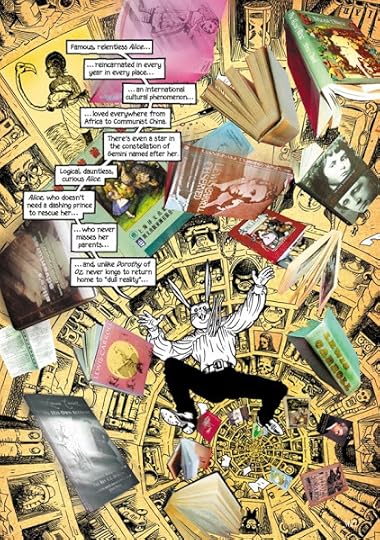

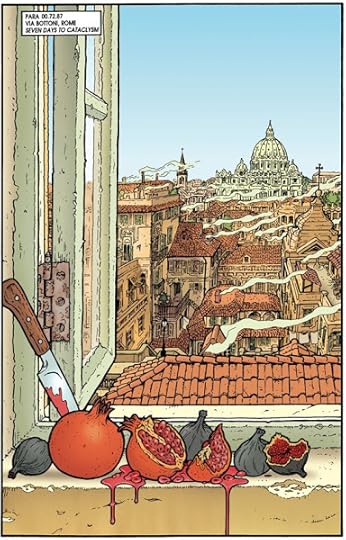
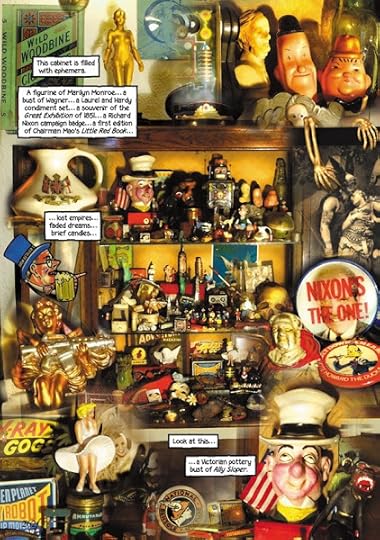
A subtle person uses the medium to critique, analyze, and...sometimes...take to task the message and its architects. Henry Jenkins is subtle; he uses the medium to make plain what can easily fall outside the awareness of the consumer: This is a story, an entire social universe, constructed around the Love of Stuff.
It seems harmless enough phrased that way. It's hard to see from inside the system what the system's designed to do. Like investigating the many-worlds interpretation of quantum physics, the theory is as close to proof of intent as we'll get...we can't observe what is, by definition, outside the system we're working within to perform the measurement.
In other words, you can't see the nose on your face unless you're looking in a mirror (or its equivalent reflective surface). Henry Jenkins is offering that mirror.
Highly recommended for your graphic-novel readin' sophisticate.
The Publisher Says: Considers how comics display our everyday stuff—junk drawers, bookshelves, attics—as a way into understanding how we represent ourselves now
For most of their history, comics were widely understood as disposable—you read them and discarded them, and the pulp paper they were printed on decomposed over time. Today, comic books have been rebranded as graphic novels—clothbound high-gloss volumes that can be purchased in bookstores, checked out of libraries, and displayed proudly on bookshelves. They are reviewed by serious critics and studied in university classrooms. A medium once considered trash has been transformed into a respectable, if not elite, genre.
While the American comics of the past were about hyperbolic battles between good and evil, most of today's graphic novels focus on everyday personal experiences. Contemporary culture is awash with stuff. They give vivid expression to a culture preoccupied with the processes of circulation and appraisal, accumulation and possession. By design, comics encourage the reader to scan the landscape, to pay attention to the physical objects that fill our lives and constitute our familiar surroundings. Because comics take place in a completely fabricated world, everything is there intentionally. Comics are stuff; comics tell stories about stuff; and they display stuff.
When we use the phrase "and stuff" in everyday speech, we often mean something vague, something like "etcetera." In this book, stuff refers not only to physical objects, but also to the emotions, sentimental attachments, and nostalgic longings that we express—or hold at bay—through our relationships with stuff.
In Comics and Stuff, his first solo authored book in over a decade, pioneering media scholar Henry Jenkins moves through anthropology, material culture, literary criticism, and art history to resituate comics in the cultural landscape. Through over one hundred full-color illustrations, using close readings of contemporary graphic novels, Jenkins explores how comics depict stuff and exposes the central role that stuff plays in how we curate our identities, sustain memory, and make meaning. Comics and Stuff presents an innovative new way of thinking about comics and graphic novels that will change how we think about our stuff and ourselves.
I RECEIVED A DRC FROM THE PUBLISHER VIA EDELWEISS+. THANK YOU.
My Review: Stuff is a nightmare. Stuff is all I got. Stuff...is. Dealing with stuff, yours. mine, or no one we know's, is a full time career.
Comic books are stuff. They're about stuff. They are, in short, great wats to explore stuff and its role in our lives.
A subtle person uses the medium to critique, analyze, and...sometimes...take to task the message and its architects. Henry Jenkins is subtle; he uses the medium to make plain what can easily fall outside the awareness of the consumer: This is a story, an entire social universe, constructed around the Love of Stuff.
It seems harmless enough phrased that way. It's hard to see from inside the system what the system's designed to do. Like investigating the many-worlds interpretation of quantum physics, the theory is as close to proof of intent as we'll get...we can't observe what is, by definition, outside the system we're working within to perform the measurement.
In other words, you can't see the nose on your face unless you're looking in a mirror (or its equivalent reflective surface). Henry Jenkins is offering that mirror.
Highly recommended for your graphic-novel readin' sophisticate.
March 17, 2022
Much too dense. Hard and fatiguing to get through.
Every time the introduction came close to a point I wanted to see explored more fully, it swerved away to talk about material culture, a subject I was not interested in. (I should have read the description more closely, I suppose, but the one attached to it here makes it seem as though the book is primarily about comics.
The author also says his specific examples were chosen because they "have enjoyed limited critical attention", but in my opinion, most of them were the same old art comics and creators that have been praised widely elsewhere. I had high hopes for such a respected scholar talking about a subject I love, but I was severely disappointed by how out of touch it all seemed. I gave up on the book.
Every time the introduction came close to a point I wanted to see explored more fully, it swerved away to talk about material culture, a subject I was not interested in. (I should have read the description more closely, I suppose, but the one attached to it here makes it seem as though the book is primarily about comics.
The author also says his specific examples were chosen because they "have enjoyed limited critical attention", but in my opinion, most of them were the same old art comics and creators that have been praised widely elsewhere. I had high hopes for such a respected scholar talking about a subject I love, but I was severely disappointed by how out of touch it all seemed. I gave up on the book.

April 18, 2020
Henry Jenkins's books are always amazing and this was no exception. As someone interested in media theory and transmedia, I found it intriguing and very helpful to my research. It was beautifully written and flowed very well. I would highly recommend this book to comic fans, media fans and literature lovers.
Thank you to NetGalley for the free ebook for an honest review.
Thank you to NetGalley for the free ebook for an honest review.

March 23, 2020
Henry Jenkins examines comics and graphic novels with an eye that is critical, detailed, and wise. A masterful look at text, culture, and representation. I’d love to add a hard copy to my shelf.

Want to Read
March 29, 2020Note: I accessed a digital review copy of this book through Edelweiss.
Displaying 1 - 9 of 9 reviews