Jump to ratings and reviews
Rate this book

Old Food

Rate this book
From one of the most lauded artists of his generation comes a purging soliloquy: a profound nowt delivered in some spent afterwards. Scorched by senility and nostalgia, and wracked by all kinds of hunger, Ed Atkins’ Old Food lurches from allegory to listicle, from lyric to menu, fetching up a plummeting, idiomatic and crabbed tableau from the cannibalised remains of each form in turn. Written in conjunction with Atkins’ exhibition of the same name, Old Food is a hard Brexit, wadded with historicity, melancholy and a bravura kind of stupidity.

Ed Atkins is an artist who makes all kinds of convolutions of self-portraiture. He writes uncomfortably intimate, debunked prophesies; paints travesties; and makes realistic computer generated videos that often feature figures that resemble the artist in the throes of unaccountable psychical crises. Atkins’ artificial realism, whether written or animated, pastiches romanticism to get rendered down to a sentimental blubber – all the better to model those bleak feelings often so inexpressible in real life.

120 pages, Paperback

First published November 28, 2019

8 people are currently reading
255 people want to read

About the author

Ed Atkins

19 books8 followers
Ed Atkins (born 1982) is a British contemporary artist best known for his video art and poetry. He is currently based in Berlin.

Wikipedia

Ratings & Reviews

What do you think?
Rate this book

Friends & Following

Create a free account to discover what your friends think of this book!

Community Reviews

5 stars
18 (15%)
4 stars
34 (29%)
3 stars
40 (34%)
2 stars
16 (13%)
1 star
7 (6%)
Displaying 1 - 29 of 29 reviews
Profile Image for Richard Derus.
4,176 reviews2,263 followers
May 4, 2020
Real Rating: 3.5* of five

I RECEIVED A DRC FROM THE PUBLISHER VIA EDELWEISS. THANK YOU.

My Review
: Listen, from *ME* , three and a half stars for poetry is a goddam rave review. I really, really dislike being condescended to; poets are, of necessity, self-referential and therefore can't avoid a certain amount of "what do you mean, what do I mean by that?" It's irritating as all get-out to me. I feel about it the way I suspect not-very-bright people feel about being forced to read The Classics. THEN there's the unrelenting Englishness of the poem! I mean, don't read a tree book of this, my fellow Murrikinz, you gonna NEED that Wikipedia/dictionary function A LOT.

Red spider mites paused
there, druft
down through the gone
skylight
with other and more real
bits of the
summer, seasoning a
generous spread
of pokey galantines, upset
duck and
I think quail. Charged with
waves of
mortadella, fagged little
Portuguese
chicken livers, garlic
mosaics. ...

Not so much, then, on the pleasure reading scale. "Druft" and "galantines" and so on and so forth, well, yes it's titled "Old Food" but good lord! Brand-name junk foods, exotic-to-Colonials preparations of things we don't eat that much of, and just flat gross mental pictures you can't unsee:

Oodles of
dropsical maggots and lice.
The
maggots moving fast like
junior
sea penises. They got all up
in her
mouth and in her ears so
that for the
longest time she could only
declaim
in Martian, hear distant
wars and/
or futures. Wiping tough
tits, is
what.
–and–
Thank you for just opening
your legs
the goose wishbone and the
gavage to
engorge to torture. On
thick, doorstop
toast with mustard seeds
and sweated
green onions, served with a
squat
glass of a cool, pale
Sauternes and
with Hannah.
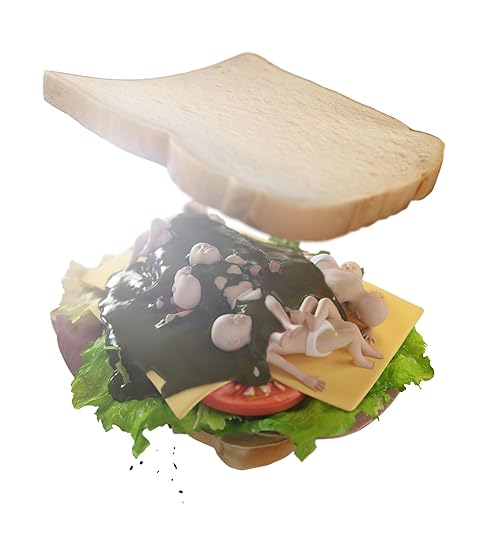
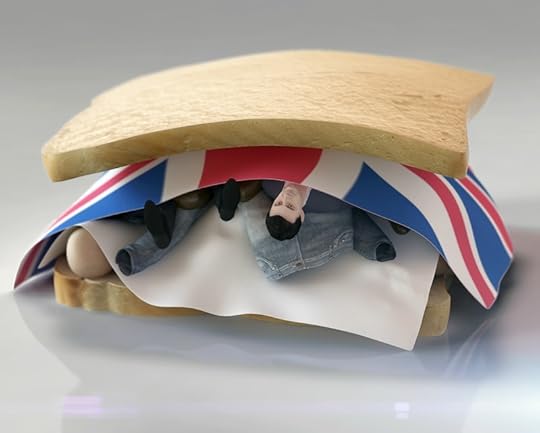
But sticking with it, keeping the pace of reading, pays off in a very strange way for the uncultured oafs like me: Bend your brain a little. Crank the handle again, spread the jalousie just a fraction more than before, and the weird, unlyrical pleasure of the writing will catch you.

Might catch you. Could catch you. Let it catch you.

And did anyone who's read a significant portion of my over seven hundred forty blogged reviews, over eighteen hundred total reviews, ever expect to hear me say that?
Profile Image for Neil.
1,007 reviews757 followers
November 21, 2019
Reading "Old Food" is a very confusing and disorienting experience. It is very short but it took me far longer to read than I imagined it would because the only way I could get a kind of sense out of it was to read it out loud. Once I started to do that, images and impressions started to form in my mind’s eye: nothing concrete, nothing definite, but a sense of something (although I am still not completely sure what!).

I think for anyone planning to read this book, it is very good advice to spend some time beforehand looking at material on the Internet about Atkins' "Old Food" show (the temptation to crack a joke about a new Atkins diet is getting too strong, so I’ll get it over and done with now). Seeing some examples of the work in that show and listening to some of the interviews Atkins has given about the show is very helpful. I didn’t do it until after reading the book, but it made me feel a lot more comfortable about the fact that I didn’t really understand the book but I somehow enjoyed the experience of reading it. Although, enjoy isn’t really the right word as it is dark and melancholic.

Atkins says in one interview I listened to that there are one or two events in his show but it is mostly ambient. This "mostly ambient" is a good description of the narrative in the book. There is no obvious storyline or plot. At one point in an interview, Atkins says of his show, "There is something missing but we are not entirely sure what. It is almost as if this show is taking place after something."

Hearing that last quote made me want to go back and re-read the book because it summed up what I had felt but until that point had not been able to express. It sounds obvious now, of course, but until I heard Atkins say it, it eluded me.

Here’s another quote from a video interview that I have attempted to transcribe. It's not word for word, but I think I’ve got the gist of it:

"If you go onto this show sort of thinking (about it) through theatre or something that is one experience, or cinema, or sculpture, or painting - all of these things lend you a lens to look at the work. And for me the preeminent lens is literature, so more often than not I'm thinking about things through a kind of literary mode - so figuration and literality and also a kind of grammar: I think I tend to push towards a grammatical understanding … or poetic, more lyrical, in fact."

And this is a largely poetic book. Lots of the sentences don’t make sense when taken on their own. In fact, that could also be said about paragraphs. But, like poetry often does, the overall narrative creates an impression. At times it feels like we are reading some kind of post-apocalyptic narrative, but at other times it feels more like someone’s nightmare that is very much grounded in our modern world.

Atkins has been described as "one of the most distinctive representatives of a generation of artists explicitly responding to digital media’s ever-increasing ubiquity."

I’m not sure it is a good idea to read this book in isolation from the exhibition that inspired it. Most of us won’t be able to ever see that exhibition, but thanks to the Internet and the digital media to which Atkins is responding, we can learn about it and view samples of it. I think any reader of this book should do that.

This book will not be to everyone’s taste. You have to be the kind of person who doesn’t require a book to make sense, who is happy with an overall impression rather than with detail, who is willing to let the author take you on a journey to an unknown destination with an awareness that that destination might not be a place you can describe to another person even after you have been there.

If that sounds like fun, this is the book for you.
Profile Image for Tommi.
243 reviews149 followers
February 29, 2020
Update, 29 Feb 2020: Attended Ed Atkins’ performance at the Museum of Contemporary Art Kiasma, where the author read aloud the whole of Old Food in front of a surprisingly big audience. (I followed the text from my copy throughout, so technically I’ve now read it twice.) The reading took approximately 2 hours including his occasional singing. A very interesting experience that strengthened my appreciation of the book, especially its auditory nature.

Original review: [3.5] Ed Atkins’ latest collection of words, flouting categories just as A Primer for Cadavers did, deals with things dietary and digestive. Written in blurts while the Old Food exhibition was running in various European locales, it consists of a highly associative text that eludes meaning in the normal sense. It is relentlessly assonant and alliterative as though the sounds of the words lead Atkins forward: the narrator reminisces the more or less edible food he has eaten (especially when together with someone called Hannah), listing ingredients…

Broad beans and peas and sweet marjoram, sage, lavender, costmary, mint, clary, sorrel, savory, parsley, fennel, basil, borage, orach, hyssop, some houseleeks. Spinach, cabbages, cole, lettuce, gourds, beets, vines, raspberries, gooseberries, violets, gillyflowers, peonies um dragonwort, lilies, and roses.

In conjunction with this phonetic reliance, a defining feature of the text is its colloquial feel, evident in the occasional “um” as seen in the passage above. The narrator recounts past events, always in the past tense, ostensibly not sure what he’s saying, often misplacing the article “an” before a noun beginning with a consonant (“an possession”). Furthermore, there are impulsive line breaks, perhaps suggesting a pause or hesitation in the narration; yet what remains certain is that all of this is just my own conjecture. Meaning-making is largely dependent on whatever these words connote to the reader. The book eschews narrative and favors impressions.

If, however, the reader cares about authorial intent, I recommend watching a short video where Atkins discusses the exhibition, and perhaps taking a peek at the actual CGI-animated artwork. Interested in representation, and food being one of the least digital things he can think of, he is clearly preoccupied with the ways artists can represent something as physical as food, and how they always to some extent fail at mimesis. Thanks to its shorter length, Old Food is easier to approach than the much denser earlier collection of similar pseudo-prose, and at its best it is an effective catalyst for kaleidoscopic imagery, and certainly a goldmine of vocabulary.
Profile Image for Paul Fulcher.
Author 2 books1,953 followers
December 9, 2020
Ed Atkins is a contemporary artist who works with video and text.

His Old Food exhibition in 2017-8 consisted, in his words, of "eight and then nine videos; anywhere between eight hundred and a few thousand costumes sourced from opera houses and theatres; and a series of enigmatic wall texts written by Contemporary Art Writing Daily and laser-etched onto locally-sourced garbage wood". Reviews and overviews of the exhibition include:

https://artviewer.org/ed-atkins-at-ca...
https://frieze.com/article/though-it-...
https://www.sleek-mag.com/article/ed-...


description

This text, was written during and afterwards as a verbal response to the visual art and published by perhaps the UK's foremost publisher, Fitzcarraldo Editions.

I struggled to gain a foothold with Atkins previous written work, A Primer for Cadavers, in part as it spanned multiple sources. Here the shorter and more focused format helped.

Old Food opens:

Spring finds medium son just on the floor. Looks maybe six? evil, holds the red plastic-handled table knife in a small right fist, fishes a slice from the open bag of bad bread with a left.

Crumb-stuck margarine blouses with the draw of the knife’s few dull serrations. Excess margarine skimmed against the rim of the tub. Margarine also stuck in a different manner to the underside of the blue foil peel, also. There is no margarine at all on the lid of the tub that rests against one um grey sock, looking perfect, plastic, the lid. Margarine also dark marls grey sock. Grey sock’s cuff ’s elastic unambiguously resigned, wilting round the blub edge of a pair of nice slippers. Untucked beige polyester short-sleeve also with margarine fat seep tabbing, also. Lax brown cords’ shot waistband frayed low. Slight merry muffin-top mini debouch? An ease of flesh into the room.

Lighting is palpably dawning. Motes and amber digits depend on young blue air. All the visible skin would shone with marge fat and the floor is a ghastly rink with it in the corner a whole family, their horse and worse.

What’s at stake with the sandwich?, to a crush of neighbours jostling for gratis crackling. Allegories used to be clear and dogmatic as baby’s beer. Foaming teats sopped in The People’s bra.


and carries on in that vein for 100 pages. At its best it was reminiscent of David Hayden's prose, Eley Williams's Fears and Confessions of an Ortolan Chef and the lyrics of At The Drive In (https://www.youtube.com/watch?v=UgAkZ...).

My favourite passage - although set in Summer, rather reminiscent of a office Christmas lunch:

An informal lunch of pot-roast pheasant, swum over with loaded, swarthy prunes and a plausible Armagnac; dry mash, weak cabbage.  Sirs got racy in the dining room. Urns of mulled wine kept wassailers blasted and tuneless till red bowls of bread pudding calmed with a thin Dairylea weep, surrendered sultanas and frangible moments of crystallised sugar roofing.  We’d load long white clay pipes with thatched of a dark shag threaded with Mike’s lenient hash dispensed from a panel of vinyl’s cardboard, cheap jigsawed heraldry, and a smoking hemp cord, wearing flat, white, charmless masks of I think hide.  Ducked out through an open sash on the south side and sprinting across the dewed lawn.  We’d exit civility and re-enter the feral and humid and tidal-smoothed, crudded with red earth, blue woad, lucked toad backs and whole proffer adder peel, shrilling in a blackened pan of raw butter, sod fire puked acrid plumes attacked the bridge between the nasal bit and throat.

2.5 stars
Profile Image for peg.
338 reviews6 followers
September 12, 2020
I am reading through the Goodreads list of eligible books for the 2020 Goldsmiths Prize. https://www.gold.ac.uk/goldsmiths-prize/ This prize seeks to reward “creative daring and fiction that breaks the mould or extends the possibilities of the novel form” The shortlist of 6 books will be announced on Sept 30. Let’s see how many of them I can have read in advance!

I ended up loving this book which at first glance seemed unapproachable! When I opened it up and saw that it looked like free verse poetry on the page I decided to read more ABOUT it, which I usually refrain from doing with a new book. I learned that it started out as an exhibition of videos created by the author Ed Atkins, watched several videos of him talking and saw some stills from the exhibition, including the S—- SANDWICH!

I Read several excellent reviews here on GR and decided to take the advice of Neil and just read it aloud to myself, since there was no chance of hearing it read by the author as another reviewer was able to do. This method worked fantastically....I was completely immersed through the 124 pages and was able to almost see the many images of food and the process of eating it, along with other unexpected fantasy type scenes that propelled the vague storyline.

A warning that the reader needs an “asbestos constitution” to stomach some of the scenes, such as when the narrator describes “eating your dad” on p.29 or “exzematous hotdogs” on p.35. I had to look up many of the substances, perhaps because I speak American English rather than British, but was able to learn many kinds of cheeses that the characters always seemed to have on hand.

I really think this might be a good fit for the Goldsmiths prizelist. It certainly has many of the listed characteristics they are looking for such as “creative daring and “breaking the mould”!

My rating on the chance of this book making the shortlist....8/10

Profile Image for Emmeline.
439 reviews
December 18, 2019
A book apparently intended to accompany, or at least complement, an exhibition of the same name. I spent an afternoon reading a few articles about the exhibition, which sounded fairly interesting but which (shocking I know in modern art) did not seem to have anything to do with food. This wouldn’t be noteworthy except that the book is – almost exclusively – about food.

The nearly-impenetrable blurb on the back cover hints that it may also be “a hard Brexit, wadded with historicity, melancholy and a bravura kind of stupidity.” As well as “a profound nowt, delivered in some spent afterwards.”

After that, the text is surprisingly readable, a kind of dazed stream of consciousness canter through descriptions of frequently revolting food and related bodily functions. There is no plot to speak of, very little character to speak of, little evolution to speak of.

I grumbled to myself about nepotism (the acknowledgements make me suspect there were perhaps a few literary influencer types who caused this to get published by Fitzcarraldo). Yet I can’t say this is an entirely bad book. It’s hard to know what it’s about, but it does, in its raging and teeth-gnashing, seem to be about something. And Atkins writes well. I have translated many, many artists’ statements, and believe that artists who write well are a rare breed. The prose is visceral and surprising.

Ultimately I have to admit it wasn’t for me. I don’t mind difficult literature but I have less patience with difficult art (a personal failing I suppose). I would have liked it more, I suspect, if an editor had taken it firmly in hand. And I admit to skipping pages towards the end, unwilling to subject myself to some of the gruesome, if well written, descriptions.

I have to say that I was charmed by Atkins himself in videos where he talks about his work, and I feel churlish not rating this higher. It's more of a 2.5 for me but I appreciate his talent while remaining convinced that this is a very niche-market book, and I am not that niche.
Profile Image for Bob Jacobs.
360 reviews31 followers
July 24, 2025
De eerste dertig pagina’s was ik echt niet mee, opnieuw begonnen en gelukkig bleek het dan wel te lukken. Old Food is op de meest bizarre manier echt breekbaar schoon. Tip: ‘luidop’ lezen!
Profile Image for michal k-c.
894 reviews121 followers
October 16, 2022
makes perfect sense that this grew out of a Berlin art exhibition, make of that what you will. but it is always important to expand our definitions of what fiction is // looks like
Profile Image for ⏺.
150 reviews21 followers
December 17, 2019
Old Food reads as the culinary history of a civilisation. It’s of course absurdist and cumulative, but an easier work to deal with than A Primer for Cadavers for sure.

The protagonist rambles on and on about what they did “that summer” or at “11pm, the night before winter solstice” or “In June 2009”, with equal parts remembering and forgetting. Many tropes of narrative are employed (like the recurring character Hannah, which makes little sense but is an easy landmark to hold tight to while getting more and more lost in bogs of expired and liquefied ingredients), but the end result is more like a stream of consciousness mixing different times with no continuity and a faint direction. It is actually a lot of fun. And quite elegiac somehow, with a sense of post-apocalyptic nostalgia pervading everything.

Every page of this small book has at least a description of food or meals, ranging from deeply questionable to nauseating; plenty of recipe ideas tho – I’ll for sure try the sandwiches with “blue margarine, time boiled ox tongue and white sauce and sweet romaine and the top bit margarined too.” Or not.

Check out his brilliant video work if you can. There’s sandwiches there, too.

Old Food
Profile Image for Heather.
Author 20 books233 followers
December 9, 2019
This won’t be to the taste of most people (please pardon that phrasing, if you’ve read the book) but I loved it; a meandering, characterless immediate expression of the visceral nature of food, of flesh as meat, of self-consumption and satisfaction. The blurb is ludicrously pretentious and perhaps so is the book itself but it gets away with it, being something of a cross between Gertrude Stein’s Tender Buttons and a very truncated version of Finnegan’s Wake. If you are here for the weird, you might love it.
Profile Image for Arno Vlierberghe.
Author 10 books137 followers
May 27, 2025
"We'd join cults, I think, in our sleep. We would join death cults in our sleep that had flamboyant leaders and silver tureens spotlit in apses and the charismatic leaders with daddy's face would solemnly give out really quite generous portions of delicious Cullen skink or maybe caldo verde right into our imploring faces and we should be grateful for it."
Profile Image for channel .
36 reviews7 followers
August 23, 2022
i think this might be unambiguously 'better written' than a primer for cadavers, and def shows success in a linguistic/perceptual evolution it seemed like he was struggling to entirely find during primer, but i guess despite being fascinating to watch how hes making language do this kind of meditative vertical endless preparation/contextualization/consumption that you are given occasional air from & finding yourself within genuinely jarring contexts, nothing hit me as hard as "or tears of course" "hammering the bars" "performance capture" etc
Profile Image for Zak .
204 reviews16 followers
December 10, 2021
Forty pages in... I stopped. So, I didnt read it in full, and didn't so much like it either. Why waste precious time on trying to finish a book, when it feels a battle or a chore. Nah.

Pass on this one. It isn't as clever and bold as its blurbers have made it out to be.

There is great art in experimentation and stupidity, in literature, in life, film, and various mediums of art, I should know as a writer of such things, but this didn't have a rhythm nor a style that is easy nor engaging enough to hold you for 130 odd pages.

Just wasn't my cuppa. Surprisingly...this didn't work for me.
2 reviews
September 17, 2022
Wow absolutely gobsmacked with this delightful and tasteful but disgustingly witty book. Hitting you from all angles with me almost wanting to give up and call quits on it. So glad I carried on to read through this mysterious writing by Ed Aktins just like his visual work it punches and splashes you with gentle humour thanks for giving me something to think about.
Profile Image for Adrian Alvarez.
573 reviews51 followers
December 6, 2019
A quote from Georges Bataille on the first page sets a tone and expectation for this work that frames Atkins' perspective and establishes his attitude. I'm willing to take an artistic vision on its own terms but here what I thought was a run up to Bataille's charge at establishment values was maybe just excusing the absence of narrative as "the accursed share." Perhaps this is what Atkins was alluding to in his interview at Berliner Festspiel when he said, describing Old Food, "...and I suppose, as ever, with so much of my work, it's kind of about what's not there - is never there - in these digital videos: is real people and real bodies."

So much for literature, the preeminent lens...

While Atkins suggests he is interested in figurations of lyrical grammar what resulted in Old Food were more like the words of insubstantial nutritional value described at the back end of the poem - near meaningless utterances without a congruent trajectory. It sounds pretty aloud but Bruno Schulz this is not. There is no warmth. No life. No generosity. No hope. There are no people.

So while this piece might be intellectually provocative it didn't strike me as very profound. Sure, riffing on the abstract outlines of sentence structure and Lacanian signifiers using a title as an origin and organizing motif is sort of cool... but why though? The Aristocrats joke does a similar thing with its title and content and I have to say it is more effectively meaningful than this. Our preeminent lens, in case he hasn't noticed, tends to ask AND answer questions. So as far as depositing a work of art into a context that might act as a unifying springboard I think Old Food needed more rigor.

In his own words:

"Like so much of it, it has that kind of - that thrill of a kind of unpacking something into a metaphoric, you know, meaning."

No, Ed, I don't know, but it's good to hear you enjoyed yourself.

Here's my hot take: scrap this printing and reissue the piece as a full color oversized cookbook. Hannah's Recipes. Charge $5,000 per copy.
Profile Image for Hugo L.B.
46 reviews
August 12, 2024
Old Food is literature as artistic exercise. Old Food is in the best and worst spirits of Beckett at times. Old Food is a wield of language, a bending and fabricating of it that succeeds in spats and disorientates in an almost permeable reliability.

"Off of the land and the broken backs of newer surfs. We became happy brutes."

"We ingested things from the outside when we could we took in strangers also into our bodies. We practiced a profane Grace."
97 reviews4 followers
December 8, 2019
A poem? A prose poem? Arranged text? Certainly, this book’s focus is food and its consequences: bodily functions, relationships, food - in lists, a recipe, an exhibition piece linked to Ed Atkins’ art. I devoured it in one gulp but I feel I will reorder this menu item - seconds - and read it again.
Profile Image for sisterimapoet.
1,299 reviews21 followers
May 29, 2020
I'm not really sure what this book was trying to be, and therefore how I was meant to read it. But I think probably it's meant to be whatever the reader wants it to be. And I read it as an extended prose poem and it worked – unsettling and unpleasant as it was. Sensory overload at many times, and being pulled between hunger and revulsion made for quite a powerful read.
Profile Image for Andrea Barlien.
293 reviews11 followers
November 26, 2019
This is not an easy read but it is an interesting one. It switches between prose and verse and the beautiful and the grotesque. It’s an anomaly. I can’t say I ‘enjoyed’ it but I sure as heck appreciated it.
Profile Image for Zach Werbalowsky.
403 reviews5 followers
Read
January 14, 2025
won't rate, its interesting and has a ugly style which i enjoyed but the act of reading it was alright but the act of digesting it was alright but the act of tasting it i didnt care for but maybe there is some value there well ta ta for now.
Profile Image for Jared Joseph.
Author 13 books39 followers
March 11, 2025
There used to be justice rather than
I don't know chocolate eggs. There
used to be rallying cries'd rather than
just a rich man suppressing belches at
you. There used to be an unopened
box and an open front door.
36 reviews
December 19, 2020
I got this book as part of a subscription, it’s not for me.
Profile Image for Almog Cohen-Kashi.
3 reviews
Read
August 4, 2021
This book demands you read it in one sitting with a drink by your side so you can take a sip in celebration after you finish the last page.
Profile Image for Martyna.
748 reviews57 followers
July 17, 2022
cudowna, dziwna, dystopijna, obrzydliwa, pyszna
Profile Image for Lindsey King.
47 reviews17 followers
January 24, 2023
A lyrical goulash of glitter and litter spoken rather than written by one manic gastronome.
96 reviews
Read
July 17, 2023
Totally insane but surprisingly cogent. Feel like it must centre around the pun on 'et,' food forging connections both social and conceptual, an organising principle. Will definitely reread soon.
Profile Image for jo.
82 reviews
January 6, 2025
The oddest and most lyrical monologue - sometimes self-indulgent but does a good job of describing halloumi ('salty, squeaky erasers')
Displaying 1 - 29 of 29 reviews

Can't find what you're looking for?

Get help and learn more about the design.