Where do poems come from? This beautiful picture book about a young aspiring poet and his grandfather shows that the answer lies all around us--if we take the time to look.
After Kiyoshi watches his grandfather, Eto, compose his delicate haiku, he wonders out loud: Where do poems come from? His grandfather answers by taking him on a walk through their city, where they see a cat perched on a hill of oranges; hear the fluttering of wings; imagine what's behind a tall wall; and discuss their walk, with each incident inspiring a wonderful new haiku from Eto. As Kiyoshi discovers that poems come from the way the world outside of us meets the world within each of us, he also finds the courage to write a haiku of his own. This lovely book will speak to any reader who treasures poetry, city life, grandparents, or the beauty of the everyday.
Mark Karlins is the author of six picture books, two books of poetry for adults, and a number of reviews and essays. he also teaches the writing and appreciation of poetry to children and adults. Mark and his wife live in the mountains near Santa Fe, New Mexico, where they savor the sounds of mourning doves, ravens, and coyotes.
We are almost to April and Poetry Month, so I am starting early with this recently released picture book. Kiyoshi admires his grandfather's poetry. How does one write a poem? asks Kiyoshi. Grandfather puts away his paper and fountain pen to take Kiyoshi for a walk. As they spend time outside, Kiyoshi realizes that poems come from seeing, listening, imagination, and feelings. I loved the many haikus that are inspired as they go on their walk. Kiyoshi shares one of his own at the end of the day:
In the cool spring night The wind's dance makes me shiver. Your voice keeps me warm.
Perhaps this book can inspire you to play a game of renga in which two or more people write linked poems. Happy National Poetry Month!
Kiyoshi admires his grandfather's poetry. How does one write a poem? asks Kiyoshi. Grandfather puts away his paper and fountain pen to take Kiyoshi for a walk. As they spend time outside, Kiyoshi realizes that poems come from seeing, listening, imagination, and feelings. I loved the many haikus that are inspired as they go on their walk. Kiyoshi shares one of his own at the end of the day:
In the cool spring night The wind's dance makes me shiver. Your voice keeps me warm.
Perhaps this book can inspire you to play a game of renga in which two or more people write linked poems. Happy National Poetry Month! *Review by Darla from Red Bridge*
I love the bridge between grandchild and grandparent that this book uses as a vehicle to discuss poetry - specifically, haiku poetry. How is it done, grandfather? Where does it come from? One little walk was all it took to answer the question.
My group, who'd had experience with writing their own haikus, were interested, but seemed pretty sure that their world might not be as exciting as the town in the book. We further discussed.
Kiyoshi’s Walk is about a young Asian-American boy who watches as his grandfather meticulously writes a poem in Japanese. As he is watching, Kiyoshi asks his grandfather, “Where do poems come from?” Rather than telling Kiyoshi directly, Eto, Kiyoshi’s grandfather, takes Kiyoshi on a walk. Along the walk, Eto teaches Kiyoshi about poems through haikus, Japanese poems that do not rhyme and contain about seventeen syllables. Along the walk, Kiyoshi realizes that poems come from sight, sound, imagination, feelings– the world around us. Most importantly, Kiyoshi learns that poems come from your heart. This book introduces readers to the Japanese poem and also encourages the reader to look around them; inspiration is everywhere.
This poetry book is a great book to use with any Kindergarten through third grade class. It is not only multicultural, but also a great way to introduce poetry, specifically haiku’s. For third grade classrooms, teachers can have students write their own haiku. Teacher’s can take students around the school or outside to gain inspiration for their haiku. For the younger grades, students can practice identifying syllables by using the haiku poems the Eto writes.
A content area that teachers can incorporate is science or social studies. Students can write a haiku about a science phenomena that they are learning about in class. They can also write a haiku or poem about a social studies topic they are learning about or a historical figure.
Where do poems come from? A beautiful picture book that shows that the inspiration for poetry comes from the blending of the world that surrounds us and the thoughts and feelings that lie within us.
Poetry form is haiku, including informative back matter for readers.
A wonderful inter-generational story about writing poetry.
Kiyoshi watches as his grandfather paints a haiku poem he has written. Kiyoshi asks him where he draws his inspiration from, so his grandfather takes him for a walk in their community, composing poems as they walk. When they return home, Kiyoshi composes his first haiku.
Karlins does a beautiful job of telling this quiet, understated story. There is no drama - there doesn't need to to be. Just a grandfather and his grandson out for a walk together to enjoy being together and subtly teaching him how to write haiku.
Illustrations (created on iPad using Procreate) by Nicole Wong are stunning. The boy and his grandfather are shown in a vibrant, diverse English-speaking community. It is difficult to pinpoint exactly where this story takes place. It does not appear to happen in an inner city or a suburban area; the apartments and city buildings all appear to be modern/recently built (based on their styling and use of paint colors), the landscape of flowering trees (pink and white) appear to be young (small caliper and compact), and the wide open park is devoid of mature trees and shrubbery. While not a problem, it would be helpful for readers to relate. There is, however, an error on the first 2-page spread with text. The grandfather is writing on the paper this incorrectly; Japanese is written from, top to bottom and right to left. The image shows him writing top to bottom, but left to right (his brush is touching the last symbol of hiragana. (I am waiting on a query to a translator to see what is written on the page is, indeed, the text of his poem or if it is gibberish.)
This would be excellent to use when starting a unit on/talking about poetry during National Poetry Month in April - or anytime! Also include in units on family and diverse neighborhoods.
Kiyoshi’s grandfather Eto is a poet who writes poetry with brush and ink. Kiyoshi wishes that he could write poems too. When he asks his grandfather where poems come from, the two set off on a walk in their neighborhood. At the corner store, they see a cat on a pile of oranges. Eto stopped and wrote a poem about what happened when the oranges toppled, inspired by what they saw. The two hear pigeons flying above them, inspiring the next poem from what they heard. After seeing an abandoned teddy bear, Eto writes a poem about how it got there and how it feels, all from his imagination. The two reach the river together where Eto writes one last poem of the day, capturing his feelings. Now it is Kiyoshi’s turn to figure out that poems come from our surroundings and how that touches what is in our hearts. He’s ready to write his first poem.
Karlins has created a touching story of the connection between grandson and grandfather. The story is gentle and focused on finding poems throughout their day together. The book clearly shows how heart and imagination meet inspiring moments in life to create art, whether it is poetry, prose, music or art. Throughout the book, Eto treats Kiyoshi as an equal, gently showing him how he works and allowing Kiyoshi to also discover on his own.
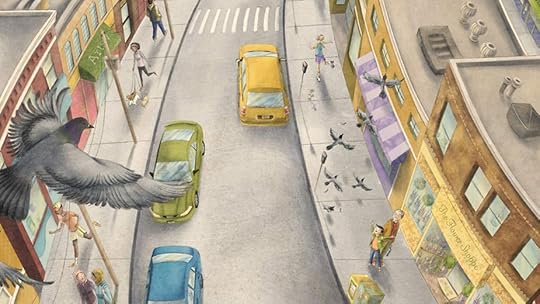
The luminous art was done digitally. It evokes the warmth of colored pencil on the page. The fine details work well in showing the vibrant and changing urban setting they live in. The color palette changes as they walk, ending with the setting sun reflected in deep colors in the river.
Full of inspiration, poetry and connection. Appropriate for ages 4-6.
Mark Karlin's book, Kiyoshi’s Walk, follows a young boy on a walk with his grandfather in an attempt to explain where poems come from. The story begins with Kiyoshi, the young boy, and his grandfather, the wise poet Eto, sitting at a table writing poetry when Kiyoshi asks, “where do poems come from?”. Eto then takes his grandson on a walk around town and begins writing haikus inspired by his surroundings. Kiyoshi notes that his grandfather writes poems based on things he sees, hears, imagines, and feels, eventually getting inspired to write his own haiku at the end of the book. This book is full of many wonderful illustrations that engage readers as well as many haikus embedded in the text to easily introduce readers to the poetry that originated in Japan. The text also features a final page that explains the structure and meaning of haikus which could be helpful for teachers.
This picture book is a poetry book best suited for K-2 students and is a great text to use as a read-aloud text when introducing haikus to young students. I like this book because of its colorful and well-thought-out illustrations that quickly catch any reader’s eye. The book also explains what inspires haikus well and in the language of a young reader, making it easy for lower elementary readers to understand. This book could be used as a great introduction to poetry for students as it holds many examples of haikus for students to take inspiration from. The book could also be used to lead a discussion on how illustrations support texts, noting the details in each picture shown in the book and how they help illustrate the poems written by Eto and Kiyoshi.
This beautifully understated story answers the questions many of us have about the origins of poems. After seeing his grandfather craft yet another poem, Kiyoshi wonders about where poems come from, and his grandfather decides to show him by talking a walk in their neighborhood. As they pass by various scenes, Eto [Kiyoshi's grandfather] pauses and writes a poem. He seems to do this effortlessly, and when Kiyoshi shares his ideas about how poems come from seeing, listening, imagining, and feeling, the elderly man remains quiet as the two of them sit with their thoughts. Eventually, he acknowledges what inspires poetry, and as they head home, Kiyoshi reflects on this simple but astounding fact: "And in everything there was a poem: the faces of the people, the sound of the river, the moon breaking from the clouds" (unpaged). The fact that Kiyoshi finally writes a haiku demonstrates that this lesson has been valuable and that this might have been one of the most important nights of his life. The comfortable way the boy and the man are able to be together, not chattering but simply BEING, two very different generations but linked through a love for words and poetry, is evoked by the text but also in the softly-colored illustrations, delicately rendered with Procreate. A note from the author discusses poetry and provides background on haiku. Writing teachers will want to add this picture book to their collection as one answer to the question so many would-be poets ask as well as possible inspiration for writers.
Kiyoshi watches his grandfather Eto write a poem. Inquisitive Kiyoshi asks him where his poem comes from. Eto asks him to go with him for a walk. On their way, they see something, and immediately Eto writes poetry about it. He does the same thing when he hears birds. He does it for everything that happens around him. But Kiyoshi finds out an answer to his question? We picked this book based on a recommendation. Where do poems come from? Where does any imagination originate? Kyoshi's grandfather finds a beautiful way to answer that question. Children will love this walk. As an adult, one can easily resonate with questioning as a child and grandparents finding a memorable way to answer. The illustrations are charming.
Creativity starts with nurturing curiosity, and Kiyoshi's Walk by Mark Karlins, beautifully illustrated by Nicole Wong, does precisely that with little Kiyoshi's and Eto's simple yet powerful story. Read the full review at Nothing But Picture Books
After watching his grandfather write haiku, Kiyoshi wonders where poetry comes from. As they stroll through their neighborhood, his grandfather composes a haiku, teaching Kiyoshi that poetry can be found in every moment and everything.
Kiyoshi's Walk explores creativity, the bond between generations, power of poetry to capture experiences and taking the time to appreciate the world around us.
Discussion Questions 1. How does Kiyoshi's understanding of poetry change throughout their walk? 2. Discuss how the relationship between Kiyoshi and his grandfather contributes to the story. 3. The book shows that poetry can be found in everyday moments. Can you think of a mundane moment that could be described poetically? 4. How does the setting of the city contribute to the story and the discovery of poetry? What unique aspects of their environment do Kiyoshi and his grandfather notice? 5. The story uses haiku to express observations and feelings. Why do you think the author chose haiku as the form of poetry for Kiyoshi and his grandfather to explore? 6. How does creating something, like a poem, help us understand our feelings or the world around us? 7. How does paying close attention to their surroundings help the characters create poetry?
Kiyoshi’s Walk is a poetry book which illustrates how the main characters grandfather finds poetry in everyday life. As Kiyoshi spends time with his grandfather, he discovers he can create poetry from listening, seeing, imagining, smelling, and feeling. I personally felt emerged into the literature when reading this book because of the detailed description of the scenery and the beautiful illustrations. Kiyoshi’s Walk is the perfect book as a read aloud is grades K-5 to introduce Haiku poetry. This book is best used for introducing the format of a Haiku poem in grades third through fifth. Specifically, I would ask students to observe similarities in each Haiku poem before giving them a template to write their own Haiku poems. Another wonderful benefit of using Kiyoshi’s Walk as a read aloud is the inspiration it provides students with. As you read the book with students point out how Kiyoshi’s grandfather can find poetry in any environment and from any feeling to help guide them in writing their own poetry. I recommend this book be included in your K-5 classroom for both the representation of the Asian population and the exposure to poetry.
It's hard not to love a book that tells where a poem comes from. For me, it's a wonderful book that takes a walk through a city when not only can I focus on the main characters, this time Kiyoshi and his wise poet grandfather, Eto, but see all those in the buildings' windows. There are cats and dogs, a parent and child, a bird peeking in, a flower pot. Kiyoshi watches his grandfather create a poem with pen and ink, then asks about poems. They take a walk, stop by a grocery where Eto smells the oranges, then writes "Hill of orange suns./Cat leaps. Oranges tumble./The cat licks his paw." while Kiyoshi, puzzled, asks: "Does that mean poems come from seeing things?" Their walk continues in thoughtful ways, with a heartwarming end. Beautiful brief words by Mark Karlins illuminated by Nicole Wong make a wonderful book. Perhaps readers will wish to take their own walks to find a poem or two?
I am so close to giving this 5 stars. I really did like this book. It's like Haikou, it's quiet and simple and deep.
We see a grandfather and grandson together and the grandfather is writing a Haikou. The kid asks "Where to poems come from?"
So, the grandfather doesn't tell him, they go for a walk. They see life all around them and the old man constructs a poem on the spot about a flower in the sidewalk. The boy learns poems come from the world around us. The boy is sad and reflective and they create a poem about them. So poems also come from inside us.
The simplicity of the story is so clear and bright. It's the best explanation of poetry I've seen. So well done.
The artwork is all digital and the pages are very glossy. I love it. It's beautiful. The city feels alive and we see how the poems are crafted out of life. Lots of color and city feel. Wonderful, just wonderful.
Anyone who loves poetry or has been in awe of their grandparent’s wisdom will love this book. Kiyoshi wants to learn to write poetry like his grandfather Eto. Eto takes Kiyoshi on a walk to show him where poems come from. They find inspiration at the market, on the sidewalk, in an old empty house, and at a pond. Kiyoshi learns that poetry comes from the meeting of the world and his heart. If you or your grandparent is a writer, or if you marvel at the way writers’ capture the world in words, this is a great choice.
For my more books about grandparents, check outmy post
For many more book recommendations for kids and parents, check out my blog: Golden Ginkgo Books
A "nice" book. It's got a friendly introduction to making poetry, and to haiku in particular, and that aspect is great. However, it's stuck in the "wise old person that young kid is magnetically attracted to" world of books, and it never feels authentic as a result (even as a person who regularly enjoys hearing stories from elders). The story feels a bit dull as another "Tell me how the world REALLY works, grandpa" (and then grandpa's conclusions are accepted as infallible fact with extremely limited investigation) story, especially when it's something so exploratory.
The artwork serves its purpose, but is similarly unimaginative in its presentation.
A fine entry for encouraging poetry writing from students, but otherwise lacking.
Kiyoshi longs to write poems of his own as his watches his grandfather Eto write haiku. His grandfather takes him on a walk, and as they walk, his grandfather takes inspiration from the world around them and creates verses. The walk closes with Eto creating a haiku of his own. One of my favorite aspects of this book is the gentle pace of the narrative. The grandfather and grandson spend the entire day together walking, not running, not shuttling from one activity to the next, just enjoying each other. The illustrations are colorful and detailed; they show the charm and beauty of an idealized version of New York City and convey the warmth between grandfather and grandson. I love this book!
"Where do poems come from?" Kiyoshi asks his poet grandfather. The grandfather leads his grandson through the city, pausing at ordinary things, absorbing what is around them, and writing charming haiku as they walk.
Kiyoshi quickly learns that poems come from observing and from the heart and creates a poem of his own. Perhaps the child is too quickly wise but I didn't mind. The illustrations are lovely and the gentle reminder to treasure all the small moments around us is beautifully done.
This would be a great choice to use in a classroom as an introduction to haiku or poetry in general.
I received an electronic ARC from Lee & Low Books through Edelweiss+. Beautiful illustrations capture the beauty surrounding this day that Kiyoshi spends with his grandfather, Eto. He wants to learn where poems come from so Eto walks with him and creates poems along the way. Readers see the scene and read the poems just like Kiyoshi. The entire day is caught in the poetry including their special relationship. Terrific to introduce the Haiku style and to show how many feelings/experiences can be shared through poetry.
"Where do poems come from?" asks Kiyoshi. We see Grandfather paint a poem with brush and ink using Japanese characters. We get to read wonderful haiku poetry throughout the book.
The dripping facet Takes me back to my old home. Rainrops on frog pond.
The digital illustration is superb, to my taste. The characters are expressive, the colors engaging, and the details enliven the story. I also like bringing in the community and everyday life on their walk. Through their walk, we encounter the sources of poetry all around.
Where do poems come from? In this picture book a simple question from a grandchild to his grandfather, becomes a glorious focus on small moments in our lives. Illustrated beautifully by Nicole Wong, this is likely to be a popular book for teachers, especially in April: Poetry Month.
Mark Karlins offers a great author's note to explain a bit of history of Haiku.
A very worthwhile addition to a library serving young children.
A book that answers the question, "Where do poems come from?"
A good intro to poetry for younger readers, distilled into mini-lessons a grandfather shares with his grandson, Kiyoshi: Poems come from seeing things. You find poems by listening. Poems come from your imagination. Our feelings also make poems. Poems come from the way the world and our heart come together.
Setting: urban city Themes: poetry, writing, family
A young boy has a grandfather who writes beautiful poetry and wants to know not only how he writes the poems but where he gets his ideas. The grandfather takes him on a walk around the neighborhood and teaches him how to learn to find inspiration in all the world around him. I loved the themes of this story and especially the focus on poetry and writing. A very clever book to introduce these ideas.
This was a neat way to explore haiku and the spirit of how they are composed as well as the idea of who gets to create/make art. A grandfather shoes his grandchild that haiku can be written just by walking around and recording what your senses observe. My 5 year old listened attentively but kept getting confused about who was talking and didn’t request the book again. Would be great in a classroom for a unit on poetry or haiku.
Kiyoshi's Walk by: Mark Karlins Illustrated by: Nicole E Wong Published by: Lee and Low Books Incorperated Pages: 32 pages Kiyoshi's walk is a great children realistic fiction picture book which does a great job of using senses to explain how poems are made. The story revolves around a boy and his grandpa taking a walk and observing what they see while turning it into poetry. This book does a really good job of explaining how to describe something simple using describing sensory words.
We're reading this to second graders during April poetry month. They have been writing haiku and as I read this book it gave me chills. It's so great at showing not telling how to write haiku. How haiku comes from a moment you want to share and remember like taking a photo but with words. It can capture the feelings and the sensory details of the moment and this moment can be shared for others to have their own recognition of a moment they have. Recommended!!
This is a really lovely book about what poetry is and how it comes to be. It shows a beautiful balance between how poems can come from both within and outside of oneself, as well as how they can explore a variety of topics ranging from emotions, observations, explorations, and desires (or even of mix of these things). The illustrations aren't anything immediately stunning, but they fit the quiet, everydayness of the story very well!
Kiyoshi's walk is a beautiful story that takes him on an adventure with his grandfather who is a poet. Where do poems come from? In this poetic masterpiece, Kiyoshi is able to find that poems come from lots of different things. I would love to use this book in my future classroom when teaching my students about poetry.
On a simple, yet inspiring walk a grandfather answers a boy's question - ‘where do poems come from?’ Whether you intend to write haiku or not, this is the perfect book to read before taking a walk. See the world through a poet’s eyes: inspiration, beauty and clues to understanding lie all around us—if we take the time to look.