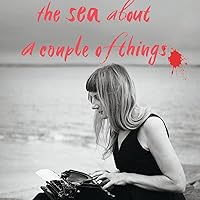
From the southern tip of Barra to the ancient stone circle of Callanish, Leonie and her friend Shuna ride off the beaten tracks on their beloved Highland ponies, Ross and Chief. In deeply poetic prose, she describes not only the beauties of the Hebridean landscape, its spare, penetrating light and its people, but also confronts the ghost of her mother and their deeply fractured relationship.
Leonie Charlton travelled extensively as a child, living in England, Africa, Wales and Scotland. She has worked as a cowgirl in Australia, an English teacher in Japan, and her degree in Hispanic Studies took her to Catalonia for two years. Marram is her first full length book although her fiction and poetry have appeared widely in magazines.
Some mother-daughter bonds are hugely strong and able to resist the traumas of all that life can through at them, others have much more traumatic relationships with their mothers, and Charlton was one of them. She took the brunt of her stepfather wrath too, as he blamed her for all sorts of things that were almost nothing to do with her. She left home at the age of 16, heading over to Australia to be a cowgirl, teaching in Japan and Catalonia to do a degree. She forged her own way in the world, but she knew she would never be safe or close to her mother again.
Marram – A coarse grass found on sandy beaches. From Old Norse maralmr, a compound of marr (“sea”) and halmr (“straw, reed”).
She had been out to the Outer Hebrides with her dad a long while ago for a fortnight’s holiday and it was a time that still meant so much to her many years later. He was a rock in her life, offering her the stability that living with her mother never gave her. Seven years after her mother had died, an act that she thought would loosen the bonds between them, she still felt the grief of her death was becoming overwhelming. What she did get from her mother that gave her some comfort was a love of horses, and in the planning for a long-distance trek through the islands of the Outer Hebrides with her friend, Shuna, she came up with the idea leaving a trail of beads as they trekked through.
Getting there with a truck and horsebox is not the easiest journey and the weather is not always the kindest as they were to find out over their two week trip from Barra all the way up to Lewis. However, it is a beautiful part of the world to travel through, and they were to be equally blasted and drenched as well as having glorious days of riding their horses, Chief and Ross. She had a small purse of beads from her mother, who was a jewellery maker. From here Charlton selects one or two beads at certain points on the journey to leave them; a bothy, on a gatepost, on the beach where the sea is just reaching and in some faerie milk holes.
My memories of her are a palimpsest like the sea-licked Lichens on the rocks at our feet, merely a thin breathing skin over the unfathomable story of the rock
I really liked this book because it is very different from a regular travel book. Several themes inhabit the prose; friendship, travel, memory, relationships, landscape and Charlton has deftly folded them together in such a way that they enhance each other, rather than one element becoming overbearing. Charlton is not relying on the natural world as a cure for her past life, rather the journey and the symbolism of placing the beads at significant points in the landscape is a release from the trauma of the past. There are moments of humour and anguish in equal measure, but mostly this is a book that is permeated with human kindness and warmth. Her evocative descriptions of the landscape that they are trekking through make this a special read too. It is one of those parts of the world that I’d love to go to when we’re allowed out again.
(3.5) In 2017, Charlton and her friend Shuna undertook a three-week pony trek through the Outer Hebrides. Like many, they worked their way south to north, starting at Barra and finishing on Lewis (we travelled in the opposite direction on our recent trip).
Although it was a low-key fundraising project for her daughter’s traditional music school, for Charlton there was another underlying reason. Her difficult mother had died of brain cancer seven years before, and she had the idea of leaving beads from her mum’s collection (she’d actually nicknamed her daughter “Beady”) along the route to lay her and their complicated relationship to rest. As one of her mother’s friends put it, “She was a nightmare, and wonderful, and totally impossible.”
I enjoyed the blend of topics – the amazing scenery, the rigours of the trail, the kindness of acquaintances and strangers who gave them places to camp and graze the ponies, and painful memories – and probably got more out of it because I was reading it on location. Her regrets about her mother formed a larger part of the book than expected, but that wasn’t a problem for me; you might steer clear if this would be triggering, though.
I loved every single bloody page in this book, what a beautiful journey Charlton has shared with us here, a journey not just across land but across her past and into her Mum’s soul. Charlton recently lost her Mum, their life together wasn’t the greatest, too much Mother/Daughter clashing and it’s not until the last weeks of her life that Charlton realised what she had been missing out on. Her Mum travelled to the Hebrides on a number of occasions, so Charlton decides to take on a journey from Barra to Lewis….and to make it that much tougher she is taking her Pony, Ross, with her.
I have to admit that I am a dog person, I’ve never understood the appeal of having a horse or a pony, you see them walking along a road looking glum and they stand in fields in all weathers looking depressed….and the ponies on the common where I work are real bullies and always chase me because this one time 5 years ago I had an apple with me. This book has changed my mind 100%, Ross is lovely fella and to read about the bond between Pony and Human was wonderful. That spark he has in his eyes really shows on these pages and it’s not until there is a chance of danger for Ross that you realise that you have started to bond with him, which is quite a remarkable experience. Whenever Charlton turns up Ross will lift his head to greet her….my dog on the other hand would never move an inch to greet me if he was comfy in his bed.
Charlton’s Mum loved to make jewellery and Charlton has taken some of her beads and stones to leave at memorable places on this trip, the intention is to create a very long piece of beaded jewellery, this is a fantastic idea and a wonderful homage to her mum.
The journey, landscape, wildlife and people made for interesting reading, the land can feel very cold and dark at times and now and then they are almost overwhelmed by the colour and beauty of the land. There was quite a mix of people too, some openly hostile and others incredibly generous, it takes a wonderful human to say “Yes you can crash at my place and the ponies are welcome too”. I don’t think this journey could have been done without the kindness of these people, a friendly smile did so much to raise their spirits. I got small issue with the book though…they ate tinned sardines….eeeeewwwww!!!
This truly is a great read and maybe one day I’ll be able to offload my kids and take a trip around the islands.
Review of Leonie Charlton’s, ‘Marram’ ––by Ali Whitelock When people ask Leonie where she is from, ‘no, where are you really from?’, it is clear on reading ‘Marram’, exactly where that place is.
This is a story of grief, of landscape, of friendship, of ponies. To say that ‘Marram’ is beautiful, is not enough. It is a work of art––tender yet profound, a deep meditation not only through the islands of Barra, Benbecula, Harris and Lewis but also through grief––written with a poet's eye and a poet's heart. What a journey Leonie take us on––through ‘aubergine’ hills, past 'roofs of peacock green and teal blue', irises a 'dense yellow', Lichen a ‘deep tourmaline'. Leonie paints the extraordinary beauty of these islands while delicately weaving profound memories of her mother and her relationship with her, into the hills, the sea, the Marram and the Machair.
Apart from the striking visual beauty, there is the sensory; the strong coffee on the camp stove I can almost smell bubbling away, the pungency of the canned sardines I can almost taste, the piquancy of tabasco sauce, crumbly oatcakes, dark chocolate, the clatter of washing pots and pans in the sea.
As a Scot living in Australia, I feel a much missed nip in the Scottish air as I read,
‘The tent was up … we put more wood on the fire … I picked up the half bottle of Jura Superstition and poured another peaty dram. The north-westerly breeze lifted ash and smoke from the fire. Gulls called as they fed off the sea coming in over the warm sand.’
Leonie’s relationship with her mother was difficult. Leonie takes a purse of her mother’s precious beads on the journey with her, intent on leaving each bead in carefully chosen spots in the landscape, a way of laying to rest the past and we are privy to the heart wrenching conversation she has with herself about her regrets,
‘I wish I’d gone in for cups of tea, I wish I’d taken her to eat mussels on the pier in Oban that sunny April day, I wish I’d gone in to talk to the surgeon with her, …’
The nuances of Leonie’s grief reveals itself here as she walks through a graveyard on Harris, stopping by a shiny granite stone,
‘… erected for Angus MacLeod who died at Quidinish, 20th March 1915 by his sorrowing widow.’
Leonie goes on to ponder the word, ‘’Sorrowing’. Noting,
‘How much rounder and fuller it was than the word ‘grieving’’
This single line shows us that grief is never linear but round and full––almost three dimensional.
As the journey moves on we are introduced to a vast array of birds––Skylarks, Oystercatchers, Corncrakes. Leonie’s love of birds and nature and wildlife is palpable. The tenderness with which she refers to each species, each blade of grass, each tiny flower is careful, precise, tender and poetic.
Leonie and Shuna meet such kindness and generosity throughout the islands––the ponies are welcomed with fields of succulent Marram, troughs of fresh water and are never far from an exhilarating canter on these exquisite highland beaches. Locals open up their crofts, offer a meal, a bed, a cup of tea, a hot shower. Highland hospitality is world renowned. Even if we haven’t been to the highlands ourselves, it’s what we’d all hope to receive from the locals there.
Memories of the lead up to Leonie’s mother’s death and her death itself fall gently throughout this prose like soft mist,
‘I remembered the cold day my brothers and I took Mum’s ashes up to the top of Deadh Choimhead … I remembered the wind thatday, how it had blown her ashes back against us, into our eyes, our hair, our mouths.’
As the journey moves from Barra and all the way to Lewis, the book tracks the subtlety and yet the enormity of how Leonie’s relationship (or memory of her relationship) with her mother changes as her travels progress. Her growth, her emergence into a new light are evident in this beautiful sequence,
‘... my head emptied into the banks of the burns, between peat hags, across the stony surface of the hilltops. That would have been the place to have left a bead for her, on that lunar ridge, but I hadn't. Instead I'd left a part of Beady, a part of myself that I no longer needed.'
As the journey nears its end, Leonie is missing her children––wanting to be back home with them,
‘I reached into my pocket for the bead purse and took out three, one for each of my children ... I threaded them together onto a single string, I didn't want them to become separated.’
When I finished reading the final page in 'Marram'––my heart was in my mouth, and never have I been happier to read of hooves and feet no longer in soft peat but back on hard track in Callanish. The ordeal experienced at Kiloch Reasort was terrifying, that terror and horror so beautifully told.
Leonie’s emotional journey starts to come to a close with this,
‘Let Mum, the woman who taught me to believe in Faeries, just be a part of me now. Let that be enough.'
As I closed the cover on my copy of ‘Marram’, I poured myself a peaty dram and raised my glass not only to Leonie, Shuna, Ross and Chief, but to the aching beauty of these islands, to nature, to friendship, to courage, to grief and to sorrowing.
––Ali Whitelock, April 2020. Author of: 'the lactic acid in the calves of your despair' 'and my heart crumples like a coke can' 'poking seaweed with a stick & running away from the smell'
This was such an interesting look at grieving a complicated, real person and how slow travel can help reconnect with those feelings. I really resonated with the authors uncertainty as to how to grieve his mother while also acknowledging that she was a flawed individual.
Was so good and honestly could go up to 5/5 if I read it on a different day tbh
Just not really my cup of tea. Very middle class travelogue with otherwise little substance and overly flowery language. Just a world away from what I want to be reading and very anthropocentric. Sometimes I think non-fiction just needs a bit more fiction when there is really not much of a point or story being told.
What a beautiful book. It's like going on a slow-time journey up the Outer Hebridies, and although I am not a horsey person, I did enjoy that slow-time experience, and was even worried about poor Ross when they got themselves in a bit of mess in the bogs on Harris - underestimating how tough that landscape is. It's something I can imagine reading again and again in the future. She mentions now and then that she bought a number of books written about the area, and I wish she'd included a list of them. I'd like to know for the sake of it and I'm also curious as to whether Finlay MacDonald was on the list.
Leonie Charlton and her friend, both pony fans, take a horse box and pony each and get the ferry over to the Outer Hebridies, where they plan to take about three weeks out riding up through the islands, exploring the landscape and having a break from real life. Leonie is also still dealing with mixed emotions from her mother's death three years prior - let's just say theirs was a complicated relationship - and decides to leave beads as she goes across the landscape in memory of her mother who had made jewellry for a living. Whether you read it just for the biographical element or for the travel, or for all of it, it is a beautifully written and evocative book. I was interested to read that she'd spent her early teenage years in Cairnholy in Galloway - ancient cairns on a hill with only a couple of cottages about. I was there on holiday last year, so I guess I will have seen THE cottage. Beautiful area, and what a treat to have such monuments on your doorstep.
They meet all kinds of people along the way, with their own thoughts and perspectives on the Hebridies to explore. For the most part people are friendly, and generally what is as rudeness described in the book could simply be people having a bad day or not feeling the obligation to interact. The group of men working for the estate that turn up at the coastline at the bogs of Harris have a more unpleasant nuance though, old echoes of landed gentry hoarding all the land for themselves, "tresspassers will be prosecuted" aggression which we still get in England, but which has gone under Scottish law.
Lovely photos, and she does some grand maps as well.
Such a moving account of a journey both physical and emotional. I won’t repeat the praise expressed in earlier reviews of Leonie Charlton’s evocative language—it’s just magical!
And I would also like to praise the publishers for a beautifully produced book. Such loving care with the layout, lovely visual details, and Leonie’s b/w photographs has become quite rare!
A great shame, therefore, that a far lesser degree of care is in evidence when it comes to spelling and other errors that have much diminished my reading pleasure. Just one of many is the spelling of “Eileen” when it should be “Eilean”, Scottish Gaelic for “Island”. Most confusing, however, and quite unforgivable, is the misspelling of “Bowmore”, a town/whisky distillery in Islay, Southern Hebrides: it should be Howmore!
I do hope the book will see a second — corrected — edition!
And I would also like to see Leonie Charlton write and publish more :)
I thought this book was a very good diary of a journey from Barra to Lewis with a couple of ponies. Some such narratives can become repetitive but Leonie Charlton avoids this. The writing is lyrical and the memories of her mother are, like those of many of us I am sure, a two edged sword. Having traveled in the Outer Hebrides I was looking forward to learning more about the areas I had visited and this book makes me want to go back and discover the places that Leonie and Shuna visited. With thanks to NetGalley and the publisher for the opportunity to read and review and e-ARC of this book.
This is a beautiful and poetic book. It seems a simple premise. A woman and her friend go on a pony trek through the Hebrides. It is a simple premise but, oh, it is so much more than that. It is deep, it is funny, it is endearing, it is heartbreaking, it is... well you get the idea. There is a lot to take you away from the current situation we find the world in. Never more did we need to wander along at the pace of a pony in a beautiful but bleak landscape.
"The strong aroma of coffee mingled with the fresh wood shavings and yesterday's horse dung, three smells that filled me with a deep sense of wellbeing."
I have never been on a pony trek and I have never been to the Hebrides but I felt every day and every part of the journey as if I was there. I could picture the flora and fauna and the weather! They meet various friends and friends of friends and have many mishaps and adventures but the whole book is just a relaxing treasure.
Recommended if you just want something to take your mind off things.
I was given a copy of this book by Netgalley in return for an honest review.
This is a delicious book. I’ve spent the last two days riding with ponies in the Outer Hebrides, surfing on lyrical prose which is full of light, of colour, of sound. I’ve shamelessly stolen phrases and images for my creative writing club, and am utterly in love with the narrative. The book is an account of a true life adventure, set in early summer, of two friends taking two ponies on a trotabout up the most western of western isles off Scotland, finding love, art, joy and just how deep peat can get. Short, easily digested, but passionate. At the same time, there is a reckoning, a laying to rest, of the author’s difficult relationship with her force of nature mum by the placement of beads at significant points in the journey. A layer of spirituality and anchoring the mundane with the mystic adds to the overall feeling of the book. Well worth getting and reading.
Vallay was an emerald green banner unfurling on our left; straight ahead, way out across the citrine sand the sea was a strip of dark aquamarines. Our world was a bright whip of mane and tail and marram grasses, and our smiles spun off into the sand.
Ideally I should stop reading books that make me yearn to visit the same places. Books that just increase my never ending travel bucket list. I feel I am running out of time, the world is going crazy and I just feel like crying because I don't see myself being able to visit all the places I want to experience! This book enchanted me with its descriptions. The Outer Hebrides truly comes to life under the magic pen of Beady. I could see all the colours, imagine the water surrounding everything, the sounds, the smells, the wind and rain. And not least the people, with their kindness and unbelievable love of the places they inhabit. I wasn't expecting the personal side of the story, following Leonie and her mom's relationship. And for a long time I wasn't really sure what to think of it. But then the last paragraph of the book reserved a huge surprise that really made me realize I know exactly how it is to have a very difficult relationship with your parents, and how it can permeate every fiber of your being. I'm ready to stop chasing the idea of a better relationship. I'm ready to stop hounding the 'what ifs', and for the 'what ifs' to stop hounding me. It was what it was, Mum. Deeply flawed. Real. Human. Difficult. You were impossible. I was impossible. And all the same we loved each other.[...]
Thank you Beady for this incredible account, one day(hopefully sooner rather than later) I hope to be able to follow you on this incredible trip!
PS: Romania gets a mention once again as apparently a Romanian family lives on Barra(wow!) PPS: Book from NetGalley with thanks to the publisher.
Such beautiful word pictures - the setting for a perceptive and sensitive journey towards self-knowledge in the company of two honest as the day is long ponies and a very kind and supportive friend.
Beautifully written, Marram was such a joy to read. Leonie honours the Outer Hebrides in three beautiful works of art: the beads and their placing, their means of travel and the horsemenship she and Shuna represent and her writing. I'd love to read more from this author! Marieke
I confess I was a little nervous about the ‘but also’ bit at the end of the blurb, but this book is a delight to read.
It helps if you have a longing for the wild, wet and woolly Western Isles of Scotland. It helps if you too adore the idea of a holiday roaming around them on your Highland pony. It helps if you love examining lichen-encrusted rocks while absorbing the sounds of wind, wave and wildlife.
Leonie Charlton writes of her journey through the marram grass, across the sands and sea-fords with a detailed eye and loving, lingering words. I strongly admired her choices of words for birdcalls. The oystercatchers, redshank and lapwing were particularly apt.
My concerns about the relationship with her mother soon blended with the rest of the journey. It had been an uneasy relationship. Her mother had developed a brain tumour, maybe when the author was in her teens. It was not diagnosed for decades. I have secondhand experience of this situation. I would hesitate to discuss it with the daughter concerned, but from the little she’s told me, Leonie’s experiences were very similar. So I even enjoyed Leonie’s gradual unravelling of her past as the journey progressed.
As for the book overall, I had the most restful nights as a result of reading it before bed. Instead of the stresses of house moves and alterations keeping my mind buzzing, I fell asleep dreaming of the sound of wind in the grass and seabirds on the strand.
Full marks to the author for what has turned out to be inspirational as well as interesting. Highly recommended!
Grounded by lockdown, it was a glorious treat to be transported to the Outer Hebrides, to
“a necklace of granite and sand, schist and gneiss, strung on streams of fresh and salt water”.
Leonie’s slow journey from Barra to Lewis by pony provides time to reflect on her troubled relationship with her parents and to come to terms with her mother’s death. There’s nothing mawkish or sentimental here; this is a journey of healing.
Leonie has the perfect travelling companions: the ponies Chief and Ross; the islanders they meet along the way; the family she misses but whose love give her strength and her friend and fellow rider, Shuna, who is also comfortable with wet socks, beds of dried sheep droppings, temperamental gas stoves, odd meal combinations, treacherous peat and silence.
Things may not go to plan, but the most testing times, and the decisions made, become more important than marks on a map -"certainty is the enemy of poetry".
I'm not a horse rider. I admire the beautiful creatures, but they don't have handlebars (hold on with your knees? don't be ridiculous) and even ponies can be quite big and scary. I’m not about to follow in Leonie and Shula’s hooftsteps. But it did make me long to return to Barra and South Uist.
And Marram is a magical tale about letting go. I started crying on page 3 (oh, the hands!) and finished crying at the end. But in a good way – pure catharsis.
I confess to rationing this book, savouring it, a few pages at a time. Skilfully crafted, I didn't want my journey to end.
This is the story of the author, her friend and their amazing ponies on a three week trek through the Outer Hebrides, and it was a joy to read from start to finish. Reading it was like a meditation, the descriptions of the scenery were so beautifully written and the the pace made me slow down and enjoy the experience as they trekked through very remote landscapes, met a number of interesting and helpful people, were battered by the rain and winds and while the author reflected on her life and relationship with her late mother.
The parts of the book where the author spoke about her mother, family, experiences and feelings were scattered throughout the story but never felt out of place or jarring. The journey that she made, emotionally and physically, was very moving, magical and restorative..
I am grateful to the publishers for providing me with an e-copy of this book in order to write a review.
This book tells the story of the author, her friend and their two Highland ponies.They travel from Barra to the island of Lewis on a remarkable and beautiful journey. As a child, my summers were spent on South Uist, my mother having been born there, and I was transported back to a simpler time when life was so much easier. Leonie has an eye for detail and a beautiful way with words. This is not just the story of a riding trip but also the relationship between mother and daughter, a truly magical read from beginning to end. I can highly recommend this well written and evocative read. Thanks to Net Galley for my ARC.
An utterly charming, heart-felt read, perfect for anyone interested in emotional journeys as well as actual ones in the Scottish Highlands and Islands. A blend of adventure, travel guide, memoir and nature writing (not to mention the lovely fact that Leonie and Shuna undertook their journey across the Outer Hebrides on horseback. As a rider I know what an undertaking that would be - so brave!), it’s sure to tug on your heartstrings while you delight in the author’s way of seeing the little things and noticing the beauty wherever she is. I could almost see the brilliant light of the Hebrides across the aquamarine water and white sands, while hearing the birds call and feeling the wind in my face. Getting to go into the little villages and communities they stay over in is a rare pleasure. The way the author intertwines the travelogue with memories of her and her mothers fraught relationship is sobering and just on the right side of personal.
As a lover of the Hebrides myself, I was reading the book with delight and a strong wish to go back as soon as possible, bringing my copy along to make sure we get to see some of the very special sights the author shares with the reader. Beautiful!
And an extra mention of Sandstone Press’ and the designer’s utterly beautiful book production - from the cover, the end papers and layout to the cover copy (and the amazing extras I got in the special release party package that was kindly sent by post) Thank you for a wonderful read!
My impression of ‘Marram’ is that it was very much a labour of love and insight. Not just toward the writing of the book but the trip itself. It was more of a pilgrimage that offered condolence and hope for the future allowing Leonie to process her feelings following her mothers’s death. The writing is beautiful and moving. You can smell the heather and hear the curlew from the pages of the book and if you have ever stood on any remote hillside and heard this call to the wild you will understand the sense of deep wellbeing and connection to the land you get from it. I have travelled some of the Scottish Isles but after reading this i am even more sure i would like to go further out. Perhaps not getting stuck in a peat bog but walking some far flung path i can remember for the rest of my life.
I mostly enjoyed this little book. A love story to the wild western isles. Part travelogue, part autobiography. I realised that the author had grown up in the same part of Scotland as me, I had been to her mother’s workshop and bought some of her exquisite jewellery. And we shared the wise Willy McKay as our blacksmith. Her account of her difficult relationship with her mother was honest without being self indulgent and the idea of leaving a trail of beads was a lovely one. A nice wee book though in a way one days description of riding over the Machair gets sometimes a bit ‘samey’ to the next.
A lovely quiet travel memoir, honest with poetic prose and a wonderful tapestry of emotions, topics and memories woven together. This is nature writing at its best. I loved Leonie's description of the wild landscape, of the birds, the ponies and the skies. I loved how she explores grief and her fractured relationship with her mother and her beautiful friendship with her best friend Shona who accompanies her on this adventure around windswept Scottish islands.
A book about people, place, love, memories, forgiveness, grief, nature and healing. A truly wonderful comfort read on a rainy afternoon.
Read this book. It is beautifully and imaginatively written, sensitive and quiet and internal, but never maudlin or twee. Maybe the influence of Robert Macfarlane in there, which is fine. Lovely photos, too, especially the one preceding Day Seventeen. With so much written about the outdoors and landscape, it's getting harder to cast a spell. This book did that for me. The author sadly has been let down by Sandstone's proofreading department (if they have one), with over 100 silly errors. But read and enjoy this book
More like a 3.5. The beginning was slow going for me. So many unfamiliar places and Scottish terms that kept tripping me up. Too many to look up. Eventually I got into the slower pace. I was growing more interested in learning more about her past as it went on and then got way more interested in the whole journey as a result. The last 100 pages moved much faster and I was riveted during the last part. And now I have to go to the outer Hebrides. I was so close in Skye this last spring. Next time.
Very poetic and visual. The exploration of nature, relationships (with others and ourselves) was beautifully embellished with descriptions of scenery. I felt like I read a fairytale, or accounts of the odyssey, with the benefit of understanding a lot more of the words and experiences. (I will say: a lot of the flora & fauna species names were completely new to me, and I stopped searching what they looked like after the first third. In my mind, a lot of things were “a flower, and by the sounds of it a humble one” or “a bird… I think”. The descriptions of colors, textures, and shapes really helped provide detail to the image I had in my head)
Mamy tu piękne opisy szkockiej przyrody, a także podróż wgłąb siebie i próbę pogodzenia się ze stratą. Brzmi jak coś idealnie dla mnie. Pomimo wielu uroczych i emocjonalnych fragmentów, nie zaangażowałam się w tę lekturę tak bardzo, jak bym chciała, a momentami czułam wręcz, że narracja staje się repetytywna. Nie żałuję jednak, że po nią sięgnęłam tuż przed podróżą do Szkocji.
A beautiful story and adventure of the author and her relationship with her mother, expanding on grief and loss, past and present, a moving memoir. Written so beautifully as well, the imagery is so potent ❤️