

What do you think?
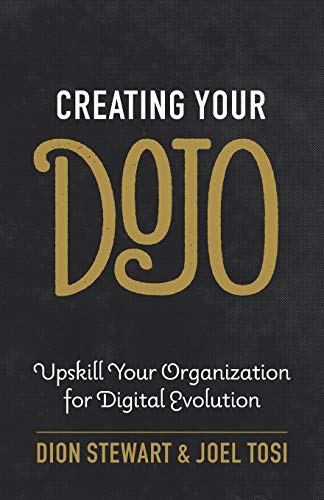
Creating Your Dojo: Upskill Your Organization for Digital Evolution
Transforming a company’s digital product development capabilities is a monumental task that can leave even the most seasoned leaders feeling completely overwhelmed.
Traditional approaches to training often fail to have their desired impact. Instead of transformation, you get piecemeal improvements that don’t lead to significant change.
Here’s the if you want learning that sticks, you need a dojo.
In Creating Your Dojo , experienced dojo coaches Joel Tosi and Dion Stewart guide you through creating a dojo—an immersive learning environment— within your organization. A dojo enables your teams to learn new skills within the context of their real-world work. You’ll create a thriving product development culture where team members feel empowered to solve their own problems. Your organization will improve the quality of the products they deliver, reduce delivery cycle time, and create innovative products with better product/market fit.
Traditional approaches to training often fail to have their desired impact. Instead of transformation, you get piecemeal improvements that don’t lead to significant change.
Here’s the if you want learning that sticks, you need a dojo.
In Creating Your Dojo , experienced dojo coaches Joel Tosi and Dion Stewart guide you through creating a dojo—an immersive learning environment— within your organization. A dojo enables your teams to learn new skills within the context of their real-world work. You’ll create a thriving product development culture where team members feel empowered to solve their own problems. Your organization will improve the quality of the products they deliver, reduce delivery cycle time, and create innovative products with better product/market fit.
- GenresManagementBusiness
224 pages, Paperback
Published November 8, 2019
Ratings & Reviews
Friends & Following
Create a free account to discover what your friends think of this book!
Community Reviews
Displaying 1 - 6 of 6 reviews
October 12, 2023
A good idea, clearly explained. I don't have the number of staff to implement a full dojo, but will definitely be using ideas from this book to try and facilitate more meaningful and impactful training for my people.

July 21, 2020
Very helpful resource to help think through how to start and run a dojo. This accelerated us through some basic learning and allowed us to come out of the gate with better informed experiments by giving us some of the early hard won lessons for free.

November 24, 2019
Excelent book
Totally recommended no matter which part of the journey you are at. Can’t wait to put the advice and recommendations to practice
Totally recommended no matter which part of the journey you are at. Can’t wait to put the advice and recommendations to practice
January 21, 2020
Joel & Dion's book does an excellent job articulating the why, who, what and how of Dojos. I appreciate their willingness to share their experiences and to help others on their Dojo journey.

February 28, 2020
Immersive and experiential experiences are the future of learning
This book shows you a step by step process on how to design, implement and run a Learning Dojo. Worth reading if you’re interested in new ways of learning.
This book shows you a step by step process on how to design, implement and run a Learning Dojo. Worth reading if you’re interested in new ways of learning.

January 29, 2020
I thought it was about "coding dojos" but the idea suggested here is different. The proposal is to create in tech companies immersive learning environments where product teams learn new skills together, mixing engineers and product people for 6 weeks in a dedicated space.
They suggest having that set-up and having the different teams in the company running through it, experiencing that "start-up like" environment.
The authors claim that the idea is based in the learning process our brain follows, taking into account explicit knowledge and tacit knowledge (the one acquired through experience and difficult to document), spaced repetition, practice, coaching and collaboration. The idea is to create a learning organisation.
They suggest a whole process for the dojo, from selecting teams to running two-and-a-half-day sprints to deciding what to learn and measuring learning or how to organise the dojo space.
They suggest different roles to run a dojo: a product manager, some coaches (product, process and technical), an operation manager and a dojo manager.
During the dojo time teams are going to learn, for instance, continuous delivery, TDD or microservices, while working on their product.
The starting point of the dojo includes chartering, deciding a name, creating the elevator pitch, defining goals and measures, identifying the community map, creating architecture diagrams, building a skills matrix and creating the working agreements, which is a good way to start with a team, in any case.
It's a good idea to try to influence in a very (very) big organisation where change is hard.
They suggest having that set-up and having the different teams in the company running through it, experiencing that "start-up like" environment.
The authors claim that the idea is based in the learning process our brain follows, taking into account explicit knowledge and tacit knowledge (the one acquired through experience and difficult to document), spaced repetition, practice, coaching and collaboration. The idea is to create a learning organisation.
They suggest a whole process for the dojo, from selecting teams to running two-and-a-half-day sprints to deciding what to learn and measuring learning or how to organise the dojo space.
They suggest different roles to run a dojo: a product manager, some coaches (product, process and technical), an operation manager and a dojo manager.
During the dojo time teams are going to learn, for instance, continuous delivery, TDD or microservices, while working on their product.
The starting point of the dojo includes chartering, deciding a name, creating the elevator pitch, defining goals and measures, identifying the community map, creating architecture diagrams, building a skills matrix and creating the working agreements, which is a good way to start with a team, in any case.
It's a good idea to try to influence in a very (very) big organisation where change is hard.
Displaying 1 - 6 of 6 reviews