Runaround is a science fiction short story by Isaac Asimov, featuring his recurring characters Powell and Donovan. It was written in October 1941 and first published in the March 1942 issue of Astounding Science Fiction. It appears in the collections I, Robot (1950), The Complete Robot (1982), and Robot Visions (1990). Runaround is notable for featuring the first explicit appearance of the Three Laws of Robotics, which had previously only been implied in Asimov’s robot stories.
Works of prolific Russian-American writer Isaac Asimov include popular explanations of scientific principles, The Foundation Trilogy (1951-1953), and other volumes of fiction.
Isaac Asimov, a professor of biochemistry, wrote as a highly successful author, best known for his books.
Asimov, professor, generally considered of all time, edited more than five hundred books and ninety thousand letters and postcards. He published in nine of the ten major categories of the Dewey decimal classification but lacked only an entry in the category of philosophy (100).
People widely considered Asimov, a master of the genre alongside Robert Anson Heinlein and Arthur Charles Clarke as the "big three" during his lifetime. He later tied Galactic Empire and the Robot into the same universe as his most famous series to create a unified "future history" for his stories much like those that Heinlein pioneered and Cordwainer Smith and Poul Anderson previously produced. He penned "Nightfall," voted in 1964 as the best short story of all time; many persons still honor this title. He also produced well mysteries, fantasy, and a great quantity of nonfiction. Asimov used Paul French, the pen name, for the Lucky Starr, series of juvenile novels.
Most books of Asimov in a historical way go as far back to a time with possible question or concept at its simplest stage. He often provides and mentions well nationalities, birth, and death dates for persons and etymologies and pronunciation guides for technical terms. Guide to Science, the tripartite set Understanding Physics, and Chronology of Science and Discovery exemplify these books.
Asimov, a long-time member, reluctantly served as vice president of Mensa international and described some members of that organization as "brain-proud and aggressive about their IQs." He took more pleasure as president of the humanist association. The asteroid 5020 Asimov, the magazine Asimov's Science Fiction, an elementary school in Brooklyn in New York, and two different awards honor his name.
Powell and Donovan are two scientists on an assignment, sent to a mining plant on planet Mercury to restart operations there. The facility is mostly autonomous, only requiring selenium to work. So first thing when they arrive is send their assistant-robot SPD-13 "Speedy" to collect some, but when it doesn't return things take a nasty turn. Without selenium to power and cool the facility, the scorching sun will kill them, in a matter of days.
This is IT! Have you ever heard of the "Three laws of Robotics"? Well, let me tell you this is the story that made it all happen. This is the point in history where Asimov redefined sci-fi as we know it. The three laws transcended literature; books, movies, series, whatever, people may have never heard of Asimov, or even about Runaround, but doubt any sci-fi aficionado never heard of about the Three Laws, implicitly or explicitly, and we owe it all to him. Asimov, take a bow.
To be honest this was sort of meh for me, and kind of confusing too; sometimes the laws conflict with each other and I'm just too dumb and slow to try to follow the reasoning without getting lost in the process. Still, I can't deny the value of Asimov's idea, and this landmark moment in sci-fi history. So that's 2.5 for me, rounded up to 3 stars for legendary status. Recommendable, for the sci-fi nerd.
----------------------------------------------- PERSONAL NOTE: [1942] [17p] [Sci-Fi] [2.5] [Conditional Recommendable] -----------------------------------------------
Powell y Donovan son dos científicos en una misión, enviados a una planta minera en el planeta Mercurio para reiniciar las operaciones allí. La instalación en su mayor parte es autónoma y sólo requiere selenio para funcionar. Entonces, lo primero que hacen cuando llegan es enviar a su robot asistente SPD-13 "Speedy" para recolectarlo, pero cuando éste no regresa, las cosas toman un giro desagradable. Sin selenio para arrancar y enfriar las instalaciones, el sol abrasador los matará en cuestión de días.
¡Es AQUI! ¿Han oído hablar alguna vez de las "Tres leyes de la Robótica"? Bueno, déjenme decirles que ésta es la historia que hizo que todo sucediera. Este es el punto de la historia en el que Asimov redefinió la ciencia ficción tal como la conocemos. Las tres leyes trascendieron la literatura; libros, películas, series, lo que sea, es posible que la gente nunca haya oído hablar de Asimov, o incluso de Runaround, pero dudo que ningún aficionado de la ciencia ficción jamás haya oído hablar de las Tres Leyes, implícita o explícitamente, y se lo debebos todo a él. Asimov, puedes hacer una reverencia.
Para ser honestos, esto fue para mi medio meh, y también un poco confuso; a veces las leyes entran en conflicto entre sí y yo soy demasiado tonto y lento para tratar de seguir el razonamiento sin perderme en el proceso. Aún así, no puedo negar el valor de la idea de Asimov, y este momento crucial en la historia de la ciencia ficción. Así que 2.5 para mí, redondeado a 3 estrellas por estatus legendario. Recomendable, para el nerd de la ciencia ficción.
If you read Science Fiction, then the Three Laws of Robotics might feel as familiar as knowing your ABC. Even general readers will probably find they have unknowingly assimilated these laws up to a point, from films and so on. They are part of our culture. But who thought these “Laws of Robotics” up, and when were they first put in print?
The answer to this is that the American writer Isaac Asimov invented the Three Laws of Robotics, and first used them in his short story Runaround. The story was written in 1941, and first published a few months later in the “Astounding Science Fiction” magazine for March 1942. It was then republished in Isaac Asimov’s first collection of Robot stories “I, Robot” in 1950. Here are the Three Laws of Robotics:
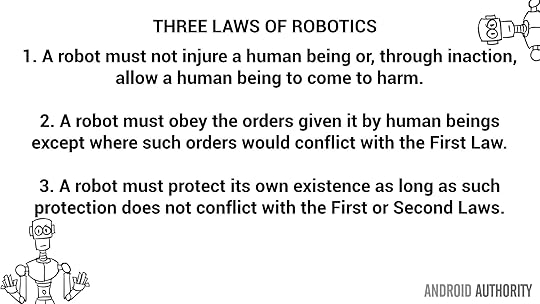
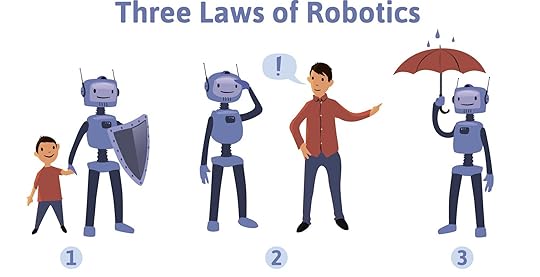
1. A robot may not injure a human being or, through inaction, allow a human being to come to harm. 2. A robot must obey the orders given it by human beings except where such orders would conflict with the First Law. 3. A robot must protect its own existence as long as such protection does not conflict with the First or Second Laws
Runaround is set in the far future (from the readers of 1942’s point of view) of 2015. We meet two characters who are to feature in several of Isaac Asimov’s stories: Mike Donovan and Gregory Powell. They have been sent to the planet Mercury, along with Robot SPD-13, known as “Speedy”, to assess operations at a mining station which had been abandoned ten years earlier. The hope is that it can be manned by a robot. However, they quickly run low on selenium. The nearest selenium pool is seventeen miles away, and humans cannot cope with Mercury’s high temperatures. Therefore Mike Donovan sends Speedy to go and get some.
However, five hours pass, and Speedy has still not returned.
In general I enjoyed this story, although I felt the ending was a little weak. The main thing that stands out is how clear it is right from the start, that Isaac Asimov anthropomorphised his robots. By adapting the model number SPD 13 into the name “Speedy”, and by referring to the robot as “he” instead of “it”, Isaac Asimov demonstrated how easy—perhaps even how necessary it is psychologically—to endow robots with human qualities. Near the end, one of the characters says:
“[Speedy] still hasn’t finished apologising for the runaround he gave us. He’s scared to come near you for fear of what you’ll say.”
The conventional words for apologising can presumably be programmed into the positronic brain, but fear is surely these humans empathically attributing an impossible experience to a robot.
Another aspect I enjoyed was the introduction of more primitive robots. This reminded me so much of gadgets with all the latest bells and whistles, most of which we may not need or want, and which are likely to go wrong more often. Sometimes the simplest machines are the most reliable. In some cases, as we see here, technological advancement can be more troublesome than it is beneficial.
The descriptions of what Mercury might be like, are very effective. Everything is brighter and darker without atmosphere—or with only a tiny, poisonous atmosphere. There is quite a lot of science and predictions of future technology in Runaround.
I personally didn’t care for the humour in this story, with the joshing and sparring of the archetypal testosterone-fueled males. Since they feature in other stories, I feel Mike Donovan and Gregory Powell may soon grow tiresome and outstay their welcome. However, this first story does show that making robots similar to humans but essentially different, offers many opportunities for quirky humour. It also shows that there are many possibilities for conflict using the Three Laws of Robotics.
If this had not been such a landmark story I might have rated Runaround at 3 stars. But the purpose of Runaround was to introduce the bold new idea of the three Laws of Robotics, and it does this in an entertaining and thought-provoking way, so it deserves 4 stars. I am looking forward to reading more about the quandaries, conundrums and unforeseen consequences resulting from these laws.
Written in September-October 1941 and first appearing in March 1942 in Astounding, Runaround further expanded the universe of robotics.
In the year 2005 AD, humanity has established mining stations on Mercury. Ten years later, in the year 2015 AD, a team with their new robot returns to restart operations at the mining station which was abandoned some years before.
"Runaround" also features the first explicit appearance of the Three Laws of Robotics which had previously only been implied in Asimov's robot articles. Conflicts in the application of the Three Laws of Robotics is the subject of the plot here. In contrast to the majority of such stories, in which the lexical ambiguities of the Laws are employed to fashion a dilemma, the robot featured in "Runaround" is actually following the Laws as they were intended.
The plot revolves around the Three Laws. Do I need to remind everyone nowadays of what these laws are? Again? Oh well, then. Here we go:
A robot may not injure a human being or, through inaction, allow a human being to come to harm.
A robot must obey the orders given it by human beings except where such orders would conflict with the First Law.
A robot must protect its own existence as long as such protection does not conflict with the First or Second Laws.
The robot finds it impossible to obey both the Second Law and the Third Law at the same time, and this freezes it in a loop of repetitive behavior.
If you haven't read about robotics yet, make it to the bookstore and get I, Robot right now.
Collected in I, Robot, The Complete Robot and Robot Visions this story can be read here. Runaround features Donovan and Powell, (future recurring characters) stuck on Mercury, the robot that is supposed to gather Selenium to power the filters, is running around instead of doing its job. In deducing the nature of the problem, Powell explicitly states the Three laws of Robotics and how a robot would respond, based on these laws. This is a very clever science puzzle story, because there is limited time to find out how they can get out alive.
Asimov, ever the scientist, cleverly inserts problems and solutions provided by thinking 🧠:- ⚛ Thermo Physics for the impact of Mercury's sun-side surface, 👩🏻🏫 Mathematics to calculating how long one could stay out 👨🔬 Chemistry (inorganic) to help find a solution, and 🤖 Robopsychology to predict how the robot subsequent actions.
Honestly as someone who loves science I really enjoyed this story. Enough that I suppose after all that mental titillation, I briefly toyed with the idea that if Powell, the more brilliant of the two characters, were real and I was available, I would probably date him.
Runaround is a science fiction short story by Isaac Asimov, featuring his recurring characters Powell and Donovan. It was written in October 1941 and first published in the March 1942 issue of Astounding Science Fiction. It appears in the collections I, Robot (1950), The Complete Robot (1982), and Robot Visions (1990). Runaround is notable for featuring the first explicit appearance of the Three Laws of Robotics, which had previously only been implied in Asimov’s robot stories.
"Two hundred seventy-three degrees Centigrade below zero. Won't it be a pleasure?"
Perhaps my rating should have been a three but it is my first encounter with hard SF and colour me impressed. Funny banter between the characters and actual emotional investment even within an extremely alien and technologically advanced space. A short story but with equilibrium between scientific talk and characterization.
Now this is absolutely ingenious in its simplicity! It is about a Robot trying to rank two out of three of its primal drives, but inevitably failing to make a judgement because lack of clear programming. In the end it manages to get out of the loop because of the first and most fundamental of laws it follows.
This entire review has been hidden because of spoilers.
Ok not going to lie I only read this for my politics course and I really didn't want to read it but it's due tomorrow so I did it.
I actually got into it within the first few pages and it was really interesting. While I felt the ending was a little I guess anticlimactic? or maybe just weird? I overall liked the ideas and how it presents the three rules of robotics.
This entire review has been hidden because of spoilers.
Isaac Asimov is a legit visionary, writing about things way ahead of his time. It felt very exciting to read the story that introduced us to the very famous Three Laws of Robotics, which is impacting cutting-edge technologies like Artificial Intelligence even today. Full sci-fi feels 🤖❤️
This is the most ham-handed exposition to ever struggle-fuck its way onto a page. Asimov always inspires me to write, as I find my grocery lists more engaging. He is truly dreadful.
It's been 20 years (jesus), and I still think different the movie is from the book. The movie is totally different story. That said, I actually liked the movie for what it was. But I wish they'd adapt Asimov works more faithfully. Don't even get me started on the Foundation television series.