

What do you think?

Imperial Mud: The Fight for the Fens
A pre-existing population of proud indigenous people are forced out of their homelands. Then they are materially, culturally and spiritually disenfranchised by a financially mighty imperial state. Their impoverishment is justified to them, and to the outside world, as being necessary for ‘progress’. All of this takes place in East Anglia, an often forgotten area of eastern England. An innovative new take on the drainage of the Fens, framed in the language of colonialism, Imperial Mud upends the classical narrative of this being a triumph of technology over nature. The final destruction of England’s last lowland wilderness and the dispossession of its custodians was not a consequence of ‘progress’, but of the growing power of a centralised and militarised state. Imperial Mud reimagines not just the history of the Fens, but the history (and identity) of the English people. And in reimagining the past, it invents a new future.
256 pages, Hardcover
First published July 2, 2020
About the author
James Boyce
6 books37 followersI am an independent writer and historian who lives in Hobart. I have written five multi award winning history books over the past two decades with a new one on the way! After seven years of labour, 'Origins: The Making of Australia and the Conquest of Australia' will be released on 17 November 2026.
Ratings & Reviews
Friends & Following
Create a free account to discover what your friends think of this book!
Community Reviews
Displaying 1 - 30 of 34 reviews

June 25, 2021
Boyce usually writes about imperialism in Australia, but here he turns to imperialist ventures in England itself and specifically the fens which stretched through South Lincolnshire, Norfolk, Cambridgeshire and bits of surrounding counties. He also includes the Isle of Axholme in North Lincolnshire.
Boyce explains his approach:
“A more direct source for this book was my research on the Australian frontier…When I began to read histories of the Fens, I was struck by some largely unacknowledged similarities with the colonial frontier. Here too was a multi-faceted defence of country, a transformation of the land, the introduction of foreign settlers and a confrontation between two worlds. While researching Australian history, I began to wonder, did the fact that the Fens was part of England justify such a radically different approach to writing its past?”
It is not easy to be precise about the extent and borders of the fens as streams and masses of water ebb and flo. Boyce identifies the Fennish (as he terms them) as an indigenous people:
“All cultures undergo times of upheaval as well as long periods of evolution. What characterises an indigenous culture is neither its uniformity nor immutability, but that it remains rooted in country as it experiences continuity and change.”
Boyce goes back about four thousand years and tracks the various invaders, who all tried to manage the fens and its people. It also describes why the fens were so unique. The common lands, as the fens were, provided so much food for its inhabitants that even in years of poor harvests food was plentiful. There was a great variety of fish and most especially eels. The wildfowl and bird life of the area was also very plentiful and edible. People raised geese for eating and eggs. The grass was always lush and provided fodder the year round for cattle and sheep. Sedge and turf-cutting provided livelihood for some. Of course the area was very wet and flooded regularly, but that was part of the deal.
The very geography made it difficult for outsiders to tame the land and its inhabitants. The Romans mainly avoided them. Dio Cassius tells how the Romans “wandered into the pathless marshes and lost many of their soldiers”. The Vikings just went round them and avoided them. William the Conqueror made more of an effort and hence grew legends like Hereward the Wake. It is also true to say that cavalry don’t do well in mud! The Church was more pragmatic and tried to move in by creating small monastic houses. This had some partial success but the Fennish have never been very religious. After the dissolution of the monasteries the Church lost its foothold for several centuries, until the advent of non-conformity and particularly Methodism which based its structure on local people and imposed less from the outside. John Wesley’s father Samuel was a Church of England Rector in the Isle of Axholme, he estimated that only about 2% of his flock actually attended Church. As I said the Fennish were not a religious lot. There is also an interesting strand in Fennish history related to the Roma people, who were able to use the fens as a refuge, a place to get food, replenish stocks and be safe with support from the locals. That seems to be a little told story in itself.
The real threat to the fens came from the early seventeenth century onwards and the advent of enclosure when there was a determined attempt to take over common land. It is here that Boyce perceives that colonization was a process wielded in Britain as well as by Britain. The battle to tame the fens lasted over two hundred years. Enclosure succeeded in the southern fens in the seventeenth century. However in Lincolnshire (south and north) it failed. There was violence, persecution by the law, destruction of new ditches with similarities to the later Luddite and Captain Swing unrest. South Lincolnshire and the Isle of Axholme held out until the late eighteenth century when the industrial revolution provided steam driven machines much better at drainage.
“The Fennish story is an integral part of the troubled history of the imperial age. As elsewhere in the empire, an indigenous people fought the land grab through every means available to them, including force, until the subversive power of the modern state and the technological power of the Industrial Revolution achieved what seemed to be a final victory.”
Boyce turns on its head the idea that the draining of the marshes was a triumph of engineering and progress, but was rather the dispossession of an indigenous people. Many of the dispossessed took to poaching (hence songs like The Lincolnshire Poacher), which still thrives today.
What can be noted is that the result of drainage is that much of the resulting farmland is slightly below sea level and any rises in sea levels would have some interesting results.
This is an interesting and innovative history which spoke to me because one strand of my family history goes back into the fens.
Boyce explains his approach:
“A more direct source for this book was my research on the Australian frontier…When I began to read histories of the Fens, I was struck by some largely unacknowledged similarities with the colonial frontier. Here too was a multi-faceted defence of country, a transformation of the land, the introduction of foreign settlers and a confrontation between two worlds. While researching Australian history, I began to wonder, did the fact that the Fens was part of England justify such a radically different approach to writing its past?”
It is not easy to be precise about the extent and borders of the fens as streams and masses of water ebb and flo. Boyce identifies the Fennish (as he terms them) as an indigenous people:
“All cultures undergo times of upheaval as well as long periods of evolution. What characterises an indigenous culture is neither its uniformity nor immutability, but that it remains rooted in country as it experiences continuity and change.”
Boyce goes back about four thousand years and tracks the various invaders, who all tried to manage the fens and its people. It also describes why the fens were so unique. The common lands, as the fens were, provided so much food for its inhabitants that even in years of poor harvests food was plentiful. There was a great variety of fish and most especially eels. The wildfowl and bird life of the area was also very plentiful and edible. People raised geese for eating and eggs. The grass was always lush and provided fodder the year round for cattle and sheep. Sedge and turf-cutting provided livelihood for some. Of course the area was very wet and flooded regularly, but that was part of the deal.
The very geography made it difficult for outsiders to tame the land and its inhabitants. The Romans mainly avoided them. Dio Cassius tells how the Romans “wandered into the pathless marshes and lost many of their soldiers”. The Vikings just went round them and avoided them. William the Conqueror made more of an effort and hence grew legends like Hereward the Wake. It is also true to say that cavalry don’t do well in mud! The Church was more pragmatic and tried to move in by creating small monastic houses. This had some partial success but the Fennish have never been very religious. After the dissolution of the monasteries the Church lost its foothold for several centuries, until the advent of non-conformity and particularly Methodism which based its structure on local people and imposed less from the outside. John Wesley’s father Samuel was a Church of England Rector in the Isle of Axholme, he estimated that only about 2% of his flock actually attended Church. As I said the Fennish were not a religious lot. There is also an interesting strand in Fennish history related to the Roma people, who were able to use the fens as a refuge, a place to get food, replenish stocks and be safe with support from the locals. That seems to be a little told story in itself.
The real threat to the fens came from the early seventeenth century onwards and the advent of enclosure when there was a determined attempt to take over common land. It is here that Boyce perceives that colonization was a process wielded in Britain as well as by Britain. The battle to tame the fens lasted over two hundred years. Enclosure succeeded in the southern fens in the seventeenth century. However in Lincolnshire (south and north) it failed. There was violence, persecution by the law, destruction of new ditches with similarities to the later Luddite and Captain Swing unrest. South Lincolnshire and the Isle of Axholme held out until the late eighteenth century when the industrial revolution provided steam driven machines much better at drainage.
“The Fennish story is an integral part of the troubled history of the imperial age. As elsewhere in the empire, an indigenous people fought the land grab through every means available to them, including force, until the subversive power of the modern state and the technological power of the Industrial Revolution achieved what seemed to be a final victory.”
Boyce turns on its head the idea that the draining of the marshes was a triumph of engineering and progress, but was rather the dispossession of an indigenous people. Many of the dispossessed took to poaching (hence songs like The Lincolnshire Poacher), which still thrives today.
What can be noted is that the result of drainage is that much of the resulting farmland is slightly below sea level and any rises in sea levels would have some interesting results.
This is an interesting and innovative history which spoke to me because one strand of my family history goes back into the fens.

January 3, 2024
The tragedy of the Fens! This book explains why, when one is country house hunting, there are oodles of houses just south of Cambridge, but then almost nothing between Cambridge and the coast: Because the Fens provided a so many resources that wealth was more evenly distributed across them, so that even the poorest peasant could have a rather high standard of living on a cow and a few eel traps. Monastic institutions understood the wealth of the Fens, but after the Civil War, new landowners refused to understand why they were being paid in eels instead of grain, and the stupid Dutch who were draining their own country, brought the technology to England and tried to start. Over a century of rebellion ensued. Boyce underscores the irony of a subjugated population successfully rebelling in England while the English were beginning to subjugate the unsuccessfully rebellious outside of England, and, after the drainage schemes started to work, those internally colonized went off to colonize the colonies. The Fens are a tragedy, but, as Boyce says, nothing is permanent. 1870 was the pre-WWII height of drained fens, but by the early 1900s, the water was seeping back. Late Victorian environmentalism was a little too late for the Fens, and the late Victorians could only imagine one kind of productive landscape: planted fields. But the water was rolling back in and some parts of the Fens were purchased by those who would protect them. WWII ruined all this. The technology was finally there to drain all the Fens properly and the need for domestic food was put above all else. The Fens are now drained. The built environment will need to be completely changed to rewet the Fens. But with climate change, the drained Fens could easily become Fens again. This book times a million. Please do read.

May 25, 2020
thanks to netgalley and the publishers for a free copy in return for an open and honest review
This book is very informative and interesting as used the fens as though it was a foreign or native land and the use of drainage and colonisation of the fens by outsiders in an imperial way
This book is very informative and interesting as used the fens as though it was a foreign or native land and the use of drainage and colonisation of the fens by outsiders in an imperial way

October 3, 2020
The process of enclosure that marked the transformation of the English countryside is a historical injustice that is often downplayed or ignored. The destruction of common lands, the land that people could collectively use and share, is usually (even in sympathetic accounts) seen as a tragic necessity arising from inevitable progress. The reality is that alongside enclosure went violence, dispossession and ecological devastation. The scale is unbelievable. As James Boyce points out, by the late 18th century "between 1750 and 1820, 21 per centre of England or 6.8 million acres was enclosed by an Act of Parliament". In the Fenlands of east England a million "wild" acres of marshland were drained in a roughly similar period. Boyce's new book is a study of this process, and the resistance too it.
Full review on the blog: https://resolutereader.blogspot.com/2...
Full review on the blog: https://resolutereader.blogspot.com/2...
April 26, 2026
Fantastic book - starts slowly but is very readable. Compelling, emotive, and relevant.

July 26, 2022
An interesting, more global, view of a difficult period of our own history. If you worry about slavery this will put man's inhumanity to man into a context much nearer to home. I will never wander around Woodwalton fen or Home fen again without thinking about the injustices that occurred not so long ago.
A well told history of the enclosures (with special reference to the fens of East Anglia) in the context of the imperialism and 'progress' that made our society the way it is today.
Readable and much food for thought.
A well told history of the enclosures (with special reference to the fens of East Anglia) in the context of the imperialism and 'progress' that made our society the way it is today.
Readable and much food for thought.

April 3, 2023
James Boyce, a Tasmanian historian, explores the fight to save the south east English fens from enclosure and drainage. He looks at it as a fight of indigenous people to save their culture and their land from colonisers. A very interesting read.

January 19, 2021
James Boyce is best known for his work on Australian colonial history, such as his much-vaunted Van Diemen's Land. Here, though, his attention turns to the eastern coast of England, to the area known as the Fens, a wetland that was aggressively drained and enclosed from the sixteenth to the nineteenth centuries.
The tale that Boyce tells is familiar from the history of European colonialism: the dispossession of the indigenous inhabitants, the greed and misappropriation of wealth by a handful of elites who are already grotesquely rich, and the poverty, social decay, and environmental destruction that follows in its wake. The difference, of course, is that these events are happening on English home soil, not in some distant foreign land. Boyce's book is a valuable reminder that colonialism begins at home, whether it is the draining of the fens in England, or the Albigensian crusade in France.
Boyce's book not only provides readers with a valuable widening of our view of colonialism as a historical phenomenon, it also helps to provide a context for some of the literature that has emerged as a response. In Iain Pears's An Instance of the Fingerpost, for instance, the central character of Sarah Blundy is from the fens; her father Ned is a kind of resistance fighter there, and the secret codes that are a key part of the plot relate to his endeavors. Perhaps the best-known novel about the fens is Graham Swift's masterpiece Waterland, although Daisy Johnson is pushing her claim as the voice of the region in works like Fen and Everything Under. I suppose you could add Sarah Perry to this list, too, although I am not a fan.
Imperial Mud is a fascinating book for its subject matter, and the way it provides a different historical perspective on England and colonialism. It earns some demerits, however, for Boyce's style, which is adequate to the task but, honestly, a little dull and academic in its presentation. Still, as a fellow Australian, I am proud of how he is able to show up the shortcomings of the English, even in their own backyard.
The tale that Boyce tells is familiar from the history of European colonialism: the dispossession of the indigenous inhabitants, the greed and misappropriation of wealth by a handful of elites who are already grotesquely rich, and the poverty, social decay, and environmental destruction that follows in its wake. The difference, of course, is that these events are happening on English home soil, not in some distant foreign land. Boyce's book is a valuable reminder that colonialism begins at home, whether it is the draining of the fens in England, or the Albigensian crusade in France.
Boyce's book not only provides readers with a valuable widening of our view of colonialism as a historical phenomenon, it also helps to provide a context for some of the literature that has emerged as a response. In Iain Pears's An Instance of the Fingerpost, for instance, the central character of Sarah Blundy is from the fens; her father Ned is a kind of resistance fighter there, and the secret codes that are a key part of the plot relate to his endeavors. Perhaps the best-known novel about the fens is Graham Swift's masterpiece Waterland, although Daisy Johnson is pushing her claim as the voice of the region in works like Fen and Everything Under. I suppose you could add Sarah Perry to this list, too, although I am not a fan.
Imperial Mud is a fascinating book for its subject matter, and the way it provides a different historical perspective on England and colonialism. It earns some demerits, however, for Boyce's style, which is adequate to the task but, honestly, a little dull and academic in its presentation. Still, as a fellow Australian, I am proud of how he is able to show up the shortcomings of the English, even in their own backyard.

February 9, 2025
As a Fenland (not Fennish) historian, I cannot tell you how much this book aggravated me. Constantly framing Fen resistance as a plucky battle by the uneducated, opiate-mad fennish against the government completely undermines the strategy, foresight and planning that these acts of resistance required. I particularly took offence at the idea that Fenlanders are indigenous. The author is Australian where the term has slightly different connotations, but there is no distinct genetic or ethnic difference among Fenlanders to the rest of England.
We are not hobbits.
I am sure that to people who have never been to the Fens, this book is a marvel, but as someone whose family has spent their entire life resident in fenland districts (Kesteven, South Holland, Marshland and Peterborough) this book is jarring, and in certain admittedly pedantic aspects, factually incorrect.
We are not hobbits.
I am sure that to people who have never been to the Fens, this book is a marvel, but as someone whose family has spent their entire life resident in fenland districts (Kesteven, South Holland, Marshland and Peterborough) this book is jarring, and in certain admittedly pedantic aspects, factually incorrect.

wish-list
April 9, 2021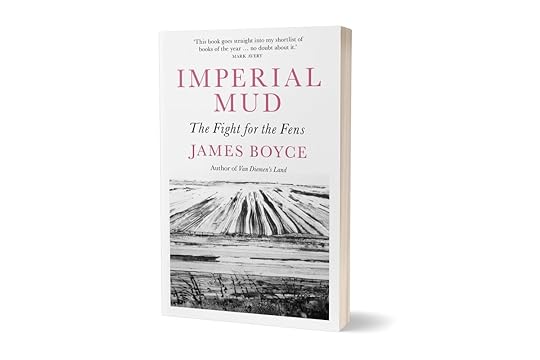
Icon Books: Masterfully argued and imbued with a keen sense of place, Imperial Mud - out now in paperback - reimagines not just the history of the Fens, but the history and identity of the English people...

September 20, 2022
Who knew a book about the English fens could be so interesting. This book looks at local resistance to those who would try to enclose the commons and drain the wetlands in the name of progress and profit over the centuries.

Read
May 15, 2024Slamming my fist on my desk when they introduce the Earl of Bedford. That man was a villain.

December 29, 2020
What a fantastic read. Often when reading various books about other topics from this era, one hears about the beginnings of the enclosure process and some of the elements that went into it, but I have never read a book that so fully explains the drainage projects and their purpose.
Not only is this a well organised book with a lot of crucial detail, but the author has a style of writing that is friendly to readers who may not be scholars or have deep familiarity with the subject at hand. I really enjoyed reading this book and found myself stinging a bit from the overall sense of loss whilst thinking about what was once wildlands, and nature being replaced by what would be considered progress by our modern minds.
I would definitely recommend this book to anyone interested in the Fens, and furthermore to anyone who would like a glimpse at what was.
This review is based on a complimentary copy from the publisher, provided through Netgalley. All opinions are my own.
Not only is this a well organised book with a lot of crucial detail, but the author has a style of writing that is friendly to readers who may not be scholars or have deep familiarity with the subject at hand. I really enjoyed reading this book and found myself stinging a bit from the overall sense of loss whilst thinking about what was once wildlands, and nature being replaced by what would be considered progress by our modern minds.
I would definitely recommend this book to anyone interested in the Fens, and furthermore to anyone who would like a glimpse at what was.
This review is based on a complimentary copy from the publisher, provided through Netgalley. All opinions are my own.
April 16, 2021
An interesting approach, looking at colonialism as a structure which occurred IN Britain as well as BY Britain, informed by the author's Australian history background.
It is this bi-focal approach to colonization that is the real strength of this book. I must confess as an Australian reader, I found myself wishing that I knew more British history and geography.Boyce is an incisive and economical writer, carefully attuned to landscape and ecology, continuity and change. His book is only small, but it makes an argument about colonization and resistance with its feet planted in two different, widely separated continents.
For my complete review, please visit
https://residentjudge.com/2021/04/16/...
It is this bi-focal approach to colonization that is the real strength of this book. I must confess as an Australian reader, I found myself wishing that I knew more British history and geography.Boyce is an incisive and economical writer, carefully attuned to landscape and ecology, continuity and change. His book is only small, but it makes an argument about colonization and resistance with its feet planted in two different, widely separated continents.
For my complete review, please visit
https://residentjudge.com/2021/04/16/...
October 16, 2020
Too many corrupt folks at the top of British society in the past. It's called the Napolean syndrome (but I believe that was initially applied to us persons of short stature) , I like to think of it applying to little islands with powerful people who see themselves as head roosters (my ancestors were driven out in Clearances.) Serves them right if they their little scheme backfired on them and left them with nothing. Great book! Makes me happy to read another about another plague on their house! Poor fens and their folks...it must please them to some degree as well!
I received a Kindle arc from Netgalley in exchange for a fair review.

May 12, 2021
Such a good read. I'll never look at the Fens the same way again.

January 12, 2025
There is a something called the "tragedy of the commons".
What the tragedy of the commons amounts to, really, is a sort of mathematical proof that—
a) if people are actually fundamentally just economic units going around rationally maximising their utility, and
b) if "commons" are just land or resources with no particular owner which can be used by anyone in any amount
—things are not going to work out very well. The coldly rational economic actors will maximise their utility by grazing as many sheep as possible on the common grass, say, and soon the commons will be ruined.
This mathematical prediction was most famously articulated by a sort-of-economist in 1968. Over the half-century since, historians have compared the mathematical prediction against the actual reality of societies which relied on commoning as a way of life for thousands of years. It swiftly became apparent that the predictions of tragedy were not borne out in reality, so either one of the premises were wrong, both of the premises were wrong, or the theory was right and reality was wrong. Which seemed unlikely.
The tragedy of the commons, with neither of its premises altered, continues to be taught in economics classes all over the world as of 2024.
This rather short book advances a brilliant illustration of the real tragedy of the commons. Fundamental to Boyce's argument are three crucial observations, relevant in the modern world just as much as the 1650s where his history centres:
I) The true tragedy of the commons is that people who take maths seriously don't know much about commoning, but still get to make decisions about the commons
II) Colonisation doesn't just happen to people far away, or of a different colour or religion
III) Understanding history (and reality) sometimes demands that we accept the way we think—about, say, mathematical proofs versus empirical reality, or hard currency versus human wellbeing—might be getting in the way.
The Fens, vast coastal wetlands in southeast England, were historically the largest and richest common in Britain. Villagers grazed cattle and sheep on the seasonally-flooded meadows and lived from wetland products—fish, fodder, wildfowl, game, reeds for thatch, willow for basketmaking and construction—in other times. As a result, even the poorer people of the Fens—according to studies Boyce cites—often owned two to four cattle supported by the vast commons, allowing them a secure living. The common fens were managed by old and flexible customs: grazing seasons opened and closed; fowling and egg-collecting were governed by strict requirements; reed-cutting was limited to plants of a certain size. This system enabled not just multiple people but multiple communities of hundreds of people, sometimes very long distances apart, to make a living from the wetland for the three thousand years from the early Bronze Age until about 1650.
As James Scott has observed, though, products like fish, fodder, fowl, eggs, game and even dairy aren't particularly assessable, transportable, storable, or taxable. So once the technology came along to drain the marshes and replace them with dry land capable of intensively producing wheat and wool—far less value for economic independence, far more value in cash money—people who were good at maths and didn't much care about commons wanted to do just that. The common land began to be seized, drained, turned into conveniently taxable pastures, and parcelled out to individual owners.
Once we accept that commons are not inevitably overused and spoiled, the process in operation becomes much clearer. The people and economy of the fens were largely self-sufficient, which is to say economically independent: they survived, thanks to their commons, without needing much of anything from—or needing to give any money to—anybody else. This, perhaps, was the tragedy of the commons from the perspective of contemporary economists. Capital was therefore invested and engineers brought in to advance the project of eliminating the fens. This had the twofold benefit of making fen land produce cash crops and making the fenfolk unable to get by without giving people money, so they needed waged work. Capital created land and a pool of workers to employ on the land with one stone.
In this light the narrative that follows (it hardly needs to be mentioned that Boyce's training and background is in the history of colonisation in Australia) is unambiguously colonial. There is an indigenous, economically independent society with a traditional way of managing resources by which they made a living (but did not, as Wendell Berry would observe, make a killing) and an arriving external group who slot themselves in as the new elite, who don't care whether or not indigenous people can make a living, and who just want to get money out of the deal. There is a carefully engineered dismantling of their ways of living: marshes are drained, commons are fenced so fish, fowl and even cows can't eat. There's resistance: fenfolk killing drainage engineers, filling in ditches, burning tools. There's the imposition of military force: English troops barracked in English villages carrying out collective punishment against English peasants. This history has all the hallmarks of the colonial apparatus of rule that would later be exported across England's empire; switch fenfolk for Irish, Highlanders, Khoisin, Māori or Pashtuns and drainage for ploughing, and the story hardly needs altering.
One instrument in that apparatus of rule, of course, which we see emerging in this early history, is the official insistence, in the face of all evidence, that commoning is inefficient, no good, invites poverty and tragedy. Therefore the commons need to be dismantled and everyone will be much better off if they just do as the new tax-collecting imperial rulers say.
That's important, I think, because it shows that what we think of as colonisation—the subordination and destruction of whole ways of life across vast territories by some small group of elites; the distortion of the human landscape of whole countries to orbit a distant and arbitrary metropole—isn't simply a matter of distance, language, religion, technologies to hand or skin colour. It's a process—Berry, again, could have told us—that happens within as well as between societies, wherever the priorities of some people are held higher than the good of others. Decolonisation, too, is a process infinitely more serious and demanding than putting a prayer to country on your website, a koru on your logo, or a flag and slogan about a faraway country on your bumper.
Part of the importance of history is its ability to speak back to power. Garrett Hardin's hard-headed rationalistic mathematics, "the tragedy of the commons", has dominated the economic training and orthodoxy that educated most of our political class for fifty years. It's also not true. Histories like this: serious, conscientious, careful histories which are subversive simply because they approach their subject from an unorthodox viewpoint help put the lie to the insouciant stupidity of received wisdom. They help us, also, understand that the concerns and interests of the wealthy need not have any bearing on what's best for everyone. The seizure, colonisation and draining of the fens—the dispossession of the fen people, the extinguishment of their way of life, in service of "improvement" and "economic growth" and "productivity"—is an important example, relevant now as ever, of why we must take care when the wealthy and powerful try to confuse what they want with progress.
What the tragedy of the commons amounts to, really, is a sort of mathematical proof that—
a) if people are actually fundamentally just economic units going around rationally maximising their utility, and
b) if "commons" are just land or resources with no particular owner which can be used by anyone in any amount
—things are not going to work out very well. The coldly rational economic actors will maximise their utility by grazing as many sheep as possible on the common grass, say, and soon the commons will be ruined.
This mathematical prediction was most famously articulated by a sort-of-economist in 1968. Over the half-century since, historians have compared the mathematical prediction against the actual reality of societies which relied on commoning as a way of life for thousands of years. It swiftly became apparent that the predictions of tragedy were not borne out in reality, so either one of the premises were wrong, both of the premises were wrong, or the theory was right and reality was wrong. Which seemed unlikely.
The tragedy of the commons, with neither of its premises altered, continues to be taught in economics classes all over the world as of 2024.
This rather short book advances a brilliant illustration of the real tragedy of the commons. Fundamental to Boyce's argument are three crucial observations, relevant in the modern world just as much as the 1650s where his history centres:
I) The true tragedy of the commons is that people who take maths seriously don't know much about commoning, but still get to make decisions about the commons
II) Colonisation doesn't just happen to people far away, or of a different colour or religion
III) Understanding history (and reality) sometimes demands that we accept the way we think—about, say, mathematical proofs versus empirical reality, or hard currency versus human wellbeing—might be getting in the way.
The Fens, vast coastal wetlands in southeast England, were historically the largest and richest common in Britain. Villagers grazed cattle and sheep on the seasonally-flooded meadows and lived from wetland products—fish, fodder, wildfowl, game, reeds for thatch, willow for basketmaking and construction—in other times. As a result, even the poorer people of the Fens—according to studies Boyce cites—often owned two to four cattle supported by the vast commons, allowing them a secure living. The common fens were managed by old and flexible customs: grazing seasons opened and closed; fowling and egg-collecting were governed by strict requirements; reed-cutting was limited to plants of a certain size. This system enabled not just multiple people but multiple communities of hundreds of people, sometimes very long distances apart, to make a living from the wetland for the three thousand years from the early Bronze Age until about 1650.
As James Scott has observed, though, products like fish, fodder, fowl, eggs, game and even dairy aren't particularly assessable, transportable, storable, or taxable. So once the technology came along to drain the marshes and replace them with dry land capable of intensively producing wheat and wool—far less value for economic independence, far more value in cash money—people who were good at maths and didn't much care about commons wanted to do just that. The common land began to be seized, drained, turned into conveniently taxable pastures, and parcelled out to individual owners.
Once we accept that commons are not inevitably overused and spoiled, the process in operation becomes much clearer. The people and economy of the fens were largely self-sufficient, which is to say economically independent: they survived, thanks to their commons, without needing much of anything from—or needing to give any money to—anybody else. This, perhaps, was the tragedy of the commons from the perspective of contemporary economists. Capital was therefore invested and engineers brought in to advance the project of eliminating the fens. This had the twofold benefit of making fen land produce cash crops and making the fenfolk unable to get by without giving people money, so they needed waged work. Capital created land and a pool of workers to employ on the land with one stone.
In this light the narrative that follows (it hardly needs to be mentioned that Boyce's training and background is in the history of colonisation in Australia) is unambiguously colonial. There is an indigenous, economically independent society with a traditional way of managing resources by which they made a living (but did not, as Wendell Berry would observe, make a killing) and an arriving external group who slot themselves in as the new elite, who don't care whether or not indigenous people can make a living, and who just want to get money out of the deal. There is a carefully engineered dismantling of their ways of living: marshes are drained, commons are fenced so fish, fowl and even cows can't eat. There's resistance: fenfolk killing drainage engineers, filling in ditches, burning tools. There's the imposition of military force: English troops barracked in English villages carrying out collective punishment against English peasants. This history has all the hallmarks of the colonial apparatus of rule that would later be exported across England's empire; switch fenfolk for Irish, Highlanders, Khoisin, Māori or Pashtuns and drainage for ploughing, and the story hardly needs altering.
One instrument in that apparatus of rule, of course, which we see emerging in this early history, is the official insistence, in the face of all evidence, that commoning is inefficient, no good, invites poverty and tragedy. Therefore the commons need to be dismantled and everyone will be much better off if they just do as the new tax-collecting imperial rulers say.
That's important, I think, because it shows that what we think of as colonisation—the subordination and destruction of whole ways of life across vast territories by some small group of elites; the distortion of the human landscape of whole countries to orbit a distant and arbitrary metropole—isn't simply a matter of distance, language, religion, technologies to hand or skin colour. It's a process—Berry, again, could have told us—that happens within as well as between societies, wherever the priorities of some people are held higher than the good of others. Decolonisation, too, is a process infinitely more serious and demanding than putting a prayer to country on your website, a koru on your logo, or a flag and slogan about a faraway country on your bumper.
Part of the importance of history is its ability to speak back to power. Garrett Hardin's hard-headed rationalistic mathematics, "the tragedy of the commons", has dominated the economic training and orthodoxy that educated most of our political class for fifty years. It's also not true. Histories like this: serious, conscientious, careful histories which are subversive simply because they approach their subject from an unorthodox viewpoint help put the lie to the insouciant stupidity of received wisdom. They help us, also, understand that the concerns and interests of the wealthy need not have any bearing on what's best for everyone. The seizure, colonisation and draining of the fens—the dispossession of the fen people, the extinguishment of their way of life, in service of "improvement" and "economic growth" and "productivity"—is an important example, relevant now as ever, of why we must take care when the wealthy and powerful try to confuse what they want with progress.

January 22, 2024
I had mixed feelings about this. In part it's a terrific survey of the history of drainage of parts of the east coast of England, told with an engaging sympathy for those who were shortchanged by that enforced process. At times, however, this view of the commons teeters on a utopianism that sidesteps wider economic/technological change by promoting local and regional riches as a long-term viable small-scale bounteous productive system. I don't really buy that, although I recognise that the developments involved in the revolutionary C17 development of capitalism are often extremely contradictory and thus difficult to write about.
Which is a pity, because Boyce is a smart and suggestive writer. I really liked, for example, his observation that the dynamism of local traditions is what gets them excluded from being treated as customary, but this sits awkwardly with his own adaptation to a nostalgic long view and his uncritical use of (bad) 1920s folklore writing that claimed customs 'had been practised since pagan times'. No, they hadn't, and that kind of sloppiness mars the better stuff here.
Which is a pity, because Boyce is a smart and suggestive writer. I really liked, for example, his observation that the dynamism of local traditions is what gets them excluded from being treated as customary, but this sits awkwardly with his own adaptation to a nostalgic long view and his uncritical use of (bad) 1920s folklore writing that claimed customs 'had been practised since pagan times'. No, they hadn't, and that kind of sloppiness mars the better stuff here.
September 21, 2025
Well-written and enlightening about a bit of the country I thought was always essentially one big flat field of spuds with a UKIP poster in it.
Boyce is a capable writer with a gift for sharp observations. The sour irony in Low Countries Protestant refugees assisting in the dispossession of local people who weren't judged to be exploiting their lands in the right way was particularly affecting, along with the fact that a good few of the evicted commoners would themselves be destined to start a similar process to people on the other side of the world.
Whilst in righteous agreement with the thrust of the book, I suspect that pre-drainage fenland society may have been presented in slightly too rosy and uncritical a light (which in no way means it wasn't worth fighting so fiercely for its preservation). And I'm afraid the use of "Fennish" didn't convince me. But these are minor quibbles about a very good historical polemic.
Boyce is a capable writer with a gift for sharp observations. The sour irony in Low Countries Protestant refugees assisting in the dispossession of local people who weren't judged to be exploiting their lands in the right way was particularly affecting, along with the fact that a good few of the evicted commoners would themselves be destined to start a similar process to people on the other side of the world.
Whilst in righteous agreement with the thrust of the book, I suspect that pre-drainage fenland society may have been presented in slightly too rosy and uncritical a light (which in no way means it wasn't worth fighting so fiercely for its preservation). And I'm afraid the use of "Fennish" didn't convince me. But these are minor quibbles about a very good historical polemic.

September 6, 2022
A single issue book and single issue book always seems to run out of steam. The enclosure and draining of the common land or Fens is not a well know historical subject and why would it be to most people but it is part of our history. The book explains the historical record in the Fens but left me with a questions. Who were the commoners how were they chosen as it seem not all the population were commoners. The book seems to dodge this question very likely because the answer isn't known?

September 22, 2024
Having been born in the Netherlands with all its famous reclamations of sodden, peaty lands, and after a recent visit to Lincolnshire, this book was a revelation. Other conclusions are possible of course, but the author's equating of the long fight of the inhabitants of the fenns against the draining of their watery land with the battles of native Australians and Americans against colonising outsiders is surprising yet compelling. Highly recommended.
February 24, 2026
The enclosure and draining of the fens in the name of agricultural improvement was an act of internal colonialism and there was a long and bloody resistance to it which was ultimately crushed by the state in the late C18. This brilliant book tells that story, and adds the postwar pursuit of intensive agriculture as ecocide. The inevitable collapse of that modem landscape and return to marsh and tidal creek as a result of global heating brings the story full circle.
August 8, 2023
Turned out to be much more than I expected as a chronicle of the complete and utter theft of a unique and priceless area of land from the indigenous people who had farmed and managed it for thousands of years and from the indescribably rich fund of wildlife that inhabited it. Tragic and forgotten history- a great allegory of the state of the wider world in the age of climate collapse.

December 16, 2023
Has more than I care about the English Civil War, but the thesis is strong: the productive marsh fens supported an independent and insurgent indigenous population until commons enclosure and agricultural systematization and a need for wage-dependent labor drove the state to drain and eradicate the communities and ecosystem.
March 25, 2025
The draining of the Fens was a unique episode in the history of the English enclosure laws that transferred common land into private ownership: the loss of wetlands destroyed a habitat on which the local communities had depended for centuries. Lost too, therefore, was a way of life probably unlike any other in Britain. This book tells a story of which I had been completely unaware.

June 24, 2024
Excellent short introduction to a subject I had no idea of apart from the brief mention of the draining of the Fens in Carlyle’s Letters of Oliver Cromwell. Very light on the historiography but with compelling and under-heard arguments on indigineity in the United Kingdom itself.

September 19, 2020
A very personal style of historical review, with the author's own heritage and views coming through strongly. Interesting points of comparison I hadn't considered before.
November 25, 2021
History is another country. Familiar yet unknowable. A never ending narrative of discovery, rediscovery and ambition. Human progress always has a terrible cost to someone.

May 13, 2022
Interesting and readable analogy of the enclosure of the fens as being akin to occupation of the Empire, with the same characters sometimes being involved in both.
September 27, 2023
Great book but gives you real sense of loss in the fens
Displaying 1 - 30 of 34 reviews