

What do you think?

Marvel Masterworks: The Amazing Spider-Man #2
Marvel Masterworks: The Amazing Spider-Man, Vol. 2
It was August, 1961 and change was in the air. Throughout the nation, a new comic book filled the stands, heralding an era of creativity soon to be dubbed the Marvel Age of Comics. Fantastic Four #1 did not feature the squeaky clean heroes of yesteryear, clad in gaudy primary colors and hiding behind secret identities. These were real characters placed in extraordinary circumstances. They lived together, they fought amongst each other, and sometimes they even lost to the bad guys. This was more than a change in attitude; it was the beginning of something entirely different. And readers couldn't get enough.
Thanks to the fertile imaginations of Stan Lee, Jack Kirby, Steve Ditko and others, the runaway train called Marvel showed no signs of slowing down. An unending list of heroes followed the FF with ever-increasing acclaim and popularity -- The Amazing Spider-Man, The Mighty Thor, The Incredible Hulk, Daredevil, Iron Man, and The Uncanny X-Men, to name but a few. These were the Marvel heroes, born of conflict and a continuous struggle to balance human lives with superhuman responsibilities.
Marvel's comics presented the drama of ordinary life on an extraordinary scale, filling each illustrated adventure with more than its share of classic themes. Love, conflict, birth, death, good and evil could hardly be contained within the twelve to twenty pages allotted to any one story. Plots and subplots could take months to resolve, so rich were the imaginary worlds these characters inhabited. Every action had a consequence and each consequence was felt throughout the collective universe.
It was this cohesiveness, this sense of continuity that set Marvel apart from its numerous competitors. Marvel was more than just a name, it was a wholly consistent environment in which its many characters could exist and interact. What eventually became known as the Marvel Universe was built on a solid foundation of interlocking occurrences, with every event felt by the collective whole and carried over from month to month.
Not only has this universe endured more than forty years, it continues to evolve within the framework solidly established by Marvel's founding fathers. Today, the exploits of Marvel's heroes and villains are enjoyed the whole world over, crossing multiple generations and breaking even the most steadfast demographic barriers. Comic book fantasy is growing like never before and the demand for Marvel stories seems insatiable.
Collects The Amazing Spider-Man #11-19, Annual #1
288 pages, Hardcover
First published December 1, 1964
About the author
Stan Lee
7,602 books2,405 followersStan Lee (born Stanley Martin Lieber) was an American writer, editor, creator of comic book superheroes, and the former president and chairman of Marvel Comics.
With several artist co-creators, most notably Jack Kirby and Steve Ditko, he co-created Spider-Man, the Fantastic Four, Thor as a superhero, the X-Men, Iron Man, the Hulk, Daredevil, the Silver Surfer, Dr. Strange, Ant-Man and the Wasp, Scarlet Witch, The Inhumans, and many other characters, introducing complex, naturalistic characters and a thoroughly shared universe into superhero comic books. He subsequently led the expansion of Marvel Comics from a small division of a publishing house to a large multimedia corporation.
With several artist co-creators, most notably Jack Kirby and Steve Ditko, he co-created Spider-Man, the Fantastic Four, Thor as a superhero, the X-Men, Iron Man, the Hulk, Daredevil, the Silver Surfer, Dr. Strange, Ant-Man and the Wasp, Scarlet Witch, The Inhumans, and many other characters, introducing complex, naturalistic characters and a thoroughly shared universe into superhero comic books. He subsequently led the expansion of Marvel Comics from a small division of a publishing house to a large multimedia corporation.
Ratings & Reviews
Friends & Following
Create a free account to discover what your friends think of this book!
Community Reviews
Displaying 1 - 30 of 112 reviews
October 24, 2022
In 2018 after Mom died, I went to live with my elderly father in Puerto Rico. Part of my reasoning was that after being married to my mother for 54 years, I didn't think he could live alone, and function well. While living here, I found much of the detritus of a family-owned comic shop from my youth in the garage, and the Marvel Masterworks were part of that merchandise. This trade paperback is #5 in the series, but Vol. 2 of Amazing Spider-Man that curates issues #11-19, and Annual #1 (1964 and thereabouts.) All the issues were written by Stan Lee, drawn by Steve Ditko, and lettered by Art Simek or Sam Rosen. Doc Ock, Mysterio, first-time Green Goblin, Kraven the Hunter, Ring Master, and Sandman all make appearances in the regular issues and for the Annual, the Sinister Six (Mysterio, Vulture, Sandman, Electro, Doc Ock and Kraven) unite for the first time to give Spider-Man a hard time. Betty Brant, Aunt May, and J. Jonah Jameson continue to be supportive characters (although in the case of Jameson the term supportive is relative). Readers are treated to the debut of such tropes as the Spider tracking device, Peter's attempt to cash-in on his web fluid, and his continuous attempts at hanging up his tights and trying to live a normal life. There are tons of cameos of not just other heroes, but real-life people, as well. Although the antiquated language at times breaks in on the enjoyment of these stories, it was not such an issue to act as impediment. Clearly, Stan Lee loved Spider-Man more than his other characters because he saved his best stories and villains for him. I ate this up so fast. Definitely worthy of the term classic.

December 26, 2021
Mighty Marvel Masterworks: The Amazing Spider-Man Vol. 1: With Great Power collects Amazing Spider-Man 11-19 and Amazing Spider-Man Annual #1.
I had such a great time with Mighty Marvel Masterworks: The Amazing Spider-Man Volume 1 that I had to grab this. The Michael Cho cover didn't hurt.
In this volume, Spidey takes on Doctor Octopus, Mysterio, The Enforcers, The Green Goblin, The Sandman, the Sinister Six, the Ringmaster, Kraven the Hunter, and his own self-doubt. He's also like Archie in that he's got the hot for Betty Brant but Liz Allan is driving for the goal line pretty hard and Aunt May is trying to get him to go out with that Watson girl.
Peter Parker progresses as a character quite a bit in this volume, more confident in both his personal life and as Spider-Man. Graduation looms and Peter juggles Spider-Man with girls and Aunt May's never ending series of health problems. Seriously, she's probably on a first name basis with the grim reaper. She also has the hots for Doctor Octopus, something that will bear fruit years down the road.
Lee and Ditko are in top form on this one. I wonder if Ditko has taken on more of the plotting at this point. As a life long Fantastic Four fan, I hate to admit that the early years of Spider-Man are a lot more readable. Lee's dialogue is a lot more suited to stories of this kind. Ditko's art is top notch, although I prefer the more psychedelic work on Doctor Strange.
Mighty Marvel Masterworks: The Amazing Spider-Man Vol. 2: The Sinister Six is Silver Age Spidey at his finest. Five out of five stars.
I had such a great time with Mighty Marvel Masterworks: The Amazing Spider-Man Volume 1 that I had to grab this. The Michael Cho cover didn't hurt.
In this volume, Spidey takes on Doctor Octopus, Mysterio, The Enforcers, The Green Goblin, The Sandman, the Sinister Six, the Ringmaster, Kraven the Hunter, and his own self-doubt. He's also like Archie in that he's got the hot for Betty Brant but Liz Allan is driving for the goal line pretty hard and Aunt May is trying to get him to go out with that Watson girl.
Peter Parker progresses as a character quite a bit in this volume, more confident in both his personal life and as Spider-Man. Graduation looms and Peter juggles Spider-Man with girls and Aunt May's never ending series of health problems. Seriously, she's probably on a first name basis with the grim reaper. She also has the hots for Doctor Octopus, something that will bear fruit years down the road.
Lee and Ditko are in top form on this one. I wonder if Ditko has taken on more of the plotting at this point. As a life long Fantastic Four fan, I hate to admit that the early years of Spider-Man are a lot more readable. Lee's dialogue is a lot more suited to stories of this kind. Ditko's art is top notch, although I prefer the more psychedelic work on Doctor Strange.
Mighty Marvel Masterworks: The Amazing Spider-Man Vol. 2: The Sinister Six is Silver Age Spidey at his finest. Five out of five stars.

July 12, 2021
More classic Spidey adventures; these are all great fun. Though I read some of these years ago, this color edition really brings it to life. If all you know of Peter Parker comes from the theatrically released films and/or the nineties cartoon, you should check these books out to see where it all started.

November 9, 2012
This book collects issues 11-19 of Amazing Spider-Man and the first Spider Man Annual, all from 1964. Doctor Octopus and Sandman (among other villains) return, while the Green Goblin, Mysterio and Kraven the Hunter all appear for the first time.

These early Spider-Man comics are simply a cut above most of Marvel’s other work from that time. Many 1960’s comics can be extremely formulaic: a villain appears and raises hell, the hero confronts the villain, and the hero sends the villain off to jail without supper (and without anyone getting truly hurt, of course). The next issue they do it again, and again…and again. Spider-Man was more creative. There are plenty of villains to be dealt with, sure, but Peter Parker also has to deal with a sick aunt, a mortgage that needs paid, and chronic girl trouble.

Unlike his heroic colleagues, poor Spider-Man isn’t adored by the public at large. He’s renounced as a menace by the local newspaper, thanks to his nemesis John Jonah Jameson. It’s enough to frustrate even the strongest would-be superhero. For the first seven issues of this collection Spidey soldiers on, but eventually Parker hits rock bottom and seriously considers hanging up the tights and getting on with a normal life.
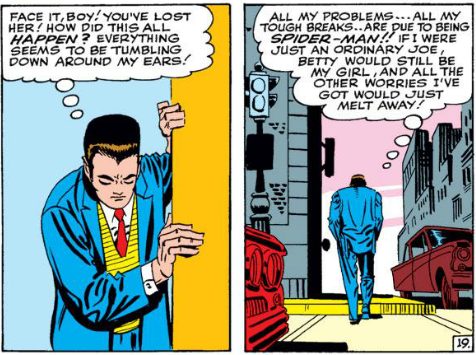
Of course, since there’s been roughly 700 issues since then, we know that Petey changes his mind. And in the final issue of this collection, Spidey strikes back with a vengeance. It makes for a very satisfying conclusion. Over the course of this book, a character dies, Spidey goes an entire issue without fighting anyone, and Peter Parker goes to great lengths to avoid getting set up on a blind date with Mary Jane Watson. Spider-Man was not quite like any other comic series from its time, and that’s A-OK. 4 stars, recommended!
These early Spider-Man comics are simply a cut above most of Marvel’s other work from that time. Many 1960’s comics can be extremely formulaic: a villain appears and raises hell, the hero confronts the villain, and the hero sends the villain off to jail without supper (and without anyone getting truly hurt, of course). The next issue they do it again, and again…and again. Spider-Man was more creative. There are plenty of villains to be dealt with, sure, but Peter Parker also has to deal with a sick aunt, a mortgage that needs paid, and chronic girl trouble.
Unlike his heroic colleagues, poor Spider-Man isn’t adored by the public at large. He’s renounced as a menace by the local newspaper, thanks to his nemesis John Jonah Jameson. It’s enough to frustrate even the strongest would-be superhero. For the first seven issues of this collection Spidey soldiers on, but eventually Parker hits rock bottom and seriously considers hanging up the tights and getting on with a normal life.
Of course, since there’s been roughly 700 issues since then, we know that Petey changes his mind. And in the final issue of this collection, Spidey strikes back with a vengeance. It makes for a very satisfying conclusion. Over the course of this book, a character dies, Spidey goes an entire issue without fighting anyone, and Peter Parker goes to great lengths to avoid getting set up on a blind date with Mary Jane Watson. Spider-Man was not quite like any other comic series from its time, and that’s A-OK. 4 stars, recommended!

April 29, 2025
Another dip into my youth. This volume not only contains Spider-Man comics from the 1960s, but also a reprint of the 1964 Spider-Man annual as well.
Good artowrk & plenty of action & humour throughout.
Good artowrk & plenty of action & humour throughout.

April 10, 2022
I have to say, I liked this a great deal more than I expected to. :P The only comic book that I've read before this was Captain America: Winter Soldier, which I wasn't too impressed by (the movie is better). But this collection was really enjoyable and fun.
Some nitpicks:
- Where is the back of these people's skulls??
- Aunt May was sooo annoying sometimes (Rosemary Harris is still the best). Does she just have no perception? Like, I'm pretty sure Rosemary Harris' Aunt May has already figured out that Peter Parker is Spider-Man, and meanwhile comic-book Aunt May is still over here treating him like a frail child. How does Peter Parker not lose his mind?? XD
Some things I liked:
- Spider-Man. I know, I know, he's everyone's favorite. I feel kinda cliché. But I gotta say, reading this made me like him even more. It was interesting to see him dealing with a sprained ankle and then catching the flu virus in the second issue, and navigating complicated relationships, and just the things like that that make him more human and relatable than most superheroes.
- The humor. I love how casually the narration was written, and how you can tell the writers were having fun and not taking themselves too seriously.
- How Stan Lee and Steve Ditko Create Spider-Man! This was just absolutely hilarious.
- Aunt May, after being kidnapped by the bad guys: "Do you realize we missed The Beverly Hillbillies??! I forgot all about them! And I've been waiting all week..."
Peter Parker: "You know something, Aunt May? In case I forgot to tell you, you're the ever lovin' greatest!"
Some nitpicks:
- Where is the back of these people's skulls??
- Aunt May was sooo annoying sometimes (Rosemary Harris is still the best). Does she just have no perception? Like, I'm pretty sure Rosemary Harris' Aunt May has already figured out that Peter Parker is Spider-Man, and meanwhile comic-book Aunt May is still over here treating him like a frail child. How does Peter Parker not lose his mind?? XD
Some things I liked:
- Spider-Man. I know, I know, he's everyone's favorite. I feel kinda cliché. But I gotta say, reading this made me like him even more. It was interesting to see him dealing with a sprained ankle and then catching the flu virus in the second issue, and navigating complicated relationships, and just the things like that that make him more human and relatable than most superheroes.
- The humor. I love how casually the narration was written, and how you can tell the writers were having fun and not taking themselves too seriously.
- How Stan Lee and Steve Ditko Create Spider-Man! This was just absolutely hilarious.
- Aunt May, after being kidnapped by the bad guys: "Do you realize we missed The Beverly Hillbillies??! I forgot all about them! And I've been waiting all week..."
Peter Parker: "You know something, Aunt May? In case I forgot to tell you, you're the ever lovin' greatest!"

June 13, 2019
Oh wow, does this bring back great memories. These are classic Stan Lee & Steve Ditko stories. First appearance of the Green Goblin and other classic Spider-Man villains. Plus the Sinister Six. Kind of funny that the Goblin never fit into the Sinister Six, almost like Stan and Steve had plans to keep the Goblin a villain of mystery for another couple of years. All were fun to read and to devour once again. Nice to be reminded how some of these villains first started, like Kraven the Hunter. Moving on Volume 3 (thanks to Comixology Unlimited).

January 19, 2013
Some of the finest Comic Books ever are collected in this book. This 2nd Masterworks Collections collects the Amazing Spider-man Issues 11-19 and Annual #1.
The book begins with a two part arch against Dr. Octopus and then issues #13-15 introduces Mysterio, Green Goblin (with guest stars the Enforcers and the Hulk), and Kraven, staples of the Spider-man universe.
The in Spider-man Annual #1, we meet perhaps the greatest supervillain team ever led by Doctor Octopus and with the Vulture, Kraven, Mysterio, and Sandman. In addition to this, Stan Lee works in a cameo for nearly every hero in the Marvel Universe from Thor to Dr. Strange and Captain America. The Human Torch gets two: one to promote the Fantastic Four and one to promote his own stories appearing in Strange Tales. We also see J Jonah show a little bit of humanity with some thinly camouflaged concern about Betty Brant leading him to put aside his feud with Spider-man to enlist Spider-man's help. He even talks to a Spider in desperation to get the message through! In addition to the main feature, you also get some nice early descriptions of Spider-man powers and some fantastic art portraying Stan Lee at work.
#16 features Spider-man fighting daredevil under the influence of the ringmaster.
The book ends with a final story arch from #17-#19. Flash Thompson has started the Spider-man fan club and Green Goblin decides to crash the party. During the fight Spider-man hears that Aunt May has taken ill and rushes away from the fight creating confusion with many believing him a coward. Issue 18 is an absolute nightmare for our webslinger as he for the first time considers hanging them up in a story that's resolved wonderfully in Issue #19.
The book has everything. Great fight, great drama, some pretty good comic relief as usual via the writing of Stan Lee. Peter Parker is growing and learning as a character, becoming a real hero in the face of media cynicism and his own self-doubt. This is Spider-man at his best and Stan Lee at his best as a writer.
There are two minor negatives. First, Steve Ditko's original drawing of Kraven is rather crude compared to other more polished work on the Hunter. Secondly, Daredevil guesses Peter's exact age in Issue 16. But 5 months later when they tangle in Daredevil #6, DD guesses merely that Spider-man is under 20.
Minor points to be sure, but this is a great collection to own either is this book or part of
Essential Amazing Spider-Man, Vol. 1.
The book begins with a two part arch against Dr. Octopus and then issues #13-15 introduces Mysterio, Green Goblin (with guest stars the Enforcers and the Hulk), and Kraven, staples of the Spider-man universe.
The in Spider-man Annual #1, we meet perhaps the greatest supervillain team ever led by Doctor Octopus and with the Vulture, Kraven, Mysterio, and Sandman. In addition to this, Stan Lee works in a cameo for nearly every hero in the Marvel Universe from Thor to Dr. Strange and Captain America. The Human Torch gets two: one to promote the Fantastic Four and one to promote his own stories appearing in Strange Tales. We also see J Jonah show a little bit of humanity with some thinly camouflaged concern about Betty Brant leading him to put aside his feud with Spider-man to enlist Spider-man's help. He even talks to a Spider in desperation to get the message through! In addition to the main feature, you also get some nice early descriptions of Spider-man powers and some fantastic art portraying Stan Lee at work.
#16 features Spider-man fighting daredevil under the influence of the ringmaster.
The book ends with a final story arch from #17-#19. Flash Thompson has started the Spider-man fan club and Green Goblin decides to crash the party. During the fight Spider-man hears that Aunt May has taken ill and rushes away from the fight creating confusion with many believing him a coward. Issue 18 is an absolute nightmare for our webslinger as he for the first time considers hanging them up in a story that's resolved wonderfully in Issue #19.
The book has everything. Great fight, great drama, some pretty good comic relief as usual via the writing of Stan Lee. Peter Parker is growing and learning as a character, becoming a real hero in the face of media cynicism and his own self-doubt. This is Spider-man at his best and Stan Lee at his best as a writer.
There are two minor negatives. First, Steve Ditko's original drawing of Kraven is rather crude compared to other more polished work on the Hunter. Secondly, Daredevil guesses Peter's exact age in Issue 16. But 5 months later when they tangle in Daredevil #6, DD guesses merely that Spider-man is under 20.
Minor points to be sure, but this is a great collection to own either is this book or part of
Essential Amazing Spider-Man, Vol. 1.

August 17, 2026
The last two issues were my favorite by far. Before that they were getting pretty tedious and repetitive, but I feel like they’re starting to switch things up a bit more, and the cliff hanger was definitely intriguing.

February 21, 2021
Enter the Green Goblin (#14)! Spidey’s nemesis is like many characters designed in these early days. Rough and unpolished (see notably Magneto in the Uncanny X-Men).
Apart from that the famous Parker’s luck sets in and causes many problems to poor Petey. Mary Jane is strongly alluded at many times but still remains to be seen. This and the mysterious Goblin identity are the only hints of a long term plot you will see for now- and I’m not sure Lee knew who was going to be the Goblin at the time.
But hey, I’ve always been fond of Spidey and him being conflicted between powers, responsibility and teenage life is the trademark we’ve all known to like.
Ditko illustrates all the issues again and again it’s hit-or-miss. Better than the first volume on the whole with some cool action poses-and casual ones- and more attention given to the inking but a lot of quickly done and unimpressive panels. I’ll admit I’m waiting for Romita senior to enter stage.
Apart from that the famous Parker’s luck sets in and causes many problems to poor Petey. Mary Jane is strongly alluded at many times but still remains to be seen. This and the mysterious Goblin identity are the only hints of a long term plot you will see for now- and I’m not sure Lee knew who was going to be the Goblin at the time.
But hey, I’ve always been fond of Spidey and him being conflicted between powers, responsibility and teenage life is the trademark we’ve all known to like.
Ditko illustrates all the issues again and again it’s hit-or-miss. Better than the first volume on the whole with some cool action poses-and casual ones- and more attention given to the inking but a lot of quickly done and unimpressive panels. I’ll admit I’m waiting for Romita senior to enter stage.

April 3, 2022
I was mildly surprised. I thought, comic book, it's pretty much all the same, right? Little to no rising tension or stakes.
Wrong. This book had a half-way decent structure with a nice climax in the last few issues, and a strong hook leading into the next volume. You can't say Stan Lee didn't know his stuff.
~
There were a lot of things to like about this. The tongue-in-cheek narration and credits was one. As well as some of the almost-passive-aggressive commentary. You can tell the team working on this were having a lot of fun.
~
As far as characters go: All of the villains were simplistically evil. Which makes for a potentially weak story... but I won't fault them for it. When writing for children, giving them a strong moral grounding is important. And if making all the villains pathological crime-bosses is the only way you know to serve that end...
That said, Green Goblin was the most compelling villain in the book because he wasn't dead set on becoming the greatest criminal to ever live. At least, not quite so overtly as the others. I can see why he's considered the Spider-Man villain.
~
In contrast to the card-board-cut-outs that the villains were, Peter Parker is surprisingly authentic and three dimensional. Seeing his struggles as a high-school kid and a loving nephew and (ex)boyfriend really made this comic series. I can see why everyone loved it.
That said, the experience of reading it was a little jarring. Like watching a 2D cartoon where the main character is (so to speak) dubbed-in Claymation.
~
As for the art: I grew to love Ditko's clear drawing style. I was never confused during the action sequences, and the dynamic poses and still shots of the superheroes, and villains, and the mild-mannered characters were nothing short of inspiring. I also very much appreciated their dramatic style (and the fact that they had to explain it was also hilarious).
~
So, yeah. Overall, I enjoyed this book a lot, and I look forward to reading Vol. 1, now (whoops).
Wrong. This book had a half-way decent structure with a nice climax in the last few issues, and a strong hook leading into the next volume. You can't say Stan Lee didn't know his stuff.
~
There were a lot of things to like about this. The tongue-in-cheek narration and credits was one. As well as some of the almost-passive-aggressive commentary. You can tell the team working on this were having a lot of fun.
~
As far as characters go: All of the villains were simplistically evil. Which makes for a potentially weak story... but I won't fault them for it. When writing for children, giving them a strong moral grounding is important. And if making all the villains pathological crime-bosses is the only way you know to serve that end...
That said, Green Goblin was the most compelling villain in the book because he wasn't dead set on becoming the greatest criminal to ever live. At least, not quite so overtly as the others. I can see why he's considered the Spider-Man villain.
~
In contrast to the card-board-cut-outs that the villains were, Peter Parker is surprisingly authentic and three dimensional. Seeing his struggles as a high-school kid and a loving nephew and (ex)boyfriend really made this comic series. I can see why everyone loved it.
That said, the experience of reading it was a little jarring. Like watching a 2D cartoon where the main character is (so to speak) dubbed-in Claymation.
~
As for the art: I grew to love Ditko's clear drawing style. I was never confused during the action sequences, and the dynamic poses and still shots of the superheroes, and villains, and the mild-mannered characters were nothing short of inspiring. I also very much appreciated their dramatic style (and the fact that they had to explain it was also hilarious).
~
So, yeah. Overall, I enjoyed this book a lot, and I look forward to reading Vol. 1, now (whoops).

January 14, 2021
This book is full of classics, maybe collecting some of the most classic comics of all time. It is deliciously corny and not to be taken seriously most of the time, but it is a boat load of fun. The art is underrated as well. Sure, it might not be a great as some of the modern comics we have now, but back then, these guys were still trying to find their bearings and figure out how to do this. It is amazing fun and it is fascinating to see just how much comics have changed from then to now. And who doesn't love Spider-Man? I mean come on.
October 31, 2022
i can’t get enough of spiderman, dude. so good.
October 15, 2024
Another stellar Spider-Man masterworks that brings in a lot more villains to be introduced and has a lot of fresh team ups new for the character.
November 2, 2022
3.5/5Actually great! The longer Lee and Ditko work on the series the more they find their groove. The villains now have more weight and the cliffhanger at the end is actually fantastic. I didn’t understand reading the first volume what the hype was about but this is great!

March 3, 2018
Forgot to cancel my free month of ComiXology Unlimited after reading Amazing Spider-Man, Vol. 1 so I decided to get a little ahead of a new podcast I’m listening to—Screw It, We’re Just Gonna Talk About Spider-Man—by reading Amazing Spider-Man, Vol. 2.
This graphic novel picks up where Vol. 1 left off, collecting the original Amazing Spider-Man comics written by Stan Lee & drawn by Steve Ditko starting with ASM #11 and going through ASM #19, with the first ASM Annual thrown in for good measure. These stories, published from April 1964 through December 1964 feature several returning villains, a few new foes, several Marvel crossover cameos, and even introduces a new team of baddies—the Sinister Six!
ASM #11’s cover tells of “the long-awaited ‘Return of Doctor Octopus!’” while the inner splash page warns that Peter may “lose Betty Brant, the girl he loves” (but didn't they just start dating in ASM #9?! Things sure do move fast in comic book land!). Seems Betty’s brother is a lawyer who got mixed up with the wrong clients. After Doc Ock is released from prison for good behavior, he has Betty drive him to Philly to break a gangster, one of her brother's clients, out of jail. Spidey follows but during a battle at the docks, Betty’s brother is killed and she blames Spider-Man for his death. Doctor Octopus escapes and Peter heads back to NYC, all alone.
ASM #12 features more Doc Ock, who has been traveling the country trying to get Spider-Man to attack him. He returns to NYC & takes Betty Brant hostage, hoping she’ll act as bait for Spider-Man again. But when Spider-Man attacks, he’s easily defeated and unmasked because Peter had the flu (or something). Luckily, everyone thinks Peter was just pretending to be Spider-Man *eye-roll*, and after a good night’s rest, he’s as strong as ever and defeats Doc Ock (after battling some animals released from the zoo).
ASM #13 introduces a new villain, Mysterio. Spoiler, he’s a movie stunt man who figured out how to replicate all of Spidey’s special powers, and then pretended to be him while pulling off crimes all over the city. He makes New York hate Spider-Man & love Mysterio, until Spidey defeats him & gets his confession on tape.
ASM #14 introduces the Green Goblin, without giving anything away about his backstory. All we know is GG has recruited the Enforcers (recently released from jail) & roped them into some crazy scheme that involves a movie shoot in the desert. Spider-Man agrees to be in their movie for the money (and because he thinks they're actors who look like the Enforcers), but the bad guys try to take him out during the first day of shooting. Unfortunately, their battle rolls into a desert cave where the Hulk sleeps, and so Spidey (and eventually the baddies) all fight the Hulk. In the end, the movie is canceled and Peter gets just enough money to travel back to NYC.
ASM #15 introduces another new baddie—Kraven the Hunter—and brings back one of the dumbest villains ever—The Chameleon. Seems Chameleon hired the greatest hunter in the world so he can hunt the one thing he hasn’t captured yet—Spider-Man! The hunter gets close to Spidey and poisons him, making him weak and shaky, but in the end, Spider-Man wins in Central Park even with Chameleon dressed up as a faux Kraven.
The first Annual features a double-long story where Doc Ock gathers Sandman, Mysterio, Kraven, Electro, and the Vulture to join forces as the Sinister Six to defeat Spider-Man. His “brilliant” plan is to capture Betty Brant (again) and lure Spider-Man to his defeat. However, Aunt May gets kidnapped too and Doc Ock places all six villains in different parts of the city, so Spider-Man fights them one by one. There are also at least half a dozen cameos from other Marvel superheroes, each with their own editorial plug for their comics (I suppose this is what all Annuals do? Plug each other’s work?). The best part about the silly plot is we’re treated to six full-page action shots of Spidey battling each foe individually.
The rest of the Annual has one-page features of every villain Spider-Man has battled so far, several pages detailing the secrets of Spidey’s powers, some of the side characters, and even a tongue in cheek look at how Lee tortures Ditko with his ideas & how they “collaborate” together each month...
ASM #16 features a villain previously defeated by The Hulk—The Ringmaster. He draws a sell-out crowd to his circus by promising Spider-Man will also be there and plans on hypnotizing the entire crowd with his big hat. When Spidey shows up to this circus where he's supposed to be, Ringmaster hypnotizes him and the entire crowd, except for one person—blind superhero, Daredevil. We get a pretty neat battle between hypnotized Spider-Man and Daredevil, but eventually, the spell is broken and Spidey defeats all the circus baddies.
ASM #17 features the return of the Green Goblin & return cameo of the Human Torch. Peter’s longtime bully, Flash Thompson throws an epic Spider-Man fan club event that GG crashes. He fights Spider-Man until Peter hears that Aunt May is sick and runs away. Torch picks up where he left off, but the whole city thinks Spider-Man is a coward.
ASM #18 is touted as the only time a “hero ha[s] no actual fight with any foe” because all issue, Peter avoids fights with the Vulture and Sandman because he’s too worried what would happen to Aunt May if he did get hurt. Flash even goes so far as to dress up as Spider-Man (again!) and gets beat up for his trouble.
ASM #19 has Aunt May return to good health, so Spider-Man returns to beating up bank robbers (and J. Jonah Jameson is humiliated for celebrating how cowardly Spider-Man was). Then Sandman and the Enforcers team up to defeat all costumed heroes, starting with a weakened Human Torch (seems Strange Tales #127 was tough on the Torch). Spidey has to battle all four to rescue Torch, and the two do some fighting side by side. The issue ends with a cliffhanger of someone in the shadows tailing Peter for some mysterious reason. Guess I’ll be reading Amazing Spider-Man Vol. 3
I think I enjoyed these stories more than the first ten, but still there are some silly plot lines or contrived setups to keep it from being a full 5*. Also, this Marvel Masterworks collection feels a little weaker than Vol 1—there was still a silly introduction from Mr. Stan Lee himself but there was only one original sketch at the end unlike the pages of extra content in Vol. 1.
I am glad that we finally got some mentions of Mary Jane Watson—but I’m still surprised she hasn’t actually been introduced yet. I guess with Pete and Betty on the rocks, maybe she’ll come into his world next volume? And the cliffhanger in Vol #19 is the perfect end for this collection—it really makes me want to read #20 right away. Is that JJJ paying someone to tail Peter because he suspects Pete’s actually Spider-Man? Or is it someone else entirely? Can’t wait to find out!
This graphic novel picks up where Vol. 1 left off, collecting the original Amazing Spider-Man comics written by Stan Lee & drawn by Steve Ditko starting with ASM #11 and going through ASM #19, with the first ASM Annual thrown in for good measure. These stories, published from April 1964 through December 1964 feature several returning villains, a few new foes, several Marvel crossover cameos, and even introduces a new team of baddies—the Sinister Six!
ASM #11’s cover tells of “the long-awaited ‘Return of Doctor Octopus!’” while the inner splash page warns that Peter may “lose Betty Brant, the girl he loves” (but didn't they just start dating in ASM #9?! Things sure do move fast in comic book land!). Seems Betty’s brother is a lawyer who got mixed up with the wrong clients. After Doc Ock is released from prison for good behavior, he has Betty drive him to Philly to break a gangster, one of her brother's clients, out of jail. Spidey follows but during a battle at the docks, Betty’s brother is killed and she blames Spider-Man for his death. Doctor Octopus escapes and Peter heads back to NYC, all alone.
ASM #12 features more Doc Ock, who has been traveling the country trying to get Spider-Man to attack him. He returns to NYC & takes Betty Brant hostage, hoping she’ll act as bait for Spider-Man again. But when Spider-Man attacks, he’s easily defeated and unmasked because Peter had the flu (or something). Luckily, everyone thinks Peter was just pretending to be Spider-Man *eye-roll*, and after a good night’s rest, he’s as strong as ever and defeats Doc Ock (after battling some animals released from the zoo).
ASM #13 introduces a new villain, Mysterio. Spoiler, he’s a movie stunt man who figured out how to replicate all of Spidey’s special powers, and then pretended to be him while pulling off crimes all over the city. He makes New York hate Spider-Man & love Mysterio, until Spidey defeats him & gets his confession on tape.
ASM #14 introduces the Green Goblin, without giving anything away about his backstory. All we know is GG has recruited the Enforcers (recently released from jail) & roped them into some crazy scheme that involves a movie shoot in the desert. Spider-Man agrees to be in their movie for the money (and because he thinks they're actors who look like the Enforcers), but the bad guys try to take him out during the first day of shooting. Unfortunately, their battle rolls into a desert cave where the Hulk sleeps, and so Spidey (and eventually the baddies) all fight the Hulk. In the end, the movie is canceled and Peter gets just enough money to travel back to NYC.
ASM #15 introduces another new baddie—Kraven the Hunter—and brings back one of the dumbest villains ever—The Chameleon. Seems Chameleon hired the greatest hunter in the world so he can hunt the one thing he hasn’t captured yet—Spider-Man! The hunter gets close to Spidey and poisons him, making him weak and shaky, but in the end, Spider-Man wins in Central Park even with Chameleon dressed up as a faux Kraven.
The first Annual features a double-long story where Doc Ock gathers Sandman, Mysterio, Kraven, Electro, and the Vulture to join forces as the Sinister Six to defeat Spider-Man. His “brilliant” plan is to capture Betty Brant (again) and lure Spider-Man to his defeat. However, Aunt May gets kidnapped too and Doc Ock places all six villains in different parts of the city, so Spider-Man fights them one by one. There are also at least half a dozen cameos from other Marvel superheroes, each with their own editorial plug for their comics (I suppose this is what all Annuals do? Plug each other’s work?). The best part about the silly plot is we’re treated to six full-page action shots of Spidey battling each foe individually.
The rest of the Annual has one-page features of every villain Spider-Man has battled so far, several pages detailing the secrets of Spidey’s powers, some of the side characters, and even a tongue in cheek look at how Lee tortures Ditko with his ideas & how they “collaborate” together each month...
ASM #16 features a villain previously defeated by The Hulk—The Ringmaster. He draws a sell-out crowd to his circus by promising Spider-Man will also be there and plans on hypnotizing the entire crowd with his big hat. When Spidey shows up to this circus where he's supposed to be, Ringmaster hypnotizes him and the entire crowd, except for one person—blind superhero, Daredevil. We get a pretty neat battle between hypnotized Spider-Man and Daredevil, but eventually, the spell is broken and Spidey defeats all the circus baddies.
ASM #17 features the return of the Green Goblin & return cameo of the Human Torch. Peter’s longtime bully, Flash Thompson throws an epic Spider-Man fan club event that GG crashes. He fights Spider-Man until Peter hears that Aunt May is sick and runs away. Torch picks up where he left off, but the whole city thinks Spider-Man is a coward.
ASM #18 is touted as the only time a “hero ha[s] no actual fight with any foe” because all issue, Peter avoids fights with the Vulture and Sandman because he’s too worried what would happen to Aunt May if he did get hurt. Flash even goes so far as to dress up as Spider-Man (again!) and gets beat up for his trouble.
ASM #19 has Aunt May return to good health, so Spider-Man returns to beating up bank robbers (and J. Jonah Jameson is humiliated for celebrating how cowardly Spider-Man was). Then Sandman and the Enforcers team up to defeat all costumed heroes, starting with a weakened Human Torch (seems Strange Tales #127 was tough on the Torch). Spidey has to battle all four to rescue Torch, and the two do some fighting side by side. The issue ends with a cliffhanger of someone in the shadows tailing Peter for some mysterious reason. Guess I’ll be reading Amazing Spider-Man Vol. 3
I think I enjoyed these stories more than the first ten, but still there are some silly plot lines or contrived setups to keep it from being a full 5*. Also, this Marvel Masterworks collection feels a little weaker than Vol 1—there was still a silly introduction from Mr. Stan Lee himself but there was only one original sketch at the end unlike the pages of extra content in Vol. 1.
I am glad that we finally got some mentions of Mary Jane Watson—but I’m still surprised she hasn’t actually been introduced yet. I guess with Pete and Betty on the rocks, maybe she’ll come into his world next volume? And the cliffhanger in Vol #19 is the perfect end for this collection—it really makes me want to read #20 right away. Is that JJJ paying someone to tail Peter because he suspects Pete’s actually Spider-Man? Or is it someone else entirely? Can’t wait to find out!
This entire review has been hidden because of spoilers.

October 14, 2023
“That guy’s the most!”
Look for: Like the Spider-Man ride at Islands of Adventure, a story ending with J. Jonah Jameson suspended at ceiling level in his office (#13); Spider-Man saying he doesn’t even want to share the same planet with the Hulk, foreshadowing Planet Hulk (#14); Spider-Man’s quip about Kraven hunting squirrel foreshadowing Squirrel Girl’s temporary redemption of him (#15); Aunt May’s spectacular Stockholm Syndrome (Annual #1); Stan Lee and Steve Ditko taking center stage in a fun bonus story (Annual #1); Spider-Man insisting on the hyphen in his name (#19); and first appearances by Mysterio (#13), Green Goblin (#14), Kraven (#15), the Sinister Six (Annual #1), and Ned Leeds (#18).
MCU connections: Mysterio uses Steve Rogers’ catchphrase “I can do this all day!” (#13); and a Spider-Man movie films in New Mexico, like the first Thor (#14).
Mistakes: A miscommunication between script and art turns a roller coaster into a Ferris wheel (#12); Green Goblin can’t count to three Enforcers, instead saying four (#14); and Kraven misplaces the Congo in South America (#15)!
Look for: Like the Spider-Man ride at Islands of Adventure, a story ending with J. Jonah Jameson suspended at ceiling level in his office (#13); Spider-Man saying he doesn’t even want to share the same planet with the Hulk, foreshadowing Planet Hulk (#14); Spider-Man’s quip about Kraven hunting squirrel foreshadowing Squirrel Girl’s temporary redemption of him (#15); Aunt May’s spectacular Stockholm Syndrome (Annual #1); Stan Lee and Steve Ditko taking center stage in a fun bonus story (Annual #1); Spider-Man insisting on the hyphen in his name (#19); and first appearances by Mysterio (#13), Green Goblin (#14), Kraven (#15), the Sinister Six (Annual #1), and Ned Leeds (#18).
MCU connections: Mysterio uses Steve Rogers’ catchphrase “I can do this all day!” (#13); and a Spider-Man movie films in New Mexico, like the first Thor (#14).
Mistakes: A miscommunication between script and art turns a roller coaster into a Ferris wheel (#12); Green Goblin can’t count to three Enforcers, instead saying four (#14); and Kraven misplaces the Congo in South America (#15)!

December 26, 2018
This is it, true believers! This is where the rubber can be truly said to have hit the road, where storytelling in the merry Marvel manner truly hit its first milestone, balancing high-flying super-heroic action with human drama and pathos. Aside from Spidey's dust-ups with foes new and old--some of them encompassing multiple dramatic issues--the people in his life finally get some vim and verve. taking on really human characteristics that make them well-rounded individuals in their own rights, as well as contributing in significant ways to Peter Parker's growth and development. Of particular note is issue #18, in which a demoralized and unlucky Spider-Man, forced to flee a battle to rush to Aunt May's sickbed, is turned on by all those around him, labeled a coward, and reaches a nadir in his personal and public fortunes--leading him, for the first time, to consider giving up his double life. Stan Lee subverts expectations by having Flash Thompson, Parker's schoolyard foe, maintain his devotion to his hero Spider-Man, going so far as to get roughed up by some thugs in a bid to bring Spidey back into action, in what's really a touching show of Flash's character. Notably, this issue is a first in the Marvel Universe in that Spider-Man never has a battle with a super-foe--though he does get chased around briefly by Sandman--with the majority of the issue devoted to his personal angsts. In the end, it's up to a speech from the rallying Aunt May--who displays heretofore stores of her own courage and strength--to convince Peter to take up the mantle of Spider-Man again. The whole issue is a fairly remarkable exploration of adolescent existential dread, with Peter forced into inaction not by any true external factor, but by his fear of *what* *might* *happen* if he *does* take action--that is, leaving Aunt May alone to pursue his destiny as a crime-fighter. It's a neat and satisfying arc, all the more remarkable in that it feels totally earned in the space of a single issue. Stan and Steve's collaborative powers are at their height here.
This collection also encompasses the exact cultural moment when people said "I'll just do that little thing!"--or at least Stan thought they did.
BRING ON THE BAD GUYS: These issues are largely made up of returning challenges: Doctor Octopus, Sandman, Electro, the Vulture, Chameleon, and even the Hulk's foe, Ringmaster. Also, SOMEONE was really fond of the Enforcers in this era--Ox, Fancy Dan and Montana--as they appear at least twice more. I am not that fond of them. Additionally, Mysterio and Kraven the Hunter make their debuts, and they team with Doc Ock, Sandman, Electro, and Vulture to form the first iteration of the Sinister Six (in a promising but ultimately weak super-villain teamup that seems to have been an excuse to seed Spidey's first Annual issue with full-page pin-ups of him clobbering his greatest foes). Most notably, this collection sees the debut of the Green Goblin, who, despite an inauspicious beginning (really, who came up with that fake movie plan?), would become one of Peter's deadliest and most enduring foes, a major shaker of the entire Marvel Universe, and ultimately the final impetus for Steve Ditko's split from the title due to creative differences with Stan Lee. Doc Ock offers one of my favorite two-part threats in a story where he--gasp!--unmasks Spider-Man! (Not a hoax! Not an imaginary tale! How does Pete get out of that one?!)
LADYWATCH: Peter spends most of this collections trying to convince Betty Brant she likes her and not Liz Allen. Betty is the blander of the two--"Golly, I thought he might be jealous if I started seeing another man!"--while Liz quickly becomes an interesting character, showing a surprisingly deep attraction for intellectual Peter Parker over her boyfriend Flash. As noted above, May transcends her frail old lady archetype to provide Peter with actual inspiration (and is it funny that I never realized until now that this woman who raised him like a son isn't even his blood relation?). Hilariously, she spends an issue kidnapped by Doctor Octopus, whom she finds completely charming, and then flips her lid when she realizes she missed the Beverly Hillbillies. This is also the first time a little lady named Mary Jane Watson is mentioned--the nice neighbor lady's niece--and Peter spends a few issues trying to avoid her.
SUPERHERO TEAMUP: This collection features cameos from just about every hero then appearing in the Marvel Universe--Stan took the opportunity of Spidey's splashy first annual to plug every title running--but three most prominently--the Hulk, Daredevil, and the Human Torch. First, ol' Green Jeans makes a very fortuitous appearance, chilling in the southwestern caves where Spider-Man just happens to be battling the Goblin and the Enforcers, and serves little purpose but to complicate an already senseless conflict. DD's appearance assisting Spidey with the Ringmaster was probably intended to goose sales on his own just-debuted title, and it's a momentous and friendly first meeting between two characters who would go on to bond and form an effective friendship in the future. The Torch's appearances are the most character-driven, with the two teen hotheads finally acknowledging the mutual respect and affection behind their bantering rivalry; like Flash, the Torch maintains his belief in Spidey during his dark times, and is right there fighting by his side when he gets his mojo back.
CONTINUITY NOTES: Lots and lots of footnotes to previous issues and other heroes' titles. In her brief cameo, the Wasp maintains her amusing and baseless antipathy for Spider-Man established in issues of the Avengers. Daredevil's guest stint falls around the time of the third issue of his own title. The ins and outs of prison of some of Spidey's foes, especially the Sinster Six, are difficult to square with their appearances here and in other titles (how does Kraven get deported so often and still keep showing up here and in Tales of Suspense?!).
This collection also encompasses the exact cultural moment when people said "I'll just do that little thing!"--or at least Stan thought they did.
BRING ON THE BAD GUYS: These issues are largely made up of returning challenges: Doctor Octopus, Sandman, Electro, the Vulture, Chameleon, and even the Hulk's foe, Ringmaster. Also, SOMEONE was really fond of the Enforcers in this era--Ox, Fancy Dan and Montana--as they appear at least twice more. I am not that fond of them. Additionally, Mysterio and Kraven the Hunter make their debuts, and they team with Doc Ock, Sandman, Electro, and Vulture to form the first iteration of the Sinister Six (in a promising but ultimately weak super-villain teamup that seems to have been an excuse to seed Spidey's first Annual issue with full-page pin-ups of him clobbering his greatest foes). Most notably, this collection sees the debut of the Green Goblin, who, despite an inauspicious beginning (really, who came up with that fake movie plan?), would become one of Peter's deadliest and most enduring foes, a major shaker of the entire Marvel Universe, and ultimately the final impetus for Steve Ditko's split from the title due to creative differences with Stan Lee. Doc Ock offers one of my favorite two-part threats in a story where he--gasp!--unmasks Spider-Man! (Not a hoax! Not an imaginary tale! How does Pete get out of that one?!)
LADYWATCH: Peter spends most of this collections trying to convince Betty Brant she likes her and not Liz Allen. Betty is the blander of the two--"Golly, I thought he might be jealous if I started seeing another man!"--while Liz quickly becomes an interesting character, showing a surprisingly deep attraction for intellectual Peter Parker over her boyfriend Flash. As noted above, May transcends her frail old lady archetype to provide Peter with actual inspiration (and is it funny that I never realized until now that this woman who raised him like a son isn't even his blood relation?). Hilariously, she spends an issue kidnapped by Doctor Octopus, whom she finds completely charming, and then flips her lid when she realizes she missed the Beverly Hillbillies. This is also the first time a little lady named Mary Jane Watson is mentioned--the nice neighbor lady's niece--and Peter spends a few issues trying to avoid her.
SUPERHERO TEAMUP: This collection features cameos from just about every hero then appearing in the Marvel Universe--Stan took the opportunity of Spidey's splashy first annual to plug every title running--but three most prominently--the Hulk, Daredevil, and the Human Torch. First, ol' Green Jeans makes a very fortuitous appearance, chilling in the southwestern caves where Spider-Man just happens to be battling the Goblin and the Enforcers, and serves little purpose but to complicate an already senseless conflict. DD's appearance assisting Spidey with the Ringmaster was probably intended to goose sales on his own just-debuted title, and it's a momentous and friendly first meeting between two characters who would go on to bond and form an effective friendship in the future. The Torch's appearances are the most character-driven, with the two teen hotheads finally acknowledging the mutual respect and affection behind their bantering rivalry; like Flash, the Torch maintains his belief in Spidey during his dark times, and is right there fighting by his side when he gets his mojo back.
CONTINUITY NOTES: Lots and lots of footnotes to previous issues and other heroes' titles. In her brief cameo, the Wasp maintains her amusing and baseless antipathy for Spider-Man established in issues of the Avengers. Daredevil's guest stint falls around the time of the third issue of his own title. The ins and outs of prison of some of Spidey's foes, especially the Sinster Six, are difficult to square with their appearances here and in other titles (how does Kraven get deported so often and still keep showing up here and in Tales of Suspense?!).
March 19, 2025
I feel like this series has started to come into its own with this volume - there wasn’t a single bad issue.
Admittedly, it wasn’t without its weaker points, as reflected in the rating - the second Dr Octopus issues paled in comparison to the first, to the point where I forgot what happened immediately after reading and Spider-Man fighting the circus as an antagonist cannot be ignored (Daredevil saved the issue).
Outside of this, it was awesome. Both the annual and Mysterio issues are arguably 5 stars in their own right, Green Goblin and Kraven had some top quality issues and I love how the Enforcers continue to feature as goons for hire.
I also have to commend issue 18. In a time where comics lived and died by their action, this issue had none, instead giving Peter some much needed character development. It was risky for the time but ended up being one of the best issues of the lot.
The series started on strong foundations and is refining its formula the more I read. Long may it continue.
Admittedly, it wasn’t without its weaker points, as reflected in the rating - the second Dr Octopus issues paled in comparison to the first, to the point where I forgot what happened immediately after reading and Spider-Man fighting the circus as an antagonist cannot be ignored (Daredevil saved the issue).
Outside of this, it was awesome. Both the annual and Mysterio issues are arguably 5 stars in their own right, Green Goblin and Kraven had some top quality issues and I love how the Enforcers continue to feature as goons for hire.
I also have to commend issue 18. In a time where comics lived and died by their action, this issue had none, instead giving Peter some much needed character development. It was risky for the time but ended up being one of the best issues of the lot.
The series started on strong foundations and is refining its formula the more I read. Long may it continue.

December 31, 2018
More of the same silliness as the previous volume. As an art form, this volume only adds to the history of Spiderman. There's a bit of promise of more by the continued presence of some of the regular characters and some very minor hints at what's to come. Stories are formulaic and rather dull. But again, as an intro to some of Spidey's great villians, not bad.
(I will admit to hating Kraven. He could have been so much more interesting. Green Goblin was introduced as a ridiculous caricature of what he eventually becomes. Other minor villians exist, but who cares? They're as uninteresting as that which they're after: victory over Spiderman and whatever wealth comes from burglary and breaking and entering.)
(I will admit to hating Kraven. He could have been so much more interesting. Green Goblin was introduced as a ridiculous caricature of what he eventually becomes. Other minor villians exist, but who cares? They're as uninteresting as that which they're after: victory over Spiderman and whatever wealth comes from burglary and breaking and entering.)
June 3, 2015
The Amazing Spider-Man #11-19 and Annual #1, April-December 1964.
The stories are a bit better than the previous volume. I rather enjoyed the guest appearances by Daredevil and Torch.
The behavior of the teenagers, especially the girls, made me angry. If this is how we were expected to behave, it is no wonder that we were messed up.
The stories are a bit better than the previous volume. I rather enjoyed the guest appearances by Daredevil and Torch.
The behavior of the teenagers, especially the girls, made me angry. If this is how we were expected to behave, it is no wonder that we were messed up.

June 14, 2024
Turning Point (originally published April 1964 in The Amazing Spider-Man #11)
The long-awaited return of Doc Ock, and the debut of the Spider-Tracer!
Peter and Betty are in love now, for no real reason, and with no real character development, and it's time for a way-too-long "will they or won't they" game. The cover promises that Peter will reveal his secret identity to someone (Betty), but that of course doesn't happen due toplot contrivances Parker Luck™. 3/5
Unmasked by Dr. Octopus! (originally published May 1964 in The Amazing Spider-Man #12)
There's some good character development in this issue for Flash Thompson and Liz Allen, but aside from that, it's just plain silly.
Spider-Man temporarily loses his powers due to a twenty-four hour virus (yes, really), has his mask ripped off by Doc Ock (!) in front of Betty, Jameson, and a police offer, and none of them even consider the possibility that Peter is Spider-Man (Ock somehow knows/remembers Peter's full name), instead believing that he foolishly tried to play hero. Liz and Flash come to the same conclusion when they hear of it. Additional silliness is found in the form of Spider-Man fighting escaped zoo animals. WTF? 2/5
The Menace of... Mysterio! (originally published June 1964 in The Amazing Spider-Man #13)
Plot contrivances don't hold back this very fun story featuring the debut of one of Spidey's coolest (on a conceptual level) baddies. 4/5
The Grotesque Adventure of the Green Goblin! (originally published July 1964 in The Amazing Spider-Man #14)
Another month, another debut of a classic rogue that would be a mainstay for decades. This time, it's Spidey's arch-enemy, and Lee/Ditko decide to leave his identity a mystery for a change. This mystery will become a recurring storyline very shortly if I remember correctly.
The Green Goblin isn't fully fleshed out visually... well, he looks mostly like we recognize him, except with a goofy crotch rocket instead of a glider. The letterer even knew it was bad, and puts "broomstick" in quotations all throughout the issue.
The story involving Hollywood caricatures is actually pretty funny and entertaining. The Hulk (whose guest appearance is advertised on the cover) is used only as a plot device at the end but it's still cool to see him. Betty is becoming insufferable at this point, though. 4/5
Kraven the Hunter! (originally published August 1964 in The Amazing Spider-Man #15)
Three heavy-hitter rogues in a row. Another classic character is introduced and it's another one of my (conceptual) favorites. The literature-inspired story is good, and the Chameleon makes a guest appearance as well. Fun stuff. Also, first mention of Mary Jane Watson (only referred to as "Mrs. Watson's niece" here). 4/5
The Sinister Six! (originally published October 1964 in The Amazing Spider-Man Annual #1)
The Sinister Six have a very strong legacy despite not showing up again until the 90s. I feel like they get discussed really frequently, and so far, there have been two failed attempts at bringing them together in Sony movies via half-baked cinematic universes.
I guess it's just the idea behind the group, because this story is mediocre. It's sooooo overly long, and should have just been a regular sized issue instead of an artificially extended jumbo-sized annual. The good stuff is good, but the padding is insufferable. Literally every other Marvel hero shows up for a brief cameo, and very few have any relevance to the plot and serve only as (very) thinly-veiled advertisements for other Marvel series. There's also a disgusting amount of exposition (even by the standards of the Silver Age) and a brief sub-plot about Peter losing his powers which serves no purpose other than to, you guessed it, pad out the length of the story.
Aunt May is typically portrayed as doting and naive in these early stories, but here, she is basically senile. The best part is a funny bit where Jameson talks to a spider to try to get info about Spider-Man (deducing that he may communicate with them like Ant-Man). For what I believe is the first time since Amazing Fantasy #15, Uncle Ben is mentioned and the origin story is recapped. The atonement theme still isn't quite there but it's getting more and more fleshed out.
After the main story which runs for an excruciating 41 pages, the remainder of the 72 pager is padded out with more junk. Villain pin-up pages, explanations about Spider-Man's powers, etc. Hilariously, the final strip shows the writing/drawing process for the comics, and it strongly implies that Ditko does most of the actual heavy lifting. So much for Lee being a glory hound. 2/5
Duel with Daredevil!! (originally published September 1964 in The Amazing Spider-Man #16)
Here we have Daredevil as a guest star, as well as the Ringmaster, a villain borrowed from The Incredible Hulk. The Marvel universe truly is a universe at this point.
It feels like a filler issue but is fun nonetheless. I've always loved the panel at the end where Matt gives the Ringmaster his business card as he is being arrested. Peter and Betty's relationship is basically Weekend at Bernie's at this point. 3/5
The Return of the Green Goblin! (originally published October 1964 in The Amazing Spider-Man #17)
I guess Lee/Ditko knew they struck gold with the Green Goblin because they sure brought him back quick. This time he has his glider. He refers to it being "redesigned," but makes no mention of the goofy "broomstick." This could honestly qualify as a retcon. We also see his signature pumpkin bombs for the first time.
The soap operatic story of the supporting cast is firing on all cylinders. Flash remaining a loyal fan despite Spidey being branded as "yellow" is a riot. Mary Jane is mentioned by name for the first time, although we won't see her for quite a bit still. The ending is a bit historic, as it's a bit of a cliffhanger that gives us the first thing resembling a continuing story that we've seen thus far. Flash at one point calls Liz Allen's father "Mr. Brant," which is of course Betty's surname. Oops. 4/5
The End of Spider-Man! (originally published November 1964 in The Amazing Spider-Man #18)
Honestly, this is a very ambitious Silver Age comic. There's almost no action at all, and Spider-Man fights no one... and it's still entertaining.
Love that Flash is still loyal to his boy. Progress is finally made with the Betty storyline. The cliffhanger of the previous issue is resolved. I can't help but think Peter's aversion to fights in this one would be handled a bit differently if the atonement theme of the origin had been fully fleshed out. Mary Jane's aunt is repeatedly referred to as "Mrs. Watkins" in this one. 4/5
Spidey Strikes Back! (originally published December 1964 in The Amazing Spider-Man #19)
After the previous issue, this one is almost non-stop action. Cool to see Spidey back in top form, but not cool that we're running in circles with Betty Brant again. It ends with a tease for things to come, and if I remember correctly, the quality of the series is about to pick up in a big way. 3/5
The long-awaited return of Doc Ock, and the debut of the Spider-Tracer!
Peter and Betty are in love now, for no real reason, and with no real character development, and it's time for a way-too-long "will they or won't they" game. The cover promises that Peter will reveal his secret identity to someone (Betty), but that of course doesn't happen due to
Unmasked by Dr. Octopus! (originally published May 1964 in The Amazing Spider-Man #12)
There's some good character development in this issue for Flash Thompson and Liz Allen, but aside from that, it's just plain silly.
Spider-Man temporarily loses his powers due to a twenty-four hour virus (yes, really), has his mask ripped off by Doc Ock (!) in front of Betty, Jameson, and a police offer, and none of them even consider the possibility that Peter is Spider-Man (Ock somehow knows/remembers Peter's full name), instead believing that he foolishly tried to play hero. Liz and Flash come to the same conclusion when they hear of it. Additional silliness is found in the form of Spider-Man fighting escaped zoo animals. WTF? 2/5
The Menace of... Mysterio! (originally published June 1964 in The Amazing Spider-Man #13)
Plot contrivances don't hold back this very fun story featuring the debut of one of Spidey's coolest (on a conceptual level) baddies. 4/5
The Grotesque Adventure of the Green Goblin! (originally published July 1964 in The Amazing Spider-Man #14)
Another month, another debut of a classic rogue that would be a mainstay for decades. This time, it's Spidey's arch-enemy, and Lee/Ditko decide to leave his identity a mystery for a change. This mystery will become a recurring storyline very shortly if I remember correctly.
The Green Goblin isn't fully fleshed out visually... well, he looks mostly like we recognize him, except with a goofy crotch rocket instead of a glider. The letterer even knew it was bad, and puts "broomstick" in quotations all throughout the issue.
The story involving Hollywood caricatures is actually pretty funny and entertaining. The Hulk (whose guest appearance is advertised on the cover) is used only as a plot device at the end but it's still cool to see him. Betty is becoming insufferable at this point, though. 4/5
Kraven the Hunter! (originally published August 1964 in The Amazing Spider-Man #15)
Three heavy-hitter rogues in a row. Another classic character is introduced and it's another one of my (conceptual) favorites. The literature-inspired story is good, and the Chameleon makes a guest appearance as well. Fun stuff. Also, first mention of Mary Jane Watson (only referred to as "Mrs. Watson's niece" here). 4/5
The Sinister Six! (originally published October 1964 in The Amazing Spider-Man Annual #1)
The Sinister Six have a very strong legacy despite not showing up again until the 90s. I feel like they get discussed really frequently, and so far, there have been two failed attempts at bringing them together in Sony movies via half-baked cinematic universes.
I guess it's just the idea behind the group, because this story is mediocre. It's sooooo overly long, and should have just been a regular sized issue instead of an artificially extended jumbo-sized annual. The good stuff is good, but the padding is insufferable. Literally every other Marvel hero shows up for a brief cameo, and very few have any relevance to the plot and serve only as (very) thinly-veiled advertisements for other Marvel series. There's also a disgusting amount of exposition (even by the standards of the Silver Age) and a brief sub-plot about Peter losing his powers which serves no purpose other than to, you guessed it, pad out the length of the story.
Aunt May is typically portrayed as doting and naive in these early stories, but here, she is basically senile. The best part is a funny bit where Jameson talks to a spider to try to get info about Spider-Man (deducing that he may communicate with them like Ant-Man). For what I believe is the first time since Amazing Fantasy #15, Uncle Ben is mentioned and the origin story is recapped. The atonement theme still isn't quite there but it's getting more and more fleshed out.
After the main story which runs for an excruciating 41 pages, the remainder of the 72 pager is padded out with more junk. Villain pin-up pages, explanations about Spider-Man's powers, etc. Hilariously, the final strip shows the writing/drawing process for the comics, and it strongly implies that Ditko does most of the actual heavy lifting. So much for Lee being a glory hound. 2/5
Duel with Daredevil!! (originally published September 1964 in The Amazing Spider-Man #16)
Here we have Daredevil as a guest star, as well as the Ringmaster, a villain borrowed from The Incredible Hulk. The Marvel universe truly is a universe at this point.
It feels like a filler issue but is fun nonetheless. I've always loved the panel at the end where Matt gives the Ringmaster his business card as he is being arrested. Peter and Betty's relationship is basically Weekend at Bernie's at this point. 3/5
The Return of the Green Goblin! (originally published October 1964 in The Amazing Spider-Man #17)
I guess Lee/Ditko knew they struck gold with the Green Goblin because they sure brought him back quick. This time he has his glider. He refers to it being "redesigned," but makes no mention of the goofy "broomstick." This could honestly qualify as a retcon. We also see his signature pumpkin bombs for the first time.
The soap operatic story of the supporting cast is firing on all cylinders. Flash remaining a loyal fan despite Spidey being branded as "yellow" is a riot. Mary Jane is mentioned by name for the first time, although we won't see her for quite a bit still. The ending is a bit historic, as it's a bit of a cliffhanger that gives us the first thing resembling a continuing story that we've seen thus far. Flash at one point calls Liz Allen's father "Mr. Brant," which is of course Betty's surname. Oops. 4/5
The End of Spider-Man! (originally published November 1964 in The Amazing Spider-Man #18)
Honestly, this is a very ambitious Silver Age comic. There's almost no action at all, and Spider-Man fights no one... and it's still entertaining.
Love that Flash is still loyal to his boy. Progress is finally made with the Betty storyline. The cliffhanger of the previous issue is resolved. I can't help but think Peter's aversion to fights in this one would be handled a bit differently if the atonement theme of the origin had been fully fleshed out. Mary Jane's aunt is repeatedly referred to as "Mrs. Watkins" in this one. 4/5
Spidey Strikes Back! (originally published December 1964 in The Amazing Spider-Man #19)
After the previous issue, this one is almost non-stop action. Cool to see Spidey back in top form, but not cool that we're running in circles with Betty Brant again. It ends with a tease for things to come, and if I remember correctly, the quality of the series is about to pick up in a big way. 3/5

August 2, 2023
Bogged down by Stan Lee's dialogue and text but it's not that bad and I think he does a good job with the characters. Again, I really love the contrast between fun heroic Spider-man and the now cocky Peter Parker. He's basically a covert narcissist, and Ditko draws him perfectly.
Ditko draws a lot of things perfectly. He's figure work on Spider-man is outstanding. He does faces super well getting Peter Parker and J Jonah Jameson perfect. His villain designs, especially Doc Octopus, are wonderful. He has a very playful almost juvenile style with a big variation in line thickness.
I'm no Spider-man scholar, so correct me if I'm wrong, but in comics I've read Spider-man basically has two uses for his webs - swinging and trapping people. Here he has all sorts of (sometimes goofy) uses including as a scuba mask, a parachute, a sticky wall (which is I guess what a spider uses it for!).
Maybe the best issue was the Annual 1964 where Spider-man takes on the Sinister Six and there's guest appearances by basically all the Marvel characters available in 64. Each villain has a full page splash with them fighting Spider-man. It's still wild to me that by issue 16, Lee and Ditko had created about 10 villains that stood the test of time. Sure, there's a few of these guys that died off pretty quick. Looking at you The Living Brain... although an AI powered robot makes sense nowadays. The Chameleon, The Vulture, Dr. Octopus, Sandman, The Lizard, Electro, Mysterio, The Green Goblin, Kraven the Hunter are all great.
Issue 16 doesn't even really have a villain. Peter Parker struggles with Jameson always attacking Spider-man, his failing relationship with Betty because she's jealous of Liz, fears about future run-ins with powerful villains after the close-calls he's had, financial struggles, Aunt May's illness. Thankfully atleast Johnny Storm believes in Spider-man. He seems to be the only one. Parker considers packing it in, but May's emotional strength and comments inspire him once again.
Ditko draws a lot of things perfectly. He's figure work on Spider-man is outstanding. He does faces super well getting Peter Parker and J Jonah Jameson perfect. His villain designs, especially Doc Octopus, are wonderful. He has a very playful almost juvenile style with a big variation in line thickness.
I'm no Spider-man scholar, so correct me if I'm wrong, but in comics I've read Spider-man basically has two uses for his webs - swinging and trapping people. Here he has all sorts of (sometimes goofy) uses including as a scuba mask, a parachute, a sticky wall (which is I guess what a spider uses it for!).
Maybe the best issue was the Annual 1964 where Spider-man takes on the Sinister Six and there's guest appearances by basically all the Marvel characters available in 64. Each villain has a full page splash with them fighting Spider-man. It's still wild to me that by issue 16, Lee and Ditko had created about 10 villains that stood the test of time. Sure, there's a few of these guys that died off pretty quick. Looking at you The Living Brain... although an AI powered robot makes sense nowadays. The Chameleon, The Vulture, Dr. Octopus, Sandman, The Lizard, Electro, Mysterio, The Green Goblin, Kraven the Hunter are all great.
Issue 16 doesn't even really have a villain. Peter Parker struggles with Jameson always attacking Spider-man, his failing relationship with Betty because she's jealous of Liz, fears about future run-ins with powerful villains after the close-calls he's had, financial struggles, Aunt May's illness. Thankfully atleast Johnny Storm believes in Spider-man. He seems to be the only one. Parker considers packing it in, but May's emotional strength and comments inspire him once again.

July 6, 2025
This volume reprints Spider-Man nos. 11-19, with the first Annual included in the middle. Ditko and Lee had settled comfortably into a way of constantly varying their formula. Betty Brant loves Peter Parker but is jealous of Liz Allen but can't make up her mind until she meets Ned Leeds. Peter Parker is perpetually looking for money, and Aunt May has a heart attack or two, forcing him to take care of her more than to take care of super-villains. J. Jonah Jameson keeps calling him a crook or a coward, and keeps winding up with egg on his face. Villains old - Doctor Octopus, the Enforcers, the Sandman - and new - Misterio, Kraven the Hunter, and the Green Goblin - cause problems. Guest stars like the Hulk, Daredevil, and the Human Torch slide in and out of stories.
I didn't know these stories when I was a kid collecting comic books - Ditko had left Marvel by that time. I discovered a couple of these in reprints, and I later acquired some of them as back issues. But it's fun to read the series in the order it originally ran, and see how Lee and Ditko kept it so fresh month after month.
A comment or two on the Annual - the Sinister Six seemed like a good idea - bringing Dr. Octopus, the Sandman, Misterio, Elektro, the Vulture and Kraven (the same month he was introduced in the regular comic) together to take on our hero. But, rather than having them actually work together, they took turns battling Spider-Man, and he dispatched them in just a few pages after it could take whole books to beat them before. Still, it was a great idea to have Aunt May think of Doctor Octopus as such a well-mannered cultured man - that would pay off in later stories.
Steve Ditko - man! What a great and entirely idiosyncratic artist he was. He hadn't yet fallen under the spell of Ayn Rand (or at least let it leak into his work), so these stories he plotted are entirely enjoyable entertainments.
I didn't know these stories when I was a kid collecting comic books - Ditko had left Marvel by that time. I discovered a couple of these in reprints, and I later acquired some of them as back issues. But it's fun to read the series in the order it originally ran, and see how Lee and Ditko kept it so fresh month after month.
A comment or two on the Annual - the Sinister Six seemed like a good idea - bringing Dr. Octopus, the Sandman, Misterio, Elektro, the Vulture and Kraven (the same month he was introduced in the regular comic) together to take on our hero. But, rather than having them actually work together, they took turns battling Spider-Man, and he dispatched them in just a few pages after it could take whole books to beat them before. Still, it was a great idea to have Aunt May think of Doctor Octopus as such a well-mannered cultured man - that would pay off in later stories.
Steve Ditko - man! What a great and entirely idiosyncratic artist he was. He hadn't yet fallen under the spell of Ayn Rand (or at least let it leak into his work), so these stories he plotted are entirely enjoyable entertainments.

February 16, 2026
More early adventures of Spider-Man find him fighting "old" enemies like coverboy Doctor Octopus along with new enemies like Mysterio and Kraven the Hunter. The Green Goblin also makes his first appearance though his identity is hidden from readers. This book contains issues 11 through 19 and the initial double-sized annual with the first appearance of The Sinister Six, a villain team-up. Doctor Octopus, Mysterio, Vulture, Kraven, Electro, and Sandman gang up on the teen-aged hero, though of course it doesn't work out for them. The annual includes a lot of "pin-up" one-page images of Spider-Man fighting each villain. It also has a bunch of info on the villains and Spider-Man's abilities (back in the time when you could not easily find past issues or possibly read up on things online), along with all other sort of trivia now relegated to fan web pages.
The narrative emphasis is still on Peter Parker/Spider-Man's personal problems. Aunt May gets seriously ill, forcing Spider-Man on the sidelines while Peter takes care of her, plummeting the reputation of Spider-Man to Jameson's delight and Flash Thompson's chagrin. Thompson tries to start a Spidey-fan club, which only causes more trouble for Peter and for Spider-Man. These issues start the hinting of Mary Jane with Aunt May promising to set up Peter even though he is more interested in J. Jonah Jameson's secretary Betty Brant. These stories are still fun to read even with the over-the-top antics and self-promotion.
Recommended, highly for Spidey-fans.
The narrative emphasis is still on Peter Parker/Spider-Man's personal problems. Aunt May gets seriously ill, forcing Spider-Man on the sidelines while Peter takes care of her, plummeting the reputation of Spider-Man to Jameson's delight and Flash Thompson's chagrin. Thompson tries to start a Spidey-fan club, which only causes more trouble for Peter and for Spider-Man. These issues start the hinting of Mary Jane with Aunt May promising to set up Peter even though he is more interested in J. Jonah Jameson's secretary Betty Brant. These stories are still fun to read even with the over-the-top antics and self-promotion.
Recommended, highly for Spidey-fans.

April 11, 2019
Angst has always been part of Spider-Man's bag, but it has a huge spike over a few issues in this volume when Aunt May suffers a heart attack and Peter gives up being Spidey to watch over her. This has repercussions for his reputation, a development that foreshadows the cynical approach that a lot of modern writers take to their fictional public's reaction to superheroes. Contrasting that though is Flash Thompson's relentless faith in Spider-Man as well as the reaction of guest-star Johnny Storm. Though a rival of Spider-Man, Storm has always secretly respected the wall-crawler, can't believe he's turned coward, and conducts his own investigation to figure out what's really going on.
All this and the introduction of some major villains like Mysterio, the Green Goblin (whose secret identity is played up as a big mystery long before any Osborns enter the series), and Kraven the Hunter. Also included is the formation of the Sinister Six in a truly epic Annual issue.
What keeps me from loving the volume is Peter Parker's love life. Aunt May begins pushing a blind date with Mary Jane Watson, but MJ doesn't appear yet. Instead, Peter is dating the extremely insecure Betty Brant while being constantly hit on by classmate Liz Allan. Betty's jealous accusations of Peter are ridiculous and I couldn't wait for that relationship to end (though her obsession with Peter doesn't stop once she moves on to date reporter Ned Leeds).
All this and the introduction of some major villains like Mysterio, the Green Goblin (whose secret identity is played up as a big mystery long before any Osborns enter the series), and Kraven the Hunter. Also included is the formation of the Sinister Six in a truly epic Annual issue.
What keeps me from loving the volume is Peter Parker's love life. Aunt May begins pushing a blind date with Mary Jane Watson, but MJ doesn't appear yet. Instead, Peter is dating the extremely insecure Betty Brant while being constantly hit on by classmate Liz Allan. Betty's jealous accusations of Peter are ridiculous and I couldn't wait for that relationship to end (though her obsession with Peter doesn't stop once she moves on to date reporter Ned Leeds).
October 24, 2023
Angst has always been part of Spider-Man's bag, but it has a huge spike over a few issues in this volume when Aunt May suffers a heart attack and Peter gives up being Spidey to watch over her. This has repercussions for his reputation, a development that foreshadows the cynical approach that a lot of modern writers take to their fictional public's reaction to superheroes. Contrasting that though is Flash Thompson's relentless faith in Spider-Man as well as the reaction of guest-star Johnny Storm. Though a rival of Spider-Man, Storm has always secretly respected the wall-crawler, can't believe he's turned coward, and conducts his own investigation to figure out what's really going on.
All this and the introduction of some major villains like Mysterio, the Green Goblin (whose secret identity is played up as a big mystery long before any Osborns enter the series), and Kraven the Hunter. Also included is the formation of the Sinister Six in a truly epic Annual issue.
What keeps me from loving the volume is Peter Parker's love life. Aunt May begins pushing a blind date with Mary Jane Watson, but MJ doesn't appear yet. Instead, Peter is dating the extremely insecure Betty Brant while being constantly hit on by classmate Liz Allan. Betty's jealous accusations of Peter are ridiculous and I couldn't wait for that relationship to end (though her obsession with Peter doesn't stop once she moves on to date reporter Ned Leeds).
All this and the introduction of some major villains like Mysterio, the Green Goblin (whose secret identity is played up as a big mystery long before any Osborns enter the series), and Kraven the Hunter. Also included is the formation of the Sinister Six in a truly epic Annual issue.
What keeps me from loving the volume is Peter Parker's love life. Aunt May begins pushing a blind date with Mary Jane Watson, but MJ doesn't appear yet. Instead, Peter is dating the extremely insecure Betty Brant while being constantly hit on by classmate Liz Allan. Betty's jealous accusations of Peter are ridiculous and I couldn't wait for that relationship to end (though her obsession with Peter doesn't stop once she moves on to date reporter Ned Leeds).

December 21, 2018
Continuing the trend of amazing (see what I did there?) talent, Stan added to the Rogue’s Gallery with Mysterio, Green Goblin, and Kraven in #s 13, 14, and 15 respectively. The mainstay Villians have far outnumbered the throw-away ones.
Speaking of Gobby, he was using a mechanical broomstick originally. It was, mercifully, replaced with the glider that I know and love in #17.
Speaking of Ish 15, Stan says “‘Nuff Said” for the first time (unless he did so in another title first).
15 was a big one for firsts; Aunt May mentions her friend, Mrs. Watson has a daughter and she’s been trying to set them up. I didn’t realize MJ was introduced so early on. Well introduced might be a strong word. She was mentioned. As of #19, she’s yet to actually appear.
Stan is spending a lot of time on Pete’s love life. Liz Allen, Flash’s girlfriend, has a thing for him. Which makes Pete’s actual girlfriend, Betty Brant, jealous. Finally, she ditches him for Ned Leeds.
In the Annual #1, the Sinister Six (Doc Ock, Sandman, Electro, Vulture, Kraven, and Mysterio) first come together AND Spidey says “Your friendly neighborhood Spider-man” for the first time.
Speaking of Gobby, he was using a mechanical broomstick originally. It was, mercifully, replaced with the glider that I know and love in #17.
Speaking of Ish 15, Stan says “‘Nuff Said” for the first time (unless he did so in another title first).
15 was a big one for firsts; Aunt May mentions her friend, Mrs. Watson has a daughter and she’s been trying to set them up. I didn’t realize MJ was introduced so early on. Well introduced might be a strong word. She was mentioned. As of #19, she’s yet to actually appear.
Stan is spending a lot of time on Pete’s love life. Liz Allen, Flash’s girlfriend, has a thing for him. Which makes Pete’s actual girlfriend, Betty Brant, jealous. Finally, she ditches him for Ned Leeds.
In the Annual #1, the Sinister Six (Doc Ock, Sandman, Electro, Vulture, Kraven, and Mysterio) first come together AND Spidey says “Your friendly neighborhood Spider-man” for the first time.

January 6, 2021
This volume contains some clunky stories but also some innovations—like an entire issue without a villain or a fight, something very unusual for the time. While most of the other Marvel comics being published at the time followed the model of the superheroes getting respect, even while they continuously destroyed property during their battles (Avengers, Giant-Man, Fantastic Four), Stan Lee was playing with the concept of the hero not being able to catch a break in stories about the Hulk and here in Spider-Man. In each of the solo hero titles (Daredevil, Hulk, Spider-Man, Thor), Lee’s goto complication involved the male hero’s inability to find/express his romantic interest because of the need to keep his identity as a hero a secret. While this had also been done over at DC with Superman for years, you never felt that Clark Kent was frustrated by the problem. For Spider-Man, Lee also got to hang complications on Peter’s frail Aunt May; the problems at school with Flash Thompson, Spider-Man’s biggest fan and Peter’s worst enemy; and the ongoing harassment from J. Jonah Jameson, publisher and media gadfly who hates Spider-Man because he hides his identify from the world.

March 9, 2022
Even at this early stage, the comics started to get tighter and more interesting than in the previous volume. Some of the stuff that's included is purely crap in the eyes of today's society (such as the attitudes of the female characters), but it was more or less par for the course when it was first written. What holds this collection together isn't what went wrong, though, but what went right.
Each of the main characters had their personalities expanded a bit, and there were also some fantastic new villains (Kraven alone presented a fantastic twist on the typical supervillain). It was also nice that there was an issue that featured Spider-Man running away from his fights because he wanted to protect Aunt May. The threat of disapproval from the world was different from being at least begrudgingly accepted, although Peter Parker wan never quite sure where he stood with the people of the city.
All in all, this volume is definitely worth reading, especially if you're a big web head fan.
Each of the main characters had their personalities expanded a bit, and there were also some fantastic new villains (Kraven alone presented a fantastic twist on the typical supervillain). It was also nice that there was an issue that featured Spider-Man running away from his fights because he wanted to protect Aunt May. The threat of disapproval from the world was different from being at least begrudgingly accepted, although Peter Parker wan never quite sure where he stood with the people of the city.
All in all, this volume is definitely worth reading, especially if you're a big web head fan.
Displaying 1 - 30 of 112 reviews