An eighteen year-old girl, Mary Shelley, dreams up a monster whose tragic story will capture the imaginations of generations to come.
A young scientist by the name of Frankenstein breathes life into a gruesome body. Banished into an indifferent world, Frankenstein's creature desperately seeks out his true identity, but the agony of rejection and a broken promise push him into darkness. Dangerous and vengeful, the creature threatens to obliterate Frankenstein and everyone he loves, in a ferocious and bloodthirsty hunt for his maker.
Rona Munro's brilliant adaptation of Mary Shelley's Gothic masterpiece places the writer herself amongst the action as she wrestles with her creation and with the stark realities facing revolutionary young women, then and now.
Rona Munro is a Scottish writer. She has written plays for theatre, radio, and television. Her film work includes Ken Loach's Ladybird, Ladybird (1994), Oranges and Sunshine (2010) for Jim Loach and Aimée & Jaguar (1999), co-authored by German director Max Färberböck. Her television work includes the last Doctor Who television serial of the original run to air, Survival (1989), episodes of the drama series Casualty (BBC) and the BBC film Rehab., directed by Antonia Bird.
Her play Iron which has received many productions worldwide. Other plays include Strawberries in January (translation) for the Traverse Theatre, Edinburgh, Mary Barton for Manchester Royal Exchange, Long Time Dead for Plymouth Drum Theatre and Paines Plough, and The Indian Boy for the Royal Shakespeare Company.
Munro contributed eight dramas to Radio 4's Stanley Baxter Playhouse: First Impressions, Wheeling Them In, The King's Kilt, Pasta Alfreddo at Cafe Alessandro, The Man in the Garden, The Porter's Story, The German Pilot and The Spider.
In 2006 the Lyric Theatre, Hammersmith presented Munro's adaptation of Richard Adams' classic book, Watership Down.
Her play, The Last Witch, was performed at the 2009 Edinburgh Festival, directed by Dominic Hill, and in 2011 by Dumbarton People's Theatre. Her history cycle The James Plays, James I, James II and James III, were first performed by the National Theatre of Scotland in summer 2014 in a co-production with Edinburgh International Festival and the National Theatre of Scotland.
Frankenstein, the Best Bits Version Review of the Nick Hern Books paperback edition (Nov. 2019)
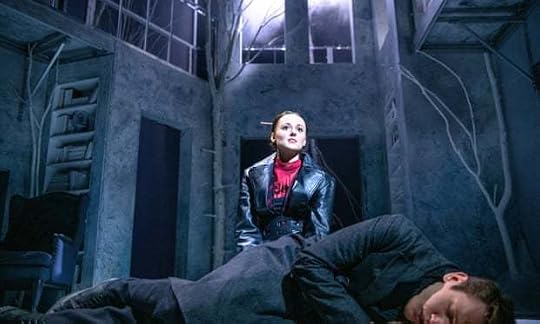
#Frankenstein200 Reviews from the 2019 U.K. touring production of Rona Munro's adaptation of Mary Shelley's Frankenstein: The 1818 Text (1818) are mixed (see example linked below), but on the page it reads like a superb distillation of the entire novel into the space of a 1.5 to 2 hour stage production. Munro adds Mary Shelley into the cast of characters acting like a stage director who is setting the scenes and directing the players in a realization of her mental process while writing the original novel. Of all the characters it is only The Monster who sees and reacts to Mary Shelley's presence.
This would result in quite a miraculous stage production if the visual, lighting and sound effects have the budget to realize it. It would require them being able to change the scene from settings such as the Frankenstein residence to Ingolstadt University to Arctic ice floes in seconds while being cued by waves and sweeps of Mary Shelley's hands. With photo slides and movie projections this would certainly be possible and I could imagine it quite well while reading.
Eilidh Loan as Mary Shelley and Ben Castle-Gibb as Viktor Frankenstein in the 2019 UK touring production of Rona Munro's "Mary Shelley's Frankenstein." Photograph by Tommy Ga-Ken Wan is linked from The Guardian review.
currently playing walton- and it was really interesting finally hearing this spoken out loud at the table read!
i find this so refreshing as a gothic classic adaptation. the inclusion of mary herself as a narrator and morally grey protagonist is unique and effective. this has the potential to be a truly terrifying piece, depending on how you play it. i like how many productions have given it the "frankenstein" treatment by making it a mash-up of period and modern design elements.
great monologues and characters. i can't wait to see what this looks like as a fully staged play.
I think there are umpteenth ways to tell this versatile story and this is as good as any other. It moves along at a solid clip and the interpolation of Mary Shelley created some really excellent interactions between creator and created. So much space for exciting stagecraft and also a genuine horror vibe.