

What do you think?

Vivere con gli dèi. Genti e credenze
Da sempre, ogni società si fonda su una serie di presupposti – una fede, un’ideologia, una religione – che trascendono la vita dei singoli individui e costituiscono l’essenza di un’identità collettiva: credenze che hanno l’eccezionale potere di definire, e dividere, i popoli, e che oggi come ieri sono una forza propulsiva della politica in gran parte del mondo. Credenze a volte laiche, come nel caso dei nazionalismi, ma più spesso, nel corso della storia, religiose. Indagando su questo aspetto centrale dell’esistenza umana, in Vivere con gli dèi Neil MacGregor viaggia – e ci fa viaggiare – nel tempo e nello spazio, guidandoci in un’illuminante avventura tra le fedi. Da Vanuatu alle Alpi sveve all’Acrocoro etiopico, dall’Era glaciale all’epoca Zhou ai giorni nostri, MacGregor passa in rassegna oggetti, luoghi e attività umane per mostrarci come la religione abbia sempre plasmato la vita pubblica, improntando le relazioni tra gli individui e gli Stati – e come abbia contribuito a fare di noi ciò che siamo oggi: «“Chi siamo ‘noi’?” è la grande questione politica del nostro tempo, e riguarda essenzialmente quello in cui crediamo».
591 pages, Hardcover
First published September 17, 2018
About the author
Neil MacGregor
54 books267 followersNeil MacGregor was born in Glasgow to two doctors, Alexander and Anna MacGregor. At the age of nine, he first saw Salvador Dalí's Christ of Saint John of the Cross, newly acquired by Glasgow's Kelvingrove Art Gallery, which had a profound effect on him and sparked his lifelong interest in art. MacGregor was educated at Glasgow Academy and then read modern languages at New College, Oxford, where he is now an honorary fellow. The period that followed was spent studying philosophy at the École Normale Supérieure in Paris (coinciding with the events of May 1968), and as a law student at Edinburgh University, where he received the Green Prize. Despite being called to the bar in 1972, MacGregor next decided to take an art history degree. The following year, on a Courtauld Institute (University of London) summer school in Bavaria, the Courtauld's director Anthony Blunt spotted MacGregor and persuaded him to take a master's degree under his supervision. Blunt later considered MacGregor "the most brilliant pupil he ever taught".
From 1975 to 1981, MacGregor taught History of Art and Architecture at the University of Reading. He left to assume the editorship of The Burlington Magazine. He oversaw the transfer of the magazine from the Thomson Corporation to an independent and charitable status.
In 1987 MacGregor became a highly successful director of the National Gallery in London. There he was dubbed "Saint Neil", partly because of his popularity at that institution and partly because of his devout Christianity, and the nickname stuck after his departure from the Gallery. During his directorship, MacGregor presented three BBC television series on art: Painting the World in 1995, Making Masterpieces, a behind-the-scenes tour of the National Gallery, in 1997 and Seeing Salvation, on the representation of Jesus in western art, in 2000. He declined the offer of a knighthood in 1999, the first director of the National Gallery to do so.
MacGregor was made director of the British Museum in August 2002, at a time when that institution was £5 million in deficit. He has been lauded for his "diplomatic" approach to the post, though MacGregor rejects this description, stating that "diplomat is conventionally taken to mean the promotion of the interests of a particular state and that is not what we are about at all". He has vowed never to return the Parthenon Marbles to Greece, saying that it is the museum's duty to "preserve the universality of the marbles, and to protect them from being appropriated as a nationalistic political symbol". He did agree to discuss a loan of the marbles on the condition that Athens rejects all claims of ownership to them.
In January 2008, MacGregor was appointed chairman of the World Collections programme, for training international curators at British museums. The exhibition The First Emperor, focussing on Qin Shi Huang and including a small number of his Terracotta Warriors, was mounted in 2008 in the British Museum Reading Room. That year MacGregor was invited to succeed Philippe de Montebello as the Director of the Metropolitan Museum of Art in New York. He declined the offer as the Metropolitan charges its visitors for entry and is thus "not a public institution". In 2010, MacGregor presented a series on BBC Radio 4 and the World Service entitled A History of the World in 100 Objects, based on objects from the British Museum's collection. From September 2010 to January 2011 the British Museum lent the ancient Persian Cyrus Cylinder to an exhibition in Tehran. This was seen by at least a million visitors by the Museum's estimation, more than any loan exhibition to the United Kingdom had attracted since the Treasures of Tutankhamun exhibition in 1972. On 4 November 2010 MacGregor was appointed to the Order of Merit by Queen Elizabeth II.
In July 2011, MacGregor spoke at TEDGlobal in Edinburgh about the Cyrus Cylinder and provided a concise summary of the role the artefact has played in Middle East pol
From 1975 to 1981, MacGregor taught History of Art and Architecture at the University of Reading. He left to assume the editorship of The Burlington Magazine. He oversaw the transfer of the magazine from the Thomson Corporation to an independent and charitable status.
In 1987 MacGregor became a highly successful director of the National Gallery in London. There he was dubbed "Saint Neil", partly because of his popularity at that institution and partly because of his devout Christianity, and the nickname stuck after his departure from the Gallery. During his directorship, MacGregor presented three BBC television series on art: Painting the World in 1995, Making Masterpieces, a behind-the-scenes tour of the National Gallery, in 1997 and Seeing Salvation, on the representation of Jesus in western art, in 2000. He declined the offer of a knighthood in 1999, the first director of the National Gallery to do so.
MacGregor was made director of the British Museum in August 2002, at a time when that institution was £5 million in deficit. He has been lauded for his "diplomatic" approach to the post, though MacGregor rejects this description, stating that "diplomat is conventionally taken to mean the promotion of the interests of a particular state and that is not what we are about at all". He has vowed never to return the Parthenon Marbles to Greece, saying that it is the museum's duty to "preserve the universality of the marbles, and to protect them from being appropriated as a nationalistic political symbol". He did agree to discuss a loan of the marbles on the condition that Athens rejects all claims of ownership to them.
In January 2008, MacGregor was appointed chairman of the World Collections programme, for training international curators at British museums. The exhibition The First Emperor, focussing on Qin Shi Huang and including a small number of his Terracotta Warriors, was mounted in 2008 in the British Museum Reading Room. That year MacGregor was invited to succeed Philippe de Montebello as the Director of the Metropolitan Museum of Art in New York. He declined the offer as the Metropolitan charges its visitors for entry and is thus "not a public institution". In 2010, MacGregor presented a series on BBC Radio 4 and the World Service entitled A History of the World in 100 Objects, based on objects from the British Museum's collection. From September 2010 to January 2011 the British Museum lent the ancient Persian Cyrus Cylinder to an exhibition in Tehran. This was seen by at least a million visitors by the Museum's estimation, more than any loan exhibition to the United Kingdom had attracted since the Treasures of Tutankhamun exhibition in 1972. On 4 November 2010 MacGregor was appointed to the Order of Merit by Queen Elizabeth II.
In July 2011, MacGregor spoke at TEDGlobal in Edinburgh about the Cyrus Cylinder and provided a concise summary of the role the artefact has played in Middle East pol
Ratings & Reviews
Friends & Following
Create a free account to discover what your friends think of this book!
Community Reviews
Displaying 1 - 30 of 134 reviews

August 30, 2018
Like MacGregor’s other books this is both immensely readable and a testament to his own wide curiosity, knowledge and sense of humanity in its broadest sense. I hesitated before reading this having no religious sensibility at all and while its focus did make it slightly less absorbing for me personally than either his A History of the World in 100 Objects or Shakespeare's Restless World, this approaches faith and religion not via dogma or creed but via objects, rituals and places. It is thus less tied to British Museum exhibits than the previous books, and overall concerned with how the appurtenances of religious faith function in terms of group identity and community. MacGregor acknowledges freely that this sense of identity can be the cause of violent conflict or operate as the basis of a more positive sense of a community of humanity.
Each short chapter focuses on a specific topic such as sacrifice, water, the sun, religious festivals, icons and images, pilgrimage, polytheism, atheism and so on, and within the chapter MacGregor ranges freely geographically and in terms of thought, bringing in expert opinion where necessary. It’s this diffuse approach which makes this book such a pleasure: there is so much to learn, so many interesting connections made between disparate cultures and times – from Siberia to Plymouth, from human sacrifice in the Aztec empire to the creation of Christmas in puritan Massachusetts, from sun worship in prehistoric caves to seal worship in Iceland, from the iconic moment when Barack Obama started singing ‘Amazing Grace’ to crosses made from capsized refugee boats on the shores of Sicily. The text is lavishly illustrated with colour photos – definitely a book that is as pleasurable as a material object as as a text.
Thanks to Penguin/Allen Lane for an ARC via NetGalley
Each short chapter focuses on a specific topic such as sacrifice, water, the sun, religious festivals, icons and images, pilgrimage, polytheism, atheism and so on, and within the chapter MacGregor ranges freely geographically and in terms of thought, bringing in expert opinion where necessary. It’s this diffuse approach which makes this book such a pleasure: there is so much to learn, so many interesting connections made between disparate cultures and times – from Siberia to Plymouth, from human sacrifice in the Aztec empire to the creation of Christmas in puritan Massachusetts, from sun worship in prehistoric caves to seal worship in Iceland, from the iconic moment when Barack Obama started singing ‘Amazing Grace’ to crosses made from capsized refugee boats on the shores of Sicily. The text is lavishly illustrated with colour photos – definitely a book that is as pleasurable as a material object as as a text.
Thanks to Penguin/Allen Lane for an ARC via NetGalley

May 24, 2019
This is a beautifully illustrated book which provides a somewhat objective view of our religious shared beliefs and the stories and objects that support them. In his comparisons of the shared objects, events, and beliefs, he attempts to show our connectedness with each other despite the resistance and hostility that has and still does manifest itself when there is intolerance for other religions and beliefs.

November 15, 2018
Neil MacGregor’s Living with the Gods: On Beliefs and Peoples explores objects, rituals, and places in terms of what they reveal about faith and spirituality. Beginning with the 40,000-year- old Lion Man of Ulm, MacGregor takes us on a penetrating and insightful journey that spans centuries, crosses all corners of the globe, and interrogates the religious traditions of the past and present with compassion and respect.
MacGregor was director of the British Museum from 2002-2015. He generously illustrates his text with beautiful color photographs taken primarily from exhibits in the British Museum. He deconstructs each exhibit, situating it in context, and explaining its function in ritual and/or as an object of faith with the goal of elucidating how we worship.
In addition to explaining the role of objects, natural phenomena, and rituals, MacGregor takes us to locations which harbor religious significance—sacred spaces pregnant with mystery which presumably function(ed) as gateways to the supernatural realm. These sites include pre-historic caves with their cryptic drawings; the underground tomb In Ireland’s Newgrange; the excavation site at Gobekli Tepe in south-east Turkey; Girsu in Iraq; Lake Guatavita in the Columbian Andes; cathedrals, synagogues, temples, and mosques in Africa, Asia, the Americas, and Europe. MacGregor also explores the role of ceremonies, prayers, festivals, and songs as communal activities that bind a people together, providing them with a cohesive identity.
MacGregor’s persona is knowledgeable, curious, non-judgmental, non-dogmatic, tolerant, immensely humane, compassionate, sensitive, and respectful of the various traditions and cultures. Perhaps one of the most intriguing aspects of this text is the way MacGregor takes an object, ritual, or ceremony and unveils its similarities with the religious activities and paraphernalia of cultures that are worlds apart and seemingly very diverse. Through these explorations, he is able to draw connections from the past to the present, from one culture to the next. It is a fascinating and wholistic enterprise which demonstrates over and over again that in spite of the ethnic, regional, racial, and religious differences that cause so much violent conflict all over the world, we all emerged from the same stock, share the same anxieties, hopes, and goals. And even though we may pursue different paths to get us there, the “there” we want to get to is fundamentally the same today as it has always been.
This penetrating text exploring religious objects, sacred spaces, ceremonies, and rituals to remind us we have more in common with each other than we have differences is more essential and relevant today than it has ever been.
Highly recommended. A pleasure to read with color photos to feast the eyes.
MacGregor was director of the British Museum from 2002-2015. He generously illustrates his text with beautiful color photographs taken primarily from exhibits in the British Museum. He deconstructs each exhibit, situating it in context, and explaining its function in ritual and/or as an object of faith with the goal of elucidating how we worship.
In addition to explaining the role of objects, natural phenomena, and rituals, MacGregor takes us to locations which harbor religious significance—sacred spaces pregnant with mystery which presumably function(ed) as gateways to the supernatural realm. These sites include pre-historic caves with their cryptic drawings; the underground tomb In Ireland’s Newgrange; the excavation site at Gobekli Tepe in south-east Turkey; Girsu in Iraq; Lake Guatavita in the Columbian Andes; cathedrals, synagogues, temples, and mosques in Africa, Asia, the Americas, and Europe. MacGregor also explores the role of ceremonies, prayers, festivals, and songs as communal activities that bind a people together, providing them with a cohesive identity.
MacGregor’s persona is knowledgeable, curious, non-judgmental, non-dogmatic, tolerant, immensely humane, compassionate, sensitive, and respectful of the various traditions and cultures. Perhaps one of the most intriguing aspects of this text is the way MacGregor takes an object, ritual, or ceremony and unveils its similarities with the religious activities and paraphernalia of cultures that are worlds apart and seemingly very diverse. Through these explorations, he is able to draw connections from the past to the present, from one culture to the next. It is a fascinating and wholistic enterprise which demonstrates over and over again that in spite of the ethnic, regional, racial, and religious differences that cause so much violent conflict all over the world, we all emerged from the same stock, share the same anxieties, hopes, and goals. And even though we may pursue different paths to get us there, the “there” we want to get to is fundamentally the same today as it has always been.
This penetrating text exploring religious objects, sacred spaces, ceremonies, and rituals to remind us we have more in common with each other than we have differences is more essential and relevant today than it has ever been.
Highly recommended. A pleasure to read with color photos to feast the eyes.

December 20, 2020
The producers of this most impressive tome should be congratulated on their efforts: fascinating snippets of wide-ranging historical information and commentary, superb reproductions, clear and unambiguous writing, and extremely positive outlooks for the fate of humanity. What’s not to like? It will appeal to many, and perhaps deservedly so. And yet, and yet…
I devoured this approach as I started reading; but eventually it all seemed to be too much of a good thing. I suspect that this positive propounding of good will was the most significant aspect behind the motivation of this production — and there’s nothing wrong with that. But the more I read, the more wearisome the “message” became for me. Instead of making me feel enthusiastic, I found that I was tending to become more depressed the more I read. I began to disbelieve the “message”. Trying to work out why was more problematic.
Perhaps my disquiet lies in the approach MacGregor takes: identification of specific artefacts, the historical facts behind each, and, in the main, the auxiliary interpretations of various archaeological, historical and religious experts all positing affirmative and corroborative testimonies of spiritual, religious, and communal significance to those artefacts.
In his Introduction MacGregor eschews the potentially divisive aspects behind humanity’s beliefs and customs (“This book is emphatically not a history of religion, nor an argument in favour of faith, still less a defence of any particular system of belief.”), and argues that the book attempts “to understand what shared religious beliefs can mean in the public life of a community or a nation, how they shape the relationship between the individual and the state, and how they have become a crucial contributor to who we are. For in deciding how we live with our gods we also decide how we live with each other.” MacGregor then goes on to say that currently belief and faith are back in the Western world, and sees that as a positive for the future of humanity.
All of this is a kind of apologia that sounds “sensible”, but in fact isn’t. A brief look at the current state of the world would show that the latest renewed emphases on beliefs and faiths are hardly testaments of harmony and compatibility for humanity, but in fact favour the very opposite! MacGregor touches only very briefly on what I would call some of the less salubrious aspects of some religious practices, but these are mostly overwhelmed by the insistence of only the positive aspects. Most of the dangerous aspects are to be found in the (missing) more negative parts, especially those which are considered to be part and parcel of the necessary requirements and consequences of those beliefs. There are no comments made, for example, on what punishments are applicable if individuals fail to accept these “requirements”.
Simply relying on the positive aspects of a belief system, while laudable in theory, is at best naive and at worst misleading. All belief systems can and do argue that their approach is for the betterment of mankind, but this always means that often enough even the most minute aspects of an individual’s life can be subject to often severe and even deadly repercussions if they are not assiduously obeyed by all and sundry. Punishments could include: public berating; humiliation; embarrassment; physical punishment; rejection; social ostracism; psychological damage; imprisonment; “judicial” murder; specific and general sacrifices; etc. etc. And these are just in relation to the members themselves within such a belief or faith system.
Further, the sense of absolute “truthfulness” inherent in many belief systems almost guarantees that any alternative system of beliefs is unequivocally to be condemned and fought against. Elimination of such alternative beliefs will “justify” killings, terrorism, personal life sacrifices, killing the “infidels”, and a preparedness to willingly commit suicide, either individually or in mass self-immolation. Thus, “living with the gods” should also include an awareness that this does not only mean joy and happiness for mankind, but also means killing and being killed in the name of the gods. Some may counter this argument that these are not applicable to every individual within any specific belief system, but relates only to disgruntled or extremist elements. This may well be true, but then again, if and when such extremist views become socially, religiously and politically powerful, then society in general will suffer accordingly — they become an obligatory part of what living with the gods means.
The best I can say about this book is that it does try to be positive about the future for humanity. Truthfully, however, it tries to achieve this by minimising (essentially completely eliminating) the darker sides of living with the gods, and from this perspective the book is disingenuous, possibly dangerous, and may even be considered patronising and not a little condescending and offensive about those beliefs and faiths. To the reader, then, my advice is to enjoy the soothing positivity of this book if you have to, but bear in mind that ultimately this may very well be an unreliable and untrustworthy feeling. Caveat lector! — reader, be wary!
I devoured this approach as I started reading; but eventually it all seemed to be too much of a good thing. I suspect that this positive propounding of good will was the most significant aspect behind the motivation of this production — and there’s nothing wrong with that. But the more I read, the more wearisome the “message” became for me. Instead of making me feel enthusiastic, I found that I was tending to become more depressed the more I read. I began to disbelieve the “message”. Trying to work out why was more problematic.
Perhaps my disquiet lies in the approach MacGregor takes: identification of specific artefacts, the historical facts behind each, and, in the main, the auxiliary interpretations of various archaeological, historical and religious experts all positing affirmative and corroborative testimonies of spiritual, religious, and communal significance to those artefacts.
In his Introduction MacGregor eschews the potentially divisive aspects behind humanity’s beliefs and customs (“This book is emphatically not a history of religion, nor an argument in favour of faith, still less a defence of any particular system of belief.”), and argues that the book attempts “to understand what shared religious beliefs can mean in the public life of a community or a nation, how they shape the relationship between the individual and the state, and how they have become a crucial contributor to who we are. For in deciding how we live with our gods we also decide how we live with each other.” MacGregor then goes on to say that currently belief and faith are back in the Western world, and sees that as a positive for the future of humanity.
All of this is a kind of apologia that sounds “sensible”, but in fact isn’t. A brief look at the current state of the world would show that the latest renewed emphases on beliefs and faiths are hardly testaments of harmony and compatibility for humanity, but in fact favour the very opposite! MacGregor touches only very briefly on what I would call some of the less salubrious aspects of some religious practices, but these are mostly overwhelmed by the insistence of only the positive aspects. Most of the dangerous aspects are to be found in the (missing) more negative parts, especially those which are considered to be part and parcel of the necessary requirements and consequences of those beliefs. There are no comments made, for example, on what punishments are applicable if individuals fail to accept these “requirements”.
Simply relying on the positive aspects of a belief system, while laudable in theory, is at best naive and at worst misleading. All belief systems can and do argue that their approach is for the betterment of mankind, but this always means that often enough even the most minute aspects of an individual’s life can be subject to often severe and even deadly repercussions if they are not assiduously obeyed by all and sundry. Punishments could include: public berating; humiliation; embarrassment; physical punishment; rejection; social ostracism; psychological damage; imprisonment; “judicial” murder; specific and general sacrifices; etc. etc. And these are just in relation to the members themselves within such a belief or faith system.
Further, the sense of absolute “truthfulness” inherent in many belief systems almost guarantees that any alternative system of beliefs is unequivocally to be condemned and fought against. Elimination of such alternative beliefs will “justify” killings, terrorism, personal life sacrifices, killing the “infidels”, and a preparedness to willingly commit suicide, either individually or in mass self-immolation. Thus, “living with the gods” should also include an awareness that this does not only mean joy and happiness for mankind, but also means killing and being killed in the name of the gods. Some may counter this argument that these are not applicable to every individual within any specific belief system, but relates only to disgruntled or extremist elements. This may well be true, but then again, if and when such extremist views become socially, religiously and politically powerful, then society in general will suffer accordingly — they become an obligatory part of what living with the gods means.
The best I can say about this book is that it does try to be positive about the future for humanity. Truthfully, however, it tries to achieve this by minimising (essentially completely eliminating) the darker sides of living with the gods, and from this perspective the book is disingenuous, possibly dangerous, and may even be considered patronising and not a little condescending and offensive about those beliefs and faiths. To the reader, then, my advice is to enjoy the soothing positivity of this book if you have to, but bear in mind that ultimately this may very well be an unreliable and untrustworthy feeling. Caveat lector! — reader, be wary!

October 23, 2017
 http://www.bbc.co.uk/programmes/b099xhmj
1/30: The Beginnings of Belief: The programme visits the cave in southern Germany where fragments of ivory were discovered in 1939. These fragments were gradually pieced together by archaeologists decades later to re-assemble the figure. Some smoothing on the torso suggests that the Lion Man was passed from person to person in the cave.
2/30: Fire and State: Many societies have seen the mesmerizing phenomenon of fire as a symbol of the divine. Neil MacGregor focuses on sacred fire which comes to represent the state itself: the perpetual fire in the Temple of Vesta in Rome, the great Parsi fire temple in Udvada, India, and 'la Flamme de la Nation', the Flame of the Nation, constantly burning beneath the Arc de Triomphe in Paris.
3/30: Water of Life and Death: In Islam, Christianity and Judaism, water is an essential part of religious practice. But for no faith does water - and one particular kind of water - play such a significant role as for Hindus. To bathe in the river Ganges is not just to prepare to meet the divine, but already to be embraced by it. The river Ganges is the goddess Ganga, and the waters of this river, which govern life and death, have not only determined many aspects of Hinduism, but in considerable measure shaped the identity of the modern state of India.
4/30: Here Comes the Sun: Neil MacGregor continues his series on the expression of shared beliefs in communities around the world, and focuses on light. He experiences the sunrise whilst inside the monumental stone passage tomb at Newgrange, Ireland, a structure older than Stonehenge or the pyramids in Egypt. Here, on the winter solstice, thanks to the design of the tomb, a bright, narrow beam of sunlight reaches deep inside the structure. He also considers the story of Amaterasu, the Japanese sun goddess, whose decision to hide herself in a cave plunged the world into darkness, and reflects on how - centuries later - the image of rising sun became closely linked with Japanese national identity. (I can recommend Newgrange)
5/30: Dependence or Dominion?: NM focuses on the natural world and seasonal change: the Yupik people of Alaska depend on the seal, and ancient Egyptians looked to the god Osiris to bring fertility to their arid land. Both societies, in radically different climates, devised practices that acknowledged the fact of their dependence on the natural world - and engaged everybody with the responsibility of co-operating with it.
6/30: Living with the dead: In the British Museum, NM focuses on mummy bundles from Peru, skeletons wrapped in textiles made of llama wool or cotton. For the living, these were ancestors with great wisdom and knowledge of the world, who could be called upon to help key decision-makers. He also examines two Chinese 'ancestor portraits', and discovers how and why they were venerated by surviving family members.
7/30: Mother and Child: He focuses on how societies and communities seek to protect the newly-born and their mothers, including the role of St Margaret of Antioch, patron saint of childbirth, and the use of protective omamori in Japan.
8/30: Becoming an Adult: He focuses on rites of passage, marking the transition from childhood to adulthood, including a lock of bound hair, from the collections of the British Museum, which reveals an important ritual for teenage boys on the Pacific island nation of Vanuatu.
9/10 Lines of Communication: He focuses on prayer, reflecting on how this most highly individualized of activities is also a profoundly communal act, with objects including a 16th century ivory and gold qibla, used to find the direction of Mecca - a function now offered by smartphone apps.
10/30: The Power of Song: He focuses on a Kirchenpelz or 'church fur' - a sheepskin coat made in the late 19th century in Transylvania, now part of Romania, for the German-speaking Saxon community there. This was not just 'Sunday Best': to wear this coat was to proclaim in public your allegiance to the Lutheran Church, and your identity as a Transylvanian Saxon.
11/30: The House of God: Stone tablets in the British Museum detail how a temple was designed and formed in Mesopotamia about 4000 years ago - the first sacred space for which we have a written record. It was a god's home, complete with private areas crafted to meet his every need: kitchens and dining rooms, family rooms and spaces for guests.
12/30: Gifts to the Gods:High in the Andes in Colombia, the indigenous Muisca population consigned highly-wrought gold figurines to the waters of Lake Guatavita. Records of the treasures stored in the Parthenon, Athens, dating from around 400BC, reveal numerous gifts for the goddess Athena - gifts with a double role. The Parthenon was also a kind of central bank, capable of operating as a lender of last resort, creating an intimate connection between the temple of a goddess and the finance of the state.
13/30: Holy Killing: Displayed in the British Museum is a finely-crafted Aztec knife, dating from around 1500, with a richly-decorated handle. It had a brutal purpose - human sacrifice. In ancient Greece, animal sacrifice was a vital ritual for connection with the deities: the grounds of a Greek temple were in part a sacred public slaughter-house.
14/30: To Be A Pilgrim: the expression of shared beliefs in communities around the world and across time, and focuses on pilgrimage, and its role in Christianity, Buddhism and Islam.
15/30: Festivals: their role in shaping a communal identity.
16/30: The Protectoresses: In Mexico, the image of Our Lady of Guadalupe came not from the hand of an artist, but was directly given from heaven - according to its history. Our Lady of Guadalupe is now the most powerful of presiding images, and the Basilica of Guadalupe near Mexico City is said to be the most visited Roman Catholic pilgrimage site in the world. The sanctuary of the goddess Artemis in the great trading city of Ephesus, now in western Turkey, was by far the most celebrated temple of the antique Mediterranean, and the cult of Artemis spread eastwards towards the Black Sea, and westwards towards Spain. Artemis was thought to protect the vulnerable at their moments of greatest personal danger.
17/30: Replicating the Divine: For the painter of a Russian religious icon, the paramount purpose is the continuation of a tradition, in which the painter seeks only to take his proper place, creating an image which opens a gateway to the divine. The Hindu goddess Durga is at the centre of the popular annual festival of Durga Puja, where communities create images of the goddess in everyday materials - clay, wood, straw and oil paint - which then are endowed with a transcendental character.
18/30: The Making of Meaning: Our understanding of the rock art created by the San people of southern Africa over many centuries is helped by written accounts, so that what first appears to be an image of a hunting expedition becomes a record of a spiritual journey into another realm of experience. "For many years it was a matter of gaze and guess," says David Lewis Williams, an authority on rock art: "You gaze at it, and if you gaze long enough, your guess will take you close to what it's all about - and I'm afraid that's not the case, but we don't have to gaze and guess any more."
In the British Museum, a small 19th century Japanese shrine shows the spirits coming to visit a long-settled agricultural society. The curved doors of a small wooden box open to reveal, inside, a shimmering world of carved gilded wood, and a scene to which Japanese viewers would bring different interpretations.
19/30: Change Your Life: A small coloured wood-cut, created in the Netherlands around 1500, offers a particularly gruesome rendering of Christ's crucifixion. Christ is pictured with blood pouring from his torso, his head, his legs and his outstretched arms. These are not realistically arranged droplets; instead we see a flurry of vertical red strokes, tightly packed together and evenly spaced. Neil MacGregor reflects on the purpose of this image.
He also considers a serene figure of the Buddha, a halo behind his head, already in his enlightened state.
20/30: Rejecting the Image: A striking cobalt blue mosque lamp, from around 1570, shows an Islamic way of doing honour to the word: calligraphy.
In Jewish religious ceremonies a yad - a small silver rod with a little hand and a pointing index finger - is used to follow the text during readings from the Torah, to avoid any damage to the delicate parchment.
21/30: Living with Many Gods: n the mid-1840s, a Roman earthenware jar was dug from the earth near Felmingham Hall in Norfolk. Inside, excavators found several belief systems, all mixed up together - for buried in the pot was a jumble of gods, deities of different kinds and origins, that tell us what it meant for people in Roman Britain around the year 250 to be living with many gods.
The great ancient Mesopotamian Epic of Gilgamesh includes a narrative with striking similarities to - but important differences from - the story of Noah in the Bible. Here a council of gods is persuaded to unleash a great flood to wipe out humankind.
22/30: Living with One God: Using objects from both ancient Babylon and ancient Egypt, Neil examines how one god could become central to worship in these societies.
23/30: The Other Side of the Leaf: the expression of shared beliefs with a focus on societies who believe that they share the landscape with co-inhabitants who are not visible but are present. Such belief systems can be found in places such as the Pacific island nation of Vanuatu.
It is difficult, Neil MacGregor suggests, to express this relationship with the landscape in the English language. Words such as spirits, gods or beings do not adequately convey the nature of the co-inhabitants - and although these co-inhabitants cannot always be seen, they are always there, on the other side of the leaf.
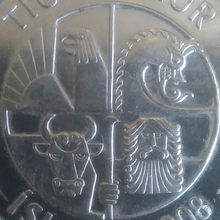 The four Landvættir of Iceland
24/30: Global Gods, Local Needs: gods can reach new communities, and how those communities can then adapt and change the faiths.
25/30: Gods Living Together: the expression of shared beliefs with a focus on how faiths co-exist in India.
26/30: Ruling With The Gods: Queens and kings may be priests of the gods, or their representatives. They may be incarnations - or even gods themselves. Or the relationship may be so close that to divide spiritual from temporal power at all would simply make no sense.
27/30: Living With No Gods: Neil examines a revolutionary clock, from around 1795, created in the wake of the French Revolution, and designed to mark a new way of living: in an age of reason, there would no longer be royalism or religion in France.
A poster from the Soviet Union celebrates the apparent triumph of scientific progress: the cosmonaut Yuri Gagarin floats in space, looks out and proclaims 'There is no God!'. It seems that the heavens are empty of divine beings, but full, instead, of starry promise.
28/30: Turning The Screw: A plain board, to be found on a 17th-century Japanese roadside, offers generous rewards to anyone who informs on Christians. At almost exactly the same time a print from France depicts the officially sanctioned destruction of a Huguenot Church just a few miles east of Paris.
29/30: The Search For A State: An over-printed coin from 2nd century Jerusalem tells of the failed attempt of Shimon bar Kokhba to lay claim to a state for the Jews, free from Roman rule - while a white cotton flag, framed in pale blue, flew over Sudan after it had been taken by Mahdist forces and before the Islamic state collapsed in the mid 1890s.
30/30: Living With Each Other: He began with the Lion Man, an object created 40 000 years ago, and now reflects on the present, on the future and on hope.
5* Living With The Gods
5* A History of the World in 100 Objects
3.5* Germany: Memories of a Nation
4* Shakespeare's Restless World

September 17, 2018
This is another excellent book from Neil MacGregor. I have no expertise in this area, but as a lay reader I found it a thoughtful, erudite and immensely illuminating book.
MacGregor takes a similar approach to that in his previous outstanding books, A History Of The World in 100 Objects and Shakespeare’s Restless World, in that he uses artefacts fascinatingly to illustrate his subject, basing each brief chapter around a subject which has has religious significance like sacrifice, water and so on. Thus, this isn’t a conventional history of religion at all, but a very insightful look at the way in which worship in its many diverse forms has played a part in human life from the earliest objects we know of to the present day. As always, MacGregor makes shrewd, penetrating and very humane points, leaving us with much to think about. It’s a great book to read a chapter or two at a time, I think, and then to come back to.
The book is beautifully illustrated and MacGregor’s unfussy, readable style is a pleasure. I can recommend this very warmly.
MacGregor takes a similar approach to that in his previous outstanding books, A History Of The World in 100 Objects and Shakespeare’s Restless World, in that he uses artefacts fascinatingly to illustrate his subject, basing each brief chapter around a subject which has has religious significance like sacrifice, water and so on. Thus, this isn’t a conventional history of religion at all, but a very insightful look at the way in which worship in its many diverse forms has played a part in human life from the earliest objects we know of to the present day. As always, MacGregor makes shrewd, penetrating and very humane points, leaving us with much to think about. It’s a great book to read a chapter or two at a time, I think, and then to come back to.
The book is beautifully illustrated and MacGregor’s unfussy, readable style is a pleasure. I can recommend this very warmly.

January 27, 2023
Inventory world religions and there you will find a series of common practices that transcend geography, culture and time. Whether it’s Buddhists, Mayans, Christians or Roman Pagans, most religions have a maternal figurehead, sacrifice rituals, prayer, music, death rituals, shrines, holy killings, coming-of-age rituals and pilgrimages.
In this delightfully readable book, Neil MacGregor takes us through distance and time, identifying these fascinating themes, then analyzing why they happen, and what they can tell us about human behavior.
This is just one of many books I’ve read by MacGregor. He has been director of the British Museum since 2002, and this has given his storytelling a unique style. The man has curated historical objects his whole life. The natural result is that his storytelling style transcends words and ideas. It seamlessly incorporates the objects found in the museums of the world.
I got turned on to MacGregor’s work through the hit BBC podcast, “The History of the World in 100 Objects.”
Just like that series, this book is filled with pictures of amazingly strange and beautiful photos of museum objects that add a delightful visual element to his powerful storytelling. We don’t just READ about death rituals around the world, we can also scrutinize the many objects that accompany this practice. It brings a whole new level of understanding and poignancy to the stories.
I’ve read all of MacGregor’s books and listened to all his podcasts. His insights into human behavior are fascinating. His easy writing style left me with a big takeaway after each and every chapter.
Extra Credit: If you really want to immerse yourself in this book, listen to the podcast or audio book by the same name, but also buy the printed or kindle book so you can see all the pictures. MacGregor’s narration is masterful.
I highly recommend this book.
In this delightfully readable book, Neil MacGregor takes us through distance and time, identifying these fascinating themes, then analyzing why they happen, and what they can tell us about human behavior.
This is just one of many books I’ve read by MacGregor. He has been director of the British Museum since 2002, and this has given his storytelling a unique style. The man has curated historical objects his whole life. The natural result is that his storytelling style transcends words and ideas. It seamlessly incorporates the objects found in the museums of the world.
I got turned on to MacGregor’s work through the hit BBC podcast, “The History of the World in 100 Objects.”
Just like that series, this book is filled with pictures of amazingly strange and beautiful photos of museum objects that add a delightful visual element to his powerful storytelling. We don’t just READ about death rituals around the world, we can also scrutinize the many objects that accompany this practice. It brings a whole new level of understanding and poignancy to the stories.
I’ve read all of MacGregor’s books and listened to all his podcasts. His insights into human behavior are fascinating. His easy writing style left me with a big takeaway after each and every chapter.
Extra Credit: If you really want to immerse yourself in this book, listen to the podcast or audio book by the same name, but also buy the printed or kindle book so you can see all the pictures. MacGregor’s narration is masterful.
I highly recommend this book.

March 19, 2021
Somehow the neverending lockdown has got to me too. Reading a non-fiction book full of facts, no matter how interesting, was a bit of a struggle. I'm pretty sure that my brain registered only about 30% of the reading material. My interest peaked at some selected topics that I will be able to pull out in a dinner party if those ever return. But less about me and more about the book... if you don't know much about religion and don't want to read a massive tome on the history of religion, this book might be your answer. The author builds his stories around religious objects and concepts found pretty much in all religious practices. You're taken on a journey not only through time, starting with a Lion Man figurine found near Ulm in Germany and dating some 40 000 years old but also across the whole world (Riga is mentioned on page 417). You might end up putting some new destinations on your travel map. You might also reconsider re-visiting or visiting British Museum as it houses many of the objects described in the book. Or you'll simply find out what's the big deal with all the people going to Varanasi. It also helps if you keep an open mind about the religious traditions and practices as the author breaks down some of their evolution to demonstrate the everchanging nature of religious concepts. Anyhow, this book goes back on my shelf pending a re-read at different times.
January 24, 2020
I do think this deserves five stars, although in a somewhat weird way; it's a different kind of book than I've ever read before.
Not rigorous enough to be an academic work, but full of scholarly insights on various traditions around the world.
Not particularly concerned with theology, much less faithful to any one religion, but greatly respectful of the enormous power, for good and ill, of all belief systems.
Not noticeably more artistic or poetic than any well-written non-fiction, but often deeply moving simply by virtue of its subject matter.
A book that reminds the humanist world of religion, and the religious world of our common humanity. A book that showcases the meaning, community, beauty, strength, violence and peace religions can create.
A book that does not believe that over ten thousand years of human religion will end anytime soon, but that is also not overly bothered by that fact and is, ultimately, rather hopeful about the positive power of religion.
Is it a book for someone other than a religious ex-fundamentalist agnostic myth-loving member of a western secular society like myself? I have no idea. But it is a very good book for me.
Not rigorous enough to be an academic work, but full of scholarly insights on various traditions around the world.
Not particularly concerned with theology, much less faithful to any one religion, but greatly respectful of the enormous power, for good and ill, of all belief systems.
Not noticeably more artistic or poetic than any well-written non-fiction, but often deeply moving simply by virtue of its subject matter.
A book that reminds the humanist world of religion, and the religious world of our common humanity. A book that showcases the meaning, community, beauty, strength, violence and peace religions can create.
A book that does not believe that over ten thousand years of human religion will end anytime soon, but that is also not overly bothered by that fact and is, ultimately, rather hopeful about the positive power of religion.
Is it a book for someone other than a religious ex-fundamentalist agnostic myth-loving member of a western secular society like myself? I have no idea. But it is a very good book for me.

February 22, 2020
Bijušā Britu muzeja direktora darbs būtībā sastāv no stāstiem par dažādiem ar reliģiju saistītiem eksponātiem, kas atrodami Britu muzeja krājumos. Priekšmeti izvēlēti ne paši pazīstamākie, līdz ar to bija ļoti interesanti. Meistarīgi vilktas paralēles starp dažādu kultūru priekšstatiem un Dieva meklējumiem.
Lasīju pa mazam gabaliņam krietni ilgā laika posmā. Iespējams, tāpēc bija grūti uztvert darba struktūru un nodaļu loģiku.
Lasīju pa mazam gabaliņam krietni ilgā laika posmā. Iespējams, tāpēc bija grūti uztvert darba struktūru un nodaļu loģiku.

March 9, 2024
This book, and the hit BBC Radio 4 podcast behind it, were incredibly interesting to me both despite and because of my lack of any religious sensibility. Here, former Director of the British Museum Neil MacGregor examines group identity and community as phenomena through the factor of their having largely and been based on shared beliefs. As he states in his introduction, Living with the Gods
MagGregor's overall tone here is optimistic, but he doesn't merely see faith as something that defines us. Though the focus is on examining artefacts across time and space and presenting their interpretations regarding culture and belonging, religious faith is also revealed here as a divisive, othering force – one that may be a positive driver of communal feeling and countering oppressions, but that has also historically created communal strife and violence. I do wish this book focused on these negative aspects a little more – while I enjoyed reading about the American invention of modern Christmas and Santa Claus as we know these today, about the French Age of Reason and its attempts at reordering time and other officially atheist states that failed (the Soviet Union, faced by the German Invasion in 1941, had to bring back religion as a force of social cohesion), I couldn't help but notice that a discussion of the more insidious aspects of religious cohesion and its shaping of politics were precluded by the author's methodology of tracing this phenomena through objects.
What, for instance, happens when faith-based systems mutate, as they have over the past several hundred years, into ones that are 'secular' but remain rooted in the groupthink that the societies they rule are based on? What happens when the growing insistence on a singular truth within a faith that doesn't necessarily worship a single truth-figure overwhelms the spirit of plurality such systems are believed to hold up? And what happens when the European model of creating nation-states – the idea that a land or territory belongs to a culture, or language, or religion, and therefore belongs to the people who practice these – overwhelms the principle of plurality, as with everything else, in post-colonial states?
A lot of my questions come from the space between the world as it was in 2018, when Living with the Gods was first published, and the one that I occupy reading it today. The book's description of the 'territorialization of the imagination' and the process of a pluralist Indian society being challenged by the demolition of the Babri mosque in Ayodhya is now complete, with the Hindu temple built over the rubble having been inaugurated earlier this year. And the 'conflict' in the Middle East – also built on that intersection of religious belief and political community – has now reached new levels of destructiveness. I wonder what MacGregor would have to say if he were writing this now.
3.5 stars, rounded up
...is emphatically not a history of religion, nor an argument in favour of faith, still less a defence of any particular system of belief. Looking across history and around the globe, it interrogates objects, places and human activities to try to understand what shared religious beliefs can mean in the public life of a community or a nation, how they shape the relationship between the individual and the state, and how they have become a crucial contributor to who we are. For in deciding how we live with our gods we also decide how to live with each other.At a time when religious fundamentalism is on the uptake all across the world by way of rising conservatism, this book explores how religion has actively shaped our political being – not just from the Cold War onwards, when the United States adopted the motto of 'In God We Trust' to differentiate itself from the 'godless' Soviet Union, but as far back as 40,000 years ago when the Lion Man of Ulm was carved out of ivory by a people looking for hope to survive the bitter cold of the Ice Age – and how this has shaped the stories we tell ourselves in order to live, the way we define and experience time (its structuring explicitly culturally specific across the world even as we have now adopted the idea of the Common Era), the way our languages have evolved, and who we are in an age when the secular (though increasingly not) myths of nationalism reigns supreme.
MagGregor's overall tone here is optimistic, but he doesn't merely see faith as something that defines us. Though the focus is on examining artefacts across time and space and presenting their interpretations regarding culture and belonging, religious faith is also revealed here as a divisive, othering force – one that may be a positive driver of communal feeling and countering oppressions, but that has also historically created communal strife and violence. I do wish this book focused on these negative aspects a little more – while I enjoyed reading about the American invention of modern Christmas and Santa Claus as we know these today, about the French Age of Reason and its attempts at reordering time and other officially atheist states that failed (the Soviet Union, faced by the German Invasion in 1941, had to bring back religion as a force of social cohesion), I couldn't help but notice that a discussion of the more insidious aspects of religious cohesion and its shaping of politics were precluded by the author's methodology of tracing this phenomena through objects.
What, for instance, happens when faith-based systems mutate, as they have over the past several hundred years, into ones that are 'secular' but remain rooted in the groupthink that the societies they rule are based on? What happens when the growing insistence on a singular truth within a faith that doesn't necessarily worship a single truth-figure overwhelms the spirit of plurality such systems are believed to hold up? And what happens when the European model of creating nation-states – the idea that a land or territory belongs to a culture, or language, or religion, and therefore belongs to the people who practice these – overwhelms the principle of plurality, as with everything else, in post-colonial states?
A lot of my questions come from the space between the world as it was in 2018, when Living with the Gods was first published, and the one that I occupy reading it today. The book's description of the 'territorialization of the imagination' and the process of a pluralist Indian society being challenged by the demolition of the Babri mosque in Ayodhya is now complete, with the Hindu temple built over the rubble having been inaugurated earlier this year. And the 'conflict' in the Middle East – also built on that intersection of religious belief and political community – has now reached new levels of destructiveness. I wonder what MacGregor would have to say if he were writing this now.
3.5 stars, rounded up

March 23, 2019
Book Porn
I'm sorry for the crass title, it can't be helped. I couldn't think of a better means of describing this book. I first saw it in my local Waterstones, and, upon opening it, knew I had to read it. The coloured images dispersed amongst the 500 odd pages of Living With The Gods are just one aspect of the care and love that have been put into this text.
Covering a plethora of beliefs and stories that humans have embodied for many centuries, Living With The Gods is a treasure trove of incredible information, and helpful guidance to the religious and non-religious alike. My favourite chapter, personally - but by no means only favourite - was discovering about Ethiopias unique Christian heritage, victory over colonial Italy, claim to the Arc of the Covenant, and ties to Rastafarianism. There are only about six pages in this chapter; yet it opened up a whole world to me.
I'm certain you will have your own, similar experience(s) reading this beautiful book.
I'm sorry for the crass title, it can't be helped. I couldn't think of a better means of describing this book. I first saw it in my local Waterstones, and, upon opening it, knew I had to read it. The coloured images dispersed amongst the 500 odd pages of Living With The Gods are just one aspect of the care and love that have been put into this text.
Covering a plethora of beliefs and stories that humans have embodied for many centuries, Living With The Gods is a treasure trove of incredible information, and helpful guidance to the religious and non-religious alike. My favourite chapter, personally - but by no means only favourite - was discovering about Ethiopias unique Christian heritage, victory over colonial Italy, claim to the Arc of the Covenant, and ties to Rastafarianism. There are only about six pages in this chapter; yet it opened up a whole world to me.
I'm certain you will have your own, similar experience(s) reading this beautiful book.

November 29, 2020
Leer Historia siempre es gratificante; lo es más cuando no se encuentra "biased".
Es tan clara la redacción que verdaderamente no sé si el autor es creyente o ateo, es básicamente un descriptor de los hechos conservando una postura neutral. La gran pregunta es ¿Por qué la religión?. Siempre la gente creyente como argumento en contra del ateísmo, utiliza a las campañas de Stalin para eliminar al cristianismo en la antigua Unión Soviética, o se refieren a las palabras de Marx "La religión es el opio del pueblo". Creo que utilizar estas dos razones en contra de un ateísmo, es injusto e insuficiente.
Se puede ser ateo sin necesidad de haber leído a Marx; Steven Pinker, Richard Dawkins, y el mismo Carl Sagan exponen que un mundo en paz debería de carecer de ella. Creo que lo que hizo Stalin en su régimen de izquierda, fue terriblemente mal ejecutado a la vez de inhumano, al igual que la escuela Marxista, con el ideal de "revolución", el mismo que ya se demostró como inútil en la historia, también me parece de lo peor.
El ateísmo debería de venir como uno no necesariamente técnico o científico, basta con entender un poco de lo básico de la historia, el por qué de las religiones, y conocer todo el avance de lo que hemos podido responder gracias al método científico.
Yo en lo personal, rezaba mucho, era creyente, obviamente me bautizaron, mi madre y mi abuela creían, y yo simplemente hacía preguntas relacionadas con el origen de la vida, del universo, y de nosotros, a la vez que leía sobre el origen de las creencias, y me di cuenta de que mi Dios, no es el mismo en otro sitio. Punto. Eso debería de bastar para no creer, y simplemente eso no hace que no ame a mi madre o a mi abuela; eso no hace que sea menos amable o empático. Al contrario, siento que cada paso que doy, mi madre y mi difunto padre caminan a donde voy. Adopté un perrito con Emily (mi compañera de vida) y siento que nos amamos mucho, siendo Nikolai un 25% similar a mí genéticamente. Ser ateo no es algo exclusivo de la creencia de la escuela marxista, pese a que lo hayan usado como excusa para implementar un régimen que causó la muerte de millones de personas.
El hecho es que la religión existe, y existe por muchos motivos. Entre ellos puedo enumerar:
- El desconocimiento del mundo físico
- El observar la naturaleza únicamente desde la óptica humana
- La transferencia (desde el punto de vista del psicoanálisis)
- El miedo a la muerte
- La obtención de un consuelo ante la pérdida de un ser querido, de la familia, de desgracias en general.
¿Quién no ha visto a la película de Gladiator, dirigida por Ridley Scott?. La película siempre me saca lágrimas, es un poema visual. ¡Cómo no entender el dolor de Maximus a ver a su esposa calcinada y crucificada junto con sus hijos! Entiendo totalmente el por qué el tanto dice "We will meet again, but not yet..not yet". Una parte de mi creía encontrarse en familia en el "más allá", o en la vida en el cielo, o Paraíso, o Elíseo, o Valhalla, o como sea que lo llamen. Pero no me puedo permitir creer en eso.
El verdadero ateísmo comprende, y entiende, que creer en una religión es una decisión, personal y comunitaria. Es parte de nosotros, es parte de ser humano, es parte de ese ciclo de vida continuo, es parte de la muerte, es parte de ese cerebro que ha tardado millones de años en estructurarse, es parte de nuestro linaje; pero ahora es una opción.
Los gatos, los perros, los venados, no creen en dioses, nosotros creemos en ellos. Ninguna otra especie lo hace, es exclusivo del cerebro humano, el mismo que superó los reflejos condicionados y puede pensar, analizar, crear, decidir.
El libro tiene su inicio en 40000 años. Casi treinta mil años antes de la creación de la revolución agrícola (en palabras de Yuval Noah Harari). !Eso quiere decir que la primera evidencia de religión y mito tiene una antigüedad de casi cuarenta mil años! Es mucho tiempo. Hagamos una comparación.
La religión como creación humana tiene más de 40000 años, mientras que la ciencia recién se desarrolló como una disciplina recién entre los siglos XVIII - XIX. Es claramente una diferencia abismal, que es hasta incluso injusto e innecesaria hacer la comparación. Pero mi mensaje es claro: la religión es más nuestra que la propia ciencia. Irónicamente -no creer- es la verdadera decisión, y creer es la regla. El vestigio evolutivo nos demuestra que superamos adversidades en conjunto, y no en la individualidad, por ende, inconscientemente nos agrupamos a creer para poder de esta manera recibir más ayuda y superar nuestros problemas - individuales- a través de la comunidad.
Uno de los pilares principales del libro es explicar cómo y por qué la religión ha estructurado tanto a las sociedades, e incluso iba de la mano de la política. Cómo el laicismo (del origen en latín laĭcus, que significa "gente común") tenía el objetivo de separar el clero (o las entidades seculares sea cuales sea) del poder político. Resulta que la religión era extremadamente necesaria para que se mantengan en una brecha pacífica las sociedades, tal y como ocurrió en la Rusa de Putín en donde hasta reconstruyeron los edificios seculares destruidos por el ateísmo de Stalin.
Verdaderamente es una joya, que viene acompañada con ilustraciones de ciertos ejemplares que se conservan en el Museo Británico, los cuales ayudan al lector a situarse en los párrafos del autor. El ateísmo es gratificante cuando es tolerante, al igual que la postura religiosa. El libro culmina con una imagen de la Virgen María siendo amparo de figuras (la sociedad), lo cual podría percibirse como la necesidad humana de sentirse protegidos, un vestigio evolutivo que nos acecha a causa de ese pasado tan conflictivo que teníamos, el mismo que unido con este presente que no comprende a la muerte como tal.
Probablemente la religión nos cura del miedo de la muerte, el mismo que Ernst Becker creía que era el temor humano más infundado en nuestra mente.
Es tan clara la redacción que verdaderamente no sé si el autor es creyente o ateo, es básicamente un descriptor de los hechos conservando una postura neutral. La gran pregunta es ¿Por qué la religión?. Siempre la gente creyente como argumento en contra del ateísmo, utiliza a las campañas de Stalin para eliminar al cristianismo en la antigua Unión Soviética, o se refieren a las palabras de Marx "La religión es el opio del pueblo". Creo que utilizar estas dos razones en contra de un ateísmo, es injusto e insuficiente.
Se puede ser ateo sin necesidad de haber leído a Marx; Steven Pinker, Richard Dawkins, y el mismo Carl Sagan exponen que un mundo en paz debería de carecer de ella. Creo que lo que hizo Stalin en su régimen de izquierda, fue terriblemente mal ejecutado a la vez de inhumano, al igual que la escuela Marxista, con el ideal de "revolución", el mismo que ya se demostró como inútil en la historia, también me parece de lo peor.
El ateísmo debería de venir como uno no necesariamente técnico o científico, basta con entender un poco de lo básico de la historia, el por qué de las religiones, y conocer todo el avance de lo que hemos podido responder gracias al método científico.
Yo en lo personal, rezaba mucho, era creyente, obviamente me bautizaron, mi madre y mi abuela creían, y yo simplemente hacía preguntas relacionadas con el origen de la vida, del universo, y de nosotros, a la vez que leía sobre el origen de las creencias, y me di cuenta de que mi Dios, no es el mismo en otro sitio. Punto. Eso debería de bastar para no creer, y simplemente eso no hace que no ame a mi madre o a mi abuela; eso no hace que sea menos amable o empático. Al contrario, siento que cada paso que doy, mi madre y mi difunto padre caminan a donde voy. Adopté un perrito con Emily (mi compañera de vida) y siento que nos amamos mucho, siendo Nikolai un 25% similar a mí genéticamente. Ser ateo no es algo exclusivo de la creencia de la escuela marxista, pese a que lo hayan usado como excusa para implementar un régimen que causó la muerte de millones de personas.
El hecho es que la religión existe, y existe por muchos motivos. Entre ellos puedo enumerar:
- El desconocimiento del mundo físico
- El observar la naturaleza únicamente desde la óptica humana
- La transferencia (desde el punto de vista del psicoanálisis)
- El miedo a la muerte
- La obtención de un consuelo ante la pérdida de un ser querido, de la familia, de desgracias en general.
¿Quién no ha visto a la película de Gladiator, dirigida por Ridley Scott?. La película siempre me saca lágrimas, es un poema visual. ¡Cómo no entender el dolor de Maximus a ver a su esposa calcinada y crucificada junto con sus hijos! Entiendo totalmente el por qué el tanto dice "We will meet again, but not yet..not yet". Una parte de mi creía encontrarse en familia en el "más allá", o en la vida en el cielo, o Paraíso, o Elíseo, o Valhalla, o como sea que lo llamen. Pero no me puedo permitir creer en eso.
El verdadero ateísmo comprende, y entiende, que creer en una religión es una decisión, personal y comunitaria. Es parte de nosotros, es parte de ser humano, es parte de ese ciclo de vida continuo, es parte de la muerte, es parte de ese cerebro que ha tardado millones de años en estructurarse, es parte de nuestro linaje; pero ahora es una opción.
Los gatos, los perros, los venados, no creen en dioses, nosotros creemos en ellos. Ninguna otra especie lo hace, es exclusivo del cerebro humano, el mismo que superó los reflejos condicionados y puede pensar, analizar, crear, decidir.
El libro tiene su inicio en 40000 años. Casi treinta mil años antes de la creación de la revolución agrícola (en palabras de Yuval Noah Harari). !Eso quiere decir que la primera evidencia de religión y mito tiene una antigüedad de casi cuarenta mil años! Es mucho tiempo. Hagamos una comparación.
La religión como creación humana tiene más de 40000 años, mientras que la ciencia recién se desarrolló como una disciplina recién entre los siglos XVIII - XIX. Es claramente una diferencia abismal, que es hasta incluso injusto e innecesaria hacer la comparación. Pero mi mensaje es claro: la religión es más nuestra que la propia ciencia. Irónicamente -no creer- es la verdadera decisión, y creer es la regla. El vestigio evolutivo nos demuestra que superamos adversidades en conjunto, y no en la individualidad, por ende, inconscientemente nos agrupamos a creer para poder de esta manera recibir más ayuda y superar nuestros problemas - individuales- a través de la comunidad.
Uno de los pilares principales del libro es explicar cómo y por qué la religión ha estructurado tanto a las sociedades, e incluso iba de la mano de la política. Cómo el laicismo (del origen en latín laĭcus, que significa "gente común") tenía el objetivo de separar el clero (o las entidades seculares sea cuales sea) del poder político. Resulta que la religión era extremadamente necesaria para que se mantengan en una brecha pacífica las sociedades, tal y como ocurrió en la Rusa de Putín en donde hasta reconstruyeron los edificios seculares destruidos por el ateísmo de Stalin.
Verdaderamente es una joya, que viene acompañada con ilustraciones de ciertos ejemplares que se conservan en el Museo Británico, los cuales ayudan al lector a situarse en los párrafos del autor. El ateísmo es gratificante cuando es tolerante, al igual que la postura religiosa. El libro culmina con una imagen de la Virgen María siendo amparo de figuras (la sociedad), lo cual podría percibirse como la necesidad humana de sentirse protegidos, un vestigio evolutivo que nos acecha a causa de ese pasado tan conflictivo que teníamos, el mismo que unido con este presente que no comprende a la muerte como tal.
Probablemente la religión nos cura del miedo de la muerte, el mismo que Ernst Becker creía que era el temor humano más infundado en nuestra mente.

November 18, 2022
Expansive and enlightening, this book is a pleasantly readable, satisfyingly detailed examination of world religion through a collection of artifacts from the British Museum and contemporary photography. Written for a British audience, the Anglo-entric point of view adds a layer of academic novelty for this American reader. While I do detect a hint of European Christian bias between the lines, it's only a hint, here and there. I recommend checking it out.

March 6, 2023
God bok om hvordan folk har forholdt seg til religioner gjennom tidene. Boka tar for seg mange forskjellige kulturer, og ser på en haug aspekter: Fra ikonografi, musikk bekledning og arkitektur til polyteisme, gudegaver og riter. Her er det mye å lære, og jo mer jeg leser, får jeg en følelse av at vi mennesker har vært ganske like i mange tusen år.
"What has been will be again, what has been done will be done again; there is nothing new under the sun."
"What has been will be again, what has been done will be done again; there is nothing new under the sun."

August 1, 2020
"Prima di vivere vicini gli uni agli altri, abbiamo vissuto con gli dèi." (p. 171)
September 1, 2019
This book is truly a stunning journey that spans every corner of the globe, with thought-provoking exhibitions of religious traditions and objects from 40 000 years ago up to the present day. I gave this book 5 stars because of the way it made me feel, and because it was profoundly aesthetically pleasing, from the way the book felt and smelt in my hands, to the choice of pictures and poems spread throughout the pages. It may be weird to say, but this is the first book I`m actually giving a higher rating purely based on it`s physical properties - because for a book like this it is actually important. I`m not a religious person, but this book made me feel like - I assume - a religious person feels when they are in the "thrall of the moment" so to speak. When they are for example singing or praying with hundreds of others in their church or mosque, and nothing is on their mind but bliss and a feeling of belonging.
That is what this book made me feel - like I finally "got" it. Why people have this profound need to believe in something supernatural, and a world beyond our own. Humans are supremely aware beings. Aware that we and everyone we know will one day die. Aware that our hard work might be for nothing, as the forces of nature turn against us. Aware that disease, conflict and disaster could be right around the corner. As only one example of many , I will refer to one of the chapters that stood out the most to me. one describing a religious monument in Ireland called Newgrange.
It is a roughly 5000 year mound/tomb containing a passage with 3 alcoves. The striking aspect of it is that the passage is constructed in such a way that when the sun turns at winter solstice, a ray of light shines into the passage and for 17 splendid minutes the beam of light continues its journey along the whole passage until the whole chamber is illuminated. Building the massive and elaborate religious site must have taken decades in an age where life expectancy was 30-40 years, so the construction was undoubtedly a multi-generational prospect. The blood, sweat, tears and engineering know-how that must have gone in to build this thing is truly astounding, considering we are talking about an essentially Neolithic (late stone age) society here.
That is the power of hope. These people built this tomb in this way to celebrate the light and the return of new life from the cold and dark of winter. Somehow this image stuck with me. What must they have felt, those ancient humans, sitting there in the dark every year, waiting for the sun to finally rise and illuminate the chamber? What a profound religious experience it must have been to see those rays of light penetrating the darkness and giving hope that life can triumph over death..
That is what this book made me feel - like I finally "got" it. Why people have this profound need to believe in something supernatural, and a world beyond our own. Humans are supremely aware beings. Aware that we and everyone we know will one day die. Aware that our hard work might be for nothing, as the forces of nature turn against us. Aware that disease, conflict and disaster could be right around the corner. As only one example of many , I will refer to one of the chapters that stood out the most to me. one describing a religious monument in Ireland called Newgrange.
It is a roughly 5000 year mound/tomb containing a passage with 3 alcoves. The striking aspect of it is that the passage is constructed in such a way that when the sun turns at winter solstice, a ray of light shines into the passage and for 17 splendid minutes the beam of light continues its journey along the whole passage until the whole chamber is illuminated. Building the massive and elaborate religious site must have taken decades in an age where life expectancy was 30-40 years, so the construction was undoubtedly a multi-generational prospect. The blood, sweat, tears and engineering know-how that must have gone in to build this thing is truly astounding, considering we are talking about an essentially Neolithic (late stone age) society here.
That is the power of hope. These people built this tomb in this way to celebrate the light and the return of new life from the cold and dark of winter. Somehow this image stuck with me. What must they have felt, those ancient humans, sitting there in the dark every year, waiting for the sun to finally rise and illuminate the chamber? What a profound religious experience it must have been to see those rays of light penetrating the darkness and giving hope that life can triumph over death..

February 7, 2020
I enjoyed MacGregor's podcasts that preceded this book, a publication that unfortunately amounts to a mere summary, rather than the expected extrapolation, of those brief episodes. I study comparative mythology, mythography and the psychology of religion and I was keen to appreciate MacGregor's aptitude for mythological/religious imagery (I'm one who equates the two in the true Romantic sense) - he's had experience as a museum director, after all - but the book is unfortunately not so much appealingly readable as breezy. Don't get too technical, too academic, Neil, I can hear his editors telling him, or we can't sell this book. I get it. But the images cry out for a deeper dive, a richer investment, a more intellectually devoted engagement with the hyper-dimensional substance of such imagery. Perhaps he indeed wrote that manuscript and someday we'll get to see it all. Meanwhile, I'm going to up my rating to "I liked it" in honor of his effort and my intuition that he's got considerably more to deliver.

January 3, 2026
Living with the Gods is Neil MacGregor calmly explaining that humanity has spent thousands of years desperately trying to make sense of existence using objects, stories, and an impressive amount of ceremonial clutter.
With the serene confidence of a man who has seen everything in the British Museum, MacGregor shows us that gods are less about heaven and more about how humans organise fear, hope, power, and the eternal question of “what on earth is going on”. Every culture is convinced their symbols have cracked reality, and every culture is wrong in fascinatingly similar ways.
The genius of the book is its refusal to argue. MacGregor doesn’t tell you what to believe; he simply lays out the evidence and lets you notice that humans are incurable meaning-makers who cannot tolerate randomness and will happily build entire civilisations around a very convincing object.
Smart, elegant, and quietly savage, Living with the Gods makes you feel informed while gently reminding you that certainty has always been humanity’s favourite illusion.
Recommended if you enjoy history, religion, and being politely dismantled by a museum director.
With the serene confidence of a man who has seen everything in the British Museum, MacGregor shows us that gods are less about heaven and more about how humans organise fear, hope, power, and the eternal question of “what on earth is going on”. Every culture is convinced their symbols have cracked reality, and every culture is wrong in fascinatingly similar ways.
The genius of the book is its refusal to argue. MacGregor doesn’t tell you what to believe; he simply lays out the evidence and lets you notice that humans are incurable meaning-makers who cannot tolerate randomness and will happily build entire civilisations around a very convincing object.
Smart, elegant, and quietly savage, Living with the Gods makes you feel informed while gently reminding you that certainty has always been humanity’s favourite illusion.
Recommended if you enjoy history, religion, and being politely dismantled by a museum director.
January 16, 2026
The first half of this book was exceptional- really fascinating exploration of belief systems and practices through time (including ancient civilisations). Very interesting coverage of religion, especially given contemporary context where the western world seems to be returning to faith and spirituality (in different ways). Lots of thought provoking links to politics as well.
Really enjoyed the use of artefacts (with photos) from the British museum to tell stories, could honestly be used as a guidebook.
The second half of the book got a bit too specific for me and honestly was boring. Much preferred the broader brush questions around belief instead of specifics of worship.
This year I want to read more non fiction and this was a great one to start with because the first half of the book honestly read like fiction because it was little stories and narratives from around the world. Second half was more about practicalities and so was boring.
All in all really enjoyed the book, and would highly recommend - but only the first half!
Really enjoyed the use of artefacts (with photos) from the British museum to tell stories, could honestly be used as a guidebook.
The second half of the book got a bit too specific for me and honestly was boring. Much preferred the broader brush questions around belief instead of specifics of worship.
This year I want to read more non fiction and this was a great one to start with because the first half of the book honestly read like fiction because it was little stories and narratives from around the world. Second half was more about practicalities and so was boring.
All in all really enjoyed the book, and would highly recommend - but only the first half!
April 7, 2020
Similar to A History of the World in 100 Objects but this time focusing on religious (or indicative of religious events) artefacts. Especially enjoyable/useful/thought-provoking for anyone who loves museums, and especially docents who guide in museums (like the one I guide in) with a gallery dedicated to religious art.

April 30, 2019
Fantastic as inspiration for worldbuilding; I have a lot of new angles on many customs. So-so as a book of non-fiction. It doesn't always go into as much depth as I'd like and the author has a tendency to get on a soapbox at times.

May 20, 2020
lovely book. RRP of £30 smackeroonies is less lovely
July 30, 2020
I bought this book in an exhibition without any expectations but ended up as an interesting read.The author takes some important
exhibits from British Museum and take us to the time and place of those exhibits.He also narrates the story behind them.It is a brilliant idea to connect those exhibits with their history.It was an interesting Journey of cultures around the world!!
exhibits from British Museum and take us to the time and place of those exhibits.He also narrates the story behind them.It is a brilliant idea to connect those exhibits with their history.It was an interesting Journey of cultures around the world!!

April 20, 2023
nihil sine deo

December 30, 2023
A really interesting holistic take on religion. As usual Neil MacGregor talks to experts in the field. I remember going to this exhibition - just wish I’d read this first!

Want to Read
March 16, 2018OMG, a new book coming out soon?! I have to buy it!!! 😍😍😍 have been waiting for ages
August 18, 2024
Very good, very readable, very long and I think it requires some rereading to internalize it all.

January 20, 2019
Mooi boek weer van MacGregor (ook eerder boek over Duitsland). Hij vertelt over de rijkdom aan culturen, godsdiensten en tradities. Hoe wij als mensen met goden leven. Mij valt op hoe moeilijk het landen/rijken valt om een veelheid van religies en goden te omarmen. Terwijl dat toch echt de interactie tussen mensen en handel op positieve wijze bevordert. Mooi om te lezen dat er in vele hoeken van de aarde dergelijke leiders hebben geleefd; zij die dat wel aandurfden en interesse hadden voor het andere in plaats van het te vrezen.
March 31, 2020
Amena panorámica pictográfica de carácter general acerca de las diversas maneras en las que las religiones -en sus múltiples manifestaciones- han configurado y aún configuran las formas de vida tanto colectiva como individual de las personas.
"Jean-Paul Sartre observaba en una frase hoy célebre , que «el infierno son los otros». Los relatos y prácticas que hemos observado en este libro sostienen justo lo contrario: que vivir adecuadamente con otros, convivir con el prójimo, es lo más cerca que podemos estar del cielo"
"Jean-Paul Sartre observaba en una frase hoy célebre , que «el infierno son los otros». Los relatos y prácticas que hemos observado en este libro sostienen justo lo contrario: que vivir adecuadamente con otros, convivir con el prójimo, es lo más cerca que podemos estar del cielo"
Displaying 1 - 30 of 134 reviews