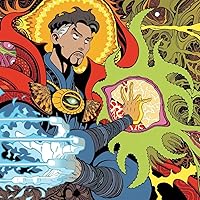
The third installment of Grant Morrison's historic run on Batman!
Morrison continues his earth-shattering run on the Batman titles with this exciting series illustrated by hot artist Yanick Paquette who features the next stage of evolution of the Dark Knight. Bruce Wayne publicly announces that he is the financial backer of Batman and establishes a worldwide franchise of Batman that will protect the entire globe.
This is the beginning of a stunning direction for the World's Greatest Detective that will team him with Catwoman, Batwoman and Batman on international crime-fighting missions against villaons like Lord Death Man in Japan, Argentina, and other parts of South America.
This third omnibus edition collects Batman Incorporated #1-8, Batman: The Return #1, Batman Incorporated #0-13, Batman Incorporated: Leviathan Strikes #1, Batman Incorporated Special #1.
Grant Morrison has been working with DC Comics for twenty five years, after beginning his American comics career with acclaimed runs on ANIMAL MAN and DOOM PATROL. Since then he has written such best-selling series as JLA, BATMAN and New X-Men, as well as such creator-owned works as THE INVISIBLES, SEAGUY, THE FILTH, WE3 and JOE THE BARBARIAN. In addition to expanding the DC Universe through titles ranging from the Eisner Award-winning SEVEN SOLDIERS and ALL-STAR SUPERMAN to the reality-shattering epic of FINAL CRISIS, he has also reinvented the worlds of the Dark Knight Detective in BATMAN AND ROBIN and BATMAN, INCORPORATED and the Man of Steel in The New 52 ACTION COMICS.
In his secret identity, Morrison is a "counterculture" spokesperson, a musician, an award-winning playwright and a chaos magician. He is also the author of the New York Times bestseller Supergods, a groundbreaking psycho-historic mapping of the superhero as a cultural organism. He divides his time between their homes in Los Angeles and Scotland.
Batman By Grant Morrison Omnibus: Volume Three collects material from Batman: The Return #1, Batman Incorporated #1-8, Batman Incorporated Volume 2 #0-13, Batman Incorporated: Leveiathan Strikes #1, and Batman Incorporated Special #1.
Officially, Bruce Wayne publicly linking himself to Batman by funding Batman Incorporated is something I'm not a fan of but after enjoying the first and second Grant Morrison Batman Omnibus, I had to complete the run. I am quite glad I did.
Despite my initial poo-pooing the idea of Batman Incorporated, I loved the shit out of this. Freshly back from the dead, Bruce Wayne takes Batman worldwide and funds Batmen in places besides Gotham. You get Batman in Japan, England, France, Australia, South Dakota, Argentina, and other places. A worldwide Batman needs a worldwide foe and we get that in Leviathan, an organization with a ring of bombs around the world.
Taking on another secret organization so soon after beating The Black Glove (and probably Court of the Owls but I have no idea how the various timelines work out) seems a little repetitive at first glance but the stories aren't that similar. Leviathan has agents everywhere and a leader near and dear to Batman's heart. We get Batman and Damian dealing with their new father/son relationship while the world hangs in the balance. I also like how Damian clearly prefers working with Dick Grayson than his own father. Batman's probably as warm as Red Forman so that's not exactly a surprise.
Grant Morrison's "all the stories are true" approach makes Batman a richer character and the Batmen of many nations expand the Batman mythos quite a bit. I'd read 50 issue runs of Batman Japan or Man-Of-Bats and Raven Red. He works in a lot of callbacks to Denny O'Neil and Neal Adams run featuring Ras Al Ghul and also nods to Dark Knight Returns and Kingdom Come.
The art team knocks it out of the park. There are a lot of black haired guys in this and there's a concerted effort to make them actually look distinct from one another. I would say Chris Burnham and Yanick Paquette were my favorites but a lot of people did a lot of great work.
Taken as one work, Grant Morrison's run on Batman is one long epic about the family Batman lost and the family he built for himself to replace it. As much as I complain about modern Batman, this was a great super hero tale. Five out of five Batarangs.
Grant Morrison has written some great graphic novels. He has also written some shit. Sometimes his imagination gets ahead of himself and the story that is created is often confusing or so far out there that it detracts from the story. This is the case of the execrable concept of "Batman Inc." that plagues the first 2/3rds of this massive third, and final, volume of Morrison's Batman run.
Bruce is back. But after being dead, thanks to being zapped by Darkseid, Batman has returned, but with some significant brain damage. Why? His "brilliant" idea is a "Batman everywhere". Ugh. So we have to sit through Batman wandering around the world looking for D-listers with no brand power and trying to turn them into native Batmen. So we have a Japanese Batman, a Mexican Batman, several Batfemales, and some other random Batpeople thrown in. Jesus. Two things: (1) Why the hell does every city need a Batman? Where do they come from? Bruce's journey to become Batman goes through decades of training with masters of their craft. Then we have these random's who trained with whom? where did they learn this shit? It's incredibly stupid and it actually calls into question everything about Batman and what drives him-since any jackass, and these D-listers are indeed jackasses, can claim the same. It's dumb. Like saying every Navy Sailor is a SEAL. (2) What tremendous levels of hubris must infect Batman? I mean the point is to fight crime. So what difference does it make if its "Batman" or some other costumed dude as long as they fight crime? There is no need for multiple Batpeople. Can't they just be heroes on their own skills and reputation? Apparently not.
So this painfully dumb, sometimes well illustrated, story just goes on and on...we have Batman wandering around the world fighting non-entities. Some of the story is very trippy and out there, but none of it satisfying. Had this been the main and only story, this would have gotten a 1 star.
But the last third- with the story of Talia's revenge and the death of Damian end this volume- this is far closer to the quality fothe previous volumes. The art and the story are pretty cool. Though was it necessary to kill Damian? He was my favorite Robin. Actually, considering comics continuity shit, is Damian even still dead in the "current" timeline? Who knows and who can keep track? He'll be back-I'm sure a'la Jason Todd. Still, my minor complaints aside, this last part of the volume was entertaining and saved the book-this part of the story is 3-4 star material.
So ends the run of Mrrison. He did some great things and a little bit of just shit. The just shit is the first 2/3rds of this volume. Taken as a whole (all the volumes) this was a magnificent run. Had he only never gone down the rabbit hole of Batman Inc, this would be one of the greatest runs of Batman. Still a good collection of massive volumes- well worth anyone wanting to see Morrison's vision of Batman, before the "New 52" blew it out of the water.
This entire review has been hidden because of spoilers.
Grant Morrison’s run on this title is surely one of the all time great Batman arcs, a truly remarkable run encompassing everything you could want from the character. Given the incredible length, I’m sure Morrison’s work will not become as venerated as say Year One or The Killing Joke. But, it’s just as good and just as essential as the others. Once again, I think the issues could be arranged differently for clarity, and for pacing. The bonus issues at the end of this would’ve been much more appreciated if they appeared in chronological order, amidst the rest of the omnibus. They feel like a total afterthought, after the thrilling conclusion to Morrison’s run.
When Batman was misplaced in time, he saw the future and in there he saw a huge threat. To fight it, he creates Batman Incorporated, an organisations that fights crime globally. He places Damian and Dick Grayson in Gotham as Batman and Robin and he goes around the globe, fighting crime and recruiting new members. Together they fight the organisation called Leviathan that's lead by Talia Al Ghul. In this amazing final part of Grant Morrison's masterful run you can truly seen Grant Morrison's understanding for Batman's character and his love for conspiracy theories. In this part of the run (like in the other parts as well) the writing was amazing. The threats are really scary, the characters are well rounded and grow, the plot is captivating, the action scenes are very well written and there's a big emotional impact. Also, the relationships between the characters are very well written. I love the way Morrison writes Batman and Alfred's relationship, as well as the relationship between Damian and Grayson. I'd consider this part of the run a very interesting and original interpretation of family and superheroes. Another great thing in this part of the run is the amazing artwork by Chris Brunham.
Morrison's run raps up in a very fitting but maybe a little unsatisfying way. The character development of the Batmen of other countries was really cool and overall Morrison's interest in those characters is very clear and helps make them engaging (especially Squire). My biggest issue is just that it feels a little too rushed and I wish we got more of Damian. I don't know how anyone could read this run and not love his development. I especially liked his reaction to Jason Todd and the small moments he had with Dick Grayson. The art was great at the start but Chris Burnham was more inconsistent than other artists in this volume. Overall I thought it worked and it didn't bother me that much but Burnham just feels like a much worse Frank Quitely sometimes. Morrison had such an interesting overall narrative for Batman, as well as their basic interpretation of the character. The Leviathan twist was a little boring at first but the more I thought about it the more it worked. The idea of a evil father and evil mother being the main overarching villains is really interesting for a Batman story. This is just really incredible run that I'd recommend to any Batman fan and I love when Morrison gets weird with the narrative (especially with chapter 2 of Leviathan Strikes). However this is in no way a good intro to Batman lore just because of how complex and weird it is.
Batman's final omnibus by Morrison finishes with Batman Inc.
Batman INC started pre-new 52 and when I first read it I HATED it so much I couldn't stand any issues. Luckily I've wised up (aged up) and enjoyed it a lot more but I will say it's one of the weaker parts of Morrison's run. Luckily once we get into New 52 Batman Inc it gets WAY better. Basically wrapping up Morrison's entire epic in a big way with Damien at the center targeted by Leviathan while Batman and Inc fight back. Epic, brutal, sad, and overall excellent ending. A 4 out of 5 all together.
This whole story (all three omnibuses) by Grant Morrison was amazing. There were parts I had no idea what was going on, and these only made sense much later. It definitely felt “deeper” than most comics I’ve read - loads of layers and hidden details to explore.
Chris Burnham is a great artist (still not Frank Quitely though). The Dedalus arc was confusing and anti-climactic. And in general, there is much more mess in this volume, because Morrison is obviously rushed by DC and their New 52 initiative. Which is sad, because his run deserved better. Also, Morrison excels in writing mythical stuff. And with Batman Inc he got into corporate boring stuff and technology. And he's simply not as great there. Iron Man is better fit for this.
4.5 The best of the 3 Omnis and what a great send off. Maybe best new 52? I’ll know once I’m done with the era. Now I gotta wait for Kel to read X-men & this to let me know which is better
Took a bit to get going, but once it did, it pops off! Such a satisfying conclusion to a run that started off feeling solid, but standard and grew to be something truly spectacular.
and so Morrison's saga concludes with like...one of the most existentially horrifying arcs out there...almost deceptive in its conclusive beats, playing out like a grand statement to disguise the thud, thud, thud of the ending...Bruce's bravada has never felt more hollow, his mission never more embarrassing, Talia's "master" plan (which she points out is more or less just a side project for her) leaves Bruce broken not just materially, but spiritually, and combined with Kathy Kane's turn as part of a global agency that overshadows Batman Inc. (now defunct), it just makes Bruce seem so...small
that to Talia (despite her own uhhh...deeply rooted issues) this entire plot is stooping to Bruce's level to engage with him, to get his attention through mimicking the aesthetics of one of his rogues to a T, just makes the whole thing that much worse...in the grand picture, with it established that Batman is capable of overcoming anything, but Bruce is fallible, that Batman can only be beaten when he is unprepared or off his game...it's evident that what Morrison wants us to consider is that Bruce's eternal limitation is in his inability to engage with the women in his life in any normal way
one can argue that he was blindsided by Damian and did his very best to redeem his son, but ultimately that redemption is more the product of Dick's influence than Bruce's...and the good nature of both "children" of Bruce is more a testament to their own qualities than their...unconventional...upbringing...Bruce laments that the first two bullets killed his father, but the third went through his mother's pearls and killed her...and this third bullet is what he identifies as the "hole in things" that plagues the trilogy of acts Morrison created, the burning absence of a mother figure and inciting incident that led to his inability to understand women
if we back up across the trilogy, we can find multiple father figures but only three key mother figures...Talia as the mother of the demon, Kane as an older woman that Bruce ultimately rejects (in this canon his first real love), and Jet as an example of a Wayne romance in real time, the courtship, the reveal, and the ultimate revelation that not only did she betray him but he supposedly never trusted her in the first place...the combination of mother issues and the nature of the world Bruce lives in leaves him unable to love, even when it's presented to him, even when it would take work but ultimately benefit his son...he is too committed to his fruitless, eternal mission, and everything in his life, any attempts to be close to him, must come through that mission
which brings us to the ouroboros, a symbol of Leviathan, the monster that is bigger than everything else and can never be beaten...and that's the nature of Bruce's status as an ongoing character, that any progress made in an individual storyline washes away with the next story, any growth must end in tragedy...and it has to be his own doing on some level metatexually, a want for his mission to continue because to stop would mean he would have to form real connections outside the context of the mission
while this limitation obviously ignores exceptions such as the playfulness and genuine development the original version of the character enjoyed, i think Morrison is specifically commenting on the version of the character post-Crisis, speedrunning first the highs of the "James Bond era" of O'Neil in the 70s followed by the grim storylines and constant loss the character went through in the Dark Age...it's a lamentation of what came before, and what will follow, an acknowledgement that...at least for now...it will never end...a Batman that cannot die can never truly find peace
and so concludes maybe my favorite longform run on a character ever...looking forward to how this informs the character going forward and if my dude can ever find even a crumb of happiness...stay tuned, same Bat time, same Bat channel!
This omnibus concludes Morrison's run on Batman. While it was a great read, with very high stakes events and pivotal moments, some of it felt somewhat rushed towards the end of it.
Morrison's pace is usually deliberatly fast, but the events he sets up usually conclude in a very satisfying manner. With Batman Inc, I felt that some very important and emotional moments weren't given the necessary breathing moments that they should have. It was, however, a very fun and exciting read.
The artwork is mostly done by Chris Burnham. While his panels are often extremely creative and dynamic, the characters do look slightly more cartoonish that I would have liked - but not nearly enougth to throw me off. The other artist that features the most in this series is Yannick Paquette. I found his artwork to be much more enjoyable, even if less dynamic and creative.
Batman Incorporated is my least favorite arc in Morrison's Batman, but it is still very good. Higly recommended.
So around the midpoint of the run of Batman Incorporated collected here is where I originally dropped off. Not necessarily because of a major drop in quality or anything, but more because I had caught up with the collected editions of the monthly comic that was still coming out, and between the last one I read and the next collection coming out, I dropped out of superhero comics in general.
When I was originally reading this part of the Morrison's run, the first Batman Incorporated run felt rushed and cramped, as if Morrison knew the New 52 reboot was coming and wanted to get as much ground laid as possible. Where Batman and Robin was able to tell a tight narrative in a minimal amount of issues, Incorporated felt confused and at times nonsensical. I don't know if something changed with me, but this time I felt that, while the issues are at a breakneck pace, they're solid, and I can follow what Morrison is doing better.
However, if there is something that has become worse on a reread, its how Morrison writes about Wayne Enterprises, and the capitalist businessman part of the Bruce Wayne character. I get what Morrison is trying to do, Batman has gone public with Bruce Wayne and Wayne Enterprises now being his public financiers. So, similar to how Morrison is trying to push Batman in new directions and redefine the character, now Morrison is trying to push the idea of Wayne Enterprises forward and redefine it's role in the mythos. But so much of it just comes across like a libertarian capitalist fantasy of the "good billionaire", who is able to push the boundaries of what we can conceive of. So he can build us perfect robot police, or Web 3.0.
Obviously the ideas of noblesse oblige have always been a cornerstone of Batman's mythology, the good billionaire who uses their money to deal with societies ills, but focusing so much on it in this way just makes this whole part of the story feel like the same kind of propaganda we've been fed ever since the techbro boom.
(I'm sorry to keep harping on this because it's taking up so much room, but there's a section that haunts me directly of the characters discussing how people are buying Wayne Enterprises stock because they want to be part of the Batman revolution, and it's just so... Stupid, that that's how the comic wants to portray stock trading.)
To move onto something that is actually interesting, and I feel is probably the highlight of the run, is the culmination of two of the running themes of the run. I talked about them a bit in my review for the first volume, but there's the unknown unknown, and the contradiction of Batman as great good while also being a childish worldview, one that drags others into it.
Both of these culminate in the final conflict of the run, embodied by the two loves of Batman's life, Kathy Kane and Talia al Ghul.
Kathy is reintroduced in flashbacks during this segment of the run, and given a revamped backstory as being an agent of an international spy agency called Spyral. She's depicted as a strong woman with a rich life and history independent of Batman, and who its revealed eventually fakes her death and has been leading an independent existence dealing with things that are beyond Batman's scope.
Talia is depicted here as someone who is trying to get through to Batman in the only way that he can see the world, basically becoming the most dangerous villain he has ever faced in her spare time as a way to break the never ending pointless game she sees his vigilantism as. And it's shown that she's not exactly that far off the mark, even if her own goals and actions are horrific. There's a good bit near the end where Batman yells out that "You might think you own the world, but you'll never have Gotham city!" and she calls him out for how childish he sounds.
And then Kathy Kane shoots her in the head. The piece of the puzzle that Talia couldn't account for, who then thanks Bruce for leading Talia into a trap she could never escape from. She then tells him to stick with dealing with what he knows best and vanishes from his life for a second time, basically being one of the few people who has both been part of Batman's life and been able to escape from it.
It's an incredibly pessimistic message to end the series on, but an utterly fascinating one, that both accepts and in some ways argues against the criticisms of the superhero world view. And while a lot of the ending's tone was influenced by Morrison's mood at the time, I can't really see another way that the comic could have ended. Batman's life is a tragedy in many ways, and while there is a lot of triumphs along the way, I can't see the ending escaping this conclusion. One that muses on the absurdity at the heart of the Batman persona.
I think I have to give this volume a 5 or 6 out of 10. While I do think it's conclusions are fascinating, I have issues with other aspects of it.
This more like a 3.5, but I have too many problems with it to give it 4 stars. (I will avoid spoilers)
This book is filled with great ideas let down by erratic pacing, shallow characterization and worldbuilding. The villains are great and Grant Morrison is excellent at creating excitement in a story and giving the characters witty dialogue that says a lot about their personalities with very little. It just feels like too many things happen too quickly, and a lot of detail and background that would give the story more weight and depth is glossed over, particularly in the climax (I find this to be the case with many of Morrison's large scale stories).
There is also a plot point set up very early that is reiterated several times throughout the story, but when it finally pays off, I was left wondering if Morrison either forgot what he was doing with it or never had a plan for it at all. Morrison also does this a lot.
The story would've benefited from more development given to the central antagonist as well as the Batman Incorporated operatives. Some of the characters are so vaguely defined that it lessens the stakes of the story for me, and some of them only appear in fight montages against villains you never see again.
The art also suffers after the issues drawn by Yanick Paquette. I think Burnham has some great ideas, but his visual style is sometines ugly and silly looking, with overly elongated torsos and unfinished faces that wouldnt look out of place in a child's notebook. The figurework and faces are frequently amateurish and the panels are mostly flat angles.
Sometimes Burnham's art looks great and has energy and passion. I also love the experiments with the panel borders and structure. It just isn't my preference for a Batman story, especially one that has terrorist attacks, mass murder and graphic depictions of children being murdered. (I don't have a problem with these story elements at all, the art style just makes them look silly and comical and robs them of their impact) It looks too cartoonish and juvenile and undermines the story and makes it feel less epic and dramatic than it should be. I'm sure there are people that love this art style in this particular story, and there are contexts where I enjoy it too, it just feels unfortunate to me that this was the art style employed for this particular story.
Despite all that, I have to complain that none of the Morrison volumes even list the artist's names on the covers. I don't know who made that call, but it feels disrespectful to the artists.
(Zero spoiler review) 1.75/5 What in the name of tarnation did I just read? I could have sworn I opened the final omnibus of Grant Morrison's Batman run. Perhaps there was a printing error, because my omnibus was filled with some of the most underwhelming, disappointing stories to feature a character who (when he actually appeared in his own book) bare's a striking resemblance to Batman. I'm pretty sure I convinced myself for the first two were better than they were, but god damn, I'd read them a dozen times then frame them and put them on the wall before I so much as glanced sideways at this dross again. Batman Inc.? Give me a break. Could I have Batman actually doing some Batman things, you know, if it's not too much trouble. I get after a thousand Batman books, it can be tough to come up with something fresh. What we have here is certainly unique, although this should be a case study in why something original isn't always good. The lengthy stint of Chris Burnham is wasted, even if the overly bright colours suited Gotham about as much as Morrison's hack idea's. Either the editors weren't willing or able to keep Morrison's inflated imagination / ego in check. Maybe if someone had the gumption to reign him in, then we might have got something good. But alas, they didn't, and we didn't. I feel a thorough re-examining of this series in its entirety is in order, as volume's one and two have been severely tainted by this. Have you ever been out on a date, thinking it was going well enough, then at the end your prospective partner throws a drink in your face, loudly and publicly shames you, then leaves with the waiter and sticks you with the bill? No? Read Morrison's Batman, you'll know how it feels. Pure garbage! 1.75/5
Kevin Conroy, voice of Batman since 1993, has passed away.
How fitting to finish this book on a day like this.
Grant Morrison, the writer of this collection, has provided Batman stories that have shaped the character for decades, began his run on the Batman title in 2006. As a scholar of comics, he wrote a massive journey of Batman's history - taking from 1950's team ups, 80's British indie comics, Japanese Manga Batman specials, 70's swashbuckling adventures, and his own sprinkling of mysticism, myth, and magic. For 7 years, Morrison crafted a Batman story to reveal the truth that Batman is a force that will never cease. Never die.
For 30 years Kevin Conroy was the voice of Batman. Television. Movies. Video Games. He captured the duality of Batman. The casual confidence and irony of Bruce Wayne living a hidden life. The trauma of Batman's loss channeled through rage at crime and evil. And the compassion - somewhere - for these villains and people who had lost their way. He had such a distinct voice, something that made his act as the character unforgettable. Attempting to describe his performance as Batman in writing is an impossible task. But when either one spoke, like harmony, The Dark Knight and Kevin Conroy seem to ring out one and the same. I still hear his voice each time I open a book with the great detective in the center of the story. Ringing boldly that he is the vengeance. The night. Batman.
Morrison was Batman's myth-maker. Kevin Conroy will always be Batman's voice. And on today, the day of Conroy's passing, Morrisons last pages of his writing on ring true.
"Batman never dies. It never ends. It probably never will"
This one’s a bit rough, and easily the most difficult of the three volumes to get through.
The issue with David Finch’s art is great, and getting to see Batman and Catwoman interact in the next couple issues is solid. El Gaucho is fun, and I like seeing Kathy Kane Batwoman being incorporated into canon.
Everything aside from those things in the first Incorporated series is really tough to get through. There’s hardly any Batman, and it’s hard to care about all these random characters that will likely barely (if ever) appear outside of this series. The digital issue is genuinely painful and I’d like to never have to see it again.
Conversely, the Leviathan Strikes issue is decent, and the majority of the second Incorporated series is quite enjoyable. Chris Burnham and Nathan Fairbarn are a striking illustration team, and there is a lot more focus on Bruce and the characters immediately in his circle so that’s inherently more interesting.
The last issue included in this omnibus, though, is insipid and I genuinely don’t understand why it was included, given that Morrison doesn’t seem to have touched it at all. This was just a really strange choice to include.
Overall, this is easily the weakest of the Morrison Omnibuses, and I’ll likely skip it or just read the New 52 Incorporated trades on a Morrison-Batman reread. It loses a lot of what made their take on the character so appealing, even if the second series is a stronger comic.
The closing chapter on Grant Morrisons Batman run and what a ride it was. An overall great read, while omnibus 2 was my all around favorite, I still enjoyed it all as a whole. We jump straight into New 52 territory with zero warning, but as long as you just go with it and treat Morrisons run as one connected piece it isn’t a bother at all. The art style is still solid and we get some amazing shots in here, I do feel as though Batman incorporated ran its run fairly fast and some members get more time to shine and are more interesting than others, but still a neat concept, Knight & Squire are definitely the favorites here. While the ending did feel a bit rushed it was still enjoyable and the buildup was solid. Throughout the 3 omnibus we jump through so many big pieces of Batman stories, from pre-52 Batman and Tim Drake Robin, Batman RIP, Grayson Batman and Damian Robin, Bruce traveling through time and the story of Barbatos (comes into play in rebirth), to even some pieces of Justice League and Final Crisis, and Batman Incorporated as well as the death of Damian and Leviathan. So many chapters and yet overall it feels to connect together fairly effortlessly throughout all these years that span these stories. Is it perfect? Absolutely not, but it is good, and an awesome era of Batman.
This entire review has been hidden because of spoilers.
Absolutely had a thrill reading the conclusion to Grant Morrison's Batman run. I'll admit the criticism I've been having of Grant Morrison's writing, where it's hard to get going and too convoluted, is there again at the start of this volume, especially during Dr. Dedalus' part. However, after that, it was such an engaging read. Loved how high the stakes were with Leviathan. Although it might seem repetitive that throughout this run Batman is constantly facing secret societies like the Black Glove, having Leviathan infiltrate every facet of society, and its head being someone who knows Batman so intimately, was very fulfilling. However, even if it made some sense, I'm not a fan of Talia's characterization. Was a big fan of Batman Inc.'s and its development as well, seeing someone who was basically brought back from the dead and traveling through time have a new outlook on fighting crime, and bringing everyone together to work as a team devoted to a mission, then witnessing the risks of putting vigilantism in the light led to its downfall was very satisfying. Lastly, on top of the mystery and conspiracy, it's very action-packed, and the art by Chris Burnham felt very fitting.
So back in 2015 I bought "Absolute Batman Incorporated" from a friend's comic store, as that was the only way to own the final act of Morrison's Bat-run in a single bound form. I ended up selling that a year or two later because I stopped collecting Absolute editions of non-Vertigo work. Batman is great, but Batman doesn't need to be read in such an unwieldy experience. It's pulp! Glorious pulp.
Anyway, five years later we finally got a single omnibus edition of Batman, Inc., sold here as Volume Three. I'm glad Morrison's run is now collected in proper sequence from start to finish in three incredible volumes. I'm not sure whether this is the best of them, or whether that goes to vol.2. They're so different, so deeply gleeful. Morrison explores every part of the Batman mythos he finds interesting and weaves great mystery plots, drama, sci-fi, horror, all together. It's so fucking good.
First half dragged on for so long that by the time things got interesting, I almost didn’t care. Almost. The second half of this book is so much stronger than the first. It’s wild that after three large collections of Grant Morrison’s take on Batman, we still spent hundreds of pages on the last book setting things up. While some of the new members of Batman Inc were intriguing, I ultimately didn’t care about any of them, and the Leviathan “mystery” just didn’t resonate with me. However, once the team was formed and the secrets were out, things kicked into high gear, and I couldn’t put the book down.
Honestly I’m just glad I’ve finally read Grant Morrison’s “legendary” Batman run. On my first pass, I was pretty lukewarm about most of it, but I’ve heard it gets better with every reread. We’ll see.
Je ne serai pas capable de résumer en quelques l'intégralité de ce run incroyable écrit par Morrison, mais qu'est-ce que c'était bien. Cette 3eme et dernière partie de run est à la hauteur des 2 précédents volumes. Morrison livre un récit dense, complexe mais très bien écrit, piochant dans la mythologie du personnage pour nous sortir une série grandiose, épique, et avec des thèmes marquants et intéressants. Les développements de personnages et leurs relations sont toujours justes et bien amenés, le rythme du récit est parfait, rapide quand il faut, lent quand il faut, et la narration ne laisse aucune place à l'ennui ou à la distraction. Un run prenant et alletant du début à la fin, et soigné par une pletor de dessinateurs tous aussi talentueux les uns que les autres.
The final volume of Morrison's Batman is a mega-volume in two parts.
On the one side we have the collection of a world full of Batman, building on the heroes from pervious volumes (and previous decades of stories), but bringing them together as Batman Inc. And that's pretty cool.
On the other hand, you have Leviathan, which turns Talia into one of Batman's most important foes ever.
Morrison's finale for Damian is ... still shocking. And it seems a little bit that he didn't want anyone else playing with his toys. Fortunately that didn't last for long.
It's really amazing how much of this still reverberates in today's DC Universe, though I'd really like to see these Batmen back!
Takes a bit to get going, but when it does… oh man. It’s like a dramatic Greek tragedy involving Batman and his family, bringing to conclusion several simmering plotlines from the previous volumes around Talia, Bruce and Damian. Especially loved the tension between Robin and Batman, even more so when put side to side with Damian’s relationship to Nightwing. I also liked the worldwide Batman Inc concept, with all the wacky returning characters (even though not all of them were equally successful). The art by Chris Burnham is a bit more cartoony/stylized, but he utilizes that very well in the action sequences, so I grew to like it. Also: Bat-Cow.
Pues con este tomo acabo la era Batmaniaca de Morrison. En su etapa se introducen muchos conceptos interesantes como la figura de damian o batman i.n.c y le da una vuelta de tuerca a otros de la golden/silver age como el club de batmans, zurr en ahrg (o como se escriba) o la batwoman original. A pesar de todo esto creo que donde está el punto fuerte es en lo bien que capta la psique de los personajes, sobretodo en el punto en el que Dick pasa a ser el nuevo batman y tiene que hacer el papel de mentor de un robin tan soberbio como es Damian mientras intenta estar a la altura de Bruce. En resumidas cuentas, que es un melocotonazo