Jump to ratings and reviews
Rate this book

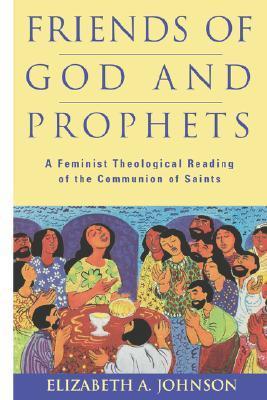
Friends of God and Prophets: A Feminist Theological Reading Of The Communion Of Saints

Rate this book
"[Johnson's] book should be read slowly, thoughtfully and prayerfully by Christians of all denominations, for it has much to say about belonging to the communion of all the saints." -Christian Century

320 pages, Paperback

First published June 1, 1998

7 people are currently reading
124 people want to read

About the author

Elizabeth A. Johnson

41 books111 followers
Johnson grew up in Brooklyn, New York, the oldest of seven children in an "Irish Catholic family." As a young adult she joined the religious order of the Sisters of Saint Joseph whose motherhouse is in Brentwood, Long island, NY. She received a B.S. from Brentwood College in 1964, an M.A. from Manhattan College in 1964.

1981, she became the first woman to earn a Ph.D. in theology at the Catholic University of America (CUA). CUA is a pontifical university of the Catholic Church and is the only university in the U.S. founded and sponsored by America's bishops. Johnson recalls that her experience there was "rich, respectful, and collegial," but was also "lacking in female presence." During her studies there in the 1970s Johnson observes, "I never had a woman professor, I never read one woman author. There were none to be had. It was a totally male education." CUA attempted to remedy this when Johnson herself was hired into a tenure-track position in Christology. She became one of the first female theologians allowed to receive a doctorate by the church authorities, as a result of the "liberalization decrees that capped the Second Vatican Council." Feminism had begun impacting the thinking and dialog of female Catholic theologians, and pioneering feminist theologians Elisabeth Schüssler Fiorenza and Sandra M. Schneiders influenced Johnson on feminist topics, including using feminine metaphors and language for God. Inspired by their example, Johnson and other women graduate students formed a group, "Women in Theology."

She has served as head of the Catholic Theological Society of America and the American Theological Society.

While at CUA in 1980 she felt profoundly affected by events of the Salvadoran Civil War when four American women, including three nuns, working as missionaries and helping oppressed people to escape violence, were abducted and killed by a death squad. Johnson mourned the women, but she "redirected her anguish by carrying out their mission in her own field of theology."

Johnson notes that leaders of her religious community encouraged her to enter the field of theology and pushed her to continue in spite of obstacles. "When I applied for tenure at Catholic University, I received the full positive vote of the faculty. But the outcome was in doubt because some bishops were not happy with an article I had written," she says, referring to her article questioning the traditional view of Mary as "humble and obedient." Though she contemplated leaving rather than facing the "arduous process of interrogation," General Superior Sister John Raymond McGann advised her not to give up, and Johnson did receive tenure.

Johnson had taught science and religion at the elementary and high school level, then taught theology at St. Joseph's College (New York) and at CUA before moving to Fordham in 1991. At Fordham, she was named Distinguished Professor in 1997 and "Teacher of the Year" in 1998.

Ratings & Reviews

What do you think?
Rate this book

Friends & Following

Create a free account to discover what your friends think of this book!

Community Reviews

5 stars
28 (51%)
4 stars
15 (27%)
3 stars
5 (9%)
2 stars
3 (5%)
1 star
3 (5%)
Displaying 1 - 2 of 2 reviews
Profile Image for Serge.
512 reviews
January 18, 2025
Using this book as part of an independent study for one of my seniors who is exploring City of God with a feminist theological lens. No better companion for such a venture than Elizabeth Johnson
Profile Image for Mars.
4 reviews1 follower
January 29, 2013
Reading an excerpt from Elizabeth Johnson's book "Friends of God and Prophets", I was struck by the simplicity of our call to holiness - it's not about attaining moral perfection, but rather about participating in the divine. Sans Christian-specific terminology, one could apply this idea of 'Holy' to any spiritual practice.
"The power of baptism justifies all persons in the church and makes them together sharers in the divine nature. "In this way they are really made holy." This holiness is not in the first instance a moral perfection but a participation in the glory (doxa) and love (agape) of God, given freely without previous merit or accomplishment on anyone's part. God is holy, and the people share in this through the grace of Christ in the Spirit" (p. 117)
Displaying 1 - 2 of 2 reviews

Can't find what you're looking for?

Get help and learn more about the design.