Kenji ha vuelto. Decidido a dejar de huir de una vez por todas, cruza la frontera y se dirige con paso a firme a la ciudad de Tokio. Por su lado, sus compañeros han empezado a reunirse, convencidos de que juntos pueden y deben detener la guerra de “Amigo”.
A todo esto, Kiriko ha conseguido fabricar la vacuna contra el virus definitivo, y el profesor Shikishima ha creado el robot que debe derribar los platillos volantes de “Amigo”. Ha llegado el momento… ¡¡Empieza la batalla final entre la Humanidad, que lucha por sobrevivir, y “Amigo”, que se ha empecinado en exterminarla!
Urasawa Naoki (浦沢直樹) is a Japanese mangaka. He is perhaps best known for Monster (which drew praise from Junot Díaz, the 2008 Pulitzer Prize winner) and 20th Century Boys.
Urasawa's work often concentrates on intricate plotting, interweaving narratives, a deep focus on character development and psychological complexity. Urasawa has won the Shogakukan Manga Award, the Japan Media Arts Festival excellence award, the Kodansha Manga Award and the Tezuka Osamu Cultural Prize. In 2008 Urasawa accepted a guest teaching post at Nagoya Zokei University.
Series list (not including short stories collections): - Pineapple ARMY (パイナップルARMY) 1985-1988, written by Kazuya Kudo; - YAWARA! 1986-1993; - Master Keaton (MASTERキートン) 1988-1994, written by Hokusei Katsushika; - Happy! 1993-1999 - MONSTER 1994-2001 - 20th Century Boys (20世紀少年) 1999-2006 - 21st Century Boys (21世紀少年) 2007 - PLUTO 2003-2009, based on Tezuka Osamu's Tetsuwan Atom - BILLY BAT 2008-2016 - Master Keaton Remaster (MASTERキートン Reマスター) 2012-2014 - Mujirushi (夢印-MUJIRUSHI-) 2017-2018, collaboration with Musée du Louvre - Asadora! (連続漫画小説 あさドラ!) 2018-ongoing
Ever since I watched the animeMonster, I have been fascinated by its creator, Naoki Urasawa. His style of storytelling, his ability to create great mystery and suspense, his deep character development, psychological analysis of villains, symbolic storytelling, philosophy, and use of surrealism—all of it captivated me. I read this manga because of my love for that great anime and the massive praise surrounding the main antagonist, Friend.
Urasawa once again nailed the concept in this manga. While the plot of Monster is a little typical like popular thriller books and movies of its time, the plot of 20th Century Boys is quite unique. I won't say much about the story, but I will say that the story world crafted by Japanese manga writers is completely different and amazing. Although the manga includes familiar elements like cult conspiracies, world domination, the heroic fight of ordinary friends against powerful evil, dystopias, virus pandemics, and whodunit mysteries, Urasawa brilliantly merges everything into one massive and fascinating narrative.
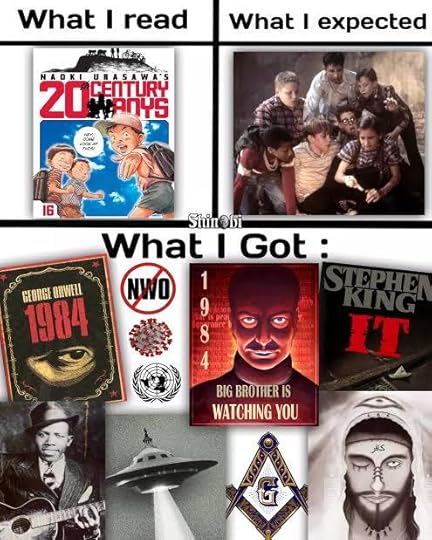
The storyline of 20th Century Boys is very strong. Despite covering such a vast range of genres, arcs, and characters, the story remains well-rounded with a complex mystery and excellent visualization. It revolves around two central themes: first, the nostalgia of childhood friendships turning into a battle against a terrifying modern-day enemy born from that very childhood; second, a dystopian world grappling with a deadly pandemic. It’s heavily reminiscent of Stephen King’s work, something Urasawa even pays tribute to here. The dystopian aspect will also remind readers of classic Orwellian themes. This shows just how grand, complex, and deeply layered 20th Century Boys really is.
But it’s not just a sci-fi mystery adventure. The story explores many inner themes: the nostalgia of growing up in 1960s–70s Japan, the punk influence on 1980s youth, and the depression during Japan’s Lost Decade in the 1990s. In these aspects, it feels like Urasawa wanted to reflect his own life experiences and emotions. The manga has also captured the sense of instability people felt at the end of the 20th century about the upcoming new millennium, presenting a warning about an alarming future. Moreover, familiar conspiracy theories and religious symbolism (Antichrist/Dajjal, Return of Christ) are cleverly woven into the story.
Now, regarding the execution of such a massive story: I have to say, Urasawa just nailed it. Even after the initial buildup, he managed to maintain a fast-paced thrill throughout the manga. As a reader, I never felt bored. To be honest, keeping readers engaged across such a scattered timeline, with so many characters and shifts, was a huge challenge, but Urasawa handled it well. Also, the mysteries are skillfully woven deep into the story, sustaining the reader's curiosity.
Coming to the world-building: 20th Century Boys leans into dystopian science fiction, and here too, Urasawa excels. The political dystopia under Friend’s totalitarian rule is convincingly portrayed, but even more impressive is the depiction of a virus pandemic. Although not as frightening as portrayed in the manga, we witnessed glimpses of that brutality during the real-life COVID-19 pandemic. Through solid world-building, Urasawa makes an unrealistic story feel very believable.
Now to Urasawa’s most special strength: character development. I was deeply impressed by his character-driven storytelling in Monster. Although 20th Century Boys is more plot-driven, so it doesn't have the same depth of character development as Monster (with the exception of the character Sadakiyo). Urasawa still has managed to develop the important characters well. Through them, the manga explores themes like family, responsibility, duty, determination, freedom and friendship.
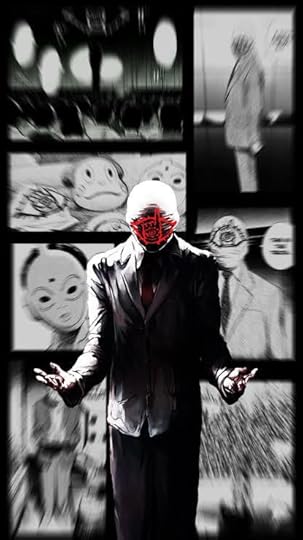
Let’s talk about the main attraction of the manga: the antagonist, Friend. Urasawa made Friend a special villain character by blending the typical "big boss" and "Antichrist" archetypes with a hidden identity mystery. Despite limited presence, Friend’s terrifying influence dominates the story. Through whispers, symbols, and the fear he inspires, he feels omnipresent, shaping the world of 20th Century Boys and haunting nearly every page like a near-mythical villain. For the first two-thirds of the story, Friend is genuinely terrifying, covered in a cryptic and mysterious past. However, toward the final third of the story, the character starts to feel a bit too cliché. One reason for this might be the over-exaggeration of the mystery surrounding Friend’s identity, which eventually creates more annoyance than excitement. Also, because I was heavily spoiled, the twists about Friend's identity didn’t have the intended impact on me. Furthermore, Friend’s ultimate purpose and motives aren't clearly defined, which weakens the characterization. Compared to Johan Liebert, the antagonist of Monster, Friend feels much weaker.
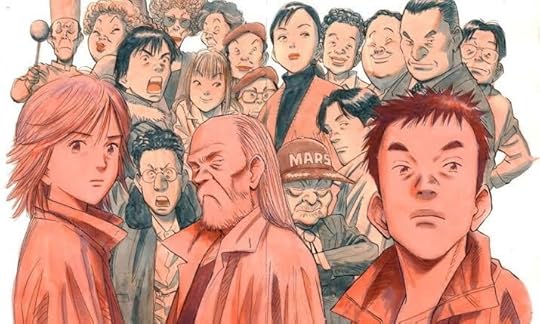
Now, about Naoki Urasawa’s artwork: I’m not an expert in drawing, but I can share my impressions. Urasawa brilliantly visualizes his imagination through vivid and dynamic illustrations. Each dialogue bubble and panel transition is very skillfully done, making the scenes feel cinematic. His artwork keeps the reader moving seamlessly from one moment to the next, which is one reason why the manga is such a page-turner. Also, his character designs are distinct, with very expressive and realistic facial expressions. Naoki Urasawa’s mastery in character face design shines through in how he draws a vast cast with distinct, recognizable features across different ages, maintaining incredible consistency throughout the story.
Now, coming to the things I didn't like. One thing that ruined parts of the manga for me is Urasawa’s indulgence in his musical fantasies. As both a mangaka and a musician, Urasawa seamlessly integrates elements of these professions into the story, such as making the protagonist a singer. Through these he explained the importance of creative liberty, freedom of speech, creative things, which was right up to a point. As the story is dystopian, it is necessary. In particular, the lonely Kenji's 'Bob Lennon' song before Bloody New Year's Eve was really good. However, the protagonist’s poor comeback through musical fantasy feels ridiculous and weakens the story a lot. The fuss around the "Guta Lala, Suda Lala" song was, frankly, complete nonsense. Moreover, the climax and conclusion of the story are very weak. After the epic climax of Monster, I expected something similar here, but instead got a poorly developed "save the world with songs" type ending that felt very underwhelming.
Also, by attempting to make Friend’s identity overly mysterious, the author ended up creating unnecessary confusion and introducing numerous plot holes. Furthermore, it often feels like Urasawa expanded the story beyond it's original plan, constantly adding new ideas. As a result, at some point, everything becomes overwhelming, making it difficult to properly resolve all the mysteries and bring the story to a satisfying conclusion.
The final face-off and showdown with Friend is very weak (especially when compared to the Ruhenheim arc of Monster). Ending the manga without solving most of the mysteries was extremely disappointing. I really didn’t expect that. Perhaps Urasawa was forced to deliver this disappointing ending due to the excessive stretching of the story, which later made it necessary for him to create the short sequel, 21st Century Boys. Finally, my overall opinion:20th Century Boys is a very good and enjoyable manga. Reading it is truly a memorable and remarkable journey. Even though it weakens toward the end, I cannot give the manga less than 4 stars. And special thanks to the anonymous translator (or translators). The quality of the English translation is excellent—easy to read, with good explanations of the manga’s pop culture references.
📚 Name of The Book:20th Century Boys: The Perfect Edition, Vol. 11
A partir de la mitad del octavo tomo (formato kanzenban), el manga cambia en muchos aspectos. Se vuelve aún más complejo, aunque pierde parte de ese trato tan cercano que se daba a los personajes; un efecto que, en realidad, viene perdiendo desde el cuarto tomo. Dejan de ser el dependiente, el cocinero, la guardia de seguridad. Ahora cargan con otro tipo de mochila y no a todos les sienta bien. Hay arcos argumentales que siguen funcionando de maravilla, pero hay otros que, sinceramente, no tienen ni pies ni cabeza.
Aún así, el reinicio de la serie a mitad del octavo tomo sigue rayando a buena altura. El cambio de escenario, con un mundo totalitario y paranoico, y una elipsis que plantea nuevos interrogantes enriquecen una trama que sigue ganando complejidad. El ritmo acelerado, el dibujo con personajes y lugares tan reconocibles y realistas, el profundo conocimiento sobre el arte secuencial que posee Urasawa, todo eso continúa ahí. Pero también empiezan a verse indicios del berenjenal donde se está metiendo el mangaka: nuevas subtramas, nuevos personajes y antiguas subtramas que continúan sin resolverse.
Entonces, en el décimo tomo, el castillo de naipes empieza a temblar; y en el último, se desmorona. Los giros finales son soluciones apresuradas carentes de sentido y el final no hay bicho viviente que lo entienda. Los últimos capítulos son torpes y dan la sensación de que el autor quería quitarse cuanto antes el muerto de encima. En conclusión, un desastre.
Pues bien, leí este último tomo avisado de lo que podía encontrarme y con conocimiento de que existe un tomo extra a modo de epílogo. Tomo extra que ya he leído y que arregla este enredo en su mayor parte (21st Century Boys).
Supongo que Naoki Urasawa lo tenía todo planeado. Puedo decir que, al haber podido leer los tomos finales más el tomo extra de seguido, la sensación final es de satisfacción, aunque sigue pareciéndome la primera mitad de la serie una maravilla inigualable.
En conjunto, la serie es una genialidad infinitamente recomendable, a pesar del (falso) final de este tomo.
WHAAAAT?! It’s not over! So now I HAVE to get 21st Century Boys and find out but the last volume of 20th Century Boys was pretty lit. This was such a long and intricate story I really wasn’t sure that the ending could wrap up in an epic way but really it did. I loved how everyone was involved too, even the least of them. If you like manga/comics and haven’t read this one, you have to give it a shot.
This ending was a bit rushed and unsatisfying. I feel like the pacing at some point in this series started to get a little all over the place. I think the ending is fine, but I could have used maybe less minor characters throughout so we could focus on the emotional impact on our main crew.
So it seems to be the end... I had no idea going into this volume that it was the last one, and even after reading it, we the open ending, I still hope there might be a continuity, it did say to be continued, but at the same time looking on the Internet, it clearly seems to be done.
It was a great series. Very enjoyable and this volume did a great job closing it all. There is some loose ends and holes if you start to deeply think about it, but nothing that was problematic enough to downgrade my rating. I like it a lot, maybe not a top series, but definitely an above average one that I wouldn't be worried to recommend!
I'm a bit sad its done to be honest. Is it really? If there is some manga geeks out there that can confirm that or not in the comment that would be appreciated!!
The end is near as Kenji survived the horror that was Bloody New Year’s Eve all those years ago and is now heading towards Tokyo to settle the score with the Friend, now the president of the world. Meanwhile, his allies – from his childhood buddies to his niece Kanna – are rallying to put a stop to the Friend’s war to end all wars as he’s preparing to unleash another virus that is deadlier than before. With a vaccine developed to counteract the virus, will there be enough time to save the people and prevent the dastardly plans of the Friend, who still remains a mystery?
As we eventually nearer to the climax, there are still things from the past that are still to be explored, such as the identity of a self-isolated radio DJ, who is revealed to be Konchi, one of the members of Kenji’s youth group. As always with Naoki Urasawa, who is about ensemble pieces, is willing to spend time with the most incidental characters, including Father Nitani, the former Yakuza-turned-priest who heads to the Vatican and warn his friend that is the Pope about the upcoming threat.
Considering that Urasawa loves telling epic mysteries, his strengths as a writer is when he stops and focuses on the little moments of character interaction. One deeply moving moment, in particular, includes Yukiji confronting Kanna about her reckless actions from meeting her father that is the Friend and threatening to blow up the Friend’s building that would’ve resulted in a number of deaths. Another sequence that stood out is when “The Boys” are reunited with the twin bullies Yanbo and Mabo, who recently became allies, turning on the Friend, but that won’t stop Yoshitsune from getting his moment to shine by punching his old childhood bullies.
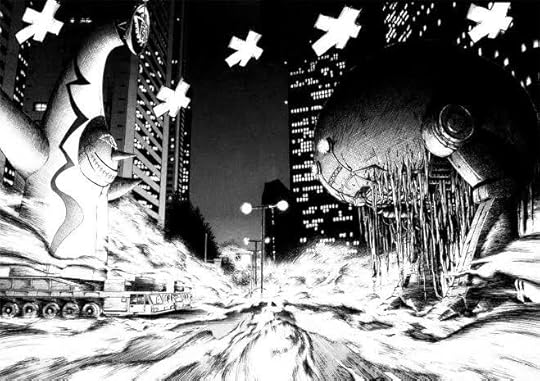
Given how dark the story has been throughout, I’ve always liked that Urasawa can still sprinkle humour, albeit in black humour, with the Friend convinces the world that space aliens exist, even getting the Vatican to believe in such a farce. To unleash the virus, the Friend’s organisation created 50s-styled flying saucers that will release the weapon. Yes, it is dark, but the sight of those types of saucers in this day and age can make you chuckle. Harking back to the events of Bloody New Year’s Eve, the climax ends up being a repeat of sorts with the return of the Mecha and Kenji finally steps into the spotlight to save the day, whilst most the allies are preparing for the largest music concert in Japan to gather as many people to safety.
Urasawa’s art is not one of great action, but he remains a master of suspense with numerous confrontations and revelations, including the suggestion of Kenji doing something in his childhood that might have triggered all of this. As a pretty explosive climax, it does resolve some things, particularly a family reunion that this series has been building towards, but there are definitely loose ends, which certainly upsetting fans at the time of publication. However, knowing fully well that Urasawa concluded the story with 21st Century Boys (which covers the upcoming final volume of these Perfect Editions), I'm interested to see what final resolutions are there left.
Urasawa is a master of the manga medium and this is an amazing series that mixes a sweet coming of age tale with the horrors of biowarfare, political conspiracies, robots, and space aliens. (Really?) I have been going at the volumes of this “perfect edition” which have been released one volume at a time, in three month long intervals. Once I read all the volumes that had come out by the time I started, my “hanging over the edge of a cliff for three months at a time” agony started. And repeated. And repeated. And repeated. What kept me going was the knowledge that by volume 11, sweet closure was sure to arrive. Well, it didn’t. Where this series ends, the next one begins and, you guessed it: a new volume every three months. How many volumes of the perfect edition there will be is not a factoid I know. So, now, I’m holding on to 21st Century Boys in hopes of sweet closure. Sometime soon.
”Everything’s always been exactly as I prophesied, hasn’t it? The world never recognized my genius. I am necessary…But this world is not. The “prophecies” were all lies. I did it. I did all of it.”
the way that every character either minor or main all connect and have their roles to play is so great. this whole series is genuinely so well written.
Powiem wam tak, większego arcydzieła nie czytałam. Jak ktoś mi powie, że nie przeczyta tego, bo jest dla "mangoz*ebow", to przepraszam ale się nie dogadamy. To jest więcej niż komiks, manga czy powieść. Żadne słowa nie opiszą, jakie to było dobre, jak zżyłam się z bohaterami i jak wpłynęło to na moje życie. Błagam was, czytajcie. Każdy tom serii był na 5 gwiazdek-to coś znaczy 😊
Sudarara, gutarara! It’s been an emotional journey reading this series, and I have a lot to say about it. Here goes:
Despite the title, 20th Century Boys primarily takes place in the 21st century, and a majority of the protagonists are 20-somethings who were born in the 1990s. There’s a lot of focus throughout the series about how, even though the titular ‘boys’ are still central to saving the world, they’re more than happy to let the young guns take the reigns. There’s this (probably unintentional) thematic undercurrent of a small cabal of Boomer-aged individuals (though is that a generational marker that the Japanese even have?) actively trying to control and destroy the world, and it’s up to a bunch of disaffected millennials to save it.
Really. Most of the major players throughout the series include a trio of young manga artists whose politically charged material lands them in prison; two high school girls who must run for their lives by daring to question historical record; two drag queens who are forced to fight for the sake of their friends; a police officer who goes rogue after learning of the deep & deadly corruption of the force; and an entire city’s-worth of mafiosi who unite for the sake of overthrowing a corrupt government. The middle-agers that the reader initially followed take the roles of mentors or protectors for the generation whose world has been ruined by their elders. This isn’t remotely relevant in any way to real life, of course. Pure fantasy. Oh, and there’s also a global pandemic or two that threatens the entire population of the planet, exacerbated by those in charge who refuse to do enough to combat it. Yeah, so unrealistic!
In this grand finale volume, the good guys win by peacefully protesting against a swarm of armed guards, while a music festival acts as a lure to protect the citizens in a safe haven. Earlier in the series, one of the characters reflects back on the opening moment of the entire saga, when he’s a child and ties up the secretary of his elementary school so he can hijack the intercom system to play T. Rex’s “20th Century Boy” for the whole school. “This is the future!” he declares in his revelry. Decades later, he tells his friend that he viewed himself as this huge badass, rebelling against the amorphous ‘man,’ but in reality no one even cared. His friend confirms that he had no memory of it even happening, despite the fact he was at school that day. And that’s one of the most potent moments of the whole series: it was a pointless act of chaos that went unnoticed—but in the end, that same kid became a man who literally saved the world with his music. He learned, somewhere along the way, that music can have that power he imagined it did as a kid, but only when its fighting for something tangible. The last moments of the series, when he plays music in front of a massive crowd and denies the audience of the song that saved the world, he yells to a teenaged punk band for THEM to play that song. He hands the baton to the 21st century boys, because rebellious music is a young man’s game, and they can save the world now. He’s spent 40 years saving it and he just wants to go home and catch up with his niece.
Y termino esta larga y compleja historia que me ha dejado encantada, un thriller que se desarrolla a buen ritmo, que se toma el tiempo para desarrollar bien los personajes, sus intereses y motivaciones, el autor logra mantener el misterio en todo momento jugando con los flashbacks para ir dando detalles de a poco, razón por la cuál siempre se mantiene la atención del lector. En definitiva un manga recomendadísimo.
Najważniejsze jest to, że zakończenie nie opiera się tylko na „kto był kim”, ale na rozliczeniu dziecięcej winy i urazy. Nienawiść Katsumaty bierze się z tego, że przed laty Kenji pozwolił, by to Katsumata poniósł winę za kradzież w sklepie i został przez wszystkich „wymazany” z grupy.
W edycji Kanzenban Urasawa proponuje zakończenie alternatywne, zgodnie z którą Kenji dochodzi do wniosku, że Fukubē zmarł już po podstawówce, a Katsumata przejął jego tożsamość dużo wcześniej, więc de facto to on miał być Przyjacielem „od zawsze”. To właśnie stąd bierze się zamieszanie, bo istnieją dwie wersje odczytania zakończenia.
Tytuł i scena z puszczeniem T. Rex w szkole są częściowo autobiograficzne. Urasawa opowiadał, że pomysł na serię wpadł mu do głowy po usłyszeniu frazy o „wejściu w XXI wiek”, a zaraz potem skojarzył mu się numer „20th Century Boy” T. Rex. Dodał też, że scena z Kenjim puszczającym ten kawałek przez szkolny radiowęzeł była oparta na jego własnym wspomnieniu.
Urasawa nie rozpisywał całej fabuły z góry. Mówił, że startuje od czegoś w rodzaju „trailera w głowie”, ale nie planuje wszystkiego wcześniej. Podał nawet przykład, że na początku nie wiedział jeszcze, kim dokładnie okaże się dziewczyna z pierwszego rozdziału.
Wenn das das richtige Ende gewesen wäre, hätte es nur einen Stern verdient. Aber da ich erfahren habe, dass 21st Century Boys das richtige Ende beinhaltet, habe ich dann doch noch drei Sterne gegeben.
Increíble como está saga me ha dejado emocionado, y es la primer vez que con un manga, por momentos emotivos que tiene, me han dado las ganas de llorar.
AHHHHHHHHHHHHHHHH. I am yellinggggg as much as my lungs allow it. What is this series??? Do you know the word masterpiece? Well, it's an understatement to say this was a masterpiece. We should create new words to describe how awesome this manga is. Well, I'll take a breath and then explain further why I became insane after reading 20th Century Boys. But before diving in, I didn’t know there was a spinoff called 21st Century Boys that actually continued the series. I thought it was done, and when I finished the 11th volume (I was reading the double edition), the only thing that spared me from yelling like a crazy person who had fled from a psychiatric hospital was the fact that I was in a library. I already ordered the spinoff and will try to survive until then. Now, back to this mind-blowing series. Guys, everything—EVERYTHING—was incredible about it. First, the drawings. I am particularly thinking about the double-page spreads—so breathtaking. Second, the characters. The complexity of the characters, the relationships between them, and their evolution from children to adults. The portrayal of their mentalities and souls is so sincere and true that you can't not be touched by it and identify with them. We get to see a canvas illustrating the contrast between the mind and soul of a child and the transformation life forces upon them as they grow up. Children, so full of life, thinking they own the world, dreaming, having such vast imaginations that they could swallow all of us—only to be reduced to mere robots. A perfect caricature of what adult life is supposed to be. Deprived of their dreams, their faith, and most importantly, their pure, strong souls. But ghosts of the past will come back and force them to ask themselves the right questions. Will they fight back and become the heroes they wished to be when the light was still shining in their eyes, or will they let this dull existence chain them forever? And this is the journey we follow, trying to understand the present and the future. Grasping the depth of this friendship, this bond between Kenji—our main character—and his friends. How everyone has and had a part to play. How much they have faith in each other and in Kenji, who wasn’t just their friend but the symbol of their old selves. The symbol of their strength, their hope, their faith, and perseverance. And now, we get to the third point that makes this series exceptional: the plot, the storyline, and the plot twists. The story starts with Kenji and his friends, making us believe they are the protagonists—until one volume hits, and suddenly we are transported from the year 2000 to the year 2014, where we follow Kanna, Kenji’s niece. We shift from a journey of self-discovery, the contrast between the me of the past and the me of the present, and the wishes we hold for the me of the future—to a chaotic present, urgent decisions that must be made, a haunted past, and a terrifying future waiting to be unravelled. Kanna took everything from her uncle—his faith, his strength, but most importantly, his sense of justice. And in times like these, when the world has crumbled, when a dystopian reality has turned life into a nightmare, her sincerity, kind smile, and determination made a difference. It is this lionhearted spirit she inherited from her uncle and his friends that made her the hope the characters in the story—and we, the readers—believed in. I haven’t even talked about the sci-fi elements, the action, or the world-building to keep this review spoiler-free, but Naoki Urasawa is a true architect when it comes to such matters. I’m so emotional that I still want to talk so much about it, but my review is already too long, I think. If you were touched by my words—go pick up this manga. It’s freaking marvellous.
El guión de este thriller es cosa de extraterrestres, Sadakiyo estaría orgulloso. Los viajes entre pasado y presente desde tantos puntos de vista, todo entrelazado maravillosamente, es algo que nunca olvidaré. De la misma forma, sus personajes. Oh, sus personajes... ellos pueden protagonizar series de mangas ellos solos sin problema alguno, complejidad y variedad sin igual.
En cambio, tengo la sensación de que se le ha dado demasiadas vueltas, para mi gusto, a la identidad de Amigo. Debido a esto, el lector se ve testigo de numerosos quebraderos de cabeza provocados por los distintos testimonios, mezclados entre sí y en concflicto constante con ellos mismos.
Tampoco soy defensor del ritmo que coge el manga en su apogeo final. Entiendo y apoyo el frenétismo del final pero los cambios de lugar que suceden en tan pocas páginas por consecuencia del guión... me descolocan ligeramente.
Me encantan también los finales que protagonizan los distintos personajes, en concreto Kenji, siendo en todo momento muy fieles a los mismos y que demuestran, una vez más, la maravillosidad de estos personajes.
En cambio, no me convence que para entender mímimamente el final dependa de otros tomos a parte (21st century boys) porque... vaya final. Es comprensible y entendible que termines el último manga y tu primera reacción sea practicar una intensa sesión de budú, con sacrificios y acordándote de la familia de Urasawa.
Concluyo con que 20th Century Boys me parece una auténtica obra maestra y con mucha diferencia se convierte en mi manga favorito ♡
El final siempre sorprende. Y este manga no me decepcionó nunca. En este último volumen se resuelven todos los misterios concernientes a la trama principal. Vemos como se alza el protector de la justicia para salvar al mundo y entendemos todo lo que hasta ahora a sucedido. El lector puede tener la impresión de que este volumen va muy rápido pero el desarrollo de las acciones es el mismo que en los volúmenes anteriores. Los personajes se acercan poco a poco a ese gran final y el lector llega, de la mano de ellos, a esos sentimientos encontrados que vienen ya que sabe que la historia esta llegando a su fin. En el estilo de narración ya no hay saltos temporales (no hay necesidad), y se puede decir que todos los misterios se resuelven ;) Al igual que los otros volúmenes, la lectura es bastante fluida. Este volumen es el mas sencillo, por así decirlo de los 11, pero los pequeños giros en la trama y las revelaciones finales mantienen al lector pendiente de lo que pasará después y de cual será el final. Finalmente, aunque a algunos les pueda parecer soso el final o incluso malo, para mi fue un final digno de la calidad de la historia que todos los lectores empezamos desde del volumen 1. Fue una gran aventura leer esta historia y, por dios, que extrañaré a " La pandilla de la Base Secreta".
The apparent final numbered volume however especially after finishing it it's more like the final chapter with still an epilogue left.
Dunno what to say but that I did not know how in the hell this was going to go down and was surprised by this volume. It's difficult to split it into storylines so I'll just freestyle
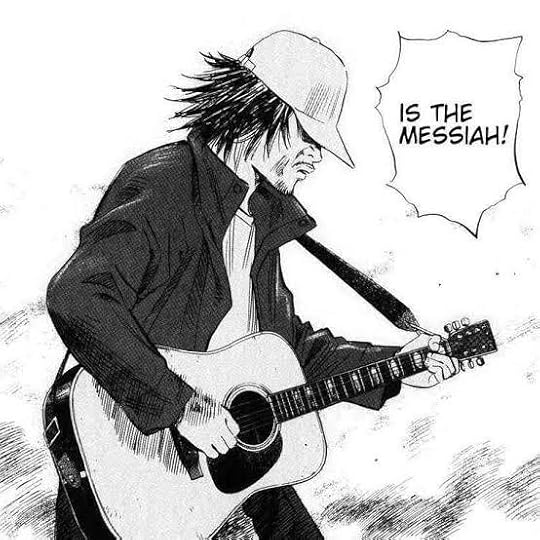
First off a concert at the end of the world is like the coolest thing Urasawa could've done for a grand finale like this and seeing Kenji finally play to an audience who knows him and wants to hear his music really got to me. No matter how long it take, even the world ending didn't stop him playing his music.
Otcho the badass tanking down the Mecha and shooting down 2 UFOs is just so raw
I love how Yoshitsune a pacifist was able to be a leader and stick to his principles. Non violence truly won in the end. Really amazing and subtle character arc he's one of my favourite lowkey characters.
Kanna setting up the concert and the confrontation with the Mecha all set up in the first volume is so insane. Crazy to think Urasawa had this all planned out. Her role in this finale, her gathering people and inspiring hope, so in character and a perfect role for her. I also love how these random side characters like Sanae played such a pivotal role. Really makes the world feel lived in instead of everyone being someone related to the kids past.
I also like the confirmation that Kamisama isint actually prophetic but rather a lucky man who bets on his own wishes. It's a nice touch.
Keroyon, Kiriko and Maruo handing out the vaccines is a little less action packed of a storyline however it is very engaging to read and gets more interesting.
Cool to see Chono pick back on the storyline of his grandfather assassination. It's neat to see Urasawa tie all the loose ends from every little storyline.
Koizumi Kyoko, Manga aritists and the drag queen making an appearance is a personal favourite as I loved all these little quirky side characters
Sadakiyo LIVES ! I knew it and I'm so glad to see him occupy a pivotal role. He finally got to be the hero.
Number 13 getting an offscreen redemption arc was the first strike of this book. I just don't buy it and wish we at least saw some of what made him change.
I also wish we saw Yukiji confrontation of Takasu more. Everyone in the main cast pulled through I just wished Yukiji also got a standout moment.
Finally my main complaint is something I can't judge until I've read the 21st century boys volume however if this is supposed to be an actual ending that exists outside of that volume then Imma have to say some parts where rushed. Kenji confronting friend was so intriguing but got cut off short and then we immediately have to backpedal into an ending. I also wish we got a real reunion with Kenji and the whole gang but the Kanna one was good enough. Overall my thoughts on this volume are purely dependent on how the 21st century volume goes. I really hope that one is the true ending and will give us something that closes this all together
Extrait : Après avoir lu ce tome, j’ai compris pourquoi certains d’entre vous m’ont dit qu’il ne s’agissait pas vraiment du dernier tome. Au final, il n’y a pas vraiment de fin, à part pour quelques personnages secondaires. Le dernier tome doit donc bien être le 21th Century Boys, j’espère qu’il apportera certains éclaircissements, que j’attends beaucoup. Ainsi qu’une conclusion un peu plus joyeuse que ce que la série a eu comme ambiance.
C’est le combat final entre les soutiens d’Ami et ses opposants, le groupe de Kenji. La musique résonne dans toute la ville, sous deux formats différents, ce qui prouve qu’il est toujours là. Entre réconciliation, trahison, révélation et abandon, l’histoire bascule assez rapidement pour entrer dans sa dernière partie. Les soucoupes volantes décollent, prêtes à déclenchés le troisième acte, mais visiblement, seule de la peinture tombe pour le moment. Tandis que la folie gagne les habitants de Tokyo et du monde entier, assez naïfs pour encore croire à un voyage sur Mars, alors même que les scientifiques savent que c’est impossible. Le pape commence à avoir des doutes, et à peine sommes-nous au courant qu’Ami avoue… Déclenchant une stupeur générale, l’incompréhension et la terreur. Après tout, cela fait des années que le monde entier le voit comme un héros, je trouve dommage qu’il n’y ai pas plus d’insistance à ce sujet. Au final, les gens se barricadent, quant aux soldats, ils ignorent tout bonnement ce qu’ils doivent faire tellement ils sont habitués à suivre les ordres.
Yoshitsune sera le personnage marquant le coup, à mes yeux, dans ce tome. S’il y a bien un personnage qui est resté pleins d’humanité c’est bien lui. Il sait ce qu’il vaut, et ce qu’il n’est pas, malgré ça peur il continue d’avancer et de guider du mieux qu’il peut, c’est mon personnage préféré de la série. Rien que par une phrase, une seule, emplie tant d’espoir que de désespoir qu’il fera bouger un peu les choses. Par rapport à d’autres, il ne semble pas avoir fait grand-chose, mais c’est celui qui n’a jamais cessé de se battre, n’a jamais été emprisonné ou capturé, celui qui, au final, a été le plus sous-estimé. Ce que j’ai bien aimé également avec la série, c’est la présence des flashbacks à des moments clés, qui permettent, d’une certaine manière, de ne pas oublier certains personnages comme Donkey qui était au centre de pas mal de choses. Pour Kenji, on sait qu’il a plus ou moins parcouru tout le Japon (voire les USA), mais au final, plusieurs choses restent encore floues, tout comme Kanna et ses pseudos super pouvoirs.
It's okay. If you didn't like, particularly the very last volume of 20th Century Boys, it is okay. I tried to, too.
Naoki Urasawa is undoubtedly a master storyteller. He plans things, he plans plans. He's a schemer both with how he plays with his characters and his readers. And I'm in for the ride. In fact, I loved these little clever schemes he plants in every arc of 20th Century Boys - all the mystery and thrill of uncovering them in a rhythmic pace that builds up to a very satisfying climax. That's his his equation, his style. And Urasawa manages to pull it off quite outstandingly. His story execution is so good that the repetition of this formula from arc to arc doesn't really bother most of his readers. I would personally be okay with it too. To hell with repetition if the story is amazing. Why change the formula if it works?
Until it doesn't. I envy those who felt awesome after reading the series. I want experience that too. But I didn't. Urasawa's formula didn't work for me in the last (Friendship Era) arc. Maybe I just didn't understand what it truly meant, or didn't appreciate how all the living characters gave their tiny contributions to make everything work. Maybe it's my own limited understanding that hindered me from fully enjoying the read.
If there's one thing I have to say before someone else barges in and shouts "no you're wrong!", it's this: my interest died when the "first friend" died, And the buildup towards the Friendship Era that could have renewed my interest was just not there (if you get this reference, the first friend is like The Joker in Scott Snyder's Death of the Family arc, while the second Friend is the Joker in Endgame"). There were a few sparks, like that Kenji comeback and the Sadakiyo full-circle moment, everything else just felt rushed and padded all at the same time. There were so many things that were implied that might have happened off-panel, and the interpretation and message is left to the readers to decipher. A little bit of discourse might have enhanced the reading experience, but the last arc have let quite a number of elements that could have improved the storytelling missing. The last arc IMO has also put too much in everything and that nothing really ever stood out.
20th Century Boys for the most part is a very spectacular run that mashes different genres all together, and I still would definitely recommend it to those who want to read Seinen manga. I admit that I am at the minority who did not fully enjoyed the last story arc, something that might change in a future re-read.
Humanity, having faced extinction at the end of the 20th century, would not have entered the new millennium if it weren't for them. In 1969, during their youth, they created a symbol. In 1997, as the coming disaster slowly starts to unfold, that symbol returns. This is the story of a gang of boys who try to save the world. Failed rock musician Kenji's memories of his past come rushing back when one of his childhood friends mysteriously commits suicide. Could this new death be related to the rise of a bizarre new cult that's been implicated in several other murders and disappearances? Determined to dig deeper, Kenji reunites with some of his old buddies in the hope of learning the truth behind it all.
This is basically the manga equivalent of a Stephen King novel, channeling themes and plot devices from the likes of It, Dreamcatcher, The Running Man and quite a few others. A young group of friends that make an innocent promise which ends up creating the most dangerous cult in the world, a 'friend' turned into the world's greatest evil, a strange suicide that reunites a group of adults to solve a mystery from their childhood which ended up leading to an apocalyptic police state, clever use of cultural references, rock songs and historical allegories to tell the full story, extremely small actions resulting in extremely massive consequences, an eerie threat lurking in the shadows that may or may not be of supernatural origins, kids overthrowing a totalitarian regime and rebelling against society while fighting against a sinister threat that no one else knows about; sound King enough for ya?
Though I don't think it's quite as good as Monster by the same author, it's definitely very close. It's a masterpiece of intricate plotting, interweaving narratives, deep character development and psychological complexity. The villain's presence is suffocating from the very beginning while remaining mysterious and terrifying until the final chapter. It's intense, it's relatable, it's horrifying and it's an emotional rollercoaster. Be careful who you call your friend and be careful of the promises you make. You might just end up causing the end of the world.