

What do you think?
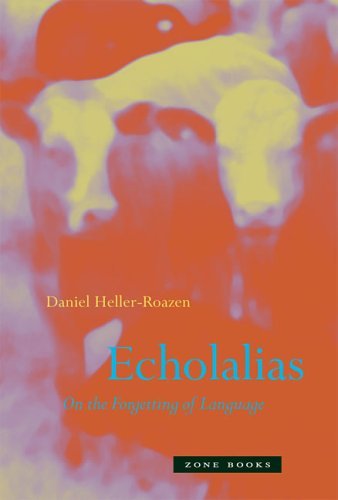
Echolalias: On the Forgetting of Language
Just as speech can be acquired, so can it be lost. Individuals can forget words, phrases, even entire languages, and over the course of time speaking communities, too, let go of the tongues that were once theirs, as languages grow obsolescent and give way to others. In Echolalias , Daniel Heller-Roazen reflects on the many forms of linguistic forgetfulness.
In twenty-one concise chapters, he moves among classical, medieval, and modern culture, exploring the interrelations of speech, writing, memory, and oblivion. Whether the subject is medieval literature or modern fiction, classical Arabic poetry or the birth of French language, structuralist linguistics or Freud’s writings on aphasia, Heller-Roazen considers with precision and insight the forms, effects, and ultimate consequences of the persistence and disappearance of language.
In speech, he argues, destruction and construction often prove inseparable. Among speaking communities, the vanishing of one language can mark the emergence of another, and among individuals, the experience of the passing of speech can lie at the origin of literary, philosophical, and artistic creation.
From the infant’s prattle to the legacy of Babel, from the holy tongues of Judaism and Islam to the concept of the dead language and the political significance of exiled and endangered languages today, Echolalias traces an elegant, erudite, and original philosophical itinerary, inviting us to reflect in a new way on the nature of the speaking animal who forgets.
In twenty-one concise chapters, he moves among classical, medieval, and modern culture, exploring the interrelations of speech, writing, memory, and oblivion. Whether the subject is medieval literature or modern fiction, classical Arabic poetry or the birth of French language, structuralist linguistics or Freud’s writings on aphasia, Heller-Roazen considers with precision and insight the forms, effects, and ultimate consequences of the persistence and disappearance of language.
In speech, he argues, destruction and construction often prove inseparable. Among speaking communities, the vanishing of one language can mark the emergence of another, and among individuals, the experience of the passing of speech can lie at the origin of literary, philosophical, and artistic creation.
From the infant’s prattle to the legacy of Babel, from the holy tongues of Judaism and Islam to the concept of the dead language and the political significance of exiled and endangered languages today, Echolalias traces an elegant, erudite, and original philosophical itinerary, inviting us to reflect in a new way on the nature of the speaking animal who forgets.
288 pages, Hardcover
First published January 1, 2005
About the author
Daniel Heller-Roazen
18 books34 followersDaniel Heller-Roazen is the Arthur W. Marks '19 Professor of Comparative Literature and the Council of the Humanities. He is the author of The Enemy of All: Piracy and the Law of Nations; The Inner Touch: Archaeology of a Sensation (2007), which was awarded the Modern Language Association's 2008 Aldo and Jeanne Scaglione Prize for Comparative Literature Studies; Echolalias: On the Forgetting of Language (2005); and Fortune's Faces: The Roman de la Rose and the Poetics of Contingency (2003). These books have been translated or are forthcoming in translation in Arabic, French, German, Italian, Polish, Portuguese and Spanish. He has also edited the Norton Critical Edition of The Arabian Nights and has edited, translated and introduced Giorgio Agamben's Potentialities: Collected Essays in Philosophy (1999). Before joining the Princeton faculty in 2000, he studied philosophy and literature in Toronto, Baltimore, Venice and Paris (BA in Philosophy, University of Toronto; MA in German and PhD in Comparative Literature, Johns Hopkins University). He has received fellowships from the Social Sciences and Humanities Research Council of Canada, the American Council of Learned Societies and the Andrew W. Mellon Foundation. He teaches courses on classical and medieval literature, aesthetics and the philosophy of art.
Ratings & Reviews
Friends & Following
Create a free account to discover what your friends think of this book!
Community Reviews
Displaying 1 - 15 of 15 reviews

May 20, 2008
I can't adequately express how much I have enjoyed this book. Nor can I fully comprehend how exactly the author went about writing it, as it seems to be about everything. Extraordinary and effortless erudition. If I ever succeed in writing an article as elegant as just one of the chapters in this book, that will truly have been an accomplishment.
I am, in a word, a fan.
I am, in a word, a fan.

February 1, 2007
If you have an interest in linguistics this would be a fun read. It examines the attribution of human qualities (like life and death) to language. The volume is segmented by chapter or essay, as it were, because one doesn't really lead into the other--you can read them willy nilly and still get the same effect. This author has a poetic sense about him as he tends to romanticize the science at times, which for me, is far more palatable than charts and graphs. With a little bit of outside reference, anyone could read and grasp the contents of this book as he does use a fair amount of jargon. Nevertheless, it's an enlightening book and worth a read if languages are your thing.

April 28, 2010
This book was great. In each chapter, Heller-Roazen explores a different case of "forgetting language." The topics range from the linguistic to the historical, from religion to literature, from psychology to philosophy. Like any good Agamben disciple, H-R sets out to explore indistinct zones that are normally overlooked, and his readings are, at times, as nuanced as the master's. Unfortunately, this also means that the threads connecting the sections can be hazy, and the overall thesis isn't as sharp as some would like, but this is a very engrossing read. Recommended to language-philes.

October 19, 2019
This ended up to be way more literary criticism than I had realized. There were a few cool factoids in there, and retellings of other people's stories that I wish I had read instead, but otherwise I didn't learn very much about cool language stuff and it was more just wishy-washy "language death isn't anything to be concerned about because languages can't really die because the concept of a living language is incoherent" kinda stuff.

May 3, 2021
A wonderous adventure through linguistic oddities. Disembodied tongues, mother tongues, writing cows, undying languages, poetic oblivion, all speaking through sounds never fully remembered nor truly forgotten.

April 24, 2020
Dispatches from the shadowy nether regions of language.

September 22, 2017
Very well-written and erudite book centered around 21 concise chapters detailing the theme of the forgetting of language. The most interesting chapter to me was chapter 5 "H & Co." which dealt with a short history of the letter H and how it is usually the first letter to be "forgotten", or dropped, from languages. Written in a literary and philosophical style that can be hard to follow at times, but I never found it to be overly technical/academic. Highly recommended!

November 4, 2019
😭😭😭😭😭😭😭😭😭😭😭😭😭😭😭😭😭😭😭😭😭😭😭😭😭😭😭😭😭😭😭😭😭😭😭😭
June 7, 2021
Ok but I may sound biased,linguistics is not poetry .If you TREAT linguistics like poetry you end up with useless Language and Arts programmes all over North America .
October 8, 2022
Interesting collection of essays dealing with anthropology, philological studies and psychoanalysis.
Some of these chapters are compelling.
Some of these chapters are compelling.

January 11, 2022
For the most part, a rockin’ survey of philological errata.
August 13, 2020
This was excellent. Very engaging. Heller-Roazen’s ostensible subject is language, but this book is really about discourse in a postmodern sense. (“Language speaks through man,” said Foucault or Barthes [I’m not longer sure who said it]). These twenty-one essays are far ranging; at times they feel like meditations by a linguist, a literary critic, or a philosopher of language, but at all times, by an extremely erudite and polyglot scholar of comparative literature. Throughout, Heller-Roazen probes the boundaries of language, continually interrogating what constitutes “language” in the most strict metaphysical sense. Is it something that requires a human mind? Must it adhere to a grammar? Must its speakers even have tongues? Heller-Roazen is our dutiful Virgil as we travel through the linguistic underworld, helping us problematize all sorts of linguistic commonplaces (such as, for instance, metaphors about language death and mother tongues). It is no coincidence, then, that the last chapter of Echolalias concerns the Tower of Babel, in which (as our host points out), God didn’t merely destroy or create language, but con-founded it. By the end of this book, Heller-Roazen equally confounds language for us, such that we really nave no idea what it this thing called “language” is.

July 24, 2014
Daniel Heller-Roazen w przystępny i ciekawy sposób prezentuje odkrycia dotyczące języka, a konkretniej mechanizmu jego zapominania. Podzielona na rozdziały książka jest przyjemną lekturą dla wszystkich tych, którzy mają ochotę dowiedzieć się czegoś więcej.
Cytując opis książki: "Od dziecięcego gaworzenia do dziedzictwa wieży Babel, od świętych języków judaizmu i islamu do koncepcji martwego języka - Echolalie w oryginalny, elegancki i erudycyjny sposób zapraszają do refleksji nad naturą zwierzęcia, które mówi i zapomina". Zgadzam się w pełni z tym podsumowaniem.
Cytując opis książki: "Od dziecięcego gaworzenia do dziedzictwa wieży Babel, od świętych języków judaizmu i islamu do koncepcji martwego języka - Echolalie w oryginalny, elegancki i erudycyjny sposób zapraszają do refleksji nad naturą zwierzęcia, które mówi i zapomina". Zgadzam się w pełni z tym podsumowaniem.

October 31, 2008
Echolalias profers no cohesive theory "On the Forgetting of Language", rather exploring a sort of linguistic negative space through examples of the different ways that memory and language mutate and fade.
November 6, 2022
Curiosa colección de ensayos de interés desigual, pero cuya originalidad no puede ser puesta en duda.
De gran interés para filólogos, y de interés general para amantes de la antropología y la filosofía del lenguaje.
De gran interés para filólogos, y de interés general para amantes de la antropología y la filosofía del lenguaje.
Displaying 1 - 15 of 15 reviews