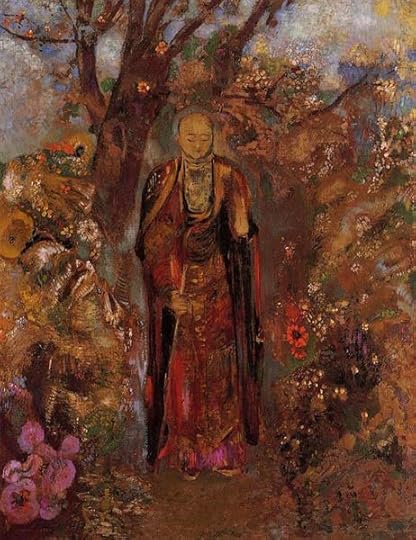
Written in clear, simple, and often light language, The Heart Sutra offers discourses on the most important sutras in Buddhist literature, penetrating to the heart of Buddhist belief.Exploring these essential teachings, Osho guides us on a profound inner journey, progressing from the merging of negative and positive to the non-existence of the ego and the arrival at our own inner Buddha. The Heart Sutra includes students questions, from the esoteric to eminently personal, posed directly to
Rajneesh (born Chandra Mohan Jain, 11 December 1931 – 19 January 1990) and latter rebranded as Osho was leader of the Rajneesh movement. During his lifetime he was viewed as a controversial new religious movement leader and mystic.
In the 1960s he traveled throughout India as a public speaker and was a vocal critic of socialism, Mahatma Gandhi, and Hindu religious orthodoxy.
Rajneesh emphasized the importance of meditation, mindfulness, love, celebration, courage, creativity and humor—qualities that he viewed as being suppressed by adherence to static belief systems, religious tradition and socialization.
In advocating a more open attitude to human sexuality he caused controversy in India during the late 1960s and became known as "the sex guru".
In 1970, Rajneesh spent time in Mumbai initiating followers known as "neo-sannyasins". During this period he expanded his spiritual teachings and commented extensively in discourses on the writings of religious traditions, mystics, and philosophers from around the world. In 1974 Rajneesh relocated to Pune, where an ashram was established and a variety of therapies, incorporating methods first developed by the Human Potential Movement, were offered to a growing Western following. By the late 1970s, the tension between the ruling Janata Party government of Morarji Desai and the movement led to a curbing of the ashram's development and a back taxes claim estimated at $5 million.
In 1981, the Rajneesh movement's efforts refocused on activities in the United States and Rajneesh relocated to a facility known as Rajneeshpuram in Wasco County, Oregon. Almost immediately the movement ran into conflict with county residents and the state government, and a succession of legal battles concerning the ashram's construction and continued development curtailed its success.
In 1985, in the wake of a series of serious crimes by his followers, including a mass food poisoning attack with Salmonella bacteria and an aborted assassination plot to murder U.S. Attorney Charles H. Turner, Rajneesh alleged that his personal secretary Ma Anand Sheela and her close supporters had been responsible. He was later deported from the United States in accordance with an Alford plea bargain.[
After his deportation, 21 countries denied him entry. He ultimately returned to India and a revived Pune ashram, where he died in 1990. Rajneesh's ashram, now known as OSHO International Meditation Resort and all associated intellectual property, is managed by the Zurich registered Osho International Foundation (formerly Rajneesh International Foundation). Rajneesh's teachings have had a notable impact on Western New Age thought, and their popularity has increased markedly since his death.
Tên sách tiếng Việt - Bát Nhã Tâm Kinh 11*/10* Osho dẫn lối ta vào một con đường vượt qua tư duy suy niệm. Góc độ nào đó mình chỉ thấy Đạo Gia hay Kinh Bát Nhã là có độ phủ lên mọi điều trong vũ trụ thôi. Nhưng để đọc cuốn này cũng hơi khó, nhiều bạn sẽ bảo ông Osho ổng lừa mình, dẫn dắt mình theo quan điểm của ổng... nếu mọi người chưa đọc các lượng kiến thức khác. Mình đọc tâm lý học hành vi, tâm lý học phân tâm, Kinh Kim Cương, Kinh Tứ Niệm Xứ, Kinh Thánh và Đạo Đức Kinh rồi mới thấm từng từ từng chữ trong cuốn này. Phải thú thực là không thể tìm ra người thứ 2 đọc và am hiểu đông tây kim cổ nhiều như Osho, Osho phản biện từng nhà tư tưởng có những điểm chết nào khiến tâm trí họ không thể đi lên được nữa. (Có thời gian mình sẽ tổng hợp thành bài tóm tắt hoặc video, vì cuốn này cực hay luôn í) Cuốn này khó kiếm ebook trên mạng, bản in cũng chưa tái bản lại, mình nài nỉ được người quen cho ebook =))) nên bạn nào cần nhắn mình gửi nhé
At times, Osho would put down Christianity, which I didn't care for. Even though I'm not one for religion, I don't like it when someone criticizes others just because they believe or don't believe. However, there were only a few instances of criticism, so it didn't taint the overall feel of the book. This book reminds me of the 'don't sweat the small stuff' ideas but on a much, much deeper level. I found that the lessons and stories helped me to understand the larger picture in life and how to make life a lot less stressful for myself. Osho teaches about enlightenment, which when I let myself get absorbed into the pages of this book, I felt like I was headed for enlightenment myself. It actually helped me with how I viewed my troubled marriage; the marriage didn't last, but I had a completely different outlook on the whole thing and was able to keep a level head and move forward. Very inspiring book for me.
You might recognize this guy from the Netflix series about the crazy cult that had that conflict in Oregon. But why don't you listen to him? Why don't you hear what convinced people to try to throw out or find a more satisfying alternative to our insanely alienated way of American life? There's much great wisdom in his meditations on the heart sutra, and he uses contradiction to great effect to point directly to to the contradictions in the dualistic way we perceive the world and each other.
This is an advanced level set of teachings despite the simplicity of the language and requires careful attention but stands for me as one of the most profound explorations about the nature of the human experience, about emptiness, truth and love.
Reading the negative comments I can see it's probably hard to access if you're early on the journey, although this is also the nature of the teaching.
One of the things I appreciate about this is the integration of psychology, religion and philosophy in the observations.
Simply fantastic. The Sutra is very small and precise, yet wholesome in itself. The seven doors and linking them to metaphors and child behavior is just outstanding. Shall buy a hardcover of Heart Sutra soon! In love with the message..
2nd read review: The understanding goes much deeper this time & I am in sync with his words. Such beauty and such awe, the text. Glad to have picked it up the second time.
“I salute the Buddha within you. You may not be aware of it, you may not have ever dreamed about it -- that you are a Buddha, that nobody can be anything else, that buddhahood is the very essential core of your being, that it is not something to happen in the future, that it has happened already. It is the very source you come from; it is the source and the goal too. It is from buddhahood that we move, and it is to buddhahood that we move. This one word, buddhahood, contains all -- the full circle of life, from the alpha to the omega. But you are fast asleep, you don't know who you are. Not that you have to become a Buddha, but only that you have to recognize it, that you have to return to your own source, that you have to look within yourself. A confrontation with yourself will reveal your buddhahood. The day one comes to see oneself, the whole existence becomes enlightened. It is not that a person becomes enlightened -- how can a person become enlightened? The very idea of being a person is part of the unenlightened mind. It is not that I have become enlightened; the 'I' has to be dropped before one can become enlightened, so how can I become enlightened? That is absurdity. The day I became enlightened the whole existence became enlightened. Since that moment I have not seen anything other than Buddhas -- in many forms, with many names, with a thousand and one problems, but Buddhas still.
So I salute the Buddha within you. I am immensely glad that so many Buddhas have gathered here. The very fact of your coming here to me is the beginning of the recognition. The respect in your heart for me, the love in your heart for me, is respect and love for your own buddhahood. The trust in me is not trust in something extrinsic to you, the trust in me is self-trust. By trusting me you will learn to trust yourself. By coming close to me you will come close to yourself. Only a recognition has to be attained. The diamond is there -- you have forgotten about it, or you have never remembered it from the very beginning. There is a very famous saying of Emerson: "Man is God in ruins." I agree and I disagree. The insight has some truth in it -- man is not as he should be. The insight is there but a little upside down. Man is not God in ruins, man is God in the making; man is a budding Buddha. The bud is there, it can bloom any moment: just a little effort, just a little help... And the help is not going to cause it -- it is already there! Your effort is only going to reveal it to you, help to unfold what is there, hidden. It is a discovery, but the truth is already there. The truth is eternal.
(...)
with this vision in the mind, that you are a Buddha, that you are a budding Buddha, that you are potentially capable of becoming one, that nothing is lacking, all is ready, things just have to be put in the right order, that a little more awareness is needed, a little more consciousness is needed... The treasure is there; you have to bring a small lamp inside your house. Once the darkness disappears you will no longer be a beggar, you will be a Buddha; you will be a sovereign, an emperor. This whole kingdom is yours and it is just for the asking; you have just to claim it. But you cannot claim if you believe that you are a beggar. You cannot claim it, you cannot even dream about claiming if you think that you are a beggar. This idea that you are a beggar, that you are ignorant, that you are a sinner, has been preached from so many pulpits down through the ages that it has become a deep hypnosis in you. This hypnosis has to be broken. To break it I start with: I salute the Buddha within you.
(...)
Let it be declared to your every cell of the body and every thought of your mind; let it be declared to every nook and corner of your existence, that "I am a Buddha!" And don't be worried about the 'I'... we will take care of it. 'I' and buddhahood cannot exist together. Once the buddhahood becomes revealed the 'I' disappears, just like darkness disappears when you bring a light in.”
Among the worst texts I’ve ever encountered. Let me be clear, I don’t believe this to be representative of the Heart Sutra and I am not reviewing the Heart Sutra. The Heart Sutra is very short, this is the ramblings of a cult leader who cannot help himself from spouting his own ignorance and ego as dogma.
He denies that anyone can know him because that is impossible yet he claims to know everyone because he is one with nature. He spends so much time using the past to make claims of what the rich or poor (fill in the blank) must be like. He also claims that you must not live in this past. This text is not an example of an enlightenment mind, it is just a collections the “ideals” that he argues against.
Really good book this. Gave me lots of great insight into the path to nothingness and letting go. The writing style is fun too, making this a much easier read than many other spiritual books. He even finishes with a joke! But it’s a very serious book nonetheless.
My only criticism is that part of what’s said could be interpreted as listen to your body and do what it asks, don’t get hung up on what society says and therefore do what you want with no sense of responsibility.
He also talks about the importance of not taking freedom from anybody else, so I don’t think that’s what he means.
In fact as I finish this review I’m wondering if it’s even fair to make the point.
Heart Sutra is such a compact piece of writing yet I hv looked thru translations and discourses from alleged high monks and gurus,even from the buddhist top dog himself,
with no avail. Your mind can sense misunderstanding, fudging understanding, or total confusion(try listening to your prof, not named benjamin pierce, who declared he didnt understand it, trying to explain the eulers equation). Well, from Osho's ,---one who is enlightened angle---, one gets the meaning,purpose and the mantra immediately...
Osho clearly cuts straight to “the heart of the matter” in these insightful, and at times very perceptively playful, discourses on one of the Buddha Gautama Siddhartha’s most cited and important sutras that serves as a most useful guides to all who take refuge in his guidance on the dharma path of individual transformation.
scho eher guet gsi. Osho isch so en goofard, er isch shono unique ahh guru. ich agree ned mit allem. Han teilweise die Sutras boring gfunde und overinterpreted vo ihm. cools buech doe. dont recommend to sunza oder osy tho. eher so für lüüt wo sho deep im spiritual realm search bullshit sind. han bock super mario 64 spielle.
I've read a few beginners Buddhism books and have heard about The Heart Sutra only in passing. I have no idea what I just listened to, but I am certain it had absolutely nothing whatsoever to do with The Heart Sutra, or 'becoming a buddha through meditation'.
After the first chapter, I thought, okay, perhaps this Osho guy is just taking a bit of liberty and giving a kind of Introduction, so I gave it the benefit of the doubt and kept reading. Unfortunately the other chapters are also just confused ramblings of a seemingly self styled "guru". He goes from talking about Buddhism, to God, to Hinduism, to Enlightenment as though he has come up with some kind of religion that combines everything while being 'better' than any of them. I might have only a basic understanding of Buddhism, but I'm pretty sure Buddhism rejects both the concept of a Soul and a God, yet he would say something along the lines of 'the Buddha taught' and then a few breathes later be talking about a soul and the Christian concept of heaven, very odd.
I wasn't surprised to learn when I googled Osho that he was involved in a mass poisoning attack and an aborted assassination plot to murder a U.S. Attorney, among other crimes, which saw him being deported from the US and barred from entering 21 Countries.
In short, Osho seems be a snake-oil salesman, creating some kind of cult like organization by selling new age nonsense to those who don't know any better. Avoid!
In this original-recording audiobook, I love not just Osho's teachings on Buddha's The Heart Sutra but also his responses to the audience's questions. However, as if he knows I'm loving this book, in the middle of a session Osho says "Loving it only won't help. Be it. Sometimes it happens you love the opposite that you are not. Because it releases fantasies in you. It gives you the vision that you would like to be. But loving the book will not help." Oh, I love that too, Bhagwan.
I read this one during my Osho marathon, this book is a treasure but it requires a higher level of spirituality and knowledge or Tao, Yoga, Buddhism, meditation principles in order to be able to follow the story. I found it particularly helpful when I re-read it in 2023 ( my heart chakra is blocked and I read it as part of finding my balance again). Overall, Osho never failed to disappoint but if you are a beginner when it comes to spirituality and now getting to know the path, don't start with this book as you'll be lost in the vocabulary and the advanced practices.