

What do you think?
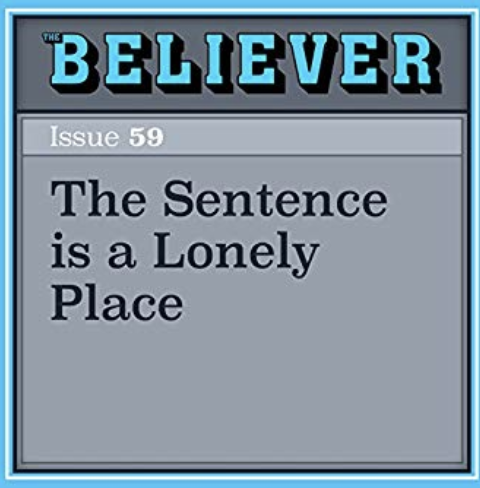
The Sentence is a Lonely Place
A lecture delivered by the short-story writer Gary Lutz to the students of Columbia University’s writing program in New York on September 25, 2008.
Audiobook
First published September 25, 2008
About the author
Garielle Lutz
16 books203 followersGarielle Lutz is an American writer of both poetry and fiction. Her work has appeared in Sleepingfish, NOON, The Quarterly, Conjunctions, Unsaid, Fence, StoryQuarterly, The Believer, Cimarron Review, 3rd Bed, Slate Magazine, New York Tyrant, The Anchor Book of New American Short Stories, The Apocalypse Reader (Thunder's Mouth Press), PP/FF: An Anthology (Starcherone Books), The Random House Treasury of Light Verse and in the film 60 Writers/60 Places.
A collection of her short fiction, Stories in the Worst Way, was published by Alfred A. Knopf in November 1996 and re-published by 3rd Bed in 2002 and Calamari Press in 2009. Lutz's second collection of short stories, I Looked Alive, was published by the now-defunct Four Walls Eight Windows in 2003 and republished by Black Square Editions/Brooklyn Rail in 2010. Partial List of People to Bleach, a chapbook of both new and rare early stories (published pseudonymously as Lee Stone in Gordon Lish's The Quarterly) was released by Future Tense Books in 2007. Divorcer, a collection of seven stories, was released by Calamari Press in 2011.
In 1996, Lutz was recipient of a literature grant from the National Endowment for the Arts, and in 1999, she was awarded a grant from the Foundation for Contemporary Arts Grants to Artists Award.
In 2020, Lutz came out as a transgender woman.
A collection of her short fiction, Stories in the Worst Way, was published by Alfred A. Knopf in November 1996 and re-published by 3rd Bed in 2002 and Calamari Press in 2009. Lutz's second collection of short stories, I Looked Alive, was published by the now-defunct Four Walls Eight Windows in 2003 and republished by Black Square Editions/Brooklyn Rail in 2010. Partial List of People to Bleach, a chapbook of both new and rare early stories (published pseudonymously as Lee Stone in Gordon Lish's The Quarterly) was released by Future Tense Books in 2007. Divorcer, a collection of seven stories, was released by Calamari Press in 2011.
In 1996, Lutz was recipient of a literature grant from the National Endowment for the Arts, and in 1999, she was awarded a grant from the Foundation for Contemporary Arts Grants to Artists Award.
In 2020, Lutz came out as a transgender woman.
Ratings & Reviews
Friends & Following
Create a free account to discover what your friends think of this book!
Community Reviews
Displaying 1 - 13 of 13 reviews

Read
January 3, 2020
American author Gary Lutz, born 1955
I recall one reviewer characterizing a collection of prose by this contemporary American author as “Gary Lutz having tantric sex with the English language.”
If you are interested in just exactly how much attention can be paid to words and sentences, Gary Lutz’s essay, The Sentence is a Lonely Place, provides a perfect starting point. If you take Gary Lutz’s ideas and suggestions seriously, your writing might be in for startling transformations. I've included the first paragraphs of Gary's essay here. To read the essay in its entirety, click on the link at the bottom:
THE SENTENCE IS A LONELY PLACE
I came to language only late and only peculiarly. I grew up in a household where the only books were the telephone book and some coloring books. Magazines, though, were called books, but only one magazine ever came into the house, a now-long-gone photographic general-interest weekly commandingly named Look. Words in this household were not often brought into play. There were no discussions that I can remember, no occasions when language was called for at length or in bulk. Words seemed to be intruders, blown into the rooms from other¬where through the speakers of the television set or the radio, and were easily, tinnily, ignorable as something alien, something not germane to the forlornities of life within the house, and readily shut off or shut out. Under our roof, there was more divulgence and expressiveness to be made out in the closing or opening of doors, in footfalls, in coughs and stomach growlings and other bodily ballyhoo, than in statements exchanged in occasional conversation. Words seemed to be a last resort: you had recourse to speech only if everything else failed. From early on, it seemed to me that the forming and the release of words were the least significant of the mouth’s activities—and more by-products of those activities than the reason for them. When words did come hazarding out of a mouth, they did not lastingly change anything about the mouth they were coming out of or the face that hosted the mouth. They often seemed to have been put in there by some force exterior to the person speaking, and they died out in the air. They were not something I could possess or store up. Words certainly weren’t inside me.
A word that I remember coming out of my parents’ mouths a lot was imagine—as in “I imagine we’re going to have rain.” I soon succumbed to the notion that to imagine was to claim to know in advance an entirely forgettable outcome. A calendar was hung in the kitchen as if to say: Expect more of the same.
I thus spent about the first thirteen or fourteen years of my life not having much of anything to do with language. I am told that once in a while I spoke up. I am told that I had a friend at some point, and this friend often corrected my pronunciations, which tended to be overliteral, and deviant in their distribution of stresses. Any word I spoke, often as not, sounded like two words of similar length that had crashed into each other. Word after word emerged from my mouth as a mumbled mongrel. I was often asked to repeat things, and the repeated version came forth as a skeptical variant of the first one and was usually offered at a much lower volume. When a preposition was called for in a statement, I often chose an unfitting one. If a classmate asked me, “When is band practice?” I would be likely to answer, “At fifth period.” I did not have many listeners, and I did not listen to myself. Things I spoke came out sounding instantly disowned.
Childhood in my generation, an unpivotal generation, wasn’t necessarily a witnessed phenomenon. Large portions of my day went unobserved by anyone else, even in classrooms. Anybody glimpsing me for an instant might have described me as a kid with his nose stuck in a book, but nobody would have noticed that I wasn’t reading. I had started to gravitate toward books only because a book was a kind of steadying accessory, a prop, something to grip, a simple occupation for my hands. (Much later, I was relieved to learn that librarians refer to the books and other printed matter in their collections as “holdings.”) And at some point I started to enjoy having a book open before me and beholding the comfortingly justified lineups and amassments of words. I liked seeing words on parade on the pages, but I never got in step with them, I never entered into the processions. I doubt that it often even occurred to me to read the books, although I know I knew how. Instead, I liked how anything small (a pretzel crumb, perhaps) that fell into the gutter of the book—that troughlike place where facing pages meet—stayed in there and was preserved. A book was, for me, an acquisitive thing, absorbing, accepting, taking into itself whatever was dropped into it. An opened book even seemed to me an invitation to practice hygiene over it—to peel off the rim of a fingernail, say, and let the thing find its way down onto a page. The book became a repository of the body’s off-trickles, extrusions, biological rubbish and remains; it became a reliquary of sorts. I was thuswise now archiving chance fragments, sometimes choice fragments, of my life. I was putting things into the books instead of withdrawing their offered contents. As usual, I had things backward.
Worse, the reading we were doing in school was almost always reading done sleepily aloud, our lessons consisting of listening to the chapters of a textbook, my classmates and I taking our compulsory turns at droning through a double-columned page or two; and I, for one, never paid much mind to what was being read. The words on the page seemed to have little utility other than as mere prompts or often misleading cues for the sluggard sounds we were expected to produce. The words on the page did not seem to have solid enough a presence to exist independently of the sounds. I had no sense that a book read in silence and in private could offer me something. I can’t remember reading anything with much comprehension until eighth grade, when, studying for a science test for once, I decided to try making my way quietly through the chapter from start to finish—it was a chapter about magnets—and found myself forced to form the sounds of the words in my head as I read. Many of the words were unfamiliar to me, but the words fizzed and popped and tinkled and bonged. I was reading so slowly that in many a word I heard the scrunch and flump of the consonants and the peal of the vowels. Granted, I wasn’t retaining much of anything, but almost every word now struck me as a provocative hullabaloo. This was my first real lesson about language—this inkling that a word is a solid, something firm and palpable. It was news to me that a word is matter, that it exists in tactual materiality, that it has a cubic bulk. Only on the page is it flat and undensified. In the mouth and in the mind it is three-dimensional, and there are parts that shoot out from it or sink into its syntactic surround. But this discovery was of no help to me in English class, because when we had to write, I could never call up any of the brassy and racketing words I had read, and fell back on the thin, flat, default vocabulary of my life at home, words ¬spoken because no others were known or available. Even when I started reading vocabulary-improvement books, I never seemed capable of importing into my sentences any of the vivid specimens from the lists I had now begun to memorize. My writing was dividered from the arrayed opulences in the vocabulary books. Language remained beyond me. My distance from language continued even through college, even through graduate school. The words I loved were in a different part of me, not accessible to the part of me that was required to make statements on paper.
It took me almost another decade after graduate school to figure out what writing really is, or at least what it could be for me; and what prompted this second lesson in language was my discovery of certain remaindered books—mostly of fiction, most notably by Barry Hannah, and all of them, I later learned, edited by Gordon Lish—in which virtually every sentence had the force and feel of a climax, in which almost every sentence was a vivid extremity of language, an abruption, a definitive inquietude. These were books written by writers who recognized the sentence as the one true theater¬ of endeavor, as the place where writing comes to a point and attains its ultimacy. As a reader, I finally knew what I wanted to read, and as someone now yearning to become a writer, I knew exactly what I wanted to try to write: narratives of steep verbal topography, narratives in which the sentence is a complete, portable solitude, a minute immediacy of consummated language—the sort of sentence that, even when liberated from its receiving context, impresses itself upon the eye and the ear as a totality, an omnitude, unto itself. I once later tried to define this kind of sentence as “an outcry combining the acoustical elegance of the aphorism with the force and utility of the load-bearing, tractional sentence of more or less conventional narrative.” The writers of such sentences became the writers I read and reread. I favored books that you could open to any page and find in every paragraph sentences that had been worked and reworked until their forms and contours and their organizations of sound had about them an air of having been fore¬ordained—as if this combination of words could not be improved upon and had finished readying itself for infinity.
And as I encountered any such sentence, the question I would ask myself in marvelment was: how did this thing come to be what it now is? This was when I started gazing into sentence after sentence and began to discover that there was nothing arbitrary or unwitting or fluky about the shape any sentence had taken and the sound it was releasing into the world.
I’ll try to explain what it is that such sentences all seem to have in common and how in fact they might well have been written.
The sentence, with its narrow typographical confines, is a lonely place, the loneliest place for a writer, and the temptation for the writer to get out of one sentence as soon as possible and get going on the next sentence is entirely understandable. In fact, the conditions in just about any sentence soon enough become (shall we admit it?) claustrophobic, inhospitable, even hellish. But too often our habitual and hasty breaking away from one sentence to another results in sentences that remain undeveloped parcels of literary real estate, sentences that do not feel fully inhabitated and settled in by language. So many of the sentences we confront in books and magazines look unfinished and provisional, and start to go to pieces as soon as we gawk at and stare into them. They don’t hold up. Their diction is often not just spare and stark but bare and miserly.
There is another way to look at this:
The sentence is the site of your enterprise with words, the locale where language either comes to a head or does not. The sentence is a situation of words in the most literal sense: words must be situated in relation to others to produce an enduring effect on a reader. As you situate the words, you are of course intent on obeying the ordinances of syntax and grammar, unless any willful violation is your ¬purpose—and you are intent as well on achieving in the arrangements of words as much fidelity as is possible to whatever you believe you have wanted to say or describe. A lot of writers—many of them—unfortunately seem to stop there. They seem content if the resultant sentence is free from obvious faults and is faithful to the lineaments of the thought or feeling or whatnot that was awaiting deathless expression. But some other writers seem to know that it takes more than that for a sentence to cohere and flourish as a work of art. They seem to know that the words inside the sentence must behave as if they were destined to belong together—as if their separation from each other would deprive the parent story or novel, as well as the readerly world, of something life-bearing and essential. These writers recognize that there needs to be an intimacy between the words, a togetherness that has nothing to do with grammar or syntax but instead has to do with the very shapes and sounds, the forms and contours, of the gathered words. This intimacy is what we mean when we say of a piece of writing that it has a felicity—a fitness, an aptness, a rightness about the phrasing. The words in the sentence must bear some physical and sonic resemblance to each other—the way people and their dogs are said to come to resemble each other, the way children take after their parents, the way pairs and groups of friends evolve their own manner of dress and gesture and speech. A pausing, enraptured reader should be able to look deeply into the sentence and discern among the words all of the traits and characteristics they share. The impression to be given is that the words in the sentence have lived with each other for quite some time, decisive time, and have deepened and grown and matured in each other’s company—and that they cannot live without each other.
Here is what I believe seems to happen in such a sentence:
Once the words begin to settle into their circumstance in a sentence and decide to make the most of their predicament, they look around and take notice of their neighbors. They seek out affinities, they adapt to each other, they begin to make adjustments in their appearance to try to blend in with each other better and enhance any resemblance. Pretty soon in the writer’s eyes the words in the sentence are all vibrating and destabilizing themselves: no longer solid and immutable, they start to flutter this way and that in playful receptivity, taking into themselves parts of neighboring words, or shedding parts of themselves into the gutter of the page or screen; and in this process of intimate mutation and transformation, the words swap alphabetary vitals and viscera, tiny bits and dabs of their languagey inner and outer natures; the words intermingle and blend and smear and recompose themselves. They begin to take on a similar typographical physique. The phrasing now feels literally all of a piece. The lonely space of the sentence feels colonized. There’s a sumptuousness, a roundedness, a dimensionality to what has emerged. The sentence feels filled in from end to end; there are no vacant segments along its length, no pockets of unperforming or underperforming verbal matter. The words of the sentence have in fact formed a united community.
Link to the entire essay: https://believermag.com/the-sentence-...

April 9, 2021
Craft essays can be hit and miss me, and this one is definitely the former. Once I got into the thick of the lecture, I started to learn a lot about different kinds of sentences. Lutz uses great examples and hearing them out loud was very helpful. I definitely recommend it to anyone looking to spice up their syntax.

January 18, 2021
The transcript from a 2008 lecture on writing and the literary life presented to Columbia University writing students. Lutz recounts how he was hooked by language and then gets down into the grammatical, orthographical, and syntactic weeds. Interesting in its granular approach, and typical “slantness” from Lutz. / Audiobook, 01/18/21.

Read
January 5, 2020Sounds like working with phrases in music. Its always touching knowing someone paying so much attention creating something. No one may know thou.
December 9, 2020
Witty, insightful and thoroughly enjoyable.

November 10, 2021
Like a little shot of espresso. Ideas about what makes a sentence good on an elemental level
July 29, 2025
re-read. i could only find this as the audiobook version on goodreads but i read this online. the more i re-read this, the more the realization becomes apparent i have to orate it to nobody to get what's going on. hence there exists the audiobook. contains amazing insight into how sentences are written and what contributes to their sonic greatness. it ends abruptly with a message tantamount to "don't get lost in the weeds", which knocks you cleanly out of the worship-stance the rest of this essay positions you in. come back here forever if you need to go low-down to the sentential bedrock and then scram
September 28, 2021
Practical poetics and poetical practic.

October 17, 2023
Short read but oh man! Such an important work.

September 4, 2024
I have never thought this hard about the words and letters used in a sentence.

August 16, 2026
Was recommended by a friend. Not really a book, I guess. Essentially just a reflection on sound pattern.
September 16, 2020
Garielle Lutz has put a lot of effort into constructing sentences. I wish she paid half as much attention to making this essay engaging, or useful. Instead, she drones on about style, and how to prefect each sentence to be it's own home. To an extant I can agree, authors who fine tune their sentences can often create spellbinding and marvelous pieces.
However, she ends up repeating himself so often my eyes glazed off the pages and I had to actively focus on the words, which were ironically dull and lacked any sort of beauty. The piece slowly meandered, there seemed to be no purpose outside of Lutz trying to prove how smart she is, and look at all these writers she's read that you've never heard of. The constant pretentious tone, is one of the largest failings of the piece.
My largest complaint about "The Sentance is a Lonely Place" is as Lutz puts it "Such a fixation on the individual sentence might threaten the enclosive forces of the larger structure in which the sentences reside. Psychiatrists use the term weak central coherence to pinpoint the difficulty of certain autistic persons to get the big picture, to see the forest instead of the trees. A piece of writing consisting ultimately of an aggregation of loner sentences might well strike a reader as stupefyingly discontinuous, too dense to enchant." Lutz herself fails to see the forest instead of the trees, and the piece suffers from a lack of structure or a real purpose.
However, she ends up repeating himself so often my eyes glazed off the pages and I had to actively focus on the words, which were ironically dull and lacked any sort of beauty. The piece slowly meandered, there seemed to be no purpose outside of Lutz trying to prove how smart she is, and look at all these writers she's read that you've never heard of. The constant pretentious tone, is one of the largest failings of the piece.
My largest complaint about "The Sentance is a Lonely Place" is as Lutz puts it "Such a fixation on the individual sentence might threaten the enclosive forces of the larger structure in which the sentences reside. Psychiatrists use the term weak central coherence to pinpoint the difficulty of certain autistic persons to get the big picture, to see the forest instead of the trees. A piece of writing consisting ultimately of an aggregation of loner sentences might well strike a reader as stupefyingly discontinuous, too dense to enchant." Lutz herself fails to see the forest instead of the trees, and the piece suffers from a lack of structure or a real purpose.

December 4, 2022
This short piece has had a profound effect on the way I write and read.
Displaying 1 - 13 of 13 reviews