Jump to ratings and reviews
Rate this book

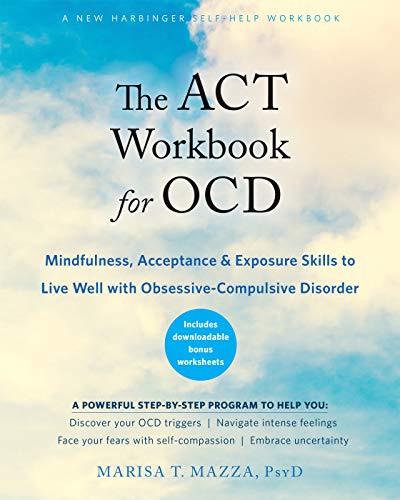
The ACT Workbook for OCD: Mindfulness, Acceptance, and Exposure Skills to Live Well with Obsessive-Compulsive Disorder

Rate this book

Stand up to your OCD! The Mindfulness and Acceptance Workbook for OCD combines evidence-based acceptance and commitment therapy (ACT) with exposure and response prevention (ERP) for the most up-to-date, effective treatment for obsessive-compulsive disorder (OCD).

If you’re one of millions of people who suffer from OCD, you may experience obsessive, intrusive, or even disturbing thoughts. You may engage in compulsive or ritualistic behaviors, such as checking to make sure you’ve locked the front door, or endlessly washing your hands for fear of germs or contamination. And you may be tempted to give up if treatment just doesn’t work for you.

Whether you’ve just received a diagnosis, or have suffered for years, this workbook can help. Using the powerful and proven-effective treatments in this guide, you’ll learn what type of OCD you suffer from (such as harm OCD), how to identify the underlying mechanisms of your OCD, move through triggering incidents while staying present and connected to your values, be more aware and flexible, tolerate uncertainty, and commit to behaviors that ultimately allow you to lead a full, rewarding life. Once you realize what really matters to you, you’ll find the motivation needed to start on the path to psychological well-being.

If you’re ready to be courageous, take a risk, and stand up to your OCD symptoms, this workbook can help guide you, every step of the way.

232 pages, Kindle Edition

Published June 1, 2020

88 people are currently reading
162 people want to read

About the author

Marisa T. Mazza

2 books2 followers

Ratings & Reviews

What do you think?
Rate this book

Friends & Following

Create a free account to discover what your friends think of this book!

Community Reviews

5 stars
19 (44%)
4 stars
18 (41%)
3 stars
6 (13%)
2 stars
0 (0%)
1 star
0 (0%)
Displaying 1 - 8 of 8 reviews
Profile Image for Panda Incognito.
4,654 reviews95 followers
May 6, 2020
I read this book as an uncorrected proof from NetGalley, and I am grateful that I had the opportunity to read and evaluate it. However, I did not like it as much as I hoped I would, because even though this workbook has some excellent features, it becomes repetitive at times, isn't clear enough about some sub-types of OCD, and includes some philosophies that I disagree with from my own experience and other reading.

This book clearly explains what OCD is, and includes cited statistics alongside case studies from the author's therapeutic practice. She does not personally suffer from this disorder, but she understands it from a research and clinical perspective, and her own struggles with anxiety help her relate. She writes in an understanding and kind way, and encourages her readers to define their values in order to overcome their compulsions and live meaningful lives.

Unfortunately, the chapter on values-definition was my first roadblock with the book. She provides examples of how some of her patients were able to overcome their compulsions by pursuing the positive values that came into conflict with their OCD. However, this topic has the potential to create confusion, and in my case, many of my compulsions actually supported my values. They were short-term fixes that reinforced the problem, and they couldn't lead to healing, but many of my compulsions were completely in line with what I loved and thought was worth living for. Even though I can see how someone with hours of checking rituals could find this values-based focus freeing, since it reminds them that they are fighting for the ability to spend that time with their family, in my case, when I was at an earlier stage of my journey, I would have seen many of my compulsions as part of living a values-based life, since they went against the intrusive thoughts that offended my values.

Because of this, I think that it would have been better for this values-focused part of the recommended therapy to appear later in the book, after a reader who is new to the topic has learned more about how their OCD works, and why their compulsions are so disruptive to their healing. Otherwise, I think that this book is best for people who have already gone through therapy or have done a significant amount of reading or personal exercises.

Another concern that I have involves the list of OCD sub-types and their symptoms, but I will start with the positive aspects. I appreciate the author including detailed information about how some OCD patients struggle to feel confident of their sexual orientation or gender, because as LGBT issues have taken center stage in culture, more and more people have struggled with confusion about these topics. I'm glad that the author addressed this and shared several related case study anecdotes throughout the book. Since so many other books about OCD were published ten or twenty years ago, when these issues were less prevalent and less likely to inspire irrational obsessions, it's good to have a recent source that addresses this.

I also appreciate the section about relationship OCD. I only recently learned about this as an official sub-type, but I have struggled greatly over the years with obsessive, anxious thoughts about certain friendships. My compulsions have included reliving past conflicts, worrying about possible ways I have offended the other person, seeking reassurance, and trying to convince myself that everything will be okay. This book only focuses on relationship OCD from the perspective of romantic partners, but it opens the door to make people aware of OCD's affects on friendship.

The problem that I have with the section about OCD types is that it does not mention the sub-type of experiencing intrusive sexual thoughts. This should be its own category, just like obsessions about violence and harm, but the author only mentions sexual issues as a potential outworking of moral scrupulosity. Although these issues can certainly be related, the author's implication is that the sufferer is experiencing guilt over normal thoughts and behaviors, not that they are experiencing barrages of horrific sexual thoughts as a major OCD symptom.

This omission is especially odd given that one of the author's repeated examples of an OCD obsession is someone fearing that they are a pedophile and will harm children. When she first mentions this, it is in the harm category, but even though that makes sense at first glance, the harm category is focused on fearing that you are responsible for catastrophic events, will cause your loved ones to become ill and die, are afraid that you will murder someone or commit suicide, etc. A harm obsession that involves terror of a sexual crime should go under the sexual category, not the category about disasters, illness, and death.

I wish that this book had included the sub-type regarding intrusive sexual thoughts, both to help sufferers and to help other people understand that people who experience graphic sexual thoughts are not threats, but are trying to manage a horrifying disorder that weaponizes unwanted thoughts against them. It is very odd to me that the author repeatedly used the illustration of someone who thinks they might be a pedophile without explaining this sub-type in any depth, especially since people are so likely to respond to this concept with horror and want to bar the person from being around children, not understanding that the sufferer finds these thoughts horrifying, would never act on them, and is desperately trying to neutralize these unwanted obsessions with their compulsions.

Also, regarding other forms of this sub-type, a paragraph-long case study mentions a woman who suffers from intrusive sexual thoughts about her family, but the author does not provide an in-depth explanation there, either. Given that this is the OCD symptom which is most likely to be deeply misunderstood and misdiagnosed, I cannot understand why this author included it in her book without an appropriately detailed explanation.

However, this book still has lots to offer. The explanations of other OCD types are very clear, and the author explains throughout the book how people can apply methods of acceptance, mindfulness, repeated exposure therapy, and clarified thought processes to work through their disorder. This book includes lots of worksheets, and even though some of them may be too New Age for some tastes and personalities, most of them simply require observation, journaling, and written plans for future steps.

The chapter about acceptance is a good resource. The author had put me off earlier by talking about "embracing" your thoughts, even though there is no reason why anyone should embrace a repulsive intrusive thought as part of their healing process, but in this chapter, she clearly explains how OCD patients can accept their difficult realities, make peace with their obsessions, and move forward to live meaningful lives in spite of their challenges. She doesn't promise total healing and happiness, but makes it clear that it's possible to overcome the worst of this disorder and still live our your values and have a meaningful life.

The section on mindfulness is also helpful, because even though some of the practices and activities won't appeal to some people, the overall focus is on maintaining awareness of your body and thoughts so that you can fight back against thought spirals and defuse anxiety before it sweeps you away. I have already learned most of these practices, but I definitely would have found this helpful in the past, and I know that it can make a big difference for people to see mindfulness through the lens of combating obsessive loops, instead of viewing it primarily as a spiritual practice or relaxation tool.

Something else that I was dissatisfied with, however, was the author's repeated message that OCD sufferers should accept uncertainty by saying things like, "I have no idea if I am a pedophile or not. I may never know." This is a real example, based on her ongoing illustration. I cannot imagine why anyone would encourage someone to say this. There is a huge difference between accepting that you can never have 100% certainty about anything, and saying that you don't know if you will harm children or not. She applies the same illustration to someone saying that they can't know whether or not they are going to stab their spouse someday. I can see the temporary value of a statement like this as part of exposure therapy, and she mentions it in that light, but she also recommends this as a general way to "lean into uncertainty."

Please don't. If you are suffering from OCD, please don't tell yourself that it is impossible to ever know if you will act on your horrifying thoughts! Read a book like Lee Baer's The Imp of the Mind: Exploring the Silent Epidemic of Obsessive Bad Thoughts instead, because this provides resources for you to overcome unwanted thoughts to the point where you don't believe them anymore, think they are silly, and can move on without feeling a need for constant reassurance. Instead of telling yourself that you can't know if you're a pedophile or not, and may very well harm children, seek out therapies that will make that terrifying thought lose its power of you.

Overall, this is a solidly three-star book for me. It has too many great attributes for me to rate it anything lower, and it also has too many problems for me to give it a higher rating. Overall, I would recommend this to people who have some existing understanding of their OCD, are looking for new and improved ways to manage it, and already have a criteria for what will be helpful or not. If someone is just beginning to understand their OCD, or if they are dealing with graphic, intrusive sexual thoughts and fears about sexual harm, this book is not a first-stop resource. People with intrusive sexual thoughts are best off reading books that clearly address that sub-type, and others who are just learning about OCD will be able to better understand and apply the values-based therapy without confusion if they use other methods first, or at least read ahead in this book and then go back to the earlier section.
Profile Image for Emma Katherine.
271 reviews15 followers
March 26, 2020
Read my full review here: https://lifesanovelty.blogspot.com/20...


Opinions: To say that I'm proud of my OCD is incorrect, but I am very vocal and unashamed of it. Therefore, I dove head-first into this workbook with high hopes and full intentions to review it. All in all, The ACT Workbook for OCD was an intermediate guide to managing your OCD symptoms and compulsions on your own. On one hand, everything is very inclusive and straightforward; you aren't treated like a patient at a hospital, you're treated like a human who can consciously follow the steps given. I also appreciate that this workbook is a refined collection of dozens of studies, articles, and other resources, meaning you have the best-of-the-best OCD treatments coming your way! On the other hand, I was a little off-put by the formatting. Mazza switches between comforting readers with an anecdote to shoving citations, sources, and data in our faces. I'm fine reading a story book and I'm fine reading an article, but I'd prefer footnotes to make a distinction. Otherwise, I would strongly suggest this workbook to any post-therapised OCD person or mild OCD person looking for guidance! If you don't have OCD but are interested in learning about the disorder, this is not the book for you because it discusses techniques of overcoming the compulsions and thoughts, not information about the condition.

My Favourite Thing: Like I mentioned above, this book is very straightforward and realistic. It doesn't sugarcoat the idea of "disorder" in fear of offending somebody, it jumps straight in and tells you how to fix your problem. Something that stood out to me was the idea of "it having to get worse before it gets better," which was explained thoroughly and truthfully. As irritating and persistent as OCD can be, this guide was consistent and determined to make sure we readers know that we are normal, things happen, and our disorder will only get better if we make an effort.

My Least Favourite Thing: Quite a lot of the workbook felt bland or redundant, as if everything was being repeated because there was no new information. Although I see the chain reactions involved with treating OCD, I wish the book had a smoother flow to it.
1 review4 followers
July 27, 2020

I’m writing this review as someone with a lifelong interest in psychology and as someone with a close family member who suffers from OCD.

This book is very comprehensive and gives one a very well rounded basis of knowledge about what OCD is, the many different types, as well as concrete examples of how to practice mindfulness and acceptance, identify unhelpful behaviors and how to identify our values and use them to provide motivation to engage in life and live fully.

I liked the emphasis on accepting with compassion the things you can’t control while giving you concrete tools to change the things you can while living a values based existence.

I think Dr. Marisa Mazza has produced a workbook that will prove extremely valuable to those suffering with OCD.
Profile Image for Alexzander Carter.
4 reviews1 follower
February 2, 2021
This workbook keeps it real!

This workbook is truly a life saver! It helps you navigate through the rocky road to recovery for OCD. I would recommend this for anyone who needs further help in becoming an OCD Warrior!
1 review
April 2, 2021
I have suffered with OCD for a long time and this book gave me a step-by-step process to navigate my feelings. It was wonderful to have the workbook within the book to actually do the hard work. Highly recommend this for anyone suffering from OCD or even anxiety.
Profile Image for Olivia Rebelo.
10 reviews
January 3, 2024
I really liked this workbook. It has significantly helped with my OCD recovery. Focusing on brining one closer to their values, and doing the exposure exercises provided in the book are excellent treatment techniques.
Profile Image for Victoria.
299 reviews5 followers
March 31, 2024
Incredibly helpful! Clear, thorough, tons of helpful examples and strategies. A must for developing skill in treating OCD.
Displaying 1 - 8 of 8 reviews

Can't find what you're looking for?

Get help and learn more about the design.