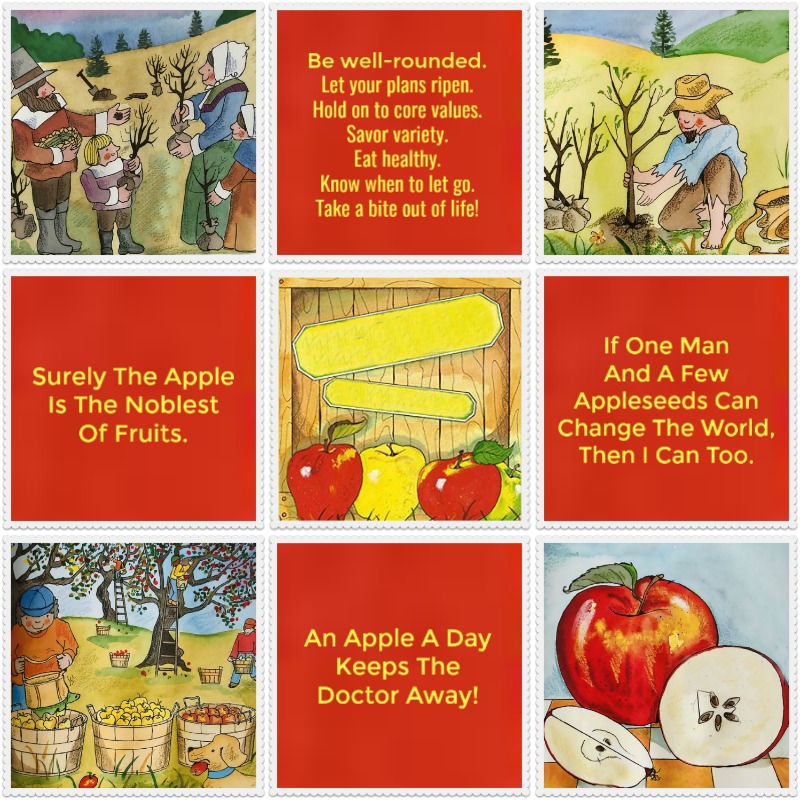
Find out where your favorite crunchy, refreshing fruit comes from in this snack-sized book.
Apples come in all shapes and sizes from all over the world. Take a bite and chew on months of planting, growing, picking, and selling that bring this tasty fruit into the home. With deliciously bright, detailed images and a simple text, Apples is the perfect board book for small curious hands who are still new to the crisp comfort of autumn.
Gail Gibbons, a dedicated explorer of the world on behalf of curious young readers, uncovers and educates young audiences with board books on everything from Pumpkins to Bicycles to Boats.
Readers ages 4-8 will also enjoy the newly-updated picture book version of Apples, which includes even more delectable details, diagrams, and vocabulary.
From gailgibbons.com: I was born in Oak Park, Illinois, in 1944. Even as a little child, I was always busy putting books together. Sometimes I would bind them with yarn to hold the pages together. I've always loved drawing and painting. I was also a very curious child. My parents tell me that I was always asking lots and lots of questions.
Later, I went on to the University of Illinois, where I studied graphic design. Then I moved to New York City, where I got a job doing artwork for television shows. Eventually I was asked to do the artwork for a children's show. While doing that show, some of the children asked me if I had ever thought of doing children's books. My mind immediately recalled how much I enjoyed doing that type of thing when I was a child. So I put an idea for a book together and right away a publisher bought it. That book was called Willy and His Wheel Wagon. Since then, over 170 books that I have written and illustrated have been published. The type of books I write are non-fiction books. This is because I love researching so much. I get to ask lots of questions, just like when I was a kid. I also get to travel and meet lots of interesting people. While doing research for my book Nature's Green Umbrella: Tropical Rain Forests, I traveled to two islands where there are tropical rain forests, Saba and Dominica. I also had a great time writing and illustrating the book. I get a lot of pleasure from doing the type of work I do.
The book first starts talking about where apples came from and how long they have been around. It then talks about the different parts of an apple. It shows all of the different things you can do with apples like bobbing for apples, having competitions for the best, and making caramel apples.
I gave this book 3 stars, I thought that it was a decent book.
In Apples Gail Gibbons makes learning about this fruit fun! Readers are introduced on how apples were first brought to this country. The book explains how apples grow and how they are distributed for consumption. What type of apple is your favorite? This book highlights a variety of apples in North America. The best part of this book is discovering how apples are very versatile. The book Apples is a wonderful resource for students, teachers and parents.
This book can be used in a variety of subjects in a K-2 classroom. After listening to this story, students can recount facts from the book. Students can also focus on new vocabulary introduced in the book. In first grade, one objective is to compare books that are stories and books that provide information. A great comparison for Apples is Herman Parish’s Amelia Bedelia’s First Apple Pie (2012). In writing, this book provides a wonderful example of an informational story. Teachers can use this book as a model when teaching students how to write facts and information about a specific subject. In social studies, students can learn about producers and consumers. With an economy unit, students can distinguish between the apple farmers who grow the apples and the consumers who purchase the apples at farm stands or stores.
This is a WOW book for several reasons. Most students have some connection, experience, and background knowledge about apples. This book allows students to build upon that knowledge. I appreciate that the text is challenging yet accessible for younger readers to comprehend. Gibbons effortlessly includes important details and information without this content being overwhelming for students. For instance, the new vocabulary words (pollination and dormant) are included in the pictures. The diagrams are also helpful in providing students with new vocabulary words. The illustrations grab the attention of readers since they look more like pictures in a storybook rather than formal photographs in a nonfiction book. Another part of this book that I enjoy is the recipe in the back of the book for making apple pie. Students can take this book home, read the text, and then try out the recipe for themselves! Gail Gibbons provides a wide range of nonfiction books. Some examples are The Pumpkin Book (1999), The Moon Book (1997), The Vegetable We Eat (2007), Galaxies! Galaxies! (2007), Bats! (1999), and My Baseball Book (2000). Her books provide enhance lessons and are a wonderful resource across several subject areas.
Short Description of the Book: Gibbon’s book Apples is a nonfiction text that gives a description of apples, including illustrations and diagrams, the history of apples, uses for apples, and various types of apples. Gibbons also includes directions for how to plant and care for an apple tree.
Focus: Sequence for How-To writing – In her book Apples, Gibbons models two great examples of “how-to” writing. The first teaches step-by-step how to plant and care for an apple and the second explains the steps for making an apple pie. These are great examples for students to understand how to describe each step of a process in their how-two writing.
Teach: CCSS.ELA-Literacy.W.1.2 Write informative/explanatory texts in which they name a topic, supply some facts about the topic, and provide some sense of closure. CCSS.ELA-Literacy.W.1.7 Participate in shared research and writing projects (e.g., explore a number of “how-to” books on a given topic and use them to write a sequence of instructions).
1) Begin by introducing the book to the students and explaining that today our focus will be on understanding how to use sequence in our writing. Explain that the word sequence means to put things in the order that they happened. 2) Read the book to students, having them pay close attention to how the author using step-by-step directions to tell how to do something in order. Ask students to turn and talk about what they think would happen if the author had put things in another order. 3) Explain to students that if we don’t tell things in order, it doesn’t make sense to our reader. When we write our how-to books, we need to tell how to do something step-by-step using the correct sequence. 4) Using your own writing, model the process of writing the steps of a how-to in order. Have students brainstorm what should come next in the process. Students may realize that the steps may need to be revised so that they are in the correct sequence.
Expected Outcomes: Students will be able to write the step-by-step process for their how-to books. They will be able to revise the steps to ensure that they are in sequential order.
I selected this book as my concept book. This particular book, written by Gail Gibbons, is a book that teaches the reader about apples. A similar concept book was referenced in the textbook, The Joy of Children’s Literature by Denise Johnson (2011), in Chapter 4 page 73. From the first page, the reader is taken on an educational adventure, learning about different kinds of apples, how they grow and how they can be used.
The jacket of the book has a country look with an illustration of apples displayed in red, green and yellow. In the background you can see the side of a wooden basket. The title and author’s name are displayed with titled banners, adding to the country theme. The back of the jacket is a continuous image of the front jacket with three apples and a background of a wooden basket. The hardcover is an exact replica of the jacket. The endpapers are solid red with no illustrations. The introduction page is simple with a basket of apples taking up approximately half of the page. The illustrations bring alive the apple structure and the process of their growth. The illustrator is careful to include enough detail to make the reader relate.
I enjoyed this book because it gave details about how apples grow, the different types of apples, and things you can make with apples. I particularly liked the last page when the author emphasized that apples are nutritious and delicious. The author was creative by adding directions on how to make an apple pie. She also shares with the reader how an apple cider press works.
This book can be used in the classroom as an introduction to nutrition and healthy eating. The book is educational and uses key vocabulary terms that makes it easy for the reader to understand. This book would be a good choice for a questionnaire treasure hunt. Students could also select one of the types of apples to further research.
The colorful picture book, Apples by Gail Gibbons is loaded with information and details all about apples. This books exposes children to various views and angles of apples showing their key parts. Children also learn about a diagram of an apple press, they look at charts of varieties of apples, along with step-by-step instructions for planting and growing apple trees. After reading this book, children are provided with life-long information that they can take with them and share with others on the topic of apples. I enjoyed reading this book, and couldn't help but look at the bright and colorful illustrations provided throughout. These captivating images helped to promote a happy and cheerful mood set throughout the story. This was an excellent picture book, appropriate for children ages 5-8 years old. This picture book is a great example of rich, high quality-literature and I recommend it! Other books I might pair with this book would relate to the topic of apples and Fall. Some other books about these topics may include: Ten Apples Up On Top! and Fall Leaves Fall!. The book Apples, by Gail Gibbons could be used as a mentor text for writing about an apple picking field trip, or other fall related activities. This text could also be used during a writer's workshop to help children learn how to incorporate content specific vocabulary within their writing pieces.
Short Description of the Book: Gail Gibbons provides a comprehensive overview of apples, including a history of apples in America, the life cycle of an apple tree, the uses of apples, and apple varieties.
FOCUS: Informational Features I would use in a Mini-Lesson
1.) Using Various Nonfiction Genres within an Informational Text: • How-To: Gibbons includes a how-to section about how an apple cider press works. She uses labels and numbered steps laid over her illustration, which makes the information pop off of the page. I love how the directions overlay the illustrations, making them more label-like. I would use this as an example “how-to” page within an informative text that students can use as a mentor text to help them when writing their own informational pages. This shows that you can include how-to sections without using a template format. • Recipe: Gibbons also includes a recipe for apple pie. This could be used powerfully to show students the variety of nonfiction elements they can include when focused upon one topic or theme.
Teach: CCSS W.1.2 Write informative/explanatory texts in which they name a topic, supply some facts about the topic, and provide some sense of closure.
This book is so informative as the author goes into great detail all about the apple from pollination to the picking, and to the many uses of the apple. It talks about how apples came to america as well as their traditional uses.
It includes cut outs of the apple showing what the inside contains as well as provides great labeling. A border is present in each page also, the text is enclosed in a text box. It includes step by step process of how to create ape pie, and apple cider. It is a great nonfiction read and includes lots of great facts about the apple. Very detailed illustrations. This book can be used for all grade levels.
This extremely colorful books is packed with information all about apples. Readers are taught about the parts of an apple, diagrams of an apple press, the types of apples and instructions on planing and growing apple trees. This book is at a K-2 interest level and a 3.4 grade level book. The presentation of this book is wonderful. The book is easy on the eyes and allows the reader to follow along easily. The organization starts with a clear beginning on how apples are made, proceeds to types of apples and ends on how to make them. It's a great picture book to read to younger audiences and my preschoolers really enjoy it.
this is the perfect book to read when opening up a science lesson on plants. You and your students can get an apple and explore the different parts of it. Have them think about why seeds are in the middle of the apple, why do apples have a skin, or even the various things we can make using an apple. I really like how the book name a lot of the different kinds of apples because I only knew the name of two kinds of apple. It would be neat to have students taste diferent kinds of apples and compare and contrast them.
Here an apple, there an apple, everywhere an apple! From apple juice to apple pie, many consumers love apples. In the book "Apples," Gail Gibbons explains everything about apples from how they were first brought to America to what apples are used for today. This informative book goes in depth and provides the science behind how apples form, the parts of the apple, and how the trees and apples change throughout the seasons. Gibbons uses unique illustrations and labels to help teach readers everything about apples.
This book is jam packed full of information! It basically tells you anything you want to know about apples. I was amazed that so much could be packed into a children's nonfiction picture book and it still be interesting. As a teacher, I could use this book to do a whole unit on apples. You could discuss the history or the science that correlates with apples. This book could also simply be used to introduce nonfiction since it is a simple subject but does provide many examples of information that may be presented in a nonfiction text.
Great book, but how hard would it have been to insert the two words "scientist believe..." before discussions of how long apples have been around? It's a theory, people, not a fact. Nobody was there to witness the first apple, so it's only an educated guess. If it's a non-fiction book, then it needs to be accurate. Normally, I only give one star if there's something like this, but it's an excellent book after the first page, so I'm giving it a boost.
This non-fiction book is devoted to apples. It gives a brieg history, the life cycle, and fun facts about apples... they even have directions for apple pie!
This book begins by explaining what an apple is, and how they got to North America. It then talks about the production of apples, and how many are grown annually. After that, it shows diagrams of the apple structure and explains the growing process. The direction of the text quickly shifts to how apples are used in our communities. There are no main characters in this book: it is all about apples.
The artwork is kiddy, which would be fine for very young children, but that does not seem to be the target audience. I had a hunch that this was an older book, so I checked. It was published in 2000: almost two decades ago. I feel that this book is outdated. Today, we know that kids can understand complex artwork, and get even more out of it than doodles. The only parts of the illustrations that seem to contribute to the meaning are the diagrams.
I felt that this book was too simplified in the beginning, with respect to the illustrations. Also, it is inaccurate to depict the white settlers and Native Americans as best-apple-buddies. I suppose that it demonstrates how views change over time. The book gets better toward the end, and very educational. The illustrations are accurate and include labels to help children better comprehend the difficult parts of the text.
The book organized all the information in an arbitrary way. It jumped from the times of colonization, to county fairs, and then a lesson on planting an apple tree. In my opinion, it should have focused on one general area. The information was interesting, but the syntax took away from that.
The book includes two literary elements: theme and tone. The theme is simple; apples have many uses. The tone is positive toward the usage of apples. Perhaps the author really enjoys them, so much so that she decided to write a whole book about The Gem of the Supermarket Produce Section.
There are two design elements in this book: font and orientation. The font is simple, indicative of informational text. The orientation allows the reader to have a full view of the scenes, sort of like they're actually in the story.
1. This book has not been given any awards. 2. Apples by Gail Gibbons is appropriate for PreK to about first grade or second grade. 3. This book informs children all about apples. Starting with the history of apples, the author writes about the different kinds of apples, how to plant an apple tree, and their different uses. Gibbons uses diagrams, charts, and illustrations to convey this information to the children. 4. I like this book because it is shows some of the different elements of a non-fiction text. With diagrams, charts, and facts throughout the book it is very informative. Also, the bright colors are very appealing to children. 5. I would use this book during a fall lesson. I would take the kids on a field trip to an apple orchard to pick apples. Then in class I would perform a science experiment with the students. I would cut the apple open so we can examine it's interior and I would ask the students to predict how many seeds they think the apple will contain. I would also copy down on a piece of chart paper the steps written in the book about how to plant an apple tree. Together, I would plant an apple tree with the students following those exact steps.
Apples is a story written by Gail Gibbons. This book goes on to explain what apples are and how they are brought into the world. It talks about how the first American colonists brought apple seeds to america and then planted them, it says they have been around for around 2 million years. It then goes on to explain how apple picking and planting trees has become so popular and how apples provide so much for the Earth. Gibbons does a good job of explaining that the apple holds more than to just being a juicy fruit. She puts a lot of information about apples in here that some I did not even know myself. The illustrations are very basic and look like they were used with watercolors, they are fun to look at and attract the eyes. I gave this book 4 stars because it shows how much apples really mean to the world and it holds a lot of information that anyone can take away from it. It is a fun little book that I think kids would enjoy to read and learn about the world of apples.
This book is full of delicious information about apples. It starts with a history of apples and takes the reader through the different seasons of the apple and apple tree. It tells about all the fun things to do with apples and gives information on the many different types of apple trees.
Gail Gibbons never disappoints with her informational books. This book is colorful, engaging, and chocked full of information about apples. It is a fun way to learn all about this delicious fruit!
Other books to read that connect to Apples: Apples for Everyone by Jill Esbaum How Do Apples Grow? by Betsy Maestro The Apple Pie Tree by Zoe Hall
"When the trees are loaded with ripe apples, it is harvest time."
This book could be used as a mentor text to teach children about writing informational text. Students could pick a favorite fruit and write, label, and draw all about it.
Apples Written & Illustrated by: Gail Gibbons Ages: 5-9 US Grades: Kindergarten- Grade 3 Lexile Measure: 650 Nonfiction, Apples, History of Apples, Johnny Appleseed, Life Cycle of Apples, Parts of an Apple, Types of Apples, Food and drink from Apples, Recipes, Facts about Apples
Apples was masterfully written and illustrated by Gail Gibbons. I love this as a read-aloud because the physical size of the book is slightly larger than an average book. Gibbons weaves the history of apples with the science of the parts of the apple, and the life cycle of an apple. She also discussed the different types of apples with descriptions of how they look and taste. * Please check out my blog for corresponding Math & Science activities for Grades Pre-K-5 7 Amazing Apple Books.
Apples is a book that describes all the history of an apple. Gail Gibbons made the background history of apples fun to read. The story is very informational because it states how apples grow and how they were distributed to eat. Gail teaches step by step on how to plant an apple tree, and gives an apple pie recipe. The story is very colorful, and shows all the different colors or an apple; green, yellow and even red.Which makes the book very cartoon like. And uses different frames like a comic. This book really caught my eyes because of how informative it is for the younger viewers. But is super informative for all views, I learned more about apples just by reading this book that i have ever known.
Apples is actually a real interesting book because it is nonfiction and gives a history about apples and what goes into creating apple trees and where they came from. I chose this book because during the holiday and cold times apple cider is a big hit especially with apple pie. So, this would be a fun book to read before thanksgiving break or winter break to give a little knowledge on how it all started. The genre is nonfiction, it tells history of the apples, which I believe is true. Overall this book has great artwork which goes with what is being said on the page as well so it helps create the image of what is being told about the time line of apples.
This entire review has been hidden because of spoilers.
This book explains the history of apples and the life cycle of apples. It describes parts of an apple and different things you can do with apples. The book teaches readers how to plant and take care of an apple tree.
I like this book because it is simple and informative. Students learn new vocabulary words while reading this book. The illustrations in this book grab the reader’s attention which keeps them engaged in the book.
This book relates to others such as Fall Apples, How Do Apples Grow?, and From Apple Trees to Cider, Please!
This book would be useful for a how-to writing assignment (planting and caring for an apple tree and making apple pie).
Everything you need to know about apples is in this book. They have the different types of apples with pictures. They also show how an apple grows from start to finish.
This book is a good information text to teach children about apples. Some of the vocabulary is a little advanced for my grade level. I do like how it tells you how they grow, to the different kinds, to what you can do with them after.
You can connect this text with " Fall Apples, Crisp and Juicy"
I'm not sure what was updated from the original, but this is still a beautifully simple book. It's a non-fiction book all about apples, but it's not dry. The pictures are vibrant and the facts are very straightforward. There are some pictures with labels, word definitions built in (ex. the word "dormant" is defined when talking about apple trees in the winter), and there even instructions for planting an apple tree and making apple pie. This would be a PERFECT fall read, especially if you're able to go to an apple orchard for a field trip!
This book is very informational and is a great way for students to begin to learn about agriculture and how that whole industry works. It is important for students to know where their food is coming from and how it came to be that way. This book as good illustrations to go along with the information to provide as well. However I do think that the book is quite lengthy for the information that they are providing so I believe that students may loose interest.
This is a great book that gives all the ins and outs of Apples and where they come from. I really enjoyed this book because it gave information such as where the first Apple Seedling came from. This informational picture book produces more questions and a greater range of vocabulary for the reader.
Genre: Informational Nonfiction Grade Level: 2nd This is a highly informational book about... apples... I know, I was surprised too. This is a solid read that young children can learn from with the interesting illustrations, but it didn't really grab me. Aside from that, if you want to quickly learn about apples, this is the book for you.