

What do you think?

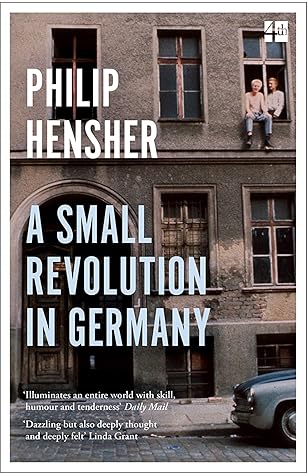
A Small Revolution in Germany
A Small Revolution in Germany is about growing up, or refusing to accept what growing up means; it’s about the small dishonest pacts that people make with their own futures; and it’s about the rare and joyous refusal to be disillusioned.
Everyone remembers what it’s like to be seventeen. The conversations you have; the ideas that burst on you; the kiss that transforms you. And then you grow up, and make a deal with adulthood. A Small Revolution in Germany is about that rapturous moment when ideas, and ideals, and passion crash over one boy’s head. And what happens in the decades afterwards? When you see the overwhelming truth when you are seventeen, why should you ever abandon that truth?
Spike is brought into a small, clever group of friends, bursting with a passion for ideas, and the wish to change the world. They smash up political meetings; they paint slogans on walls; they long for armed revolution; they argue, exuberantly, until dawn. In the years to follow, they all change their minds, and go into the world. They become writers, politicians, public figures. One of them becomes famous when she dies. They all change their minds, and make sensible compromises. Only Spike stays exactly as he is, going on with the burning desire for change, in the safe embrace of unconditional love. Alone from the old group, he is the only one who has achieved nothing, and who has never deviated from the impractical shining path of revolution he saw as a teenager. Thirty years on, photographs of the teenage group look like a bunch of celebrated individuals, with only one unknown face in it – Spike.
Everyone remembers what it’s like to be seventeen. The conversations you have; the ideas that burst on you; the kiss that transforms you. And then you grow up, and make a deal with adulthood. A Small Revolution in Germany is about that rapturous moment when ideas, and ideals, and passion crash over one boy’s head. And what happens in the decades afterwards? When you see the overwhelming truth when you are seventeen, why should you ever abandon that truth?
Spike is brought into a small, clever group of friends, bursting with a passion for ideas, and the wish to change the world. They smash up political meetings; they paint slogans on walls; they long for armed revolution; they argue, exuberantly, until dawn. In the years to follow, they all change their minds, and go into the world. They become writers, politicians, public figures. One of them becomes famous when she dies. They all change their minds, and make sensible compromises. Only Spike stays exactly as he is, going on with the burning desire for change, in the safe embrace of unconditional love. Alone from the old group, he is the only one who has achieved nothing, and who has never deviated from the impractical shining path of revolution he saw as a teenager. Thirty years on, photographs of the teenage group look like a bunch of celebrated individuals, with only one unknown face in it – Spike.
336 pages, Hardcover
Published February 2, 2020
About the author
Philip Hensher
44 books118 followersHensher was born in South London, although he spent the majority of his childhood and adolescence in Sheffield, attending Tapton School.[2] He did his undergraduate degree at Lady Margaret Hall, Oxford before attending Cambridge, where he was awarded a PhD for work on 18th century painting and satire. Early in his career he worked as a clerk in the House of Commons, from which he was fired over the content of an interview he gave to a gay magazine.[1] He has published a number of novels, is a regular contributor, columnist and book reviewer for newspapers and weeklies such as The Guardian, The Spectator , The Mail on Sunday and The Independent.
The Bedroom of the Mister’s Wife (1999) brings together 14 of his stories, including ‘Dead Languages’, which A. S. Byatt selected for her Oxford Book of English Short Stories (1998), making Hensher the youngest author included in the anthology.http://literature.britishcouncil.org/...
Since 2005 he has taught creative writing at the University of Exeter. He has edited new editions of numerous classic works of English Literature, such as those by Charles Dickens and Nancy Mitford, and Hensher served as a judge for the Booker Prize. From 2013 he will hold the post of Professor of Creative Writing at Bath Spa University.[3]
Since 2000, Philip Hensher has been listed as one of the 100 most influential LGBT people in Britain,[4] and in 2003 as one of Granta's twenty Best of Young British Novelists.[1]
In 2008, Hensher's semi-autobiographical novel The Northern Clemency was shortlisted for the Man Booker Prize. In 2012, Hensher won first prize -German Travel Writers Award, and is shortlisted for the Green Carnation Prize. He also won the Stonewall Prize for the Journalist of the Year in 2007 and The Somerset Maugham Award for his novel Kitchen Venom in 1996. He wrote the libretto for Thomas Adès' 1995 opera Powder Her Face. This has been his only musical collaboration to date.
His early writings have been characterized as having an "ironic, knowing distance from their characters" and "icily precise skewerings of pretension and hypocrisy"[1] His historical novel The Mulberry Empire "echos with the rhythm and language of folk tales" while "play[ing] games" with narrative forms.[1]
He is married to Zaved Mahmood, a human rights lawyer at the United Nations.
You can find out more about Philip on his author page at 4th Estate Books: http://www.4thestate.co.uk/author/phi...
The Bedroom of the Mister’s Wife (1999) brings together 14 of his stories, including ‘Dead Languages’, which A. S. Byatt selected for her Oxford Book of English Short Stories (1998), making Hensher the youngest author included in the anthology.http://literature.britishcouncil.org/...
Since 2005 he has taught creative writing at the University of Exeter. He has edited new editions of numerous classic works of English Literature, such as those by Charles Dickens and Nancy Mitford, and Hensher served as a judge for the Booker Prize. From 2013 he will hold the post of Professor of Creative Writing at Bath Spa University.[3]
Since 2000, Philip Hensher has been listed as one of the 100 most influential LGBT people in Britain,[4] and in 2003 as one of Granta's twenty Best of Young British Novelists.[1]
In 2008, Hensher's semi-autobiographical novel The Northern Clemency was shortlisted for the Man Booker Prize. In 2012, Hensher won first prize -German Travel Writers Award, and is shortlisted for the Green Carnation Prize. He also won the Stonewall Prize for the Journalist of the Year in 2007 and The Somerset Maugham Award for his novel Kitchen Venom in 1996. He wrote the libretto for Thomas Adès' 1995 opera Powder Her Face. This has been his only musical collaboration to date.
His early writings have been characterized as having an "ironic, knowing distance from their characters" and "icily precise skewerings of pretension and hypocrisy"[1] His historical novel The Mulberry Empire "echos with the rhythm and language of folk tales" while "play[ing] games" with narrative forms.[1]
He is married to Zaved Mahmood, a human rights lawyer at the United Nations.
You can find out more about Philip on his author page at 4th Estate Books: http://www.4thestate.co.uk/author/phi...
Ratings & Reviews
Friends & Following
Create a free account to discover what your friends think of this book!
Community Reviews
Displaying 1 - 30 of 51 reviews

December 16, 2019
Hensher's new novel is a political Bildungsroman that is bound to ruffle some feathers on its publication. It follows a group of students from Northern England from the 80s to our present day, charting their ideological and professional evolution through the years.
While they all start from a radical left position, the superficiality of that position and the flexibility of ambitious characters is gradually revealed. Hensher is damning in his portrayal of these characters and his anger shines through the work, giving the novel a gripping urgency. The similarity to actual British politicians is very obvious.
The authors expertise and knowledge of Britain's political landscape are apparent and add authority to the novel. The episode set in Germany was particularly convincing, creating a believable and nuanced picture of the two Germanys before the Fall of the Wall.
In the beginning I found the prose slightly contrived and overly clever, however that might have been due to the protagonist's own precocious and arrogant youth, as the prose relaxed significantly later in the book.
Overall, an intelligent, gripping and refreshingly angry novel, that doesn't pull any punches when dealing with its explosive subject matter.
While they all start from a radical left position, the superficiality of that position and the flexibility of ambitious characters is gradually revealed. Hensher is damning in his portrayal of these characters and his anger shines through the work, giving the novel a gripping urgency. The similarity to actual British politicians is very obvious.
The authors expertise and knowledge of Britain's political landscape are apparent and add authority to the novel. The episode set in Germany was particularly convincing, creating a believable and nuanced picture of the two Germanys before the Fall of the Wall.
In the beginning I found the prose slightly contrived and overly clever, however that might have been due to the protagonist's own precocious and arrogant youth, as the prose relaxed significantly later in the book.
Overall, an intelligent, gripping and refreshingly angry novel, that doesn't pull any punches when dealing with its explosive subject matter.

January 15, 2020
This is the one I’m going to find hardest to talk about, not only because I finished it the most recently and therefore haven’t had time to let my thoughts about it percolate, but because there’s a lot about it that resists summary, though not necessarily analysis. It is, in essence, the story of a political awakening, but where most such stories tend to stop after that moment (the “small revolution” of the title, in one possible reading), Hensher’s more interested in the repercussions, the implications, of changing your mind or refusing to. His protagonist, Spike, and Spike’s partner of many decades, Joaquin, are the only two people from their youthful friendship group who have not deeply compromised their teenage radical principles. Others—like Percy Ogden, erstwhile leader of their gang, who once harangued an Army recruitment officer and now writes smug, condescending columns for a national newspaper, or Eric Milne, now a QC and a lord—most certainly have. Perhaps the worst offender of all is James Frinton, whom Spike recalls as the offspring of a pub landlord and a clinical depressive, smelling of overcooked peas and despair, and who reinvented himself so thoroughly at Oxford that he is now Home Secretary. And yet Spike doesn’t seem quite comfortable with his own integrity. He repeatedly notes, with something like unease, that the word “boyish” is often used of himself and of Joaquin. There is an extent to which moral compromise defines adulthood; if Spike and Joaquin haven’t compromised, how much can they be considered participants in the “real world”? How much do they want to be? (I wonder, also, if Hensher’s choice to make his protagonist a childless gay men is meant to be a gesture towards this as well. Not that I think Hensher is actually saying that a childless long-term homosexual relationship is a form of lifestyle immaturity; but I do think he might be suggesting that the world at large often frames choices like Spike’s in this way.) Anyway. Very interesting, and quite a good introduction to Hensher’s work, I think.

Read
May 25, 2020❧ audiobook review
Sometimes, as humans, we decide without consultation what would be best for people.
It made for a nice listen and the narrator was quite good. Spike was interesting character and his relationship with Joaquin is explored well. The political conversations and musings are thought-provoking, and Hensher certainly knows how to write witty dialogue. I'm just not sure what my thoughts are on this one. Overall, though, the prose was good, and it made for a nice addition to lgbt+ historical fiction.
☆ Book Reviews | Bluesky | Twitter | Threads ☆
Sometimes, as humans, we decide without consultation what would be best for people.
It made for a nice listen and the narrator was quite good. Spike was interesting character and his relationship with Joaquin is explored well. The political conversations and musings are thought-provoking, and Hensher certainly knows how to write witty dialogue. I'm just not sure what my thoughts are on this one. Overall, though, the prose was good, and it made for a nice addition to lgbt+ historical fiction.
☆ Book Reviews | Bluesky | Twitter | Threads ☆

October 6, 2021
Can you age without compromising your values and political beliefs? Spike, the narrator, can and does. We join him at three points in his life starting in 1982, when he is a 17 year old, who falls in with a group of radicals. Do his friends sell out for the sake of power, or have they simply grown up? One of them dies young, and the circumstances of her death become part of this question.
Is this novel a satire on the left? Or holding a mirror up to a more widespread disillusionment with politics and politicians? And how far will people go in pursuit of their own ambition? One former comrade appears totally ruthless in a desire for power and self advancement.
A Small Revolution in Germany is enjoyable and absorbing, but too ambiguous. The unchanging Spike is just too good to be true.
3/5
A Small Revolution in Germany (2020) was my first Hensher. I read it for my book group.
Is this novel a satire on the left? Or holding a mirror up to a more widespread disillusionment with politics and politicians? And how far will people go in pursuit of their own ambition? One former comrade appears totally ruthless in a desire for power and self advancement.
A Small Revolution in Germany is enjoyable and absorbing, but too ambiguous. The unchanging Spike is just too good to be true.
3/5
A Small Revolution in Germany (2020) was my first Hensher. I read it for my book group.
March 2, 2020
At the close of A Small Revolution in Germany an early photograph is described. The photo shows the revolutionary Sparticists: Kate (but not Euan her ever absent boyfriend), Eric, Ogden, Tracy, James, and Spike (the narrator, but not Joaquin, his partner, who must hide his identity for political reasons). The borderline member, Mohammed, takes the photograph. This is a set-piece: a photograph that looks from the present to the past, but suggests the future: all those present are expected to have entered life bearing trails of glory. And all do become famous or infamous, except for Spike. What is not said as regards this photograph, however, is that this novel is Spike's story, his expose of the Spartacists - its publication will be his attempt to speak truth to power ... far more dangerous than throwing a "bag of shit into a bank."
A Small Revolution in Germany is a bitter satire on politics. It is written with fangs bared, and is sharp and savage, and bloodily funny. In this small novel, Hensher packs a lot of intellectual thought and emotional drama: he excoriates liberal views. There is one scene where a group of teenagers vandalise an elderly woman's flat and hurl her television from a window. The liberal commentary is given: the teenagers are deprived and therefore the real victims, to which Joaquin replies, "No. they are just little cunts." It is telling that the only characters who remain true to themselves and their principles are the gay couple, Joaquin and Spike.
For a time, Hensher worked as a clerk in the House of Commons. That experience serves him well. He catches brilliantly the hypocrisy and vanity of the Establishment, an Establishment based on elite education. The novel aims a gun at Hollinghurst and other writers who set their novels in the land of dreaming spires. The bullets are implied, but they are not blanks.
Reviews have criticised Hensher for using excessive details, for not being able to resist another comic jab. Not sure this is the case at all, for a substantial part of Hensher's novel is concerned with the extravagance of youth and indulgent celebrities who are thin on compassion.
A Small Revolution in Germany is a bitter satire on politics. It is written with fangs bared, and is sharp and savage, and bloodily funny. In this small novel, Hensher packs a lot of intellectual thought and emotional drama: he excoriates liberal views. There is one scene where a group of teenagers vandalise an elderly woman's flat and hurl her television from a window. The liberal commentary is given: the teenagers are deprived and therefore the real victims, to which Joaquin replies, "No. they are just little cunts." It is telling that the only characters who remain true to themselves and their principles are the gay couple, Joaquin and Spike.
For a time, Hensher worked as a clerk in the House of Commons. That experience serves him well. He catches brilliantly the hypocrisy and vanity of the Establishment, an Establishment based on elite education. The novel aims a gun at Hollinghurst and other writers who set their novels in the land of dreaming spires. The bullets are implied, but they are not blanks.
Reviews have criticised Hensher for using excessive details, for not being able to resist another comic jab. Not sure this is the case at all, for a substantial part of Hensher's novel is concerned with the extravagance of youth and indulgent celebrities who are thin on compassion.

August 22, 2021
Pretentious hate speech. I had to endure 215 pages replete with generalisations on the human condition (labelling all suicides selfish was particularly unwelcome) yet wholly devoid of developed female characters. Then I was confronted by this:
“We were both expelled from the local LGBT group, as it now calls itself, for shouting at a man in a dress who called himself a lesbian. When the chair told us we had to leave, Joaquin, thinking he might as well be hanged for a sheep as a lamb, punched the man in a dress who called himself a lesbian.”
A Google search revealed the author has signed letter slating Stonewall and has Tweeted that “Trans women can be Freemasons, just not women”.
The Spartacists were always the worst of the left-wing sects (defending North Korea’s ‘right’ to nuclear weapsons) and in the author’s defence he does admit to some of this. However, all he succeeds in doing is demonstrating, through Frinton in the fictional world and his own transphobia in the real one, how easy the journey from ultra-left to ultra-right is.
I rarely throw books out but I genuinely don’t think any decent person could enjoy these unstructured meanderings of a newly-converted gammon.
“We were both expelled from the local LGBT group, as it now calls itself, for shouting at a man in a dress who called himself a lesbian. When the chair told us we had to leave, Joaquin, thinking he might as well be hanged for a sheep as a lamb, punched the man in a dress who called himself a lesbian.”
A Google search revealed the author has signed letter slating Stonewall and has Tweeted that “Trans women can be Freemasons, just not women”.
The Spartacists were always the worst of the left-wing sects (defending North Korea’s ‘right’ to nuclear weapsons) and in the author’s defence he does admit to some of this. However, all he succeeds in doing is demonstrating, through Frinton in the fictional world and his own transphobia in the real one, how easy the journey from ultra-left to ultra-right is.
I rarely throw books out but I genuinely don’t think any decent person could enjoy these unstructured meanderings of a newly-converted gammon.
April 9, 2020
Maybe I missed the point of this meandering story. The various events just don’t seem to add up to anything and the main theme - some people change and others don’t - is repetitive and not especially interesting.
And what is with the ludicrously long and unrealistically eloquent monologues (e.g. from Pete Frinton toward the end of the book) that are used to fill in a lot of the back story? They felt so weird, particularly because a lot of the other dialogue is quite good.
Perhaps I just don’t like characters who talk endlessly about politics.
And what is with the ludicrously long and unrealistically eloquent monologues (e.g. from Pete Frinton toward the end of the book) that are used to fill in a lot of the back story? They felt so weird, particularly because a lot of the other dialogue is quite good.
Perhaps I just don’t like characters who talk endlessly about politics.

April 25, 2020
Philip Hensher's latest novel is about politics - more specifically, what happens to our political beliefs as we get older. It's a commonplace fact that people become more conservative as they get older, but Hensher's novel focuses more on what this process looks like from the perspective of a narrator who refuses to follow this tendency.
The novel is narrated in first person by "Spike" who, in his youth, is impressed by the left-wing ideas of a fellow schoolboy named Percy Ogden. Spike is then introduced to Ogden circle: Joachin, a revolutionary from Chile who becomes Spike's life partner; James Frinton, a charming fraud who becomes Home Secretary; Percy Ogden, an uncharming fraud who follows a political career in the Labour Party; Mohammad, a working-class boy with whom Spike gradually falls out of touch; and
Tracy Cunningham, Mohammed's former lover, and a misfit who changes her politics and her name (to Alexandra) in university.
After this initial set-up, Spike provides us with various vignettes showing how these ardently left-wing revolutionaries turned out. The most interesting is Spike's trip with Percy Ogden to East Germany during the early 1980s, in which Ogden's monstrous selfishness becomes glaringly obvious - quite simply, his political stance is grounded not in any kind of moral belief, but purely from his lust for power.
A holiday in a remote part of Germany brings an aging Spike and Joachin back into contact with Peter Frinton, James's brother. Through this episode we learn that James and Tracy had a casual romantic attachment while in university, and during this time James had written her various embarrassing letters. James was the last person to see Tracy before her death (presumably alcohol-related), and Spike strongly suspects James of engaging in some kind of foul play in order to get his letters back.
A Small Revolution in Germany has some minor flaws as a novel. I didn't particularly care for the character of Joachin, for instance, and his presence in the story seemed dangerously close to the kind of virtue-signally that Percy Ogden gets up to later in his career. Spike also seems too undamaged by his life and experiences to be fully realistic.
Nonetheless, what really shines about Hensher's novel is its central theme of existential compromise, which is built on Marx's famous observation in The 18th Brumaire of Louis Napoleon that history repeats itself "the first time as tragedy, the second time as farce." As someone who has held onto my revolutionary politics over the years, I have been repeatedly dismayed to see the people I knew in my youth return to the conservative beliefs of their parents. I really felt Spike's pain and disappointment in this regard, and its broader resonance in the arena of British politics must carry a similar weight.
The novel is narrated in first person by "Spike" who, in his youth, is impressed by the left-wing ideas of a fellow schoolboy named Percy Ogden. Spike is then introduced to Ogden circle: Joachin, a revolutionary from Chile who becomes Spike's life partner; James Frinton, a charming fraud who becomes Home Secretary; Percy Ogden, an uncharming fraud who follows a political career in the Labour Party; Mohammad, a working-class boy with whom Spike gradually falls out of touch; and
Tracy Cunningham, Mohammed's former lover, and a misfit who changes her politics and her name (to Alexandra) in university.
After this initial set-up, Spike provides us with various vignettes showing how these ardently left-wing revolutionaries turned out. The most interesting is Spike's trip with Percy Ogden to East Germany during the early 1980s, in which Ogden's monstrous selfishness becomes glaringly obvious - quite simply, his political stance is grounded not in any kind of moral belief, but purely from his lust for power.
A holiday in a remote part of Germany brings an aging Spike and Joachin back into contact with Peter Frinton, James's brother. Through this episode we learn that James and Tracy had a casual romantic attachment while in university, and during this time James had written her various embarrassing letters. James was the last person to see Tracy before her death (presumably alcohol-related), and Spike strongly suspects James of engaging in some kind of foul play in order to get his letters back.
A Small Revolution in Germany has some minor flaws as a novel. I didn't particularly care for the character of Joachin, for instance, and his presence in the story seemed dangerously close to the kind of virtue-signally that Percy Ogden gets up to later in his career. Spike also seems too undamaged by his life and experiences to be fully realistic.
Nonetheless, what really shines about Hensher's novel is its central theme of existential compromise, which is built on Marx's famous observation in The 18th Brumaire of Louis Napoleon that history repeats itself "the first time as tragedy, the second time as farce." As someone who has held onto my revolutionary politics over the years, I have been repeatedly dismayed to see the people I knew in my youth return to the conservative beliefs of their parents. I really felt Spike's pain and disappointment in this regard, and its broader resonance in the arena of British politics must carry a similar weight.
This entire review has been hidden because of spoilers.

December 6, 2021
To grow up is to change, to leave behind the radical idealism of one's youth and adapt to more mainstream views to get ahead - or is it?
As a teenager, Spike fell in with a group of idealistic would-be revolutionaries, introducing him to a whole new way to see the world, and to the man he would spend the rest of his life with. As time goes by, one by one, his former friends drift away, turning their backs on the beliefs they so fervently embraced in the past to embrace the establishment instead, going on to find fame as politicians, writers and public figures. Only Spike remains the same, unchanged in his views, the only one who hasn't sold out - and in an old photo of the group recently published in a newspaper, his is the only face labelled "unknown".
Certainly to me, Spike's is the path clearly preferable out of all those taken by the friends of his youth - better to stay true to yourself and be quietly happy than trade in your integrity for fame and fortune. Though I suppose this is one of those books in which I think every reader, depending on their own views and beliefs, will find a different message.
As a teenager, Spike fell in with a group of idealistic would-be revolutionaries, introducing him to a whole new way to see the world, and to the man he would spend the rest of his life with. As time goes by, one by one, his former friends drift away, turning their backs on the beliefs they so fervently embraced in the past to embrace the establishment instead, going on to find fame as politicians, writers and public figures. Only Spike remains the same, unchanged in his views, the only one who hasn't sold out - and in an old photo of the group recently published in a newspaper, his is the only face labelled "unknown".
Certainly to me, Spike's is the path clearly preferable out of all those taken by the friends of his youth - better to stay true to yourself and be quietly happy than trade in your integrity for fame and fortune. Though I suppose this is one of those books in which I think every reader, depending on their own views and beliefs, will find a different message.

January 30, 2021
A small disappointment in America. This is the only novel by Hensher I’ve read. I know nothing of his other work; I know nothing about him. Caveat lector.
At the end of this 300-plus page novel, I could only think: Really? That was it? At times the book read like a minor variant of Brideshead Revisited or A Dance to the Music of Time, or one of their chattering progeny about young men who go to Oxford (more rarely, Cambridge) and metamorphose in the usual ways, encountering the exaltations and humiliations of England’s class system. No Sebastian Flyte and Aloysius appear, no Kenneth Widmerpool. Instead we get a sad set of feckless socialists, of whom not a single soul is scintillating.
Here I’ll pause to notice the range of reponse in the other Goodreads reviews. I’m startled to read “Hensher is damning in his portrayal of these characters and his anger shines through the work, giving the novel a gripping urgency.” Or to learn that Hensher’s novel is “a bitter satire on politics. It is written with fangs bared, and is sharp and savage, and bloodily funny.” My own response is much closer to the reader who wrote “Maybe I missed the point of this meandering story. The various events just don’t seem to add up to anything and the main theme - some people change and others don’t - is repetitive and not especially interesting.” As an American who has barely survived the machinations of Trump and Fox News, who has been forced to confess that almost half his country is capable of believing demonic conspiracies that yield nothing in savagery or bloody fantasy to the middle ages, Henshler’s world of wan opportunists is weak tea indeed.
There is a wicked murder at the heart of it all. And one could hardly care less.
The two protagonists are a couple of middle-aged gay men who have kept their integrity, passion and principles from the very beginning. Apparently this is not satire. Unlike any gay man I’ve ever known, the narrator has only had sex with his one and only lover (if you discount an improbable rape by a school buddy). Love endures and it is dull beyond comprehension.
There is one finger-snapping exception:
“We keep up with stuff. We like an argument. We were both expelled from the local LGBT group, as it now calls itself, for shouting at a man in a dress who called himself a lesbian. When the chair told us we had to leave, Joaquin, thinking he might as well be hanged for a sheep as a lamb, punched the man in a dress who called himself a lesbian. (He came with his wife; he had told two real lesbians to sit down and shut up. We are now rather the heroes of the real lesbians. Not that they have heroes.)”
That did make me laugh, but Monty Python would have done it better.
At the end of this 300-plus page novel, I could only think: Really? That was it? At times the book read like a minor variant of Brideshead Revisited or A Dance to the Music of Time, or one of their chattering progeny about young men who go to Oxford (more rarely, Cambridge) and metamorphose in the usual ways, encountering the exaltations and humiliations of England’s class system. No Sebastian Flyte and Aloysius appear, no Kenneth Widmerpool. Instead we get a sad set of feckless socialists, of whom not a single soul is scintillating.
Here I’ll pause to notice the range of reponse in the other Goodreads reviews. I’m startled to read “Hensher is damning in his portrayal of these characters and his anger shines through the work, giving the novel a gripping urgency.” Or to learn that Hensher’s novel is “a bitter satire on politics. It is written with fangs bared, and is sharp and savage, and bloodily funny.” My own response is much closer to the reader who wrote “Maybe I missed the point of this meandering story. The various events just don’t seem to add up to anything and the main theme - some people change and others don’t - is repetitive and not especially interesting.” As an American who has barely survived the machinations of Trump and Fox News, who has been forced to confess that almost half his country is capable of believing demonic conspiracies that yield nothing in savagery or bloody fantasy to the middle ages, Henshler’s world of wan opportunists is weak tea indeed.
There is a wicked murder at the heart of it all. And one could hardly care less.
The two protagonists are a couple of middle-aged gay men who have kept their integrity, passion and principles from the very beginning. Apparently this is not satire. Unlike any gay man I’ve ever known, the narrator has only had sex with his one and only lover (if you discount an improbable rape by a school buddy). Love endures and it is dull beyond comprehension.
There is one finger-snapping exception:
“We keep up with stuff. We like an argument. We were both expelled from the local LGBT group, as it now calls itself, for shouting at a man in a dress who called himself a lesbian. When the chair told us we had to leave, Joaquin, thinking he might as well be hanged for a sheep as a lamb, punched the man in a dress who called himself a lesbian. (He came with his wife; he had told two real lesbians to sit down and shut up. We are now rather the heroes of the real lesbians. Not that they have heroes.)”
That did make me laugh, but Monty Python would have done it better.
March 3, 2023
When I read this novel I thought it, and its author, were brilliant but much as I admired the novel I couldn't love it. I loved its message and its sqewering of a certain type of English 'radical chic' but it was so wonderfully constructed that I found it hollow. I have this problem with most of Hensher's writing, I wouldn't dispute its stylistic brilliance but I never become engaged with any of the characters or their stories. I'd hardly call it bad writing or story telling, but there is just a huge part of me that just doesn't care.

June 12, 2020
This was really interesting.
I have a soft spot for any fictional novel set in the GDR. This book very much revolves around the politics and the ideology of the characters (and how those opinions progressed/ceased to exist in later life).
A small revolution in Germany is cleverly split into three parts. The first part, mostly focused on the teenage years of Spike and his friends. I couldn’t quite get my head around because there was so much jumping around, into the future, back into the present (with no chapters or divisions for time period - we just went where the brain of the protagonist went).
The second part goes through the events that take place when Spike goes to the GDR with his old pal Percy Ogden in the late 1980s (it’s pretty eventful).
And the third part is spilt between the joining of stories together, what happened at university and what is currently happening in the present day (Spike and his boyfriend’s most recent holiday to the now unified Germany).
By the end, I had figured out the way the story was being told and I enjoyed it, I found the memories and storytelling a great way of bringing all the loose ends together.
The dialogue was full of character and Spike often goes off on these rambling monologues, which I found pretty funny.
Toward the end, Spike and Joaquin are discussing how so many opportunities for change have occurred in their lifetime, but everything truly has remained the same. That really resonates with today, I believe 2020 could be a turning point for us as humans, and we should not let it pass us by without action.
I have a soft spot for any fictional novel set in the GDR. This book very much revolves around the politics and the ideology of the characters (and how those opinions progressed/ceased to exist in later life).
A small revolution in Germany is cleverly split into three parts. The first part, mostly focused on the teenage years of Spike and his friends. I couldn’t quite get my head around because there was so much jumping around, into the future, back into the present (with no chapters or divisions for time period - we just went where the brain of the protagonist went).
The second part goes through the events that take place when Spike goes to the GDR with his old pal Percy Ogden in the late 1980s (it’s pretty eventful).
And the third part is spilt between the joining of stories together, what happened at university and what is currently happening in the present day (Spike and his boyfriend’s most recent holiday to the now unified Germany).
By the end, I had figured out the way the story was being told and I enjoyed it, I found the memories and storytelling a great way of bringing all the loose ends together.
The dialogue was full of character and Spike often goes off on these rambling monologues, which I found pretty funny.
Toward the end, Spike and Joaquin are discussing how so many opportunities for change have occurred in their lifetime, but everything truly has remained the same. That really resonates with today, I believe 2020 could be a turning point for us as humans, and we should not let it pass us by without action.

June 5, 2021
Thought provoking novel which basically asks ,’Does adulthood consist of renouncing your principles? Do we all compromise the ideals of our youth ? Filled with poignancy and regret ,the story starts in 1981 with an idealistic group of teenagers .Fast foward through the years and the paths they have all taken .A quote from the book which sums it up is ‘The narrow tarmacked road of our lives is a thin ribbon ,laid out in front of us ,that most people follow without question,the forests to either side catching only the edges of our vision .’

February 10, 2020
A beautifully written book, about the beliefs of your adolescence, and how life tends to stifle them. It has been a couple of days and I still cannot completely figure out what this book is trying to say. Or if it is actively trying to say anything. Philip Hensher tells his story, and leaves you to figure out the truths it tells yourself. An absolutely incredible book, I loved it!

January 31, 2022
The changing and betrayed principles of teenage rebels in what feels like a more autobiographical novel from Hensher

February 16, 2020
This is one of those books that one begins to read without knowing what to expect, and then finds oneself being somehow captivated by the storytelling and the flow of the prose, until the end.
To be quite honest, the story is of a somewhat different era and there shouldn’t have been much with which to relate, yet somehow the story resonated enough for me to kept reading all weekend.
The author deserves a lot of credit for that, at least.
To be quite honest, the story is of a somewhat different era and there shouldn’t have been much with which to relate, yet somehow the story resonated enough for me to kept reading all weekend.
The author deserves a lot of credit for that, at least.

December 13, 2022
This is a novel with many themes running through - integrity and being true to yourself, determinism and the role of chance external events on the course of a life - against the background of the changing political landscape in the UK and Germany from the 1980s to the present day (ish). It’s the story of one man’s social, political and emotional development from late teens to late 50s.
It took me a while to get into the novel - the characters at the start are all pretty obnoxious, there’s not a lot of structure in terms of chapters or breaks, and there are a few weird dream sequences where I thought my Kindle had packed up! But it all picked up for the better as I went along - and interestingly, I realised I would have avoided the main character as a teenager, but would have enjoyed a beer or two with him today.
There’s some excellent social observation and insight - I’m slightly older than the main character, but the early sections took me right back to the 1980s , pretentious philosophical and political discussions and the oddball collection of “trendy lefties” I knew at that time. Tracy’s metamorphosis into a party girl in 1980s Oxford and London rang a few bells too. The present day German scenes were credible and made a refreshing change from UK authors’ obsession with Berlin, as if it was the only German town or city that existed.
I like the author’s unusual turns of phrase:
“They were only four or five years older than us. They were separated from us by the lifetime of a pair of Y-fronts.”
“There was a smell in Berlin in those days that you never smell any more, a smell of flesh long steeped in beer, and of what happens to clothes when they are deposited in an old-clothes shop.”
The relationship between Spike and Joaquin as they grow into middle age together feels realistic - soul-mates who are true to themselves and each other as the world and their group of comrades from youth change beyond recognition.
This is a novel evocative of time and place, nostalgic and thought-provoking. I’m glad I stuck with it.
It took me a while to get into the novel - the characters at the start are all pretty obnoxious, there’s not a lot of structure in terms of chapters or breaks, and there are a few weird dream sequences where I thought my Kindle had packed up! But it all picked up for the better as I went along - and interestingly, I realised I would have avoided the main character as a teenager, but would have enjoyed a beer or two with him today.
There’s some excellent social observation and insight - I’m slightly older than the main character, but the early sections took me right back to the 1980s , pretentious philosophical and political discussions and the oddball collection of “trendy lefties” I knew at that time. Tracy’s metamorphosis into a party girl in 1980s Oxford and London rang a few bells too. The present day German scenes were credible and made a refreshing change from UK authors’ obsession with Berlin, as if it was the only German town or city that existed.
I like the author’s unusual turns of phrase:
“They were only four or five years older than us. They were separated from us by the lifetime of a pair of Y-fronts.”
“There was a smell in Berlin in those days that you never smell any more, a smell of flesh long steeped in beer, and of what happens to clothes when they are deposited in an old-clothes shop.”
The relationship between Spike and Joaquin as they grow into middle age together feels realistic - soul-mates who are true to themselves and each other as the world and their group of comrades from youth change beyond recognition.
This is a novel evocative of time and place, nostalgic and thought-provoking. I’m glad I stuck with it.

April 17, 2020
Like several other Hensher novels, A Small Revolution in Germany has you in equal measures smiling to yourself in recognition of the truth of the characters, while at the same time wanting to hurl the book down at its conceitedness. Perhaps it is too good at observing a particular kind of Englishman (see below for why
not Englishwoman) and now the lens is turned on fifty somethings who should now be leading their country. The elite.
Except the elite - Oxbridge graduates, or in this case specifically Oxford graduates like Hensher himself - aren’t interested in leadership, they are interested in power. Hensher demonstrates this by mapping how a group of friends - the narrator excepted - abandon their principles and become poets, journalists and politicians. Hensher’s masterstroke is to convey first how Oxford undergraduate life can be an opportunity to reinvent yourself, from grammar school northerner to tweed wearing Tory, from anarchist to Tory arm candy, before showing that far from being an opportunity for reinvention, it is instead a charade, with the only roles to play ones circumscribed by the Oxford Union or the drinking societies. If you want to stay true to who you are (were, before you “went up”) you stay in the ‘real world’ of Cowley communist clubs, or remain solitary and lonely. Those who frequent the parties like Tracy realize too late if at all that the price for doing so is their integrity: believing she is fooling the party givers with her new name (Alexandra) and her posh “darlings”, she finds herself stereotyped as a floozy and used by everyone, especially her old friend, for whom she is reduced to a plaything, then a stepping stone and finally an obstacle to be removed. Could she has played her role differently, when the roles are all dictated by the powerful, the establishment, the Bullingdon club? Hensher doubts it, as the products of public school have no archetypes for strong women independent of the male gaze.
Women are not the only group invisible to Oxford societies; the narrator is working class, northern and gay, which makes his experience equally alienated from Oxford’s braying social life. Hensher portrays his narrator and the other gay characters more subtly but not always sympathetically: the journalist Ogden is slated for talking about gay experience as if he alone were able to define it, champion it, own it. Ogden is a delightfully unappealing character anyhow. To his credit, Hensher does appear - somewhat sideways - to admit to being less able to conjure the female experience:
“So much of the significant lives of women is hidden from us...When I use the word us I use it, confidently, only of Joaquin and me. We are friends with women. At the end of the evening we say goodnight to them and leave. Not all the important things in a woman’s life could be shared with us.”
Or maybe that’s the narrator trying to diminish his responsibility for what happens to Tracy. Is she murdered by the future Home Secretary? A brilliantly unanswered question, allowing Hensher to transfer the vacuum of integrity into modern politics. After all, James Frinton could be several members of the cabinet right now.
not Englishwoman) and now the lens is turned on fifty somethings who should now be leading their country. The elite.
Except the elite - Oxbridge graduates, or in this case specifically Oxford graduates like Hensher himself - aren’t interested in leadership, they are interested in power. Hensher demonstrates this by mapping how a group of friends - the narrator excepted - abandon their principles and become poets, journalists and politicians. Hensher’s masterstroke is to convey first how Oxford undergraduate life can be an opportunity to reinvent yourself, from grammar school northerner to tweed wearing Tory, from anarchist to Tory arm candy, before showing that far from being an opportunity for reinvention, it is instead a charade, with the only roles to play ones circumscribed by the Oxford Union or the drinking societies. If you want to stay true to who you are (were, before you “went up”) you stay in the ‘real world’ of Cowley communist clubs, or remain solitary and lonely. Those who frequent the parties like Tracy realize too late if at all that the price for doing so is their integrity: believing she is fooling the party givers with her new name (Alexandra) and her posh “darlings”, she finds herself stereotyped as a floozy and used by everyone, especially her old friend, for whom she is reduced to a plaything, then a stepping stone and finally an obstacle to be removed. Could she has played her role differently, when the roles are all dictated by the powerful, the establishment, the Bullingdon club? Hensher doubts it, as the products of public school have no archetypes for strong women independent of the male gaze.
Women are not the only group invisible to Oxford societies; the narrator is working class, northern and gay, which makes his experience equally alienated from Oxford’s braying social life. Hensher portrays his narrator and the other gay characters more subtly but not always sympathetically: the journalist Ogden is slated for talking about gay experience as if he alone were able to define it, champion it, own it. Ogden is a delightfully unappealing character anyhow. To his credit, Hensher does appear - somewhat sideways - to admit to being less able to conjure the female experience:
“So much of the significant lives of women is hidden from us...When I use the word us I use it, confidently, only of Joaquin and me. We are friends with women. At the end of the evening we say goodnight to them and leave. Not all the important things in a woman’s life could be shared with us.”
Or maybe that’s the narrator trying to diminish his responsibility for what happens to Tracy. Is she murdered by the future Home Secretary? A brilliantly unanswered question, allowing Hensher to transfer the vacuum of integrity into modern politics. After all, James Frinton could be several members of the cabinet right now.
This entire review has been hidden because of spoilers.

March 26, 2020
This is the first book I have read while virtually the whole world is in self-isolation from the COVID-19 virus. I have some issues with the style of the book but the message and the ending were very apt.
Whilst China and many left-leaning countries have supported their population and moved quickly to halt the spread of the disease (accepted that in a socialist government the curtailing of freedoms is easier to do), the capitalists and far-right such as America and millionaires in the UK have been more concerned with the economy and keeping their incomes and are willing to sacrifice thousands to avoid a downturn.
"I looked into the forest as far as I could see. Deep within it, it appeared that something had changed. It was a steady movement in the deepest shade. .. Something that had its back to me had turned, as if preparing to howl in rage or despair.."
Hensher's character's feelings that there might be a turn of tide against the current "crumbling structure of this society" is more likely now than ever before.
The story itself focuses on Spike, who tells of his early student years in the 1980s with a group of radical Socialists who commit small acts of disobedience and crimes to rail against the status quo.
He meets a Chilean immigrant who has escaped a truly oppressive regime and instantly they become lovers. Joaquin provides some voice of reason to his turmoil and they become life partners.
Much of the story is told in retrospect, whilst the couple are on a walking holiday exploring the remains of the Berlin Wall.
The style is where I have problems. The narrator, Spike, drops what would normally be huge plot points into the conversation as a one-liner.. "And yet it was my father, and not the Frinton's mother, who committed suicide in the years after this conversation.".. and then moves on.
Also early on we are introduced to the penchant of Spike and Percy Ogden, another of the radicals, to make up backstories of passers-by. This, I think, is supposed to introduce you to the fact that Spike can relate whole swathes of action taking place between other character without actually being there. But then you don't know whether this is true or supposition.
All of his "friends" become figures of the establishment as they grow up - QC, Home Secretary, Newspaper Editor. They all become part of the regime and stand together in solidarity. In an article on the Home Secretary's past, a photograph shows all of them and where they are now, except Spike, who has become Unknown, as he stuck to his principles and none of the others want to acknowledge him as he could reveal their socialist past. There is also a plot point that hinges around evidence of this past, which, because of the narrative style, is left up to the reader to decide.
Whilst China and many left-leaning countries have supported their population and moved quickly to halt the spread of the disease (accepted that in a socialist government the curtailing of freedoms is easier to do), the capitalists and far-right such as America and millionaires in the UK have been more concerned with the economy and keeping their incomes and are willing to sacrifice thousands to avoid a downturn.
"I looked into the forest as far as I could see. Deep within it, it appeared that something had changed. It was a steady movement in the deepest shade. .. Something that had its back to me had turned, as if preparing to howl in rage or despair.."
Hensher's character's feelings that there might be a turn of tide against the current "crumbling structure of this society" is more likely now than ever before.
The story itself focuses on Spike, who tells of his early student years in the 1980s with a group of radical Socialists who commit small acts of disobedience and crimes to rail against the status quo.
He meets a Chilean immigrant who has escaped a truly oppressive regime and instantly they become lovers. Joaquin provides some voice of reason to his turmoil and they become life partners.
Much of the story is told in retrospect, whilst the couple are on a walking holiday exploring the remains of the Berlin Wall.
The style is where I have problems. The narrator, Spike, drops what would normally be huge plot points into the conversation as a one-liner.. "And yet it was my father, and not the Frinton's mother, who committed suicide in the years after this conversation.".. and then moves on.
Also early on we are introduced to the penchant of Spike and Percy Ogden, another of the radicals, to make up backstories of passers-by. This, I think, is supposed to introduce you to the fact that Spike can relate whole swathes of action taking place between other character without actually being there. But then you don't know whether this is true or supposition.
All of his "friends" become figures of the establishment as they grow up - QC, Home Secretary, Newspaper Editor. They all become part of the regime and stand together in solidarity. In an article on the Home Secretary's past, a photograph shows all of them and where they are now, except Spike, who has become Unknown, as he stuck to his principles and none of the others want to acknowledge him as he could reveal their socialist past. There is also a plot point that hinges around evidence of this past, which, because of the narrative style, is left up to the reader to decide.

April 7, 2023
I had forgotten. When I was at school I read many books in the Billy Bunter series, by Charles Hamilton (pen-name Frank Richards), concerning the antics of a fictional schoolboy (aged 14-15) at a fictional English school in Kent. As I read “A Small Revolution in Germany” (A Small Revolution) other characters from the Billy Bunter series came back from a distant memory, including Remove Captain Harry Wharton. I doubt that I had thought of these stories, nor characters, for decades. But Philip Hensher’s novel brough it all back to the forefront of my memory. Because the first third of A Small Revolution seemed remarkably similar in containing a rather incredulous plot - - some friends and school larks – by characters we wish to know more of, and description and literary techniques that are some way from the quality that I am used to reading from today’s writers, such as (say) Christy Edwall, Ben Lerner, or Sally Rooney.
Without disclosing the plot, the narrator (Spike) is a teenager at school in 1980s Sheffield and mixes with a group of friends who are engaged in left-wing politics. The second part of the book moves to a visit to East Germany by Spike and his partner after university, where Spike is briefly jailed after meeting a Stasi informer. Finally, the novel jumps ahead in time to the late 2010s, when Spike (now in his mid-50s) is in a teaching role as a lecturer in a UK university. The first two parts, therefore, are Spike recalling his teenage school years and friends, and mid-20s sojourn to East Germany, respectively.
The final section adds a simple plot – not to be revealed here – which links back to the first part of the novel. I note the surprising lack of feelings, or emotion, in Spike – apart from those towards his partner. The death of Spike’s father is described by him as almost trivial on three occasions – no feelings, no comment. Similarly an event of sexual violence in the second part of the book. Suppressed feelings. I started the book and hoped it would improve, but it did not. I started, so I finished.
Without disclosing the plot, the narrator (Spike) is a teenager at school in 1980s Sheffield and mixes with a group of friends who are engaged in left-wing politics. The second part of the book moves to a visit to East Germany by Spike and his partner after university, where Spike is briefly jailed after meeting a Stasi informer. Finally, the novel jumps ahead in time to the late 2010s, when Spike (now in his mid-50s) is in a teaching role as a lecturer in a UK university. The first two parts, therefore, are Spike recalling his teenage school years and friends, and mid-20s sojourn to East Germany, respectively.
The final section adds a simple plot – not to be revealed here – which links back to the first part of the novel. I note the surprising lack of feelings, or emotion, in Spike – apart from those towards his partner. The death of Spike’s father is described by him as almost trivial on three occasions – no feelings, no comment. Similarly an event of sexual violence in the second part of the book. Suppressed feelings. I started the book and hoped it would improve, but it did not. I started, so I finished.

March 10, 2021
This was an oddity: very different to Philip Hensher's previous novels. It took a long time to get engaged, yet when it did, it was very compelling. It's a story of a young man who at sixteen gets involved with a group of fellow schoolmates who are anarchists. He's always on the periphery as the group was well- established before he joined. So he's the outsider. It's all seen from his point of view and we dont know his real name, he wants to be known as Spike.
Spike narrates in great (rather boring) detail the ideals and motivations of this Trotskyite/anarchist group of youngsters, who are also aligned with an older group of students who live in a council flat. There is anarchy in the shape of dumping horse manure in the house of a leading politician; glass is thrown through windows and bags of human excrement chucked at a bank that supports South Africa.Nothing too terrible. However, the story really gets interesting when our narrator later goes to the DDR with his "friend" Ogden. It's clear they really dont like each other and the trip ends badly. The story goes back to spike's time at Oxford, where two of his anarchist friends also are, incredibly they dont look up Spike or spend any time with him. It's all very odd. Occasionally the narrative becomes a stream of consciousness which I found jarring.
The last part of the story ends in a sweet little backwater on the old East- West border of Germany, and Spike comes to some conclusions about his life and his past. It's a slow burner, but its worth it in the end, for sure.
Spike narrates in great (rather boring) detail the ideals and motivations of this Trotskyite/anarchist group of youngsters, who are also aligned with an older group of students who live in a council flat. There is anarchy in the shape of dumping horse manure in the house of a leading politician; glass is thrown through windows and bags of human excrement chucked at a bank that supports South Africa.Nothing too terrible. However, the story really gets interesting when our narrator later goes to the DDR with his "friend" Ogden. It's clear they really dont like each other and the trip ends badly. The story goes back to spike's time at Oxford, where two of his anarchist friends also are, incredibly they dont look up Spike or spend any time with him. It's all very odd. Occasionally the narrative becomes a stream of consciousness which I found jarring.
The last part of the story ends in a sweet little backwater on the old East- West border of Germany, and Spike comes to some conclusions about his life and his past. It's a slow burner, but its worth it in the end, for sure.

May 29, 2020
I was really looking forward to this book. I really enjoyed the Northern Clemency and enjoyed the Sheffield locations in the first part. The central theme of the loss of political idealism as one ages, and the triumph of cynicism was spoiled by the lack of development of the ‘changed’ characters who were largely absent other than in recollections of others. One character in an interlude between the two main scenes of school days and middle age was involved in a life changing event with the narrator, the significance of which wasn’t clear. The final section was marked by a improbable (to say the least) meeting, ludicrously detailed remembered conversations from years ago, and the suggestion that one of the group of school friend was involved In the death of another, because of her ownership of letters which might have been career threatening for him. All references throughout to revolutionary political parties brought Monty Python straight to mind. Very disappointing.

January 9, 2024
I’ve read a couple of Philip Hensher novels over the last 10 years ago and he’s a novelist I’ve always meant to return to. This is a novel I received as a Christmas present, it concerns a group of teenage school kids in the early 80s who are hard core Trotskyites. The novel is told from the perspective of one of that group - Spike. The novel takes is from the 80s through to the present day. Ultimately it’s a novel of whether people change as they grow old (mainly politically) or whether they keep the views they had in their youth. As people mature and gain respectability, what are they prepared to do to bury their youthful indiscretions?
It’s a slightly odd structure as although the novel is written from the perspective of Spike, it’s lapses quite a lot in the final part of the novel into describing events and dialogue that he wasn’t present for. That was a bit confusing and jarring for me.
I enjoyed it - although at times it felt like an idea in search of a plot.
It’s a slightly odd structure as although the novel is written from the perspective of Spike, it’s lapses quite a lot in the final part of the novel into describing events and dialogue that he wasn’t present for. That was a bit confusing and jarring for me.
I enjoyed it - although at times it felt like an idea in search of a plot.

June 27, 2026
Thirty years on and Spike is the only unknown face in a photograph full of celebrated people. That image stayed with me from the moment I read it. Philip Hensher has written a character who is simultaneously the biggest failure and the most honest person in the room and the tension between those two things is what gives this book its extraordinary power. Our book club had one of the most personal conversations we have ever had because of Spike. People started talking about their own ideals and what they had given up to get where they are. That is what great literary fiction does and this book does it beautifully."

April 13, 2020
I haven't updated my Goodreads in ages (and haven't actually read that much recently), but I finished reading Hensher's latest this morning. Split into three sections, the first and third parts are lovely, almost as good as Scenes from Early Life, my favourite of the Henshers I've read, but the middle section is interminably dull and I nearly gave up on it. Could have been four or five stars, but instead it's just three.
June 17, 2020
The novel promised a lot with a fizzing start. It then drifted and rambled.
I found the verbatim accounts of dialogue by those who were not present unbelievable and annoying.
Were some parts meant to be amusing? If so, they failed. If not they were poorly written.
Other bits were clunky and jarred.
The dialogues in the Saramago-style were ok, but why did Hensher do this?
The only redeeming elements for me were when the story brought me some reminiscences. But this may not work for everyone.
I found the verbatim accounts of dialogue by those who were not present unbelievable and annoying.
Were some parts meant to be amusing? If so, they failed. If not they were poorly written.
Other bits were clunky and jarred.
The dialogues in the Saramago-style were ok, but why did Hensher do this?
The only redeeming elements for me were when the story brought me some reminiscences. But this may not work for everyone.

August 29, 2022
I think the problem with this novel is its basic premise that holding on to one's youthful idealism (however misplaced) is difficult when maturing. What we are shown is a group of misfit, middle-class, precocious, provincial teenagers who pose as far left radicals, it doesn't come as much of a surprise that some them move on to pose as something else - Oxbridge It girl, New Labour hack etc If they were never very serious about their starting point, it's hardly surprising that they can cast it off.
There's some good writing but it doesn't persuade.
There's some good writing but it doesn't persuade.

June 27, 2026
What Philip Hensher does with Spike is remarkable. Here is a character who by every conventional measure has failed. No career, no recognition, no legacy that the world can point to. And yet he is the only one in the group who never betrayed what he believed at seventeen. The others became writers, politicians, public figures. One became famous when she died. But Spike just stayed Spike. Reading this as a group we spent most of our discussion asking ourselves which path we would have chosen and nobody could answer honestly. That is the mark of a truly great piece of literary fiction

August 18, 2021
A good chunky weekday read about growing up and whether one should change as one ages and the consequences of doing or not so doing so. The characters felt well drawn and with differing degrees of likeability as darkness and events affect them different ways as they move from school to university and then to adulthood in the 1980s along with the lead character's gayness being well depicted and engaged with.
September 23, 2022
This was a good book and I read it at the right age I feel (21). This book feels like a warning yet also an invitation, a good book that’s worth the read but perhaps the people of the right wing would not be fans. Maybe they would and it would read as a comedy but to me it read as quite a sad, yet inspiring, story. I truly don’t know what I think of it but I like that. Not all books need to be as simply described as “a fantastic, great piece of literature” …
Displaying 1 - 30 of 51 reviews