Jump to ratings and reviews
Rate this book

Elvis #1

Bela B Felsenheimer liest: Last Train To Memphis: Die Elvis Presley Biographie 1935 bis 1958

Rate this book
"Als Elvis 1977 starb, war ich gerade 14 Jahre alt und gab mich voll der Revolte des Punkrock hin. Doch schon bald erkannte ich, dass all das ohne Elvis nicht passiert wäre. Elvis hat mehr in dieser Welt verändert als die meisten Kriege oder Regierungswechsel.
Peter Guralnicks Buch gab mir das Gefühl, Elvis näher zu sein als ich es für möglich gehalten hatte. Es war manchmal so, als stünde ich direkt neben ihm." (Bela B. Felsenheimer)

Audio CD

First published March 1, 1994

1341 people are currently reading
17234 people want to read

About the author

Peter Guralnick

59 books362 followers
Peter Guralnick is an acclaimed American music critic, author, and screenwriter best known for his deeply researched works on the history of rock and roll. He earned a master’s degree in creative writing from Boston University and soon began writing about blues, country, soul, and early rock music. His two-volume biography of Elvis Presley, Last Train to Memphis and Careless Love, is considered a definitive account of the singer’s life. Guralnick also authored landmark biographies of Sam Cooke and Sam Phillips, earning praise from critics and musicians alike. He has written liner notes for legends like Jerry Lee Lewis and Charlie Rich, winning a Grammy for his notes on Sam Cooke Live at the Harlem Square Club. His documentary scripts include Sam Cooke – Legend and Feel Like Going Home, directed by Martin Scorsese. Guralnick’s writing stands apart for its straightforward, unembellished style, earning him a reputation as one of rock’s most respected storytellers. He has taught at Vanderbilt University since 2005 and was inducted into the Blues Hall of Fame in 2010. His recent works include Looking to Get Lost and a forthcoming biography of Colonel Tom Parker. Guralnick lives with his wife, Alexandra, and their family. His extensive archive is housed at the University of North Carolina’s Wilson Library.

Ratings & Reviews

What do you think?
Rate this book

Friends & Following

Create a free account to discover what your friends think of this book!

Community Reviews

5 stars
4,719 (46%)
4 stars
3,368 (33%)
3 stars
1,324 (13%)
2 stars
429 (4%)
1 star
268 (2%)
Displaying 1 - 30 of 675 reviews
Profile Image for Spencer Orey.
600 reviews208 followers
May 27, 2019
The writing is so good here it makes things like the details of signing a contract with an agent into a riveting read. I thought the opening was the strongest, bringing the worlds of poverty in Memphis to life with so much empathy and detail (clothing, language, segregation, mixed neighborhoods, music styles and public housing). But I stayed fascinated throughout as Elvis start to get famous, even in the sections that were mostly a ton of names.

Seeing the process of how Elvis was meticulously turned from a shy teenager into a larger than life sensation was incredible. His own musical training gets woven with the changes in the music industry and especially the radio.

I'll definitely read book 2 someday, but it sounds a lot heavier. I mean just the weight of celebrity here in this book was already a lot to handle.
Profile Image for Howard.
440 reviews381 followers
November 6, 2021
Well, that's all right, mama
That's all right for you
That's all right mama, just anyway you do
Well, that's all right, that's all right
That's all right now mama, anyway you do

Well mama, she done told me
Papa done told me too
Son, that girl you're fooling with
She ain't no good for you
But, that's all right, that's all right
That's all right now mama, anyway you do

Songwriter: Arthur "Big Boy" Crudup


The subtitle of this meticulously detailed (forty pages of notes), definitive biography is The Rise of Elvis Presley. And that is what you get as Peter Guralnick devoted eighty-eight pages to the first nineteen years of the entertainer’s life and then four hundred to the next four years, beginning with his first record release (‘That’s All Right’) and ending with his induction into the army. Furthermore, it is only volume one of a two-volume biography.

The title of volume two is Careless Love and unfortunately, but truthfully, the subtitle is The Unmaking of Elvis Presley. It is over seven hundred pages long and since I haven’t read it I don’t know how much of that is text, but I do know it is another doorstop book.

I was barely aware of his rise before he became an international star, but I do remember him after his discharge from the military and the disappointing turn that occurred in his personal and professional life, and I’m not likely to read Careless Love, especially since it will be written in the depressing, ultimately devastating, detail that Guaralnick is sure to feature in the downfall of the entertainer that John Lennon called the greatest rock ‘n’ roll singer who ever lived, but who died the day he was inducted into the army.

If, on the other hand, your only image of Elvis is as a star of the insipid, cookie cutter, musical comedy (I use the term loosely) movies that he turned out after his military discharge, such as "Viva Las Vegas" and "Girls! Girls! Girls!," or the even later image of a bloated, overweight, jump-suited lounge singer, then you might enjoy the story of the singer’s climb to fame, a singer who still holds the top spot for record sales by a solo performer. If so, Last Train to Memphis is your book.

The warden threw a party in the county jail
The prison band was there, and they began to wail
The band was jumpin', and the joint began to swing
You should've heard them knocked out jailbirds sing

Let's rock
Everybody, let's rock
Everybody in the whole cell block
Was dancin' to the Jailhouse Rock

Spider Murphy played the tenor saxophone
Little Joe was blowin' on the slide trombone
The drummer boy from Illinois went crash, boom, bang
The whole rhythm section was the Purple Gang
Number forty-seven said to number three
"You're the cutest jailbird I ever did see
"I sure would be delighted with your company
"Come on and do the Jailhouse Rock with me"

Sad Sack was sittin' on a block of stone
Way over in the corner weepin' all alone
The warden said, "Hey, buddy, don't you be no square
"If you can't find a partner use a wooden chair"

Shifty Henry said to Bugs
"For Heaven's sake
"No one's lookin', now's our chance to make a break"
Bugsy turned to Shifty and he said, "Nix nix
"I wanna stick around awhile and get my kicks"

Let's rock
Everybody, let's rock
Everybody in the whole cell block
Was dancin' to the Jailhouse Rock

Songwriters: Jerry Leiber / Mike Stoller
Profile Image for Prateek.
32 reviews5 followers
October 9, 2007
One of the most exhilarating stories ever told. Guralnick accomplishes something astonishing -- he rescues Elvis from myth, in the process reaffirms his legend. This volume chronicles Elvis's early life -- his crackling charisma, musical inventiveness and genuine iconoclasm. The backdrop is America in transformation -- postwar restlessness, racial integration and (much needed) rebellion. In the end, we see why America needed Elvis, and why, sadly, his tragic fall was so inevitable. As good a book as I've ever read.
Profile Image for Roman Clodia.
2,898 reviews4,652 followers
January 8, 2020
Meticulously documented and filled with quotations from interviews as well as contemporary news pieces and articles, this is the first volume of an authoritative biography of Elvis from his childhood to 1958 when he is forced to suspend his career as he's drafted into the U.S. army.

Guralnik leaves no detail undocumented so that for a general reader like me this can be too granular - but, then, I'd rather skip details of precisely which backing musicians were present at each recording session, say, than not have it included.

This is as interesting on the development of US teen culture and the burgeoning post-war music business as it is on the man himself, and the amounts of money being generated from the Elvis franchise are just jaw-dropping.

And Elvis himself? A complicated mix of guilessness and sweet innocence, with something more ambitious and single-minded, entangled with a charisma and natural blazing talent underpinned by a genuine spirituality. The image of him ringing his parents every night from hysterical tours and Hollywood film sets, of bringing home Natalie Wood to stay with his mum and dad, of buying them Graceland to compensate for the single room and shared housing he grew up in is a testament to real feeling.

Guralnik is a bit reticent about Elvis' relationships with women which is fair enough in avoiding a kind of intrusive prurience, but slightly frustrating at the same time.

Patterned as a classic rise and fall, the great American Dream and its undoing, this is the triumphal part of the story, with volume 2 charting the darker underbelly of the second two decades of Elvis' life which I'll be reading next. It's worth keeping YouTube open while reading this for footage and videos of the early songs and recording sessions which form a natural soundtrack to this book. Gripping.
Profile Image for Shane Fitz.
43 reviews5 followers
April 3, 2022
This book is about Elvis Presley's life from birth until his mother died in 1958.

I thought this book was very well researched and informative. Prior to going in I had minimal Elvis knowledge but this entire book covers his life before he was the King. He was first a boy and then a man before taking the throne. I enjoyed the first person narratives from this book.

I learned a lot about Elvis but I think even the biggest Elvis fan can learn something new from this book.

I look forward to the second installment by the same author that covers the rest of Elvis' life.
Profile Image for M. D.  Hudson.
181 reviews128 followers
September 22, 2009
Another book I picked up after last fall’s trips to visit my friends Heather and Clay in the wonderful city of Memphis. Great book, couldn’t put it down. Reviewers say it’s the best book on Elvis around. Haven’t read much about Elvis, but I can’t imagine it getting much better than this. A very sympathetic account, it keeps an eye on what is important about Elvis – his astonishing talents – and not the sordid stuff (although the sordid stuff is mentioned). To my delight, Elvis’s Army buddy Rex Mansfield is mentioned several times (and quoted) towards the end of the book – I met Rex in the course of my career in utility equipment sales. Rex was a rep for American equipment in Germany, and visited us several times at the factory. He told us Elvis stories, which pretty much thrilled me. Lots of girls over in Germany when you hung out with Elvis. Lots of girls… Pretty cool to say I know a guy who knew Elvis. Which is about as cool as I’m ever going to get.

Profile Image for Daniel.
795 reviews153 followers
December 23, 2024
This was EXACTLY what I wanted it to be! Basically, it was like walking right beside Elvis from early childhood until Fall 1958 when he is drafted into the US Army. Almost 600 pages ... and this is just the first half of the duology (Careless Love: The Unmaking of Elvis Presley) ... so it is obviously tremendously detailed and well-researched. This was all about the "rise" of Elvis, with the second book covering the "fall" of Elvis. I'm lookin' forward to diving into the rest of his storied, but all-too-short, life in '25.
Profile Image for Nathan.
523 reviews4 followers
July 21, 2009
A sharply-rendered and painstakingly-detailed account of Elvis' early days. Guralnick's narrative prose is simple, even crude, but his material is richly precise: in some places, we get an almost day-by-day account of Elvis' life and career, with sources split neatly between firsthand interviews and the author's own historical knowledge, which is impressive. Guralnick is, it should be noted, a far better historian than he is a writer, and there are whole blocks of prose that ramble indistinctly and contribute little to the story. Still, the story is what counts, and when it is allowed to upstage the weak writing, this book is worth a read -even if you aren't a fan of Elvis.
Profile Image for Boy Blue.
621 reviews107 followers
July 1, 2022
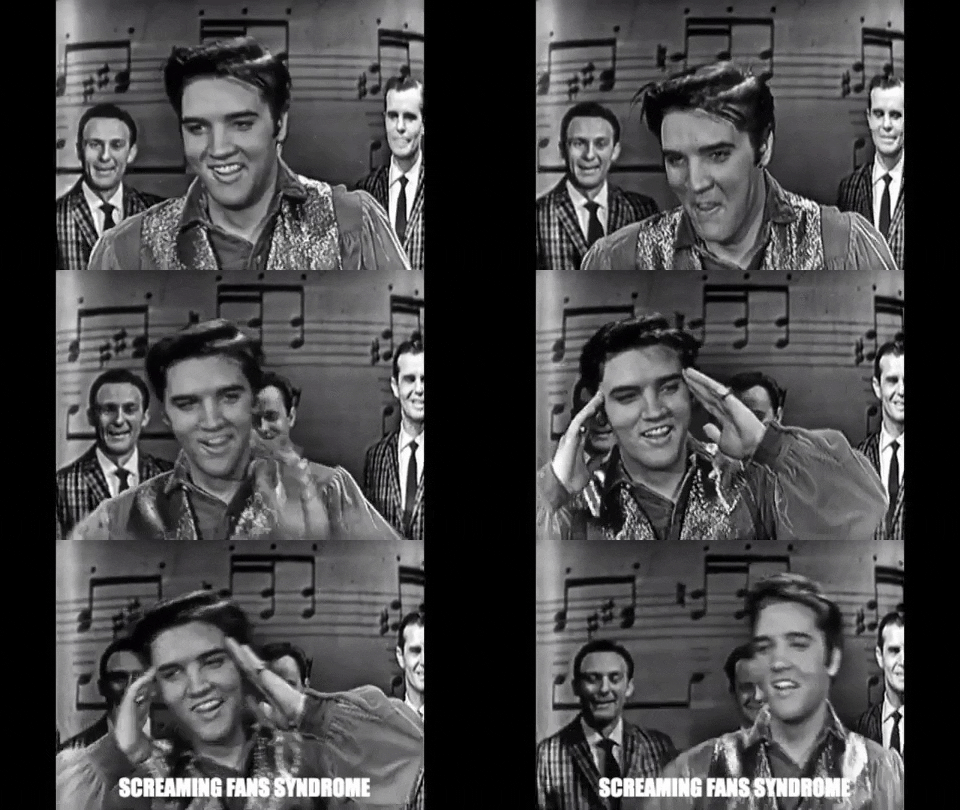
Exhaustive and Exhausting but in a deeply fulfilling way. In the same way it would have felt to have been among the screaming masses at an Elvis concert as he created the rock n' roll scene with a shake of his leg. Or to be Elvis up on the stage as he wrung his soul dry teasing and pleasing his fans.

"It's been a wonderful show, folks. Just remember this. Don't go milking the cow on a rainy day. If there's lightning you may be left holding the bag."

as the Houston Chronicle reported

"Four thousand females just died."


Guralnick has created an exceptional music biography, especially considering he never had the opportunity to actually interview his subject. The level of research and detail is extraordinary. I was almost expecting Guralnick to confess to writing under a pen name and actually being one of Elvis' cousins or friends. He's more than a fly on the wall, he's the whole room. He's Elvis, his family, his friends, and his fans.


The writing is strong and while it does tend a little bit towards tedium, it only serves to shore up reality and dispel myths. Ultimately, brightening Elvis' star even further as we realise quite how phenomenal he was.


As for the man in question. I'm stunned. I really don't think we'll ever see his like again. The level of fame and success is actually unbelievable. As much as I dislike the Svengali like Colonel Parker, his ability to turn Elvis into the most successful commodity in the history of entertainment is nothing short of genius. When I try to think of modern correlatives no one even comes close. People might mention stars like Justin Bieber but Bieber is not an actor and nor will there be thousands of Bieber impersonators running nightly shows in Vegas after he's gone. It's the combination of movie star and rockstar with such a ridiculous omnipresence that makes Elvis unique. 


A quick aside, Sam Phillips is a God. To find that sound and recognise something in it and nurture it into what it became, and to then repeat that process again and again with Johnny Cash, Jerry Lee Lewis, Carl Perkins, Roy Orbison, unbelievable. He also did it on his own dollar and a deep faith in what he was doing. It seems that Phillips had basically spent the first part of his life listening to as much as he possibly could and learning every facet of the business, creating the network. He was essentially the internet before it existed. He pulled that sound out of the ether.


Back to Elvis. Guralnick seeks the truth and despite the immense amount of research he's clearly done, he still seems to retain a sense of awe for quite how well Elvis handled his fame and for his deep natural talent to entertain. For some reason I wasn't raised on any of Elvis' music so my appreciation of him has only come later. This book does a great job of identifying the prevailing paradigm in music and the change Elvis wrought. Guralnick recognises the deep debt to black musicians, the blues, and the spiritual sounds of the south. The unholy mix of that with the Hillbilly sound and that gyrating pelvis created the most unbelievably potent brew. Here's Elvis on his musical debts.

"The colored folks began singing it and playing it just like I'm doin' now, man, for more years than I know. They played it like that in the shanties and in their juke joints, and nobody paid it no mind 'til I goosed it up. I got it from them. Down in Tupelo, Mississippi, I used to hear old Arthur Crudup bang his box the way I do now, and I said if I ever got to the place where I could feel all old Arthur felt, I'd be a music man like nobody ever saw."
-Elvis Presley


and Sam Phillips on part of his appeal.

"He tried not to show it, but he felt so inferior. He reminded me of a black man in that way; his insecurity was markedly like that of a black person."
- Sam Phillips


It's fascinating to see how Elvis handled the fame. I understand it's unfair to compare him to modern day stars, and the pressures are different, especially with the pervasiveness and deep intrusion of social media. However, I can't help but feel Elvis handled being the prototype of megastar better than many since. So young and pure. I know it's coming, the fall, but it's amazing that he just kept hanging out with his mates drinking cokes for so many years as he rapidly turned into the most famous person in America. I did find Guralnick's handling of Elvis' sexuality quite interesting, it seems everyone around Elvis implies that he was completely chaste but then we also hear that he's sleeping with all sorts of women. It's never clear whether he actually just stays up late talking and then goes to sleep or participates in more physical activities. I would have been interested for Guralnick to explore whether Elvis was channelling his repressed sexuality and vice into his performances. That seems most likely to me. That he was a good boy who when freed on stage just let it all pour out of him.

Marion Kiesker, Sun Records co-founder had this to say about Elvis' purity

"My total image of Elvis was as a child. His attitude towards people was the equivalent of tipping your hat as you walk down the street - 'Good evening, ma'am, good evening, sir' - but not showing off. He never said a wrong thing from the very first night he appeared on the Dewey Phillips show - he was like a mirror in a way: whatever you were looking for, you were going to find in him. It was not in him to lie or say anything malicious. He had all the intricacy of the very simple."
- Marion Keisker


Two other things stood out to me.


One is Elvis' relationship with his gift. Countless times we hear him saying he can't forsake the gift or God will take it back from him. Was he truly a lamb of god? Did he really believe in this deal with the big guy? It seems he did.

Natalie Wood on his religiosity

"I hadn't been around anyone who was that religious. He felt he had been given this gift, this talent, by God. He didn't take it for granted. He thought it was something that he had to protect. He had to be nice to people. Otherwise, God would take it all back."
- Natalie Wood


Elvis on his own gift

"The Lord can give and.... the Lord can take away. I might be herding sheep next year."
- Elvis on his Gift


The second is the opinion of many of the muso's around him that he was an idiot savant. He seemed to have a genius for creating music but absolutely no intellectual understanding of the process. Almost every recording session has him and the band just improvising and noodling their way through the session until they strike the motherlode. Sometimes Elvis is actively directing take after take until they find the sound he knows he wants and sometimes they're mucking around and someone goes, this could actually sell. Occasionally in later recording sessions Elvis would sit at the piano and sing gospel songs and hymns with his backing vocals for 8 hours.

Here's Bones Howe on the recording process:

"It was always about the music. He would keep working on a song, and he would listen to it played back, and his criterion was always: did it make him feel good? He didn't care if there were little mistakes, he was interested in anything that would make magic out of the record. The sessions were always fun, there was great energy, he was always doing something that was innovative. It was always about whether you had a feeling for music or not, whether you felt what he felt."
- Bones Howe


And here's Sam Phillips on Elvis' talent:

"I was amazed. Here I am twelve years older than him, I'm thirty-one and he's nineteen, and I've been exposed to all kinds of music and lived through the damn depression, and yet he had the most intuitive ability to hear songs without ever having to classify them, or himself, of anyone I've ever known outside of Jerry Lee Lewis and myself. It seemed like he had a photographic memory for every damn song he ever heard - and he was one of the most introspective human beings that I've ever met. You see, Elvis Presley knew what it was like to be poor, but that damn sure didn't make him prejudiced. He didn't draw any lines. And like [Billboard editor] Paul Ackerman said, you have to be an awful smart person or dumb as hell (and you know he wasn't dumb) to put out that kind of thinking."
- Sam Phillips


Interestingly, the thing that Elvis seems to have in common with Sam Phillips is the ear for "the sound". They both listened to insane amounts of music and they developed a particular taste, and an insatiable desire to bring what they weren't hearing but thought they should be to life. In Elvis' case it was gospel, revival, hillbilly and Blues that he could pluck the feeling from and inject it into his songs. It seems that Elvis' ear for the sound was completely natural, whereas Sam could carve it out of what he heard.

"Yep, some of the music is low-down. But, not like Crosby means. There is low-down people and high-up people, but all of them get the kind of feeling this rock 'n; roll music tells about."
-Elvis Presley


I noticed that many times people said Elvis wasn't a prodigy on guitar, in fact they say he wasn't very good. That stops once he becomes famous and then there's a scene towards the end where he easily picks up Bill's discarded electric bass during a Jailhouse rock recording session and plays Bill's part the whole way through, despite Bill having given up in frustration on it and Elvis never having tried it before. There was similar sentiment around his voice as there was his guitar. Most people seemed to think it wasn't anything special but then countless times you see people hear him live either in the recording studio or at one of the early concerts and they're just transfixed. It electrifies their soul. Elvis also never wanted writing credit for any of the songs, he didn't see it as something that he did. Even where it would be normal for him to get credit because he's essentially taken a few words and turned them into something amazing, he wasn't interested in it. He just seemed so focussed on "the sound".


Overall, a great read that clued me in on what now seems like a gaping hole in my musical education and understanding of American culture. In many ways Elvis is the USA.


"I grabbed his hand, and he grinned and said, 'Cut me loose,' so I cut him loose. It was heavenly."
- Girl from the audience.


"Good-bye, you long black sonofabitch."
- Elvis to his Black Cadillac Limousine when leaving to join the Army
Profile Image for Susan.
3,018 reviews570 followers
April 27, 2012
This enormous biography takes Elvis from his birth in 1935, through his gradual rise to stardom and on to the death of his beloved mother. The author meticulously lists every live concert date, every record and every film made, but that is not all the book is about. As well as explaining how and why Elvis became the huge star he became, it explains who he was. The gentle boy who loved his mother and who never seemed to be anything other than caring (if a little fickle) with his many girlfriends, who was spiritual and clean living - warning his mother against the horrors of drink when she had a beer late at night, who seemed so lonely he ended up with a local entourage to protect and keep him company, was also, undeniably, a very ambitious man. Also a man who seemed to prefer to leave any difficulty to the Colonel and slip out from the requirements of personal responsibility at times - not acknowedging the bitterness of Scotty Moore and Bill Black for example, until they resigned in anger at how they were treated financially. This really is THE Elvis biography and continues with "Careless Love", which I am really looking forward to reading.
13 reviews
January 29, 2009
the Elvis book left me speechless and amazed. Dreaming about hillbilly forevers. Sentimental on a Sun Recording bender that nearly drove the neighbors to nail my windows shut to save them from the pain of the thousandth play of "Its all Alright Momma" at full volume. Have you ever seen "Jesus Camp?" It was kinda like that but with Elvis instead of Jesus and I only cried when Gladiolus died near the end. To say Elvis is iconic from Tokyo to Mobile and cult like for many that hide in Dixie caves is an understatement. A figure so discussed, loved, hated, mocked and glorified is anything but human. But this book makes Elvis a human. A man with a special talent embarked on a special journey. That’s the best compliment i can give a biography, especially when dealing with an epic figure. Elvis is a person to me now and not a poster my mom had when i was growing up. Read it for sure.

Profile Image for Ben.
182 reviews26 followers
July 27, 2015
I was three quarters of the way through this book before I realized that it is the first of two gigantic volumes, and I was enjoying it so much that it made me excited because I wanted a lot more. This volume covers Elvis' youth up until his deployment in Germany with the Army.

I have wanted to read this book since visiting Graceland expecting to make fun of everything and winding up feeling sympathetic and melancholy. His gravesite, where he is buried next to his twin brother Jesse who was stillborn, stuck with me. They said that Elvis always felt like he had to live the lives of two people and you can see that in this book. His workrate when he starts his recording career is stunning. And everything is driven by his ex-carnie manager who calls himself "The Colonel" (he is not a colonel). I couldn't believe he was a real person.

It is fascinating how Elvis grew up in an environment perfectly suited for the type of music he would get famous playing (Memphis was a musical hotbed, his adolescence was spent around a lot of black people, BB King had a local radio show, Sun Records in Memphis was obsessed with black music, and more). And while the debate over whether he knowingly "stole" music from black performers will continue forever, I loved how Elvis loved all kinds of music, even opera. He spoke openly of the black musicians he admired (and there were a lot of them) and even scolded people scandalized by his dancing by saying that black people had been performing like that since before he could remember. He was a musical enthusiast.

The level of celebrity that he dealt with is incredible, even by modern standards. Girls he goes on two dates with are interviewed by the national press about marriage, fans set up camp outside of his house and he signs autographs for them every afternoon, fans set up roadside stands with signs that say "Stop Here Elvis" when they find out the routes he takes (and he does stop), and photographers are there snapping pictures as he cries in his father's arms at his house after his mother passes away. Despite all that, he is self-assured, mature, and honest with the press. One moment that cracked me up is how Elvis talks openly about how ridiculous the contracts are that he signs - he gets songwriting credits for songs he doesn't write because The Colonel is such a hardass.

Now this volume is only Elvis' ascent to greatness, but the author does a great job of noting the cracks in the foundation without harping on them. His extremely close relationship with his mother who "brought the sunshine into the home" foreshadows the trouble he will find once she passes away. The people that cared about him before he was famous start to melt away and even his time in the Army is a series of photo ops. The author's note at the beginning of the book says that he wanted to write it after hearing a story about Elvis as a teenager fidgeting as he waited for his cousin to get off of work. A few years later, he'd be having his clothes torn off (literally) by a riot of fans in Florida. And as the book develops, the people around him are increasingly sponges, and the real tragedy is that he knows it but doesn't know how to stop it.

I would recommend everyone who is passionate about music read this book, but it is a huge commitment. Beck was interviewed on All Songs Considered recently and they chatted about how good it is, and Beck basically said that it should be required reading for people interested in the music industry. I've never been led wrong by listening to Beck, so I'll just echo his sentiments here.

Great book!
Profile Image for Michelle Only Wants to Read.
513 reviews61 followers
August 9, 2022
This book is absolutely amazing. Peter Guralnick is a master of his craft in putting together the complexities of Elvis Presley's early life and career and presenting the information in a compelling, and engaging manner.

The book is based on facts, not opinions. You can find over 50 pages of notes at the end with all the sources of his research. I love this about this book. He does not take a side in the story. Guralnick takes us by the hand and describes in words all the events that lead to the rise of the musical phenomenon that became Elvis back in the 50s. His descriptions are so good that you can feel yourself present in the scene he describes. When you pull the footage or photos of the event he describes, you can see the accuracy in the carefully crafted sentences.

This is the second time I read this book, but I almost feel like it's the first time around all over again. I read this back in 2011, before Goodreads. This book was my introduction to Elvis' life. By now, both this book and Careless Love: The Unmaking of Elvis Presley are considered the absolute and unquestionable biographies of The King of Rock and Roll for a reason. I decided to read it again after watching the new Baz Luhrmann movie.

Gosh! Baby boy was so wholesome and full of life when it all started. The sky was the limit and he was catapulted into stardom in an unprecedented way. That charming young man had no clue he had made a deal with the devil.

To be able to travel back in time and witness it all!


ElvisEdSullivan


Profile Image for Patrick Casebeer.
146 reviews2 followers
February 20, 2020
Meh. I’m not really sure why all the high marks on this one. I really felt it was detailed in all the wrong places, ended in a weird spot, and just lacked an overall ‘interesting’ quality.

I’m sure it’s taste but the stories that sounded interesting to me, got very little write up. Then others seemed to ramble on with just constantly flowing facts and nothing other than it was In Elvis’ world to tie it all together. Maybe that’s all it needed. But I wanted more.
Profile Image for Joe L.
117 reviews10 followers
August 14, 2024
Finally got to reading this one after it had been on my desk for a few years. Id first begun to read this volume in 2007 or so but for whatever reason didnt finish.
Most people believe these are the two definitive works on the life of Elvis Presley. Nearly everyone who was close to Elvis in either a romantic or friendly way has written about their time with “The King”. But if you want just one set of books about his life this is it.
Peter Guralnick interviewed dozens of people, some multiple times. And that’s most anyone who’d had any contact, even musicians who’d only played on one record.
What you find is a picture of an insecure young man who’d grown up in poverty with a mother that nearly worshipped him (the feeling was mutual) and a somewhat remote but loving father that wasn’t ambitious and had trouble holding a job.
A young man that set the world on fire by the age of 22, but was drafted into the army, lost his beloved mother and had it all end by the age of 23.
There’s also another man that nearly looms as large as Elvis in the book named Tom Parker. The honorary title of “Colonel” was bestowed on him by the governor of Louisiana.
A dog catcher and carnival barker turned Elvis manager who set his sights on Elvis and never looked back. The two were so intertwined it seemed when one took a breath the other exhaled.
I’m a casual Elvis fan but loved the book. It reveals the man himself and what made him so special.
5/5 stars.
Profile Image for Nate.
94 reviews21 followers
December 24, 2012
Really good biography. Prior to reading this book, my image of Elvis was (sadly) the picture of him standing next to Richard Nixon in some ridiculous outfit, offering his services I believe as an undercover narcotics agent. He has become something of a cartoon character in modern times. This biography - the first volume at least - goes a long way towards reminding us of who Elvis really was, before the pressure of unprecedented fame became truly insane. There is very little about his hit songs - perhaps because he did not write them - but that actually makes the book stronger, because all the focus is on Elvis the person - and he was fascinating - a mamma's boy, unfailingly polite, guileless, a people pleaser, lover of gospel music, comfort food, and roller skating. As far as that goes, the book actually serves as an excellent window into 1950's America. Yes, the largest phenom the world of entertainment had ever seen was drafted into the Army, drank milk (not alcohol), and unwound by roller skating with his cousins. The times they have a-changed.
Profile Image for NON.
558 reviews182 followers
August 24, 2018
I've never been a fan of Elvis. In Helen Kolawole's words “He wasn't my king. For black people, Elvis, more than any other performer, epitomizes the theft of their music and dance.”

So, I grabbed Mr. Guralnick's book in a (failed) attempt to like the man and the 'artist' but this book was no use for me. When I first picked up this biography I had high expectations because the cover is beautiful and there are some great reviews about it. I saw a potential but it did not meet any of expectations at all. Actually, it was a let down. I miserably tried to finish it hoping maybe it'd get better somehow but nope! The endless detailing for every tiny thing became just too overwhelmingly boring. There was no connection between the author and his subject, Elvis Presley. It felt as if reading from an encyclopedia It's either Presley's early life was too boring or the writer's writing is just terrible. All in all, it is bland, terrible and exhausting.
1,063 reviews
May 31, 2017
Can I rate this book less than one star? With a negative number?

I actually started this book at the end of Dec. 2012. I've read 97 books in the interim. After a certain point, stubbornness alone made me finish. I literally had to force myself to pick it up and read another chapter.

Detailed much? Enough to take the life out of Elvis. Example sentence: "He showed up at the draft board in the M&M Building at 198 South Main at 6:35 the next morning and parked just south of the Malco Theatre." One sentence of so, so many that contains too much information - such as the address of the building and exactly where Elvis parked. Really?

Oh my gosh ... dry, dry, dry ... and this book is only Part One. Nothing can make me pick up the next one (which undoubtedly adds "depressing" into the mix).
Profile Image for Penny -Thecatladybooknook.
739 reviews29 followers
November 29, 2022
For die-hard Elvis fans, this is an incredible book! I like Elvis, his music, and his place in music history. I loved seeing some of the music industry's big stars getting their start around the same time Elvis did and when their world's collided it was very exciting to me. Having grown up when Elvis was doing his comeback tour and watching some of that on TV, this book was great for filling in a lot of blanks I had....like how did Graceland get its name? How was Elvis' family situation? Where did he really meet Colonel Parker?

While I loved all of that, there was a bit TOO much detail here for me. Some was necessary to background information so you could see how his career evolved or how his first record label came about, but I wasn't here for the nitty gritty details of Sam Phillips and Sun Records. But in the end, I think it was necessary to know how Elvis was able to make his first recording before he started on his path to stardom. Seeing some details that you never get in movies shows how certain moves were made in his career to get from one record label to another; how his contracts came about; how different managers helped (or took advantage) because all Elvis really wanted to do was to perform and make music. Music was his heart.

I loved getting a peek behind his tours, his entourage and how he was still very lonely even having close friends around. I also learned a few things I didn't know....like that he was quite a player with the ladies. :O One comment stuck out to me from one of his bandmates...the girls were screaming so loudly that half the time they couldn't tell if they were playing on key or not! LOL

I plan to read Part 2 in January probably which I know is the saddest part....unless I want to believe that he is off on some island somewhere with JFK (as all the rumors used to say in the 70s/80s. LOL)
Profile Image for Teri.
763 reviews95 followers
March 28, 2018
If you are a fan of Elvis, this is your book. This is the first of a two-part series on the King of Rock and Roll. Guralnick goes into painstaking detail on Elvis' life from the time he was a young boy getting his first guitar through the death of his beloved mother and shipping off to Germany as PFC Elvis Presley. It is clear that Elvis was his own person. He was at times naive and humble while at other times he was rambunctious and rebellious. Everything he did, he did for his family. His love for his parents, especially his mother was both sweet and heartbreaking. He was inconsolable when she passed away.

This book truly is a deep dive into Presley's life. Where I am a fan of his (I saw him in concert just a couple months before he died), I don't know that I needed details to the level that Guralnick noted. For superfans, this is definitely a book worth reading. It was entertaining and interesting and I will read the second book in the series. This book does not cover his life with Pricilla or eventual decline in health.

The Kindle version that I read included audio clips of some of the interviews that Guralnick conducted with some key people in Elvis' life. It is worth the purchase if you are a Kindle user.
Profile Image for Will Lashley.
74 reviews5 followers
November 7, 2013
Peter Guralnick's books on American R&B, Soul, Country, Blues and Rock and Roll are all heartfelt, deeply researched, and written nearly entirely in the third person, and that last bit separates him from the self aggrandizing that mars the writing of so many other music writers covering the same ground. If he has a fault it is his reverence for his subjects. Accordingly, this first volume of his two volume biography of Elvis Presley will set you aglow with the excitement, innocence and exuberance of the Hillbilly Cat's early days, ending with his induction into the Army in 1958. Guralnick is the anti-Albert Goldman - no armchair psychoanalysis of the budding sexual preferences or the Oedipal domestic arrangements of his subject will be found, but instead a sympathetic treatment that pulls you into the unlikely story of Elvis' success. Presley nursed a gift that was bigger than he was. In the second volume "Careless Love: The Unmaking of Elvis Presley", the abuse of that gift destroys Presley, but in "Last Train To Memphis" there is the delicacy of watching a butterfly emerging from a chrysalis mixed with the rude exhilaration of a musical revolution.
Profile Image for Yulia Shagelman.
115 reviews23 followers
January 8, 2023
Книгу захотелось прочитать после фильма База Лурмана, который во мне пробудил интерес к Элвису, о ком я, как выяснилось, довольно мало знала. Также было интересно, сколько в фильме правды, а сколько вымысла - соотношение примерно 7/93, но это его совсем не портит, а даже делает лучше )).
Книга Гуральника считается ultimate биографией Элвиса, хотя бы по объему проделанной работы. И правда, эти 1000 страниц - только первый том, от рождения до отправки на армейскую службу в Германию, хроника взлета паренька из Тупело, штат Миссисипи, в стратосферу, которая обрывается на совершенно душераздирающей ноте. Иногда автор тонет в подробностях, деловых переговорах, контрактах, процентах роялтис и т.п. (потому 4, а не 5, через некоторые страницы трудновато продраться). Но в других местах он описывает концерт, или сессию записи песни, или вечер у кого-то в гостях, когда все берут инструменты и начинают петь спиричуэлсы, или долгую поездку на поезде с проигрывателем, пластинками и комиксами, и за звездой проступает человек, очень юный, растерянный от всего, что на него обрушилось, смотрящий в будущее с надеждой и страхом, которого автор явно любит. И тогда эти 1000 страниц того стоят.
Profile Image for Kim.
228 reviews3 followers
March 13, 2023
This may be the definitive bio of the King of Rock ‘n Roll. The author created a great narrative. There’s so much information that it was divided into two volumes. This first volume covers his dirt poor roots in Tupelo, Elvis’s first guitar and love of country and gospel, and the family’s move to Memphis when Elvis was 12 in hopes that Vernon could find more work. It was there in Memphis that Elvis combined his country roots with the fashion and flair of Beale Street. After cutting a few demos, Elvis caught a few breaks, begin playing county fairs, exploded in popularity, and frequented national talk shows while becoming a superstar singer and a very popular actor. Not long after, Elvis was drafted and life took on a sullen turn. Would Elvis’s popularity suffer while he was on military duty?
Profile Image for Alberto.
675 reviews55 followers
May 22, 2019
Creo que está considerada la biografía más exhaustiva de Elvis Presley. Cuenta absolutamente todos los detalles de sus comienzos en la música. Sus primeras grabaciones en Sun Records, el contrato con el coronel Parker, apariciones televisivas, actuaciones, primeras películas... El volumen acaba con su incorporación a filas y la muerte de su madre.
Profile Image for Allison.
97 reviews3 followers
January 8, 2023
Craziest white boy to ever do it (also CANNOT believe I finished this on his birthday HBD king)
Profile Image for James.
504 reviews19 followers
September 17, 2021
In his 1954 essay, "The Loss of the Creature," Walker Percy contrasts the experience of Garcia Lopez de Cardenas, commander of the first group of Europeans to set eyes on the Grand Canyon, with that of a 20th-century tourist. "It can be imagined:," he writes, "One crosses miles of desert, breaks through the mesquite, and there it is at one's feet. Later the government set the place aside as a national park, hoping to pass along to millions the experience of Cardenas. Does not one see the same sight from the Bright Angel Lodge that Cardenas saw?" As, I'm sure, you have guessed, Percy's answer is- decidedly - "no." "It is almost impossible [to gaze directly at the Grand Canyon]," he proposes, "because the Grand Canyon, the thing as it is, has been appropriated by the symbolic complex which has already been formed in the sightseer's mind." You can't see it because you're too busy trying to confirm all the received ideas you already have about it.

I was thinking a lot about this essay while I read Last Train to Memphis. If I may lean a little too hard on Percy's idea, one might think of Elvis as the Grand Canyon of popular culture, if the Grand Canyon weren't already the Grand Canyon of popular culture, of course. I was born in 1964, so I came to awareness, if you will, during the years that saw Elvis's final, operatic act. I'm pretty sure that I learned about Elvis Presley's huge place in 20th-century American culture by way of broad caricatures in cartoons and cheesy advertisements for compilation albums of his sentimental, kitschy, late-stage recordings. I can't say that I had any class-consciousness as a pre-adolescent, but I would've seen the cartoons and the advertisements broadcast on one of those locally-based, non-network tv stations that filled up the programming day with vintage, syndicated sitcoms, an afternoon B-movie show hosted by a former weatherman who ran contests and took viewer phone calls at the station break, and their own low-budget, amateurish programming. I knew, on some level, that my parents considered Channel 11 a little trashy and that Elvis Presley's music must appeal to the sort of low people who consume Ovaltine and Jiffy Pop (ordinary prole treats with an exotic appeal because I could only enjoy them at another kid's house). Vulgar people, as Southern snobs used to say. When I became a music fan myself, I couldn't hear Elvis Presley's music, either, coming as it did through my ideas about it as embarrassing kitsch. I can remember reading the liner notes to a Deep Purple record, Who Do We Think We Are?, in which guitarist Ritchie Blackmore rhapsodizes about being a teenage Elvis fan, and wondering how someone so cool -in my fourteen-year-old estimation - could like someone so awful. I was well into adulthood before I realized how thrilling and revolutionary Elvis Presley's music had been.

Guralnick can be a bit of a pedestrian stylist, but his research is comprehensive, he writes about the music with knowledge and sensitivity, and there is a novelistic liveliness to the narrative. The signal achievement of Last Train to Memphis, though, is the way that Guralnik pierces through the Elvis symbolic complex to present the thing as it is - at the heart of the Hunka Hunka Burnin' Love is a shy, grandiose, clothing-and-music-obsessed, "greasy" mama's boy whom we come to care about very much. With the possible exception of Michael Jackson, Elvis Presley is the ultimate example of the price that celebrity exacts. In the 90s, I saw a tv special about Elvis in which Bono read his poem, "Elvis: American David" , which is hit and miss but contains the stunning line, "Elvis ate America before America ate him." I gotta say that I'm really dreading Careless Love and the terrible thing that's gonna happen to this sweet boy.
Profile Image for Melissa.
485 reviews101 followers
August 28, 2015
Last Train to Memphis: The Rise of Elvis Presley is beautifully written portrait of Presley's early years -- his impoverished childhood in Tupelo, Mississippi, the move to Memphis in his teenage years, and the amazingly rich and complex soup of musical influences that city offered to a shy, sensitive boy with a huge love of singing and music of all kinds.

The Elvis you meet in this book is not the troubled, larger-than life, jumpsuit-wearing star of the Vegas years that may first spring to mind when you think of him. Instead author Peter Guralnick introduces us to a churchgoing, family-loving, polite, humble, kindhearted young man who didn't quite fit in anywhere until he knocked (timidly but tenaciously...and repeatedly) on the door of Sun Records in Memphis, eager to make music and have Sun founder Sam Phillips hear him. Once the ball got rolling at Sun, things happened fast. Guralnick paints a vivid picture of lengthy but creatively exhilarating recording sessions, nonstop road trips to play gigs in small towns throughout the South, and the mounting hysteria surrounding this young man (only 21 when he hit it big on the national scene, aided by the smarmy but undeniably effective huckster "Colonel" Tom Parker) as his fame and wealth exploded. Soon he was off to Hollywood, where he dreamed of becoming a dramatic actor like his heroes James Dean and Marlon Brando.

Guralnick must have read everything ever written about Elvis, listened to every interview or press conference Elvis ever gave, listened to every recording or snippet of a recording he ever made, and spoken with every possible person still living who knew Elvis Presley even a little bit. The book is that authoritative and in depth on both the personal and the musical Elvis. It's a brilliant biography, presenting a wealth of research in a totally readable way. The book is a page turner, except for the moments when you want to put it down to Google Dewey Phillips (famed Memphis DJ who first played Elvis's tunes) or The Statesmen (one of the gospel quartets that greatly influenced Elvis's sound), or look at the famous, breathtakingly intimate photos of Elvis on the cusp of massive fame, taken by Alfred Wertheimer in 1956.

The book ends in 1958, the year Elvis's music and movie career was put on hold by his induction into the Army. It's also the year his beloved mother Gladys died. The unselfish love and devotion she had always shown him were suddenly gone, at the very time when the rest of his life was going dizzyingly, ridiculously nuts, and it tore him up. Without her as his moral compass, he was never the same again.

Guralnick continues Presley's life story in the second volume of his biography, Careless Love: The Unmaking of Elvis Presley. That book delves into the darker side of his life -- the bad choices, the drugs, the women, the entourage of sycophants with their hands out, the ego run amok. Last Train to Memphis focuses on Elvis's rise, however, and it's a remarkable rags-to-riches story about an endearing and talented young man you can't help but empathize with and root for. It made me look at and appreciate Elvis in a whole new way, and wish his story could have had a happier ending.
Profile Image for Brendan Lyons.
16 reviews1 follower
January 9, 2015
I was an Irish kid in Germany in 1958 (my Dad worked in the AFEX system as an accountant) when Elvis came over as an army draftee. A family friend got his autograph for me which I lost soon after (damn & double-damn!)and this is the point where this book - the first of a two-part biography - closes. It takes us from Elvis' birth in Tupelo to his family's move to Memphis, his geeky high school days, the $12 guitar his father bought for him, and his burning desire to cut a record. This brought him to Sam Phillips and Sun Records. This early recording took off thanks to radio play throughout the South and a series of live gigs followed getting ever bigger and bigger. Soon things became so big they nearly got out of control. From some peculiar mixture of gospel, hillbilly, and Negro blues Elvis had hit on a new sound that caught the imagination of teenage America. By the age of 21 (1956) he was pulling in huge audiences and the music moguls were taking an interest. The predatory ex-Carnie barker "Colonel" Tom Parker moved in to guide this boy along and in his manipulatory and conniving ways made Elvis a national phenomenon.

What makes this story so fascinating is the way it is told. The author, an early fan of the music, spent 11 years tracking down all the surviving friends and associates of Elvis and tells the story as if he were looking through a keyhole, recording conversations and first impressions and opinions from such a wide number of people that you begin to feel you are there yourself. The way this book was put together is extremely impressive: by no means is it your "standard" biography. Whether you like the music or not (I did even then, I still do!) you cannot help but get caught up in the story. After such a meteoric rise you just know that a fall is bound to come: hubris, as we know from the wise old Greeks, is followed by nemesis.

A second volume of the biography entitled "Careless Love" charts the course of Elvis' career from the time he was released from the army to his early death at the age of 42. That will require another review.
Profile Image for Sarah.
107 reviews1 follower
August 29, 2008
Long live the King! Before you dismiss this with, "I don't like Elvis...," it doesn't matter. It is a really cool look at 50s culture in the U.S., and the development of the first true music mega-star. This book will also appeal to people interested in Southern culture. Guralnick does a great job with describing the alignment of hemispheres that allowed Elvis to became the huge sensation that he was. I was particularly facinated in the details of Elvis' first long-term relationships; both women were interviewed extensively. My only complaint was the length of the book (576 pages); toward the end, I was just looking forward to finishing. I'm taking a breather before reading the sequel about the decline of The King.
Displaying 1 - 30 of 675 reviews

Can't find what you're looking for?

Get help and learn more about the design.