This volume, comprising Part I of the authors classic work Revolutionary France 1770-1880, offers a vivid narrative and radical reinterpretation of the years surrounding the momentous events of 1789 and their aftermath. During this period there were not one, but two by intent the first was egalitarian, the second- Bonapartes authoritarian. The tension between the two characterized the period and was to shape the Republic that eventually emerged from the ruins of the ancien regime.
François Furet (27 March 1927, Paris – 12 July 1997, Figeac) was a French historian, and president of the Saint-Simon Foundation, well known for his books on the French Revolution.
He was elected to the Académie française in March 1997, just three months before he died in July.
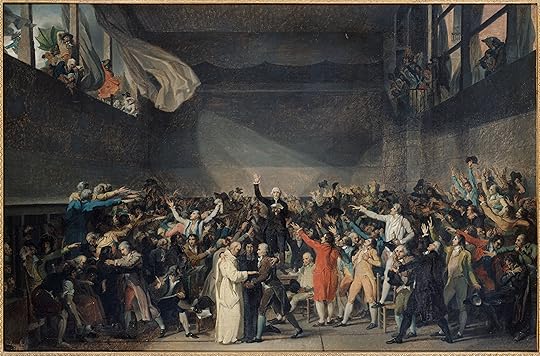
The Tennis Court Oath (June 20, 1789) - Jacques Louis David, 1791
This outstanding collection of works by historian François Furet maps out the formation of the revolutionary idea, its implementation in France throughout the many regimes extant in between 1789 and 1870, and their influence nowadays (around 1997 that is, but in my opinion the observations are still as relevant as they were back then).
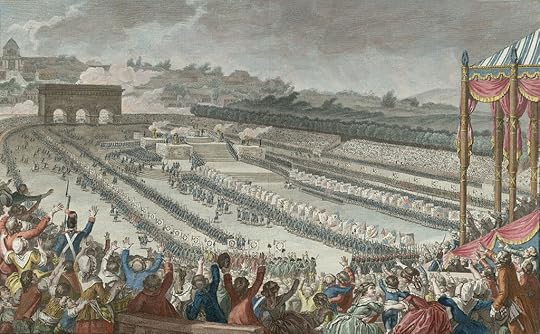
Festival of the Federation (July 14, 1790) - Isidore Stanislas Helman
Major points outlined by Furet:
1) The French Revolution is born out of the anachronic nature of the privileges enjoyed by nobles, without real compensation and actual political responsibility. It is not only an end and a beginning, it is the continuation of many traits inherited from the absolute monarchy.
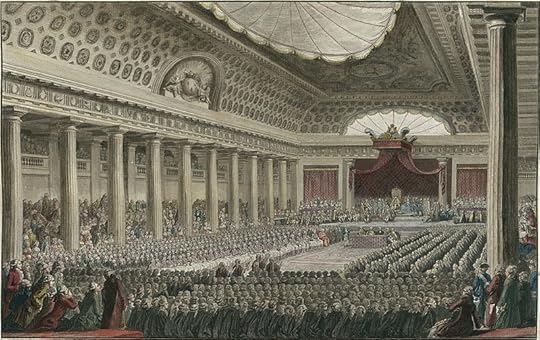
The opening of the Estates General May 5, 1789 in the Salle des Menus Plaisirs in Versailles.
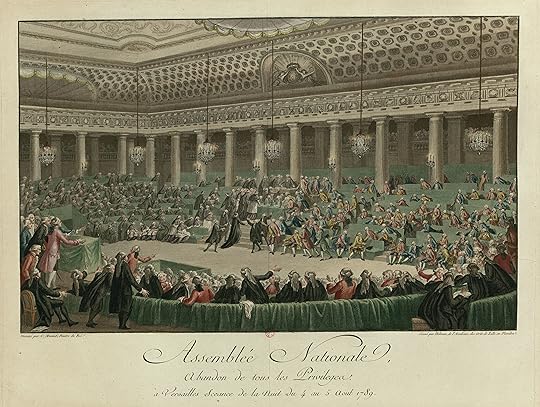
The abolition of feudal privileges, August 4-5, 1789 - Charles Monnet
Some constants from 1789 onwards:
Administrative centralization, raison d'État, legacy of the Old Regime strengthened by the Revolution and the Consulate (1799-1804) in particular. The parallel rise of equality and the individual.
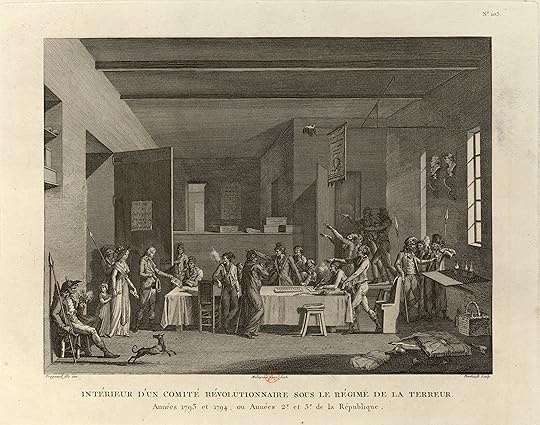
2) The Terror (1793–1794), far from being a mere answer to extraordinary circumstances, obeys to a radical political mindset, Jacobinism.
A Committee of Revolutionary Supervision under the Terror, 1793-1794 Pierre-Gabriel Berthault, Claude-Nicolas Malapeau after Alexandre-Évariste Fragonard, 1802.
3) From the Terror to the Empire (at the bare minimum), there is no room left for the voicing of dissent, and revolutionary legitimy only exists in war. It is only gradually that multilateralism, party politics and republicanism appear, after many short-lived regimes:
4) The formation of Socialist theories and historical teleology, issued from the timelessness and universality of the Revolution in general and Jacobinism in particular, at first mixed with a fair deal of Catholicism.
5) Democracy and Capitalism are products of the same dynamics and rest on the same foundations.
6) Different categories of hate for the bourgeois... by the bourgeois. By definition, bourgeoisie is a highly plastic population, multiple and contradictory, seen at the same time as the caricature of the free man celebrated by the Revolution and, indeed the embodiment of the values of modern democraties relying on individual freedom and civic equality.
The progressive transition of political groups from revolutionary to electoral status: institutionalization of anti-democratic parties relying on a democractic electoral basis (Fascism, Socialism, Communism);
Some of the authors discussed thoroughly: Augustin Cochin, Alexis de Tocqueville, Guizot, Michelet; Mirabeau, Rousseau, Chateaubriand, Edgar Quinet.
Contents of La Révolution Française:
Interpreting the French Revolution The Revolution from Turgot to Jules Ferry, 1770-1880 Portraits: Mirabeau, Rousseau, Chateaubriand, Quinet and several articles dealing with the latest offspring of the revolutionary idea.
Ce livre, à mi-chemin entre le pamphlet et le livre d'histoire, expose une interprétation la révolution Française de 89 à l'Empire. Les auteurs passent donc bien plus de temps à crier contre les historiens qui les ont précédés, et à rabâcher sans arrêt ce qu'il faut penser de la Révolution, plutôt qu'à exposer simplement les faits, lesquels sont réduits à des allusions extrêmement schématiques. Seule la partie concernant le Directoire sort un peu du lot. Il est clair que les auteurs ont en tête un objectif politique qu'il faut replacer dans le contexte de la guerre froide.
Je commence à me lasser de tous ces livres d'histoire extrêmement polémiques, truffés d'invectives et de formules choc, mais avec très peu de matière pour étayer leurs thèses, et qui font finalement perdre plus de temps qu'ils n'instruisent. L'appareil critique est nul, et il faut se contenter d'à peine quelques rares tableaux. Je préfère très largement l'ouvrage plus ancien de Michelet, lequel était presque contemporain des événements, et au moins prend le temps de montrer les choses dans le détail. Par deux fois je me suis amusé à lire des livres sur des chapitres qui étaient expédiés ici de manière tout à fait légères, comme la fuite à Varennes ou le siège de Lyon, et chaque fois j'ai constaté la faiblesse de cet ouvrage. Décevant.
Furet is known as the Chuck Norris of French Revolution historiography. He could punch you through the torso and out the other side before you could say "Thermidor!" If you neglect to read at least a significant portion of his contributions to the field, you can't be a historian. If you "skim" Furet, you get hung up by barbs through your nipples. I can't stress enough how important Furet is.
Questo saggio di Furet e Richet (primo tomo) resta uno dei testi più lucidi e influenti sulla Rivoluzione francese.
Non è solo una ricostruzione degli eventi dal 1789 al Terrore: è un’indagine sulle idee che hanno cambiato per sempre il modo di pensare la politica, la libertà e la democrazia moderna.
Ho apprezzato molto l'analisi economica del fenomeno, spesso messo in secondo piano quando si tratta della rivoluzione.
L'analisi dei protagonisti come Danton, Robespierre, Marat e Saint-Just (solo per citarne alcuni) è, a parer mio equilibrata rispetto ad altre interpretazioni del fenomeno (vedi il film storico "La rivoluzione francese" di Robert Enrico e Richard T. Heffron) che oggettivamente tendono a distorcere le figure dei Montagnardi.
Furet is a bit of a jerk -- it even comes through in print! -- and he assumes too much of the reader at times, such that the book often reads like an inside joke that only the author is in on; but this is a solid, deep read. Headache-inducing for those with bad lighting or a minimal interest in the French Revolution.
François Furet’s book is more an interpretation of the events than a meticulous expose of what happened during the Revolution. By this I do not mean that he does not have a command on the minutiae of the events (he certainly does) but that he assumes the reader has a quite detailed level of knowledge and has enough information to question with the author both the historiography of 19th century historians and subsequent Marxist historians. His case is very compelling: Furet’s view is that the Revolution can’t be reduced to being the simple result of a class struggle. It is caused by a conjunction of factors. These factors include the radicalisation caused by the attitude of foreign powers, the King and the nobles who emigrate abroad ; the lack of a clear political project going beyond the abolition of privileges ; the deep seated rejection of the differences in social status inherited from the Ancien Regime and the resentment it generates, which in turn drives a more and more radical drift towards the Terreur. The language, depth and clarity of the book made it a fascinating read.
During the French Revolution, the government created a new calendar, which dated years from the beginning of its rule. It renamed the days and the months, and even instituted a new clock. This is because the partisans of the Revolution wished to create the impression of a radical rupture with the past. Through an close analysis of the Revolution's history, especially its intellectual foundations, Furet convincingly demonstrates that this impression of radical novelty was an illusion. According to Furet, pre-revolutionary France was essentially "a republic in the guise of an absolute monarchy," since power was in practice distributed among many agents. The makers of the Revolution retained, and even magnified, the idea of centralized, absolute power, but attempted to transfer this to "the people," conceived in the abstract. But the citizens are not a monolithic body, but, rather, a collection of groups and individuals. The only way in which they could hold, or appear to hold, such power was as embodied in a single person. For a while Robespierre became, in effect, the monarch of France, and soon after that position was taken over by Napoleon, who became far more powerful than the beheaded king had ever been. The major structural change was only that the monarchy was integrated into a predominantly bourgeois, rather than a primarily feudal, social order. The old formula was reversed, and France became "an absolute monarch in the guise of a republic." The changes in the calendar were only used for a very short time, but we still often date the "modern era" from the French Revolution. But if, as Furet maintains, there was no lack of continuity with the preceding period, modernity itself may be, as Bruno LaTour has argued, an illusion.
Definitely not a great book if you’re not already familiar with the French Revolution. This book doesn’t really tell the history of the revolution as it does interpret the events of the revolution and weave a narrative together that contradicts the Marxists.
It's a French book, and as all French non-ficition books I've read, the book is badly bloated . Furet spends as much time on his own general musings as on descriptions of historical events. The first facts and names are mentioned on the page 32. I almost gave up by the time Furet started to write about the Revolution itself, instead of his own thoughts about it.
Also, Furet apparently writes for French readers, and, as it sometimes seems, not for French general readers but for French history students - he frequently mentions some places, names and events without describing them at all. Most of these names and events are not familiar for foreginers, and some of them, I suppose, are not familiar even to the majority of the French. To make sense of it I had to consult Wikipedia every several pages or so.
But, with the little help from Wikipedia, the book gives a good picture of what, why and how happened in France between 1770 and 1814. It's probably the best French book about the Revolution, because other well-known French books on the topic I've tried are written by Marxists and even less readable.
Probably my idea that if I want to understand the French Revolution I need to read a French author have been wrong from the very beginning. The next book I try will be American.
Quando ho finito il libro ho tirato un sospiro di sollievo.
Forse non appartengo al gruppo di lettori a cui si vuole rivolgere questo volume, ma per una persona con un'infarinatura generale dei fatti della Rivoluzione Francese, alcuni passaggi sono praticamente incomprensibili, soprattutto quando l'autore sciorina elenchi infiniti di personaggi a quanto pare importanti, ma di cui non è data alcuna spiegazione. Altre volte vengono utilizzati termini specifici dando per scontato che il lettore sappia il significato. Un esempio: l'autore cita casualmente i "dragoni", senza che ci sia una nota o un commento che spieghi che si tratta di uno specifico soldato francese.
I passaggi da un paragrafo all'altro, o anche all'interno di un paragrafo stesso, sono sconclusionati e praticamente dei voli pindarici; il lettore medio si può trovare in difficoltà a seguire i passaggi logici dell'autore.
In conclusione, il libro può essere un buon approfondimento se si ha già una solida base storica del periodo trattato, ma non lo consiglierei come primo approccio alla Rivoluzione Francese.
Prime 50 pagine ottime poi il saggio inizia a diventare moralistico e i due autori sembrano voler decantare i grandi meriti di alcuni e demolire le azioni di altri dando giudizi morali che fanno tanto guerra fredda (e in effetti il saggio è degli anni '50 e questa cosa si percepisce tutta). Questa roba moralistica va avanti fino alla fine e a ciò si aggiunge una sintesi della Rivoluzione francese in cui manca l'interpretazione storiografica per una sottomissione alla storia evenemenziale e del racconto che francamente non mi sembra nulla di eccezionale. Altra scelta un po' discutibile è il registro verbale che passa continuamente dal passato remoto/imperfetto (combinazione classica dei saggi di storia) al presente e a lungo andare questa cosa stona un po'. Un po' deluso.
1 star for the Arabic edition لا أعرف أن كان هذا كتابا متقدما وموجها لمن سبق له ودرس الثورة الفرنسية وعلي اطلاع كامل بشخصياتها.. ام ان كانت النسخة العربية التي قراتها تعاني من سوء الترجمة وهو الظن الأرجح وعدم فهم المترجم للنص او للأحداث التي وجب سردها فكل شيء مبهم الاحداث والشخصيات وأعتقد أن هناك كثير من الخلط حدث بينها..كانت تمنياتي بوجود كتاب يشرح الاحداث بشكل متسلسل وواضح لكن خاب ظني للاسف وبكل تأكيد لن اكمل للجزء الثاني.
Un livre très détaillé. Il a des idées intéressantes. Il contient trop de noms - de longues listes de personnes impliquées dans divers événements - que j'ai trouvé impossible de me souvenir et donc inutiles à moins que ce livre ne soit le début d'une étude encore plus détaillée.
A very detailed book. It has some interesting insights. It has too many names - long lists of who was involved in various events - which I found impossible to remember and therefore of no use unless this book was the start of an even more detailed study. The French was relatively easy to follow for this anglophone.
Furet represents a grand synthesis. There is dash of Tocqueville in his examination of a Revolution both caught in the old patterns and the new. There is Marxism in his examination of class and a view of the Revolution as having class like phases. There is even Taine and Burke in his view that the Revolution was practically doomed to violence. Most of all, there is Macauley and Michelet, in an interpretation that the Revolution was ultimately for the good of mankind.
Un livre très précis sur la révolution et sur sa fin. Le pouvoir aux mains de la bourgeoisie est revenu sur des propositions démocratiques. La révoolution restait à faire mais avec Bonaparte, retour à l'ordre.