

What do you think?

Sharpe #22
Sharpe's Waterloo
Richard Sharpe and the Waterloo Campaign, 15 June to 18 June 1815. It is 1815. Sharpe is serving on the personal staff of the inexperienced and incompetent Young Frog, William, Prince of Orange, who has been given command of a large proportion of the Allied force. More concerned with cutting a dash at a grand society ball in Brussels, the Young Frog refuses to listen to Sharpe's scouting reports of an enormous army marching towards them with the lately returned Napoleon at its head. When the Battle of Waterloo commences, Sharpe has to stand by and watch military folly on a grand scale. But at the height of the conflict, just as victory seems impossible, he makes a momentous decision. With his usual skill, courage and determination he takes command and the most hard-fought and bloody battle of his career becomes Sharpe's own magnificent triumph.
451 pages, Paperback
First published January 1, 1990
About the author
Bernard Cornwell
535 books19.9k followersCornwell was born in London in 1944. His father was a Canadian airman, and his mother, who was English, a member of the Women's Auxiliary Air Force. He was adopted and brought up in Essex by the Wiggins family, who were members of the Peculiar People, a strict Protestant sect who banned frivolity of all kinds and even medicine. After he left them, he changed his name to his birth mother's maiden name, Cornwell.
Cornwell was sent away to Monkton Combe School, attended the University of London, and after graduating, worked as a teacher. He attempted to enlist in the British armed services at least three times but was rejected on the grounds of myopia.
He then joined BBC's Nationwide and was promoted to become head of current affairs at BBC Northern Ireland. He then joined Thames Television as editor of Thames News. He relocated to the United States in 1980 after marrying an American. Unable to get a green card, he started writing novels, as this did not require a work permit.
As a child, Cornwell loved the novels of C.S. Forester, chronicling the adventures of fictional British naval officer Horatio Hornblower during the Napoleonic Wars, and was surprised to find there were no such novels following Lord Wellington's campaign on land. Motivated by the need to support himself in the U.S. through writing, Cornwell decided to write such a series. He named his chief protagonist Richard Sharpe, a rifleman involved in most major battles of the Peninsular War.
Cornwell wanted to start the series with the Siege of Badajoz but decided instead to start with a couple of "warm-up" novels. These were Sharpe's Eagle and Sharpe's Gold, both published in 1981. Sharpe's Eagle was picked up by a publisher, and Cornwell got a three-book deal. He went on to tell the story of Badajoz in his third Sharpe novel, Sharpe's Company, published in 1982.
Cornwell and wife Judy co-wrote a series of novels, published under the pseudonym "Susannah Kells". These were A Crowning Mercy, published in 1983, Fallen Angels in 1984, and Coat of Arms (aka The Aristocrats) in 1986. (Cornwell's strict Protestant upbringing informed the background of A Crowning Mercy, which took place during the English Civil War.) In 1987, he also published Redcoat, an American Revolutionary War novel set in Philadelphia during its 1777 occupation by the British.
After publishing eight books in his ongoing Sharpe series, Cornwell was approached by a production company interested in adapting them for television. The producers asked him to write a prequel to give them a starting point to the series. They also requested that the story feature a large role for Spanish characters to secure co-funding from Spain. The result was Sharpe’s Rifles, published in 1987, and a series of Sharpe television films staring Sean Bean.
A series of contemporary thrillers with sailing as a background and common themes followed: Wildtrack published in 1988, Sea Lord (aka Killer's Wake) in 1989, Crackdown in 1990, Stormchild in 1991, and Scoundrel, a political thriller, in 1992.
In June 2006, Cornwell was made an Officer of the Order of the British Empire in the Queen's 80th Birthday Honours List.
Cornwell's latest work, Azincourt, was released in the UK in October 2008. The protagonist is an archer who participates in the Battle of Agincourt, another devastating defeat suffered by the French in the Hundred Years War. However, Cornwell has stated that it will not be about Thomas of Hookton from The Grail Quest or any of his relatives.
Cornwell was sent away to Monkton Combe School, attended the University of London, and after graduating, worked as a teacher. He attempted to enlist in the British armed services at least three times but was rejected on the grounds of myopia.
He then joined BBC's Nationwide and was promoted to become head of current affairs at BBC Northern Ireland. He then joined Thames Television as editor of Thames News. He relocated to the United States in 1980 after marrying an American. Unable to get a green card, he started writing novels, as this did not require a work permit.
As a child, Cornwell loved the novels of C.S. Forester, chronicling the adventures of fictional British naval officer Horatio Hornblower during the Napoleonic Wars, and was surprised to find there were no such novels following Lord Wellington's campaign on land. Motivated by the need to support himself in the U.S. through writing, Cornwell decided to write such a series. He named his chief protagonist Richard Sharpe, a rifleman involved in most major battles of the Peninsular War.
Cornwell wanted to start the series with the Siege of Badajoz but decided instead to start with a couple of "warm-up" novels. These were Sharpe's Eagle and Sharpe's Gold, both published in 1981. Sharpe's Eagle was picked up by a publisher, and Cornwell got a three-book deal. He went on to tell the story of Badajoz in his third Sharpe novel, Sharpe's Company, published in 1982.
Cornwell and wife Judy co-wrote a series of novels, published under the pseudonym "Susannah Kells". These were A Crowning Mercy, published in 1983, Fallen Angels in 1984, and Coat of Arms (aka The Aristocrats) in 1986. (Cornwell's strict Protestant upbringing informed the background of A Crowning Mercy, which took place during the English Civil War.) In 1987, he also published Redcoat, an American Revolutionary War novel set in Philadelphia during its 1777 occupation by the British.
After publishing eight books in his ongoing Sharpe series, Cornwell was approached by a production company interested in adapting them for television. The producers asked him to write a prequel to give them a starting point to the series. They also requested that the story feature a large role for Spanish characters to secure co-funding from Spain. The result was Sharpe’s Rifles, published in 1987, and a series of Sharpe television films staring Sean Bean.
A series of contemporary thrillers with sailing as a background and common themes followed: Wildtrack published in 1988, Sea Lord (aka Killer's Wake) in 1989, Crackdown in 1990, Stormchild in 1991, and Scoundrel, a political thriller, in 1992.
In June 2006, Cornwell was made an Officer of the Order of the British Empire in the Queen's 80th Birthday Honours List.
Cornwell's latest work, Azincourt, was released in the UK in October 2008. The protagonist is an archer who participates in the Battle of Agincourt, another devastating defeat suffered by the French in the Hundred Years War. However, Cornwell has stated that it will not be about Thomas of Hookton from The Grail Quest or any of his relatives.
Ratings & Reviews
Friends & Following
Create a free account to discover what your friends think of this book!
Community Reviews
Displaying 1 - 30 of 387 reviews

April 30, 2014
I appreciated this as a window on the famous 1815 battle, with Sharpe a Zellig-like figure at key turning points. However, I missed Sharpe’s personal story as the main focus of the narrative rather than getting a sense of him being used as a tool to illustrate historical events.
If you have read any of the Sharpe series on the British army during the Napoleanic Wars, you will want to read this out for a sense of completion, with this being the penultimate volume. He still thinks of himself as a rifleman, but his capacity to lead men leads him to advance to become a competent officer. In the brief peace he has taken up the life of a country farmer with a French woman in Normandy and is now a father, leaving his wife back in England to squander his modest estate and pursue her own lovers. As the book opens, his need for money has led him to assume a post as a brevet colonel in the Dutch forces led by of the young, inexperienced Prince of Orange. Along with their allies in the so-called Seventh Coalition, the Prussians and Wellington’s international army are defending Dutch Belgium against a likely incursion by Bonaparte. In the three months since escaping Elba, he has won over the French army and state, and Sharpe is a witness of the advance dragoon scouts leading the invasion by an army of 125,000. His skills in combat by gun and sword are rusty, but he still has the right stuff in mano-a-mano action.
Sharpe has been dreading the fulfillment of orders from the Prince to show up at a grand ball in Brussells, so it’s perfect for him to show up all grotty and bloody. The plan of Napolean to divide the forces of Wellington and the Prussians is close to being completed, and the warnings Sharpe tried to send did not reach the allied command. Rallying to the defense of a key crossroads becomes an emergency objective for the allies. Sharpe’s old sergeant, the Irishman Harper, is now a bar owner and dealer of stolen horses, but chooses to join him on location, despite lack of a commission. There they learn what a dangerous, pompous idiot the Prince is, ordering his men to deploy in lines for musketry attacks and leaving them vulnerable to decimation by the cavalry. As we learn later, the formation of battalions into squares with a wall of bayonets protecting concentrated firepower was the critical strategy to defeat cavalry charges. Harper pegs the Prince as a “silk stocking full of shit”, and discussion of fragging him becomes a serious topic.
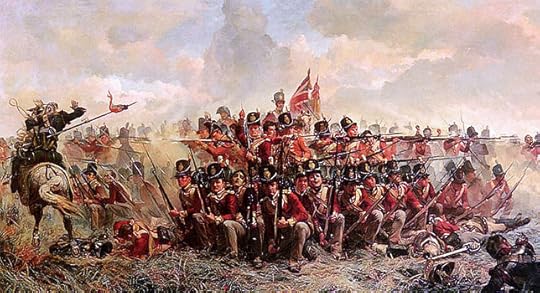
Illustration of a British deployment in the square formation at the battle of the Quatre Bras crossroads.
Because his scattered forces have not had time to coalesce, Wellington is forced into a strategic retreat. His choice of a site for consolidation and defense, a ridge near Waterloo flanked by a solid farm house and a chateau, was critical to his success. Yet he counted on the Prussian army joining the fray, and they were very late in arriving after their bludgeoning at Ligny. Sharpe and Harper get to play a role in a miraculous beating off a nearly successful takeover of the farmhouse fortress. From this point on, Cornwell’s version of the battle gives emphasis to mistakes made by the French. Their poor coordination between infantry, artillery, and cavalry is covered. The French sending a huge cavalry force about a dozen times alone against the allies in square formation is a big focus of the narrative. Later, when the superior numbers of the French seems to have prevailed, Napolean sends the glorious, undefeated Imperial Guards, all dressed to the hilt in frippery, to deliver an expected final blow. But their keeping to orderly columns diminished their firepower. It was cool to get to experience Sharpe and Harper rallying the ragged and nearly officerless forces of their old regiment, the Prince of Wales’ Own Volunteers, to outflank and rout the Guards. (It should be noted that this regiment is fictional with a home base in South Essex instead of South Lancashire for the historical regiment).
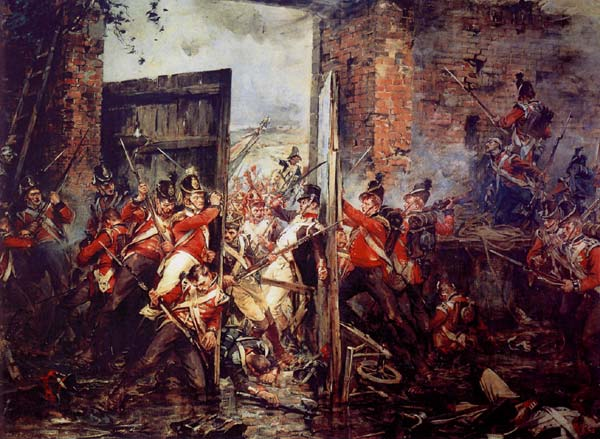
The British Recoats fighting at the gate to the strategic farmhouse redoubt at the beginning of the Waterloo battle.
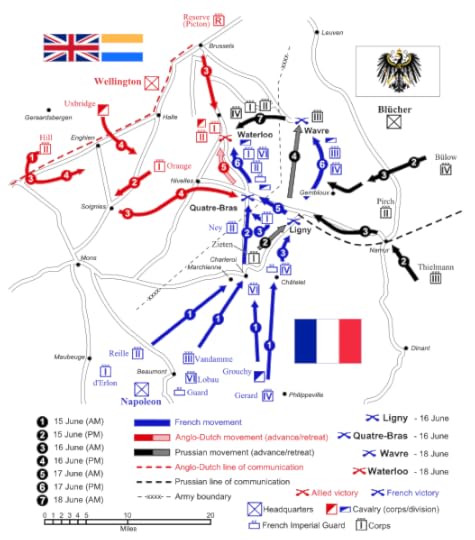
Map of action showing the French in blue dividing the Anglo-Dutch (red) and Prussians (black), defeating the latter at Ligny and the former at the crossroads of Quatre Bras, then facing Wellington near Waterloo, 10 miles south of Brussels.
As usual, Cornwell walks the line between showing the brutal and tragic realities of war and the uncaring, blind ambitions of most commanding officers while at the same time revealing the heroism and resourcefulness of many common soldiers and lesser officers. Again, Sharpe wins our hearts with his balance of irreverent cynicism and brilliant actions on behalf of the success of his fellow soldiers. If you have not read Sharpe tales, you would do best not start to with this one. But if you want to read it for a gritty, bloody profile of this critical battle, that would work fine. Cornell’s afterward makes it clear that the history of the battle suffers from very limited accounts from Wellington and likely bias from versions told from the French perspective.
When I read the excellent Wikipedia account, I learned how the engagement by the Prussians under Blücher near the end is considered another critical factor for the outcome. Cornwell takes pains to present evidence that Blücher delayed his arrival on purpose, so I don’t blame him for putting the British directed actions on center stage. Regardless, this definitive defeat of Napolean’s dream of empire was achieved though the highest butcher’s bill in history at the time: about 15,000 dead or wounded for Wellington’s army, 8,000 Blücher, and 25,000 for Napolean. It would be another 50 years for the Battle of Gettysburg to supersede that level of slaughter and another 50 years for the Battle of the Somme to supersede that.
If you have read any of the Sharpe series on the British army during the Napoleanic Wars, you will want to read this out for a sense of completion, with this being the penultimate volume. He still thinks of himself as a rifleman, but his capacity to lead men leads him to advance to become a competent officer. In the brief peace he has taken up the life of a country farmer with a French woman in Normandy and is now a father, leaving his wife back in England to squander his modest estate and pursue her own lovers. As the book opens, his need for money has led him to assume a post as a brevet colonel in the Dutch forces led by of the young, inexperienced Prince of Orange. Along with their allies in the so-called Seventh Coalition, the Prussians and Wellington’s international army are defending Dutch Belgium against a likely incursion by Bonaparte. In the three months since escaping Elba, he has won over the French army and state, and Sharpe is a witness of the advance dragoon scouts leading the invasion by an army of 125,000. His skills in combat by gun and sword are rusty, but he still has the right stuff in mano-a-mano action.
Sharpe has been dreading the fulfillment of orders from the Prince to show up at a grand ball in Brussells, so it’s perfect for him to show up all grotty and bloody. The plan of Napolean to divide the forces of Wellington and the Prussians is close to being completed, and the warnings Sharpe tried to send did not reach the allied command. Rallying to the defense of a key crossroads becomes an emergency objective for the allies. Sharpe’s old sergeant, the Irishman Harper, is now a bar owner and dealer of stolen horses, but chooses to join him on location, despite lack of a commission. There they learn what a dangerous, pompous idiot the Prince is, ordering his men to deploy in lines for musketry attacks and leaving them vulnerable to decimation by the cavalry. As we learn later, the formation of battalions into squares with a wall of bayonets protecting concentrated firepower was the critical strategy to defeat cavalry charges. Harper pegs the Prince as a “silk stocking full of shit”, and discussion of fragging him becomes a serious topic.
Illustration of a British deployment in the square formation at the battle of the Quatre Bras crossroads.
Because his scattered forces have not had time to coalesce, Wellington is forced into a strategic retreat. His choice of a site for consolidation and defense, a ridge near Waterloo flanked by a solid farm house and a chateau, was critical to his success. Yet he counted on the Prussian army joining the fray, and they were very late in arriving after their bludgeoning at Ligny. Sharpe and Harper get to play a role in a miraculous beating off a nearly successful takeover of the farmhouse fortress. From this point on, Cornwell’s version of the battle gives emphasis to mistakes made by the French. Their poor coordination between infantry, artillery, and cavalry is covered. The French sending a huge cavalry force about a dozen times alone against the allies in square formation is a big focus of the narrative. Later, when the superior numbers of the French seems to have prevailed, Napolean sends the glorious, undefeated Imperial Guards, all dressed to the hilt in frippery, to deliver an expected final blow. But their keeping to orderly columns diminished their firepower. It was cool to get to experience Sharpe and Harper rallying the ragged and nearly officerless forces of their old regiment, the Prince of Wales’ Own Volunteers, to outflank and rout the Guards. (It should be noted that this regiment is fictional with a home base in South Essex instead of South Lancashire for the historical regiment).
The British Recoats fighting at the gate to the strategic farmhouse redoubt at the beginning of the Waterloo battle.
Map of action showing the French in blue dividing the Anglo-Dutch (red) and Prussians (black), defeating the latter at Ligny and the former at the crossroads of Quatre Bras, then facing Wellington near Waterloo, 10 miles south of Brussels.
As usual, Cornwell walks the line between showing the brutal and tragic realities of war and the uncaring, blind ambitions of most commanding officers while at the same time revealing the heroism and resourcefulness of many common soldiers and lesser officers. Again, Sharpe wins our hearts with his balance of irreverent cynicism and brilliant actions on behalf of the success of his fellow soldiers. If you have not read Sharpe tales, you would do best not start to with this one. But if you want to read it for a gritty, bloody profile of this critical battle, that would work fine. Cornell’s afterward makes it clear that the history of the battle suffers from very limited accounts from Wellington and likely bias from versions told from the French perspective.
When I read the excellent Wikipedia account, I learned how the engagement by the Prussians under Blücher near the end is considered another critical factor for the outcome. Cornwell takes pains to present evidence that Blücher delayed his arrival on purpose, so I don’t blame him for putting the British directed actions on center stage. Regardless, this definitive defeat of Napolean’s dream of empire was achieved though the highest butcher’s bill in history at the time: about 15,000 dead or wounded for Wellington’s army, 8,000 Blücher, and 25,000 for Napolean. It would be another 50 years for the Battle of Gettysburg to supersede that level of slaughter and another 50 years for the Battle of the Somme to supersede that.

October 8, 2013
Well, hopefully most of us have read something about Waterloo (not the song). If we haven’t, or we haven’t read much, here is Cornwell’s fairly accurate historical fiction of the famous battle told from the POV of Sharpe and his Rifles Regiment. Wellington, the British general, called the battle “a near run thing” - in other words, Napoleon almost won the day and that would have changed European history …. mais oui, tout le monde.
I would love to read some French historical fiction about the battle and also a German (Prussian) POV.
Well written, well researched, fast moving, and the drama herein is not just about war but about friendships and about love lost.
I would love to read some French historical fiction about the battle and also a German (Prussian) POV.
Well written, well researched, fast moving, and the drama herein is not just about war but about friendships and about love lost.

November 19, 2020
Waterloo is of course one of the biggest battles in European history. Cornwell brings history to life in a way you would never get in a class room. Waterloo was originally intended to be the last book of a 11 part Sharpe series but since completion Cornwell has added to Sharpe's career and polished his character a bit.
Sharpe's waterloo well my copy is just called waterloo as the name suggest is more about the battle than Sharpe, As it should be. Probably the most expansive treatment of a battle in the series. The characters do take more of a backseat to the battle. Kind of a shame because character development is such a spotlight in the series as a whole. But Cornwell does a great job of interweaving some familiar plotlines like the prince of orange being the anthesis of the bad commander. A theme which is pervasive in the series. And Cornwell writing in general. Also a superb subplot involving Sharpe estranged wife and her new man a elegant Calvary officer. Gives waterloo a bit of Sharpe's personal touch a reader of the series expects. Sharpe is now Lt. Col. And is summoned from his Normandy farm because, well he could use the colonel's pay. So he brings his wife, dog, and the retired Patrick harper to Belgium and is posted to the young and arrogant prince of orange staff who he calls the young frog! In that capacity he is more of a observer to battle than a participant with a specific job to do. But never fear he does end up commanding the South Essex by battles end. The way he takes control of his former battalion is a bit unbelievable but is classic Sharpe. The relationship between Sharpe and Harper is at its highest point with their dialogue relating a lot of what's going on. The Duke of wellington is also included more in waterloo than other books in the series. One downside is because it's supposed to be the end of the series many recurring characters die with little fan fair which is a shame. Sharpe has come a long way from a private in India to a colonel living in Normandy. From butting head with sergeants to now a spoiled prince. It has all lead up to this point! the battle of waterloo! I have loved the journey.
There's another book in the series written in this manner where the battle is the focal point. Can't remember which at the moment. But because there is not much plot or character development I can understand many dropping their rating for those reasons. You need the series as context this is not a stand alone read by any means. But it has the since of epic conclusion. A favorite of mine!
Sharpe's waterloo well my copy is just called waterloo as the name suggest is more about the battle than Sharpe, As it should be. Probably the most expansive treatment of a battle in the series. The characters do take more of a backseat to the battle. Kind of a shame because character development is such a spotlight in the series as a whole. But Cornwell does a great job of interweaving some familiar plotlines like the prince of orange being the anthesis of the bad commander. A theme which is pervasive in the series. And Cornwell writing in general. Also a superb subplot involving Sharpe estranged wife and her new man a elegant Calvary officer. Gives waterloo a bit of Sharpe's personal touch a reader of the series expects. Sharpe is now Lt. Col. And is summoned from his Normandy farm because, well he could use the colonel's pay. So he brings his wife, dog, and the retired Patrick harper to Belgium and is posted to the young and arrogant prince of orange staff who he calls the young frog! In that capacity he is more of a observer to battle than a participant with a specific job to do. But never fear he does end up commanding the South Essex by battles end. The way he takes control of his former battalion is a bit unbelievable but is classic Sharpe. The relationship between Sharpe and Harper is at its highest point with their dialogue relating a lot of what's going on. The Duke of wellington is also included more in waterloo than other books in the series. One downside is because it's supposed to be the end of the series many recurring characters die with little fan fair which is a shame. Sharpe has come a long way from a private in India to a colonel living in Normandy. From butting head with sergeants to now a spoiled prince. It has all lead up to this point! the battle of waterloo! I have loved the journey.
There's another book in the series written in this manner where the battle is the focal point. Can't remember which at the moment. But because there is not much plot or character development I can understand many dropping their rating for those reasons. You need the series as context this is not a stand alone read by any means. But it has the since of epic conclusion. A favorite of mine!

August 20, 2019
Book 20 in the Richard Sharpe series.
A bit of a change in the story narrative this time, the last 19 books have been more concerned with the life and times of Richard Sharpe with a battle of some importance as a back drop. But this time the narrative is well and truly about the battle of Waterloo with, the now Lt. Col. in Prince William of Orange’s army, Richard Sharpe as a minor player.
Did I miss Sharpe’s presence? Yes.
Did it detract from the telling of the battle of Waterloo? No.
This is the moment that the last 19 books have been heading to, the end of the Napoleonic Wars.
Bernard Cornwell’s brilliance as a story teller brings the battle of Waterloo with all its blood and gore, the cost in human and horse life was horrendous, right to your favourite reading chair.
Talking of horses, the slaughter of these poor animals was massive. Of all the death and destruction that happened on the battle field it was the horses that I felt for. The soldiers chose to be there, the horses had no say in it.
This is about as riveting as history gets.
A highly recommended 4 star read.
A bit of a change in the story narrative this time, the last 19 books have been more concerned with the life and times of Richard Sharpe with a battle of some importance as a back drop. But this time the narrative is well and truly about the battle of Waterloo with, the now Lt. Col. in Prince William of Orange’s army, Richard Sharpe as a minor player.
Did I miss Sharpe’s presence? Yes.
Did it detract from the telling of the battle of Waterloo? No.
This is the moment that the last 19 books have been heading to, the end of the Napoleonic Wars.
Bernard Cornwell’s brilliance as a story teller brings the battle of Waterloo with all its blood and gore, the cost in human and horse life was horrendous, right to your favourite reading chair.
Talking of horses, the slaughter of these poor animals was massive. Of all the death and destruction that happened on the battle field it was the horses that I felt for. The soldiers chose to be there, the horses had no say in it.
This is about as riveting as history gets.
A highly recommended 4 star read.

February 3, 2022
I wasn't aware that this was billed as "Sharpe's Last Adventure". But Sharpe is involved in the Battle of Waterloo.
I bought this book because I thought it was Cornwell's take on Waterloo. It is, but told from the POV of Sharpe ensconced within the Allied Forces and specifically the British forces. Thus, the entire battle is seen from a microview. The engagements with the Prussians is happening in the background. Thus if you have limited or no knowledge of this battle, may I suggest you read the real history? Why?
This book is a superb description of the brutal bloody style of Napoleonic warfare. While Cornwell may limit himself to Sharpe's POV, that POV encompasses the entirety of linear warfare. From the use of skirmishers to the use of different types of cavalry to artillery usage-it's all gloriously described. But, to truly appreciate what you are reading you should understand the entire battle.
It is important to realize that Napoleon's Army was capable of defeating either Wellington's allied British forces or Blücher's Prussians singly. but should they combine then they would outnumber his forces and thus the battle was really designed to split the forces, prevent them from combining and then isolate and destroy each force one at a time. A truly fascinating battle and one, once you appreciate the maneuvers, you should read this book to get a mental image of this brutal conflict. had this book been more broad in its description then it'd have been a 5, but it is still very accurate and well worth your time. While it is not necessary to know Sharpe's background, it would be wise to know about the battle of Waterloo before reading this excellent British POV description.
I bought this book because I thought it was Cornwell's take on Waterloo. It is, but told from the POV of Sharpe ensconced within the Allied Forces and specifically the British forces. Thus, the entire battle is seen from a microview. The engagements with the Prussians is happening in the background. Thus if you have limited or no knowledge of this battle, may I suggest you read the real history? Why?
This book is a superb description of the brutal bloody style of Napoleonic warfare. While Cornwell may limit himself to Sharpe's POV, that POV encompasses the entirety of linear warfare. From the use of skirmishers to the use of different types of cavalry to artillery usage-it's all gloriously described. But, to truly appreciate what you are reading you should understand the entire battle.
It is important to realize that Napoleon's Army was capable of defeating either Wellington's allied British forces or Blücher's Prussians singly. but should they combine then they would outnumber his forces and thus the battle was really designed to split the forces, prevent them from combining and then isolate and destroy each force one at a time. A truly fascinating battle and one, once you appreciate the maneuvers, you should read this book to get a mental image of this brutal conflict. had this book been more broad in its description then it'd have been a 5, but it is still very accurate and well worth your time. While it is not necessary to know Sharpe's background, it would be wise to know about the battle of Waterloo before reading this excellent British POV description.

August 19, 2020
I've just re-read the entire series over several months (with a few other books sprinkled here and there).
I would rate Bernard Cornwell number one when it comes to historical fiction, and the Sharpe series is my favourite of his many stories. Obviously some are better than others but a few really stand out as superb and Waterloo is one of them.
Possibly the reason I enjoy this book so much (I must've read it five times) is the way it seeks to explain the numerous mysteries that confound historians, despite the huge amount that was written at the time and shortly afterwards. Historians can't even agree whether it was Wellington or Blucher who was most responsible for the victory, and no-one can properly account for why the French suddenly collapsed when on the brink of victory and still vastly outnumbering the British.
That's all very interesting but even better is BC's characters - both historical and fictional. I've always loved his depiction of Wellington (who appears in every story but one (Trafalgar) and his portrayal of the Prince of Orange in Waterloo is outstandingly graphic. Even better are the fictional figures - especially Harper and Sharpe himself. The grief that the characters feel when split for the final time at the end of the wars is palpable. BC clearly felt it as he wrote it.
History truly comes alive in the hands of Bernard Cornwell and I am grateful for the countless hours I've spent in his company.
I would rate Bernard Cornwell number one when it comes to historical fiction, and the Sharpe series is my favourite of his many stories. Obviously some are better than others but a few really stand out as superb and Waterloo is one of them.
Possibly the reason I enjoy this book so much (I must've read it five times) is the way it seeks to explain the numerous mysteries that confound historians, despite the huge amount that was written at the time and shortly afterwards. Historians can't even agree whether it was Wellington or Blucher who was most responsible for the victory, and no-one can properly account for why the French suddenly collapsed when on the brink of victory and still vastly outnumbering the British.
That's all very interesting but even better is BC's characters - both historical and fictional. I've always loved his depiction of Wellington (who appears in every story but one (Trafalgar) and his portrayal of the Prince of Orange in Waterloo is outstandingly graphic. Even better are the fictional figures - especially Harper and Sharpe himself. The grief that the characters feel when split for the final time at the end of the wars is palpable. BC clearly felt it as he wrote it.
History truly comes alive in the hands of Bernard Cornwell and I am grateful for the countless hours I've spent in his company.

October 13, 2024
[7/10]
His name was Sharpe, Richard Sharpe, and he was a British soldier.
The Bond, James Bond of the Napoleonic wars finally arrives at the culmination of his military career. He’s about to single-handedly win the battle of Waterloo for Wellington and his allies.
It’s been a twenty years journey for Sharpe, from the scorching plains of India to the back and forth of the Peninsular War, an unprecedented rise in the ranks from simple soldier to regimental commander and honorary Colonel. All due to his killer instincts and his peerless talent with sword, musket, rifle or bare knuckles. Similar to the 007 spy, Richard Sharpe has civilian talents aplenty, manifested mostly in the bedrooms of several ladies he met in his long journey.
It’s been a several years journey also for me, since I read Sharpe’s Tiger . My enthusiasm has known some ups and downs, with a slight feeling of exhaustion towards the end: as in I can’t wait to get this over with and start something else.
Cornwell’s ability to insert epitome of martial hero into all the important battles of the campaign, with some creative sleigh of hand and cavalier attitude towards documented facts is not something new. Nevertheless, the lengths he goes to make Richard Sharpe the key player all through the deciding moments of the battle of Waterloo is starting to get ridiculous. He is the first man to spot the surprise French crossing of the Belgian border, the first man to announce the attack at the ball in Bruxelles, the man who saved the defenders of Quatre Bas against overwhelming odds, he fought in the desperate defence of La Haye Sante and atop the hill he resisted the cavalry charges of Marshall Ney. Finally, he rallied the troops and stopped the most dangerous assault of the Imperial Guard when the battle was all but lost.
You get the idea. All this while he was at Waterloo just as an observer, an aide-de-camp for the allegedly incompetent [because nobody will be allowed to shine beside Wellington] Belgian Prince.
Cornwell’s incontestable talent in describing battle scenes and one-on-one duels made Sharpe’s improbable exploits easier to swallow, but the overall strong bias against the French and his hero worshipping of Wellington make this action filled volume one of the least reliable for actual historical details in the whole series.
After watching recently the Ridley Scott biopic of Napoleon, and now reading this skewed account of a famous battle, I am starting to lose hope of ever finding an English author who can bypass the national propaganda and the usual character assassination regarding the French and their Emperor.
Sharpe had fought the French for over twenty years, yet he had never seen the Emperor and, all unbidden, a sudden and childish image of a man with cloven tail, sharp horns and demonic fangs stalked Sharpe’s fears that were made worse by the Emperor’s real reputation as a soldier of genius whose presence on a battlefield was worth a whole corps of men.
This book could have been the best in the series – not a moment to relax, plenty of epic action and skilfully weaved in subplots like the some deadly fight between Sharpe and the man who had stolen his wife and his money. Probably I have my own francophone bias, because I was driven time and time again to fact-check Cornwell with other accounts of the battle of Waterloo online and he came up short, skewing everything to make the odds more impressive [the armies were actually pretty well matched initially, before the arrival of the Austrians] , painting Napoleon as a bumbling incompetent and moving the timeline to make it look like Boucher played an insignificant role in the final outcome.
My critical frame of mind made the passages where the author is glorifying the dismembering of the enemy really stand out in the text, leaving a bitter aftertaste in my mouth instead of inspiring awe and respect:
the sheer joy of killing
They were drunk on the slaughter, drenched in it, glorying in it.
their voices ululating a paean to massacre
I would have probably appreciated the book a lot more if I had read the series out of order and this episode earlier in my journey. Right now, I’m hesitating if it is worth the effort to read the last chronological novel, of Sharpe fighting spies in Paris after the war, or head out to greener pastures.

October 3, 2021
Read this book in 2006, and its the 20th volume, chronologically, of the magnificent Richard Sharpe series.
Set in in the year AD 1815, and we're heading to and will end with the famous Battle of Waterloo.
At first a society feast is celebrated in Brussels in AD 1815, when the French under Emperor Napoleon are marching towards Brussels to take on the war against the British forces and their allies.
In the resulting chaos, skirmishes will break out between different factions, and some clashes between the British and Allies against the French will take place, before Lieutenant Colonel Richard Sharpe and his men are taken along with all the other British forces under the leadership Sir Arthur Wellington to a certain place where they will face the French for the ultimate battle that will decide the fate of Europe for the coming future.
That place will be Waterloo, and in that place this famous battle will at first swing back and forth, before the Prussians will eventually arrive, and the battle becoming a close run thing, and in a desperate climactic Battle the British/Prussian Alliance will finally succeed to defeat Napoleon's forces once and for all, and restore peace for Europe for the time being.
Very much recommended, for this is a tremendous addition to this captivating series, and that's why I like to call this episode: "A Superb Sharpe Waterloo"!
Set in in the year AD 1815, and we're heading to and will end with the famous Battle of Waterloo.
At first a society feast is celebrated in Brussels in AD 1815, when the French under Emperor Napoleon are marching towards Brussels to take on the war against the British forces and their allies.
In the resulting chaos, skirmishes will break out between different factions, and some clashes between the British and Allies against the French will take place, before Lieutenant Colonel Richard Sharpe and his men are taken along with all the other British forces under the leadership Sir Arthur Wellington to a certain place where they will face the French for the ultimate battle that will decide the fate of Europe for the coming future.
That place will be Waterloo, and in that place this famous battle will at first swing back and forth, before the Prussians will eventually arrive, and the battle becoming a close run thing, and in a desperate climactic Battle the British/Prussian Alliance will finally succeed to defeat Napoleon's forces once and for all, and restore peace for Europe for the time being.
Very much recommended, for this is a tremendous addition to this captivating series, and that's why I like to call this episode: "A Superb Sharpe Waterloo"!

August 4, 2023
Wow. What a dramatic climax for the long Napoleonic Wars, and man alive did Cornwell do it justice. This is one of the most battle-centric books in the series with much less of a focus on fictional intrigue than usual, which felt like a fantastic choice. Even knowing the historical outcome didn't stop me from being on the edge of my seat the whole time, since I had never studied the battle and had no clue how it all played out.
It seems impossible that Wellington and the British pulled out a victory against the French veterans who outnumbered them, and I was just riveted by all the twists and turns the battles took over the few days the book covers. Cornwell is so great at writing battle scenes immersively with so much descriptive imagery that hits all the senses, it's like I'm there on the battlefield with Sharpe.
Special kudos to the audiobook narrator Rupert Farley, who is simply one of the best and most engaging actors in the art form.
This would have been quite the suitable ending to the series, but I can't say I'm disappointed that I get to stay with Sharpe for a couple more books. Napoleon is still alive after all, and I'm so curious what Cornwell is going to have Sharpe do now that the wars are over.
It seems impossible that Wellington and the British pulled out a victory against the French veterans who outnumbered them, and I was just riveted by all the twists and turns the battles took over the few days the book covers. Cornwell is so great at writing battle scenes immersively with so much descriptive imagery that hits all the senses, it's like I'm there on the battlefield with Sharpe.
Special kudos to the audiobook narrator Rupert Farley, who is simply one of the best and most engaging actors in the art form.
This would have been quite the suitable ending to the series, but I can't say I'm disappointed that I get to stay with Sharpe for a couple more books. Napoleon is still alive after all, and I'm so curious what Cornwell is going to have Sharpe do now that the wars are over.

August 28, 2020
Sharpe #20. Another re-read. The events take place over the course of four days in June of 1815.
In the last book, Napoleon had abdicated and skedaddled to Elba, so the European nations breathed a collective sigh of relief that the long war was finally over. He apparently decided that abdication wasn't in his best interest, however, so he left the island, gathered an army, and proceeded to recapture Paris and invade Belgium.
Most people are familiar with Waterloo, but the details in this book were something else. The Allies were completely caught by surprise that the French had invaded. Napoleon had raced through France and was in Belgium long before anyone thought possible. The four-day battle waged by France against the Allies, (British, Scottish, Irish, German, Prussian and some Dutch forces), began at this totally insignificant crossroads in the countryside just south of Brussels. The fighting began in a field of rye at the crossroads, (Quatre Bras). The descriptions were extremely vivid. The French were advancing through the rye, but they weren't visible over the tall crops... just heard. Their drums were beaten in a distinctive and sinister cadence. Then the drummers would pause and the entirety of the French masses would shout in unison, "Vive l’Empereur!" The Dutch-Belgian forces on the side of the allies promptly fled. (They had formerly fought for France and were hoping that Napoleon would be victorious.) From that point at the crossroads north to Waterloo, it was one vicious battle after another.
Amidst the horror of this war, Lieutenant Colonel Sharpe is unfortunately under the command of the young and astoundingly foolish Prince William of Orange, heir to the throne of the Netherlands. At the not-so-wise age of 22, this Dutch prince was responsible for a high number of casualties due to his inexperience and incompetence. He was infuriating!!!! He also was an actual historical figure, but that didn't make him any less infuriating. Aside from him, the Prussian forces were not too reliable, either. And then there is the whole Jane/Lord John subplot. Poor Sharpe! At least he had Lucille and Patrick on his side. And he has a good dog 🐕
Bernard Cornwell has always been renowned for his depictions of battle scenes, but this? This book was intense!!
In the last book, Napoleon had abdicated and skedaddled to Elba, so the European nations breathed a collective sigh of relief that the long war was finally over. He apparently decided that abdication wasn't in his best interest, however, so he left the island, gathered an army, and proceeded to recapture Paris and invade Belgium.
Most people are familiar with Waterloo, but the details in this book were something else. The Allies were completely caught by surprise that the French had invaded. Napoleon had raced through France and was in Belgium long before anyone thought possible. The four-day battle waged by France against the Allies, (British, Scottish, Irish, German, Prussian and some Dutch forces), began at this totally insignificant crossroads in the countryside just south of Brussels. The fighting began in a field of rye at the crossroads, (Quatre Bras). The descriptions were extremely vivid. The French were advancing through the rye, but they weren't visible over the tall crops... just heard. Their drums were beaten in a distinctive and sinister cadence. Then the drummers would pause and the entirety of the French masses would shout in unison, "Vive l’Empereur!" The Dutch-Belgian forces on the side of the allies promptly fled. (They had formerly fought for France and were hoping that Napoleon would be victorious.) From that point at the crossroads north to Waterloo, it was one vicious battle after another.
Amidst the horror of this war, Lieutenant Colonel Sharpe is unfortunately under the command of the young and astoundingly foolish Prince William of Orange, heir to the throne of the Netherlands. At the not-so-wise age of 22, this Dutch prince was responsible for a high number of casualties due to his inexperience and incompetence. He was infuriating!!!! He also was an actual historical figure, but that didn't make him any less infuriating. Aside from him, the Prussian forces were not too reliable, either. And then there is the whole Jane/Lord John subplot. Poor Sharpe! At least he had Lucille and Patrick on his side. And he has a good dog 🐕
Bernard Cornwell has always been renowned for his depictions of battle scenes, but this? This book was intense!!

August 30, 2026
This book appeared near the end of Cornwell's massive Richard Sharpe series, and it's one of the most masterful war novels I've ever read.
I only knew Waterloo as the site of Napoleon's defeat by the Duke of Wellington, but I never knew the details of the battle. A particular problem for a novelist is how to tell the complicated story of a shifting battle without getting into too much detail or making it too confusing, all the while depicting it through the eyes of a few key protagonists. Cornwell handles all of this with consummate skill.
Sharpe enters the battle as a British rifleman with a fierce reputation. He also is in love with a French woman, with whom he has been living in Normandy, even though he is married to the beautiful but grasping Jane. She has taken a British nobleman, John Rossendale, as her lover, and he enters the battle as an untried aristocratic officer fond of his fancy uniform and his luxuries.
I don't know if this theme runs through the other Sharpe books, but Cornwell is particularly vicious in his portrayal of royalty who are incompetent on the battlefield. Chief among them at Waterloo is William Prince of Orange, who is nominally second in command under the Duke of Wellington, but makes several serious mistakes that stem from his ignorance and his narcissistic belief in himself, costing hundreds of lives. Sharpe will tangle with Orange more than once and eventually take matters into his own hands.
Waterloo was fought in a compact valley between two ridges, where Napoleon threw most of his army at British, Dutch and Prussian forces. Cornwell's ability to depict the shape of this battle, giving you just enough geographical and physical details so that you can form a mental picture, but also emphasizing the chaos, noise, blood and brutality of early 19th century fighting, is superb.
Along the way you learn the tactics of this era of fighting. Skirmishing snipers fanned out ahead of the armies. Cavalry could quickly demolish foot soldiers, but they were vulnerable to squares -- a box formation with all rifles pointed outward, which forced the riders to flow around the enemy soldiers, where they could be fired upon from the front and the sides. Cannon could provide lethal covering fire even while many of the shots missed, and the British introduced canister shot in this battle, where the shell was filled with smaller bullets that sprayed outward upon impact. The rest of the deadly impact was accomplished with swords.
Throughout this depiction, most of which takes place in a single day, you see stories of great heroism, even as officers tried to hide their fears, and you see rank cowardice and indecision.
Most of all, you see a master storyteller at work. You don't have to have read any of the other Sharpe novels to revel in this book. Highly, highly recommended
I only knew Waterloo as the site of Napoleon's defeat by the Duke of Wellington, but I never knew the details of the battle. A particular problem for a novelist is how to tell the complicated story of a shifting battle without getting into too much detail or making it too confusing, all the while depicting it through the eyes of a few key protagonists. Cornwell handles all of this with consummate skill.
Sharpe enters the battle as a British rifleman with a fierce reputation. He also is in love with a French woman, with whom he has been living in Normandy, even though he is married to the beautiful but grasping Jane. She has taken a British nobleman, John Rossendale, as her lover, and he enters the battle as an untried aristocratic officer fond of his fancy uniform and his luxuries.
I don't know if this theme runs through the other Sharpe books, but Cornwell is particularly vicious in his portrayal of royalty who are incompetent on the battlefield. Chief among them at Waterloo is William Prince of Orange, who is nominally second in command under the Duke of Wellington, but makes several serious mistakes that stem from his ignorance and his narcissistic belief in himself, costing hundreds of lives. Sharpe will tangle with Orange more than once and eventually take matters into his own hands.
Waterloo was fought in a compact valley between two ridges, where Napoleon threw most of his army at British, Dutch and Prussian forces. Cornwell's ability to depict the shape of this battle, giving you just enough geographical and physical details so that you can form a mental picture, but also emphasizing the chaos, noise, blood and brutality of early 19th century fighting, is superb.
Along the way you learn the tactics of this era of fighting. Skirmishing snipers fanned out ahead of the armies. Cavalry could quickly demolish foot soldiers, but they were vulnerable to squares -- a box formation with all rifles pointed outward, which forced the riders to flow around the enemy soldiers, where they could be fired upon from the front and the sides. Cannon could provide lethal covering fire even while many of the shots missed, and the British introduced canister shot in this battle, where the shell was filled with smaller bullets that sprayed outward upon impact. The rest of the deadly impact was accomplished with swords.
Throughout this depiction, most of which takes place in a single day, you see stories of great heroism, even as officers tried to hide their fears, and you see rank cowardice and indecision.
Most of all, you see a master storyteller at work. You don't have to have read any of the other Sharpe novels to revel in this book. Highly, highly recommended

June 22, 2025
I’ve read or listened to most of Cornwell’s Sharpe series. They’re solid action novels and damned entertaining. But this dramatization of the most important battle of the 19th century reaches unexpected heights. I’ve long thought the greatest war novel ever written is Michael Shaara’s The Killer Angels. Sharpe’s Waterloo might run a close second. Cornwell believably places Richard Sharpe at the battle’s most important moments—and it all works. This contains Cornwell’s best prose and saddest death scene. I absolutely loved this.

February 29, 2016
Waterloo: The True Story of Four Days, Three Armies and Three Battles This is the actual book that I read and reviewed here. What is shown in the header is Cornwell's 20th Sharpe novel ... This is the first non-fiction book by Bernard Cornwell, but he brings all the talent that he has honed over the years in writing his many historical novels to retelling the story of Waterloo. It's worth mentioning up front that those who have read a lot of military history may be put off by the repetitiveness of some points that he want to drive home, e.g. the way that the Duke of Wellington would invariably position his forces on the reverse side of slopes to protect them from artillery fire. He repeats this perhaps ten times at different times in the books. Notwithstanding the repetition, I found it a great read. Again, I think his skill in writing fiction that allows him to build suspense of this battle, even though you know the outcome.
He starts his story as Napoleon has returned from exile and sees most of the French army join him. The action really gets underway as Wellington attends a ball in Brussels, where most of his senior officers are in attendance. The next day, the Allied army is underway, heading to a fateful encounter with the French forces near the small town of Waterloo. Several engagements happen over the next few days, beginning with Quatre-Bras. Wellington, with maybe only half of forces being of the quality that he needs goes into battle, knows that if Blucher doesn't arrive with his Prussian army, he probably will lose the battle to Napoleon. And he had hoped never to fight Napoleon. The suspense continues to build.
The battlefield action is terrible, and it is well worth reading to fully comprehend what war really meant back then. You will understand how the battle was won by the British and Prussians and how it was lost by the French generals. In the end, you will come to understand why Cornwell says that Napoleon was worshiped by his men, Blucher was loved by his, but Wellington was only respected by his. One of the closing scenes has Wellington crying as he read over the casualty list of his officers.
It is a book that I will heartily recommend to anyone who wants to understand how the battle of Waterloo was fought and what it meant.
He starts his story as Napoleon has returned from exile and sees most of the French army join him. The action really gets underway as Wellington attends a ball in Brussels, where most of his senior officers are in attendance. The next day, the Allied army is underway, heading to a fateful encounter with the French forces near the small town of Waterloo. Several engagements happen over the next few days, beginning with Quatre-Bras. Wellington, with maybe only half of forces being of the quality that he needs goes into battle, knows that if Blucher doesn't arrive with his Prussian army, he probably will lose the battle to Napoleon. And he had hoped never to fight Napoleon. The suspense continues to build.
The battlefield action is terrible, and it is well worth reading to fully comprehend what war really meant back then. You will understand how the battle was won by the British and Prussians and how it was lost by the French generals. In the end, you will come to understand why Cornwell says that Napoleon was worshiped by his men, Blucher was loved by his, but Wellington was only respected by his. One of the closing scenes has Wellington crying as he read over the casualty list of his officers.
It is a book that I will heartily recommend to anyone who wants to understand how the battle of Waterloo was fought and what it meant.

August 5, 2011
Firstly, my prejudices - I've been a huge fan of the TV versions of the Sharpe books; I've been an even bigger fan of the Napoleonic Wars, and Waterloo in particular - I've probably read more on and around the subject than is healthy for anyone.
Although I've never actually read a Bernard Cornwell novel before, I was really looking forward, therefore, to reading his account of Richard Sharpe's contribution to the Battle of Waterloo.
All the ingredients for a literary disaster therefore - I had set my sights so high, disappointment was the only possible outcome.
But for once in my life, reality exceeded a very high expectation.
Cornwell manages to hit the bullseye on all fronts here. This is an historical account, as well as being a rip roaring novel; he describes and develops characters superbly throughout the plot without letting the individual's persona overshadow the action he is but a small cog within; he describes the visceral, stomach churning horror of 19th Century battle whilst also introducing some delightful humour - such as the two junior officers, just falling into shellshock as the French cannons' create bloody mayhem all around them, discussing the sport of golf "I once saw a little man with a red beard playing golf at Troon".... - into the narrative. Finally, he somehow manages to capture and describe the morality of man at war, both at an individual and collective, higher level.
If there is something that he leaves out of the book, it is the political context of the Battle, and the implications for both sides of winning and losing. But as he says in the epilogue, there are people far better qualified than him to do this, and he is right.
What impressed me most of all about this book though was the quality of the writing. There is a rhythm to the author's sentences that seem to match the setting - battle scenes are described in an almost staccato style, echoing the junctures between the volleys of musket shots that are being described, whereas some of the more descriptive chapters of the novel are presented in longer, languorous stanzas. Everything is conveyed in a rich language which is actually very easy on the eye.
I was expecting much from my first Bernard Cornwell book - and my expectations were surpassed. A fantastic read. I'll be going back for more!
Although I've never actually read a Bernard Cornwell novel before, I was really looking forward, therefore, to reading his account of Richard Sharpe's contribution to the Battle of Waterloo.
All the ingredients for a literary disaster therefore - I had set my sights so high, disappointment was the only possible outcome.
But for once in my life, reality exceeded a very high expectation.
Cornwell manages to hit the bullseye on all fronts here. This is an historical account, as well as being a rip roaring novel; he describes and develops characters superbly throughout the plot without letting the individual's persona overshadow the action he is but a small cog within; he describes the visceral, stomach churning horror of 19th Century battle whilst also introducing some delightful humour - such as the two junior officers, just falling into shellshock as the French cannons' create bloody mayhem all around them, discussing the sport of golf "I once saw a little man with a red beard playing golf at Troon".... - into the narrative. Finally, he somehow manages to capture and describe the morality of man at war, both at an individual and collective, higher level.
If there is something that he leaves out of the book, it is the political context of the Battle, and the implications for both sides of winning and losing. But as he says in the epilogue, there are people far better qualified than him to do this, and he is right.
What impressed me most of all about this book though was the quality of the writing. There is a rhythm to the author's sentences that seem to match the setting - battle scenes are described in an almost staccato style, echoing the junctures between the volleys of musket shots that are being described, whereas some of the more descriptive chapters of the novel are presented in longer, languorous stanzas. Everything is conveyed in a rich language which is actually very easy on the eye.
I was expecting much from my first Bernard Cornwell book - and my expectations were surpassed. A fantastic read. I'll be going back for more!

February 23, 2022
There is a clever mixture of historical accuracy and the usual insertion of Sharpe and his fictitious friends, enemies and acquaintances seamlessly into the narrative. This time the background narrative is the main character and Sharpe goes along for the ride...
Sharpe is always in the right place at the right time to avoid the slaughter or save the day, but in a way that does not abuse the historical facts...too much. In this book, his means of dealing with an annoying and incompetent senior officer is big and bold and cloaked in the anonymity of war...
In the early stages of the book, there is enough time spent away from the battlefield to allow his rough edges to catch, including at an inappropriate ball.
The book is in chronological terms a fitting end given the awesome scale of the battle. (And now, he is back in a new adventure - Sharpe's Assassin - many years on. I look forward to catching up with Sharpe once more...)
There are appearances from old colleagues and - close enough - friends, there is Wellington, still looking over Sharpe with a disapproving, suspicious and slightly begrudging respectful eye, and there's Bonaparte sharing the same battlefield. For fankind, who could want more...?
The battles are as vivid as ever, evoking the confusion, ferocity and fear of battle, together with an almost quiet underpinning of resignation, heroism and stubborn fury, all rolled into one.
Brilliant glad-we-weren't-there details; dashing, sobering and matter-of-fact.
Interesting that Bernard Cornwell slightly changed his descriptions of Sharpe to fit with Sean Bean. Quite right!
It's nearly time to start working through them all again...
Sharpe is always in the right place at the right time to avoid the slaughter or save the day, but in a way that does not abuse the historical facts...too much. In this book, his means of dealing with an annoying and incompetent senior officer is big and bold and cloaked in the anonymity of war...
In the early stages of the book, there is enough time spent away from the battlefield to allow his rough edges to catch, including at an inappropriate ball.
The book is in chronological terms a fitting end given the awesome scale of the battle. (And now, he is back in a new adventure - Sharpe's Assassin - many years on. I look forward to catching up with Sharpe once more...)
There are appearances from old colleagues and - close enough - friends, there is Wellington, still looking over Sharpe with a disapproving, suspicious and slightly begrudging respectful eye, and there's Bonaparte sharing the same battlefield. For fankind, who could want more...?
The battles are as vivid as ever, evoking the confusion, ferocity and fear of battle, together with an almost quiet underpinning of resignation, heroism and stubborn fury, all rolled into one.
Brilliant glad-we-weren't-there details; dashing, sobering and matter-of-fact.
Interesting that Bernard Cornwell slightly changed his descriptions of Sharpe to fit with Sean Bean. Quite right!
It's nearly time to start working through them all again...

March 10, 2012
I'd suspected that SHARPE'S WATERLOO, the penultimate Sharpe adventure and the culmination of his adventures in the Napoleonic War, could be nothing but a triumph. After all, it's a novel dedicated to one of the biggest, most-remembered battles in all of history, so how could Cornwell get it wrong? He built to it for a decade, honing his craft with more minor (but no less gripping) stories before finally sitting down to tackle it.
Needless to say, I loved everything about this story. It's a massive, epic-feeling book, one that exhausts and moves you and makes you feel like you're a spectator in the battlefield. Cornwell admits in his foreword that he tried to combine the story of the battle with a plot before giving up on the latter, which was the right decision: Waterloo is the story in itself. This is the most ferocious, bloody and terrible battle of Sharpe's entire campaign.
SHARPE'S WATERLOO is one of the longer Sharpe stories, clocking in at over 400 pages, but it feels like one of the shortest because the pages fly as you read. I knew very little about Waterloo itself before I started this, and I'm left feeling like, perhaps not an expert, but somebody who knows a great deal more. I'm wanting to find out more, too, which can only be a good thing.
Just one more to go now, SHARPE'S DEVIL. It's been a long old slog, but this will be the year I finally finish the series. It's going to be a bittersweet close - one of the reading joys in my life was always knowing I had a new Sharpe novel waiting for me whenever I chose to look at it!
Needless to say, I loved everything about this story. It's a massive, epic-feeling book, one that exhausts and moves you and makes you feel like you're a spectator in the battlefield. Cornwell admits in his foreword that he tried to combine the story of the battle with a plot before giving up on the latter, which was the right decision: Waterloo is the story in itself. This is the most ferocious, bloody and terrible battle of Sharpe's entire campaign.
SHARPE'S WATERLOO is one of the longer Sharpe stories, clocking in at over 400 pages, but it feels like one of the shortest because the pages fly as you read. I knew very little about Waterloo itself before I started this, and I'm left feeling like, perhaps not an expert, but somebody who knows a great deal more. I'm wanting to find out more, too, which can only be a good thing.
Just one more to go now, SHARPE'S DEVIL. It's been a long old slog, but this will be the year I finally finish the series. It's going to be a bittersweet close - one of the reading joys in my life was always knowing I had a new Sharpe novel waiting for me whenever I chose to look at it!

September 2, 2024
Koste meg gløggings! Kjøpte bokå spontant på en bruktbutikk i forbindelse med min brors (og nå svigerinnes!) bryllup. Dermed e bokå litt ekstra kjær. Fantastiske skildringer og karakterer satt i en objektivt utrolig spennda periode!! (napoleonskrigene huehue, så opplevelsen av bokå avhenge fort litt av historieinteressen/nerdegrad). Likte godt kor tett romanen la seg opp mot historiske kilder, men med et spicy dryss av fiksjonelle karakterer her og der. Med kavaleri, spyd, sverd, kanoner, musketter og bayonetter i samme slag la ikkje bokå skjul på brutalitetene på slagmarkå. Hadde ABBA lest denna før de lagde sangen sin tror eg de hadde nølt litt med å bruka slaget som en metafor for et kjærlighetsforhold.
Måtte smila av en sekvens der en britisk bataljon holdt på å bli ridd ned av fransk kavaleri:
"Run, you buggers!"
The buggers ran
Bernard Cornwell ska absolutt leses mer av!
Takkformeg
Måtte smila av en sekvens der en britisk bataljon holdt på å bli ridd ned av fransk kavaleri:
"Run, you buggers!"
The buggers ran
Bernard Cornwell ska absolutt leses mer av!
Takkformeg

August 31, 2017
Some of my favourite Sharpe moments are in this book, and some quality comedy from when Sharpe is busy elsewhere. I don't know how accurate the battle descriptions are, but they are vivid. I do believe that this book will work as a standalone novel, there's enough background to catch you up, but when the back story is waiting to be read, why skip it? It doesn't matter how many times I reread these, it doesn't matter that I remember all of the twists, o the little surprises, it's still an excellent read.
September 21, 2019
As well written as ever. The boys own adventure delivers the thrills made all the better by the historical detail and nuance.

October 8, 2015
The 20th Sharpe novel delves into the famous battle of Waterloo and pretty much nothing else. This time around, Sharpe serves in the staff of the Prince of Orange fighting the war against Napoleon. The author goes to great lengths to justify Sharpe's presence in the lead-up engagement and then in the main battle at Waterloo and not all of these feel very natural and Sharpe really doesn't have much to do in most of those battles and serves mostly as an observer.
This is the greatest failing of the novel. Sharpe really doesn't have anything to do but observe the battles and use a small sliver of his time to miss his farm and its apple trees and only a little bit of more time wanting his money back from his wife who's stolen it and lives with another man now.
Other characters are as badly employed. The worst case is a character who's entire arc consists of him being certain that he will die in the upcoming battle. This is pretty much the entirety of the character so it is no wonder that the reader doesn't really care what the outcome is.
The final battle - the battle of Waterloo - takes a lion's share of the novel and is mostly a very dull read. There are a couple of occasions where Sharpe has a little to do, but even they seem tacked on. It seems that the author was too worried about writing a correct description of the battle and could not have Sharpe messing it up too much.
Overall, this was a surprisingly weak addition to the series especially when you consider that it is part of the "original run", before Cornwell went back to write additional (generally weaker) novels to fill in the gaps between his earlier novels.
This is the greatest failing of the novel. Sharpe really doesn't have anything to do but observe the battles and use a small sliver of his time to miss his farm and its apple trees and only a little bit of more time wanting his money back from his wife who's stolen it and lives with another man now.
Other characters are as badly employed. The worst case is a character who's entire arc consists of him being certain that he will die in the upcoming battle. This is pretty much the entirety of the character so it is no wonder that the reader doesn't really care what the outcome is.
The final battle - the battle of Waterloo - takes a lion's share of the novel and is mostly a very dull read. There are a couple of occasions where Sharpe has a little to do, but even they seem tacked on. It seems that the author was too worried about writing a correct description of the battle and could not have Sharpe messing it up too much.
Overall, this was a surprisingly weak addition to the series especially when you consider that it is part of the "original run", before Cornwell went back to write additional (generally weaker) novels to fill in the gaps between his earlier novels.

December 17, 2008
This may be the best book I've read in the entire series and most of them were pretty terrific.
I've read accounts of the Battle of Waterloo but none of them were as complete or as clear as this one. Plus, Cornwell's description of the fighting is as compelling as in any of the other books.
Sharpe is called back to the army to serve under the Prince of Orange, Sweet William, an arrogant commander who creates unnecessary casualties with his brainstorms. Patrick Harper, his fighting partner, joins Sharpe as a civilian.
A sub-plot involving Sharpe's estranged wife and her lover actually adds to the story as Cornwell weaves it into the historical narrative.
Sharpe somehow gets involved in the center of the action
The epilogue wraps up a number of loose ends. Even the Historical Notes are fascinating.
I've read accounts of the Battle of Waterloo but none of them were as complete or as clear as this one. Plus, Cornwell's description of the fighting is as compelling as in any of the other books.
Sharpe is called back to the army to serve under the Prince of Orange, Sweet William, an arrogant commander who creates unnecessary casualties with his brainstorms. Patrick Harper, his fighting partner, joins Sharpe as a civilian.
A sub-plot involving Sharpe's estranged wife and her lover actually adds to the story as Cornwell weaves it into the historical narrative.
Sharpe somehow gets involved in the center of the action
The epilogue wraps up a number of loose ends. Even the Historical Notes are fascinating.

August 30, 2009
Cornwell outdid himself with this original end to the Sharpe series. (Since then, he also wrote Sharpe's Devil in which Sharpe gets to meet the former Emperor on St Helena.)
Waterloo was a close call. Napoleon came within a millimeter's length of winning, but he was too hidebound to change his tactics that worked when facing lesser opponents. Here, he was facing Wellington, who was quite another kettle of fish entirely. I was gratified that in a book written primarily to entertain, its author managed to avoid the temptation of straying from the factual record.
As it was, the factual record by itself was incredible. Not until Gettysburg and the later battles between Grant and Lee would there be such a high butcher's bill.
Waterloo was a close call. Napoleon came within a millimeter's length of winning, but he was too hidebound to change his tactics that worked when facing lesser opponents. Here, he was facing Wellington, who was quite another kettle of fish entirely. I was gratified that in a book written primarily to entertain, its author managed to avoid the temptation of straying from the factual record.
As it was, the factual record by itself was incredible. Not until Gettysburg and the later battles between Grant and Lee would there be such a high butcher's bill.

December 24, 2015
Don't know how I missed this book out of the 21 Sharpe books, but glad I discovered this missing piece. I really enjoyed it, more than all the others, perhaps partially because I was reading it after a sizable lag time. I also was unaware that there had been a series produced based on these books with Sean Bean as Sharpe. There were wonderful examples of beautifully described settings/scenes in the quiet of the countryside before the arrival of the hordes and the brutal ends of so many - and I bookmarked them so I could share a couple. However, I am apparently Kindle challenged and could not locate the passages. Maybe I will read "directions" some day, but don't count on it. This is a great book imagining the battle of Waterloo.

July 23, 2011
A novel that's not so much about the fictional Richard Sharpe, than it is about the hostorical Battle of Waterloo. Along with Austerlitz, this is, of course, probably the most famous battle of the Napoleonic wars, where Sir Arthur Wellesley (the future Duke of Wellington) Allied Anglo-Dutch army defeated the might of France and brought to an end those wars which had raged for years and years!
It's no surprise, therefore, that Cornwell has perhaps his most famous protaganist caught up in the events leading up to the battle, and then in the thick of the battle itself!
It's no surprise, therefore, that Cornwell has perhaps his most famous protaganist caught up in the events leading up to the battle, and then in the thick of the battle itself!

May 21, 2018
An awful long buildup to a rather rapid denouement is the largest mark-able flaw, but in the grand scheme it is a minor quibble. More battle scenes than in any previous volume, which is only appropriate for such a looming historical event, and possibly more time spent away from the many character than ever before, which again, given the scope of the backdrop is fitting, since no one man could hope to stand out against the grandeur and ghastliness of a 19th century battlefield.

May 13, 2022
Well, it's Sharpe, so it's bound to be fun if you've been following his career.
What actually surprised me was that our hero played a minor role throughout. I know that Mr Cornwell has written about the Battle of Waterloo elsewhere, but this read like a "first attempt", more about the battle.
I'm wondering if it's worth reading his "Waterloo" now... or would that be a bit deja vue?
What actually surprised me was that our hero played a minor role throughout. I know that Mr Cornwell has written about the Battle of Waterloo elsewhere, but this read like a "first attempt", more about the battle.
I'm wondering if it's worth reading his "Waterloo" now... or would that be a bit deja vue?

August 4, 2011
The Richard Sharpe series is a magnificent work of historical fiction. Bernard Cornwell has written an amazing series following Sharpe from a private in India to a Lt. Colonel at Waterloo and then a civilian farmer.

February 19, 2022
The climax to the Spain-France campaign that has spanned 13 novels, and it doesn't disappoint. A satisfying and suitable end to the story, with all the bloody gore, sacrifice and futility of war laid bare and a final hurrah for the characters we've followed across the continent. Excellent.

August 24, 2025
Roughly a year after Richard Sharpe headed back to Normandy and Patrick Harper departed for Ireland to buy a tavern and start horse trading, Napoleon has escaped from Elba, raised an army of over 100,000 veteran troops and is poised to march in to Belgium. Sharpe is recalled to the army and has to go as he can't afford to forfeit his half-pay retirement, since Jane still has control of his money. He's attached to the staff of the Prince of Orange in the hopes that he can provide some guidance to a neophyte commander.
This really is the story of the Battle of Waterloo with Sharpe inserted into the action. So it should come as no real surprise when Wellington and Blucher end up successful and Napoleon retires from the field and, ultimately, will end up on St. Helena. Of course Patrick ends up in Belgium to sell horses to the army and while he promised Isabel that he'd stay far from danger...well...we know how Mr. Harper loves a battle.
This is a solid look at on of the most important, arguably the most important, battles of the 19th Century. It's obviously from the British point of view but it's a very readable start to a look at the battle. Cornwell subscribes to the view that the Prince of Orange was completely incompetent, a view which I've always found compelling. The battle is the thing here. While we get some looks at the personal lives of Sharpe and his women, Harper, Major Peter d'Alembord and a few of the surviving riflemen they really aren't the focus. It was nice to see Lord John Rossendale get his comeuppance and one hopes that Jane will now be completely ostracized.
My understanding is that we have one more book that takes place some time after Waterloo before we start in on prequels and filling in the bare spots in the Pennisular War. At this point I trust Cornwell enough to move ever forward even through my long-standing dislike for prequels. Hopefully he won't let me down.
This really is the story of the Battle of Waterloo with Sharpe inserted into the action. So it should come as no real surprise when Wellington and Blucher end up successful and Napoleon retires from the field and, ultimately, will end up on St. Helena. Of course Patrick ends up in Belgium to sell horses to the army and while he promised Isabel that he'd stay far from danger...well...we know how Mr. Harper loves a battle.
This is a solid look at on of the most important, arguably the most important, battles of the 19th Century. It's obviously from the British point of view but it's a very readable start to a look at the battle. Cornwell subscribes to the view that the Prince of Orange was completely incompetent, a view which I've always found compelling. The battle is the thing here. While we get some looks at the personal lives of Sharpe and his women, Harper, Major Peter d'Alembord and a few of the surviving riflemen they really aren't the focus. It was nice to see Lord John Rossendale get his comeuppance and one hopes that Jane will now be completely ostracized.
My understanding is that we have one more book that takes place some time after Waterloo before we start in on prequels and filling in the bare spots in the Pennisular War. At this point I trust Cornwell enough to move ever forward even through my long-standing dislike for prequels. Hopefully he won't let me down.
June 18, 2022
All the years of fighting has led to this, and it exceeds expectations more than I could anticipate. The Sharpe formula is gone here and we get an incredibly honest and accurate slice-of-life during the last days of the 100 days campaign. I am a veteran of the Sharpe's series; this book ups the visceral death, destruction, and devastation. Literary violence has never felt more assured and close to me. The reader may know the outcome of the battle, but Sharpe does not and, by god, it was a close run thing indeed. When Sharpe takes over and mistakenly called out "South Essex!", the pride I felt at that moment was palpable. It was no mistake, it was Sharpe and the battalion back where it belongs. Maybe as a standalone book this is a 4 out of 5, but as a culmination of so much, it does it in vicious style.
This entire review has been hidden because of spoilers.
Displaying 1 - 30 of 387 reviews