

What do you think?
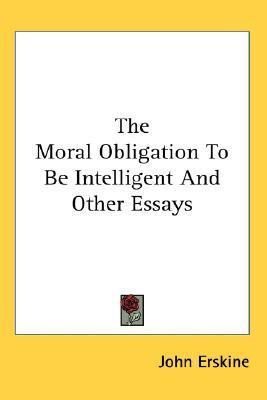
The Moral Obligation to Be Intelligent & Other Essays
This scarce antiquarian book is a facsimile reprint of the original. Due to its age, it may contain imperfections such as marks, notations, marginalia and flawed pages. Because we believe this work is culturally important, we have made it available as part of our commitment for protecting, preserving, and promoting the world's literature in affordable, high quality, modern editions that are true to the original work.
180 pages, Hardcover
First published January 1, 1921
About the author
John Erskine
385 books19 followersJohn Erskine (October 5, 1879 – June 2, 1951) was an American educator and author, pianist and composer. He was first an English professor at Amherst College from 1903 to 1909, followed by Columbia University from 1909 and 1937, during his tenure he formulated the General Honors Course, which later founded the influential Great Books movement. He published over 100 books, novel, criticism, essays including his most important essay, The Moral Obligation to Be Intelligent (1915).
Ratings & Reviews
Friends & Following
Create a free account to discover what your friends think of this book!
Community Reviews
Displaying 1 - 11 of 11 reviews

May 9, 2018
This book contains four essays, "The Moral Obligation to be Intelligent," "The Call to Service," "The Mind of Shakspere", and "Magic and Wonder in Literature." I read all four essays, but tried to study and understand "The Moral Obligation to Be Intelligent" especially as it was read before the Phi Beta Kappa Society of Amherst College right before World War I began in Europe.
The author attempts to make the point that people should not hold great character above high intelligence. He begins his thought provoking piece with an interesting question. What character traits do we esteem? Not what character traits do we profess to esteem, but for which ones do we daily strive? Of course, this is a difficult question to answer because individuals differ. And, he was addressing American intellectuals of one hundred years ago.
At any point, he then carefully lays the foundation that our culture, heavily influenced by our mother country, Great Britain, and the many other countries from which our immigrants have arrived, tends to uphold bravery, loyalty, hard work, and keeping one's word above finding out information on all sides and using that information to make decisions so that not only are the best results for the most individuals seen as soon as possible, but are also experienced down the road. I would say that the author did not advocate sloughing off the good character traits, but perhaps merging them with the intelligence to help overall in the lifting up of the human experience. The author, being an English professor, brings in several examples from literature, especially English literature, where character seems elevated above intelligence, even further than that. He alludes to writing where intelligence is portrayed as though it was an evil aspiration.
Plainly speaking, John Erskine seems to be speaking to people he believed had been taught to submissively and blindly follow "God" (I put that in quotes, because I assume that they had been taught to follow authority figures they were told got the orders of the day from God) rather than to seek wisdom. He wanted people to once again place intelligence as a virtue to be highly sought after, not as something separate from God, but as utilizing their God-given brain.
In "The Call for Service," a commencement address, John Erskine speaks to people he hopes will not just be going to serve communities in the world in areas like religion, education, or medical ways to benefit themselves and try to make themselves feel as though they were extremely altruistic and very needed as so many others are so ignorant and self-serving. He hopes that people will still use their education to serve others, but that they will do so with the knowledge that others may have a different way of doing similar things; and that we can serve others better if we take care of our home and selves, seeking to learn broader truth before we move in an insist that others do things our way.
In "The Mind of Shakspere," Erskine writes at length about William Shakespeare's poetry and dramas having some foibles and some touches of genius. His body of work has been criticized at length by other gifted authors as well as literary critics, and in Erskine's opinion, the hugely abundant and popular works reveal to us an author who was able to communicate very well with all different kinds of people. He wasn't perfect or a genius. He was very able to relate with humanity on so many levels that his writing helps us to do the same, and we appreciate him for it.
In "The Magic and Wonder in Literature," Erskine speaks to literate people about many of the classic written works and challenges us to view the forces of nature through the lens of these works and to scientifically use our acquired knowledge of the way of nature to our advantage in getting more and better work done. In other words, we should not wander aimlessly during our journey on this planet Earth, but we should take the information recorded for us in our poetry and literature and use it to the best of our ability to improve life.
The author attempts to make the point that people should not hold great character above high intelligence. He begins his thought provoking piece with an interesting question. What character traits do we esteem? Not what character traits do we profess to esteem, but for which ones do we daily strive? Of course, this is a difficult question to answer because individuals differ. And, he was addressing American intellectuals of one hundred years ago.
At any point, he then carefully lays the foundation that our culture, heavily influenced by our mother country, Great Britain, and the many other countries from which our immigrants have arrived, tends to uphold bravery, loyalty, hard work, and keeping one's word above finding out information on all sides and using that information to make decisions so that not only are the best results for the most individuals seen as soon as possible, but are also experienced down the road. I would say that the author did not advocate sloughing off the good character traits, but perhaps merging them with the intelligence to help overall in the lifting up of the human experience. The author, being an English professor, brings in several examples from literature, especially English literature, where character seems elevated above intelligence, even further than that. He alludes to writing where intelligence is portrayed as though it was an evil aspiration.
Plainly speaking, John Erskine seems to be speaking to people he believed had been taught to submissively and blindly follow "God" (I put that in quotes, because I assume that they had been taught to follow authority figures they were told got the orders of the day from God) rather than to seek wisdom. He wanted people to once again place intelligence as a virtue to be highly sought after, not as something separate from God, but as utilizing their God-given brain.
In "The Call for Service," a commencement address, John Erskine speaks to people he hopes will not just be going to serve communities in the world in areas like religion, education, or medical ways to benefit themselves and try to make themselves feel as though they were extremely altruistic and very needed as so many others are so ignorant and self-serving. He hopes that people will still use their education to serve others, but that they will do so with the knowledge that others may have a different way of doing similar things; and that we can serve others better if we take care of our home and selves, seeking to learn broader truth before we move in an insist that others do things our way.
In "The Mind of Shakspere," Erskine writes at length about William Shakespeare's poetry and dramas having some foibles and some touches of genius. His body of work has been criticized at length by other gifted authors as well as literary critics, and in Erskine's opinion, the hugely abundant and popular works reveal to us an author who was able to communicate very well with all different kinds of people. He wasn't perfect or a genius. He was very able to relate with humanity on so many levels that his writing helps us to do the same, and we appreciate him for it.
In "The Magic and Wonder in Literature," Erskine speaks to literate people about many of the classic written works and challenges us to view the forces of nature through the lens of these works and to scientifically use our acquired knowledge of the way of nature to our advantage in getting more and better work done. In other words, we should not wander aimlessly during our journey on this planet Earth, but we should take the information recorded for us in our poetry and literature and use it to the best of our ability to improve life.

October 21, 2019
Dated in many aspects but in considering how the ideas of anti-intellectualism continue to be lodged at society, this should be considered among essential readings for those studying the history of education and history. Erskine was among those who were involved in the argument for the "Great Books" curriculum. The idea continues to this day at some universities and works such as The Closing of the American Mind by Allan Bloom continue to chime in on it. While perhaps not directly related, Erskine details some of the challenges and follies to a system that has long linked the idea of goodness to not challenging ideas and with intelligent to badness. He plays on ideas presented in fiction and tends to be very English in his examinations, oft neglecting, as did most of his contemporaries, those books that we not English or ancient in nature. This is the theme of the titular essay.
The remaining, lesser known essays, focus on the commencement addressed themed "Call to Service," wherein Erskine examines what education should mean, how it is an idea that warrants considerations of fellow humans, and that it bears with it no small amount of expected unselfishness. He discusses that the "life of service is often exploited in such a way as to come fairly within the range of criticism..." and discusses the risks of an "ominous gulf between the server and the served" that should be addressed. Though he spends much of his time focused on those who may be looking at the ministry, his words also echo effectively for educations, cautioning that the "gulf between your good intentions and the real needs of those whom you may have thought of as destined to be served." In this way, he almost connects to a bit of an element that one might more readily find in the banking concept of education in Pedagogy of the Oppressed by Paulo Freire .
The remaining essays veer more literary - looking at "The Mind of Shakespeare," "Magic and Wonder in Literature," and the lasting elements of "Immortal Things," with the latter examining that which is constant and that which is forgotten, quipping that Caesar is known for crossing the Rubicon which we "remember" but that to do so, we must also assume that Caesar often ate to have existed, yet we do not picture "Caesar immortally dining." These get to the way that data, from literature to history, is codified and stored and are compelling enough in their time, but may not be readily of interest to the modern scholar unless they are doing historical analysis and examining the structures of the past.
Overall, a compelling collection for the historian looking at those who impacted the educational system of the early to mid twentieth century.
The remaining, lesser known essays, focus on the commencement addressed themed "Call to Service," wherein Erskine examines what education should mean, how it is an idea that warrants considerations of fellow humans, and that it bears with it no small amount of expected unselfishness. He discusses that the "life of service is often exploited in such a way as to come fairly within the range of criticism..." and discusses the risks of an "ominous gulf between the server and the served" that should be addressed. Though he spends much of his time focused on those who may be looking at the ministry, his words also echo effectively for educations, cautioning that the "gulf between your good intentions and the real needs of those whom you may have thought of as destined to be served." In this way, he almost connects to a bit of an element that one might more readily find in the banking concept of education in Pedagogy of the Oppressed by Paulo Freire .
The remaining essays veer more literary - looking at "The Mind of Shakespeare," "Magic and Wonder in Literature," and the lasting elements of "Immortal Things," with the latter examining that which is constant and that which is forgotten, quipping that Caesar is known for crossing the Rubicon which we "remember" but that to do so, we must also assume that Caesar often ate to have existed, yet we do not picture "Caesar immortally dining." These get to the way that data, from literature to history, is codified and stored and are compelling enough in their time, but may not be readily of interest to the modern scholar unless they are doing historical analysis and examining the structures of the past.
Overall, a compelling collection for the historian looking at those who impacted the educational system of the early to mid twentieth century.

July 5, 2025
Mostly quite good. "The Moral Obligation To Be Intelligent" elucidates the value of education, magnanimously trumping the latter three essays in this collection. Intelligence is a good and beautiful thing that ought to be pursued and held in high esteem. Of course, I don't believe intelligence is salvific (and I don't believe Erskine was proposing intelligence as the propitiation for sin and means of salvation, either), still and all, 'sins of ignorance' and mistakes do exist. Erksine paints a helpful illustration of the moral duty in that respect: “If I give you poison, meaning to give you wholesome food, I have to say the least not done a good act; and unless I intend to throw overboard all pretence to intelligence, I must feel some responsibility for that trifling neglect to find out whether what I gave you was food or poison. "Immortal Things" returns to this theme, reminding the reader that the pursuit of knowledge is indissoluble. Upon the recollection of forgotten truth (Plato's idea of knowledge in Crito, I think) he must call his neighbors to rejoice with him. "It is happiness, we say, to enter upon this attitude early, and to abide in it forever; we can attribute to God no office more divine than the beholding and the sharing of truth.” To pursue truth is to engage in an intellectual activity: “The skein of life for them too was mystery and tangle; but out of it they drew their heavenly fortune here and now, choosing whatsoever things were true, and honest, and just, and pure, and of good report whatsoever things were not temporary.”
"Magic and Wonder in Literature" was too pedantic, please don't scathe Milton so.
A few quotes to savor:
“We really seek intelligence not for the answers it may suggest to the problems of life, but because we believe it is life, not for aid in making the will of God prevail, but because we believe it is the will of God. We love it, as we love virtue, for its own sake, and we believe it is only virtue's other and more precise name.”(John Erskine, The Moral Obligation To Be Intelligent, 40-41.)
“The scholar, therefore, is no high priest of special mysteries, but the type of happiness for all men. In so far as he is a scholar, he is also a teacher; for when he recovers the forgotten truth, as the woman found the lost piece of silver, out of sheer gladness he must call in his neighbors to rejoice with him. It is happiness, we say, to enter upon this attitude early, and to abide in it forever; we can attribute to God no office more divine than the beholding and the sharing of truth.” (John Erskine, The Moral Obligation To Be Intelligent, 197-198.)
“To distinguish between the things that pass and the things that abide is the very beginning of wisdom. If we are ever to be wise, we must be critical of time and of eternity; if we are to become living souls, we must give our wills to immortal causes.” (John Erskine, The Moral Obligation To Be Intelligent, 185.)
"Magic and Wonder in Literature" was too pedantic, please don't scathe Milton so.
A few quotes to savor:
“We really seek intelligence not for the answers it may suggest to the problems of life, but because we believe it is life, not for aid in making the will of God prevail, but because we believe it is the will of God. We love it, as we love virtue, for its own sake, and we believe it is only virtue's other and more precise name.”(John Erskine, The Moral Obligation To Be Intelligent, 40-41.)
“The scholar, therefore, is no high priest of special mysteries, but the type of happiness for all men. In so far as he is a scholar, he is also a teacher; for when he recovers the forgotten truth, as the woman found the lost piece of silver, out of sheer gladness he must call in his neighbors to rejoice with him. It is happiness, we say, to enter upon this attitude early, and to abide in it forever; we can attribute to God no office more divine than the beholding and the sharing of truth.” (John Erskine, The Moral Obligation To Be Intelligent, 197-198.)
“To distinguish between the things that pass and the things that abide is the very beginning of wisdom. If we are ever to be wise, we must be critical of time and of eternity; if we are to become living souls, we must give our wills to immortal causes.” (John Erskine, The Moral Obligation To Be Intelligent, 185.)

April 29, 2026
This book showed up via ILL at the library, and I couldn't remember requesting it. Clearly, it was recommended highly enough to inspire me to go out of my way to make an ILL request, and I assumed it was to prep for one of my classes for next year. But the list of essay titles didn't ring any bells--there was one essay on Shakespeare, but since I'm wrapping up my Shakespeare class for this year, I was fairly certain I wouldn't have chased down an obscure essay collection for that.
But still. I must have requested it for a reason, so I read it cover to cover. It was interesting, delightful, and dull by turns, with essays on intelligence, service, Shakespeare, and wonder in literature. But I couldn't figure out why on earth I had requested this particular collection.
So then I went back through my internet history to try to figure out who recommended it and why.
Turns out, I requested The Moral Obligation to Be Intelligent by Lionel Trilling so I could read his essays on Jane Austen, which makes SO MUCH more sense. The library sent me the wrong book. I will confess to being highly entertained by the mix up. Hopefully they'll send me the right one next time.
But still. I must have requested it for a reason, so I read it cover to cover. It was interesting, delightful, and dull by turns, with essays on intelligence, service, Shakespeare, and wonder in literature. But I couldn't figure out why on earth I had requested this particular collection.
So then I went back through my internet history to try to figure out who recommended it and why.
Turns out, I requested The Moral Obligation to Be Intelligent by Lionel Trilling so I could read his essays on Jane Austen, which makes SO MUCH more sense. The library sent me the wrong book. I will confess to being highly entertained by the mix up. Hopefully they'll send me the right one next time.

November 14, 2025
I only read “The Moral Obligation to be Intelligent” and not the entire collection of essays. I assigned it to a high school literature class as we are studying 20th century essays. I now think it should be standard reading for education theory.
I think he is saying important things about goodness and intelligence that are hard to apprehend outside of story. The same thing we sense in Shakespeare or Fielding or Dickens but can’t quite make an argument for. That intelligence is not something to strive for or be blinded by, that it is more often aligned to bad characters like Satan (Milton) or Faust. That goodness is an act of the will. Tradition coming through the English common law country squire (the sense of good we get from non-intelligent characters.) That the scientific spirit of intelligence is essentially an inordinate appetite for dominance of nature and fellow man.
I plan to read it again. I think its main function is to throw out a rumble strip of warnings and cautions much needed.
I think he is saying important things about goodness and intelligence that are hard to apprehend outside of story. The same thing we sense in Shakespeare or Fielding or Dickens but can’t quite make an argument for. That intelligence is not something to strive for or be blinded by, that it is more often aligned to bad characters like Satan (Milton) or Faust. That goodness is an act of the will. Tradition coming through the English common law country squire (the sense of good we get from non-intelligent characters.) That the scientific spirit of intelligence is essentially an inordinate appetite for dominance of nature and fellow man.
I plan to read it again. I think its main function is to throw out a rumble strip of warnings and cautions much needed.

March 18, 2024
An excellent collection of four essays. I found "The Call to Service" a moving read, which I recommended to several of my friends. Otherwise, I also highly enjoyed "The Mind of Shakspeare", which confirmed a few of my own murmurations of the man.
May 27, 2017
Interesting literary theses. Erskine is a good read.

March 10, 2021
Includes three essays, the first was my favorite.

May 27, 2024
calkiem przyjemne do poczytania w autobusie, ciągle nie mogę się zdecydowac czy fakt ze byly to glownie rozprawy o literaturze mi sie podoba czy przeszkadza
March 9, 2014
It considers intelligence from a few different perspectives and in each case points out how funking awesome it is to be intelligent. Other essays in the book are unnoteworthy.
November 1, 2014
Grade: 92% / 'A'
Displaying 1 - 11 of 11 reviews