Jump to ratings and reviews
Rate this book

Dark Skies: Space Expansionism, Planetary Geopolitics, and the Ends of Humanity

Rate this book
Space is again in the headlines. E-billionaires Jeff Bezos and Elon Musk are planning to colonize Mars. President Trump wants a "Space Force" to achieve "space dominance" with expensive high-tech weapons. The space and nuclear arms control regimes are threadbare and disintegrating.

Would-be asteroid collision diverters, space solar energy collectors, asteroid miners, and space geo-engineers insistently promote their Earth-changing mega-projects. Given our many looming planetary catastrophes (from extreme climate change to runaway artificial superintelligence), looking beyond the earth for solutions might seem like a sound strategy for humanity. And indeed, bolstered by a global network of fervent space advocates-and seemingly rendered plausible, even inevitable, by oceans of science fiction and the wizardly of modern cinema-space beckons as a fully hopeful path for human survival and flourishing, a positive future in increasingly dark times.

But despite even basic questions of feasibility, will these many space ventures really have desirable effects, as their advocates insist? In the first book to critically assess the major consequences of space activities from their origins in the 1940s to the present and beyond, Daniel Deudney argues in Dark Skies that the major result of the "Space Age" has been to increase the likelihood of global nuclear war, a fact conveniently obscured by the failure of recognize that nuclear-armed ballistic missiles are inherently space weapons. The most important practical finding of Space Age science, also rarely emphasized, is the discovery that we live on Oasis Earth, tiny and fragile, and teeming with astounding life, but surrounded by an utterly desolate and inhospitable wilderness stretching at least many trillions of miles in all directions. As he stresses, our focus must be on Earth and nowhere else. Looking to the future, Deudney provides compelling reasons why space colonization will
produce new threats to human survival and not alleviate the existing ones. That is why, he argues, we should fully relinquish the quest. Mind-bending and profound, Dark Skies challenges virtually all received wisdom about the final frontier.

464 pages, Hardcover

Published March 2, 2020

26 people are currently reading
642 people want to read

About the author

Daniel Deudney

4 books7 followers

Ratings & Reviews

What do you think?
Rate this book

Friends & Following

Create a free account to discover what your friends think of this book!

Community Reviews

5 stars
18 (24%)
4 stars
27 (36%)
3 stars
17 (23%)
2 stars
8 (10%)
1 star
3 (4%)
Displaying 1 - 28 of 28 reviews
Profile Image for Jeff Greason.
297 reviews12 followers
June 2, 2021
A despicable book. It purports to be a reasoned and researched look at the pros and cons of the militarization and the commercial use of space including industrialization and settlement. It then purports to examine these arguments and find that space is a harmful enterprise.

It does no such thing. It examines the history of the theory and practice of space activities with a very selective eye, ignoring all the writers who examined these issues before (who did not agree with Deudney), so as to claim he is the first to take these issues seriously. He advocates for a world state, but not a government, a web of regulations and arms and technology control, empowered to restrain not only space technology, but all technology he deems "disruptive"

He then acknowledges that arms control arrangements have been examined by other workers and found to to be futile save where they are unnecessary, because states only enforce such things when it is in their mutual interest to do so -- and having acknowledged this , ignores is and lays out his "middle way" -- just enough governance to stop all the risks, bringing humanity to a state of perfect stasis, with no new changes and no risky technologies.

The thought that this is a far less realistic or grounded proposal than those he critiques goes unexamined, and he simply asserts through repetition that which he wishes to be true, but at great length.

In the last few chapters his agenda is laid bare -- he fears that space settlement and industrialization will succeed, that it will bring on a limitless future and escape the control of bureaucracy and regulation; he fears that in time there will be more humans off Earth than on it and that we should fear the loss of power and influence this will bring to the Earth. The argument proves too much -- the same arguments would have kept humanity confined to Africa, if listened to.

The book is not an 'argument' at all -- it is a polemic, meant to revitalize the flagging influence of the 'internationalist regulators' who have been losing their choke-hold on space for a generation. Heed it not.
Profile Image for Daniel Hageman.
368 reviews52 followers
February 9, 2021
It's only within the past year that I've come to think that pushing for planetary space expansion is a net negative endeavor, and this work does an insightful job breaking down the typically unconsidered risks--from uncontrolled armaments to the arguably inevitable geopolitical struggles that would ensue. The romanticized endeavor to spread throughout our solar system (and beyond) with our technology and human-centric goals is a scary one upon reflection that needs to be pushed back on, and this book does a solid job in that. I wish there was a bit more directly about the ethics that would be in play, but hey maybe an author actually 'stays in his lane' for once instead of risking becoming to opinionated on a topic he does not have direct expertise in :)
Profile Image for Kevin Castro Riestra.
8 reviews2 followers
July 31, 2020
Daniel Deudney has set out to thoroughly examine the space futures envisioned and advocated for by space expansionists and to assess whether such futures are desirable. He has a dark take on these imagined futures and argues for a space program whose activities are geared towards protecting Earth. He begins by laying out the history of space expansionism and drawing distinctions between different programs/visions that have been put forward. These chapters helpfully draw together a lot of strands of space futurist thinking. While doing so, Deudney provides insightful commentary that points to some of the problems with space expansionist arguments, although he waits until the final chapters to really make his case.

In presenting his argument, Deudney's most novel contribution is an examination of the scenarios imagined by space expansionists using geopolitical theory. His main contentions are that space expansionists have preserved an undue sense of optimism by ignoring military activities in space (or thinking them necessary for security) and discounting how inhospitable to human life space exploration has shown outer space to be. By incorporating military space activities and knowledge about outer space acquired during the space age into his analysis, Deudney arrives at his overriding concern that the technological changes space settlement would require would drastically increase humanity's destructive capacities. He concludes that space settlement would generate threats with no corresponding, adequate restraint mechanisms.

I went into this agnostic about space settlement in the long-term and remain so. Deudney covers a lot of ground, illuminating many of the problems with space expansionist visions along the way, yet there are other critiques of the dominant space expansionist strands (and thus other views on how to proceed in space) that he leaves unexplored. His geopolitical analysis rests on a pessimistic view of human relationships that I don't find definitively convincing. Nonetheless, Deudney certainly does raise questions that need to be addressed in conversations about how to proceed in outer space, if at all.
Profile Image for Mary Agnes Joens.
414 reviews8 followers
May 21, 2022
This was really compelling, and I'm glad I took the time to listen to it. It's long and dense, and since I'm not necessarily familiar with the language and most concepts in political science, it was definitely a challenging book. That being said, it's extremely thorough and ultimately convincing in its assessment of space expansionism and the many associated downsides that space expansion advocates tend to conveniently ignore, and proposes what seems like a well-reasoned, cautious, and still somewhat optimistic alternative paradigm for space technology. As a whole, this feels especially relevant as freewheeling "move-fast-and-break-things" billionaire space-entrepreneurs ramp up their efforts. One caveat is that I went in already sympathetic to the author's overall viewpoint and argument so may be less inclined to truly dissect them than someone more invested in or optimistic about humanity moving off-world in the future.
84 reviews74 followers
December 30, 2023
Dark Skies is an unusually good and bad book.

Good in the sense that 95% of the book consists of uncontroversial, scholarly, mundane claims that accurately describe the views that Deudney is attacking. These parts of the book are careful to distinguish between value differences and claims about objective facts.

Bad in the senses that the good parts make the occasional unfair insult more gratuitous, and that Deudney provides little support for his predictions that his policies will produce better results than those of his adversaries. I count myself as one of his adversaries.

Dark Skies is an opposite of Where Is My Flying Car? in both style and substance.

I read the 609 pages of Where Is My Flying Car? fast enough that the book seemed short. The 381 pages of Dark Skies felt much longer. It's close to the most dry, plodding style that I'm willing to tolerate. Deudney is somewhat less eloquent than a stereotypical accountant.

The book is nominally focused on space colonization and space militarization. But a good deal of what Deudney objects to is technologies that are loosely associated with space expansion, such as nanotech, AI, and genetic modifications. He aptly labels this broader set of adversaries as Promethean.

It seems primarily written for an audience who consider it obvious that technological progress should be drastically slowed down or reversed. I.e. roughly what Where Is My Flying Car describes as Green fundamentalists.

War

One of Deudney's more important concerns is about how space expansion will affect war.

Because the same powerful technologies enabling space expansion also pose so many existential threats, whether and how humans expand into space assumes a central role in any consideration of humanity's survival prospects.

Deudney imagines that the primary way in which war will be minimized is via arms control and increased political unity (although he doesn't want world government, at least not in the stereotypical form).

Large-scale space colonization would make such political unity less likely.

It seems likely that large-scale space colonization will make it harder to achieve that sort of unity. In fact, some of the ideas behind space colonization actively resist political unity, since they're directed toward increased experimentation with new types of political systems.

Deudney focuses on obstacles to political unity that include large distances between space colonies (less communication, less intermingling), culture drift, and genetic changes.

Deudney's analysis seems fairly weak when focusing on those specific mechanisms. His position seems a bit stronger when looking at an historical analogy.

Imagine back when humans lived only in Africa. How should they analyze a choice between everyone staying in Africa, versus allowing humans to colonize Eurasia? Hindsight tells us that the people who expanded into distant regions diverged culturally and genetically. They became powerful enough to push central Africa around. It's not obvious how that affected political unity and incidence of war. I understand why Deudney finds it a worrying analogy.

Another analogy that I consider worth looking at is Britain circa 1600. Was it good for Britain to expand to North America, Australia, etc? It wasn't good for many non-British people, but that doesn't appear to have any analogue in space colonization. It did mean that North America became more militarily powerful than Britain. It seemed to cause some increase in British war between 1776 and 1815. It looks like there were about 11 years of war out of four centuries in which Britain had mostly cooperative relations with the colonies. That seems fairly peaceful compared to typical countries that have relationships with each other. This ought to reassure Deudney.

Deudney says lots about avoiding war, but says surprisingly little about the literature on the causes of war.

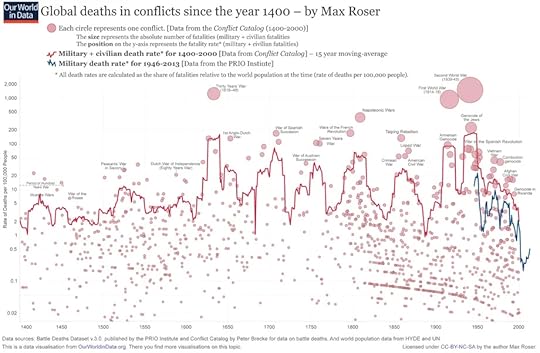
There's been a decline in war deaths that seems loosely correlated with advancing technology:

war deaths from 1400

From my review of War in Human Civilization by Azar Gat, some leading theories of what caused this decline are:

* increased wealth makes people more risk averse
* war has become less profitable
* young males are a smaller fraction of the population
* increased availability of sex made men less desperate to get sex by raping the enemy ("Make love, not war" wasn't just a slogan)


Space colonization won't directly have much affect on these factors, but the technologies related to it that Deudney opposes will likely increase wealth and life expectancy, thereby making war less likely.

I'm less optimistic than is Deudney about arms control being stable and effective, and more optimistic that some of these other factors will make war less likely.

War is the kind of problem where we don't have strategies that come close to guaranteeing good results. So it's hard to resolve the disagreement I have with Deudney here.

The preponderance of the evidence says that Deudney is wrong about the effects of space colonization on war. I'm uneasy that I can't make stronger claims than that. I hope that this is studied more carefully by someone with more expertise on war that Deudney or myself.


Inhuman Descendants?

Where Bostrom sees a future with 10^32 people, Deudney sees 10^32 aliens.

The default outcome of massive population growth into new environments is that humans will adapt to those environments. Humanity will fragment into different species.

Deudney's hostility to such adaptation is partly due to concerns about it contributing to war. But he also strongly implies that he attaches little moral value to most beings who have adapted to new environments.

I'm tempted to dismiss Deudney as a xenophobe. But that's mostly a reflection of my cultural values, not an objectively more moral position. I'm vulnerable to similar criticisms from people with broader notions of what constitutes a person. Let's just say that Deudney's culture is alien enough to mine that we'll have extreme difficulty finding policies on which we can agree.

Species radiation may open new possibilities for biological warfare. As long as all the adversaries in a conflict are human, the employment of comprehensively lethal bioweapons inevitably risks suicidal blowback, but this limiting factor disappears if adversaries have biologically diverged.


I don't see how that possibility is new. See how smallpox affected the new world.

This risk only weakly depends on the degree of divergence. It depends more on the rate at which defenses against such attacks are developed. A Promethean future will likely create defenses. I'm unclear whether Deudney's preferred future would.

Freedom and Democracy

Deudney predicts that space colonization won't produce the freedom that its advocates are seeking. Instead, it will produce colonies that are more despotic than what he expects from his preferred sustainably stagnant Earth.

He only devotes a couple of pages to this topic, leaving me with less understanding of his reasoning than with other predictions. His main evidence seems to be historical patterns of ship governance.

Ships are never governed as democracies, and the rights of all are massively circumscribed by the operational needs of the machine.


I have a clear counter-example: 18th century pirate ships were democratic. Possibly even pioneers in Western civilization's struggle to adopt democracy.

Those who fear world government as a threat to freedom on Earth and look to space expansion as a freedom frontier fail to consider the effects of a Solar Archipelago on the trajectory of Terran political development. ... a sure path to the political unification of the Earth would be the emergence of a threat from beyond


It's not so much that we fail to consider it. It's due to a combination of (1) differing predictions about how likely space expansion is to influence such unification, and (2) we consider Earth to be a much smaller fraction of what we care about than does Deudney.

Hype
Deudney complains that advocates of space colonization overstate the advantages and overlook the risks and difficulties.

Those are mostly valid complaints against those who treat space colonization as urgent. It is not yet time for a massive push toward large-scale space colonization. That means that people who currently lead space advocacy have been selected for overconfidence.

I used to share that overconfidence back during the Cold War. In hindsight, I was implicitly assuming that land and natural resources were the primary determinants of a society's wealth. I've changed my mind due to sources such as Julian Simon, and this kind of analysis:
In 2014, natural capital (including both exhaustible and non-exhaustible resources) accounted for about 50 percent of the total wealth of low-income countries. In the same year, it accounted for 3 percent of the total wealth of high-income OECD countries ... natural capital only contributed to 10 percent of growth in low-income countries. In advanced economies, it contributed to 3 percent of growth during that period.


I now consider space colonization to be a low priority, most likely something to be started a few decades from now.

Minor Points
In his attempt to warn us of the anarchy that will prevail among space colonies, he writes:
A better analogy for the prospects for a solar federation is to be found in the abortive efforts in the late nineteenth century to establish a British imperial federation.


I gather that he wants us to be scared of the extent to which relations between the British Isles, Canada, Australia, and New Zealand have been anarchic. I'm sure his allies are scared of such anarchy. But I think he could have found a better example if he'd focused more on persuading people who didn't already agree with him.

Deudney has a favorable opinion of Environmental Impact Statements. He cites them as being responsible for the discovery that CFCs were damaging the ozone layer. The short histories that I've found on the web do not confirm any role for those statements. I don't have time to read the books that Deudney cites, e.g. this one. I suspect Deudney exaggerates.

Examples of his insults:
Libertarianism, the political philosophy of the politically naive (or the cynical rich), is adept at privatizing the benefits of public expenditures but is unlikely to propel significant human expansion into space.


Unlimited extensive growth, the goal of Promethean modernity, is the ideology of a cancer cell and a planetary menace.



Conclusion

Deudney is a mostly respectable adversary. Dark Skies helped me understand opposition to technological change.

He overstates the risk that allowing humanity to fragment into diverse populations will cause destructive conflicts. I see plenty of cooperation between humans and cats, and plenty of conflict between the People's Front of Judea and the Judean People's Front.

There's a bit of truth behind Deudney's concerns. I think those concerns are heavily outweighed by the potential benefits of Promethean technologies. Deudney seems mostly blind or indifferent to those benefits.
1 review
April 14, 2020
What a great book! Deudney combines insights from a range of scholarly communities to argue that there are unacceptable (existential) risks associated with space expansionism due to the interplay of nuclear weapons, weaponized asteroids, and geopolitics. Aside from problematizing habitat space expansionism, Deudney's second main contribution lies in the clear and well-researched typology that he offers of space expansionist proposals and ideologies. Deudney divides space expansionism into three main strains and discusses each of them in great detail. The first is habitat space expansionism, which consists of a large variety of (thereotical) proposals to build settlements outside of Earth to gain Lebensraum and create redundancies for survival. The second is military space expansionism, which can be simplified as space-based (nuclear) weapons are feasible and desirable. The third is planetary security space expansionism, which refers to space-based arms control and cooperation to strengthen international institutions and foster global identities.

Deudney dubs the tensions between military and planetary security objectives in near Earth space as the first great debate on space. What he aspires to open is a second great debate on the larger, more long-term aspiration of habitat space expansionism. Even though I personally remain in the habitat space expansionist camp, I fully support Deudney's problematization of it. The geopolitical challenges of space expansion are as great as the engineering challenges, and we neglect them at our own peril.
86 reviews2 followers
November 1, 2021
Dark Skies is a VERY hard book to read.

First of all, you must realize that you're reading one giant unpopular opinion that argues against what many consider to be exciting, fascinating, and somewhat necessary, and that is of course space expansionism.

The difficulty stems from the way Deudney outlines his thoughts. Chapters are near endless and tend to lose rhythm quite quickly. The arguments tend to get a bit off track from the original subject, and as soon as the author has seemingly made his point, he'll drone on for another 15 pages.

The subject matter is a bit "out there" as well. I found myself skimming several chapters wondering what the author was trying to get at. It reads like somebody just jotted down all their thoughts on any subject that came to mind and decided to throw them together and try to make it stick.

There were a few useful snippets and I appreciate the counter-argument to space expansionism but it's a tough read and was not enjoyable.
2 reviews
October 29, 2022
Deudney may construct his argument in a very roundabout way, with claims being dropped for chapters on end, only to be revitalized in an entirely different section of the book, but Dark Skies presents a well-reasoned argument against the human drive toward space expansionism. While I don't agree with the eventual conclusions he reaches about space militarization and its implications for the Earth, I can't ignore that he had me questioning my own logic quite a few times. It raises vital questions about how the political balance of power will shift as other human-populated entities reach a level of organization comparable to earth, but I again don’t agree with his vision of how that balance will affect humanity as a whole. It is ultimately hard to predict exactly what would happen when considering questions of such scale on such a large timeline without making major leaps in assumptions about human nature, but I can’t fault Deudney for his boldness.
Profile Image for Henry.
57 reviews3 followers
July 10, 2025
Daniel Deudney’s Dark Skies: Space Expansionism, Planetary Geopolitics, and the Ends of Humanity is a formidable, often unrelenting work that challenges the dominant narratives of space exploration with the weight and density of a collapsing neutron star. It is, in many respects, the intellectual equivalent of a planetary defense system—aimed not at asteroids, but at the runaway enthusiasm for colonizing the solar system. With Deudney as a kind of grim space-age prophet, the book warns that humanity’s extraterrestrial ambitions may be not a bold leap forward, but a tragic stumble into a militarized, unstable, and potentially apocalyptic future.

At its core, Dark Skies contends that space expansionism is not the morally neutral or inevitability-charged venture its proponents often claim, but rather a deeply political act shaped by terrestrial power structures and Cold War legacies. Deudney is particularly concerned with how these ambitions—particularly those cloaked in techno-utopian language—might accelerate existential threats. He draws direct lines between spacefaring dreams and nuclear brinkmanship, asserting that the same forces that built missiles to destroy the Earth are now fashioning them as vehicles to “save” it. The irony is not lost on him, and it forms a central pillar of his argument: that without rigorous, Earth-centered governance, space development will not liberate humanity—it may end it.

To his credit, Deudney offers a coherent alternative. His “Space for Earth” agenda is a grounded, sober response to escapist fantasies about Mars colonies and asteroid mining empires. He champions the redirection of space activity toward environmental monitoring, nuclear de-escalation, and sustainability. It’s the sort of vision that rarely makes headlines or inspires science fiction franchises, but it does have the benefit of being both realistic and responsible.

However, that clarity of purpose is frequently obscured by the book’s sheer mass of content. Dark Skies is packed to the airlocks with geopolitical theory, historical analysis, philosophical musings, and enough references to fill a doctoral syllabus—and that’s really what it is best suited for: a graduate-level, academic audience already fluent in international relations, space policy, and global security discourse. For serious scholars, this book is a must-read—an intellectual gauntlet thrown down in the middle of the astrostrategy table. But for the mildly curious general reader, or anyone simply looking to understand the risks and rewards of space development, this is not the place to start. It is not written in an approachable manner. It assumes a high level of prior knowledge, endurance, and perhaps even an above-average fondness for footnotes. A reader with only passing interest may find themselves stranded somewhere around chapter three, adrift in an ocean of citations and wondering when the author plans to land the rhetorical spacecraft.

Further complicating matters is Deudney’s tendency to wander off course. The book’s thesis is strong, but at times buried beneath layers of tangential excursions and selectively curated evidence. There are moments when one suspects that, in his effort to be comprehensive, Deudney simply couldn’t resist including everything—even when it distracts from rather than sharpens his core message. The result is a work that feels less like a guided tour of a critical issue and more like being handed the entire filing cabinet.

Critics have rightly pointed out that some of his most dramatic claims—such as the weaponization of asteroids or the inevitable descent into cosmic authoritarianism—rest on thin or speculative ground. His curt dismissal of interplanetary federalism, for example, overlooks the real potential for cooperative governance in space, a topic that many believe warrants deeper exploration rather than summary rejection. And while the warnings about space militarization are valid, the tone occasionally veers from cautionary to catastrophizing, as if Deudney fears we might start the next world war from low Earth orbit sometime next Tuesday.

Still, there’s no denying the value of Dark Skies as a provocative counterweight to the dominant narratives of space as humanity’s salvation. It forces its readers—those who can endure the journey—to consider the geopolitical consequences of space development with greater seriousness. It challenges the comfortable assumptions that have driven both public enthusiasm and private investment in off-world futures.

In the end, Dark Skies is not a crowd-pleaser, and it’s not trying to be. It’s a fire alarm in the observatory, an urgent plea for caution in an age drunk on acceleration. For scholars and policy professionals, it is a rigorous, sometimes maddening, always thought-provoking interrogation of our extraterrestrial ambitions. For casual readers, it is best approached with caution—or perhaps not at all. If your curiosity about space policy is more “documentary on Netflix” than “PhD dissertation,” you may want to look elsewhere. But for those prepared to do the intellectual heavy lifting, Deudney offers a bracing, if often overstuffed, tour of the darker side of our cosmic aspirations.
Profile Image for Karl.
378 reviews7 followers
February 24, 2022
The literature of space settlement is by its very nature highly optimistic, perhaps excessively so. In reading the works of authors like Gerard O'Neill or Robert Zubrin, I often sense a enthusiasm that fails to consider all of the necessary angles. For example, why is it assumed that a space colony would (somehow) be a bastion of personal liberty when the very nature of such a settlement would require an erosion of such liberty? How could everyone be free if so many freedoms could threaten the community's survival? The most sobering point that Deudney makes is about the dangers of dual use technology: the same methods used to deflect or redirect an asteroid, could easily weaponize that asteroid. The Solar System has no shortage of ammunition.

I've read some of Deudney's other academic works, so I was familiar with his broad take on international relations. He is trying to consider space from the standpoint of international anarchy (i.e., the world that has existed for thousands of years) and apply some of those lessons to a possible anarchic multi-polity Solar System of the future. He is also attempting to devise some kind of language to understand how an "international politics" of an inhabited Solar System might look, and its possible dangers of Humanity.

I feel that book is a useful contribution to the literature of space politics and a valuable counter-argument to the widely espoused narrative of outer space manifest destiny.
Profile Image for Carlos.
2,702 reviews77 followers
February 18, 2024
In this slow and methodical work Deudney lays bare all the hidden assumptions behind the push to get humanity into the stars, as well as the perfectly predictable consequences that are being willfully ignored. Deudney main criticism of “space expansionists” is the way they ignore holes in their proposals, either of scientific discoveries not yet made (how to successfully sustain an enclosed ecosystem) or of human nature (assuming once humans leave the earth all the simmering conflicts and military use of new technologies will disappear). He sets out therefore to lay out all the basis for his argument of caution and entirely ending certain lines of inquiry. This results in a very long winded establishment of historical, geopolitical, and game-theory analysis to buttress his arguments. On the other hand, he very skillfully uncovers the hidden aspects of current space programs, from their almost exclusive military beginnings to the continued push by certain lobbies to resume more overt military programs, showing the kinds of dangers that are being ignored. While Deudney certainly makes a strong argument for caution and for re-routing the energies of space programs around the world, the whole work feels like someone yelling to a runaway train to stop.
2 reviews
November 1, 2022
In Dark Skies, Duedney thoroughly explores the possible consequences of space exploration and expansion, and his compelling arguments warn about the impacts of it to humanity. Unlike other literary works, Duedney works to debunk the romanticized idea we have with expanding into space. He goes as far as to argue that this could have the devastating effect of ending the human race. Throughout his work, he uses geopolitics to support his argument that current political conflicts would also continue to be perpetuated in foreign spaces. An important example of this is his references to recent times of political turmoil, such as the arms race. An argument that stood out to me was his take on how technology in space could have long term effects on the human race. His examples of possible uses of technology to improve or even replace humans poses lots of ethical questions that sway readers to believe that it could only adversely affect humanity. Overall, this book strongly opposes the idea of looking to space as a possible place to expand, arguing that the threats, such as those on the human race, are too great to ethically pursue it as a serious option.
2 reviews
December 5, 2022
Duedney's Dark Skies was a fascinating read for someone completely unfamiliar to any topics related to space at all. The read is clear and succinct enough that I feel I have a thorough understanding of what it takes to travel and colonize space. I didn't find his argument for or against space abundantly clear, but his simplistic diagrams and explanations created a space pessimism in me. I am not adamantly for or against space colonization efforts, but this book created a sense that regardless, it is unlikely I will see space travel beyond our own moon and possibly some nearby planets in my lifetime. Our science, as I feel Duedney explains, is just not there yet. There is also so many ethical concerns to be considered when looking at space travel. In an example that covers both, in the science of building an ecosystem (for the purpose of doing so on another celestial body), the failure was extreme, the project expensive, and it eventually fell apart anyways because of drama involving its funder. Humanity is just not yet ready for space, there are far too many known unknowns and countless more unknown unknowns.
Profile Image for Rue.
2 reviews
November 1, 2022
To begin, I am more than happy to give Daniel Deudney’s book an enthusiastic five stars. Even if only for saying what I’m sure any skeptic of modern space expansion is privately thinking, “Allowing a handful of messianic internet billionaires to steer the space enterprise is an extremely dubious way to make decisions with species-existential consequences” (380). In what can only be called a sea of rising optimism, his counter-argument should serve as a reminder that we ought to anchor ourselves to some understanding of human reality. As he suggests throughout Dark Skies, we cannot divorce space expansion from either the potential repercussions for the future of humanity or from the motivations of those who are funding it (regardless of whether you are speaking about the likes of Elon Musk, or our own governments). For anyone who has reservations about modern space expansion, Dark Skies is a breath of fresh air. For those who have no reservations whatsoever about modern space expansion, Dark Skies ought to be thought of as a must-read.
3 reviews
August 9, 2025
I listened to the audiobook - and the narration and pacing are excellent at putting one to sleep on a re-listen!

Be that as it may, this book is an important counterpoise to overly optimistic, naive or techno-fetishistic believers of a utopian expansion into space.

Deudney focuses on how human nature, exposed in historical precedents, argues against a lot of the utopian arguments for both the simplicity and the utility of expansion by emphasizing the persistence of conflict, inequality, and environmental degradation even in new frontiers, suggesting that these problems are likely to be at best relocated, or at worst magnified rather than solved.

The author's premise and arguments are important, and rarely expounded outside of Luddite / green movement circles, both of which are burdened with other political issues that are not relevant to the discussion of space expansionism. Therefore, whilst this book should objectively only have 3 stars as the writing is dry and somewhat repetitive, I'm going to bump it up a bit due for its counter-narrative significance.
636 reviews176 followers
September 26, 2021
A stinging indictment of the boosterish nonsense promoted by space expansionists which use a series of misleading metaphors not only to delude themselves and others about the feasibility of human space colonization as a solution to existential risk but also to distract us from the grave dangers posed by the main actually existing space program, which is overwhelmingly military in nature and which drastically exacerbates the primary real existential, which is nuclear war.

Theoretically intense and densely argued, it is a polemic specifically designed to infuriate the space expansionists (like this guy https://www.goodreads.com/review/show...) who risibly believe that that outer space represents some get out of jail free card to escape from the political dilemmas of being human on a crowded planet.
Profile Image for Leona.
2 reviews
October 31, 2022
I love how interdisciplinary all of Deudney’s arguments and evidence are. He dives into ethics, philosophy, physics, astronomy, and social science. There is no stone left unturned as he argues against space expansionism. Despite his writing being filled with various theories and examples, his prose-like style struck me. Deudney infuses his book with captivating imagery to accompany the imaginaries he presents. Additionally, his sense of humor is an Easter egg between the lines. I found myself laughing at how aliens would certainly finish off humans if aliens behaved like how humans treat each other. Aside from these two highlights, its crowning jewels are the six threats space exploration will continuously bring to humanity. Dark Skies is a beautifully written intellectual challenge for all who love the infinite stars and beyond.
2 reviews
October 31, 2022
This read was not what I was expecting going in because it paints a much less optimistic view of space exploration that shocked me when reading. This negative view was the first thing that really shot out at me but that’s not to say that I didn’t appreciate this point of view. I found it fascinating, the points that Deudney brought up to support his argument and he presented them in a very interesting fashion making it not an easy read as there are many sections that feel like side-tracks, but a very intriguing read. It is clear that Deudney is incredibly well versed in this topic and passionate about the debate of the future of space exploration and I would highly recommend anyone slightly interested in this topic to give this a read.
Profile Image for Bjkeefe.
125 reviews14 followers
March 16, 2025
DNF. I found this a bit of a slog, although I feel guilty enough about saying so that I hope I will go back and finish it.

Part of the problem, I have to admit, is that Deudney is strongly opposed to pretty much everything to do with expansion into space. Which, to put it mildly, does not align with my views. I have tempered my enthusiasm for crewed missions ASAP (links upon request) but I still believe in that goal after we've gotten some more smarts. And meanwhile, I'm an unabashed fan of robotic missions. So this is probably part of why I found this book to be a bit of a slog -- while I think it is a Good Thing to read points of view different from mine, it is also true that it takes work, and these days, I mostly read books for fun.
Profile Image for Ryan Nowicki.
1 review
November 1, 2022
I found Deudney's Dark Skies to be a thoroughly engaging read, despite the sometimes dense language. Deudney does a good job capturing and questioning many of the possible scenarios that humanity will face in its quest to conquer the Solar System, and he presents them tactfully, although biased toward his own opinion -- fitting of a work designed to be an argument, rather than a simple telling of facts. I highly encourage this read, though I suggest future readers be aware of Deudney's ultimate perspective as one critical of human exploration of and expansion into space.
79 reviews6 followers
May 28, 2024
Very important arguments, an absolute must-read for anyone interested in space.
Sadly the editor was asleep at the wheel here, the book is 200 pages too long (for most readers). If you are very interested in the history of ideas of space expansion, the length is all right, since this book is a combination of (1) a book on the history of ideas of space expansion and (2) an argument that the risks of space expansion outweigh the benefits.
Profile Image for Clarissa.
20 reviews
May 12, 2025
Great critique of space expansionism. It is shocking hard to find rigorous, well researched and well argued critiques of space expansion/colonization but this text is top notch. I am an academic so perhaps my view is not accurate to the generalist reader but I found the writing accessible, nuanced, well cited, and at times even funny. Deudeny is an excellent writer and his arguments are vital to anyone interested in the pro/anti space debate.
Profile Image for Sally Robinson.
246 reviews3 followers
May 16, 2021
What had potential to be a very interesting topic was presented in a very dry and drawn out manner.
Profile Image for Douglas Shaw.
12 reviews
March 30, 2022
Must read for understanding the role of space technology in human survival.
Displaying 1 - 28 of 28 reviews

Can't find what you're looking for?

Get help and learn more about the design.