Barbro Enskog was born in Bromma, Stockholm. She graduated from art school in 1958 and has been writing books for publication since 1965. Her style has exerted a major influence on Swedish children's literature. Located between realism and surrealism, her works are humorous and imaginative, and her books for children treat important issues to be taken seriously and treated for children. Early in her career Barbro Lindgren won the 1973 Astrid Lindgren Prize, an annual Swedish literary award distinct from the Astrid Lindgren Memorial Award. The once-in-a-lifetime award established on Astrid Lindgren's 60th birthday honours good writing for children or youth. Barbro Lindgren's long-time collaborator, the illustrator Eva Eriksson (born 1949), won the Prize in 2001.
I don't review that many board books. A lot of this is due to the fact that they're just not really things that come across my radar. Some of this is due to the fact that they're always fairly well beaten up in any library (and this is a good sign, trust me, because they're being heavily used) and also because I've never seen much space in the books to *allow* me to review them. Picture books, yes, they're full of space - but board books? They're complex beasts; texts designed more to engage a child with the *idea* of literacy than literacy itself (which is something, by the way, that I shall be writing about in the future). I find them fascinating but I never really found them reviewable.
Until now.
(She says, dramatically).
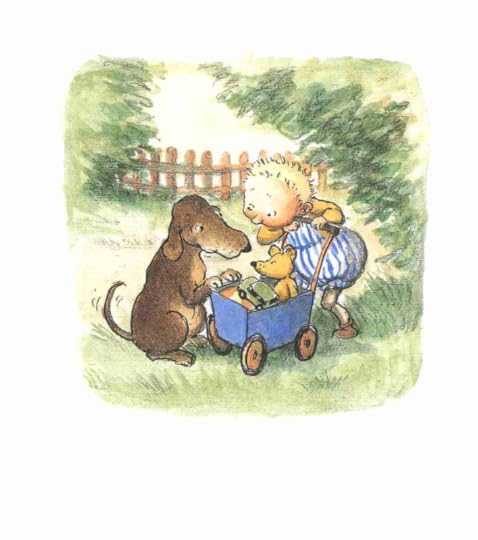
Max's Wagon is an utter joy. It's probably the most perfect board book I've ever read. I picked up whilst shelving one day and flicked through with vague interest. This vague interest of mine turned to a rapid and intense love. It's a simple, elegant story. Max is putting things into his wagon. This includes toys and his dog; a mildly perplexed, Gromit-esque hound who obediently jumps in and then helps Max to pick up all the things that fall out of the wagons. Max's ball gets put into the wagon, it falls out, and gets put back in. Max's car gets put into the wagon, falls out, and gets put back in. Max's cookie goes into the wagon, falls out .... and ?
"Dog gets the cookie /
The cookie has gone /
Where is the cookie?"
The last panel; a *very* innocent dog sits on the side of a wagon being carefully studies by Max who is very concerned as to where his cookie has gone. Nothing is explicit, there's no crumbs on the dogs face but the teddy is looking right at the dog (and so's Max, his body language is towards the dog) and the dog? He's sat there with an expression very familiar to anybody who has ever done anything that they shouldn't have done. It's adorable. Such a small moment but it's so vividly drawn and constructed, the dialogue between the understated text and the understated drawing, I could bang on for hours about this panel but I won't. Suffice to say, it's beautiful.
That little note of doubt (who ate the cookie? Where's the cookie gone?) is such a glorious way to end this because it opens the book up to questions and dialogue and conversation. It opens up a reader to the possibility of a conversation going beyond the space of the book and that possibility is something that can be returned to and interrogated as the child grows up. It's just perfect and I love this book so much for what it gives to the reader. Because it's everything.
Max is an adorable child. His wide-eyed, innocent expression invites readers to empathise with him. He’s a busy boy who is constantly occupied with everyday childhood tasks.
In this clever story, Max is seen loading his wagon with his preferred play things, including the family dog. Young children need regular nourishment so a cookie is added to the cargo. Soon the wagon is overloaded and stuff starts spilling out. Max’s dog is helpful at retrieving the items - all except one ....
The colourful illustrations are appealing, particularly Max’s blue-striped, padded overalls which accentuate his vulnerability. Although his dog is a loyal companion, the canine’s watchful eyes show he is on the look-out for an opportune reward.
This quality hardback book is one of a splendid series for young children. Other titles are: Max’s Bear and Max’s Bath.
"Sam's Wagon" by Babro Lindgren tells the cute story of Sam and all of the items he places in his wagon. The story begins with Sam placing a teddy bear in his wagon. Soon after that, Sam puts his pet dog in the wagon. As Sam continues to push his wagon, he places other items in the wagon such as his toy car, his cookie, and his ball. Once all of these items are in the wagon, a few of the toys begin to fall. When Sam’s belongings fall out of the wagon, the dog does an excellent job of retrieving the lost items and placing the items back into Sam's wagon. Despite the dog’s helpful gestures though, the dog cleverly eats the cookie that falls out of the wagon before Sam could notice. Sam begins searching for the cookie, but it is nowhere to be seen.
After reviewing this book, I am initially disappointed because of the illustrator’s choice of colors in the pictures. The illustrator uses dull colors like tan, brown, dark green, and white to complete the majority of the illustrations. In my opinion, bright colors are better to attract young children and to retain their interest in the story. In addition, the illustrator makes the main character, Sam, blend into the background in many pictures. For example, Sam is a light-haired, fair-skinned boy that is camouflaged in with the brown and tan colored backgrounds in some of the pictures. However, the illustrator does a nice job focusing the reader’s attention on the wagon by painting the wagon a bright blue color. In continuation, Sam's body language and facial expressions coincide perfectly with the text. For example, as the author talks about the teddy bear falling from the wagon, the illustrator shows Sam’s face full of shock and surprise. Additionally, when the author talks about Sam’s cookie falling from the wagon, the illustrator shows the dog’s face lighting up with excitement because he realizes the opportunity for a quick snack.
Furthermore, the illustrator does a lot of framing and bordering for the pictures. More specifically, each picture is placed in the center of the page, and all of the pictures have a white, square border. I think this particular style of border is very plain and boring. However, I think this border is effective for a child’s book because children get distracted easily. Children take in a lot of stimuli, and young children are not experts on filtering unimportant stimuli. Therefore, children may not stay focused on the important points of the story if they are distracted by illustrations that are too busy. With this being said though, I would still recommend this book to children that are just beginning to read. The dialect is very basic, and the text in this book should be fairly simple for a young child to interpret. Also, this story would be fantastic for children with no prior reading experience. The illustrations relate perfectly to the text. Thus, this story would be beneficial to children with no reading experience because it challenges them to utilize their creativity to develop their own twist on this story.