

What do you think?
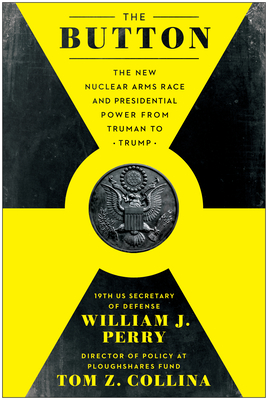
The Button: The New Nuclear Arms Race and Presidential Power from Truman to Trump
Since the Truman administration, America has been one push of a button away from nuclear war--a decision that rests solely in the hands of the president. Without waiting for approval from Congress or even the secretary of defense, the president can unleash America's entire nuclear arsenal. From authors William J. Perry, secretary of defense in the Clinton administration, and Tom Z. Collina, the director of policy at Ploughshares Fund, a global security foundation in Washington, DC, The Button recounts the terrifying history of nuclear launch authority, from the faulty forty-six-cent microchip that nearly caused World War III to president Trump's tweet about his much bigger & more powerful button. Perry and Collina share their firsthand experience on the front lines of the nation's nuclear history and provide illuminating interviews with former president Bill Clinton, former secretary of defense Jim Mattis, congressman Adam Smith, Nobel Peace Prize winner Beatrice Fihn, senior Obama administration officials, and many others. Written in an accessible and authoritative voice, The Button reveals the shocking tales and sobering facts of nuclear executive authority throughout the atomic age, delivering a powerful condemnation against ever leaving explosive power this devastating under any one person's thumb.
335 pages, Hardcover
Published June 30, 2020
Ratings & Reviews
Friends & Following
Create a free account to discover what your friends think of this book!
Community Reviews
Displaying 1 - 29 of 29 reviews
October 28, 2020
I read this as part of an INMM book club at my university. First off, I’m a nuclear engineering grad student whose technical chops deal more with fission reactors than bombs; however, my university offers a really good nuclear security program that I have taken a class or two in. From a policy standpoint, this book makes some great points about how we are literally never more than an order away from wiping out humanity. And even worse, they make it clear that the risks we’ll wipe ourselves out because of a MISTAKE are growing everyday (which was amply covered in one of my nuclear security classes).
Will and Tom make it very clear how partisan politics, defense lobbies, and the armed forces (among others) have stifled progress and misguided nuclear weapons policy. I wish I could have read this sooner....
Will and Tom make it very clear how partisan politics, defense lobbies, and the armed forces (among others) have stifled progress and misguided nuclear weapons policy. I wish I could have read this sooner....

November 29, 2020
Like many Americans, I have assumed that because the Cold War is over, my chances of dying in a nuclear war are pretty slim, and I don't need to spend too much time worrying about the bomb. The Button has convinced me otherwise. William Perry, former Secretary of Defense, and Tom Collina, nuclear weapons policy expert, outline all of the ways in which our current nuclear policies increase the chances of accidental nuclear warfare breaking out, in particular our allowance of first strikes, responding to perceived launches against us before they are confirmed (particularly given our history of false alarms and now cybersecurity threats), and putting all of the decision making power in the hands of one person.
I learned so many terrifying things from reading The Button, and while I am not trying to suggest that we need more things to worry about given the current state of the world, I do think after reading this book that we need to move nuclear disarmament up the list of American priorities. It's appalling that this issue, like everything else, is becoming partisan when we would all equally perish in an accidental nuclear war. I do wish the authors had started with a brief historical overview of the various treaties discussed throughout the book, to give readers like me a better foundation. While it does get occasionally bogged down in policy, I absolutely recommend The Button to my reading friends who want to learn more about this existential threat to our world.
I learned so many terrifying things from reading The Button, and while I am not trying to suggest that we need more things to worry about given the current state of the world, I do think after reading this book that we need to move nuclear disarmament up the list of American priorities. It's appalling that this issue, like everything else, is becoming partisan when we would all equally perish in an accidental nuclear war. I do wish the authors had started with a brief historical overview of the various treaties discussed throughout the book, to give readers like me a better foundation. While it does get occasionally bogged down in policy, I absolutely recommend The Button to my reading friends who want to learn more about this existential threat to our world.

February 19, 2021
This is one of the most important books you will read this year. If the pandemic has taught us anything it is that the collective discounting of future threats cannot continue. Full of great information and arguments for why nukes are one of the largest threats to humanity today.
August 27, 2020
Bought this after hearing a podcast with the author. I think it was on the Same Harris podcast. Highly recommend both.

December 6, 2022
Knowledgeable, passionate and convincing arguments for A) not forgetting about the threat of nuclear weapons B) rethinking US nuclear doctrine - especially the presidential powers, land-based ICBM's and crisis response procedures

January 23, 2023
Generally speaking, I liked this book and agree with the ideas presented. But it was SO REPETITIVE. With better editing, I likely would have given it 4 or 5 stars.
Read
February 26, 2025I'm tellin' you to loosen up my buttons, babe (Uh-huh)
But you keep fronting, uh
Sayin' what you gon' do to me (Uh-huh)
But I ain't seen nothing
But you keep fronting, uh
Sayin' what you gon' do to me (Uh-huh)
But I ain't seen nothing

August 19, 2020
Nuclear weapons, as far as most Americans are concerned, are out of sight and out of mind. After all, the Cold War is long gone. The conflict may be over, but the weapons, strategy, policy and protocol are not gone. In this highly informative and objective book, Tom Collina and former Sec Def Bill Perry, bring us face to face with reality. We, that is the U. S. Stratcom, are still locked, loaded, and ready to pull the nuclear trigger, even though we know it is a lose/lose scenario on an unfathomable scale. On top of that, we are faced with risks which did not exist even during the height of the Cold War. If you were born post Cold War, the danger we face even 30 years after its end, dwarfs the terror of 9/11 and the resulting wars in Afghanistan and Iraq. If you lived in it, this book will be eye opening. If you want to read a book to help you evaluate our two Presidential choices in 2020 in an area that should be one of the highest priorities on any President’s or Congresswoman/ Congressman’s agenda, this book is a good place to start.
September 20, 2024
I hadn’t heard about Perry and Collina’s most excellent book The Button. As far as I know, it wasn’t reviewed in the publications I follow and its publisher is named after the socialist founder of Algeria, hardly reassuring as a source of cogent writing about nuclear policy. It’s a pity this book hasn’t achieved the popularity it deserves, for it delivers devastating criticism at the policy as it stands. Said policy in the US is based on (1) the single authority of the president to launch nukes; (2) the US will launch a nuclear strike based on the warning of a launch directed at the US or any of its allies, without having verified whether there has actually been an attack; (3) Intercontinental Ballistic Missiles (ICBMs) are a key component of the nuclear triad (ground-based ICBMs, misales launched by supersonic fighter planes and sea based missiles launched by nuclear submarines); (4) the US maintains the right to nuclear strike first and unprovoked; (5) the US will maintain and develop a missile defense initiative, to strike down incoming nukes before they strike; (6) the US will match the nuclear buildup by rivals, notably Russia; (7) limited nuclear is possible (limited to tactical rather than strategic use), it may not escalate and it is a viable military option.
All the components of this policy are wrong:
(1) single authority was assumed by President Truman in 1945 to avoid the military leadership from being able to launch nukes by itself. I wasn’t aware that a third nuclear bomb was nearly dropped on Japan without Truman even being aware of it. It has been said single authority is necessary because of the short times (about 10 minutes) available to decide to launch on warning. However, this is a consequence of the launch on warning component, to which I now refer.
(2) launch on warning is, prima facie, a solid policy, for how may one be sure one’s ability to retaliate a nuclear attack will survive the first wave thereof? But things are not so clear. Given that nuclear submarines and fighter jets are highly mobile, most or all of them would survive a first strike and be available for retaliation. Given they carry Multiple Independently-targetable Reentry Vehicles (MIRVs), a single nuclear sub has enough ammunition to nuke the 50 major cities in Russia. So the retaliatory capability will be there even if ICBMs are all totaled.
(3) and (4) may be dealt with jointly. First strike is not really an option for any nuclear power as long as the power to retaliate against it remains, as it does either all the major ones. So it is a worthless threat without any strategic value and should be dispensed with. ICBMs are also worthless (because their locations are known and they can’t be moved, they can be blown up in the ground). They are only useful for a first strike option, which is not viable, as noted. Also, they are the only component of the nuclear triad that can’t be recalled once launched. This, associated with the launch on warning component, is really tantamount to playing Russian roulette with nukes, since it has happened that the nuclear attack detection systems both in the US and Russia have failed repeatedly for decades and are subject to a hack by hostile actors. So, if one were to renounce the first strike option (which only a crazy US president would engage, since retaliation is assured), dismantling ICBMs is mandatory.
(5) The missile defense initiative is a non starter for the US. It could work if deployed for a single city or for a military site, but there is no way to protect the entire country. This was very clearly shown in Annie Jacobsen’s recent book Nuclear War: it only works about 50% of the time, which is about as good as coin toss. Would we entrust all we hold dear to a coin toss? It is also a distraction. The population has been led to believe this is a working defense for a nuclear strike, which it isn’t and will never be, since, if it evolves, attack capabilities will keep pace, and in the end the bomb will get through. It also has dissuaded US leadership (particularly the Republicans, who have been in this, as in other matters, most irresponsible actors over the past 30 years) from maintaining and extending arms control treaties with the Russians, which are the only way to bring down the danger from nuclear annihilation.
(6) The foregoing is why matching nuclear buildup is a mistake: it generates groups interested in a buildup that never ends (the military-industrial complex) and it won’t make anyone safer. The only way forward is cutting down the number of total nukes, not increasing it.
(7) Limited nuclear war is but possible, there are too many factors that would lead to escalation. As the leaders of nuclear powers have said, a nuclear war cannot be won and must never be fought.
Reading this book, which narrates the 70 year experiences of former defense secretary William Perry with nuclear weapons (as I write this, he is 96), is sensible, fact based and always practical. I am saddened that its recommendations will like not be heeded (although he does quote senator Kamala Harris on the nuclear matters, which indicates she has given it some thought) because they contradict the established interests. If president Trump is reelected come November, he is guaranteed to pursue the policy of dismantling nuclear control treaties he followed in hiatus first term. We were lucky there weren’t nuclear emergencies in that term. Will we all be so lucky a second time?
All the components of this policy are wrong:
(1) single authority was assumed by President Truman in 1945 to avoid the military leadership from being able to launch nukes by itself. I wasn’t aware that a third nuclear bomb was nearly dropped on Japan without Truman even being aware of it. It has been said single authority is necessary because of the short times (about 10 minutes) available to decide to launch on warning. However, this is a consequence of the launch on warning component, to which I now refer.
(2) launch on warning is, prima facie, a solid policy, for how may one be sure one’s ability to retaliate a nuclear attack will survive the first wave thereof? But things are not so clear. Given that nuclear submarines and fighter jets are highly mobile, most or all of them would survive a first strike and be available for retaliation. Given they carry Multiple Independently-targetable Reentry Vehicles (MIRVs), a single nuclear sub has enough ammunition to nuke the 50 major cities in Russia. So the retaliatory capability will be there even if ICBMs are all totaled.
(3) and (4) may be dealt with jointly. First strike is not really an option for any nuclear power as long as the power to retaliate against it remains, as it does either all the major ones. So it is a worthless threat without any strategic value and should be dispensed with. ICBMs are also worthless (because their locations are known and they can’t be moved, they can be blown up in the ground). They are only useful for a first strike option, which is not viable, as noted. Also, they are the only component of the nuclear triad that can’t be recalled once launched. This, associated with the launch on warning component, is really tantamount to playing Russian roulette with nukes, since it has happened that the nuclear attack detection systems both in the US and Russia have failed repeatedly for decades and are subject to a hack by hostile actors. So, if one were to renounce the first strike option (which only a crazy US president would engage, since retaliation is assured), dismantling ICBMs is mandatory.
(5) The missile defense initiative is a non starter for the US. It could work if deployed for a single city or for a military site, but there is no way to protect the entire country. This was very clearly shown in Annie Jacobsen’s recent book Nuclear War: it only works about 50% of the time, which is about as good as coin toss. Would we entrust all we hold dear to a coin toss? It is also a distraction. The population has been led to believe this is a working defense for a nuclear strike, which it isn’t and will never be, since, if it evolves, attack capabilities will keep pace, and in the end the bomb will get through. It also has dissuaded US leadership (particularly the Republicans, who have been in this, as in other matters, most irresponsible actors over the past 30 years) from maintaining and extending arms control treaties with the Russians, which are the only way to bring down the danger from nuclear annihilation.
(6) The foregoing is why matching nuclear buildup is a mistake: it generates groups interested in a buildup that never ends (the military-industrial complex) and it won’t make anyone safer. The only way forward is cutting down the number of total nukes, not increasing it.
(7) Limited nuclear war is but possible, there are too many factors that would lead to escalation. As the leaders of nuclear powers have said, a nuclear war cannot be won and must never be fought.
Reading this book, which narrates the 70 year experiences of former defense secretary William Perry with nuclear weapons (as I write this, he is 96), is sensible, fact based and always practical. I am saddened that its recommendations will like not be heeded (although he does quote senator Kamala Harris on the nuclear matters, which indicates she has given it some thought) because they contradict the established interests. If president Trump is reelected come November, he is guaranteed to pursue the policy of dismantling nuclear control treaties he followed in hiatus first term. We were lucky there weren’t nuclear emergencies in that term. Will we all be so lucky a second time?
May 22, 2024
A remarkable book, written by two gentlemen who know their way around American military policy with an emphasis on nuclear weapons. Perry was Secretary of Defense under Bill Clinton, while Collina is a policy wonk focusing on nuclear arms at Ploughshares. They clearly wrote this book to argue for a very different approach to US policy around nuclear weapons. Specifically, they take on the fact that only the US president is able to order a nuclear launch, and he or she requires no other opinion. They want it made specific and overt that the US will not strike first, which would necessarily lead to eliminating nuclear-armed ICBMs, which only make sense as a first strike weapon — they function as a deterrent, but both submarine-based and aircraft-based nukes are better for this purpose. They believe that the cost to maintain and update ICBMs is a colossal waste of money and create additional danger, given that they demonstrate both false positives in our monitoring of Russian launches and the minuscule amount of time a US president has to decide about a counter-launch (they brilliantly walk us through an imaged scenario, which they clear intend to highlight how an uninformed president like Trump might screw this up and destroy civilization, a chilling thought whatever your politics. The book is extremely persuasive, carefully researched and well argued. It is also absolutely terrifying. By a weird confluence of circumstances, I read this book right before reading Rachel Maddow’s Drift and watching a Netflix series on the Cold War and nuclear weapons. Taken together, this is all making me want to get involved in changing US policy regarding nuclear weapons.
Grade: A
Grade: A

May 31, 2023
Nuclear weapons are something that most people have accepted as something that is here to stay. We have grow complacent with the status quo.
The authors outlines how WMD came into being, the history of WMD in Washington & Moscow/Soviet Union, the treaties/deals struck to reduce WMD, and the golden opportunities to reduce nuclear war that were never reached.
No president have ever behaved in a perfect way regarding WMD, so each president is criticized (constructively imo) over their policies (or lack of). In this book Trump is criticized more harshly. I'm not educated enough on this topic to know if this was fair or not, but it is something to note.
This book has a fair criticism of USA's current/past behavior/policy regarding WMD (missile defense, etc). On top of that, it outlines what should be done instead in a simple clear way.
It unfortunately is easy to manipulate uneducated people to support policies that are good on the surface, but terrible in reality (such as Anti ballistic missile defense, etc). Some good policies are counterintuitive (removing all ICBMs). To compound this, nuclear war is still very unlikely, so people get complacent and they don't care. To get effective changes that makes the world safer also requires an educated (educated on WMD), dedicated, and popular president who is willing to go against the flow. However, anything that increase the possibility of nuclear holocaust should receive some focused attention from the public.
I highly recommend this book.
The authors outlines how WMD came into being, the history of WMD in Washington & Moscow/Soviet Union, the treaties/deals struck to reduce WMD, and the golden opportunities to reduce nuclear war that were never reached.
No president have ever behaved in a perfect way regarding WMD, so each president is criticized (constructively imo) over their policies (or lack of). In this book Trump is criticized more harshly. I'm not educated enough on this topic to know if this was fair or not, but it is something to note.
This book has a fair criticism of USA's current/past behavior/policy regarding WMD (missile defense, etc). On top of that, it outlines what should be done instead in a simple clear way.
It unfortunately is easy to manipulate uneducated people to support policies that are good on the surface, but terrible in reality (such as Anti ballistic missile defense, etc). Some good policies are counterintuitive (removing all ICBMs). To compound this, nuclear war is still very unlikely, so people get complacent and they don't care. To get effective changes that makes the world safer also requires an educated (educated on WMD), dedicated, and popular president who is willing to go against the flow. However, anything that increase the possibility of nuclear holocaust should receive some focused attention from the public.
I highly recommend this book.
January 18, 2023
While the principle arguments of this book may be valid, that nuclear weapons pose a threat to all life and the ideal course of action would be to reduce all arsenals to zero, this is not how one would argue for that position. Perry and Collina make arguments founded on provably false assumptions (for example, that the only use for ICBMs is to be a missile sponge). They often argue out of both sides of their mouth (the idea that we can reduce the number of submarines because their targets can be covered by other systems, except that they are also arguing that we should eliminate those other systems, ICBMs, that would cover those targets). Unfortunately, both Perry and Collina should (and almost certainly do) know better. This book is poorly argued and does a disservice to its underlying principles. It was clearly written to sell books, not to change minds.

November 21, 2022
The is an important topic, and Perry was a direct participant in many of the events, but it's basically an anti-Trump screed (which doesn't age very well now that he's no longer President but the same risks/worse still exist). It also doesn't do a great job of covering 1940s to 1970s (other books, including Ellsberg's and others, do that far better), and is hilariously wrong in light of heightened conflict with both China and especially Russia in the past year. Skip this book and read The DOomsday Machine (Ellsberg) and Command and Control (Schlosser).

November 25, 2024
This book was equal parts interesting, informative, and downright scary. Some information seemed a bit repetitive from chapter to chapter, but it made sure to drive home the main points about the dangers of one person being in control of such a world-altering decision, and it also made clear that being constantly ready for an unlikely first-launch was not the safest option as well. I was quite fascinated with the nuclear history, as well as the first-hand anecdotes and experiences from the authors.

August 6, 2020
The authors make a cogent, convincing case why the decision to use nuclear weapons should not be solely up to the President of the United States. They further make the case for the U.S. to significantly reduce its nuclear weapons arsenal, and advocate for several other major reforms to U.S. nuclear arms policy. An important, authoritative account of one of the most urgent of national security matters.

January 31, 2021
Solid overview of current and past approaches toward nuclear arms usage with an emphasis on current policy and recommendations to lessen the very deadly and world-ending mistake of a nuclear engagement. The author specifically went into the most frightening aspects of having a complete moron in charge of the nuclear football via the 45th President, and presented other options for approaching arms and proliferation that were sound and will hopefully one day be put into action.
September 3, 2020
This book explains the terrifying This book explains the terrifying existential risk of nuclear bombs with a focus specifially around “sole authority”. At any moment, the President of the US (along with Russia, China) has the power to render the world uninhabitable. It doesn't have to be this way, and Perry explains why.

September 10, 2021
Excellent overview of the situation up to recently. There is a LOT of repetition, but maybe it needs to be dinned into people's head how appalling the whole nuclear scenario is. Listened as an audiobook.

October 12, 2021
This book is well-written, easily digestible, and frames its argument clearly and cohesively, but I wish it would have taken a more nuanced and thorough approach towards addressing different counterarguments.
December 30, 2025
Interesting and scary, read alot in this topic, is it trustworthy? I found sometimes some of the stories a little tabloid paper warning but most parts in the book where very accurate and well researched. Liked the book but give it a 3 star.

September 2, 2020
See my review here: https://medium.com/@pastey.n/book-rev...
February 6, 2021
Authors are authoritative and provide an accessible understanding of the history of nuclear weapons. Using historical evidence and logic, they present a convincing argument for their thesis.
February 19, 2021
Dank book alert!

November 5, 2021
3.5 stars
June 12, 2024
A book that may keep you up at night.
October 16, 2024
A bit dated (Trump as president) and a bit partisan but very thought provoking.

August 8, 2025
Some excellent arguments on an important subject, but at times a bit too repetitive.

September 17, 2025
Not quite as compelling as "Nuclear War."

December 6, 2023
Great overview of the history that lead to our current nuclear policies, without getting too into the weeds. Shame it was published shortly before Russia invaded Ukraine, which rendered some of the analysis quickly outdated. Despite that it really is approachable and informative - I recommend.
Displaying 1 - 29 of 29 reviews