“How many of the detective stories you read do you remember?” Not very many. And there Margery Allingham stands out like a shining light.
In this collection of eighteen short stories, Queen of Crime Margery Allingham dabbles in the occult, the mysterious, and the murderous. Always the perceptive observer, Allingham fills these stories with astute characterisations, brilliant humour, and her classic wit.
With a tribute by Agatha Christie, this Golden Age collection is sure to dazzle and delight fans of this master of detective fiction.
The Allingham Minibus was first published in 1973 and has also been published as Mr Campion’s Lucky Day and Other Stories.
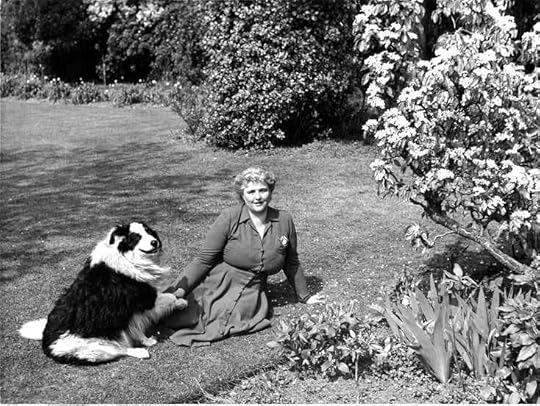
Margery Louise Allingham was born in Ealing, London in 1904 to a family of writers. Her father, Herbert John Allingham, was editor of The Christian Globe and The New London Journal, while her mother wrote stories for women's magazines as Emmie Allingham. Margery's aunt, Maud Hughes, also ran a magazine. Margery earned her first fee at the age of eight, for a story printed in her aunt's magazine.
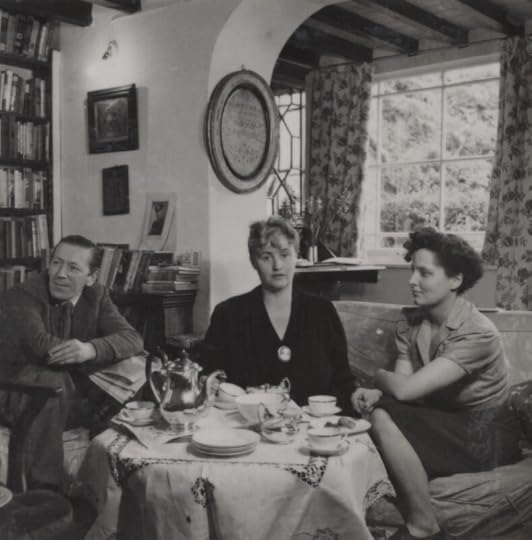
Soon after Margery's birth, the family left London for Essex. She returned to London in 1920 to attend the Regent Street Polytechnic (now the University of Westminster), and met her future husband, Philip Youngman Carter. They married in 1928. He was her collaborator and designed the cover jackets for many of her books.
Margery's breakthrough came 1929 with the publication of her second novel, The Crime at Black Dudley. The novel introduced Albert Campion, although only as a minor character. After pressure from her American publishers, Margery brought Campion back for Mystery Mile and continued to use Campion as a character throughout her career.
After a battle with breast cancer, Margery died in 1966. Her husband finished her last novel, A Cargo of Eagles at her request, and published it in 1968.
Did I enjoy all eighteen short stories equally? Of course not. There is, however, plenty to like in this collection as the author had many different talents. I had not read any of her "ghostly" tales previously and there are some good ones in this book. Albert Campion wins the prize for one of my favorite stories of the bunch. The "Minibus" consists of a wide variety of story types with characters that are truly rich in detail and thus easily envisioned. This book can provide hours of enjoyable reading and can certainly be revisited.
NetGalley Reader's Copy - Thank you to Agora Books To be published Oct 10, 2019
The Allingham Minibus was first published in 1973 and is about to be re-released. This eighteen story collection begins with a tribute to Margery Allingham contributed by Agatha Christie. There are only three Albert Campion stories among this collection which, I must admit, was a bit of a disappointment to me. Those stories are: Mr. Campion's Lucky Day, The Unseen Door and The Man With the Sack. Of the remaining stories, many of them have supernatural or paranormal elements. I have noticed in the past that Allingham seemed to enjoy writing stories that touch on the mysticism of ghosts and specters so if you enjoy a little bit of the creepy/foggy atmosphere this collection might be just the next read you are searching for. Most of the stories are very short; the exception to that is A Quarter of a Million which pits a gang of criminals against Scotland Yard.
This was a nice, fast read with an assortment of stories so I never knew what to expect next. I don't think they are the best examples of the talent possessed by Allingham because her best work needs more space and scope to develop the characters and atmosphere over a longer period of time. If you are exploring the style of writing for Margery Allingham, this collection will give you some peeks into her abilities, but her novels are quite different from the stories presented here. Agatha Christie said she thought Death of a Ghost was one of Allingham's best books. That's a great recommendation.
Thank you to NetGalley and Agora Books for an e-galley of this collection of short stories.
An excellent collection of short stories from Margery Allingham. I expected them all to feature her favourite detective, Albert Campion, but, in fact, only two of them did. Both of them were excellent, demonstrating Campion's ability to grasp the salient clues to quickly solve both mysteries. I enjoyed them very much. I was surprised, pleasantly it turned out, that there were 3 or 4 ghostish stories contained in the book. I can't say the endings totally surprised me, but I enjoyed them very much. My favourite story also happened to be the longest, A Quarter of a Million, which featured a gang of ruthless, cunning robbers who didn't mind killing to get what they wanted and an intelligent police inspector who was able to outsmart the gang, with a neat little twist at the end as he explained how he had figured things out. All in all, a most enjoyable collection.
Varied and intriguing, these 18 tales, mainly dating from the 1920s 30s and 40s,display different aspects of Allingham’s not inconsiderable talent to amuse, bemuse, and feed the soul of the reader. Resurrection, immortality, life after death, in their various forms and meanings, are found here. Marriage is looked at obliquely in a few of the tales, most wonderfully in “The Pioneers”.
Campion crops up in three, but there is not much by way of conventional detection, except in the over-long “A Quarter of a Million”. Ghostly themes predominate.
I would have appreciated Bibliographical information about the stories, as this helps one understand the development of a writer’s craft and style.This could profitably replace the tepid Tribute by Agatha Christie, which said more about that writer than about Allingham.
Not for the Campionistas, but essential reading for lovers of the Margery Allingham who was more than just one of the Queens of Crime.
Thank you to NetGalley and Agora Books for the digital review copy.
A side of Margery Allingham that isn't apparent in the Campion books.
I suspect that many Allingham fans have never read anything but the seventeen books featuring amateur detective Albert Campion. Campion was a popular character early on and (as writers do) she capitalized on his popularity by writing a long series of books about him. Had she not died young (age 62) I'm sure there would have been more.
I like the Campion books, especially after his creator stopped imitating Lord Peter Wimsey and let her main character mature and become less irritatingly fey. It's not my favorite series and I've enjoyed reading Allingham's stories and novelettes, which showcase her talent and intelligence in a way that the formulaic Campion books do not.
She lived when magazines were plentiful and paid well. Most authors found that checks for magazine stories were especially welcome during the dry months between the last book published and the next one. An author then collected those stories and got paid twice. Surprisingly, Allingham only published one story collection during her life, but her widower brought out several after her death and this is one of them.
I was interested in the introduction by Agatha Christie, who was an admirer of Allingham's work. They weren't close, but Mrs Christie must have been shocked at Allingham's death in her early sixties. Christie herself lived to be 85 years old and kept writing almost until the end. As a writer, Allingham should have had many good years ahead of her.
I was also interested that Christie classified books as enjoyable or memorable. I, too, rate a book by how much I think about it after I finish it. Dame Agatha considered "Death of a Ghost" to be Allingham's best book, while I think "Tiger in the Smoke" is far above the rest, but both of us admire her writing.
There are seventeen stories in this book and Campion only appears in three of them, all typical mystery stories in which the gifted amateur pulls a rabbit out of his hat. They're good enough, but I enjoyed the other stories more.
Six of the stories are ghost stories or paranormal tales and I'm reminded that Agatha Christie wrote some fine ghost stories. Spiritualism was popular in the early 1900's and even considered a "science." Writers like Allingham and Christie who were young during that time weren't ashamed to create a spooky story.
My favorites are the stories that don't include a crime at all. "Publicity" is a wonderful story about a famous, popular stage actor who's middle-aged, but still a heart-throb. Will marrying a much younger woman keep his image fresh? Or will it blow-up in his face?
Another good one is "The Pioneers", which concerns a pair of artists who have made marriage work for them, much to the surprise of their unconventional friends. But what happens if the Great Experiment goes bad?
Judging from her books and stories, Allingham was a woman who had wide interests, including theatre, art, fashion, and dancing. She used her knowledge of those different cultures to tell her stories. It's rare for an author to have created so many characters who were so different from each other and yet all so realistic. I think Mrs Christie was justified in calling Margery Allingham "a shining light" and these stories show her talent to excellent advantage.
A knitting designer I follow, Kate Davies, is doing a summer knitalong and readalong, books by Margery Allingham. I am embarrassed to say I had not really heard of her so I set out to remedy that. Of course the Minneapolis library next to my office had the original edition from 1973 (charmingly stamped "Minneapolis Public Library and Information Center" and "Stacks").
I was a little taken aback by this collection. I was expecting detective stories and there are only four you could call that, three featuring Allingham's detective Albert Campion, and one really long short story "A Quarter of a Million." This latter made me think about how this was definitely a rather vast sum of money when the story was written, and that in return made me think of Dr. Evil with his pinky and his "One million dollars!" But I digress. I was not expecting a collection of mostly ghost stories, but that's what this is, and quite predictable ones too. Having recently read the ghost stories of Edith Wharton, I thought that collection vastly superior. Maybe it's an unfair comparison.
The story I really liked was neither detective nor spooky- Publicity. A sort of timeless tale, that with a few tweaks, could be absolutely contemporary in 2024.
I am going to read more Allingham though, because I am curious about Campion and it's fun to read these stories from a bygone era. Though this collection is from 1973... yikes, is that truly what we already consider a bygone era?
The Allingham Minibus by Margery Allingham is a collection of short stories from a writer of the Agatha Christie ilk. Although a renowned mystery writer, these stories are not entirely mystery: they verge on the Twilight Zone. Many of them are, or appear to be ghost stories. Some are mysteries. All are delightful. These are the type of short stories I would read my tenth grade English class. They make you think, "Oh, I get it!"
There are only three Campion stories in the minibus. Campion was lead detective in 18 of Allingham's novel and many short stories. He is up there with Poirot and Wimsey as 1930's crime-fighting heroes. Not all of the stories in the minibus are as enjoyable as the others but they have weathered the test of time. This work was originally published in 1973 and has a place in today's world just as it had in 1940 and 1973. I enjoyed it. I am not normally a reader of short stories so it was a nice change of pace. I enjoy the more formal language of the time, as well. I recommend The Allingham Minibus.
I received a free ARC of the Allingham Minibus from Netgalley. All opinions and interpretations contained herein are solely my own. #netgalley #theallinghamminibus
I’ve read and enjoyed many/most of Margery Allingham’s golden age Albert Campion mystery books. So I was happy to get a chance to read an advance copy of a collection of Allingham’s short stories, The Allingham Minibus, in exchange for an honest review.
First off, potential readers should note that only a few (three if I counted right) of the short stories in this book feature Campion, and only a few more are really mysteries. I was surprised to find that most of the rest of the stories are more sort of macabre/ghost stories, which is not a style I typically associate with Allingham. Regardless, all of the stories are well crafted, and enjoyable to read – just don’t expect them to be “Campions”.
Finally, a bit of background – per the current e-book publisher, this collection was originally published in 1973, and also published with a different title, Mr Campion’s Lucky Day and Other Stories. And please note that for me, 4 stars out of 5 (or 8/9 out of 10) is a really good ranking. I reserve 5 stars for a very few absolute favorite books; probably no more than one in twenty or thirty books that I read. And once again, my thanks to NetGalley and the publisher for the advance review copy.
I usually rush through a Margery Allingham book, following the narrative to its conclusion yet it took me a couple of weeks to read this collection of stories. I found myself needing to savour each one, absorbing its perfection. Most of the stories have a ghostly element. I avoid supernatural mysteries but these stories are of a different ilk. They extend life beyond the grave for very specific purpose - for revenge, or justice or protection. The short story form accepts this device readily, because it provides the twist and surprise at the end and is focused on the specifics of each event. It was easy to suspend disbelief and admire Allingham’s artistry in creating such gems of the genre. They sit alongside O’Henry as exemplars of the short story.
Campion features in three of the stories, all in the ‘think-outside-the-box’ tradition. In ‘The Sexton’s Wife’ Allingham creates a powerful portrait of a woman intimidated into a life of subservience and fear. ‘She Heard it on the Radio’ is perhaps the cleverest.
I am very pleased to have read these, and am grateful to NetGalley for the opportunity. I may not have found them without the review copy. They provide a satisfying read and fodder for students of the short story.
Allingham's short stories add something to the Campion world which fans will love to catch up on. I started this book and then let it lie. I've only recently finished it, and now can't remember the earlier stories or Christie's introduction.
The most engaging story was the long, almost novella, about crooks and their underground lair just off Oxford Street, accessed thru stables, garages, mews... It read like a story from the 30s or the 20s or even earlier, but one of the crooks claims "We don't hang men any more". Capital punishment was only abolished in the 1960s in the UK, this collection was published in 1973. I wonder if Pip Youngman Carter, who had a hand in her earlier books, made the adjustment to bring the story up to date? It renders the story baffling: it is not a tale of 1973.
The story features Thos T. Knapp, the ratlike familiar of Mr Campion. In his later career, he was on the side of the angels, but here he is definitely one of the demons, without a redeeming feature. Was this his debut? Did Allingham decide to use him again and make him a communications expert? When WAS this darned story first published?
Her ghost stories are very accomplished and too terrifying for me. I couldn't finish The Sexton's Wife.
This entire review has been hidden because of spoilers.
I haven't actually read any of Margery Allingham's book before, so I wasn't really sure what to expect. I'm not sure why I haven't read any before, I've always been a fan of detective novels from the golden age and I have even come across Campion, the detective she is most known for on TV. Although Campion does appear in a couple of the short stories in this book, the collection isn't all about mysteries. In fact, my favourite stories in the collection were those with a bit of a spooky feel. The one with the parrot or the old lady with the radio really stood out. The stories in this collection are for the most part quite short, but they still offer a lot despite this. She has the ability to tell an engaging and interesting story in just a few short pages. In fact, the one that I enjoyed the least was the longest in the collection. Even that was still a good read. This might be the first Margery Allingham that I've read, but I'm sure that it won't be the last and I'll be dipping into her books when I get the chance. I received a complimentary copy of this book through NetGalley. Opinions expressed in this review are completely my own.
I wish I could find a copy of this book readily available - only read it years ago through a library that has since culled it from their collection. These were definitely a different kind of tale than what I had become accustomed to with Allingham's Campion series. Made me think of some of the Hitchcock compilations, with tales of mystery, horror, and the bizarre. Allingham's sense of humor can be seen in most of the stories, and all in all, it's a nice little collection of short stories. I wish there were more sets that Allingham had done (or that had become available in the U.S., as I've noticed several British authors have additional works that haven't made their way to American libraries).
Thanks to NetGalley for the eARC in exchange for an honest review.
The Allingham Minibus is a collection of short stories by Margery Allingham, best known for mysteries featuring detective adventurer Albert Campion. Campion appears in only a few stories, while the rest are stand alone - some narrated in first person, others not. There's a theme of the supernatural in many of stories, character studies of situations sometimes left unresolved (many only allude to crimes committed in the past).
Allingham's wit and ability to establish the situation while subtly leaving hints to the story's resolution (with little melodrama) is second to none, which is why she is among my favorite Golden Age mystery writers.
It seems fitting to me that the foreword to this collection of short stories by Margery Allingham is written by the Queen of Crime herself, Agatha Christie. Her books are what gave me my love of crime fiction and in Allingham there can be few better exponents. Her descriptions are spare yet vivid. I’m glad she eschews the endless paragraphs others use to set the tone, describe the scenery or the protagonists. It’s a refreshing change to have a story unfold without repetition, for an author to be able to tell the tale succinctly. Eighteen stories and many will stay in my memory for all the reasons stated above
This is an excellent compilation of Allingham's short stories. As well as three Campion stories - always a pleasure to discover more about that enigmatic man, and to see Stanislaus Oates again! - there are a number of supernatural stories, which I particularly enjoyed.
Allingham's stories are well-constructed and she gives as much care to her characterisation as she does in her books. The tale of the birdcage reminded me of Saki. I know I'll be returning to these stories again and again - I have an appointment with them next Christmas - and I'm delighted that Agora has reissued them. I hope they find a whole new audience.
Knowles stood his ground and looked the newcomer glassily in the eye. Before that stare, as unnatural as his own, the visitor wavered and turned slightly, so that the old man saw his absence of collar and another very unpleasant thing about his chest and the shoulder of his coat.
When I was sent out to the small house on the marsh to look for the ghost there, I went stolidly and uncomplainingly, as is my nature. I was an ugly, over-energetic little beast in my late teens, and had just begun to realise that my chosen profession of journalism was not the elegant mixture of the diplomatic service and theatrical criticism which my careers mistress had led me to suppose.
These shorts are a mixture of mysteries and ghost stories. Albert Campion fans may be disappointed that there isn't more of him - the longest story is crime but doesn't feature him.
I haven't read much Margery Allingham because what I did read when I was younger never impressed me. I tried this collection thinking perhaps that would have changed, or I didn't give her a fair trial. But no, her writing somehow leaves me cold. Nothing comes to life for me. Others appreciate her more, so I expect it's not her, it's me.
I didn't really get a sense of the authors alleged ability from these. Rather too often there was a ghostly solution which frankly I don't consider to be a resolution to the supposed crime or happening.
All a bit frustrating. I might try a full length novel to try and establish why people seem to believe that she's on a par with Christie but I just can't see how she can be compared to the Queen of detective fiction at all based on these.
A collection of short stories (some okay, some very good) I haven’t seen collected elsewhere. Most do not feature Albert Campion and are tales of suspense rather than mysteries.
He Was Asking After You Publicity The Perfect Butler The Barbadian Mr. Campion’s Lucky Day ‘Tis Not Hereafter The Correspondents He Preferred Them Sad The Unseen Door Bird Thou Never Wert The Same To Us She Heard it on the Radio The Man With the Sack The Secret A Quarter of a Million The Pioneers The Sexton’s Wife The Wink
It averages out. Includes some very bad longer stories, particularly a singularly uninteresting detective novella that cries out for Campion and Lugg. This is balanced by the three Campion stories, all of which are very good (especially “The Man with the Sack”). And the bland romantic stories are balanced by the ghostly stories, which have a general sameyness, but are quite chilling—especially “The Wink” and “The Sexton’s Wife.” Certainly not where to start, but not bad for picking and choosing.
Before I picked up this iteration of The Allingham Minibus – a work that's been around in varying versions since the 1970s – I'd never read any of Margery Allingham's work. I knew little of her, save that she was considered one of the Queens of Crime, alongside Agatha Christie, Dorothy L. Sayers and Ngaio Marsh. I expected, given her contemporaries, that I'd have a quaint read ahead, of clockwork mysteries and tea and crumpets before bedtime.
Thankfully, that presumption was false. The 18 tales gathered together in this collection (the name of which admittedly made me think of a Tarago packed with story denizens) are of a distinctly stranger bent.
There is a distinct link to crime in the works in here, it's true. Allingham's stories generally involve some kind of wrongdoing, and her best-known creation, the detective Albert Campion, makes an appearance in a handful of tales. The most strident connection to the golden age of crime writing comes from the memorial introduction to the book, penned by Agatha Christie, even if Christie seems to be a little bit disingenuous in a "well, we remember her well but too bad she's dead" vein.
The stories generally begin with a bit of a bang. You'll often discover who will murder (or has murdered) who within the first couple of lines – time being of the essence in a six-page tale. But how it transpires is what drags you in. Of course, being writing of its time, there's a certain element of AHA! which rewards the astute reader, but I'm happy to say that the reveals never really tended to be as pat as I'd expected.
Instead, there's elements of transgression in the stories here. Sure, there's blackmail, but there's also eloping ghosts. There's kidnapping, but there's also grave-robbing revenge. There's meditations on divorce and futility, and some raciness just offstage. There's one story which is an extended jab at institutionalised racism. There's even a story which moves into much weirder tale territory – let's just say you'll eye your headphones askance afterwards. Hell, if anything, the stories that drag are the ones that focus rather too much on detection: it's Allingham's knack for extensive portraiture with a minimum of text that drew me in.
Other reviews of this work have occasionally moaned about the lack of Campion stories, which, I assume, means a dissatisfaction with the level of ratiocinative narrative. I tend the other way: I wish there were fewer straight-up detective tales and more oddity. When Allingham's on it, she's on it in the best Robert Aickman fashion: sensible, but not quite right.
The Allingham Minibus is an impressive collection. It's done precisely what a good sampler should: drawn me in and made me want more. The only question is what next?
(This book was supplied by Netgalley in exchange for an honest review. It's published by the Agora Books and is well worth your time. It's available now.)
Very enjoyable story collection split almost evenly between Allingham's more expected mystery/crime stories (including three with her recurring character, Albert Campion) and ghost stories, all of which I found entertaining, with "The Sexton's Wife" particularly effective. There's not a great deal of thematic depth to these, but I put the book down with the sense of stories well-told by a good professional writer.
A collection of 18 short story mysteries. Light and enjoyable.
The stories: 1. He Was Asking After You 2. Publicity 3. The Perfect Butler 4. The Barbarian 5. Mr. Campion's Lucky Day 6. 'Tis Not Hereafter 7. The Correspondents 8. He Preferred Them Sad 9. The Unseen Door 10. Bird Thou Never Wert 11. The Same to Us 12. She Heard It on the Radio 13. The Man with the Sack 14. The Secret 15. A Quarter of a Million 16. The Pioneers 17. The Sexton's Wife 18. The Wink
Campion appears only in 3 not so remarkable but enjoyable stories but there are a few very good short stories in the mix. The Perfect Buttler, He preferred them sad and the sextons wife stands out .There are a few weak ones also but the prose style is captivating as usual and all in all this is a good enough book to merit 3.5 stars .
This is not my favorite Allingham but I am prejudiced toward Campion stories and not a huge fan of short stories. There are a couple of Campions. There are some "ghost stories." There are a number of "twists" or "surprise endings." Allingham is a fairly impeccable writer. These are what I'd call mostly period pieces. Still worth a read on a dark and stormy night....
I've read a lot of Margery Allingham's novels recently - and I got a surprise when I read her short stories for the first time. I thought they were even better than her full length work. Check them out.
The collection of short stories is a mixture of detection, mystery and the supernatural. The stories are as you would expect from Margery Allingham. They are well written with the characters carefully drawn and the interest does not fail. I thoroughly enjoyed it.
A mixed bag from the fabulous Margaret Allingham. A couple of short stories featuring Albert Champion but mostly stories are from the supernatural, all very well told with that superb storytelling style that is only Allingham.
A series of wonderful stories, only one of which was published in another volume, were entertaining and many of them insightful. One was a creepy story like the kind we heard around the campfire when camping. It was chilling and effective. All of them were good enough to get you thinking.