

What do you think?

Vincent's Books: Van Gogh and the Writers Who Inspired Him
“Books and reality and art are the same kind of thing for me.”
One of the most famous artists in history, Vincent van Gogh (1853–1890) was also a man with another powerful passion—for books. An insatiable reader, Van Gogh spent his life hungrily consuming as many books as he could. He read, reread, and copied out books in Dutch, English, and French. He knew many passages by heart from works by Dickens, Zola, Shakespeare, and Maupassant, among many others. As he wrote to his brother, Theo, in one of their hundreds of letters: “I have a more or less irresistible passion for books.”
In Vincent’s Books, Mariella Guzzoni explores Van Gogh’s life as a voracious bookworm, noting what he read, what he wrote about, and how his love of reading influenced his art. She walks us through his life, chapter by chapter: from the religious aspirations of his early adulthood, to his decision to be a painter, to the end of his tragically short life. He moved from Holland to Paris to Provence; at each moment, ideas he encountered in books defined and guided his thoughts and his worldview. Van Gogh wrote with eloquence and insight about what he was reading in his letters to Theo, referring to at least two hundred authors. Books and readers are frequent subjects of his paintings, and Guzzoni highlights over one hundred of these works, such as Still Life with Bible in the Van Gogh Museum and his vivid paintings of l’Arlesienne.
A gorgeously illustrated biography that will appeal to any booklover, Vincent’s Books takes us on a fresh, fascinating journey through the pages of a beloved artist’s life.
Explore Van Gogh’s musings on his favorite writers, including
Thomas à Kempis, Charles Blanc, Honoré de Balzac, Edmond and Jules de Goncourt, Guy de Maupassant, Charles Dickens, Erckmann-Chatrian, Homer, Victor Hugo, Pierre Loti, Jules Michelet, William Shakespeare, Harriet Beecher Stowe, Émile Zola
One of the most famous artists in history, Vincent van Gogh (1853–1890) was also a man with another powerful passion—for books. An insatiable reader, Van Gogh spent his life hungrily consuming as many books as he could. He read, reread, and copied out books in Dutch, English, and French. He knew many passages by heart from works by Dickens, Zola, Shakespeare, and Maupassant, among many others. As he wrote to his brother, Theo, in one of their hundreds of letters: “I have a more or less irresistible passion for books.”
In Vincent’s Books, Mariella Guzzoni explores Van Gogh’s life as a voracious bookworm, noting what he read, what he wrote about, and how his love of reading influenced his art. She walks us through his life, chapter by chapter: from the religious aspirations of his early adulthood, to his decision to be a painter, to the end of his tragically short life. He moved from Holland to Paris to Provence; at each moment, ideas he encountered in books defined and guided his thoughts and his worldview. Van Gogh wrote with eloquence and insight about what he was reading in his letters to Theo, referring to at least two hundred authors. Books and readers are frequent subjects of his paintings, and Guzzoni highlights over one hundred of these works, such as Still Life with Bible in the Van Gogh Museum and his vivid paintings of l’Arlesienne.
A gorgeously illustrated biography that will appeal to any booklover, Vincent’s Books takes us on a fresh, fascinating journey through the pages of a beloved artist’s life.
Explore Van Gogh’s musings on his favorite writers, including
Thomas à Kempis, Charles Blanc, Honoré de Balzac, Edmond and Jules de Goncourt, Guy de Maupassant, Charles Dickens, Erckmann-Chatrian, Homer, Victor Hugo, Pierre Loti, Jules Michelet, William Shakespeare, Harriet Beecher Stowe, Émile Zola
224 pages, Hardcover
First published March 13, 2020
Ratings & Reviews
Friends & Following
Create a free account to discover what your friends think of this book!
Community Reviews
Displaying 1 - 30 of 30 reviews
Read
June 21, 2021departing from a lot of the melancholy myths we hear about van gogh which are coloured by his last days, this book instead honed in on the literary inclinations of the man who produced such affective works which still hold us today. i, personally, really loved the care which the author took in doing this, because for once it felt like i was reading about a man who was able to live a full, sparkling life rather than a narrative which solemnly announced itself as a tragedy from page 1. 1000% recommend (especially if you like van gogh, obviously)
Read
May 14, 2024Thoughtful and inspiring— and the sort of book that sends you searching for other books and jotting down quotes in your notebooks.

August 16, 2020
An impressive study, relating Vincent van Gogh’s reading of his favorite books and authors to the effect it had on his painting. Careful reading of letters reveals his reading throughout his life, and it is interesting to see how often specific favorite books were included in his still life and portrait paintings. To quote from a letter: ‘Books and reality and art are the same kind of thing for me.’

June 10, 2020
The Van Gogh stereotype is of the solitary artist, isolated and ignored, who produced his visionary art through his passions rather than his intellect. The passion part is accurate, but Italian scholar Mariella Guzzoni demonstrates that Van Gogh fully participated in the intellectual and artistic life of his time. He also read, voraciously, throughout his life, in French and English as well as his native Dutch.
Van Gogh was never an academic, and he used his readings of Balzac, Dickens, Victor Hugo, Maupassant, Shakespeare, and Zola to inspire and guide his own artistic quest. We know this, as we know so much else about Van Gogh's inner life, from his hundreds of glorious letters to his brother Theo — and to community of artists and writers with whom he regularly communicated.
In sober formal prose, Guzzoni traces Van Gogh's evolution as an artist and thinker from his early devotional reading of the Bible and Thomas a Kempis's Imitation of Christ to the French historian Jules Michelet and the novels of Balzac and Zola. "Books and reality and art are the same kind of thing for me," Van Gogh writes.
But books and printed materials opened Van Gogh to other worlds as well. Throughout his life, he collected copies of drawings, engravings, and woodcuts that he admired, often from publications like London's The Graphic. At one time, Van Gogh seriously considered becoming a magazine illustrator who could depict the poor and downtrodden of 19th-century society.
In both writing and painting, Van Gogh sought the ideals of truth and honesty — the world as it is, through the unique consciousness of the artist. He approvingly quotes one writer who declared, "To be true is what remains."
Van Gogh's exposure to Japanese art, or "Japonisme" — all the rage in Europe after the opening of the country to the West — transformed his work, especially his use of pattern and color (that celebrated yellow). Guzzoni spends far more time on Van Gogh's study and imitation of Japanese masters like Hiroshige and Hokousai, for example, than on his relationship with the Impressionists. When Van Gogh finally traveled to Arles in Provence, he said, "I'm in Japan here."
Another pleasure of the book are reproductions of seldom seen Van Gogh drawings and paintings — or at least ones unfamiliar to me. Many depict readers, and in several instances, arrangements of French novels. Curiously, in all his self-portraits, Van Gogh never painted himself reading, although he constantly writes about books and his reactions to them in his letters.
For anyone who admires Van Gogh, or simply enjoys the art of painting and drawing, Vincent's Books is a genuine pleasure.
Van Gogh was never an academic, and he used his readings of Balzac, Dickens, Victor Hugo, Maupassant, Shakespeare, and Zola to inspire and guide his own artistic quest. We know this, as we know so much else about Van Gogh's inner life, from his hundreds of glorious letters to his brother Theo — and to community of artists and writers with whom he regularly communicated.
In sober formal prose, Guzzoni traces Van Gogh's evolution as an artist and thinker from his early devotional reading of the Bible and Thomas a Kempis's Imitation of Christ to the French historian Jules Michelet and the novels of Balzac and Zola. "Books and reality and art are the same kind of thing for me," Van Gogh writes.
But books and printed materials opened Van Gogh to other worlds as well. Throughout his life, he collected copies of drawings, engravings, and woodcuts that he admired, often from publications like London's The Graphic. At one time, Van Gogh seriously considered becoming a magazine illustrator who could depict the poor and downtrodden of 19th-century society.
In both writing and painting, Van Gogh sought the ideals of truth and honesty — the world as it is, through the unique consciousness of the artist. He approvingly quotes one writer who declared, "To be true is what remains."
Van Gogh's exposure to Japanese art, or "Japonisme" — all the rage in Europe after the opening of the country to the West — transformed his work, especially his use of pattern and color (that celebrated yellow). Guzzoni spends far more time on Van Gogh's study and imitation of Japanese masters like Hiroshige and Hokousai, for example, than on his relationship with the Impressionists. When Van Gogh finally traveled to Arles in Provence, he said, "I'm in Japan here."
Another pleasure of the book are reproductions of seldom seen Van Gogh drawings and paintings — or at least ones unfamiliar to me. Many depict readers, and in several instances, arrangements of French novels. Curiously, in all his self-portraits, Van Gogh never painted himself reading, although he constantly writes about books and his reactions to them in his letters.
For anyone who admires Van Gogh, or simply enjoys the art of painting and drawing, Vincent's Books is a genuine pleasure.

July 25, 2023
I saggi editi da Johan & Levi regalano sempre piccole perle e questo volume dedicato a Van Gogh e alle sue letture non è da meno. Attraverso le numerose lettere scritte dal pittore al fratello Theo, Mariella Guzzoni rilegge le opere e il pensiero artistico di Van Gogh attraverso non solo i suoi dipinti ma soprattutto i libri che ha più amato.
I libri, la realtà e l'arte sono una cosa sola per me e lo diventa anche per il lettore che si perde fra i testi di romanzieri, biografi e viaggiatori amati da Van Gogh.
Parliamo di Dickens, Zola, Maupassant, Voltaire, di classici e moderni che si alternano per raccontare la storia della letteratura, in particolare francese, con occhi nuovi: quelli di chi analizza le parole ma soprattutto cerca i dettagli nelle litografie degli artisti che illustrano i volumi più importanti dell'Ottocento.
I libri, la realtà e l'arte sono una cosa sola per me e lo diventa anche per il lettore che si perde fra i testi di romanzieri, biografi e viaggiatori amati da Van Gogh.
Parliamo di Dickens, Zola, Maupassant, Voltaire, di classici e moderni che si alternano per raccontare la storia della letteratura, in particolare francese, con occhi nuovi: quelli di chi analizza le parole ma soprattutto cerca i dettagli nelle litografie degli artisti che illustrano i volumi più importanti dell'Ottocento.

August 30, 2022
A very interesting view on Van Gogh and books that have been great source of inspiration to him. It's a great extension for those, who perhaps read little about Goghs life and work before. It could serve as a first book as well, though the topic I think serves well when one knows little about Vincent's work before.
There is a quote I loved: "With the soul of the realist, Vincent conceived of the world through words and images, and still frames of life being lived; he combined art, literature and reality in his own extremely personal way, integrating diverse elements and stimuli, often after long periods of patient incubation."
There is a quote I loved: "With the soul of the realist, Vincent conceived of the world through words and images, and still frames of life being lived; he combined art, literature and reality in his own extremely personal way, integrating diverse elements and stimuli, often after long periods of patient incubation."

July 3, 2022
This was an interesting read, about the way books influenced Van Gogh’s art (& also his thinking) throughout his life. It gives a decent biographical overview of Van Gogh as well, which was a nice way to refresh myself on the details and connect this new info with what I’ve already read (given that I read his letters to Theo a few years ago now).
I recommend this to anybody that’s a fan of art and literature!
I recommend this to anybody that’s a fan of art and literature!
December 30, 2020
This is an attractive, beautifully illustrated book which discusses the importance of literature to Vincent van Gogh. Who would have thought that one of his favourite authors was Charles Dickens?
The book includes images of the many van Gogh works which feature books and suggests why they might be significant.
The book includes images of the many van Gogh works which feature books and suggests why they might be significant.

March 5, 2021
Avevo letto un altro studio di Mariella Guzzoni, Van Gogh. L'infinito specchio. Il problema dell'autoritratto e della firma in Vincent, che ricordo come un’esperienza affascinante, un saggio che mi aveva incantato.
Interessante e ben curato anche questo saggio, ricco di informazioni.
Si legge che è un piacere.
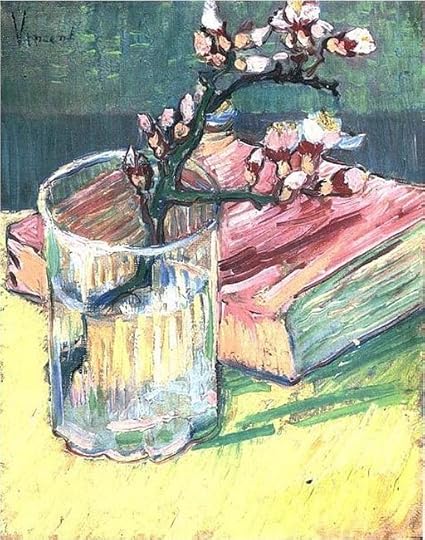
Ramo di mandorlo in fiore in un bicchiere, Arles 1888
(l’immagine sul retro di copertina)
pag.11 _______________________________
I dieci anni che seguono lo vedono all'opera come artista sempre avido di opere letterarie da scoprire e di nuovi autori con cui confrontarsi.
Se c'è un elemento unificatore nella complessa esistenza di Vincent, questo è senza dubbio il libro. Il suo amore per la lettura corre lungo tutta la sua vita, con obiettivi diversi (mercante d'arte, predicatore, pittore), ma sempre e comunque con il gran desiderio di imparare, capire, ragionare, confrontare, servire la gente, trovare il modo di essere utile all'umanità. Il bagaglio artistico-culturale dei primi dieci anni pone le basi per la carriera dell'artista che sarebbe diventato. I libri e lo studio saranno, come vedremo, il principale motore della sua trastormazione da predicatore a pittore.
…
I numerosi libri che ritrae nei quadri danno alle sue composizioni innovatrici un'atmostera particolare, come in Pile di romanzi francesi, una tela dipinta a Parigi nel 1887, un concentrato di entusiasmo. Vincent legge moltissimo, secoli d'arte e di letteratura: nelle sue lettere cita centinaia di opere letterarie diverse, di oltre duecento autori, in quattro lingue. Le sue letture riflettono l'evoluzione del suo gusto, in simbiosi con le svolte della sua vita. In molti casi, esse anticipano i suoi spostamenti da un paese all'altro, da una missione all'altra. La corrispondenza con Theo e con altre persone ci permette di seguire il suo percorso artistico-intellettuale dall'Olanda (1881-1885) a Parigi (1886-1888), dalla Provenza (1888-1890) fino agli ultimi mesi ad
Auvers-sur-Oise (maggio-luglio1890).
pag.148 _______________________________
Indubbiamente Vincent è vissuto in un'epoca di mutamenti socioculturali profondi, avvenuti con una velocità senza precedenti in tutta Europa, nel dinamismo irreversibile ereditato dalla Rivoluzione francese. L'Ottocento letterario europeo - che Van Gogh aveva assorbito come una spugna in pochi anni - si era evoluto progressivamente dal Romanticismo al Realismo, al Naturalismo, e da ultimo al Simbolismo e Decadentismo. La visione del mondo non era più confinata entro gli schemi del razionalismo settecentesco e della tradizione classicista.
Nel Settecento leggere era per lo più un'attività condivisa, i testi venivano sovente letti in contesti pubblici dalla voce di chi era in grado di farlo; studiosi, religiosi e membri delle classi più istruite godevano di un rapporto privilegiato con la carta stampata, Ma nel secolo che segui, una nuova presa di coscienza politica e sociale, l'aumentata alfabetizzazione e i progressi nella tecnologia della stampa, avevano creato le condizioni di un nuovo mercato della parola scritta, che si era fatto progressivamente strada in tutta Europa. Nel nuovo panorama del materiale letterario, il romanzo s'impone, e annuncia l'arrivo di opere destinate a tutte le classi sociali.
In questo grande teatro di cambiamenti, l'Ottocento assiste a una rivoluzione silenziosa, avvenuta soprattutto all'interno delle case di chi poteva abbracciare una nuova abitudine: quella della lettura. Questa rivoluzione letteraria non si riferisce soltanto alla possibilità di leggere le notizie nei quotidiani, o nei periodici illustrati, divenuti così popolari dalla seconda metà del secolo, anche oltre i confini delle metropoli. La diffusione e la popolarizzazione del romanzo (spesso pubblicato a puntate nei settimanali) offrono al pubblico la possibilità di godere del piacere della lettura silenziosa.
___________________________________
FROM BOOK: Sulle tracce di Van Gogh. Un viaggio sui luoghi dell’arte
___________________________________
WANT TO READ BOOK: L’arte dell'autoritratto. Storia e teoria di un genere pittorico (Omar Calabrese)
___________________________________
WANT TO READ ARTICLE: Van Gogh: il mio Giappone (Mariella Guzzoni, Rocco Ronchi - doppiozero.com)
Interessante e ben curato anche questo saggio, ricco di informazioni.
Si legge che è un piacere.
Ramo di mandorlo in fiore in un bicchiere, Arles 1888
(l’immagine sul retro di copertina)
pag.11 _______________________________
I dieci anni che seguono lo vedono all'opera come artista sempre avido di opere letterarie da scoprire e di nuovi autori con cui confrontarsi.
Se c'è un elemento unificatore nella complessa esistenza di Vincent, questo è senza dubbio il libro. Il suo amore per la lettura corre lungo tutta la sua vita, con obiettivi diversi (mercante d'arte, predicatore, pittore), ma sempre e comunque con il gran desiderio di imparare, capire, ragionare, confrontare, servire la gente, trovare il modo di essere utile all'umanità. Il bagaglio artistico-culturale dei primi dieci anni pone le basi per la carriera dell'artista che sarebbe diventato. I libri e lo studio saranno, come vedremo, il principale motore della sua trastormazione da predicatore a pittore.
…
I numerosi libri che ritrae nei quadri danno alle sue composizioni innovatrici un'atmostera particolare, come in Pile di romanzi francesi, una tela dipinta a Parigi nel 1887, un concentrato di entusiasmo. Vincent legge moltissimo, secoli d'arte e di letteratura: nelle sue lettere cita centinaia di opere letterarie diverse, di oltre duecento autori, in quattro lingue. Le sue letture riflettono l'evoluzione del suo gusto, in simbiosi con le svolte della sua vita. In molti casi, esse anticipano i suoi spostamenti da un paese all'altro, da una missione all'altra. La corrispondenza con Theo e con altre persone ci permette di seguire il suo percorso artistico-intellettuale dall'Olanda (1881-1885) a Parigi (1886-1888), dalla Provenza (1888-1890) fino agli ultimi mesi ad
Auvers-sur-Oise (maggio-luglio1890).
pag.148 _______________________________
Indubbiamente Vincent è vissuto in un'epoca di mutamenti socioculturali profondi, avvenuti con una velocità senza precedenti in tutta Europa, nel dinamismo irreversibile ereditato dalla Rivoluzione francese. L'Ottocento letterario europeo - che Van Gogh aveva assorbito come una spugna in pochi anni - si era evoluto progressivamente dal Romanticismo al Realismo, al Naturalismo, e da ultimo al Simbolismo e Decadentismo. La visione del mondo non era più confinata entro gli schemi del razionalismo settecentesco e della tradizione classicista.
Nel Settecento leggere era per lo più un'attività condivisa, i testi venivano sovente letti in contesti pubblici dalla voce di chi era in grado di farlo; studiosi, religiosi e membri delle classi più istruite godevano di un rapporto privilegiato con la carta stampata, Ma nel secolo che segui, una nuova presa di coscienza politica e sociale, l'aumentata alfabetizzazione e i progressi nella tecnologia della stampa, avevano creato le condizioni di un nuovo mercato della parola scritta, che si era fatto progressivamente strada in tutta Europa. Nel nuovo panorama del materiale letterario, il romanzo s'impone, e annuncia l'arrivo di opere destinate a tutte le classi sociali.
In questo grande teatro di cambiamenti, l'Ottocento assiste a una rivoluzione silenziosa, avvenuta soprattutto all'interno delle case di chi poteva abbracciare una nuova abitudine: quella della lettura. Questa rivoluzione letteraria non si riferisce soltanto alla possibilità di leggere le notizie nei quotidiani, o nei periodici illustrati, divenuti così popolari dalla seconda metà del secolo, anche oltre i confini delle metropoli. La diffusione e la popolarizzazione del romanzo (spesso pubblicato a puntate nei settimanali) offrono al pubblico la possibilità di godere del piacere della lettura silenziosa.
___________________________________
FROM BOOK: Sulle tracce di Van Gogh. Un viaggio sui luoghi dell’arte
___________________________________
WANT TO READ BOOK: L’arte dell'autoritratto. Storia e teoria di un genere pittorico (Omar Calabrese)
___________________________________
WANT TO READ ARTICLE: Van Gogh: il mio Giappone (Mariella Guzzoni, Rocco Ronchi - doppiozero.com)

June 3, 2024
really lovely overview of how literature & art intertwine in van gogh’s life. surprisingly, i learned as much about his japanese influences as i did about his reading practices.

May 31, 2021
Van Gogh was a reader the same way he was a painter: the man who produced a painting a day plus drawings during the last three months of his life must have read at a similar rate. ALL of Zola's twenty-novel Rougon-Macquart cycle, much of Victor Hugo, all of Shakespeare. In the spring of 1890, he said he was planning to RE-read ALL of Balzac - that's 90 novels. He read Tolstoy, he read Flaubert, De Maupassant, and Dickens (god love him - in English AND in French). He read them, he studied them, he wrote to his brother and sister about them; he woke up in the night, turned on his lamp and kept reading.
Guzzoni's lovely little book, abundantly illustrated, surveys Vincent's reading, and makes a case for how he wove life, art, and books into single way of seeing the world. As a young man he fanatically collected illustrated magazines for the sake of the pictures, which he hung on his walls, then Japanese prints. He read the stories, he knew who the illustrators were (he had thoughts of becoming an illustrator himself). He thought deeply about what he read, memorizing long passages, using incidents in books as a prism through which to describe events in his own life. A small drawing from a story he read recognizably reappears in one of his paintings. He even painted books - many of his portraits and still lifes include books, some identifiable as to title and author. One poignant painting (unfortunately not reproduced in the book - you can see it here), depicts the ward of the hospital in Arles during one of his stays. The figures in the long and looming room are faceless, turned away, or downcast. Except for one man, turned toward us, wearing a yellow straw hat, reading a newspaper. Reading seems to be as essential to this man as his painting.
It's a fascinating look into Vincent's mind, beliefs, philosophies, and artistic influences from a different medium. And whatever you may think about how Vincent's death came about, one has to wonder: does a plan to re-read all of Balzac sound like someone who was within weeks of suicide?
Guzzoni's lovely little book, abundantly illustrated, surveys Vincent's reading, and makes a case for how he wove life, art, and books into single way of seeing the world. As a young man he fanatically collected illustrated magazines for the sake of the pictures, which he hung on his walls, then Japanese prints. He read the stories, he knew who the illustrators were (he had thoughts of becoming an illustrator himself). He thought deeply about what he read, memorizing long passages, using incidents in books as a prism through which to describe events in his own life. A small drawing from a story he read recognizably reappears in one of his paintings. He even painted books - many of his portraits and still lifes include books, some identifiable as to title and author. One poignant painting (unfortunately not reproduced in the book - you can see it here), depicts the ward of the hospital in Arles during one of his stays. The figures in the long and looming room are faceless, turned away, or downcast. Except for one man, turned toward us, wearing a yellow straw hat, reading a newspaper. Reading seems to be as essential to this man as his painting.
It's a fascinating look into Vincent's mind, beliefs, philosophies, and artistic influences from a different medium. And whatever you may think about how Vincent's death came about, one has to wonder: does a plan to re-read all of Balzac sound like someone who was within weeks of suicide?

February 10, 2025
“I libri di Vincent” di Mariella Guzzoni è un’esplorazione di una delle componenti più significative dell’arte e della vita del celebre pittore olandese: i libri. Van Gogh era un lettore appassionato di un’ampia varietà di generi, dalla Bibbia alla narrativa contemporanea del suo tempo, come Charles Dickens, fino ai classici, tra cui Shakespeare e Tolstoj.
Il libro è scritto in modo semplice e scorrevole. Offre diversi spunti di approfondimento, come suggerimenti di lettura. Ho trovato particolarmente interessante un’informazione riguardante il quadro La Berceuse: questo dipinto fu concepito come un “ritratto confortante”, immaginato per i marinai del romanzo Pêcheur d’Islande (Pescatore d’Islanda) di Pierre Loti. Van Gogh stesso scrisse:
“Credo che, se si appendesse questa tela così com’è in una barca, anche i pescatori d’Islanda vi sentirebbero la ninna-nanna [La Berceuse].”
Il libro è rilegato e presenta moltissime immagini di alta qualità, nonostante il formato compatto. Tuttavia, speravo di trovare qualche approfondimento in più sulla relazione tra la letteratura e l’opera di Van Gogh. Detto ciò, per me un libro ben scritto su Van Gogh è sempre un piacere da leggere.
Il libro è scritto in modo semplice e scorrevole. Offre diversi spunti di approfondimento, come suggerimenti di lettura. Ho trovato particolarmente interessante un’informazione riguardante il quadro La Berceuse: questo dipinto fu concepito come un “ritratto confortante”, immaginato per i marinai del romanzo Pêcheur d’Islande (Pescatore d’Islanda) di Pierre Loti. Van Gogh stesso scrisse:
“Credo che, se si appendesse questa tela così com’è in una barca, anche i pescatori d’Islanda vi sentirebbero la ninna-nanna [La Berceuse].”
Il libro è rilegato e presenta moltissime immagini di alta qualità, nonostante il formato compatto. Tuttavia, speravo di trovare qualche approfondimento in più sulla relazione tra la letteratura e l’opera di Van Gogh. Detto ciò, per me un libro ben scritto su Van Gogh è sempre un piacere da leggere.

January 1, 2022
Day 1 (2022), book 1! Loved the theme of books and art and how for Van Gogh these two were so intertwined. As a reader, he was drawn to writers that were able to ‘paint’ before our eyes the world as they observe it. He studied and analysed the writers as artists.
The pace of the book is high and I would have appreciated more background on specific movements and ideologies among both painters and writers. Last chapter on ‘abstract art’ was lost on me mostly because I don’t master the theory and terminology.
The book is filled with pictures of paintings, drawings, sketches and letters of Van Gogh as well as paintings and illustrations that have inspired or influenced him. The references to these sources are extensive and thorough. Reading the regular text was sometimes difficult though because of the (even mid sentence) interuptions with pages of images and additional quotes.
(Quite a few typos, but that’s a detail.)
The pace of the book is high and I would have appreciated more background on specific movements and ideologies among both painters and writers. Last chapter on ‘abstract art’ was lost on me mostly because I don’t master the theory and terminology.
The book is filled with pictures of paintings, drawings, sketches and letters of Van Gogh as well as paintings and illustrations that have inspired or influenced him. The references to these sources are extensive and thorough. Reading the regular text was sometimes difficult though because of the (even mid sentence) interuptions with pages of images and additional quotes.
(Quite a few typos, but that’s a detail.)

July 29, 2026
A beautiful discussion of the painter as reader. You can find out about stories he read over and over like "A Christmas Carol" and prints Van Gogh studied in books and magazines about Japanese art. I learned about Van Gogh's favorite French authors, including Victor Hugo and Millet and English authors, including Dickens, George Eliot. Who knew he loved "Scenes of Clerical Life?" But it makes perfect sense. Van Gogh emerges as an astute reader particularly attuned to stories of the poor, the forgotten, and the suffering. I got a sense of Van Gogh as an artist who is always searching and applying what he learns in imaginative ways. This book is not only insightful but gorgeous. The prints, paintings and sketches cited appear on right page every time. Paper, binding, and color prints are wonderful to hold and to behold. And the book has a satin ribbon bookmark. The cover is Van Gogh's yellow and the bookmark is sky blue. Who could ask for anything more?
May 8, 2026
This is a unique biography anchored on the books Vincent Van Gogh reads and loves over different periods of his life, with information primarily sourced from his correspondences to his brother Theo. What book a person reads and how they talk about it reflects a lot about the person’s characters and beliefs; this is a really creative angle for looking into a person’s inner world and is quite effective. Because of this, as well as the source being personal letters, the discussions become quite intimate and special. I especially like how the author tries to draw connections between Vincent’s books, his paintings, his aesthetic, as well as the underlying philosophical ideas and societal trends. It would have been a better reading experience if the book were more organized and coherent, both in terms of the storytelling and the visual aids.
February 21, 2021
Finished this last year before the end of September. Brilliant book, gave insights into Vincent’s life and how much society and family influenced him.
You learn that he was always intense from a child.
His name came from an older brother who died - could explain quite a lot. As a ‘newby’ to Vincent’s life I never knew he worked in London, near Seven Dials, or that he had a sister or that his beloved brother died shortly after him. He read Dickens on several occasions both in the original form and when they transferred to complete books - in english - in Paris, as well as french literature.
Well recommended. The yellow colour of this book also has significance to the french authors he read!
Fascinating!
You learn that he was always intense from a child.
His name came from an older brother who died - could explain quite a lot. As a ‘newby’ to Vincent’s life I never knew he worked in London, near Seven Dials, or that he had a sister or that his beloved brother died shortly after him. He read Dickens on several occasions both in the original form and when they transferred to complete books - in english - in Paris, as well as french literature.
Well recommended. The yellow colour of this book also has significance to the french authors he read!
Fascinating!

August 4, 2024
Everyone knows Vincent Van Gogh. Everyone knows his Starry Night (1889), his Sunflowers (1889) and his Bedroom in Arles (1888). Everyone knows that he suffered from a mental illness that led to the mutilation of his ear. But what most people seems not to realise, as I also failed to realise, is that all this represents only the last year of Van Gogh's life.
Through his passion for books, Mariella Guzzoni brings a fresh perspective on Van Gogh's life and work, showing the reader facets of his life that we are not used to knowing and hearing. Vincent's books is not only about the books he loved but about all kinds of art that influenced his own. I can only recommend it to all fans of books and art.
Through his passion for books, Mariella Guzzoni brings a fresh perspective on Van Gogh's life and work, showing the reader facets of his life that we are not used to knowing and hearing. Vincent's books is not only about the books he loved but about all kinds of art that influenced his own. I can only recommend it to all fans of books and art.
September 4, 2024
I really enjoy Van Gogh pictures, but didn’t know much about him, just main biography facts. This book opens for me a new perspective of Van Gogh’s talent. He’s not only an artist, he’s a great philosopher, really good knowledgeable person about many topics. After that I’d like to read his letter to his brother Teo to learn more about his personality. And last, but not least, this book had incredible illustrations which complete the full picture of narrative.

November 23, 2024
A fascinating book in both detail and writing style. Never have I read a work of nonfiction that flowed as well as this one did. In addition, the University of Chicago printed a wonderful hardcover volume that is simply beautiful -- exceptional paper quality, excellent weight, and beautiful reprints of artistic works with fine detail.

June 4, 2024
Short book focussed on the books Van Gogh read, owned, want to read, recommended and probably inspired him.
I felt some things were missing (Flaubert) and that there wasn't enough to fill the book itself.
But is was a pretty book and a quick read.
3.4 stars. Would recommend if you love Vincent.
I felt some things were missing (Flaubert) and that there wasn't enough to fill the book itself.
But is was a pretty book and a quick read.
3.4 stars. Would recommend if you love Vincent.
August 13, 2025
prose was a bit clunky but content kept me reading, was so interesting hearing about van gogh’s deep love for literature and attempts to reconcile his reading with his painting (his taste for french naturalist novels resonating with his philosophy of honestly depicting the world as it is)

May 22, 2021
What Van Gogh read and how, maybe, that influenced his paintings. Many illustrations of lesser known works. Thin.
October 1, 2021
7.5/10

March 1, 2022
Promising cover and concept, but the writing is dry as dust. Read if you are having trouble sleeping. 🥱

April 26, 2022
One word - passion. We all need our passion projects.
Also, the soul in every artist.
Also, the soul in every artist.
August 25, 2022
Fantastic! Will definitely reread! Learned about his passion for books, his relationships and how he translates this into art.

July 27, 2023
I enjoyed learning more about Van Gogh but found certain things disappointing, like flipping back and forth in the book to look at the paintings discussed. And it got a little long for me at the end.
August 1, 2023
A good look at what help to inspirer Vincent and I think that gives more meaning to his paintings.
January 16, 2026
A beautifully illustrated book exploring the artist’s reading. I chose it as a Christmas gift to self. Recommended for all who are interested in VG

February 14, 2022
This book got me in the feels I cannot lie.
Displaying 1 - 30 of 30 reviews