I think that this will be my first nonfiction review.
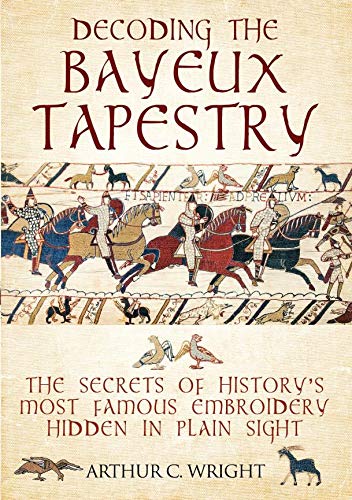
I got onto this book via a Great Courses set on the Medieval World. At the same time I got this book at the library, I also got a lovely, big book filled with close-up photographs of the Tapestry. (OK, it's actually an "Embroidery", but the name isn't going to change any time soon.) The photos were so excellent that I kept thinking that I could reach out and feel the textures. The work is amazing. Also a little weird, with colors apparently tossed in at random (a red animal with a white tail, a horse with multiple colors). In crowded scenes, some of the men's faces are stitched in with dark threads, making them really catch the eye. The big book of photos shows the Tapestry "warts and all", with stains, holes, damaged spots, and repairs clearly to be seen. The Decoding book shows the scenes in glorious bright colors, presumably how it might have looked when brand new. I find his hypothesis that the border art is giving commentary on the big main images fascinating, and I think that it shows fairly good evidence. His ideas on what Harold might possibly have MEANT to do when he landed in Normandy are also interesting.
That having been said, I have to say this: I found this book extremely aggravating. I kept thinking of a line I read in an Elizabeth Peters book: "You are twisting facts to suit a theory, not basing a theory on known facts." He puts a lot of his statements as questions, making it clear that it's opinion and speculation, but there are also places where he authoritatively states his opinions as facts.
One of the problems is that the imagery in the Tapestry, both the main sections and the borders, are up for interpretation. In other words, where you see a po-tay-to, I see a po-tah-to.
Examples: * he makes the flat statement that King Edward is represented as sickly and frail, although no other contemporary references do so. Sorry, but I don't see him as frail in that first scene. He definitely looks comparatively older, but then, he WAS. He looks like he's enjoying himself, too, as though he's about to give a big smile.
* he states that the two fancy birds beneath Edward in the border are "caladrii"--mystical birds that tend to hang around royalty. Problem is, the caladrius is a snow-white bird, no color, and these birds have dark blue (or black) barred wings and crests. Yes, he knows that, but they're still caladrii because if they stitched white birds into the tapestry, they would be take n as ghostly portents, so of course they had to put in some color. Oh, really? I think if you stitched the outline of a bird with dark thread, leaving the white background fabric to do the rest, you would have a proper recognizable white bird. Pale thread for a ghostly bird. In point of fact, there is an all-white bird in the Tapestry. Or perhaps it's pale gold. At any rate, it's all one color. Perhaps a ghost bird? We won't get the answer from Wright, because he ignored it. Perhaps he didn't notice it, being ghostly!
I can imagine a conversation at the first viewing of the Tapestry:
"This is really something. Look, there's old King Edward. What are those fancy white-and blue birds under him?"
"Are you daft, man? Can't you tell those are caladrii?"
"Oh, go on. Everyone knows that a caladrius is a pure white bird. For royalty, don't you know."
"Yeah, but if they had made them white, we might think they were ghosts. So they threw in a bit of color. They knew that we would understand."
"YOU might, I don't. As far as I'm concerned, if it's not white, it must be something else. How about eagles? They look like they could be eagles."
And so on. There are birds that he identifies as flamingos (in 1066 England?) despite the fact that there are other birds with exactly the same shape that are called other things. In the scene where Edward's body is being carried to Westminster, he describes a pard (cat) "prowling and howling" beneath. First off, cats aren't known for throwing their heads back and howling; that's a canine thing. Second, the red body looks distinctly like a fox. In fact, a very good representation of a fox. The tail isn't all that fox-like, but I didn't see any foxes in the Tapestry with the traditional "brush" tail.
In another scene (the one on the cover of the book) he describes the animal down below leaping and seizing a goose as a tiger. (In 1066 England. Yup.) It must be a tiger; it has stripes. Ahh...not the way I see it. In the photo book, where you can see it nice and clear, those spots on the body are...spots. Big, lumpy spots, to be sure, but spots. Not stripes. And the body is clearly a canine shape, as you can see plainly when you compare it with the very next beast, identified as another fox, this one seizing a (presumed) hen. The body shapes are virtually identical; one is just a little larger. And another thing: he interprets the "tiger" as representing a fierce warrior taking down an enemy spy or watchman. The fox next door, who is doing exactly the same thing, is interpreted as "To the victor belong the spoils". Two different interpretations for essentially the same picture.
While we're here, allow me to point out an oddity that I spotted with this scene. If you study the borders, you'll see patterns. They have a set of images that have been interpreted as scenes from Aesop's fables, but a lot of them are simply birds and beasts. And the majority of them seem to come in pairs, with both creatures doing the same thing--looking startled, biting their tails, heads down, heads looking backward, etc. The colors are sometimes different. And with each pair, they either face each other, or they have their backs to each other. Rarely, there will be a four-way set, with bird, beast, beast, then matching bird. In this one single spot, with the two creatures (call them what you will) leaping to snag a bird, they are both leaping in the SAME DIRECTION. They are not facing each other, or back-to-back. This seems trivial, but it really grabbed my attention, and I do think that it's the only place on the Tapestry where this happens. I would like to know if there's some significance there.
Another really irritating point: the book does not contain images of the entire Tapestry. Why the (bleep) not? He is constantly referencing images that the reader cannot look at for him/herself. (Unless, like me, they also have a nice big book of pictures.) Why didn't they make the book just a little longer and include all the images? Maybe collect them in order at the back, in an appendix.
Wright clearly does not admire William the Conqueror (William the Bastard until he became a success, as Richard Armour once pointed out.) He rarely misses an opportunity to point this out. In the thick of the battle scenes, William curiously fades out of the picture. His half-brother, Bishop Odo, is in the center of things, rallying the men and moving forward to the climax. Wright interprets this to mean that William was frightened at this point, scared out of his chauses that he was going to lose the battle, and contemplating fleeing the field and leaving his men behind. (This, by the way, is the same William that we see a few inches away making the supremely courageous and fearfully risky action of removing his helm, so that his men can see that he's still alive--and so can the enemy!) What other explanation can there be? Well, in just a few paragraphs, he himself offers a perfectly good explanation: Wright tends toward the theory that Bishop Odo himself commissioned the Tapestry, and you can be certain that Odo told the designer to make him look good, even at William's expense. (This also explains the scene of the feast, where Odo is presiding and looking remarkably like Jesus at the Last Supper, while William apparently wasn't hungry.)
It is a fact that history is written by the victors. But William did have a good claim to the throne (as did numerous other people) and who is to say at this late date if Edward promised it to him or not, or if Harold pledged it to William (touching those icons!) or not?
There's a spot near the end of the battle where one of the border creatures (looks like a little dog) seems to have gotten himself thrown up into the main body of the tapestry, and he looks like he's frantically trying to crawl back down to the safety of the border again! Wright makes no mention of this. Curious. Surely it meant something? He said that EVERYTHING in the border meant something.
In Harold's death scene, Wright points out that the arrow was stitched in later. Well, you certainly can't stitch the entire scene simultaneously; some of it had to come later. His point is that perhaps Harold didn't die from that arrow in the eye. That may or may not be, but the fact (and yes, it is a fact) is that the figure stitched on that Tapestry has his arm lifted up and his hand close to his face, and his fingers are clearly clasping something. Very probably, the arrow. Print the legend.
It all comes down to a matter of perspective. What do you see? What do you want to see? In the book of photos, the author points out one of the Aesopian images as the fable of the pregnant bitch. (I had to look that one up; I'd never heard of it.) The image is a kind of curved bank, (rather like an ocean wave) with a bunch of heads poking out and looking at a canine standing in front. The fable is of a pregnant bitch needing a place to whelp, and a shepherd kindly loans her a place. Once the pups are grown enough to back up Mom, Mom informs the shepherd that she's keeping the place. Moral: people that you show a kindness to will sometimes turn on you. O.K. That's cool. But later in the Tapestry, that identical imagery shows up again. Despite the fact that some other fables are shown at least twice, the author does not identify this as a second showing of the pregnant bitch fable, he merely states that some animals seem to be hiding. Did he just forget about the fable, or did he want a different interpretation?
You could probably study this Tapestry for a lifetime and not come to any definite conclusions. It is a fascinating piece, all the more amazing that this fragile fabric has lasted nearly intact (what DID happen to that last section??!!!) for almost a thousand years.
What do you see?