How will Brexit affect daily life in Britain? From the NHS to pet passports, broadcaster and journalist Gavin Esler has the surprising answers in this timely guide.
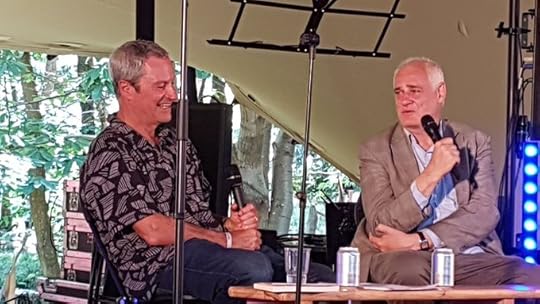
Gavin Esler is an award winning television and radio broadcaster, novelist and journalist. He is the author of five novels and two non-fiction books, The United States of Anger, and most recently Lessons from the Top, a study of how leaders tell stories to make other people follow them. It’s based on personal encounters with a wide variety of leaders, from Bill Clinton and Angela Merkel to Tony Blair, Margaret Thatcher, and even cultural leaders such as Dolly Parton.
Reviewers have been full of praise for Esler’s fiction and story-telling abilities. The writer Bernard Cornwell said his novels are "made luminous with wisdom, sympathy and story telling." The Guardian commented that Esler's fiction displays "undoubted sympathy for the human condition and a burning anger, a genuine lyricism, a quick sensitivity and a real understanding of other people." The Financial Times said Esler's stories of people in power and the compromises they are forced to make, shows that he "understands the political beast better than anyone."
Gavin EslerGavin Esler was born in Glasgow, and brought up in Edinburgh and Northern Ireland. His family are descended from German Protestant refugees who fled to safety in Scotland during the religious wars of the early 17th Century. He spent the first three years of his life living with his parents, grandmother and aunts in a three-bedroom council house in Clydebank. The family moved to Edinburgh and Gavin won a scholarship to George Heriot's School. He planned to study medicine at Edinburgh University and then, to the relief of patients everywhere, made an abrupt switch to English, American and, eventually, Irish literature. After he finished his post-graduate studies he was offered a job on The Scotsman in Edinburgh but turned it down as likely to be a bit dull, preferring instead The Belfast Telegraph. He moved on to the BBC in Belfast during some of the worst of "the Troubles," and got to know leaders of the IRA and other Republican and loyalist paramilitary groups. On one occasion the leader of a loyalist organisation introduced himself to Esler with the memorable words: “I am speaking to you as someone deeply involved in violence.” It turned out to be an accurate description.
His investigative work on the wrongful convictions of Giuseppe Conlon and his son Gerry led to a campaign which eventually overturned the convictions of the so-called “Guildford Four” and “Maguire Seven” -- innocent Irishmen and women convicted of bombing offences on the basis on non-existent or unreliable “evidence.” Their stories eventually became the basis of the film, In the Name of the Father.
Esler moved on to become the BBC's Chief North America Correspondent, based in Washington and covering the Bush and Clinton White House. He visited 48 of the 50 states but somehow missed out on Wisconsin and North Dakota. His first encounter with Bill Clinton in 1991 led him to believe that the then Governor of Arkansas might indeed become President of the United States some day - a belief somewhat dented when a Democratic party official described Clinton to Esler as “Oh, you mean Governor Zipper Problem.”
He then reported from countries as diverse as China, Peru, Argentina, Cuba, Brazil, Russia, Jordan, Iran, Saudia Arabia and from the Aleutian Islands, as well as all across Europe. He won a Royal Television Society award for a TV documentary about Alaska and a Sony Gold award for a BBC radio investigation into the case of Sami al Hajj, who was detained without charge in Guantanamo bay, but released shortly after the radio programme was broadcast.
Over the past two decades Gavin Esler has interviewed world leaders ranging from Mrs Thatcher, David Cameron, Gordon Brown, Tony Blair, John Major, King Abdullah of Jordan and President Chirac to President Clinton, President Carter, Nicaragua's President Daniel Ortega, Ed Miliband and Israel's Shimon Peres. In the arts and culture programmes he anchors for BBC World he has als
Honestly, I was so fatigued by the writing. It’s only around 165 pages or so but it felt longer because the writing wasn’t straightforward. It could have been really interesting especially because of the way it’s structured, but half the time it took so much concentration to understand what was being side and sometimes I still didn’t get it because the writing was too pithy and less literal and plain speaking. My face is twitching. Clearly didn’t enjoy it.
The book strips bare the excuses, the fantasies and the ignorance of those pushing the idea that the UK can go it alone in the globalized world. Without attacking the personalities, the author serves up the facts, identifies the quantifiables and where one must fall back on speculation, points out that these are based on projection. Though his speculations are at least founded on understanding patterns and the things that drive them. His analysis of potential impacts is excellent, particularly in his explanations of how the NHS will suffer, how supply chains can and most likely will be disrupted.
In the final chapter he summarises some of the commonly misunderstood aspects of trade, trade deals, institutions and, of course, the WTO. A great pity as he says, that many of our politicians babble away about them without any understanding of what they are or indeed, what they do.
My best take away from this book? Brexit is not a cut off, or an event, it is a process that will still be influencing our lives for many years to come.
TL;DR Brexit was really really bad and will be even worse if no deal is reached
The purpose of this book was to draw out the consequences of Brexit on food, jobs, schools, NHS medicine and staff so I guess the style couldn't be helped. Reading it felt like reading an answer to an IB economics question in which many assumptions and hypotheticals are traced to the end - if A, then B, C, D, which would then cause E, F, G, which would then cause H, I, J. It got a bit annoying.
As it was for a British audience, some of the consequences didn't seem to me to be all that significant - e.g. travel will be more difficult in the EU so you will have to maybe get a visa waiver like an ESTA and time at immigration will be longer. As someone who hasn't lived in this system, and who waits at immigration when I travel to other countries, it didn't seem that bad. But I guess to someone in the UK who was used to driving down to France for a nice dinner, that might be more significant?
One thing is for sure - the bureaucracy and paperwork that is going to ensue with deal or no deal is going to be a nightmare for everyone.
Vital to understanding Brexit (despite its recent overshadowing) and what happens next. Although Esler is pretty obviously anti-Brexit (and I think that probably does influence the book in a biased manner), it's mostly objective and presents the hard facts and figures. It makes for sobering reading but also suggests some optimism; there are some positive routes for a post-Brexit Britain. But to get there, we must properly understand Brexit fact from fiction and what decisions to make in the future.
A brief but illuminating overview of all the areas where Brexit will impact our lives.
Worth a read if only to familiarise yourself with the many ways in which we are going to be worse off, whether financially or via a reduction of opportunities.
Carefully researched, well presented and very informative. It exposes 'Project Pie in the Sky' for what it really is, and the clowns and buffoons who sold it to us as the charlatans that they really are. There is no 'alternative truth' there is just truth - the cold light of day.
I finished this a while ago, but haven't written anything about it.
Frankly, I need to re-read it to take in more of what Esler argues. Nevertheless, I felt this was a committed 'Remainer's' attempt very reasonably to counter the misleading information and emotional hype that, for him, created the 2016 referendum result.
His efforts to be as fair as possible seem to me to be summed up in his discussion of chlorinated chick. For example, a remainer might whip out 'and we'll have to have chlorinated chicken on our shelves before you can say Donald Trump' as an argument for why leaving the EU is a bad thing, and would be guilty of the same kind of emotionalism as he is accusing the leave campaign of. Esler, by contrast will examine the issue. He says he has lived in America and eaten chlorinated chicken without any ill effects, and adds that the British Poultry Council don't think there is anything inherently unsafe about 'putting chicken carcasses in chlorinated water'. But he goes on to argue that the practice is a way of circumventing what we regard as 'good hygienic practices' and the sale of chlorinated chicken would be part and parcel of an American trade deal which would include requirements for us to deregulate to force us to accept farming practices that we currently - and in my view quite rightly - do not.
As I say, I need to re-read the book.
One other moment sticks, in my mind, however. Esler recounts a conversation with a member of the public when he was campaigning for Change UK in the European elections. He was told that the EU was totally undemocratic - a characteristic kneejerk statement along with 'Take Back Control' and 'We've had enough of experts' etc etc. Esler pointed out to his interlocutor that she was about to vote in European elections. She had the decency to admit she'd never thought of that before. I suspect that this is the level at which many voters, on both sides, cast their votes in the referendum. I do not exclude myself from ignorance, either. I'm afraid I belong to a nation that is largely politically uneducated - not necessarily politically unengaged (though the fact that about 13 million of us didn't vote in the refendum says quite a lot), but politically uneducated. What I really know about the way the EU works is reprehensible. It's time for Civics to enter the curriculum, perhaps.
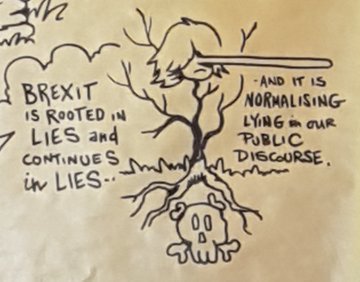
Whether it's politics or media, it's hard to know what or who to believe about Brexit. in Brexit Without The Bullshit, Gavin Esler presents the facts about the possible impact of leaving the EU will have on different aspects of our lives. While Esler is on the Remain side, his point is that the facts speak for themselves, and he acknowledges that his interpretation of the impact is necessarily conjecture.
Another of Esler's points is that people voted in the 2016 referendum without knowing what leaving the EU actually means for Britain. I was drawn to this book because I am looking for a completely unbiased, objective presentation of the facts on Brexit, and this is what the book promises. On that basis it's all looking a bit depressing, and from reading this book completely objectively I still don't know whether there is a compelling counter position on Brexit or room for optimism in what we may inevitably face. Perhaps the facts to back this up are simply not there.
What I got from this book was a lot of information to be able to form opinions, and to remain skeptical and questioning about what I read and hear in the news, but with a more informed viewpoint. The explanation of some key technical terms is useful. I enjoyed Esler's writing style - the book is engaging, easy to read and he brings to life the issues by placing them in a day to day context that people can relate to.
I recommend this book to anyone who wants to understand more about Brexit and the impact it might have. As Esler says, Brexit isn't going to happen as an event and then go away. Instead it's a process that will last for years. The book does end on a positive note that Britain is more than Brexit. Perhaps only time will tell whether there is room for further optimism.
Thanks to NetGalley and the publisher for a copy of this book in exchange for my personal review. #BrexitWithoutTheBullshit #NetGalley
Brexit means Brexit, went one particularly unhelpful soundbite approximately a hundred years ago, but what exactly *does* Brexit mean? I’ll happily admit to not understanding the ins and outs of it all, and I don’t believe the majority of the rest of the public understands it either. Thankfully, Gavin Esler has made a sterling (no pun intended) effort at cutting through the oceans of crap and presenting some facts (remember those?) about what a post-Brexit Britain is likely to look like in various key aspects. It makes sobering, at times frightening, but fascinating reading. And given the current situation, the short chapter on no deal is particularly instructive.
Brexit hasn’t caused the deep divisions in our society but it has exacerbated and brought them to the fore. As the “debate” has become increasingly toxic, tolerance and respect for others’ views seem to be things of the past. I hope there’s a way back from this, because it’s seriously depressing.
The key message here is that Brexit is a process, not an event, which will take many years to play out. So if you’re sick to death of hearing about it (we all are) and just want it over with, deal or no deal, think again. The knock-on effects are going to last for a long, long time. No matter what happens in the coming months, we’ll all be hearing about Brexit for a long time yet.
Scary and utterly depressing. Although not because of the author's fault. Britain's perspectives and future in a globalized world after Brexit, without the hype and the passion. Well researched it seems and factual, with quite of few pages listing sources and further reading at the end of the book to be referred to. I am not a big take of swearing and I wish the author has not used the word "bullshit" on its cover. It may appeal to the wrong audience, and deter others from giving it a try.
Really interesting summary of the impacts Brexit will have, and I’m afraid there’s not much in the way of sunlit uplands. Esler examines the possible outcomes for trade, the NHS and other areas of our lives.
An unopinionated, informative, stark reality of what’s to come from Brexit. There are no ‘alternative facts’ written here, and that makes for an uncomfortable read. Brace yourselves.