‘Here was Emily … in these diaries and scrapbooks. An unprecedented, intimate angle on the real Emily’ Elsabe Brits has drawn on a treasure trove of previously private sources, including Emily Hobhouse’s diaries, scrap-books and numerous letters that she discovered in Canada, to write a revealing new biography of this remarkable Englishwoman. Hobhouse has been little celebrated in her own country, but she is still revered in South Africa, where she worked so courageously, selflessly and tirelessly to save lives and ameliorate the suffering of thousands of women and children interned in camps set up by British forces during the Anglo-Boer War, in which it is estimated that over 27,000 Boer women and children died; and where her ashes are enshrined in the National Women’s Monument in Bloemfontein. During the First World War, Hobhouse was an ardent pacifist. She organised the writing, signing and publishing in January 1915 of the ‘Open Christmas Letter’ addressed ‘To the Women of Germany and Austria’. In an attempt to initiate a peace process, she also secretly metwith the German foreign minister Gottlieb von Jagow in Berlin, for which some branded her a traitor. In the war’s immediate aftermath she worked for the Save the Children Fund in Leipzig and Vienna, feeding daily for over a year thousands of children, who would otherwise have starved. She later started her own feeding scheme to alleviate ongoing famine. Despite having been instrumental in saving thousands of lives during two wars, Hobhouse died alone - spurned by her country, her friends and even some of her relatives. Brits brings Emily’s inspirational and often astonishing story, spanning three continents, back into the light.
I wonder how many people know about Emily Hobhouse. She was certainly not someone I heard of in school and still remains little known in this country. During her lifetime she was often reviled in England by the press and politicians. Her first years were unremarkable and until she was 34 she cared for her father. He died in 1894. Following a brief and unsuccessful romance she became involved in the movement for peace following the outbreak of the Boer War. She learnt of the policies of the government which were causing distress to the civilian population. What the army was doing was using a scorched earth policy, destroying farms and villages and putting the residents into camps: these came to be known as concentration camps. Another great British invention! Hobhouse was the first to highlight how appalling they were. Deaths in the camps are estimated at over fifty thousand. In 1900, having helped to raise money to relieve distress, Hobhouse went to South Africa to have a look for herself. She had relatives in the Liberal Party and had managed to get permission to visit. Once there she had to get permission to visit the camps from Lord Kitchener who was in charge. He reluctantly agreed to allow her to visit a limited number of camps (a decision he came to regret). The conditions she found were appalling: “In some camps, two, and even three sets of people, occupy one tent and 10, and even 12, persons are frequently herded together in tents of which the cubic capacity is about 500 c.f. I call this camp system a wholesale cruelty… To keep these Camps going is murder to the children. It can never be wiped out of the memories of the people. It presses hardest on the children. They droop in the terrible heat, and with the insufficient unsuitable food; whatever you do, whatever the authorities do, and they are, I believe, doing their best with very limited means, it is all only a miserable patch on a great ill. Some people in town still assert that the Camp is a haven of bliss. I was at the camp to-day, and just in one little corner this is the sort of thing I found – The nurse, underfed and overworked, just sinking on to her bed, hardly able to hold herself up, after coping with some thirty typhoid and other patients, with only the untrained help of two Boer girls–cooking as well as nursing to do herself. Next tent, a six months' baby gasping its life out on is mother's knee. Two or three others drooping sick in that tent. Next, a girl of twenty-one lay dying on a stretcher. The father, a big, gentle Boer kneeling beside her; while, next tent, his wife was watching a child of six, also dying, and one of about five drooping. Already this couple had lost three children in the hospital and so would not let these go, though I begged hard to take them out of the hot tent. I can't describe what it is to see these children lying about in a state of collapse. It’s just exactly like faded flowers thrown away. And one has to stand and look on at such misery, and be able to do almost nothing. It was a splendid child and it dwindled to skin and bone ... The baby had got so weak it was past recovery. We tried what we could but today it died. It was only 3 months but such a sweet little thing… It was still alive this morning; when I called in the afternoon they beckoned me in to see the tiny thing laid out, with a white flower in its wee hand. To me it seemed a "murdered innocent". And an hour or two after another child died. Another child had died in the night, and I found all three little corpses being photographed for the absent fathers to see some day.”
Hygiene was poor, people were starving and disease was rampant. Hobhouse was shocked and angry and vowed to do something about it. She made a nuisance of herself to try to improve conditions. There were camps for different races and she visited at least one of those. Death rates were high in them all and she reported back to the British authorities with limited success. On her return to Britain she wrote, harried politicians and spoke at public meetings. She received some support in Liberal circles but mostly the press were very critical as were much of the public and the government. She was thought unpatriotic and anti-British. However the government couldn’t entirely ignore her and appointed a commission to investigate. Hobhouse tried to return to South Africa in 1901, but was promptly deported when she arrived. After the war she did go back to organise relief work, setting up charities to provide oxen and ploughs for farmers and training skills for women. As time went on Hobhouse began to become more distanced from some of her South African friends, especially those in government as they began to consider segregationist policies then years later turned into Apartheid, although Hobhouse has always been more celebrated and commemorated in South Africa. She met Gandhi in 1913. He wrote to her “It was during the Boer war that I came to admire your selfless devotion to Truth, and I have often felt how nice it would be if the Indian cause could plead before you for admission” During the First World War Hobhouse was defiantly pacifist, falling out with some of her suffragist friends who supported the war. During the war she even travelled to Germany (via Switzerland and without permission) to see their prison camps and to see if there was a chance of peace talks. The British government were not impressed and the press accused her of treason. She had left the Liberals by now and was very much a socialist. After the war she went to Germany (Leipzig) to campaign for support and relief for those left destitute by the war, campaigning in her usual fashion. Hobhouse is well remembered and respected in South Africa and in parts of Germany and pretty much forgotten in Britain. This is a competent and well researched biography of a woman who was frequently a thorn in the side of the male establishment
I received this book as a Christmas present, with the inscription ‘you are our rebel Irish, English, Australian’. From this it is probably clear that I am the ideal audience for this book, being not only a frustrated 35-year old spinster - like Emily at the start of the book - but feminist, pacifist, and angry. I am astonished that in all my self-education of feminism I never came across Hobhouse before, and can only agree with author Brits’ suggestion that she’s been purposefully buried by the English establishment for her ‘lack of patriotism’. Even her funerals in England and South Africa show a marked contrast in respect.
Hobhouse is a truly astonishing individual. Even one of the three grand feats she accomplished - reporting on the inequities of the British concentration camps during the Second Boer War, establishing a thriving system of education for girls in South Africa, or feeding the starving of Leipzig after WWI, would be sufficient achievement for a lifetime - yet she did all three, besides advocating for universal suffrage and suffering huge amounts of backlash. I think she’s just fantastic, and I’m so glad I learned about her. A more thorough grounding in the Second Boer War through this lens was also very welcome. I must also commend Brits’ style, which is a clean recounting of facts and quotations with a clear bias towards the subject. If you happen to be jingoistic, this probably won’t appeal.
Some great quotes:
“[...] in war, an arbitrary line is drawn, one side of which is counted barbarism, the other civilisation. May it not be that, in reality, all war is barbarous, varying only in degree?”
“Lived to sum up Governments as poor things more careful of their own prestige than of justice and right. And always when the conduct of war is in question devoid of conscience.”
“Emily said she would rather be an ‘ordinary man’ than a ‘distinguished woman’ - [...] more attention was paid to the words and deeds of ‘ordinary men’ than to those of distinguished women.”
“I was fond of [solitude] from a child, and at last, though not without painful initiation, have accepted it as the most abiding factor in my life. I could not, now, exist without long spells of it.”
HARD SAME, EMILY.
Pericles: “The grandest of all sepulchres they have, not that in which mortal bones are laid, but a home in the minds of men; their story lives on far away, without visible symbol, woven into the stuff of other men’s lives.”
Bernard Shaw: “You can have glorious wars or you can have glorious cathedrals, but you can’t have both.”
This entire review has been hidden because of spoilers.
This book recounts the story of Emily Hobhouse who was born the daughter of a Church of England pastor from St. Ive in Cornwall, and the influence she had on the history of South Africa, while remaining virtually unknown in her home country. The book recounts the animosity she had to endure in her home county, and England as a whole, as at the turn of the twentieth century she stood up for the sufferings of the Boer women and children in the light of the English scorched earth approach to the (Second) Anglo-Boer War in South Africa. General Kitchener’s policy of rounding up women and children into what were essentially concentration camps was creating a nightmare scenario where about a third of all captives were to die, and most of the dead being children. Not enough drinking water, no fuel to boil what water there was, no soap to wash themselves, not enough food and inadequate medical care characterised the situation Emily found when she obtained permission to go to the war torn states to see for herself. Having seen what was really happening she tried to bring the horrific situation to the knowledge of the British people whether they liked it or not. Her continued pioneering work was focussed on attempting to help the poor women and children, the real victims of the war. Her South Africa experience however was just the first of her brushes with authority, if you call the British government authority. Even as she grew physically weaker she took it on herself to try to bring an end to the First World War by communicating with the German high command whom she knew would rather stop fighting if it could do so without losing face. This too was unpopular and was called unpatriotic by the jingoistic press in England. But for Emily peace was always preferable to war, and saving lives preferable to expending them. This book is an account of her life of constant combat against so called patriotism under the guise of nationalism and for humanity. A war on behalf of the oppressed women and children, victims of war as they were, wherever they found themselves. Emily was no doubt born to a position in society that gave her the connections she used so well to make her point known to the powers in the land. Her links to the aristocracy no doubt gave her inroads lesser born individuals would not have had at that time. It is a very readable book, that is a fact, and it always was going to be as the subject is an extraordinary human being. Although it mainly appears to be an edited version of hers and other people’s’ diaries and letters, it is very readable. The style unobtrusive in the extreme. The easy prose being ideal for the task of recounting Emily’s adult life beginning from the death of her father until her own thirty or so years later, as she crossed swords with generals and politicians alike.
Wat 'n fantastiese boek! Pragtig om na te kyk, maklik om te lees en só insiggewend! Mens kom agter presies hóé baie navorsing Elsabé Brits moes doen en hoe Emily deel van haar lewe geword het en steeds is. Voorwaar 'n juweel van 'n boek!
This book tells the remarkable story of Emily Hobhouse, the details feel true to her feelings and how things happened as it’s so excellently sourced.
Having visited the rectory at St Ive several times, being a new ‘attraction’ in Cornwall, this book throws a very different light on her time spent there (34 years) and how she felt about it, particularly the last 6 years.
Emily achieved a huge amount of humanitarian work in her later years, and not only in the second Boer War for which she is most well known. Some deemed her a traitor to England during WW1, which maybe she was but with the very best of intentions. She was extremely well connected this is how she achieved so much, knowing the who’s and how’s of fundraising and providing practical help to those in most need. Even if these countries were England’s enemies, she saw no boundaries.
A remarkable book about a remarkable lady. One star away from a 5 as I found it quite long and heavy on details in some chapters, though this is not the fault of the book but my own attention span.
An amazing woman way ahead of her time as far as a peace maker during two wars. And saving hundreds of thousands of women and children. At a cost to herself as her health and financial Status became a concern. Emily has had little recognition for her humane works in the Boer war in this country.
In South Africa she has been recognised whole heartedly her ashes are the centre point in the memorial dedicated to the women and children that died in the concentration camps .
I have visited the museum dedicated to Emily Hothouse in St Ive in Cornwall. A very moving experience. Respect Emily Hobhouse.
I read this book following a visit to The Story of Emily museum in St. Ive, near Liskeard in Cornwall, which is well worth a visit. Both tell the incredible story of a woman written out of British history. Highly recommend
Dit was bitter lekker om hierdie boek te lees. Ek het geen idee gehad van die omvang van Emily Hobhouse se betrokkenheid nie. Sy klink werklik formidabel.
Excellent read, well written and interesting. She was a remarkable woman. Worth visiting Emily's Story museum near Liskeard, which is an amazing interactive experience.
This is a thoroughly researched book that provides fresh insight to the life of this humantarian. The author had at hand the many private and public documents of Miss Hobhouse and slotted it chronologically into this biography. However I feel that there should have been much tighter editing. Not only is it repetitive, but has too much trivial information. The outlay of the book is innovative and very interesting. But printing on a dark background makes the script difficult too read. It also puzzles why the recent photos are often dark - it could have been brightened by a picture editing program. I also noticed a number of typos. Apart from the niggles this is a wonderful book that would hopefully go into reprints.
Die eerste gedagte wat by my opgekom het namate ek hierdie boek gelees het, was dat Emily Hobhouse in die voetspore van Elizabeth Fry of Dorothea Dix volg. Hobhouse het egter iets gedoen wat die ander twee nie vermag het nie: Sy het in lande (Suid-Afrika en Duitsland) gaan werk wat vyande van haar geboorteland was. Aan die eenkant uiters eerbaar, aan die anderkant die een ding wat haar tot op die dag van haar dood gepla het: Dat haar landsgenote nie verstaan het dat sy nooit 'n verraaier wou wees nie. Sy wou bloot diegene help wat gely het as gevolg van haar land se verkeerde besluite.
Die indruk wat die boek opsig self op my gelaat het is dat die persoon wat die blad uitleg gedoen het, probeer het om dit soos die biografie van Ingrid Jonker te laat voel. Hierdie poging vaal egter aangesien daar talle bladsye (bv. p. 64-5; 200; o.a.) is waar die foto op die agtergrond die teks amper onleesbaar maak. Ek is ook van mening dat die font wat gebruik is vir haar toespraak by die onthulling van die Vrouemonument om dieselfde rede nie 'n goeie keuse was nie. Hier en daar het mens ook gewonder of die boek nie dalk oorspronklik in Engels geskryf is nie aangesien die taalgebruik soms effens ongemaklik was.
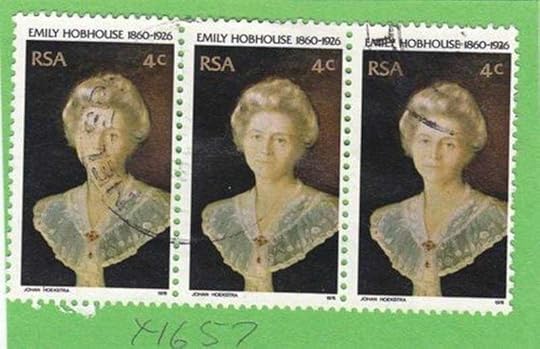
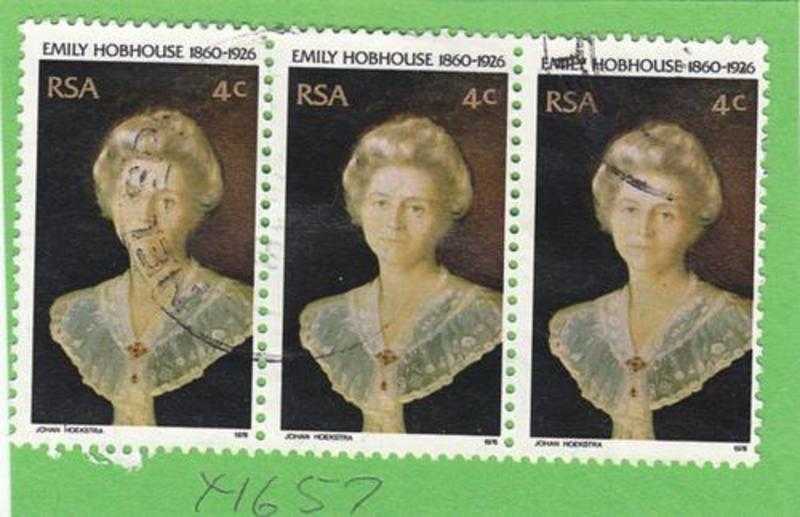
As kind het ek niks meer van Hobhouse geweet behalwe hoe sy op die Suid-Afrikaanse seël van haar gelyk het nie. Nou is sy 'n inspirasie. Kyk net met hoeveel passie sy haar taak in 1900 aanpak: "Deeply I had felt the call. Passionately I resented the injustice of English policy ... But never did the vision fade of those desolate women and children, nor the certainty that I must go to them" (p. 48). Hierbenewens het ek nie geweet van die weef- en kantskole wat sy gestig het nie, minder nog van die liefdadigheidswerk wat sy in Leipzig na die Eerste Wêreldoorlog gedoen het nie. Sonder twyfel 'n vrou van formaat.
An interesting insight into a key social reformer of the early C19th. It seems that she was both powerfully motivated to do good and somewhat naieve, so that she hasn't had a good press. At least not in the UK. She is understandably better thought of in South Africa, although she came to see the Boers so favourably that it took her a long time to realise that they were capable of things she didn't believe them capable of.
She was also unfortunate in love, where she seems to have been too trusting of cads and unfortunate in that the best of intentions in trying to arrange peace talks, during WWI, saw her branded a traitor.
It's quite an easy read as there isn't really enough material here for a full biography. Hence the weaving school episode is done to death and there is a fair bit of the author writing themselves into the tale.
This book is exceptional. Not only a memoir but a glimpse to the emotions and thoughts that the spectacular woman, Emily, felt while fighting for the people. She fought for the morality, for food, for clothes, and for soap. One woman who changed a lot and offered her life for change. A marvellous read!
I thoroughly enjoyed this journey of good intent that went against the grain, both for a women at the turn of the previous century and in the context of British politics at the time.
I read the book in print and found some of the black font difficult to read against the occasional dark backgrounds used throughout the book.