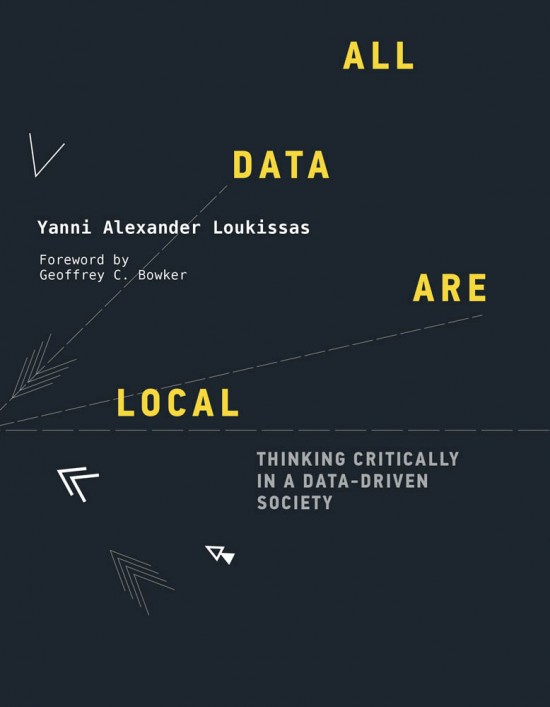
How to analyze data settings rather than data sets, acknowledging the meaning-making power of the local.
In our data-driven society, it is too easy to assume the transparency of data. Instead, Yanni Loukissas argues in All Data Are Local, we should approach data sets with an awareness that data are created by humans and their dutiful machines, at a time, in a place, with the instruments at hand, for audiences that are conditioned to receive them. The term data set implies something discrete, complete, and portable, but it is none of those things. Examining a series of data sources important for understanding the state of public life in the United States—Harvard's Arnold Arboretum, the Digital Public Library of America, UCLA's Television News Archive, and the real estate marketplace Zillow—Loukissas shows us how to analyze data settings rather than data sets.
Loukissas sets out six principles: all data are local; data have complex attachments to place; data are collected from heterogeneous sources; data and algorithms are inextricably entangled; interfaces recontextualize data; and data are indexes to local knowledge. He then provides a set of practical guidelines to follow. To make his argument, Loukissas employs a combination of qualitative research on data cultures and exploratory data visualizations. Rebutting the “myth of digital universalism,” Loukissas reminds us of the meaning-making power of the local.
Yanni Alexander Loukissas is Assistant Professor of Digital Media in the School of Literature, Media, and Communication at Georgia Institute of Technology. He is the author of Co-Designers: Cultures of Computer Simulation in Architecture.
3.5 The book argues that data (plural) aren’t universal. They’re local, shaped by context, institutions, and culture. Data gain authority by pretending they aren’t local (“big data” - singular). data only matter globally by denying the very conditions that produced them ( To scale, they flatten & to compare, they erase context). The book is sharp on critique but offers little guidance on trade offs. Flattening can be useful. A weather model doesn’t need every nuance of how people experience rain. Sometimes universality has a purpose. Still, as Loukissas argues: categories, interfaces, and numbers are not neutral. They make arguments, tell stories, etc. Recognizing that changes how we read, use, and trust data. The hard question , how to balance scale with context , remains though. Chapters 1, 2, and 6 and the better ones.
I found this work to be both very interesting and very frustrating. While I broadly agreed with the points the author was making, I felt he often missed the mark in providing a convincing argument. Chapters 1 and 2 did an excellent job setting up the book's premise and diving into the complexities of data settings through the Arnold Arboretum example. Chapter 3, however, completely missed the mark in my mind. It borrowed heavily (and, in some cases, verbatim) from a conference paper Loukissas co-authored by Matthew Battles which makes clear that many of the conclusions presented in Ch 3 as broadly applicable were originally developed only around collection data. Using the DPLA as an example just doesn't quite fit the claims being made by Loukissas in my eyes, as the data being discussed is a means by which users can access works at their original institutions. His discussion of "data artefacts" as applied to DPLA data falls fairly flat as well. The discussion in Ch 2 does pretty well in providing examples of possible meanings encoded in data artefacts, but Loukissas struggles to do the same in the later chapters, often only claiming such artefacts (like different ways of recording the date, not the most inspiring example) could be important. His arguments about algorithms and data being inseparable in Ch 4 are also poorly made, in that he completely neglects to discuss (for example) original experimental data and instead only focuses on data created through NLP processes. It's an important case to discuss, yes, but the point that all data should be considered inseparable from algorithms should also have been considered in terms of the human "algorithms" that go into even analog data. Ch 5 begins an admirable turn towards social justice-focused data initiatives and, along with Ch 6, seems to indicate that Loukissas a key battleground (for lack of a better term) when it comes to the utilization of data. It left me wondering, though, why three out of the four case studies for this book, those covered in Ch 2-4, had little to do with social justice initiatives and were certainly not presented in that sort of framework. If this really was something Loukissas wanted to focus on, I would've liked to see more of a focus on it!
Picked up the title when scouring for things related to how to think, and didn't quite read the summary closely enough to realize it didn't fit my intended topic. Nevertheless wanted to get a sense of the content. Initially thought it was in the style of a popular science or tech and society book, but in fact it is somewhat heavy in the scholarly style. Read the intro carefully, looked over the index as suggested, then mostly went over just the section titles, which are in fact the arguments the subsequent text supports, as well as the visuals, which are focused more to be experimental and provocative than representing facts. The general ideas (at least what I grasped) are worth thinking about, and the form (such as in terms of structure, language and visual style) is very interesting to see.
It is an enlightening book for someone who is interested in the intersection of information science, data visualization, and science, technology, and society (STS), and care about how data should be collected and used with sensitivity. The examples are interesting, and the texts can be a good entry for people who are new to the field. The book cited a lot of good literature that worth looking into.
I find data visualization, to be an evolving area. The needs of data science vs. statistics, as data science evolves, are becoming different; Where this will go in the long term is hard to say. Recommended.