The reader makes choices to determine the fates of three protagonists in three separate narratives: Helen, Jed and Saunders. The narratives are connected, with overlapping characters.
I discovered this book's existence through Jason Dyer's Renga in Blue blog, in a post which surveys "gamebooks" with branching narratives that were published *before* the explosive success of the official "Choose Your Own Adventure" series in the '80s. The first such example with true branching narratives the reader can choose between is this book, "Consider the Consequences!" written by Doris Webster and Mary Alden Hopkins...in 1930!
It seems impossible to find a copy for sale, but I fortunately got my hands on it via inter-library loan from the University of Pennsylvania. Some intriguing differences from what became standard CYOA formula are apparent right away:
- It's written for adults - It's realism-based, not the genre-adventure CYOA became known for - It's in third person. While second-person narration is the standard for CYOA - explicitly putting the reader in the role of the protagonist, here the reader is invited to make decisions for external characters. ("The reader who thinks she should give up Paul completely turns to paragraphs H-25. He who thinks she should encourage him to get a divorce and marry her turns to paragraphs H-26...)
There are three different characters the reader is invited to control the life-choices of: passionate Helen with an independent streak, spoiled playboy Jed, and responsible, upright Saunders - each of whom gets their own section of the book. Jed and Saunders are both suitors of Helen's, so all the characters appear in each other's narratives to a lesser or greater degree, depending on choices the reader makes.
The writing, while nothing stellar and often relying on a summarizing approach rather than depicting scenes in detail, does its job well, and bringing these characters to ruin or happiness is actually quite fun. The book does have a didactic side in how it judges the various resolution the readers can bring the characters too, but this is not as severe or predictable as some other descriptions of the book had led me to believe -- especially for the time the book was written. For instance, Helen gets positive reinforcement for seeking out work and independently supporting herself, and in one branch has an extramarital affair that instead of ruining her, actually gives her experience that makes her subsequent faithful marriage stronger! That's not the say they're aren't many period-bound judgement embedded in the book, but in general the authors seem to reward a middle path between sticking safely to society's expectations and taking life-enhancing risks.
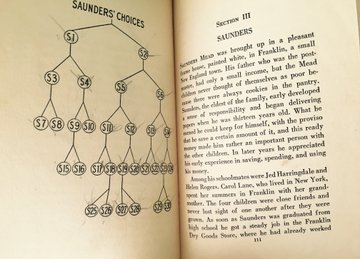
The authors even included nifty charts that show (without spoilers) the complete choice tree available to each character: (image from James Ryan's tweets about the book
All in all, a fascinating bit of interactive fiction history and an enjoyable read to boot.
This book - the first "choose you own adventure"-style story ever published, as far as I know - was conceived by the authors as a party game. It has three chapters, each focused on a different character: Helen, Jed, and Saunders. In each chapter, you get to make major life decisions for the titular character, mainly focused on relationships (but certainly not all). The characters all inhabit the same world; all three are residents of the small New England town of Franklin (which might be a real place; there is a Franklin in Massachusetts and Boston and MIT both appear in the story). In fact, the first choice in Helen's chapter - the first of the three - concerns her decision whether to marry Jed, a wealthy playboy, or Saunders, a stolid businessman, and characters from each chapter show up again in the other two.
I'm a huge fan of CYOA so the moment I heard about this book I had to read it. Now that I've done so, I feel honored to have been able to. The book is so much better than I expected, and quite good in its own right. Several things stand out to me and leave me very impressed:
1. The book is internally consistent (unlike many modern CYOA books... I'm looking at you, R.A. Montgomery...). The characters in particular behave the same in one chapter as the next, and many events whose outcome you decided occur in other chapters. I could easily envision Franklin as a real place inhabited by real people with their own quirks, vices, and talents.
2. The book is aimed firmly and unequivocally at adults. You can direct the characters to have affairs, engage in graft or insurance fraud, divorce, commit suicide(!), even get away with murder. The authors assume their readers are intelligent, educated adults and write accordingly.
3. The book is startlingly modern. The two authors (both middle-aged women at the time they wrote this) were feminists, and it shows. They also had a wicked sense of humor, and the book is peppered with politely-worded snark. Helen has the option to become a career woman, and she can be a homewrecker just as well as Jed. Jed's hypocrisy regarding his own affairs and those of his wife's (the dissipated Carol) is spotlighted more than once. The women are just as full-fledged and imbued with agency as the men: the captains of their own ships, as it were.
I've read a lot (a lot, a lot) of chooseable-path fiction. Very few books stand out from the morass, but this is unquestionably one of the shining stars, and not just because of its historical importance as The First. It's a well-thought-out, clever, delightful book that I only wish I could be so lucky as to own. Here's hoping someone scans this volume so its snapshot of a bygone era not dissimilar from our own, its wit, and its meticulous design won't be lost to history and others can enjoy it, too.
Supposedly the first ever choose-your-own-adventure book, dating from the 1930s, this is not so much about choosing adventures as it is choosing opportunities. There are three separate sections in it, giving you the opportunity to play the game of life for three people from the same small New England town. Will it be elopement, career, education, affair, divorce, fidelity, remarriage, self-sacrifice, dishonesty, a change of location, a child… etc, etc, etc.
At the end of each possible path, you’re given a moral to the story. This makes it feel more like a didactic work for young people than a game. Mildly amusing if you’re looking for something very much of its time or if you’re interested in seeing the development of a form of fiction that would come into its own many decades later.
Thanks to NetGalley and Pushkin Press for this digital review copy. Note that there was absolutely no formatting or internal links to allow you to actually jump to different parts of the book, so I just had to read it straight through and more or less remember how the paths were shaping up. I can only hope that’s fixed in the final digital version.
Consider the Consequences (1930) is considered to be the first game book. It has narrative choices that you make by flipping to a certain page to get multiple endings. I'm often more interested in the concept of a game book than actually reading it, but this one was surprisingly domestic and interesting. The three sections of the book let the reader make choices as first Helen, then Jed, and then Saunders. Each section starts with a node diagram of the available branches in that section. The book is co-written by two women, Doris Webster and Mary Alden Hopkins. The characters and their situations reflect the cultural values of the 1930s, and it's a fascinating window into the social norms surrounding marriage, child support, investments, and other social topics. I found myself irritated when the book seemed overly concerned that my mother would be left at home with no one to keep her company, which is actually an important consideration, if you think about it. The men's stories similarly have the status of their mother's home to consider when investing or spending.
Helen's first choice is whether to marry the irresponsible son of a rich widow or not; if you marry him, you have a baby right away, but it turns out he's an alcoholic and his mother is emotionally dependent on him. Helen's choices are fairly broad. You can end up as a writer to a fancy magazine who falls in love with your editor, and you can choose whether to pursue an affair and ask him to get a divorce, pursue an affair an not ask him to get a divorce, or not pursue an affair. The results are fairly sensible. If you choose to have the affair without him getting a divorce, you have a little difficulty finding an apartment but have some passionate moments together and can't compete with his love for his children. You can also end up at home keeping your mother company! The book has a wry humor that comes out in the endings, which are a considered opposite to morale fairy tales, but definitely have a practical "morale." For example: "the consequence of Helen's choosing the prudent course was that she was safe." Or "the consequence of denying herself an unpractical romance or a broken heart was the discovery that she could love a second time as heartily as the first time."
The style of the book is matter-of-fact, and time passes rapidly between choice nodes. It was refreshing to be able to play a "romance" game book with such a variety of options, all of which were given due consideration, and that progressed so rapidly. While there were some old-fashioned values in the book, like when your character gets away with murder by revealing that the victim was in a romantic relationship with his wife, the available options and reflections felt surprisingly progressive. I highly recommend this early gamebook if you can borrow a copy.
Wie kann man ein als Partyspiel gedachtes Buch von 1930 einfach nur übersetzen und 2026 rausbringen ohne Kommentar, dass die Rollenbilder logischerweise komplett veraltet sind? Und dazu noch dieses irreführende Cover: Schach kommt kein einziges Mal vor und während jede Fehlentscheidung in den männlichen Kapiteln zu mehr oder weniger Erfolg führt, kann man im Kapitel der Frau eigentlich nur verlieren. 1930 war das vielleicht ganz witzig, fast 100 Jahre später ist es mehr als überholt, aber gut die beiden Autorinnen sind auch seit fast 60 Jahren tot.
This was a tough read. I liked the concept of Choose-Your-Own-Adventure; I was a big fan of these when they came out in the 80s. However, those were more upbeat and didn’t feel like you were stuck in an “afterschool special”, where you see the consequences of your poor choices as a cautionary tale. Just about every option for Helen is disastrous and depressing, thereby cementing the thinking at that time that women shouldn’t be able to make their own decisions. This didn’t age well and should have stayed in the vault.
Thank you to NetGalley and Steerforth & Pushkin for the review copy.
When I first saw this on NetGalley, I was so intrigued by the concept. Consider the Consequences is a playful, inventive novel first published in 1930, well ahead of its time and is being republished this year by Pushkin Press.
The premise is simple but brilliant: you follow the lives of three characters, Helen, Jed, and Saunders and at the end of each chapter, you get to choose how their stories unfold. While the characters’ lives gently brush against each other, the choices you make for one don’t affect the others’ perspectives. The writing is light, witty, and incredibly readable. It is perfect for those moments when you're in a reading slump and want something refreshing yet smart. The consequences vary widely, and it’s genuinely fun to choose your own path. Of the three, Helen’s arc stood out to me the most, her storyline felt the most engaging and satisfying in terms of both stakes and payoff.
This was such a fun and innovative read, especially when you’re in need of something a little different. That said, I couldn’t help but feel it would be even more enjoyable as a group activity or party game. Reading it alone is fun, but reading it together could be an experience.
Would I Recommend? Yes For readers who like: Interactive entertainment, games for group, Social satire Song Rec: None
Thanks to NetGalley and Pushkin Press for an e-ARC of this book in exchange for an honest review.
As a child of the 80s/90s, choose your own adventure is deeply nostalgic for me. I didn’t realize its origins are even earlier! So that was fun. Beyond the format, this is mainly a curiosity from the period. If you consume other 30s media, it’s got a similar vibe. However, this particular story has so many morose outcomes that I’m not sure how much I enjoyed it (suicide! Manslaughter! Poverty! Disgrace!). Was this really ever an enjoyable party game, as the marketing suggests? It’s mostly kind of a moralizing bummer. Thanks to netgalley and the publisher for the arc!
Ormai sapete che adoro i librigame e non potevo certo perdere l’occasione di leggerne uno pubblicato negli anni 30. E vi dirò: è più progressista di quanto appaia dato che è stato scritto da due autrici che lottavano per i diritti delle donne, anche se ovviamente trasuda la mentalità dell’epoca. Dopotutto è stato progettato con l’idea di coinvolgere i giovani e aiutarli a compiere scelte morali di tutto rispetto e fidatevi che i bivi non mancheranno. Lo stile è fresco e scorrevole, tanto che si legge molto facilmente e ho apprezzato il suo essere “moderno”. È diviso in tre parti con i rispettivi protagonisti: Helen, Jeb e Suanders. La cosa interessante è che le loro disavventure si intrecciano, nonostante le apparizioni di nuovi personaggi (e conseguenti scelte), rendendo quindi la lettura un piccolo microcosmo. Ho apprezzato molto le storie di Helen e Suanders. Helen è la classica donna che dovrà scegliere tra il cuore e la mente, oltre che assicurarsi una carriera dignitosa e la vita dei suoi sogni senza rimpianti; Saunders, invece, dovrà scegliere tra la sua carriera e quella dei suoi fratelli, oltre che al bene della comunità, dimostrando quindi una storyline più matura e interessante. Ma Jeb… Jeb merita solo tante di quelle sberle. Piccolo spoiler: c’è una parte dove una delle sue fiamme gli rivela di non essere vergine prima del matrimonio e lui si indigna da morire. Quando lei gli fa notare che anche lui non è innocente la sua risposta è: “ma io sono un uomo! È diverso!” Insomma, è il classico maschio tossico che non vuole prendersi le proprie responsabilità e si lascia condizionare dalle scelte di terzi. Ma ehi, sempre un esemplare della società è. Le scelte che si dirameranno davanti al lettore non sono poi così scontate ed è stato davvero interessante trovare tutti i possibili scenari. E le conseguenze alle volte sono assai tragiche. Non sarà uno dei librigame più appassionati, ma intrattiene e ha il suo perché.
Ad avermi incuriosita è stato il fatto che questo libro-game è stato pubblicato per la prima volta negli anni Trenta. È fatto benissimo ed è molto coinvolgente. Si seguono le vicende di tre personaggi e si fanno compiere loro scelte in grado di avere impatti significativi sulle loro vite. Mi è piaciuto davvero tanto immergermi nelle loro esistenze, ho trascorso un paio di ore piacevolissime.
The first thing I do when faced with a 'choose your own adventure' book for review is to get a piece of A4 and a pen, so I can map all the branches as I go along – to work out methodically that I've covered every eventuality, to check the complexity of the stories on offer, and to see how many paths there are. So blow me when I turn to practically the first of these offerings – a romance saga in miniature from 1930 to be used as a moralising party game, more or less – and find it has a map already planned out. OK, it didn't tell me what the dashed lines meant, but it did show there was more interest on one side of the plot, and so on – which to be honest was patently honest from what was going on.
What was going on was our heroine Helen was stuck between the risque Jed, who was not liked by her parents (while she was not liked by his doting mother, either) and the elders' choice, Saunders, who was staid and sensible and earning, and did nothing for her beating heart at all. I was able to choose the route to my choice of first ending on the map, knowing which way to go, and found the story about eight pages long – these chapters can cover years, if not decades, in just a paragraph or two. (It later proves that many of the story options end with a single page of precis.) Map in hand I was able to backtrack and cover a lot more – the divorce, the last-gasp, beneficial option to go skiing or not...
And what we do learn going through the map is that this is not Jed vs Saunders – it is Jed vs not-Jed. It's quite odd how she leaves one but the other never turns up again. But still, it was interesting enough to follow the "Sliding Doors" options offered to the woman on these pages. Yes, it gains a lot seeing this kind of book in such an early form, but Helen already has sixteen potential endings, one way or another, and it's not just the intrigue of encountering such a pioneering game book – although that does also help.
I say this is a moralising task when 'playing' this read – and it seems to be that, even given the vintage of it. That first path I mentioned, to the quickest ending down one route, left Helen "safe" – and I don't think you are wrong to read the disappointment into that. This "safe" is not the best thing. That said, the main arc of this side of things is that Saunders comes back in to try and replace Jed, so perhaps the less dodgy man is the one to prioritise after all. But then, her not taking that proposal leads to so much…
The book completes the options for Helen, and then gives us separate chunks regarding Jed, and Saunders, which have a lot of overlap, but almost seem to run in alternative universes so separate are they – which is only fitting. The piece manages to have a lot of vintage sexism about the intended roles and characteristics and suchlike of the two genders, but also manages to get a lot of mileage from Jed being a mummy's boy, and Saunders merely gaining small-town glory when more was on the cards, due to him in his world marrying quite the snowflake.
What this is then is quite varied – perhaps not allowing for the most coherent story arcs, but certainly providing some debate for one's soiree. I'd certainly recommend a look at this (unless you know already that quite flippant use of suicide is really not your thing), for while it may forsake some subtlety and some logic in the more melodramatic storylines, it's still an ever-interesting thing; perhaps rightly a novelty to have a non-genre game book, but a pleasant novelty nonetheless. You don't really need to have a dinner party of friends to inflict it on, either.
I probably should have realized that with a title like "Consider the Consequences", this interactive, choose your own adventure book wouldn't exactly be a joy-ride through lots of happily ever afters.
No, there was a definitive lack of sunsets being ridden off into, and instead a whoooole lot of unemotional reality checks. But honestly, I could only help but laugh at the various endings for Helen, Jed & Saunders, and the strangely straight forward nature of them.
I truly did try the system honestly, at the beginning. My choices for Helen I assumed were a fairly good balance between rebellious and submissive, predictable and unexpected. So I quietly shrieked when I was told after a mere few paragraphs "The consequence of Helen's inability to take chances and be moderately selfish was that she had no failures in her life, nor had she any hard-won triumphs from which to draw strength for further struggles." And that was it.
That was it!? I asked myself. And then promptly returned to the beginning to start over again, just to hit another sudden and slightly clinical conclusion. Again. And again. And again. Until I finally decided I would just read through every single path that Helen's life could possibly take and see what directions would be taken.
There were certainly many variations running the gamut of personal, romantic, and professional outcomes. But I wouldn't hesitate to say that nearly every ending was fully realistic and dosed with a small bit of worldly wisdom. The morals and lessons within this little book certainly remind you that it was written nearly 100 years ago, and I recognize that I'm reading it through a cultural lens that is very far removed from the time it was originally published.
I suppose when it comes down to it, I don't prefer to be told outright what the moral lesson is to be found from a person's decisions. I want to experience it. And that was my main issue with this style of book.
Don't get me completely wrong - I enjoyed this little blast from the past, and it was fascinating to peek inside what was a new concept for that day and age. And personally, I've never done a choose-your-own-adventure style book like this. It's just limited by its format more than anything else.
Thanks to NetGalley for letting me read and review this ARC!
It was okay - quite interesting, but nothing too impressive.
This is the first (and possibly last) romance gamebook I've read (not a big fan of the genre, that's why). What prompted me to buy in the first place was the fact that it was from the 1930s. I mean yes, I read books written by people from hundreds and thousands years ago (aka, classics), but somehow, weirdly enough, 1930s felt like an awful long time for me and therefore, it intrigued me. I suddenly like to have a glimpse into the past, to find out the type of entertainment available for the contemporary audience back then.
Of course I didn't read the whole book, but just followed the path of my choices. I play-read it with my sister and we had a good laugh comparing our choices and endings.
It was a fun, interactive reading experience. Could recommend if you haven't tried this before.
P/S: I may revisit this book some other time and pick different paths to see how they all go. A reasonable dose to chase boredom away.
3.5 Stars* I found a copy of this novel at a local bookstore and thought it sounded like so much fun. "Consider the Consequences" is a novel written in the 1930's and designed to be a choose your own adventure style book. Helen Rogers must choose between two men. The first, Jed Harrington, is absolutely charming and good looking, but her family does not approve of him. The second, Saunders Mead is dependable, but there is just no chemistry. Whoever Helen chooses will dramatically dictate the rest of her life. This book is obviously a little dated and the messaging comes across as a little sexist by today's standards, however, I still had a really fun time with this. I loved choosing a path for Helen and then when I got to the end, I went back to see what would happen if I would have chosen differently. I found it intriguing that the final choice always revealed the consequence of the previous choices. It often made it feel like there was no saving Helen and no matter what her life was going to have some adversity. I think this would be a really fun game to play at a dinner party (as it was intended to) or as a book club pick. You could really dissect the choices and consequences as a group and really liven up a dry conversation. If you are looking for a fast paced, choose your own adventure dating book, and you enjoy media from the early 1990's, then I recommend this for you.
Thank you Steerforth and Pushkin for the advance copy in exchange for my honest unbiased review.
The book is a reprint of a nostalgic party game of sorts… pick your future and we’ll see where it goes! If you don’t like it, return to the beginning and start again. As a kid who enjoyed “choose your own adventure” books, I was very excited to dive into this one for adults.
The story follows Helen, Jed and Saunders through a series of completely relatable life choices. You get a lot of great backstory and then the fun starts… who do I marry? Where should I work? Do you lend someone money? Etc etc. Each journey has the potential to end in several different ways and the take on the outcomes are funny, alarming. and frustration inducing, which I think that’s probably the whole point. If you loved these types of books as a kid. If you love nostalgia or if you have a game night coming up and want something different and entertaining, this is a great pick for you.
Helen, Jed and Saunders are the three main characters in this choose your ending story. Helen is in love with an exciting man...but is he the right one for her long term or should she try to force herself to love another who would be a more reliable choice? Depending on the route the reader takes, families come into play, too, including a hateful mother in law and children.
It was a nostalgic experience for me and I adore Golden Age writing. Consider the Consequences was originally published in 1930 and I know I would have loved it if only the options to be shown where to start reading the chosen section were obvious in this format. The only option was to basically read it through like a novel relying on detail and memory. Of course this affected my enjoyment which is a shame as the potential is huge. It would be great fun to read this properly formatted (I read the Kindle version). Due to this challenge, it is tricky to review and rate.
This may be the earliest 'choose your own adventure' styled book, so I really wanted to read it and see the beginnings of that literary subgenre. Unfortunately, the overall mood of "Consider the Consequences" was not what I expected. No matter what route you read through (whether it's Helen, Jed, or Saunders), the book's tone is too serious and the same story beats happen every time a new route happens. Every 'bad' decision seems to lead to love affairs, unhappy marriages, bad parental relationships, etc. Had the authors focused on just one character, the book would have been much better. NOTE: the advanced review copy I read has serious formatting issues, where routes weren't labeled properly (or at all sometimes), and it took a lot of extra work to figure out which paragraph was the correct next step.
The first of the "choose your own adventure" type of books, it enlightened the possible life paths of three people: a woman and two men -though the woman has by far the biggest share- in 1930s USA. It is an interesting and charming read, not only because of the possibility, but because in the possibilities given and the results portrayed it gives a very clear picture of the potential paths that people one hundred years ago perceived, and how they thought of it, for good or ill. Helen, the woman, has potential careers that are not discounted, can become a wife of several men, stay at home or leave, and there is in general more choice than what we would think.
I found it a very interesting read, and strongly suggest it to anybody interested in the time period.
Thanks to NetGalley and Pushkin Press for this digital review copy.
Consider the Consequences is a game book in three sections. I used to enjoy historical game books when I was little, but this was all about romantic choices. One of the really interesting features is that three sections are stand-alone, with the choices from one section not affecting the choices in the others. However, the same characters crop up in the different sections, so the reader sees characters they have decided for, suggesting some canonical paths.
The first character is Helen. She has to choose between the rakish fun guy, Jed, and the steady Saunders. Her happiest endings happen when she gets away from both this people, with my favourite ending having her live a satisfying life with an artist. If you do stick with Jed or Saunders, there are lots of endings where Helen ends up trapped in some really miserable endings. Although this book was written by two women, she was probably the least developed character.
The next is Jed. Oddly, Helen is very much an also-ran in Jed’s affections, playing a very small role in her story. His are the stories with the big drama, his stories can include murder and suicide. There are few happy endings for Jed, largely because of his absolute harpy of a mother.
The last is Saunders. My first ride with him was the dullest but was a reasonable life. He actually has the most varied set of outcomes. He can become an unscrupulous success, can abnegate himself for his family and happily see them all set up, can throw everything away through bad romantic choices or can succeed in making everyone happy. Seemingly the dullest character, he had the most depths.
I'm a big fan of choose-your-own-adventure books so I was excited to try this one out. I am thankful for the maps at the beginning of each chapter as it's not very clear that it's the end if you didn't have that. I started reading the next chapter thinking you were to keep going until it said the end. It was still a cute and fun time, considering it was originally written in the 30s, and I could see reading a book like this, or similar style, would be fun to do around the pool or laid-back time with friends (or by yourself too!).
Thank you to NetGalley for a copy of a new print of this in return for an honest review.
Consider the Consequences was a fun and entertaining pick a path read. While I enjoyed reading it and making the decisions for the different characters, some of the choices I got to choose between were pretty grim. This is probably due to it being written almost 100 years ago, with many choices coloured by societies rules and options at the time.
I liked Helen and Jed, but I really wasn't a fan of Saunders. Overall, it was a quick, easy, and entertaining read.
3 stars from me. ⭐️⭐️⭐️
Thanks to Netgalley, Steerforth & Pushkin/Pushkin Press, for the chance to read this ARC in exchange for an honest review.
I found this book while on a trip to Utah and I thought it was so unique and fun that I scooped it right up! After reading it I want to scour the internet for more books like this one. So the way the book works is you start off reading the story and it comes to a point where you get to decide what happens next. Then you jump to the section you chose and so on and so forth. The best part is you can go back and make a different choice to read a whole different story. This book has different people/sections and it was so fun to read. Highly recommend.
It was very interesting seeing what the outcomes would be! It's such a fun adventure book, and it is a wonderful window to American domesticity from almost 100 years ago! It was great to read with my boyfriend in the park. We had lots of fun deciding what each character would do, explaining our reasoning, and coming to a decision together.
Fascinating to learn Choose Your own Adventure style books started much, much earlier than the 1980's! Here, we get a look into the mindset of the 1920's, a mix of lingering Victorian morality and a giddy rush towards 20th century civil / sexual / economic freedoms.
While inventive for its time, as a book and story it's a pretty boring read. The characters lack any real depth and the paths are quite simple. I would have liked to dive deeper into some of the characters and learn more about them.
Regarded as the first CYO Adventure book. 1930. A romance novel where you or your friends can basically play the Sims with these people. The introduction claims this can be played as Solitaire or as a Party game. Now in the public domain.