Second reading thoughts:
The Sharpe series was one of Cornwell’s early successes, and it remains built around a durable premise: Richard Sharpe, a London orphan, joins the British Army in search of relief and protection, only to discover that his real gifts are his fighting skill, endurance, and determination.
The early books follow Sharpe’s soldiering in India, but this installment moves him out of that familiar theater and sends him back to England as an ensign aboard an Indiaman, a British East India Company ship. That shift to the sea is unusual for a Sharpe story, and it gives Cornwell room to bring Sharpe into contact with the most famous naval battle of the Napoleonic Wars.
Even with the nautical setting, the central theme remains familiar: Sharpe is the common man trying to make his way in a world constrained by rank, caste, nobility, and privilege. Here, those pressures sharpen when Sharpe, through no design of his own, is thrown among the shipboard elite and finds himself drawn to a peer’s beautiful wife.
As the Calliope moves slowly west, that tension between Sharpe’s class position and his personal desires plays out through a series of incidents and adventures.
One of the strongest threads is the way desire unsettles Sharpe’s usually hard-won caution. In The Lucifer Principle, scientist and philosopher Howard Bloom writes that women “encourage killers” by admiring warriors and heroes; men, he argues, respond eagerly to that admiration. Sharpe is certainly a brave killer—everyone says so—but in this case bravery does not make him clear-sighted. He believes he is in love, and that belief makes him vulnerable.
That romantic and social tension gives the novel an unexpected Austen-like shape, though with considerably more blood and bawdiness. Pride is everywhere, and so is prejudice—class prejudice, occupational prejudice, and racial prejudice. Sharpe’s attraction to Lady Grace, who is married to Lord William, drives much of the plot, but Cornwell layers in other sources of suspense as well: people who are not what they seem, questionable sailing decisions, and several fortunes on board that could be stolen before the voyage ends. Deception and treachery accumulate, and Sharpe understands the danger only as each layer is revealed.
All of this personal intrigue eventually converges with the larger historical drama, as Sharpe and the Calliope are drawn into Britain’s iconic sea battle.
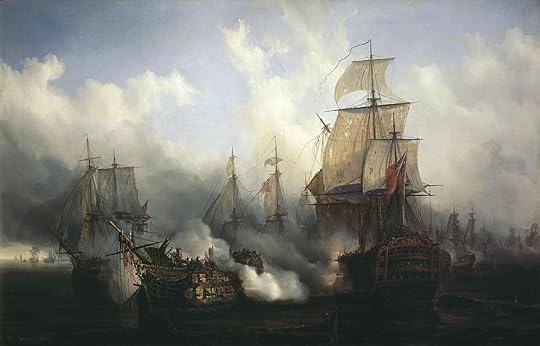
PS: A “ship of the line” is a floating fortress with 2, 3, or 4 complete decks of cannons. The world had never seen the likes of the Trafalgar battle. “Thirty-four enemy ships would take on twenty-eight British. Two thousand five hundred and sixty-eight enemy guns, manned by thirty thousand French and Spanish seamen would face two thousand one hundred and forty-eight guns crewed by seventeen thousand British tars.”
Many of my GR friends know that I have an outsized interest in the “tall ships” of the Napoleonic period. I have read all the Aubrey/Maturin novels where O’Brian provides delightful details of life aboard a ship of the line. Cornwell doesn’t disappoint by comparison. “The Pucelle used every sail that Chase could cram onto her masts. He even rigged extra hawsers to stay the masts so that yet more canvas could be carried aloft and hung from spars that jutted out from the yards. There were studdingsails and skyscrapers, staysails, royals, spritsails and topsails, a cloud of canvas that drove the warship westward…Shard still did not understand how men could work in the dark, a hundred feet above a pitching deck, clinging to thin lines and hearing the wind’s shriek in their ears. It was a bravery, he reckoned, as great as any that was need on a battlefield”
4*
For many, such as myself, who appreciate the novels of Bernard Cornwell, that appreciation began with his novels of Britain during its wars with France that became The Napoleonic Wars. It was Cornwell’s intention to convey British history from the “ground floor” rather than “the eagle’s nest.” To that end, he created the character of Richard Sharpe, a London lad who joins the British Army and starts his career in India.
By 1805, Sharpe has risen to the rank of ensign in the 74th Regiment and this book concerns his journey from India back to England in an “Inidanman,” a commercial ship of the British East India Company. Shape is always a man of initiative and courage and this book opens with him being cheated by some Indian chandlers and his determination not to leave before he is made whole.
An interesting perspective on the Indian experience: ‘I’ve been five months in India,’ Chase said, ‘but always at sea. Now I’m living ashore for a week, and it stinks. My God, how the place stinks!’
‘No more than London,’ Sharpe said, which was true, but here the smells were different. Instead of coal fumes there was bullock-dung smoke and the rich odours of spices and sewage. It was a sweet smell, ripe even, but not unpleasant, and Sharpe was thinking back to when he had first arrived and how he had recoiled from the smell that he now thought homely and even enticing. ‘I’ll miss it,’ he admitted. ‘I sometimes wish I wasn’t going back to England.’
Richard Share was a feral London boy before he joined the British army. In the time just before this book, he was sent to India to battle both indigenous peoples and other countries with imperial ambitions. He saves the life of an officer (who later will become Lord Wellington, hero of Waterloo) and is promoted from the ranks to ensign.
This is an unusual book for the series because it takes place primarily at sea. Cornwell is not Patrick O’Brian but he does well in his descriptions of life at sea and the roles of those who defend the British Empire as well as those who are “just traveling” with the British Navy or the British East India Company. Class, as well as rank, come in for close scrutiny and Sharpe (of course) is the mirror in which most of these observations are reflected.
This is an excellent effort on Cornwell’s part and an excellent description of the Battle of Trafalgar that prevented Napoleon from wresting sea superiority from the Brits and forestalled the Emperor’s plans to invade England. But, this historical novel is beyond that a great entertainment of manners, romance, perfidy, and courage.
PS: For those who have come late to Richard Sharpe, the following quote from Trafalgar will give you a sense of his powerful character. Cornwell has devoted a substantial portion of his writing to such characters (see Uhtred of Bebbanburg in The Saxon Tales).
“You did not kill men at long range in this kind of fighting, but came as close as a lover before you slaughtered them. To go into that kind of fighting needed a rage, or a madness or a desperation. Some men never found those qualities and they shrank from the danger, and Sharpe could not blame them, for there was little that was admirable in rage, insanity or despair. Yet they were the qualities that drove the fight, and they were fueled by a determination to win. Just that. To beat the bastards down, to prove that the enemy were lesser men. The good soldier was cock of a blood-soaked dunghill, and Richard Sharpe was good.”
What may be remarkable is that, over about twenty novels, Cornwell never waivers from this but he adds many facets to Sharpe’s character and makes many of these historical novels memorable.