

What do you think?

Hinduism : Ritual, Reason and Beyond - A Journey Through the Evolution of 5000 Year Old Traditions
About the Book:
The book is journey through 5000 years of evolution of Hinduism, and is outcome of seven years of study to understand the roots of Hinduism. Tracing the genesis of Hinduism to pre-Indus Valley period, the book explains Hindu, Hinduism and Sanatana Dharma, before it takes one through Hinduism’s oldest scriptures - the four Vedas, the four components of each Veda, and what they contain. How all original translations of Vedic texts were done by Western Sanskrit scholars, and why their works have left scope for doubt about the fidelity of translations.
The yajnas (yagya) like Ashvamedha, Rajsooya, Vajpeya, etc., about which we only hear on TV serials and talk shows, have been demystified. The reader will be taken aback reading the sheer size and scale of Soma yajna, described step by step, in great detail. Hinduism’s journey to the Age of Reason, the Upanishads, its encounter with Buddhism, and its transformation into idol worshipping society with many gods and a multitude of stories about its millions of gods is lucidly explained. Puranas, what they contain and what was the reason they were created, has been described and explained next.
Hinduism's journey to its modern form - idol worship, the modern puja, detailed description of puja and Sanskaras like Vivaha, their detailed description, the meaning of each action and how they are conducted, the gift to the priest, types of idols, their consecration, all are explained to help a reader understand the why and the how of what we do as a Hindu.
The book concludes with a discussion of - Do mantras have power? & Do rituals have meaning?
About the Author:
Author, Ashok Mishra, a double post graduate in electronic engineering was CEO of a Indo Japanese manufacturing venture and Director of International Management Consultancy. He runs manufacturing business producing defense grade electronic components for US & other markets.
540 pages, Print on Demand
Published October 5, 2021
Ratings & Reviews
Friends & Following
Create a free account to discover what your friends think of this book!
Community Reviews
Displaying 1 - 30 of 43 reviews
June 20, 2021
Let me start with the PROS
1. The book has a good flow and has captured the historical sequence of Hindu philosophical evolution accurately.
2. Lists in detail different type of soma sacrifice, paka yajna, havir yajna and 40 samskarasm, upacaras, vivaha, gotra, murti pujas.
3. Does a good job presenting different perspectives of the meaning of rituals and mantras
4. A good comparison of rituals from Vedic age to Shramana religions and later.
But the shortcomings are evidently visible to the people well-versed in the subject, which are overwhelming when compared to the merits of this book. and which itself would take a book to mention and refute the author. But the primary pain points are
1. The author himself admits he does not know sanskrit and vedic sanskrit which is a serious drawback and he has heavily dependent on western translations of Hindus scriptures which can be seen in his references which is at the most subpar or mediocre and in many cases incorrect. And rest of the flaws below stems from this one single flaw. There is not even a single homebred reference which in many ways provide more accurate meaning of the mantras and rituals even if not history. The western commentary itself is a borrowed light and not original and the authors interpretation is borrowed from the borrowed light. The more far you stray are away from truth the less diluted the truth becomes.
2. The authors choice of words is poor in many instances, for example when he states immigrants brought rituals with them and there are numerous such occasions which are cringe worthy.
3. The authors dealing of Aryan immigration is also not detailed and there are numerous offfhand assumptions and reductions.
4. The author raises people like Bodhayana and Apastambha and their whole lot to Rsi status which they are not howsoever venerable they might be, they are at best Law Makers which any Brahmin could tell.
5. That Upanishads Jainism and Buddhism arose opposition to vedic ritual which is again a flawed western rhetoric because many indologists were never able to fully appreciate or understand evolution of Hindu society and their flawed reasoning keeps propagating that these arose in opossition to vedic religion. In truth Neither Upanishad not Jainism or Buddhism was a reformation movement against Vedic rituals.
6. The author himself appears to be agnostic and has tried to discover the meaning of rituals in this book, but he has exactly not done that. He has failed to understand the spiritual or philosophical aspects of the same and has just reduced it to orthopraxy and provided a sub-commentary of Brahmanas and finally concluded that they are helpful in leading a ethical life. Is this the true meaning of ritual?
7. The author has implicitly assumed the rituals involved widespread animal sacrifices, which in itself is debatable. And never considers the differing viewpoint given that Vedas are full of allegories.
8. Similar to Western scholars who lack the innate ability to appreciate rituals but regard Vedanta in high regards, the author has followed suit.
To conclude this book would appeal to liberals who are pragmatic and rely more on reason (like the author himself) in discerning the meaning of rituals and Vedas. Having said that this book can be used as an introductory book on understanding rituals and their meaning but need to be supplemented with other genuine references and thorough research to realize the true import of rituals. This book is more of a compilation of authors quest in understanding the rituals which is heavily based on western interpretation of Hindu culture but has it own flaws and shortcoming which any serious Vedic scholar would readily point out.
Finally it does not matter how many years your quest took but how true your quest was. The truth reveals itself to the one who is pure.
1. The book has a good flow and has captured the historical sequence of Hindu philosophical evolution accurately.
2. Lists in detail different type of soma sacrifice, paka yajna, havir yajna and 40 samskarasm, upacaras, vivaha, gotra, murti pujas.
3. Does a good job presenting different perspectives of the meaning of rituals and mantras
4. A good comparison of rituals from Vedic age to Shramana religions and later.
But the shortcomings are evidently visible to the people well-versed in the subject, which are overwhelming when compared to the merits of this book. and which itself would take a book to mention and refute the author. But the primary pain points are
1. The author himself admits he does not know sanskrit and vedic sanskrit which is a serious drawback and he has heavily dependent on western translations of Hindus scriptures which can be seen in his references which is at the most subpar or mediocre and in many cases incorrect. And rest of the flaws below stems from this one single flaw. There is not even a single homebred reference which in many ways provide more accurate meaning of the mantras and rituals even if not history. The western commentary itself is a borrowed light and not original and the authors interpretation is borrowed from the borrowed light. The more far you stray are away from truth the less diluted the truth becomes.
2. The authors choice of words is poor in many instances, for example when he states immigrants brought rituals with them and there are numerous such occasions which are cringe worthy.
3. The authors dealing of Aryan immigration is also not detailed and there are numerous offfhand assumptions and reductions.
4. The author raises people like Bodhayana and Apastambha and their whole lot to Rsi status which they are not howsoever venerable they might be, they are at best Law Makers which any Brahmin could tell.
5. That Upanishads Jainism and Buddhism arose opposition to vedic ritual which is again a flawed western rhetoric because many indologists were never able to fully appreciate or understand evolution of Hindu society and their flawed reasoning keeps propagating that these arose in opossition to vedic religion. In truth Neither Upanishad not Jainism or Buddhism was a reformation movement against Vedic rituals.
6. The author himself appears to be agnostic and has tried to discover the meaning of rituals in this book, but he has exactly not done that. He has failed to understand the spiritual or philosophical aspects of the same and has just reduced it to orthopraxy and provided a sub-commentary of Brahmanas and finally concluded that they are helpful in leading a ethical life. Is this the true meaning of ritual?
7. The author has implicitly assumed the rituals involved widespread animal sacrifices, which in itself is debatable. And never considers the differing viewpoint given that Vedas are full of allegories.
8. Similar to Western scholars who lack the innate ability to appreciate rituals but regard Vedanta in high regards, the author has followed suit.
To conclude this book would appeal to liberals who are pragmatic and rely more on reason (like the author himself) in discerning the meaning of rituals and Vedas. Having said that this book can be used as an introductory book on understanding rituals and their meaning but need to be supplemented with other genuine references and thorough research to realize the true import of rituals. This book is more of a compilation of authors quest in understanding the rituals which is heavily based on western interpretation of Hindu culture but has it own flaws and shortcoming which any serious Vedic scholar would readily point out.
Finally it does not matter how many years your quest took but how true your quest was. The truth reveals itself to the one who is pure.

April 22, 2021
Highly Informative. Never had read a book of such level. And really shocked to know how little do I knew in general about my own history and rituals.
I got over 400 highlights and numerous screenshots on kindle from here.
This book will act as a mirror for both sorts of people, showing them the true reflections:
* People who idealize the religion, and present it as perfect in everything, may get disappointed or delighted to know, that it is full of evolution and things are getting changed for good continuously. And there were lots of ugly things in Hinduism that were changed for good. For instance, Vedas being full of animal sacrifices.
* Leftists who mock everything religious may get to know how it all happened.
However, the author has provided some clear details supporting himself, which are as quoted:
I got over 400 highlights and numerous screenshots on kindle from here.
Belonging to a family not only blindly following the customs as almost everybody do, but unfortunately, here it is being done rather aggressively as bigots, this book has such an impact on me, that even made me depressed somewhat in the middle, to be honest; getting to know the reality here and various customs which I have been forced to follow as superstitions and lack of knowledge by parents and society as a whole.
This book will act as a mirror for both sorts of people, showing them the true reflections:
* People who idealize the religion, and present it as perfect in everything, may get disappointed or delighted to know, that it is full of evolution and things are getting changed for good continuously. And there were lots of ugly things in Hinduism that were changed for good. For instance, Vedas being full of animal sacrifices.
* Leftists who mock everything religious may get to know how it all happened.
My only concern, in the beginning, was that instead of doing proper research, the author has massively taken the references and quotes from foreign authors directly rather than relying on Indian scholars for most of the stuff, which I didn't feel much reliable and trustworthy; including his full support for Aryan Invasion Theory, which I strongly reject referring from the other books that I have read just before this, which openly comments on the colonial mindset of that time.
However, the author has provided some clear details supporting himself, which are as quoted:
"Later, having decided to write on Hinduism, I thought it necessary to learn Sanskrit. However, when I attempted to study the first volume of the Ṛgveda, I discovered that ordinary Sanskrit is of no use in understanding the Vedas. I struggled to find translations of the Vedas that weren’t written by Western translators of the 17th and 18th centuries."
"I was surprised to discover that most, if not all, of what is written on the Vedas is based on nearly two-centuries-old translations by German and English scholars’ secondary sources. It was only when I was finishing this book that a properly detailed modern translation of the Rg Veda - by Jamieson and Brereton - came out in print. Most of what we rely on when we talk of Rgvedic Samhitā was translated from archaic Sanskrit into their language by English and German scholars of yore."
Reading the book further, I realized that how much effort had been actually made in making this book, later part of it was full of arguments and logical counter facts, showing both sides of the story very well and making readers discover themselves. Also, this picture may make it more sensible: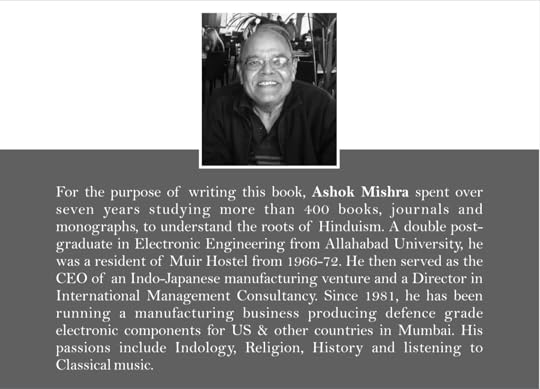
In the end, I recommend it as a must-read if you want to know about Hinduism deeply
"It will be rare to find a Hindu, indeed an Indian, who has not heard of the Vedas. And, it will be equally difficult to find a Hindu who has read all four, i.e. Ṛg, Yajur, Sāma, and Atharva Veda, or who knows the different constituents and subject matter of these ancient books of knowledge. In fact, for most Indians, the Vedas are simply the oldest books of the Hindu religion; they hardly know anything about its contents. "
"Not Geography, history or nationalism, nor even the Bollywood - the tīrtha is the biggest unifying factor in India. Rameswaram and Kanyakumari at the southern end, Badrinath and Kedarnath nestled in the Himalayas up north, the Kāmakhya śakti pīṭha at the eastern tip in Assam, Pushkara and Dwarka in the extreme west - all these are considered holy by Hindus."

August 29, 2020
The book is full of historical events that explain why we have various rituals in Hinduism and what it actually is. Various events in the past had made the cultural differences. And all of them have been put in the book in an extremely smart way.
The language is extremely easy. All of things described are very well researched and explained. I loved reading this book and enjoyed learning more about the religion.
The language is extremely easy. All of things described are very well researched and explained. I loved reading this book and enjoyed learning more about the religion.

August 5, 2021
Every religion has its origin, it's traditions and it's important to be aware of the foundations on which the whole belief system of a religion is set up.
Because there are always sentimental emotions attached to religious practices, it becomes quite complicated to talk about it in a subjective way and form an unbiased opinion in which people can accept both the beauty and the flaws of such a vast system of belief.
This book dives deeper into the various rituals of Hinduism and their significance.
It aims to clear misconceptions and pave a clear path of understanding to those who feel lost and cannot comprehend the reasons behind age-old traditions and the need behind them.
It explains why certain rituals take place and what their meaning is supposed to be. The symbolism behind certain customs and why they were performed. Why do people still follow traditions that have been continuing for eons and are still prevalent today and probably will be, for years to come.
A lot of research has been done to make this book what it is and it shows in the way that the author writes about the vastness of Hinduism with careful details and respect. The book explores the origins of practices that go back five thousand years from now. It's commendable how such complex practices are described with ease to make the readers understand the motivations behind each and every ritual.
The thing I liked about the most is that being the person that I am, someone who is always curious about everything, someone who has had a complex relationship with her faith, it just cleared a lot of things for me to get a better understanding. I have always asked questions that my adults didn't have an answer to but this book certainly did.
To be able to believe in something, you've to understand where it comes from. What significance it holds, what change it brings to your ideologies, and whether that change is good or bad. Whether you want to be a believer or not depends entirely on you but this book is a first step in understanding the how's and why's behind all of it.
It's an insightful book that provides better answers than most adults will ever do. It attempts to make you understand everything in a way that is both simple and yet coherent. It clears the air for anyone who is seeking answers with respect to Hinduism and the culture that it birthed. The culture that still thrives even though a thousand years have passed.
It's hard for me to be subjective about this book because of my own ideologies but it does clear up the fog in one's mind about certain things and I guess that's what some of us are looking for, at the end of the day.
I normally don't read non fiction, especially not spiritual ones but I read this out of curiosity and it did satisfy the curious cat inside of me, to some extent, if not fully. So, if you're looking for something that will help you gain a better understanding about the traditions in Hinduism, this is something you should definitely check out.
Because there are always sentimental emotions attached to religious practices, it becomes quite complicated to talk about it in a subjective way and form an unbiased opinion in which people can accept both the beauty and the flaws of such a vast system of belief.
This book dives deeper into the various rituals of Hinduism and their significance.
It aims to clear misconceptions and pave a clear path of understanding to those who feel lost and cannot comprehend the reasons behind age-old traditions and the need behind them.
It explains why certain rituals take place and what their meaning is supposed to be. The symbolism behind certain customs and why they were performed. Why do people still follow traditions that have been continuing for eons and are still prevalent today and probably will be, for years to come.
A lot of research has been done to make this book what it is and it shows in the way that the author writes about the vastness of Hinduism with careful details and respect. The book explores the origins of practices that go back five thousand years from now. It's commendable how such complex practices are described with ease to make the readers understand the motivations behind each and every ritual.
The thing I liked about the most is that being the person that I am, someone who is always curious about everything, someone who has had a complex relationship with her faith, it just cleared a lot of things for me to get a better understanding. I have always asked questions that my adults didn't have an answer to but this book certainly did.
To be able to believe in something, you've to understand where it comes from. What significance it holds, what change it brings to your ideologies, and whether that change is good or bad. Whether you want to be a believer or not depends entirely on you but this book is a first step in understanding the how's and why's behind all of it.
It's an insightful book that provides better answers than most adults will ever do. It attempts to make you understand everything in a way that is both simple and yet coherent. It clears the air for anyone who is seeking answers with respect to Hinduism and the culture that it birthed. The culture that still thrives even though a thousand years have passed.
It's hard for me to be subjective about this book because of my own ideologies but it does clear up the fog in one's mind about certain things and I guess that's what some of us are looking for, at the end of the day.
I normally don't read non fiction, especially not spiritual ones but I read this out of curiosity and it did satisfy the curious cat inside of me, to some extent, if not fully. So, if you're looking for something that will help you gain a better understanding about the traditions in Hinduism, this is something you should definitely check out.

December 8, 2021
A very informative book about cultural belief and hindu mythology. Also, very well researched with excellent narration.
The book is extremely detailed about significance of Hinduism in our lives. Overall, interesting a d made me curious to read more about hindu mytholgy.
The book is extremely detailed about significance of Hinduism in our lives. Overall, interesting a d made me curious to read more about hindu mytholgy.
December 22, 2020
If you are curious about where it all started and how Hinduism progressed, this is the book you must read. The author has made exponential efforts in reading various historic texts to compile all this information. He has explained a lot of things starting from Vedas, Dharma texts, Sutras, Upanishads, and Samskaras.
That being said the author has given a biased, non-scientific account of things that he tried to give his opinion on. He was selective in his examples and counterexamples that justified his narrative. I personally discourage such shoveling of one's own opinion in a beautifully written book of facts.
What it lacks is
1. How vegetarianism came into practice in Hindu/Brahmins.
2. Temple rituals including modern arti, festival pujas/rituals etc.
3. Commentary on the Purans.
4. How evil practices of modern society like dowry etc evolved.
That being said the author has given a biased, non-scientific account of things that he tried to give his opinion on. He was selective in his examples and counterexamples that justified his narrative. I personally discourage such shoveling of one's own opinion in a beautifully written book of facts.
What it lacks is
1. How vegetarianism came into practice in Hindu/Brahmins.
2. Temple rituals including modern arti, festival pujas/rituals etc.
3. Commentary on the Purans.
4. How evil practices of modern society like dowry etc evolved.

September 13, 2021
'Hinduism' by Ashok Mishra is an overview of almost 5000 years of Hinduism expressed in the range of 6 parts and 41 chapters. Beginning with arrival of Aryans to Indus civilization, charting across the Vedic culture and its influence on successive religious movements. The chapters on Sanatana Dharma, Vedas, Yajnas, Hindu scriptures, rituals and social hierarchy is dealt in concise ways inviting further explorations. Concerns of Mantras, Hindu ritual and Hinduism in modern context closes the text. It's a detailed introduction with more of anthropological, sociological approach to the religion.
The book was well written and author does a very fine job of covering 5000 years of evolution of Hinduism. It was worth the time and left me with a better 30,000 foot understanding of Hinduism. One need to spend more time reading the Vedas, the Upanishads, the Epics, and the Sutras to have understanding of Hinduism like the author Ashok Mishra has. This book takes a scholarly approach to explain some of key foundations of Hinduism and it’s relation to Indian society and the world. I think this has helped me a lot in understanding parts of the foundation and influence of Hinduism and Sanatana Dharma.
It summarizes Hinduism and the Hindus, looks at its history tracing the genesis of Hinduism, while also giving an overview of karma, the Four Vedas, Puranas, the Upanishads, the Yajnas, its encounter with Buddhism, its transformation into idol worshipping religion with many gods, meditation, rituals, mantras etc. Finally, Ashok Mishra ends the book discussing power of mantras and the meaning of Hindu rituals, and the possibilities of development and enlightenment as Hinduism grows in a new field.
The Indian subcontinent as a whole is filled with sacred places and sacrality in every region. All of these Teerthas, Pithas and Kshetras are connected to Hindu history and puranas, giving India her sense of cultural and historical unity. While India as a whole has rarely been politically unified, it is this sacred geography sanctified by the deeds of Gods and Heroes and connected by the paths of the pilgrims that has always created a strong sense of unity and uniqueness of Indian subcontinent.
In Hinduism, Ashok Mishra explores this Hindu sacred geography and its interconnectedness in all its dimensions. Starting with the history of Hindu geography in prologue, he explores the sacredness attached to all the Indian subcontinent, the deep rooted meanings and stories attached to Hinduism and also the places associated with journeys of the epic heroes in Mahabharata and Ramayana. It's an outstanding overview of the complex history and identities of Hinduism. This would be very useful as a textbook for college-level courses, and will also appeal to non-specialists looking for a scholarly treatment.
Hinduism is a brilliantly written book in which the author brings to bear his scholarly knowledge on Hindu rites and rituals, spaces and places. After reading this book one would not only emerge aware of the way divinity is embedded in Hindu life but also how that divinity pervades the landscape of the country, from the rocks to the mountains. This great comprehensive work took about seven years for the author to complete, and the detail, knowledge and coherence derived from such hard work is evident in this book.
However, what makes the book a must-read, apart from its exhaustive knowledge of Hinduism and spirituality, is the sheer skills with which Ashok Mishra writes. Over the 500 pages long journey, the reader shall seldom find the words disengaging. Distributed into neatly demarcated zones of chapters, 'Hinduism - Ritual, Reason and Beyond' is a continuing tale of devotion, respect, fascination and beauty. Seen through the eyes of a research scholar and a delightful writer, the book sketches, stroke by stroke, a picture that shall remain etched in the memory of the reader for a long time- the magnificence of Hinduism!
The book was well written and author does a very fine job of covering 5000 years of evolution of Hinduism. It was worth the time and left me with a better 30,000 foot understanding of Hinduism. One need to spend more time reading the Vedas, the Upanishads, the Epics, and the Sutras to have understanding of Hinduism like the author Ashok Mishra has. This book takes a scholarly approach to explain some of key foundations of Hinduism and it’s relation to Indian society and the world. I think this has helped me a lot in understanding parts of the foundation and influence of Hinduism and Sanatana Dharma.
It summarizes Hinduism and the Hindus, looks at its history tracing the genesis of Hinduism, while also giving an overview of karma, the Four Vedas, Puranas, the Upanishads, the Yajnas, its encounter with Buddhism, its transformation into idol worshipping religion with many gods, meditation, rituals, mantras etc. Finally, Ashok Mishra ends the book discussing power of mantras and the meaning of Hindu rituals, and the possibilities of development and enlightenment as Hinduism grows in a new field.
The Indian subcontinent as a whole is filled with sacred places and sacrality in every region. All of these Teerthas, Pithas and Kshetras are connected to Hindu history and puranas, giving India her sense of cultural and historical unity. While India as a whole has rarely been politically unified, it is this sacred geography sanctified by the deeds of Gods and Heroes and connected by the paths of the pilgrims that has always created a strong sense of unity and uniqueness of Indian subcontinent.
In Hinduism, Ashok Mishra explores this Hindu sacred geography and its interconnectedness in all its dimensions. Starting with the history of Hindu geography in prologue, he explores the sacredness attached to all the Indian subcontinent, the deep rooted meanings and stories attached to Hinduism and also the places associated with journeys of the epic heroes in Mahabharata and Ramayana. It's an outstanding overview of the complex history and identities of Hinduism. This would be very useful as a textbook for college-level courses, and will also appeal to non-specialists looking for a scholarly treatment.
Hinduism is a brilliantly written book in which the author brings to bear his scholarly knowledge on Hindu rites and rituals, spaces and places. After reading this book one would not only emerge aware of the way divinity is embedded in Hindu life but also how that divinity pervades the landscape of the country, from the rocks to the mountains. This great comprehensive work took about seven years for the author to complete, and the detail, knowledge and coherence derived from such hard work is evident in this book.
However, what makes the book a must-read, apart from its exhaustive knowledge of Hinduism and spirituality, is the sheer skills with which Ashok Mishra writes. Over the 500 pages long journey, the reader shall seldom find the words disengaging. Distributed into neatly demarcated zones of chapters, 'Hinduism - Ritual, Reason and Beyond' is a continuing tale of devotion, respect, fascination and beauty. Seen through the eyes of a research scholar and a delightful writer, the book sketches, stroke by stroke, a picture that shall remain etched in the memory of the reader for a long time- the magnificence of Hinduism!

May 17, 2026
Firstly do not read this review if you can't handle truth bombs.
For someone who read dozens of historical books till date, this book served as a playground to catch distortions. Happy to answer any criticism
1)The whole book is based on Aryan Migration theory
Right from the initial chapter, Ashok Mishra establishes Aryan Migration theory and affirms that brahmans are aryans and they have pushed the original indians i.e dravidans towards south. Every other chapter author reminds the reader about aryans, how they nicely assimilated and dravidans started listening to them. Spoiler alert, Aryan invasion theory has been proven to be a myth since 1940s and Aryan migration has been debunked since last 20years by several historians across the world and it has become the established consensus. Despite that author pushing so hard proves how shallow his understanding of history and hinduism. Now that AMT is debunked and Parallel historical & linguistic arguments cite out of india , will the author accept his mistake, the catch-22 situation and revise the book?
2)The title is grossly misleading
Reader assumes that the book is about reasoning of rituals , author spends atleast 100 pages on the detailing of the yagnas (Havans) but mentions nothing on the health and environmental benefits of the practice. The modern studies repackages the yagna smoke as medicinal smoke which was demonstrated by a family that survived 1985 bhopal toxic gas tragedy by conducting yagna all through the night. Similarly significance and practical benefits of rituals during pregnancy ,child birth or death are not discussed.
3)No mention of barbaric invasions of islam or missionary oriented christanity
Though author mentions few of the verses were added to counter islamic conversions , no mention of abrahamic theology. Author says there were auditorium for debate on god such as kutuhala shala and were welcomed in hinduism , he never mentioned that questioning God in pre-protestant christanity and islam till date is called as blasphemy and punished by death.
4)Buddhism and jainism are established as rebellion of hinduism
Author cites Ashoka's example of conversion to Bhuddism after kalinga war. Who will tell this author that it's a lie fabricated by so called distorians till recently. Ahoka was a bhuddist even before the war and his entire legacy is a well distorted piece in the history. Also Buddism and jainism are concluded to be superior to hinduism citing it's ahimsa and non ritualistic way of life. Any given day both these religions are 100 times better than abrahamic religions, however can the author answer the hard questions of how all areas that were once reigning with buddism such as afganiatan,Uzbekistan, Turkmenistan, and Kazakhstan etc fell to islam invasions within 110 years whereas mainland india has been resisting them since 1400 years. Roughly Hinduism -Kshatriya dharma =Budduism, this sounds nice during peace time but not when the enemy crashes your gate. P.S: Both the buddha and mahavira are greats saints that established two more panths of hinduism and are widely respected and accepted by hindus even today. Period.
5)Only christian scholars are cited to understand sanskrit vedas
how funny can it be write a book based on the works of people who are from different religion , different culture, different nation and doesn't understand the nuances of sanskrit. All through Ashok mishra cites maxmuller who created the 'Aryan invasion theory'. No indian authors or research was cited all through.
For someone who read dozens of historical books till date, this book served as a playground to catch distortions. Happy to answer any criticism
1)The whole book is based on Aryan Migration theory
Right from the initial chapter, Ashok Mishra establishes Aryan Migration theory and affirms that brahmans are aryans and they have pushed the original indians i.e dravidans towards south. Every other chapter author reminds the reader about aryans, how they nicely assimilated and dravidans started listening to them. Spoiler alert, Aryan invasion theory has been proven to be a myth since 1940s and Aryan migration has been debunked since last 20years by several historians across the world and it has become the established consensus. Despite that author pushing so hard proves how shallow his understanding of history and hinduism. Now that AMT is debunked and Parallel historical & linguistic arguments cite out of india , will the author accept his mistake, the catch-22 situation and revise the book?
2)The title is grossly misleading
Reader assumes that the book is about reasoning of rituals , author spends atleast 100 pages on the detailing of the yagnas (Havans) but mentions nothing on the health and environmental benefits of the practice. The modern studies repackages the yagna smoke as medicinal smoke which was demonstrated by a family that survived 1985 bhopal toxic gas tragedy by conducting yagna all through the night. Similarly significance and practical benefits of rituals during pregnancy ,child birth or death are not discussed.
3)No mention of barbaric invasions of islam or missionary oriented christanity
Though author mentions few of the verses were added to counter islamic conversions , no mention of abrahamic theology. Author says there were auditorium for debate on god such as kutuhala shala and were welcomed in hinduism , he never mentioned that questioning God in pre-protestant christanity and islam till date is called as blasphemy and punished by death.
4)Buddhism and jainism are established as rebellion of hinduism
Author cites Ashoka's example of conversion to Bhuddism after kalinga war. Who will tell this author that it's a lie fabricated by so called distorians till recently. Ahoka was a bhuddist even before the war and his entire legacy is a well distorted piece in the history. Also Buddism and jainism are concluded to be superior to hinduism citing it's ahimsa and non ritualistic way of life. Any given day both these religions are 100 times better than abrahamic religions, however can the author answer the hard questions of how all areas that were once reigning with buddism such as afganiatan,Uzbekistan, Turkmenistan, and Kazakhstan etc fell to islam invasions within 110 years whereas mainland india has been resisting them since 1400 years. Roughly Hinduism -Kshatriya dharma =Budduism, this sounds nice during peace time but not when the enemy crashes your gate. P.S: Both the buddha and mahavira are greats saints that established two more panths of hinduism and are widely respected and accepted by hindus even today. Period.
5)Only christian scholars are cited to understand sanskrit vedas
how funny can it be write a book based on the works of people who are from different religion , different culture, different nation and doesn't understand the nuances of sanskrit. All through Ashok mishra cites maxmuller who created the 'Aryan invasion theory'. No indian authors or research was cited all through.

August 8, 2021
First of all, I should mention, yes it's a book about Hinduism but it hasn't uplifted or down any religion at all. So if anybody wants to explore Hinduism more, definitely can pick this book doesn't matter in which religion you are. This book respects all religions and has especially of spreading love. It was kind of life-changing for me as I was suffering from traumatic situations and all. This book helped me to overcome as well. I will recommend it to anybody who wants a blissful read, or something unique on nonfiction can grab this book right away.
This book consists of a journey of Hinduism from the very close of its root and the complete evolution of 5000 years. The principle of Hinduism is Vedas and it's very tough to explain in a lucid way for readers. I can't explain how perfectly author Ashok Mishra has done this job, it has important to me indeed. Hinduism encloses the rituals of Hinduism and explains their cause, significance, and importance. The real theory behind those rituals and why they should be followed.
The way every single raw detail of Hinduism has been defined, it is visible how specific researchers were done for making this book a treasure. This book has kind of all solutions and answers I could ask for. It's miracle! On every page, I got some questions in my mind, and it was answered by the next few pages. The author's dedication and knowledge towards Hinduism are mindblowing! Sometimes I thought, how somebody can be so wise to know so many things about it in one life! I have all respect for him, kudos to him.
Somehow, this book has made my soul more holy, blissful, and strengthen. I obey the rituals without knowing the story and solid reason behind it. But now, it's I am so particular about all of my next steps. The power of Mantras are so genuine and impactful, I really hadn't any idea about it. I have more beliefs and respect after reading this. I can see the changes within myself. Author Ashok Mishra's writing style is so straightforward without having any extra dragging. It took time to complete this book but of course it's worth of time. There is no complex word that will interrupt in between. But some phrases of Vedas can be hard for readers, but they will understand it perfectly with reading more pages of it.
As I said, anybody can pick this book if you have respect for all religions. This book is spreading love and bless to readers and I have felt it after completing it. The way of thinking has been changed and I got more peace at the end of it. The cover is simple and the title tells everything the book is about. I will not place it on my shelf now as there are many things I have to note down that transform my mental trauma into serenity.
This book consists of a journey of Hinduism from the very close of its root and the complete evolution of 5000 years. The principle of Hinduism is Vedas and it's very tough to explain in a lucid way for readers. I can't explain how perfectly author Ashok Mishra has done this job, it has important to me indeed. Hinduism encloses the rituals of Hinduism and explains their cause, significance, and importance. The real theory behind those rituals and why they should be followed.
The way every single raw detail of Hinduism has been defined, it is visible how specific researchers were done for making this book a treasure. This book has kind of all solutions and answers I could ask for. It's miracle! On every page, I got some questions in my mind, and it was answered by the next few pages. The author's dedication and knowledge towards Hinduism are mindblowing! Sometimes I thought, how somebody can be so wise to know so many things about it in one life! I have all respect for him, kudos to him.
Somehow, this book has made my soul more holy, blissful, and strengthen. I obey the rituals without knowing the story and solid reason behind it. But now, it's I am so particular about all of my next steps. The power of Mantras are so genuine and impactful, I really hadn't any idea about it. I have more beliefs and respect after reading this. I can see the changes within myself. Author Ashok Mishra's writing style is so straightforward without having any extra dragging. It took time to complete this book but of course it's worth of time. There is no complex word that will interrupt in between. But some phrases of Vedas can be hard for readers, but they will understand it perfectly with reading more pages of it.
As I said, anybody can pick this book if you have respect for all religions. This book is spreading love and bless to readers and I have felt it after completing it. The way of thinking has been changed and I got more peace at the end of it. The cover is simple and the title tells everything the book is about. I will not place it on my shelf now as there are many things I have to note down that transform my mental trauma into serenity.

August 22, 2021
No wonder it took more than 7 years for the author to pen this book. It's quite evident after I finished reading this magnanimous book. The sheer amount of time invested in it in order to finish this huge volume is commendable. However, the level of expertise in the procurement & arrangement of different forms of content already available in various novels done in this book is totally inappropriate & unjustifiable. What I failed to understand is what the writer is trying to say here? Is he talking about Hinduism at all or completely ruining it in the process of developing a sassy book!
Though the one thing I appreciate about this book is that it justifies both sides of every story just like how a coin has two sides. As we're all aware of, each time a polical controversy shows up, people never fail to blame Hindus or Hinduism. They just blinding proclaim & boast everywhere that Hinduism is the root cause of all problems in this world. However, that's utter preposterous & rightfully bogus. The truth of the matter is these very people don't even know what being a Hindu means or what Hinduism even stands for. They don't even have a clear conscience or sheer tenacity to grasp the copious knowledge available to learn pertaining to Hinduism. They're oblivious to it, hence, post ambiguous comments lacking any moral support.
The wide variety of topics covered in this book ranges right from the beginning of time from Aryan Invasion to the establishment of Dharma, the existence & the establishment of the very base of Sanatana Dharma, the importance of Guru in every relevant field of work or sector of mankind, the necessity of Bhakti & Shakti, the cause behind Rituals; & the uncovering of many ideals followed in the path of righteousness right from root/origin of mankind.
The drawbacks pertaining to this book ranges from the lack of research to poor presentation made with every topic/aspect/sector/consciousness as there's an absolute absence of the support of concrete evidences. With lack of facts in every possible manner, it becomes apparent that it's quite tedious to read. Let's not forget to emphasise the poor cover design accompanied by a storytelling which is monotonous in nature, & top of that, the language with which this is developed, determined & written ain't easy to understand at all. It takes immense focus, pressure & thrust just to move from one page to another. Hence, making it all the more abnoxious to read completely. A one-time read just to kill time.
Though the one thing I appreciate about this book is that it justifies both sides of every story just like how a coin has two sides. As we're all aware of, each time a polical controversy shows up, people never fail to blame Hindus or Hinduism. They just blinding proclaim & boast everywhere that Hinduism is the root cause of all problems in this world. However, that's utter preposterous & rightfully bogus. The truth of the matter is these very people don't even know what being a Hindu means or what Hinduism even stands for. They don't even have a clear conscience or sheer tenacity to grasp the copious knowledge available to learn pertaining to Hinduism. They're oblivious to it, hence, post ambiguous comments lacking any moral support.
The wide variety of topics covered in this book ranges right from the beginning of time from Aryan Invasion to the establishment of Dharma, the existence & the establishment of the very base of Sanatana Dharma, the importance of Guru in every relevant field of work or sector of mankind, the necessity of Bhakti & Shakti, the cause behind Rituals; & the uncovering of many ideals followed in the path of righteousness right from root/origin of mankind.
The drawbacks pertaining to this book ranges from the lack of research to poor presentation made with every topic/aspect/sector/consciousness as there's an absolute absence of the support of concrete evidences. With lack of facts in every possible manner, it becomes apparent that it's quite tedious to read. Let's not forget to emphasise the poor cover design accompanied by a storytelling which is monotonous in nature, & top of that, the language with which this is developed, determined & written ain't easy to understand at all. It takes immense focus, pressure & thrust just to move from one page to another. Hence, making it all the more abnoxious to read completely. A one-time read just to kill time.

September 13, 2021
Hinduism is the third largest religion in the world. It is the most oldest religion which is still widely practised. It was found at generally 2500BC. It is a mixture of many beliefs and religion in the Indian religion. It has no set founder. They practised polytheism, which means having belief in or worshiping of many Gods. However, there are some who only worship Shiva as their God, but most of them have belief in all their Gods. This remembering of God may prove tiresome for those who are new. This can also be confusing to others like which one to worship and accept as the mightiest of all. Hinduism was influenced by two other religions, Jainism and Buddhism. The Puranas, which means the information of the past were spread throughout India. Through this medium, the faith in Hindu religion began to standardize. This spreading of sacred texts was in full flow as the Brahmins who wrote it was worried that Jainism and Buddhism would become dominant. The most important sacred text is the Bhagavad-Gita. Later on, it was a successful time for the religion which was helped by rising literacy in India, and saw a lot of great philosophical achievements and literary works. It was also at that time when the Gupta Empire who practised Hinduism ruled over larger parts of India and grew rich overtime. Hindus have a strong belief in Sanatan Dharm. This book tells us about the four vedas- Rig Veda, Yajur Veda, Sama Veda and Atharva Veda, the four main components of each of them and what they contain. The different yajnas such as Ashvamedha, etc. has been described clearly with context to how it came into force. It describes the evolution of yajnas in step wise. This book also describes how the evolution of worshipping idols started. And the most important part is that it explains the meaning of the rituals that Hindus use in their day to day life for marriage or prayers etc. It has a climax and thoughtful question in the end.
This book is a result of intense hard work and lot of research which makes it quite a knowledgeable book. The knowledge stored in this book is very well describing the efforts which author had made. The readers will love this book as there is no confusion in reading. Hats off to the author.
This book is a result of intense hard work and lot of research which makes it quite a knowledgeable book. The knowledge stored in this book is very well describing the efforts which author had made. The readers will love this book as there is no confusion in reading. Hats off to the author.

August 14, 2021
🌺🌺🌺🌺🌺
📚 Book Review
Title : Hinduism
Author : Ashok Mishra
Language : English
Edition : Paperback
Pages : 540
💫 Hinduism is a religion of India. It is a way of life that people follow. It is the third largest religion of the world. Nearly 16 percent of the world's population follow this religion. It is one of the most oldest religion of the world. Many people also call it Sanatana Dharma. The origin of this religion lies in the ancient history.
💫 Hinduism is a vast topic. Despite of being a Hindu by birth some people lack the in depth knowledge about the religion. This book comes as a boon for those people explaining each and every concept in a simple and easy manner.
💫 Hinduism by Ashok Mishra is a journey through the evolution of five thousand year old traditions. I thank the author for taking the initiative to explain about Hinduism in details to the people who are eager to know more.
💫 It is an engaging book which takes us on a different dimension of culture and traditions. The book is a result of an extensive research which has been done over years by the author. It is really not possible to summarize the entire religion into a couple of books. It is the author's hard work over the years which came to us in the shape of this book.
💫 The author has showed his love and respect for all religions equally. He is trying to study each religion in order to write upon it in full details. He has presented this book in a simple and systematic manner so that a non hindu can also understand the contents without any difficulty.
💫 It is an interesting book which increases our knowledge about hindu religious beliefs, rituals and practices. I had a great time reading about Hinduism in details. We get a clear concept about this religion through this book. It is written in simple language which is very easy to understand. It is a must read for the younger generation to have a clear understanding of the religion.
🌺🌺🌺🌺🌺
📚 Book Review
Title : Hinduism
Author : Ashok Mishra
Language : English
Edition : Paperback
Pages : 540
💫 Hinduism is a religion of India. It is a way of life that people follow. It is the third largest religion of the world. Nearly 16 percent of the world's population follow this religion. It is one of the most oldest religion of the world. Many people also call it Sanatana Dharma. The origin of this religion lies in the ancient history.
💫 Hinduism is a vast topic. Despite of being a Hindu by birth some people lack the in depth knowledge about the religion. This book comes as a boon for those people explaining each and every concept in a simple and easy manner.
💫 Hinduism by Ashok Mishra is a journey through the evolution of five thousand year old traditions. I thank the author for taking the initiative to explain about Hinduism in details to the people who are eager to know more.
💫 It is an engaging book which takes us on a different dimension of culture and traditions. The book is a result of an extensive research which has been done over years by the author. It is really not possible to summarize the entire religion into a couple of books. It is the author's hard work over the years which came to us in the shape of this book.
💫 The author has showed his love and respect for all religions equally. He is trying to study each religion in order to write upon it in full details. He has presented this book in a simple and systematic manner so that a non hindu can also understand the contents without any difficulty.
💫 It is an interesting book which increases our knowledge about hindu religious beliefs, rituals and practices. I had a great time reading about Hinduism in details. We get a clear concept about this religion through this book. It is written in simple language which is very easy to understand. It is a must read for the younger generation to have a clear understanding of the religion.
🌺🌺🌺🌺🌺

August 8, 2021
"Dharma protected, protects."
Written by Ashok Mishra, the book 'Hinduism: Ritual, Reason and Beyond - A Journey Through the Evolution of 5000 Year Old Traditions' encapsulates the knowledge passed down from generation to generation for 5000 years and the seven years of study the author has gone through to understand the complexity of it.
I have been interested in Hinduism and in knowing the very ground truth of this ancient tradition. Growing up, I witnessed multiple rituals performed but have rarely gotten an explanation for those. Then I began learning it for myself and gathered bits and pieces of knowledge that answered some of my queries and made me realise we know very little, and sometimes we know the wrong thing. So when I picked up this book, I didn't know if I should enter with a sceptical mind or let the book teach me something as it claims.
I'm glad I did pick it up, for it opened up a whole world to me. It spoke to me about the real Sanatan Dharma and about our ancestors, and how the entire concept of Hinduism came into being. The thing about age-old traditions is that we know so little of its origin, but it's awe-worthy that it has survived for so long. The author speaks about the heterogeneous nature of this old faith and how new ideas found a place to grow. It didn't shy away from change and adaptations and often questioned itself. Laws and beliefs have sprung up following a path not traversed by many - an open path where opposing beliefs also find equal respect and reverence.
I have no complaints about this book since it delivers what it says. It is a long book, so readers need to be patient as they read on. There is just so much to explore. I would recommend this to serious, non-fiction readers who would like to explore this amazing way of life.
For more such detailed reviews, check out my bookstagram: www.instagram.com/mystic_tales_tintin
Written by Ashok Mishra, the book 'Hinduism: Ritual, Reason and Beyond - A Journey Through the Evolution of 5000 Year Old Traditions' encapsulates the knowledge passed down from generation to generation for 5000 years and the seven years of study the author has gone through to understand the complexity of it.
I have been interested in Hinduism and in knowing the very ground truth of this ancient tradition. Growing up, I witnessed multiple rituals performed but have rarely gotten an explanation for those. Then I began learning it for myself and gathered bits and pieces of knowledge that answered some of my queries and made me realise we know very little, and sometimes we know the wrong thing. So when I picked up this book, I didn't know if I should enter with a sceptical mind or let the book teach me something as it claims.
I'm glad I did pick it up, for it opened up a whole world to me. It spoke to me about the real Sanatan Dharma and about our ancestors, and how the entire concept of Hinduism came into being. The thing about age-old traditions is that we know so little of its origin, but it's awe-worthy that it has survived for so long. The author speaks about the heterogeneous nature of this old faith and how new ideas found a place to grow. It didn't shy away from change and adaptations and often questioned itself. Laws and beliefs have sprung up following a path not traversed by many - an open path where opposing beliefs also find equal respect and reverence.
I have no complaints about this book since it delivers what it says. It is a long book, so readers need to be patient as they read on. There is just so much to explore. I would recommend this to serious, non-fiction readers who would like to explore this amazing way of life.
For more such detailed reviews, check out my bookstagram: www.instagram.com/mystic_tales_tintin
August 26, 2021
This book is good for what it is. If you are eccentric about where it all started and how Hinduism progressed, this book is the must. It gives you an awesome introduction to Hinduism as a whole that would feel like an extended, more colourful article and that's what I got.
This book has detailed explanation of topics on Aryan Invasion, Dharma, Santana Dharma, Guru, Bhakti, Rituals, and all the grounds behind them. The author moulded it in a way where we can understand it very neatly. With this book you can understand the transformation of religious things from 5000 years.
If you grew up in a society that was always telling you how a certain books are infallible and they contain all the wisdom in the world, it becomes a little difficult to question those claims. A different narrative might not be easy to digest.
But there are areas where I disagree with the author, particularly his views on evolution. The general theme dealt with in this book strike a chord with me. But I am glad to have learned enough about this ancient, kaleidoscopic and intriguing way of life to whet my appetite for future study about this topic.
The thing which I like the most about this book is that it clearly explains the relationship with God and it gives a better understanding on this religion. It gives the purpose to believe in this religion. Because of the detailed explanation it brings the ideology and Wheather the changes happens in us is good or bad. I loved how flowcharts have been laid forward to make the spiritual thoughts more believable and more convincing.
This Book clearly explained about the root of our origin and the misconception about our religion. If you want to know more about our religion and ancient India and the idol worship, do grab the book and read it.
This book has detailed explanation of topics on Aryan Invasion, Dharma, Santana Dharma, Guru, Bhakti, Rituals, and all the grounds behind them. The author moulded it in a way where we can understand it very neatly. With this book you can understand the transformation of religious things from 5000 years.
If you grew up in a society that was always telling you how a certain books are infallible and they contain all the wisdom in the world, it becomes a little difficult to question those claims. A different narrative might not be easy to digest.
But there are areas where I disagree with the author, particularly his views on evolution. The general theme dealt with in this book strike a chord with me. But I am glad to have learned enough about this ancient, kaleidoscopic and intriguing way of life to whet my appetite for future study about this topic.
The thing which I like the most about this book is that it clearly explains the relationship with God and it gives a better understanding on this religion. It gives the purpose to believe in this religion. Because of the detailed explanation it brings the ideology and Wheather the changes happens in us is good or bad. I loved how flowcharts have been laid forward to make the spiritual thoughts more believable and more convincing.
This Book clearly explained about the root of our origin and the misconception about our religion. If you want to know more about our religion and ancient India and the idol worship, do grab the book and read it.
September 24, 2021
🅱🅾🅾🅺 🆁🅴🆅🅸🅴🆆
𝑯𝒊𝒏𝒅𝒖𝒊𝒔𝒎 : 𝑹𝒊𝒕𝒖𝒂𝒍, 𝑹𝒆𝒂𝒔𝒐𝒏 𝒂𝒏𝒅 𝑩𝒆𝒚𝒐𝒏𝒅 - 𝑨 𝑱𝒐𝒖𝒓𝒏𝒆𝒚 𝑻𝒉𝒓𝒐𝒖𝒈𝒉 𝒕𝒉𝒆 𝑬𝒗𝒐𝒍𝒖𝒕𝒊𝒐𝒏 𝒐𝒇 𝟓𝟎𝟎𝟎 𝒀𝒆𝒂𝒓 𝑶𝒍𝒅 𝑻𝒓𝒂𝒅𝒊𝒕𝒊𝒐𝒏𝒔
🆀🅾🆃🅳#: Do you like reading books based on spiritualism, religion and mythological?
#AOTD: No words. Occupied as hell!
ᴀᴜᴛʜᴏʀ: Ashok Mishra
ꜰᴏʀᴍᴀᴛ: Paperback/ Kindle
ᴘᴀɢᴇꜱ/ᴄʜᴀᴘᴛᴇʀꜱ: 540
𝙶𝚎𝚗𝚛𝚎: ---
ᴘᴜʙʟɪꜱʜᴇʀ: StoryMirror Infotech Pvt. Ltd.
🎙️SYNOPSIS: Whenever we talk about religion it seldom happens that we discuss about it prejudice. Religions are something we wishes to talk about but some times we do not talk about it because of sentimental valued attach to this. Kudos to author who has chosen such a debatable topic to write a book.
🎙️NOVELTY: The author has explained many traditional aspects of Hinduism. The research done for this book reflects through flipping the pages and the references that author has took while writing this book.
🎙️GUESSWORK: Reading book on Hinduism which tlaks about various layers hide within is something I never read and encounter. Thus for me it was indeed a refreshing as well holds the knowledgeable aspects for the reader.
🎙️LANGUAGE: The book is quite thick but written beautifully with an amazing narration and good language.
🎙️FINAL CALL: Despite the thickness of the book it holds the readers interest. The language is good and it has many elements which holds the readers interest throughout. The author has put his hardwork in the book which made this book a book without prejudice.
- - #readwithbindu
- #reviewwithbindu
- - #bookwormbindz

June 2, 2022
A very comprehensive and neutral overview of the Hindu religion (mainly the vedic religion. Doesn't cover much about the southern take on religion mainly saiva siddantha philosophy which doesn't really have its origins in the vedas. ). It was delightful to see the author has tried to maintain a neutral stance and not pushing an opinion about the religion. Definitely brings about a great perspective on the origins and evolution of Hinduism. It actually changes your perspective of the Vedas as being the holy grail and the untainted repository of cosmic and philosophical knowledge. A lot of awkward/ugly/unexpected things are brought up in this book about the ancient practices present. This book kind of brought Hinduism from that shining pedestal that I had it on. That being said, it is in no way a book debunking Hinduism, rather it inspires us to truly learn our culture so as to appreciate the phenomenal thoughts that have occurred within it, while at the same time discarding some of the irrelavant/unjust practices. I felt like the amount of detail given in some of the sections about these rituals could have been avoided/ put in the appendix so as to just give an overview of the different aspects of the ancient Hindu religion.
August 30, 2020
The title of the book itself gives a brief idea about taking you beyond the horizon of ritualism and spiritualism,reason and spiritualism. This book is a collection of informative words that will take you on a journey through the evolution of 5000 year old traditions.
.
The author has spent more than seven years in order to unravel the roots of Hinduism and the massive hold of information is evident throughout the book. The book carefully throws a light on how rituals allowed to stay in touch with the first and foremost role of knowledge, which in turn plays a suppporting role.
The roots of religion is divided among the masses,either by discrimination or by thoughts. I loved how flowcharts have been laid forward to make the spiritual thoughts more believable and more convincing.
.
The book has thrown a light on how we have had a misconception about the roots of our origin or specifically,the origin of our religion.
Ritual practices of the Vedic period have been gently inscribed on the pages of this book.
Grab the book if you want to know how this religion started in ancient India,the arrival of idol worship and meet the origin of the two extremes of this religion.
.
The author has spent more than seven years in order to unravel the roots of Hinduism and the massive hold of information is evident throughout the book. The book carefully throws a light on how rituals allowed to stay in touch with the first and foremost role of knowledge, which in turn plays a suppporting role.
The roots of religion is divided among the masses,either by discrimination or by thoughts. I loved how flowcharts have been laid forward to make the spiritual thoughts more believable and more convincing.
.
The book has thrown a light on how we have had a misconception about the roots of our origin or specifically,the origin of our religion.
Ritual practices of the Vedic period have been gently inscribed on the pages of this book.
Grab the book if you want to know how this religion started in ancient India,the arrival of idol worship and meet the origin of the two extremes of this religion.

September 7, 2021
I have always been one to question the various rituals that is practiced in my home. Why do we have to or not have to do certain things on particular day? Why do something in a particular way?
I always used to have these whys and whenever I asked my mother these questions she would simply reply saying that you should not question why and how in religious rituals, you just do it because our elders taught us to do it.
.
This book came in as an answer to a few of my questions. Hinduism is dharma, it's a way of living, this is something that we in present times have forgotten. We have confused it with religion.
.
The author has definitely done extensive research to bring us answers that I am pretty sure most people might have asked or at least thought of. The author should get huge credit for this. He delivered us the answers for why we do some of the rituals.
.
This book has left me feeling satisfied. I do have started believing in the rituals after knowing the reasons behind it. The author has put up all the facts so simply. I would definitely recommend this book to anyone who is just like me, looking for answers.
I always used to have these whys and whenever I asked my mother these questions she would simply reply saying that you should not question why and how in religious rituals, you just do it because our elders taught us to do it.
.
This book came in as an answer to a few of my questions. Hinduism is dharma, it's a way of living, this is something that we in present times have forgotten. We have confused it with religion.
.
The author has definitely done extensive research to bring us answers that I am pretty sure most people might have asked or at least thought of. The author should get huge credit for this. He delivered us the answers for why we do some of the rituals.
.
This book has left me feeling satisfied. I do have started believing in the rituals after knowing the reasons behind it. The author has put up all the facts so simply. I would definitely recommend this book to anyone who is just like me, looking for answers.
September 26, 2021
6️⃣ out of 🔟 readers will learn about 'Hinduism' 📓
A subject too vast and deep to cover in a book, however thick it may be. It could have focused on the sub-title i.e. Ritual, Reasons & Beyond; rather than attempting to confirm the 'Aryan Invasion Theory', reject the power of Mantras, ignore the ageing of ancient scriptures & their authors, prove 'Tamil' a language senior to 'Sanskrit' and base itself too much on the work of a lot of English authors.
This book gets overshadowed by the scholarly language, complex terminologies and historical references; to land with the message that is meant for the masses, in a rather simpler way. It takes a lot of time to reach the theme that is set in the preface and, by then, leads to a lot of confusions and controversies about Hinduism.
Visit and follow @pustak_darpan for more such comprehensive and objective Book Reviews in Hindi & English 👍
#pustak_darpan #book #review #hinduism #bookstagram #history #vedas #research #discover
A subject too vast and deep to cover in a book, however thick it may be. It could have focused on the sub-title i.e. Ritual, Reasons & Beyond; rather than attempting to confirm the 'Aryan Invasion Theory', reject the power of Mantras, ignore the ageing of ancient scriptures & their authors, prove 'Tamil' a language senior to 'Sanskrit' and base itself too much on the work of a lot of English authors.
This book gets overshadowed by the scholarly language, complex terminologies and historical references; to land with the message that is meant for the masses, in a rather simpler way. It takes a lot of time to reach the theme that is set in the preface and, by then, leads to a lot of confusions and controversies about Hinduism.
Visit and follow @pustak_darpan for more such comprehensive and objective Book Reviews in Hindi & English 👍
#pustak_darpan #book #review #hinduism #bookstagram #history #vedas #research #discover

August 23, 2020
Hinduism: Ritual, Reason and Beyond - A Journey Through the Evolution of 5000-Year-Old Traditions
by Ashok Mishra.
.
.
.
ABOUT AUTHOR:- Ashok Mishra, a double post graduate in electronic engineering was CEO of an Indo Japanese manufacturing venture and Director of International Management Consultancy.
BOOK NAME:- "HINDUISM"
REVIEW:-
=>Hinduism is a very interesting book and I enjoyed the book very much. The author has written the book in such a way that I am impressed by the author Ashok Mishra. This book is about history.
=>The narration of the book is how and why Hinduism has developed, how important it has become, how it has evolved with time, and how extraordinary they are in the current scenario.
=>This gift to the priest, types of idols, their consecration, all are explained to help a reader understand the why and the how of what we do as a Hindu.
by Ashok Mishra.
.
.
.
ABOUT AUTHOR:- Ashok Mishra, a double post graduate in electronic engineering was CEO of an Indo Japanese manufacturing venture and Director of International Management Consultancy.
BOOK NAME:- "HINDUISM"
REVIEW:-
=>Hinduism is a very interesting book and I enjoyed the book very much. The author has written the book in such a way that I am impressed by the author Ashok Mishra. This book is about history.
=>The narration of the book is how and why Hinduism has developed, how important it has become, how it has evolved with time, and how extraordinary they are in the current scenario.
=>This gift to the priest, types of idols, their consecration, all are explained to help a reader understand the why and the how of what we do as a Hindu.

August 28, 2020
Hinduism, this book explains the significance, faiths and rituals of Hindu.
This book also have the principles of 5000 years before and after.
We must read this valuable book, because this is our culture.
We have to know about our Hinduism. Really I learned many things from this book. It is a informative and excellent read.
Author has done a good research about the Hindu culture and history of Hindu. He must be appreciated for the excellent work.
The language is lucid. And cover of the book is quite simple and good. I thoroughly enjoyed the book.
The person who wants to know about your religion history just grab the book, it's really worth..
This book also have the principles of 5000 years before and after.
We must read this valuable book, because this is our culture.
We have to know about our Hinduism. Really I learned many things from this book. It is a informative and excellent read.
Author has done a good research about the Hindu culture and history of Hindu. He must be appreciated for the excellent work.
The language is lucid. And cover of the book is quite simple and good. I thoroughly enjoyed the book.
The person who wants to know about your religion history just grab the book, it's really worth..

August 19, 2020
I have given a four star to this book not because it stood to my expectations but as the language is a bit difficult to decode. Else, it is a very good book which will definitely give you a lot of information regarding our culture, belief.

August 1, 2022
An amazing read, specially the first few chapters. It discusses the origin of one of the oldest religion on the planet and it's evolution. Definitely worth the time to understand the impact of religion on culture and vice versa.

June 17, 2025
I had no idea Hinduism had such deep interactions with Jainism and even the Greeks! This book opened my eyes to how it has evolved without losing its essence. A little dense in some parts, but totally worth it.

June 18, 2025
Absolutely fascinating! I learned so much about the early evolution of Hinduism. Mishra has a gift for making complex ideas feel approachable. A must-read for anyone interested in India’s religious history.
June 20, 2025
Reading this book reminded me why Hinduism is often called Sanatana Dharma the eternal way. Despite being tested by new ideologies and foreign influences, it continued to adapt without losing its spiritual heartbeat.

June 21, 2025
This book is not just about history—it's about Dharma navigating disruption. Mishra shows how Hinduism, when challenged, didn’t crumble but expanded its soul. A masterful reflection on resilience through spiritual flexibility.

June 21, 2025
This book beautifully captures how Hinduism became what it is today—through encounters, not isolation. Whether it was the questioning spirit of Buddhism or the rationalism of the Greeks, Hinduism embraced it all in its own way.
August 3, 2021
Not readable
The poem written by my friend GC laad. I stole south Indian background track and composed tune as it came to my mind
The poem written by my friend GC laad. I stole south Indian background track and composed tune as it came to my mind

March 31, 2022
Well researched book with a wealth of info and references about Sanatana Dharma. Highly recommend.
Displaying 1 - 30 of 43 reviews