Jump to ratings and reviews
Rate this book

The Feathered Bough

Rate this book
When the eminent therapist Dr Rudkin reached the Colony institute he did not expect to find another world waiting for him, nor did he imagine that a patient there could be its creator and his guide in that dreamt paradise; a man who also claimed to be the dead poet Gerard de Nerval.

After Nerval declares that he has met Dr Rudkin’s late wife in that other world, promising to reunite them, a strange pact is made as ancient masters watch in the wings. Rudkin in turn believes he can rid Nerval of his delusions and rescue the real man lost in an invented land. Together they salvage memories of Nerval’s imagined journey in the form of a sacred book. Yet as they map his hidden world an enemy rises to end their dreams.

Somewhere between Carrol’s Alice in Wonderland and Swift’s Gulliver’s Travels, edging Hodgson’s House on the Borderland and Kubin’s The Other Side, The Feathered Bough is a profusely illustrated novella of the occult and the grotesque; a grimoire and hallucinatory field guide to a fallen realm that might have been.

From the author of In Delirium's Circle and The Satyr and Other Tales.

230 pages, Paperback

First published January 1, 2018

174 people want to read

About the author

Stephen J. Clark

15 books62 followers
Stephen J. Clark’s stories have appeared in numerous anthologies. Frequent collaborations with Tartarus Press have notably featured Clark’s cover illustrations for a complete series of Robert Aickman’s strange tales.

In Delirium’s Circle, Clark’s debut novel, was published by Egaeus Press in 2012. The Satyr and Other Tales, a collection of novellas was released by Swan River Press in 2015. His second novel The Feathered Bough was published by Zagava in 2018. A third illustrated novel, The Mirror Remembers (also from Zagava) was published in 2024.

A Mythology of Masks, a collection of short stories and novellas was published by Egaeus Press in 2025.


Ratings & Reviews

What do you think?
Rate this book

Friends & Following

Create a free account to discover what your friends think of this book!

Community Reviews

5 stars
22 (73%)
4 stars
6 (20%)
3 stars
1 (3%)
2 stars
0 (0%)
1 star
1 (3%)
Displaying 1 - 10 of 10 reviews
Profile Image for Jack Tripper.
531 reviews352 followers
September 2, 2024
This book has only cemented my opinion that Stephen J. Clark is in the upper echelon of weird/horror fiction authors working today. I didn't think it'd be possible for Clark to top 2012's masterful In Delirium's Circle, but I was wrong. Very rarely can an atmosphere of unease and unreality be sustained throughout a full novel (which is why I prefer shorts/novellas in this genre), but he's two for two now. The dozens of vivid, nightmarish illustrations throughout, by Clark himself, only adds to the strangeness.

A must for those who don't mind entering hallucinatory hellscapes every so often.
Profile Image for Sirensongs.
44 reviews106 followers
February 3, 2019
An utterly unique and beautifully haunting literary and visual experience; I have never encountered anything quite like this in all my many years of ravenously devouring books. Part of my soul has been left behind in Hortus Palatinus, and will probably reside there forever.
Profile Image for Forrest.
Author 47 books903 followers
March 6, 2021
Books are books, except when they are performative grimoires, the sort of book that opens itself to the reader as the reader opens their soul to the book. This is one such grimoire, a ritual descent into a labyrinth of madness and memory, and the shutting out of memory. It is no mere mechanical work, however, being suffused with a spirit of both sympathy and vengeance, a human spirit.

I've made no bones about my love of Stephen J. Clark's fiction. Thus, I was pleased to see a sort of continuity here with his astounding novel In Delirium's Circle. A "sort of" continuity because the protagonist of The Feathered Bough has completely forgotten that he is the protagonist of In Delirium's Circle, or at least they share the same name. The twist here is that the traumas suffered in the first book lead to a willful disavowal of the person in the former by the (same) person in the latter. The man who has found The Feathered Bough wants nothing to do with the man who existed in his body, who looked through his eyes, In Delirium's Circle.

As with any work of fiction, that is merely one reader's interpretation. The wonder here is that, as a grimoire, different acolytes will be led to different forms of gnosis. Though the ritual is the same for all, the insight gained from its performance is keyed to each individual's experience, capacity, and need.

Regardless of your personal gnosis, however, we all descend into another world, exploring its dark, verdant caverns echoing with the caws of rooks and seething with shadows, until that world prolapses into our own, turning an escape-route from trauma into an explosion of such into this dimension. Reality, then, is turned inside-out, as above, so below.

The author helps this along by illustrating the work throughout in his signature artistic style, letting that other world seep deep into our own through our eyes, directly into our brains. It is at times sinister, at other times almost playful, but whatever the emotion evoked, the visualizations help to add yet another dimension to this darkened place.

This is a book-as-artifact that should not be missed. Zagava has bound this as a "tight" package, each part supporting the other. It is as immersive as a book can be without a soundtrack (though I do have a recommendation for that, as well). And while the subject matter may trend toward the esoteric, the book is readily available in paperback, numbered limited-edition hardback, or an absolutely stunning lettered edition. Whichever way you enter, tread carefully, and with eyes wide open.
Profile Image for S̶e̶a̶n̶.
978 reviews581 followers
February 23, 2019
What came first the story or the dream?
The year is 1954. A man calling himself Nerval, who may or may not be the noted dead dream-poet Gérard de Nerval, is confined to a questionable mental institution tucked away from prying eyes in a rural area known as The Colony. The hospital's chief administrator has left, likely as a result of pressure from above, leaving the new reformist psychiatrist Dr. Rudkin in charge. Under Rudkin's care Nerval's persistent silence lifts, thus ushering in the mythology of The Feathered Bough. Yet there are those who disapprove of Rudkin's collaborative methods, and one in particular, the sadistic Head of Wardens Malfrey, who is determined to undermine Rudkin's authority, particularly regarding Nerval's course of treatment.

From this text rises a strong condemnation of the horrors of psychiatric institutionalization. Here, once again, psychiatry refuses to accommodate the vast range of human response and imagination, choosing instead to efface it all with pharmaceuticals. As Nerval tells Rudkin during one of their sessions:
They said my thoughts were too fast, that I had too many strange ideas, and that's why I had to be drugged. This Largactil, this sedative they give me every day here, eats away at my intelligence and memory...it debilitates my imagination.
Throughout the book Nerval races against the drug's effects, struggling to realize the vision set out ahead of him. Interweaving Nerval's illustrated manuscript, Rudkin's journal notes, Malfrey's log book entries, and various other ephemeral documents, Stephen J. Clark presents the reader with a gnarled case of mise en abyme. As the narrative spreads its tendrils forward it begins to mirror itself in unsettling ways. We begin to question what exactly is The Feathered Bough. Is it identical to Featherbough, an institute for mask-making? Or maybe also a vast bird's nest constructed by the god-like Great Rooks? Is it the book Nerval and Rudkin compose together during their increasingly dreamlike therapy sessions? Or is it the one I hold in my hands. Perhaps in addition to all of these it is also an elaborate metafictional allegory of the artistic process.

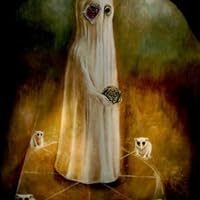
However one chooses to read it, and it seems near impossible to read it in only one single way, The Feathered Bough is both a grand testament to Clark's prodigious artistic and storytelling talents, and a wondrous artifact of Zagava bookmaking design.
Profile Image for Ben.
83 reviews26 followers
July 20, 2018
There have been some groundbreaking, landmark books in the field of Weird literature released this year, beautiful, talismanic objects, antidotes to the banality of print on demand paperbacks. I am thinking particularly of 'A Spy in the Panopticon' by Damian Murphy and 'Tears for Europa' by DP Watt, both from Ex Occidente, and this wonderful tome from Zagava - 'The Feathered Bough'.
It is the illustrations which strike you first when you open 'The Feathered Bough'. There are copious, lushly decadent, full page drawings throughout and these really add to the air of menace which emanates from the text. I won't reveal any spoilers about the story, but the publishers description that the book is 'a grimoire and hallucinatory field guide to a fallen realm' is pretty spot on. The narrative takes place, both in a sinister psychiatric hospital and the 'imaginary' realm of 'The Hortus Palatinus', a shadowed world of overgrown ruins, sunken towns and lost gardens. This makes for an enchanting setting. Stephen Clark only ever hints at its secrets...I would love to read more set in this intriguing world! Buy a copy before it goes out of print.
Profile Image for Des Lewis.
1,071 reviews102 followers
January 9, 2021
This is potentially the most disturbing book you will have ever read. And I do not say that lightly.

The detailed review of this book posted elsewhere under my name is too long to post here.
Above is its conclusion.
Profile Image for Kulchur Kat.
75 reviews26 followers
November 27, 2020
Some artists are reluctant to analyse their creative process too much for fear the flow from the source may stop. Not Stephen J. Clark, who, with The Feathered Bough, has written and illustrated a visionary novel about mining the mythic imagination and the alchemical properties of the creative process.

Set in a psychiatric institute, the novel centres around an inmate calling himself Gérard de Nerval, his imaginary world, called the Hortus Palatinus, and Dr Rudkin, the psychiatrist treating him. As an empathic form of treatment, Rudkin agrees to help Nerval put together a book of writings and drawings that will explain both the Hortus Palatinus, and, the doctor hopes, Nerval’s trauma. The name of this healing book, The Feathered Bough.

Like Clark’s previous novel, In Delirium’s Circle, the narrative is constructed from various texts; notebook and journal entries, interwoven with the incantatory sections that describe the dream-like Hortus Palatinus. In this there are historic echoes with Carl Jung’s visionary experiences accessing the mythopoetic imagination he collated in his Red Book. These historic echoes continue throughout the novel, with references and allusions to alchemical processes and hermetic lore. But there is also a lightness of touch with some meta references to one of the founding fathers of weird fiction who appears in the novel as Old Man Machen.

The novel is richly illustrated with Clark’s flowing artwork. Serpentine pen and ink wash drawings delineating the creatures and locales of the Hortus Palatinus; the gnarly intertwining of roots and vines, over broken statuary and neo-classical ruins. The artwork is not merely illustrative but is fully integrated into the narrative. Definitely a book to revisit time and again.
Profile Image for Vultural.
460 reviews16 followers
June 1, 2024
Clark, Stephen - The Feathered Bough

Really an extraordinary book, almost trance-like at times.
The core of the story, the "insane" patient describing in no small detail to the sympathetic psychoanalyst reads like a lulling chant of words.
While my favorite character was the mysterious Mr. Gentle, the figure of Old Man Machen will appeal to aficionados of strange.

There is an afterward by Mr Clark. I read one sentence after finishing the story, and then stopped.
In it, Clark explains influences and processes. It is illuminating, but I would caution prospective readers to wait several days (as I eventually did) before investigating.
Let the magic of the story itself linger as long as you can.
Displaying 1 - 10 of 10 reviews

Can't find what you're looking for?

Get help and learn more about the design.