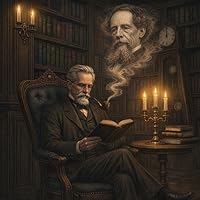
Caustic wit and a strong sense of horror mark works, including In the Midst of Life (1891-1892) and The Devil's Dictionary (1906), of American writer Ambrose Gwinett Bierce.
People today best know this editorialist, journalist, and fabulist for his short story, An Occurrence at Owl Creek Bridge and his lexicon.
The informative sardonic view of human nature alongside his vehemence as a critic with his motto, "nothing matters," earned him the nickname "Bitter Bierce."
People knew Bierce despite his reputation as a searing critic, however, to encourage younger poet George Sterling and fiction author W.C. Morrow.
Bierce employed a distinctive style especially in his stories. This style often embraces an abrupt beginning, dark imagery, vague references to time, limited descriptions, the theme of war, and impossible events.
Bierce disappeared in December 1913 at the age of 71 years. People think that he traveled to Mexico to gain a firsthand perspective on ongoing revolution of that country.
Theories abound on a mystery, ultimate fate of Bierce. He in one of his final letters stated: "Good-bye. If you hear of my being stood up against a Mexican stone wall and shot to rags, please know that I think it is a pretty good way to depart this life. It beats old age, disease, or falling down the cellar stairs. To be a Gringo in Mexico--ah, that is euthanasia!"
Having just read Stephen Crane’s civil war short stories it seemed right to compare those with the war stories of Ambrose Bierce. They were published within a shot time of one another. Crane’s The Red Badge of Courage probably demonstrates his artistry better. His stories struck me as uneven, although at his best they were extremely evocative and successful at showing the misery of war. Bierce actually fought in the war as a young man and suffered a severe head injury which may help explain why he was called “Bitter Bierce” later in life. His stories strike me as more crafted towards art than Crane’s. The edition I read from included some of his post Civil War stories set in California, some strictly supernatural. I can’t help but think they detract from the impact of the war stories. The gothic and supernatural elements in the war stories did not annoy me as they have some critics over the years. The Occurrence at Owl Creek just can’t be bested.
4 stars for the war stories, 3 stars the remainder
In the Midst of Life: Tales of Soldiers and Civilians is a very fine collection of short stories by Ambrose Bierce, who came to be known by the sobriquet of Bitter Bierce. It comprises 26 tales, among which probably An Occurrence at Owl Creek Bridge and Chickamauga are the best-known (and probably also the best).
What makes Bierce’s war stories so gripping and breath-taking is not only the fact that he himself saw the Civil War with his own eyes when he fought as a Union soldier, for example in the Battle of Shiloh, but also that his war stories often make the Civil War itself a mere backdrop against which human folly and egoism show themselves in their starkest colours, as, for instance, in An Affair of Outposts, which is a story of betrayal and adultery, or The Affair at Coulter’s Notch, which tells us something about “duty”, whereas Killed at Resaca gives us an impression of what Bierce thought about romantic notions of valour. These stories are much more touching than your ordinary anti-war stories, even though they are much more pessimistic, too, in that they show that human folly and blindness seem to be invincible principles, and that not even the terrors of war can overcome human selfishness.
The second part of the collection contains stories about civilians, and the pessimistic tone harping on man’s tendency towards destruction is maintained throughout them, and here it is enriched by the motif of the suggestive powers of human imagination and fear. One of the finest, most ambiguous of them is The Boarded Window, which will definitely keep on haunting you with its eerie resolution. Interestingly, in The Eyes of the Panther, Bierce seems to have anticipated the motif that has inspired Val Lewton to write his short story The Bagheeta, which was made into the well-known movie Cat People by Jacques Tourneur in 1942. I also liked The Famous Gilson Bequest, which is an intriguing treatment of how human greed can make a man dedicate his life to a lie, finally making himself believe in that lie. Besides, it is a clever story about one of man’s dearest hobby-horses: having it out with others.
Although this collection contains some masterpieces of the form, and Bierce is an excellent prose stylist throughout, it suffers from repetitiveness and a large number of mediocre stories. Furthermore, every single story has a twist ending, which felt tiresome by the end of the book.
I actually think the first three stories (“A Horseman in the Sky,” “An Occurrence at Owl Creek Bridge,” and “Chickamauga”) are the best of the bunch. Though the second of these is by far his most famous work, the one that made the biggest impression on me was “Chickamauga,” which is a brutal and terrifying story that perfectly encapsulates the absurd horrors of war.
The collection is split into two sections, “Soldiers” and “Civilians.” The first is the more thematically repetitive of the two, but also has better stories overall. In some ways, its repetition lends it strength, as each tale takes place during the American Civil War, causing the section to feel fairly cohesive. A constant theme is strictly adhering to an arbitrary masculine code, even if it is counterintuitive and hinders the war effort. One of the stronger stories is “The Affair at Coulter’s Notch,” where this concept is on full, devastating display. Another effective story is “One of the Missing,” which, like “An Occurrence at Owl Creek Bridge,” explores the subjective experience of time in an extreme situation, though in a very different way. By the end of the first section, however, the stories do begin to feel quite repetitive, and the last of them, “The Mocking-Bird,” uses exactly the same plot device as “A Horseman in the Sky,” but in a less effective way.
“Civilians” is less cohesive than the first section, and simply has less stories that stick out. And, similarly to in the first section, “A Watcher by the Dead” and “The Suitable Surroundings” are so similar that it would have been better for only one to be included.
Bierce is an excellent writer. His ability to describe landscapes and spatial relationships is astounding. While he certainly wrote some of my very favorite stories, most of them are found in his next collection, “Can Such Things Be?” I will re-read a few of my favorite stories collected here, but most of them will be one-time reads.
I'm in a quandary regarding older, denser fiction such as this. I find I never finish these works if they are *too* dense, but I wanted to do it anyway, and so I downloaded this collection of stories from librvox. While I did actually finish it, it was incredibly difficult for me to stay focused. I had to supplement this experience by finding writeups, summaries, and reflections online to make sure I "got" the plots, which in the end were not very complicated. So the experience of this was messy, but I'm glad I did it anyway. Bierce was a brilliant craftsman of the language. And we, the readers, are to be participants in the appreciation of that language, because if not, if our attentions spans demand a Hollywoodesque display of distractions and fast-pacing, we will simply NOT experience what is at offer here. Of course, since I brought up Hollywood, I do have a parallel to offer: you may be, like me, tired of the M. Night Shyamalan style of surprise endings. Bierce did this a LOT. His tone is that of dark humor + horror, so perhaps such endings are natural here. And he does establish that tone successfully throughout (though as I said, my attention span was like a bratty child, making it less likely I will dive into much more on the classic literature shelves). I just started to expect that climax, that reveal, in the final sentence of almost every story. Don't let this deter you from reading his works, however. I'm glad I did it, but I'm equally glad I am finished. Lots of great quotes jump out (I found it impossible to refrain from sharing some on my Facebook page), and if you really dig language, I think you'll really dig Mr. Bierce's work.
Many tales well to!d. Bierce is to literature what the Twilight Zone was to early television. I consider An Occurrence at Owl Creek Bridge a masterpiece. But it represented just one of many quirky, well written in this collection well worth reading.
From one of the masters of psychological horror, The Collected Works of Ambrose Bierce (Volume 2) has some shocking and disturbing tales. The collection is divided into two halves. The first half contains tales of soldiers, the second half tales of civilians. The war stories demonstrate the mind collapsing under extreme trauma; the civilian tales show the mind breaking down through twisted perception and fear.
These short stories are visceral and disturbing. Bierce writes with a cold and calculating style, distancing himself from the tragic plights of his characters through his objective journalistic style of prose. He was a master of psychological horror, bridging the gap between Poe's Gothic tales and Lovecraft's cosmic horror. His terror concerns the mind and what happens to it when fear penetrates the fragile veil of sanity and normalcy.
An Occurrence at Owl Creek Bridge, the short horror story that made him famous, employs an artful narrative technique where the mind, on the verge of imminent death, bends, stretches, and distorts the concept of time. It's a classic example of how stream of consciousness operates.
A fierce critic of corruption and hypocrisy, Bierce's tales are also bitter indictments on the senselessness of war. According to Bierce, war has nothing to do with honor or glory; on the contrary his tales portray war's savagery, senselessness, suffering, inhumanity, and detestability.
The is a poignant and powerful collection of some of his most disturbing and thought-provoking tales.
"These sensations were unaccompanied by thought. The intellectual part of his nature was already effaced; he had power only to feel, and feeling was torment."