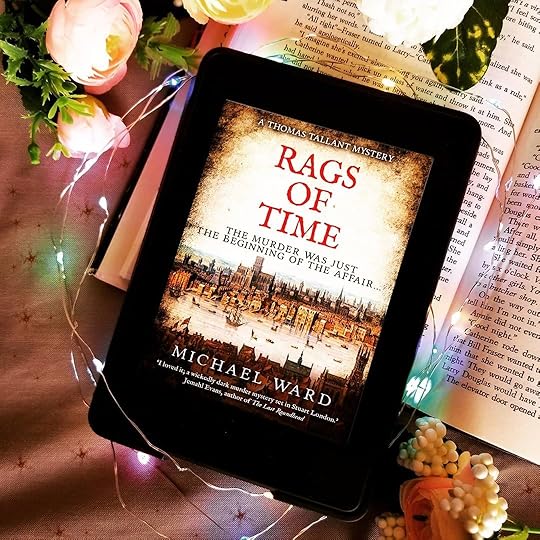
‘Rags of Time’ is the first book in a new series of historical novels by British-based author, Michael Ward. Our main protagonist is Thomas Tallant, the headstrong and impetuous younger son of a spice merchant and his Dutch wife. The book is written in the third person and the past tense. There is a helpful map and key at the beginning to give the reader a sense of the geography of London in the seventeen century.
Within days of Tom’s return from a two year voyage to India, a wool merchant dies in mysterious circumstances. At this time, there is no official police force, so an investigating agent is appointed by the Merchant Adventurers to discover the truth. Following another death, Tom find himself increasingly under suspicion and turns to enchanting and enigmatic scholar, Elizabeth Seymour, for help.
The backdrop to the allegation against Tom is the febrile atmosphere of England in the latter stages of the reign of Charles I. The capital, overcrowded and insanitary, is a dichotomy of political and social disconnection. The public mood turns ugly, with families and friendships torn apart as the fabric of society is threatened by radicals inciting violence. Brutal punishments are meted out for trivial or non-existent crimes and, seemingly unaware of the simmering cauldron his nation has become, is a monarch who’s increasingly losing his grasp. Spice merchants are now as wealthy as traditional wool traders, creating rivalry and jealousy, so maybe a brash Anglo-Dutch interloper is the perfect scapegoat on whom to pin two unexplained deaths? As the tensions between parliament and the king intensify, so the net closes around Tom.
Through carefully researched and cleverly written prose, the author takes us on a roller-coaster journey of intrigue, intolerance, injustice, guilt, blackmail and betrayal, contrasting with loyalty, love, compassion and honour.
The author has mixed fact and fiction in superb fashion. I knew of John Pym but found articles about Archbishop Laud, Jeremiah Horrocks and the Earl of Strafford. In addition, I read of the Madagascan tribe of Sakalava and the tulip bubble in the Netherlands.
Michael Ward employs many literary devices to develop his plot; similes and metaphors when used skillfully, help paint a vivid scene for the reader but I’m always delighted when an author elevates a story to a higher level by adding foreshadowing, misdirection, imagery, symbolism and thought-provoking pathos.
These were troubled times with the ever-present threat of an invasion from Scotland. Conversely, it was also a time of great discovery and in the character of Elizabeth Seymour, we are given someone whose mathematical mind is equal to the task of finding vital clues which will help Tom prove his innocence. However, what really gilds the lily, is the scattering of clues in plain sight. Something which seems like an innocent descriptive passage is revealed in the denouement to contain a vital piece of the jigsaw to help complete the picture.
If you are a fan of historical fiction, this multi-layered tale will capture your attention and deliver on its promise of a slick and satisfying whodunit, combined with a fascinating social history of the era. I congratulate the author on an excellent piece of work. I award 5 stars.