Eva Peron remains Argentina's best-known and most iconic personality, far outlasting her own husband, President Juan Domingo Peron, himself a remarkable and charismatic political leader without whom she, as an uneducated woman in an elitist and male-dominated society, could not have existed as a political figure. In this book, Jill Hedges tells the story of a remarkable woman whose glamour, charisma, political influence and controversial nature continue to generate huge amounts interest 60 years after her death. From her poverty-stricken upbringing as an illegitimate child in rural Argentina, Peron made her way to the highest echelons of Argentinean society, via a brief acting career and her relationship with Juan. After their political breakthrough, her charitable work and magnetic personality earned her wide public acclaim and there was national mourning following her death from cancer at the age of just 33.Based on new sources and first-hand interviews, the book will seek to explore the personality and experiences of 'Evita'. As the first substantive biography of Eva Peron in English, this book will be essential reading for anyone interested in modern Argentinean history and the cult of 'Evita'."
Evita Peron lives on in my imagination on almost a daily basis. Little Jaidee first had contact with this legend/saint/criminal/woman when I was ten or so. I was so very excited to be going on a date with my auntie to see my very first adult musical. (I was corrected in 2023 by my auntie who recently told me my first was Side by Side with Ms. Peggy Lee in Detroit but my memory of the muscial fails me although I do remember the trip and yummy food lol) My mother placed me in my uncomfortable sober grey suit and when my aunt saw me she asked me if this is what I wanted to wear. I rushed upstairs and wore my rust colored levi cords and my favorite sweater that was orange with autumn leaves of gold, red and brown. I kept my black patent shoes and off we went into the taxi. I remember many men looking at my aunt in her pretty crimson dress, very red lipstick and tall black high heels. She ignored them and had me by the hand the whole time. The show was one of my peak childhood experiences. The music, the dancing, the singing and the glory of Evita. I had no idea who this woman was but I was mesmerized. For years afterwards I would re-enact scenes in my head and listen to the soundtrack so many times that I knew it by heart. To this day I sing selections of this musical on almost a daily basis. My aunt spoiled me and called me Evito for a number of years as I loved this character so very much. I have seen this musical live at least twenty times.
But who is the real Evita ?
Shamefully I knew little. I watched a few tv docs that when they did not fit in with the artistic Evita I would erase from my memory.
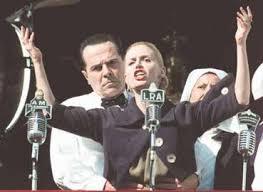
Here is a little clip from her last speech that she gave:
Jill Hedges is an academic with expertise on Argentina. She admirably sifted through many books, articles and had some interviews to tease out what she believes to be as near the truth about Evita as can be deciphered. No woman in the 20th century has been as widely adored and loved by some and hated and disdained by others. Through a childhood of poverty, an adolescence and young adulthood of radio and film acting to meeting Peron and becoming the first lady of Argentina in the 1940s. She was headstrong, heartful, generous, emotional, hysterical, vindictive, loving, uneducated and yet so very healing to her descamisados (shirtless ones) the poor and struggling in Argentina. She fought for women's rights to vote and work. She opened up hospitals, nursing schools and housing communities while in the meantime erecting more and more larger monuments to herself and her only love Peron. She tragically denied and ignored her vaginal hemorhages that could have easily cured her cancer through hysterectomy. Both a simple and a complex woman that was worshipped by half her nation while the other half planned or wished for her demise. She died at the young age of 33.
Jill Hedges is so careful about how she writes this biography that the magic and myth of Evita is sometimes lost to too much delving into Peronist politics and history. I wished for more psychological and interpersonal understanding of Evita rather than the grand strokes of Argentine history and bureaucracy. Despite this a very informative, interesting and well written book.
I want to leave you with one of my very favorite songs of all time and performed by Madonna who I think really understood the legend of Evita Peron:
This is a nuanced approach to a complicated subject. Eva Peron remains an icon to her admirers and a object of venom to her detractors. What Hedges does well is accept when the truth is less clear (a common thing due to her subjects origins) but explain to the best of her ability when there is some clarity. What emerges is a portrait of a remarkable woman who transformed her situation with amazing initiative and drive against insurmountable odds. It left me curious to learn more about Peronism and Argentina
The was a fascinating read about the life of Eva Peron and her family. Of course, I've heard of Evita and her fame - who hasn't? - and I will find myself humming along to Don't Cry for me Argentina, but truthfully I've never paid much attention to what it was all about until now. We leave next week for a holiday in Patagonia which includes a few days in Buenas Aires and I wanted to know more about the history, politics and culture of Argentina. I am vaguely aware that they love their beef and the economy is often in trouble. Now I have a better understanding of the culture, politics and leadership values that have contributed to this story. And I know more about Peronism which has been the dominant political movement since the end of WW2. The book is well written if sometimes confusing often with very long sentences that wind around. It has significant Endnotes and References, suitable for a political science student, but it is also a story of Evita and her enduring impact on the country and its people and politics - even though she lived only until age 33.
Jill Hedges offers her readers an extremely thorough account of the Peronist movement in mid-century Argentina, a period in history that directly and irreversibly altered the very nature of the country. After spending so much time reading up on the fall of Roman Republic, it was shocking to see that many of the same issues facing a biography of Julius Caesar or Cicero plague the efforts to properly explain a much more contemporary figure such as Eva Perón. Because later governments attempted to erase both her and her husband, General / President Juan Perón, from the history books, it has become nearly impossible to tell the most accurate truth. As such, Hedges is very cautious with the material she has to present - she is very liberal with her signposting, letting the reader know exactly what is fact, what is rumor, and whether or not any of those rumors hold water (always offering substantial examples and solid reasoning for her conclusions).
Of course, much like other biography writers, Hedges is not always neutral when it comes to her subject. It's clear that much repair needs to be done in order to give Evita a fighting chance in a world that often seeks to write her off as a manufactured puppet. She is quite direct in how she sees Evita, and thankfully she is also quick to list her flaws (something other authors tend not to do).
The only problems I personally had with the text (I would say this book is a 4.5-star read in all actuality) were Ms. Hedges's somewhat longwinded phrasing, slight repetition, and overly floral vocabulary. It meant that I had to re-read certain passages to make sure she was not in fact contradicting herself. She does this at least once or twice that I can remember. Regardless, the book is an overall fascinating and fair dissection of Argentina between 1920 and 1970 and how Eva Perón not only changed Argentine history but global history.
I enjoyed this biography for two reasons: 1. I learned a great deal about Eva Perón as a historical character. Having read this book while in Argentina added to the charm and my personal interest in her life story. I visited her tomb and, having learned how it took over 20 years for her to find her final rest and peace in the Recoleta Cemetery, I could appreciate this much more than if I didn’t have the background.
2. It was one of the most objective biographies I ever read. Even though trustworthy resources about Eva Perón’s life are relatively rare in comparison to her popularity, the author did a fantastic job in presenting the facts and staying away from assumptions, yet still providing some possible explanations for certain behaviors and historial moments. I particularly enjoyed how she presented Eva Perón and the cult of Evita from both perspectives of the pro-peronists and of the anti-peronists. All in all, she did a great job in representing the complex personality of Evita, without deifying her or denigrating her, but by painting a realistic picture of an ambitious woman who, for better or worse, has gained global recognition.
A good compilation of a very complicated life story, made more challenging by the destruction of various primary sources either by Eva Peron herself (eliminate embarrassing documents) or by the anti-Peron government that took power in 1955 (who wished to remove all traces of Juan and Eva Peron). My biggest challenge in reading was to sort out details and relationships that seemed at times tangental, or inserted parenthetically.
Having recently seen the revival of “Evita” in the West End I was curious to learn more about the life of Eva Duarte de Peron. It was fascinating to learn about her humble beginnings, life as a radio actress to film actress to First Lady of Argentina. When reading history it’s hard not to apply today’s lens to events that happened 70-80 years ago but overall fascinating to learn about Evita’s impact then and now.
The cautious and balanced analysis of Eva Peron’s life (upbringing, relationships, actions, beliefs and legacy) leaves the reader sitting uncomfortably on a Peronist fence. I’m still unsure whether she was a Facist apologist, a ‘people’s princess’, a closet socialist or a self-seeking egotist. However, I did enjoy the trip along the fence!
A good book to explore the life of Eva Peron. The author lets us know there is controversy over many supposedly factual information about Evita. Much of the documentation was destroyed after her death. What is amazing is that a woman who died so young and was in the public eye for a short time had such an influence on Argentenia and her influence continues.
This is a good, shortish introduction book to this enigmatic character. Fascist? Socialist? Read it and find out. How a young lady in a macho country and macho continent rose so fast and so far and help the poor of that rich land is fascinating. I went to her grave in 2008. Buenos Aries is a wonderful city too.
This is a well balanced view of a, still after so many years, highly controversial figure in Argentine history. As Dr Hedges highlights, there is plenty written out there about Evita, mostly in "black or white" terms. The author is trying to bring a more reasonable, pragmatical, approach to this mythical character. Evita is brought to life from her humble origins, through her years as a show-business person, including very well documented descriptions of the world of radio in those days, until her brief yet intense life as a political figure and as Peron's wife. Evita's "afterlife" is also addressed following the same approach. The book is well written in a language that can be easily accessed, yet it also shows Dr Hedges' first-hand knowledge of Argentina and the years she has dedicated to study Peronism. "Evita: The Life of Eva Peron" goes beyond the myth letting us re-encounter with the human being behind Eva and that is probably Dr Hedges' best achievement. The book is totally recommendable for anyone wanting to learn more about Eva and Peronism and, because of the importance of both, for anyone interested in Argentine politics and history in general.
Everyone knows the basics of the story of Eva Peron. This book covers them but doesn't real give much insight into the person. I didn't learn anything new.