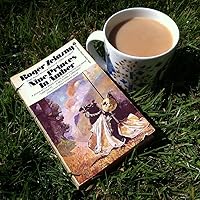
This was such a weird, weird book. Less a work of fiction and more a collection of ideas, like an exploratory essay of what-ifs - it's a dystopia presented as an utopia but the utopia has a sinister undercurrent that raises more questions than it answers. The prose oscillated between being blunt and obscure; Guy's horrified reactions to 22nd century philosophies, ideals, and society hammering home the point that this is Not Good, and at times I felt I lacked the context or background knowledge to fully understand what so or so was in reference to.
That said, some if the most horrifying elements of this dystopia were throwaway lines that Guy didn't pick up on (no reaction at all), such as the fact that when people (intellectuals) get fancies to be carried around like they're Egyptian royalty or whatnot, the people carrying them will "naturally be supplied"...who supplies them, how, and who are the people being forced to perform this task? Why is this a matter of course and not a horrifying implication of slavery?
What struck me also was the new class division in this future society between intellectuals and normals (smart people and stupid people) and how this is framed by the intellectuals (through the character John) as Just The Way It Is, those people are naturally stupid and have no ambition, etc, how inter-class marriages are frowned upon by intellectuals as children by mixed classes turn out normals...and how any "normal" characters are subdued by this oppression, driven to believe they are stupid, that their intellectual friends are all right actually because they're kind... it's so very condescending, patronising, abusive, gaslighting... and it bothers me that in the introduction the character of Ena is reduced to a silly girl, when she actually is the most powerful symbol of this dystopia: she is a "normal" girl, locked into a set of behaviours by society she doesn't want to perform and rebels against by, well, performing the expected behaviours (in this case, emotional outburst), and when at the end of the novel she seeks out Guy, he misinterprets what she wants as guidance for his to live (he's not entirely wrong, but it is not the essence of her desires) when what she truly wants us to break free of the oppressive class system and be treated like an equal, not a "normal", and to her Guy represents that. Unfortunately for her, Guy brought his early 20th century patriarchal trappings with him (remember that the novel starts with him being friendzoned and in response he forces his own soul out of his body? The implication is that he died from it, to later be resurrected by Ena's father) which leads to him rejecting her utterly. Despite his misgivings about and horror at the 22nd century society he finds himself in, it was all too easy for him to accept *some* of its philosophies, and by the end he...well, ends up perpetuating it. The very end of the book which has been described by others as intentionally vague (hence the title "the question mark" reads to me like the end of a horror story - this is a dystopian SFF novel, sure, but I would argue this book has more in common with horror. After all, as Guy succinctly points out, there is no hope.
ETA: because I'm apparently not done thinking about this book.
I thought yesterday when I finished reading that the whole friar Emmanuel plot was a weird detour and I dismissed it as bad writing, or at very least the sort of thing I as an editor would've had a serious conversation about with the writer. But it struck me that the scene at the end where Ena begs Guy to be with him (not as a lover, as a companion/friend) was very similar to how the masses of "normals" flocked to Emmanuel for guidance, and that this could account for Guy's misinterpretation of Ena's desires - and his rejection of her is linked to his own mediocrity. He can't or doesn't want to be a guide to her! But at the same time, there's a very uncomfortable message in the Emmanuel plot, which is that these "normals" who get caught up in the religious fervour of his followings, are too stupid to not fall for it. John, as the avatar for what's wrong with the 22nd century, treats them dismissively if not outright cruelly, and says that this kind of thing happens all the time, and that intellectuals of course are too smart to get involved...but they observe it for sport and for laughs.
I don't know if it's the author's intention to portray religion (Christianity especially?) as I enlightened and like opiates for the (stupid) masses, but given how much it is exaggerated in this 22nd century where everyone has more leisure....coupled with the fact that the only crime that still exists is crimes of passion, committed only by "normals"? I feel like it rather shows the author's own opinions on people.
Another thing I've been thinking about a lot is that Guy was set up in the beginning as incredibly mediocre and bland - not stupid, but not clever either, and with the unfortunate character flaw that when he didn't get what he wanted he deemed it the fault of external forces, not his own (basically, he comes across as an incel). When he wakes up in the 22nd century where the class divide has nothing to do with income or aristocracy (on the surface anyway - the intellectuals certainly like to flaunt their superiority and they do it by modelling historical aristocracy) but brains, where everyone has been sorted into either the smart box or the stupid box, he seems to be the only true mediocre person who is neither.
There are throwaway lines that show that isn't true - Agatha, Ena's mother and extremely subdued day by her "normal" class asks the question "there are different kinds of intelligence aren't there?" and so on and so forth - the intellectuals seem made up exclusively of book smart people, with everyone else relegated to stupid. But given the society structure everyone in the stupid class is oppressed to the point of believing it and following those norms....so when Guy comes along and breaks that structure by the fact of his existence, is it any wonder that Ena latches on to him as an alternative to the oppression she's known her whole life?
This book could have been about a fight to dismantle this class system - Guy could've been the hero to do it - but this isn't that book, because this is a horror story. There is no hope.
A cautionary tale, perhaps, of what can happen...personally I don't think this is what will happen if we wind up with a nearly automated system where everyone is fed and cared for and there's leisure for all, but it's food for thought.