

What do you think?

Zodiac Signs
Zodiac Signs: Aries
A new series of sign-by-sign guides from contemporary astrologers.
Astrology is a vital tool for understanding our place in the world and the universal forces that move us. A cosmic calling rather than a fated destiny, our astrological sign is a key to uncovering our mission here on earth. Learn about how your sign grows from child to adult, fits in at school and at work, and functions best as a friend, lover, parent, and more. In these practical and empowering guides to the zodiac signs, contemporary astrologers teach you to use this dynamic language to better understand yourself and the people around you.
Astrology is a vital tool for understanding our place in the world and the universal forces that move us. A cosmic calling rather than a fated destiny, our astrological sign is a key to uncovering our mission here on earth. Learn about how your sign grows from child to adult, fits in at school and at work, and functions best as a friend, lover, parent, and more. In these practical and empowering guides to the zodiac signs, contemporary astrologers teach you to use this dynamic language to better understand yourself and the people around you.
- GenresAstrology
144 pages, Hardcover
Published February 4, 2020
Ratings & Reviews
Friends & Following
Create a free account to discover what your friends think of this book!
Community Reviews
Displaying 1 - 5 of 5 reviews

March 8, 2026
The Ram at Dawn: Jeff Hinshaw’s “Zodiac Signs: Aries” Reimagines Astrology as a Language of Renewal, Justice, and Selfhood
By Demetris Papadimitropoulos | March 8th, 2026
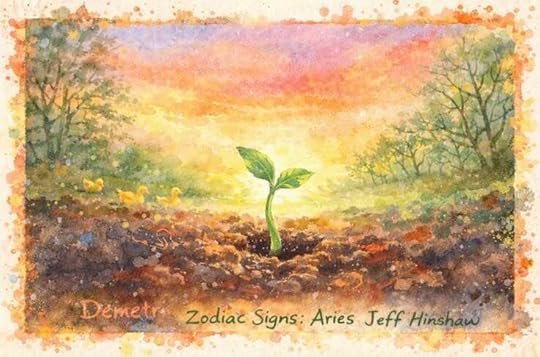
Watercolor Piece by Demetris Papadimitropoulos
“The Sprouting Seed” — Aries begins not in fury but in springlight: a green shoot breaking thawed earth beneath a sky of innocence and possibility.
There are astrology books that behave like laminated placemats: brisk, serviceable, full of bullet-point certainties about temperament, flirtation style and ideal careers, as if a life could be reduced to a bright wheel and a few agreeable adjectives. And then there are books like Jeff Hinshaw’s “Zodiac Signs: Aries,” which would rather stand in the thaw of late March and watch the world begin again.
Hinshaw opens not with dominance, combat or charisma, but with the spring equinox, the soft green insistence of buds, the wobble of hatchlings, the sprouting seed and the equal measure of day and night. Aries season, in his telling, is less the entrance music of a conqueror than the first clearing of the throat after winter, the body remembering light. He explicitly pushes back on the typecast image of Aries as the “Angry Warrior,” and that act of revision is the governing tenderness of the book. The Ram, here, is not merely hot-blooded. It is nascent. It is hopeful. It is life arriving with more force than finesse.
This gentling of a cliché is the book’s first real success. Its second is structural. Hinshaw does not organize “Zodiac Signs: Aries” around the usual consumer-facing astrological categories, the compatibility scorecards and trait inventories that have made pop astrology so comfortingly legible and so often so thin. Instead, he moves through arenas of becoming: Aries as child, student, lover, parent, worker, adult and citizen of the world. The table of contents alone reveals his ambition. He wants not to define a sign once and for all, but to watch it refract through a life.
That life, in Hinshaw’s account, is powered by what he calls cardinal fire. Aries is firstness stacked upon firstness: the first sign, the first fire sign, the initiator of spring, the beginning of the zodiac’s personal arc. The book lingers over that initiating charge until it becomes almost metaphysical. To be Aries is not just to be energetic. It is to be implicated in beginning itself, in ignition, in the primal sentence that starts with I am. The prose, with its fondness for vibration, resonance, intention and soul purpose, occasionally swells into a language of uplift that will either feel nourishing or diffuse, depending on your tolerance for spiritual abstraction. But there is no mistaking the sincerity of the vision. Hinshaw wants Aries rescued from caricature and returned to mystery.
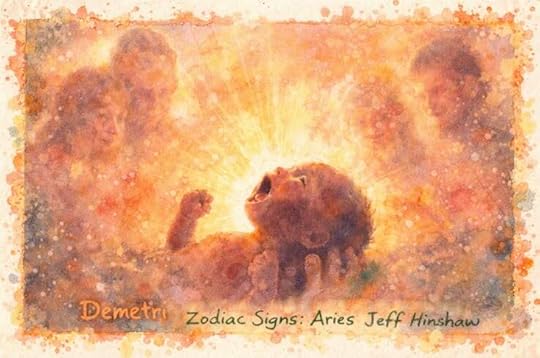
Watercolor Piece by Demetris Papadimitropoulos
“Headfirst Into Life” — Hinshaw’s Aries arrives as first breath and first cry, a soul thrusting into the world with courage, wonder, and need.
His larger theory of that mystery arrives in the sections on the cardinal cross and ruling planets, where the book becomes more intellectually interesting than its pastel cover might suggest. Aries, Cancer, Libra and Capricorn are presented not merely as seasonal points but as members of a shared pact. Aries is the individual. Libra is the other. Cancer is mother, home, matriarchy, lineage. Capricorn is father, authority, patriarchy, law. Their joint mission, Hinshaw writes, is intergenerational healing. That is the sort of phrase one can imagine rolling one’s eyes at on first encounter, until one notices how deftly it allows him to give Aries an actual conflict. The Ram is no longer just impulsive. It is entangled with inheritance, family expectation, power, permission and resistance to authority. The square to Cancer and Capricorn, he tells us, foreshadows recurring struggles around home, parentage and rules. The opposition to Libra becomes the sign’s lifelong invitation to evolve.
This is where the book begins to hum with a deeper note. Hinshaw’s Aries is not merely learning to manage a temper. It is trying to outgrow fear-based ego, to move from self-assertion into relation, from appetite into ethics. Libra, as he repeatedly insists, is the hidden co-star of the whole enterprise. Through Libra, Aries learns collaboration, communication, justice, rightful relation, social inclusion. Through Libra, the book says, ambition stops being only personal and becomes answerable to a wounded world. It is an arresting proposition, especially now, when so much public life seems trapped between theatrical selfhood and exhausted institutions, between the cult of the singular personality and the frayed language of the common good. Hinshaw does not write polemic. He writes astrology. But his best intuitions brush against the moral weather of the present: how to remain vivid without becoming brutal, how to claim birthrights without abandoning the shared field, how to turn heat into light.
The Mars and Mercury framework is another of the book’s better ideas. Mars, Aries’ traditional ruler, governs action, ambition, desire, aggression and war in its lower expression, divine masculinity and purposeful motion in its higher. Mercury, the esoteric ruler, opens a second, later road: intellectual transmission, conscious communication, intuition, cognition, soul purpose. Hinshaw uses the pair almost as developmental stages. Mars belongs more to Aries’ younger years, Mercury to its maturation. It is a clean and useful distinction, and one of the few places where the book’s spiritual vocabulary acquires an actual contour. Aries, in this formulation, must be upgraded from head-banging force to thoughtfulness, from motion to meaning.
The most generous move in the book is the “Self-Discovery” section, where Hinshaw insists that all twelve signs live within everyone and asks even non-Aries readers to locate where Aries falls in their birth chart. The sign becomes not a fixed identity badge but a house of pressure, a place in the life where initiation is demanded. If Aries falls in the second house, the book suggests questions of worth, value and material confidence. In the first, selfhood. In the third, communication. This is less rigorous than a full astrological workbook and more alive than a generic sign profile. It gives the reader a reason to stay, a reason to make the book personal. One senses Hinshaw the teacher here, wanting to democratize an esoteric system without flattening it beyond recognition.
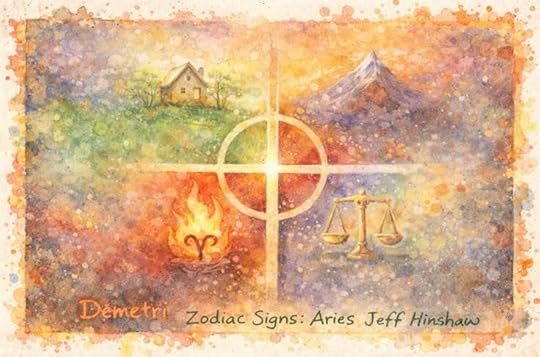
Watercolor Piece by Demetris Papadimitropoulos
“The Cardinal Cross” — At the book’s spiritual center, Aries stands between home, authority, and relationship, learning that identity is shaped in tension with others.
His author bio makes that mission explicit. Hinshaw’s background is rooted in ritual immersion, somatic studies, embodied health, yoga, psychology, creative writing and tarot, and he says outright that his aim is to upgrade the vocabulary of esoteric practice into an all-inclusive accessible lens. That aspiration explains both what is appealing about this book and what limits it. On the one hand, it carries a humane warmth uncommon in mass-market astrology. On the other, its desire to be inclusive and spiritually elevated can blur its language, replacing precision with atmosphere.
The chapters themselves vary in force. “Aries as a Child” is among the strongest, in part because the metaphorical fabric of the sign finds a natural home in childhood. Aries becomes the first cry, the headfirst arrival into the world, the child who is born not only to act but to individuate. Here Hinshaw’s symbolic imagination feels intuitive rather than imposed. He understands that the mythology of Aries, stripped of adult branding, is really about emergence: the difficult, necessary work of becoming separate. That idea lets him see defiance not only as temperament but as the early form of selfhood. It is a lovely, subtle shift.
“Aries in School” is perhaps the book’s most practically engaging chapter. Hinshaw’s Aries student learns experientially, needs movement, challenge and participation, and withers under deadening rigidity. He is convincing on the difference between stimulation and competition, and on the need to help Aries slow down without extinguishing momentum. In a culture that still too often confuses learning with compliance, the chapter’s argument for embodied, collaborative education lands with unusual freshness. Its most eccentric feature is the chart mapping the twelve zodiac signs onto stages of schooling, from Aries as preschool and pre-K to Pisces as emeritus and retirement. The device is odd, memorable and a little whimsical, but also revealing. Hinshaw is always looking for ways to make astrology tactile, teachable, diagrammable. He even pauses to clarify that the system is not meant as a hierarchy of intelligence or worth. That small disclaimer says much about the book’s ethic: interpretive, yes, but trying not to humiliate.
“Aries in Love” and “Aries as a Parent” have a gentler pulse than one might expect from a sign so often sold as a romantic pyrotechnic device. Hinshaw is less interested in seduction than in what intimacy demands from an instinctively self-propelling nature. The answer, repeatedly, is Libra. Compassionate communication. Consideration of the other. A willingness to bring someone else along rather than treating desire as a solitary march. There are moments when the prose grows gauzy with affirmation, and one wishes for a little more grain, a little more risk, a little more worldly friction. Still, there is something moving in the refusal to glamorize appetite. Hinshaw wants Aries to become not merely irresistible, but ethical.
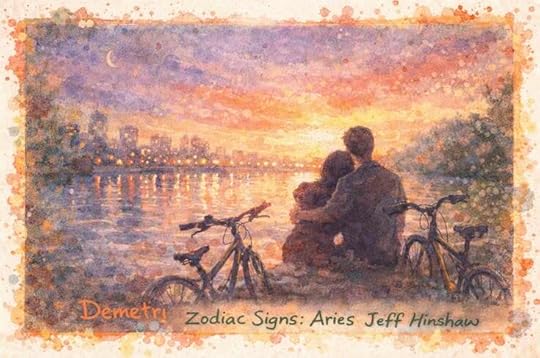
Watercolor Piece by Demetris Papadimitropoulos
“The Riverside Instead of Times Square” — Love slows Aries from conquest into presence, trading spectacle for a quiet twilight refuge beside the water.
The work chapter, too, is strongest when it is concrete. Aries is drawn to initiative, leadership, visible effort, missions that require courage. Hinshaw is particularly good on the sign’s hunger for meaningful exertion, its difficulty with roles that flatten aliveness into protocol. There is an implicit argument here about vocation in an era of algorithmic convenience and exhausted professionalism. Even if one does not accept the astrological premise, the psychological observation has force: some people require work to feel like ignition, like movement toward the horizon, and suffer in environments that reward only containment.
Later, in “Aries in the World,” the book reaches for its highest octave and comes close to overreach, but not without beauty. Aries, evolved through Libra, becomes a conscious agent for equality, a being acting not from war and oppression but from “Divine Intention.” The final distillation of Aries into five soul-centered traits could sound saccharine in less committed hands, yet it arrives after so much insistence on justice, collaboration, ancestry and future generations that one is inclined to grant it some of its ceremony. The language is not hard-edged enough to survive close analytical pressure. It is trying for benediction, not thesis. But there is grace in the attempt. The sign that began as I am is asked, by the book’s end, to mean I am with, I am for, I am responsible to.
That is the review one keeps writing in one’s head while reading “Zodiac Signs: Aries”: a book of genuine imaginative sympathy, repeatedly undone and redeemed by its own earnestness. Hinshaw has an instinct for the emblematic image. He knows how to gather spring, seed, head, fire, child, dawn and justice into one field of feeling. He has a teacher’s desire to make systems welcoming. He has a reformer’s suspicion of stale astrological shorthand. What he does not always have is the stylistic severity to trim repetition or the analytic firmness to keep spiritual language from dissolving into soft-focus uplift. Certain phrases recur with the weightlessness of incense. One begins to crave the occasional cold sentence, the sentence that would sharpen rather than soothe.
And yet perhaps this is partly a question of category error. To ask Hinshaw for the severity of a skeptical critic is to miss the nature of his project. He is not writing “The Inner Sky,” nor “Linda Goodman’s Sun Signs,” nor the brisk modern self-help astrology of “You Were Born for This.” He is closer to a devotional essayist of archetype, someone using the zodiac as a contemplative grammar for personality, wound and aspiration. His prose is not built to persuade the unbeliever. It is built to companion the seeker. That is why the best comp titles for this book are not the most technical ones, but the ones that treat astrology as a language of self-recognition, ethical growth and symbolic re-enchantment. What distinguishes Hinshaw within that tradition is his emphasis on maturation. Aries does not simply express itself here. It must be educated, civilized, opened, made relational.
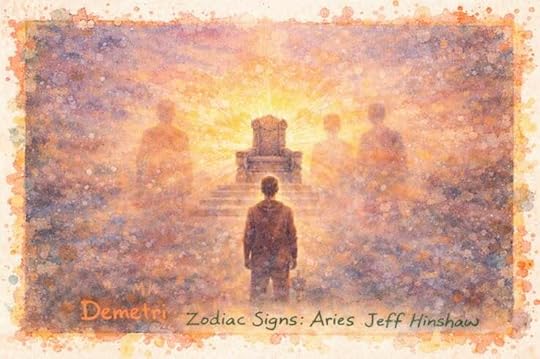
Watercolor Piece by Demetris Papadimitropoulos
“I Am Me / I Am You / I Am Life” — In adulthood, Aries awakens into heart-led authority, moving from solitary selfhood toward a larger, shared consciousness.
There are also fleeting moments when the book’s concerns feel startlingly of the hour. Its language of birthrights, equality, social inclusion and intergenerational healing inevitably brushes against contemporary anxieties, even if Hinshaw never descends into topicality. Read now, his insistence that raw individual fire must submit itself to collaboration and justice can sound less like zodiac advice than like a civic plea. The recurring tensions with home, authority and inherited structures carry their own resonance in a period when so many readers are rethinking family scripts, public trust, gendered expectation and what forms of power can still be redeemed. Hinshaw’s spirituality can be diffuse. But its objects of concern are not frivolous.
If the book finally remains a modest achievement rather than a commanding one, it is because its most luminous intuitions are not always matched by equal discipline of execution. The chapter-by-chapter design is smart, but some sections feel thinner than the concepts that frame them. The spiritual vocabulary aspires to largeness, but largeness is not the same as depth. There are paragraphs in which one senses that a sharper editor might have asked for fewer declarations and more discoveries, fewer assurances and more hard-won insight. The book’s emotional weather is almost uniformly benevolent. A little abrasion might have made it truer.
Still, one leaves “Zodiac Signs: Aries” with more than one expected to. Hinshaw has written a sign book that takes seriously the possibility that personality can ripen into character, that force can be instructed by love, that the beginning of a life and the beginning of a season may illuminate each other. He treats astrology not as a game of sorting types, but as a means of asking what a person is for once instinct has burned off and something steadier remains. That question, whatever one believes about the stars, is not a trivial one.
“Zodiac Signs: Aries” earns a 77 out of 100 because it is thoughtful, sincere and intermittently beautiful, more morally and psychologically ambitious than a generic zodiac handbook, yet too often content with atmosphere where one longs for precision, and too often repetitive where one longs for surprise. It is a book of springlike intelligence: fresh, hopeful, imperfectly formed, reaching toward the light with more feeling than finish.
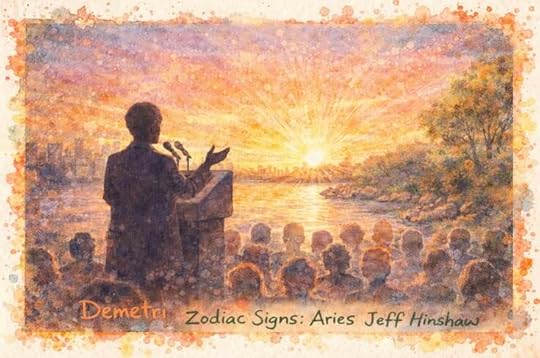
Watercolor Piece by Demetris Papadimitropoulos
“On the Pulse of Morning” — The book closes by imagining Aries as a public voice of hope, equality, and renewal, speaking into the light of a collective dawn.
By Demetris Papadimitropoulos | March 8th, 2026
Watercolor Piece by Demetris Papadimitropoulos
“The Sprouting Seed” — Aries begins not in fury but in springlight: a green shoot breaking thawed earth beneath a sky of innocence and possibility.
There are astrology books that behave like laminated placemats: brisk, serviceable, full of bullet-point certainties about temperament, flirtation style and ideal careers, as if a life could be reduced to a bright wheel and a few agreeable adjectives. And then there are books like Jeff Hinshaw’s “Zodiac Signs: Aries,” which would rather stand in the thaw of late March and watch the world begin again.
Hinshaw opens not with dominance, combat or charisma, but with the spring equinox, the soft green insistence of buds, the wobble of hatchlings, the sprouting seed and the equal measure of day and night. Aries season, in his telling, is less the entrance music of a conqueror than the first clearing of the throat after winter, the body remembering light. He explicitly pushes back on the typecast image of Aries as the “Angry Warrior,” and that act of revision is the governing tenderness of the book. The Ram, here, is not merely hot-blooded. It is nascent. It is hopeful. It is life arriving with more force than finesse.
This gentling of a cliché is the book’s first real success. Its second is structural. Hinshaw does not organize “Zodiac Signs: Aries” around the usual consumer-facing astrological categories, the compatibility scorecards and trait inventories that have made pop astrology so comfortingly legible and so often so thin. Instead, he moves through arenas of becoming: Aries as child, student, lover, parent, worker, adult and citizen of the world. The table of contents alone reveals his ambition. He wants not to define a sign once and for all, but to watch it refract through a life.
That life, in Hinshaw’s account, is powered by what he calls cardinal fire. Aries is firstness stacked upon firstness: the first sign, the first fire sign, the initiator of spring, the beginning of the zodiac’s personal arc. The book lingers over that initiating charge until it becomes almost metaphysical. To be Aries is not just to be energetic. It is to be implicated in beginning itself, in ignition, in the primal sentence that starts with I am. The prose, with its fondness for vibration, resonance, intention and soul purpose, occasionally swells into a language of uplift that will either feel nourishing or diffuse, depending on your tolerance for spiritual abstraction. But there is no mistaking the sincerity of the vision. Hinshaw wants Aries rescued from caricature and returned to mystery.
Watercolor Piece by Demetris Papadimitropoulos
“Headfirst Into Life” — Hinshaw’s Aries arrives as first breath and first cry, a soul thrusting into the world with courage, wonder, and need.
His larger theory of that mystery arrives in the sections on the cardinal cross and ruling planets, where the book becomes more intellectually interesting than its pastel cover might suggest. Aries, Cancer, Libra and Capricorn are presented not merely as seasonal points but as members of a shared pact. Aries is the individual. Libra is the other. Cancer is mother, home, matriarchy, lineage. Capricorn is father, authority, patriarchy, law. Their joint mission, Hinshaw writes, is intergenerational healing. That is the sort of phrase one can imagine rolling one’s eyes at on first encounter, until one notices how deftly it allows him to give Aries an actual conflict. The Ram is no longer just impulsive. It is entangled with inheritance, family expectation, power, permission and resistance to authority. The square to Cancer and Capricorn, he tells us, foreshadows recurring struggles around home, parentage and rules. The opposition to Libra becomes the sign’s lifelong invitation to evolve.
This is where the book begins to hum with a deeper note. Hinshaw’s Aries is not merely learning to manage a temper. It is trying to outgrow fear-based ego, to move from self-assertion into relation, from appetite into ethics. Libra, as he repeatedly insists, is the hidden co-star of the whole enterprise. Through Libra, Aries learns collaboration, communication, justice, rightful relation, social inclusion. Through Libra, the book says, ambition stops being only personal and becomes answerable to a wounded world. It is an arresting proposition, especially now, when so much public life seems trapped between theatrical selfhood and exhausted institutions, between the cult of the singular personality and the frayed language of the common good. Hinshaw does not write polemic. He writes astrology. But his best intuitions brush against the moral weather of the present: how to remain vivid without becoming brutal, how to claim birthrights without abandoning the shared field, how to turn heat into light.
The Mars and Mercury framework is another of the book’s better ideas. Mars, Aries’ traditional ruler, governs action, ambition, desire, aggression and war in its lower expression, divine masculinity and purposeful motion in its higher. Mercury, the esoteric ruler, opens a second, later road: intellectual transmission, conscious communication, intuition, cognition, soul purpose. Hinshaw uses the pair almost as developmental stages. Mars belongs more to Aries’ younger years, Mercury to its maturation. It is a clean and useful distinction, and one of the few places where the book’s spiritual vocabulary acquires an actual contour. Aries, in this formulation, must be upgraded from head-banging force to thoughtfulness, from motion to meaning.
The most generous move in the book is the “Self-Discovery” section, where Hinshaw insists that all twelve signs live within everyone and asks even non-Aries readers to locate where Aries falls in their birth chart. The sign becomes not a fixed identity badge but a house of pressure, a place in the life where initiation is demanded. If Aries falls in the second house, the book suggests questions of worth, value and material confidence. In the first, selfhood. In the third, communication. This is less rigorous than a full astrological workbook and more alive than a generic sign profile. It gives the reader a reason to stay, a reason to make the book personal. One senses Hinshaw the teacher here, wanting to democratize an esoteric system without flattening it beyond recognition.
Watercolor Piece by Demetris Papadimitropoulos
“The Cardinal Cross” — At the book’s spiritual center, Aries stands between home, authority, and relationship, learning that identity is shaped in tension with others.
His author bio makes that mission explicit. Hinshaw’s background is rooted in ritual immersion, somatic studies, embodied health, yoga, psychology, creative writing and tarot, and he says outright that his aim is to upgrade the vocabulary of esoteric practice into an all-inclusive accessible lens. That aspiration explains both what is appealing about this book and what limits it. On the one hand, it carries a humane warmth uncommon in mass-market astrology. On the other, its desire to be inclusive and spiritually elevated can blur its language, replacing precision with atmosphere.
The chapters themselves vary in force. “Aries as a Child” is among the strongest, in part because the metaphorical fabric of the sign finds a natural home in childhood. Aries becomes the first cry, the headfirst arrival into the world, the child who is born not only to act but to individuate. Here Hinshaw’s symbolic imagination feels intuitive rather than imposed. He understands that the mythology of Aries, stripped of adult branding, is really about emergence: the difficult, necessary work of becoming separate. That idea lets him see defiance not only as temperament but as the early form of selfhood. It is a lovely, subtle shift.
“Aries in School” is perhaps the book’s most practically engaging chapter. Hinshaw’s Aries student learns experientially, needs movement, challenge and participation, and withers under deadening rigidity. He is convincing on the difference between stimulation and competition, and on the need to help Aries slow down without extinguishing momentum. In a culture that still too often confuses learning with compliance, the chapter’s argument for embodied, collaborative education lands with unusual freshness. Its most eccentric feature is the chart mapping the twelve zodiac signs onto stages of schooling, from Aries as preschool and pre-K to Pisces as emeritus and retirement. The device is odd, memorable and a little whimsical, but also revealing. Hinshaw is always looking for ways to make astrology tactile, teachable, diagrammable. He even pauses to clarify that the system is not meant as a hierarchy of intelligence or worth. That small disclaimer says much about the book’s ethic: interpretive, yes, but trying not to humiliate.
“Aries in Love” and “Aries as a Parent” have a gentler pulse than one might expect from a sign so often sold as a romantic pyrotechnic device. Hinshaw is less interested in seduction than in what intimacy demands from an instinctively self-propelling nature. The answer, repeatedly, is Libra. Compassionate communication. Consideration of the other. A willingness to bring someone else along rather than treating desire as a solitary march. There are moments when the prose grows gauzy with affirmation, and one wishes for a little more grain, a little more risk, a little more worldly friction. Still, there is something moving in the refusal to glamorize appetite. Hinshaw wants Aries to become not merely irresistible, but ethical.
Watercolor Piece by Demetris Papadimitropoulos
“The Riverside Instead of Times Square” — Love slows Aries from conquest into presence, trading spectacle for a quiet twilight refuge beside the water.
The work chapter, too, is strongest when it is concrete. Aries is drawn to initiative, leadership, visible effort, missions that require courage. Hinshaw is particularly good on the sign’s hunger for meaningful exertion, its difficulty with roles that flatten aliveness into protocol. There is an implicit argument here about vocation in an era of algorithmic convenience and exhausted professionalism. Even if one does not accept the astrological premise, the psychological observation has force: some people require work to feel like ignition, like movement toward the horizon, and suffer in environments that reward only containment.
Later, in “Aries in the World,” the book reaches for its highest octave and comes close to overreach, but not without beauty. Aries, evolved through Libra, becomes a conscious agent for equality, a being acting not from war and oppression but from “Divine Intention.” The final distillation of Aries into five soul-centered traits could sound saccharine in less committed hands, yet it arrives after so much insistence on justice, collaboration, ancestry and future generations that one is inclined to grant it some of its ceremony. The language is not hard-edged enough to survive close analytical pressure. It is trying for benediction, not thesis. But there is grace in the attempt. The sign that began as I am is asked, by the book’s end, to mean I am with, I am for, I am responsible to.
That is the review one keeps writing in one’s head while reading “Zodiac Signs: Aries”: a book of genuine imaginative sympathy, repeatedly undone and redeemed by its own earnestness. Hinshaw has an instinct for the emblematic image. He knows how to gather spring, seed, head, fire, child, dawn and justice into one field of feeling. He has a teacher’s desire to make systems welcoming. He has a reformer’s suspicion of stale astrological shorthand. What he does not always have is the stylistic severity to trim repetition or the analytic firmness to keep spiritual language from dissolving into soft-focus uplift. Certain phrases recur with the weightlessness of incense. One begins to crave the occasional cold sentence, the sentence that would sharpen rather than soothe.
And yet perhaps this is partly a question of category error. To ask Hinshaw for the severity of a skeptical critic is to miss the nature of his project. He is not writing “The Inner Sky,” nor “Linda Goodman’s Sun Signs,” nor the brisk modern self-help astrology of “You Were Born for This.” He is closer to a devotional essayist of archetype, someone using the zodiac as a contemplative grammar for personality, wound and aspiration. His prose is not built to persuade the unbeliever. It is built to companion the seeker. That is why the best comp titles for this book are not the most technical ones, but the ones that treat astrology as a language of self-recognition, ethical growth and symbolic re-enchantment. What distinguishes Hinshaw within that tradition is his emphasis on maturation. Aries does not simply express itself here. It must be educated, civilized, opened, made relational.
Watercolor Piece by Demetris Papadimitropoulos
“I Am Me / I Am You / I Am Life” — In adulthood, Aries awakens into heart-led authority, moving from solitary selfhood toward a larger, shared consciousness.
There are also fleeting moments when the book’s concerns feel startlingly of the hour. Its language of birthrights, equality, social inclusion and intergenerational healing inevitably brushes against contemporary anxieties, even if Hinshaw never descends into topicality. Read now, his insistence that raw individual fire must submit itself to collaboration and justice can sound less like zodiac advice than like a civic plea. The recurring tensions with home, authority and inherited structures carry their own resonance in a period when so many readers are rethinking family scripts, public trust, gendered expectation and what forms of power can still be redeemed. Hinshaw’s spirituality can be diffuse. But its objects of concern are not frivolous.
If the book finally remains a modest achievement rather than a commanding one, it is because its most luminous intuitions are not always matched by equal discipline of execution. The chapter-by-chapter design is smart, but some sections feel thinner than the concepts that frame them. The spiritual vocabulary aspires to largeness, but largeness is not the same as depth. There are paragraphs in which one senses that a sharper editor might have asked for fewer declarations and more discoveries, fewer assurances and more hard-won insight. The book’s emotional weather is almost uniformly benevolent. A little abrasion might have made it truer.
Still, one leaves “Zodiac Signs: Aries” with more than one expected to. Hinshaw has written a sign book that takes seriously the possibility that personality can ripen into character, that force can be instructed by love, that the beginning of a life and the beginning of a season may illuminate each other. He treats astrology not as a game of sorting types, but as a means of asking what a person is for once instinct has burned off and something steadier remains. That question, whatever one believes about the stars, is not a trivial one.
“Zodiac Signs: Aries” earns a 77 out of 100 because it is thoughtful, sincere and intermittently beautiful, more morally and psychologically ambitious than a generic zodiac handbook, yet too often content with atmosphere where one longs for precision, and too often repetitive where one longs for surprise. It is a book of springlike intelligence: fresh, hopeful, imperfectly formed, reaching toward the light with more feeling than finish.
Watercolor Piece by Demetris Papadimitropoulos
“On the Pulse of Morning” — The book closes by imagining Aries as a public voice of hope, equality, and renewal, speaking into the light of a collective dawn.

November 24, 2020
Formulaic.

September 16, 2021
wasn't my favourite book out of the zodiac series, but it was okay. rate 3/5.
January 7, 2022
Excellent content with wonderful detail about Aries!

January 22, 2022
Very repetitive
Displaying 1 - 5 of 5 reviews