From the former New York Times bureau chief in Baghdad comes the gripping and heroic story of an elite, top-secret team of unlikely spies who triumphed over ISIS. The Spymaster of Baghdad tells the dramatic yet intimate account of how a covert Iraqi intelligence unit called “the Falcons” came together against all odds to defeat ISIS. The Falcons, comprising ordinary men with little conventional espionage background, infiltrated the world’s most powerful terrorist organization, ultimately turning the tide of war against the terrorist group and bringing safety to millions of Iraqis and the broader world. Centered around the relationship between two brothers, Harith al-Sudani, a rudderless college dropout who was recruited to the Falcons by his all-star younger brother Munaf, and their eponymous unit commander Abu Ali, The Spymaster of Baghdad follows their emotional journey as Harith volunteers for the most dangerous mission imaginable. With piercing lyricism and thrilling prose, Coker’s deeply-reported account interweaves heartfelt portraits of these and other unforgettable characters as they navigate the streets of war-torn Baghdad and perform heroic feats of cunning and courage. The Falcons’ path crosses with that of Abrar, a young, radicalized university student who, after being snubbed by the head of the Islamic State’s chemical weapons program, plots her own attack. At the near-final moment, the Falcons intercept Abrar’s deadly plan to poison Baghdad’s drinking water and arrest her in the middle of the night—just one of many covert counterterrorism operations revealed for the first time in the book. Ultimately, The Spymaster of Baghdad is a page-turning account of wartime espionage in which ordinary people make extraordinary sacrifices for the greater good. Challenging our perceptions of terrorism and counterterrorism, war and peace, Iraq and the wider Middle East, American occupation and foreign intervention, The Spymaster of Baghdad is a testament to the power of personal choice and individual action to change the course of history—in a time when we need such stories more than ever.
It's been so long since I've read a great book about my home country Iraq like this one. Through her writing style, the author narrated the story of the secret spy cell against ISIS skillfully. I wanted to finish the book in one sitting, has life not got in the way. It's that good. She mastered describing the culture and politics of Iraq, most importantly the people of Iraq. As an Iraqi myself, I think she nailed it. The book is a must-read for anyone interested in the Middle East politics and affairs. It's a great mirror into how Iraqis have endured a lot of pain and how their resilience and love for their country encourage them to fight the terror group. It's also a mirror into seeing how skillful those terrorists were and how sophisticated their approach was. Even better, it's a mirror into the heads of some Iraqis who unfortunately fell victim to hate and how they turned from being great citizens to terrorists. It's an eyeopener.
If you've ever loved any of the late legendary journalist Anthony Shadid's work, then you'll love this one too. Margaret Coker brings life to the suffering, resilience and heroism of the Iraqi people as they go one with their lives in the wake of wars and terrorism.
Brutal, complex, riveting, and devastating - a phenomenal look into the recent horrors of the Islamic State in modern Iraq, and the bravery of those that stood against it. Coker’s storytelling here is outstanding. Her ability to weave together the intricacies of this true story with real heart is as insightful as it is stirring. There’s a lot to digest here, and this is a read I’ll be thinking about for a long time. One question that persists in my mind after finishing: what is the cost of valor?
The book contains acts of valor that every Iraqi must know about. The spy master of Baghdad A book about the falcons intelligence cell that had a vital impact on isis plans and played a crucial part in turning the tide in the war against the radicals and the story of Harith Al-Sudani the spy who infiltrated isis barracks. The author wrote the book in an exciting and precisely detailed novel style telling a story from 3 point of views which will cross-roads later. Abu Ali Al-basri the godfather of the falcons, Harith and Muthana 2 spies from the cell, Abrar Al Kubaise one of isis most dangerous chemical scientists. Finally the book is based on true events that we lived through and focuses on intelligent stuff rather than political. Many of the info and operations were classified until 2018 when the ministry of Interior declassified it for the press.
"...When the pleasantries were done, the spymaster got down to business. He had heard of my queries and wanted to set the record straight. “We have eyes inside,” he told me, using the Arabic slang for a spy. “We have penetrated Islamic State.”
Despite this intriguing quote, dropped early in the book, this one was not really what I expected...
Author Margaret Coker was the Baghdad bureau chief from 2017 to 2018. She has been a foreign correspondent for 18 years — 12 of which she has spent covering the wider Middle East.
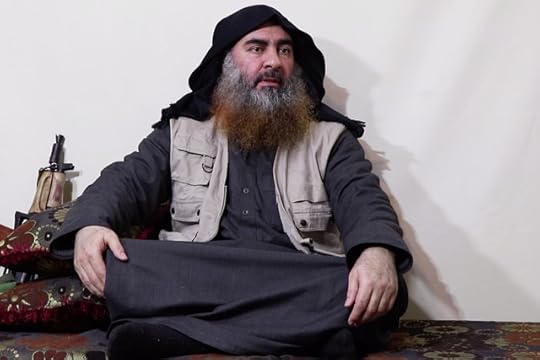
Margaret Coker: The story here details events that would lead up to the eventual killing of the self-described Caliph of The Islamic State, Abu Bakr al-Baghdadi, through the work of members of the elite Iraqi intelligence unit called Al-Suquor, or the Falcons.
Abu Bakr al-Baghdadi:
Despite a decent introduction, the writing in the book proper gets off to a very slow start. Coker spends quite a lot of time detailing the early lives of the key players in this book; including extensive and lengthy stories from their childhoods.
I realized that part of my confusion with this book has to do with my expectation of what would be covered. From the book's intro, I was expecting more of a gripping tale on the hunt for, and killing of Baghdadi. While that is covered here, it is not really the central plot. Instead, the writing here focuses on two brothers; Munaf and Harith al-Sudani, who become members of the Falcons. A subplot also follows female jihadist Abrar al-Kubaisi, who planned to poison Bagdhad's water supply with the toxin ricin. Coker's writing details the lives of the brothers and Abrar al-Kubaisi; their early childhoods, their adolescence, and then the brothers work in the Falcons. Indeed, the ending of the book doesn't focus on the death of Bagdhadi, but rather - what becomes of the two brothers. I've included the ending of this story beneath a spoiler, for anyone interested, as well as my own future reference.
Unfortunately, there was something about Coker's telling of this story that did not really resonate with me... I'm not exactly sure what that was. Maybe it had to do with my initial expectations. Maybe it is also partly that I didn't particularly like the style she writes with. In any case, this may well be a subjective thing. I see that this book has garnered largely positive reviews from others, so take from this what you will. I rate this one 3 stars.
This was a great read. I was really impressed with the amount of research that the author did to have such a well rounded story. The heavy amount of research made this a pretty dense book that allowed me to learn a lot about Iraqi history that I had little knowledge of prior to reading.
Harith’s story breaks my heart. I keep thinking about the photo of him in Lebanon near the water that his brother took and think that he deserved more. It’s really sad that his family had no knowledge of who Harith really was until after he died. Reading about how his father began to blame himself and how Harith’s wife regretted their last conversation was really hard to read. He is such an unsung hero of Iraq, and I’m grateful that I was able to learn about him. I’m also grateful to learn about the accompanying unsung heroes like Abu Ali and the rest of the Falcons. They had such a thankless job even though their success allowed a changing of tides to take place in the war.
I thought the story of Abrar was really captivating. It showed how someone who is seemingly normal can have a long and slow ideological transition into that of ISIS.
The themes of honor and shame throughout the book may seem foreign to a westerner, but they are important to understand in order to understand eastern culture. It makes me want to understand honor and shame more to better relate to this culture.
Overall, I really enjoyed this book. It was a thought provoking read that allowed me to learn about something that I otherwise wouldn’t have learned about. 5/5
This entire review has been hidden because of spoilers.
This book spoke on a lot of really important topics. It highlighted the hardship and loss the Iraqi people faced at the hands of the Islamic state. It described realistic, brave and very human choices people made in the fight against the Islamic state. There was a lot of interesting tradecraft described around human sources. Most importantly I thought this book did a great job describing the paths to radicalization that are less glamorous and often glossed over but are very real with insurgent groups. This was very well done and I highly recommend it to anyone interested in the complex social, cultural and human history of the Iraqi people’s fight against the Islamic state.
Utterly gripping and impossible to put down. At the heart of Coker's excellent account of an elite Iraqi intelligence unit and its efforts to bring down ISIS are two brothers, one of whom volunteered to infiltrate an ISIS cell as an undercover agent and the other who served as his handler. It's an incredible tale of courage, determination and sacrifice, and an absolutely engrossing read.
Written by a former NYT bureau chief in Baghdad about an Iraqi intelligence unit that was instrumental in beating back ISIS.
While intellectually I know there is so much complexity in the lives of Iraqis, I had a hard time picturing in my head everyday Iraqis who weren’t either terrorists or victims of terrorists. Coker does a great job telling the story of everyday Iraqis whose lives and aspirations sound like they would fit right in my friends circle.
But this story is largely about a heroic team of intelligence agents who were fighting for peace for patriotism in their country. Loved this story for humanizing people from a part of the world I didn’t know very well at all.
This book feels like being on a long-distance train: it starts quite slowly (I think because you can’t understand how the various characters are going to end up fitting together), but I ended up reading the final 180 pages in one go this morning.
The story is remarkable - both in terms of the level of courage that it took to infiltrate ISIS, and also how ramshackle ISIS itself was. As the Iraq War and its immediate aftermath move back into history, the sheer fragility of the day-to-day reality of life in Iraq really comes through. I’m surprised that I’d never seen a book on the topic before, but this is a great read (and a really tight first book from the author).
This is an undeniably astounding book of how the people of Iraq managed to live their lives against their war with the ISIS. The bravery it took to do the things they did to save their country, often all by themselves, opens your eyes to how lucky we are to live in America and have the freedoms we have. A truly heart rending story of truths most of us don’t want to hear! The work that this author put into this book, with all the research was an eye opener – the whole book really makes you think hard about your own life and what you would do and who you would give up to keep it safe!
Fascinating, hard to put down. Reads like a spy thriller. We never really hear much of the Iraqi side of their recent history of war and violence. This is the perfect account.
تروي بشكل متوازي قصة الشهيد البطل حارث السوداني والذي نجح في اختراق صفوف داعش و سيرة ابو علي البصري مؤسس وكالة التجسس الأشهر في العراق (خلية الصقور الاستخباراتية) و أبرار الكبيسي عالمة الكيمياء التي انضمت لصفوف داعش وخططت لشن هجمات كيميائية على بغداد
تحاول الكاتبة حكاية الأحداث من نهاية السبعينات مع نظرة تحليلية لكي يستطيع القارئ فهم السياق وعبور المنعطفات التاريخية التي تركت اثرها على شخصيات الكتاب و رغم بعض التفاصيل الزائدة وبعض الهنات من قبل الكاتبة إلا أن الأحداث مشوقة ومحركة للمشاعر و تجبرك على مواصلة القراءة رغم النهاية المؤلمة
This book had everything. Margaret Coker really wrote this so that it read more like a novel therefore it was easier to digest and the confusion stayed to a minimum. I feel like the defeat of ISIS is something that was overlooked due to the division here stateside so it was interesting to hear what was going on, as recent as 2019. Definitely a book for anyone interested in military or foreign policy.
Thought provoking, sad, and horrifying look into the Islamic State in Iraq told through these stories of the unsung heroes of this war. The stories of these men were heart wrenching yet beautiful. Really deep dive into the history of Iraq and left me needing the dictionary feature on my kindle often but learned so much. Left me thinking a lot about honor and shame, valor, loyalty, the price of life, and so much more. Dense but worth it
What a fun book. The two interleaving stories are not super interleaved but they're both interesting stories about two separate stories of Iraqis. The story is intriguing and the politics of Iraq are probably a bit simplified the story is an amazing immersion into the lives of two families in Iraq.
I know very little about ISIS, outside what I hear on TV. Part of this book covers an inside look at an Iraqi soldier who went undercover in ISIS and the challenges that he and his team members faced.
جهل المؤلفة أفسد الكتاب.فتحميل السنة إرهاب داعش تسطيح وجهل مطبق فهم أحد الضحايا و لطالما كانت القاعدة الشقيقة الكبرى لداعش تفجر و تقتل بدول السنة بينما رموزها تحميهم إيران الشيعية.ايضا تصوير صدام أنه طاغية ضد الشيعة فقط نكتة أخرى . عدى ذلك فشجاعة حارث رحمه الله تستحق التوثيق و التقدير .
This is page-turner non-fiction - not subtle, not packed with evidence or context - and it was such fun to read. Coker has tightened her focus around a small cast of characters and, mostly, one mission: to stop bombings in Baghdad. The tight focus tells only a few stories, but they illustrate various aspects of Baghdadi society. Coker introduces several ISIS members as well, and based on interviews, it reconstructs their stories. There is a lot of grief in this book. There is not a lot of politics - but you can see the lines where it goes. Coker comments little on why the Americans are there. She takes a dispassionate tone around motives where necessary - explaining, for example, that the tight focus on defeating Iran led directly to coopting Baathist security officers in preference to training Shiá officers. The generalised exploitation of sectarian differences is shown with devastating effect. But perhaps the most astounding part of this book is how much the intelligence efforts of a decade ago came down to a small, underfunded unit of men who barely owned a computer, and certainly, no smartphones - working occasionally with billion-dollar operations led out of Washington. ISIS is adept at online recruiting, but the leadership operate entirely without technology, making all Pentagon's killer toys largely useless. Instead, this relies on men using skills the American's simply don't have. Coker wants you to feel the heroism here, and she certainly succeeds.
Conventional conservative families existed in all parts of Baghdad, including the Shiites in lower class parts of Saddam City and the Sunni’s living in middle class neighborhoods of Baghdad. Despite their cultural differences, an elite intelligence agency was slowly formed in Iraq after the American invasion of 2003. Journalist Margaret Coker, who reported from Iraq during the time period after 2003, thoroughly investigated this group called the Falcons.
Although there were many members in the Falcons agency, Margaret Coker focused on three members and their leader. Two of the featured members were brothers from the poor neighborhood of Saddam City, and the other featured member was a young lady from a middle class neighborhood who witnessed unjust treatment of community residents. The group was not a quick fix to end all terrorism in Iraq, but they became a reliable group to encourage change in Iraq while they shared their classified information with British and American sources.
#ThespymasterofBaghdad - Margaret Coker #viking (#penguinrandomhouse)
Until I first read the subtitle ‘The untold story of the elite intelligence cell that turned the tide against ISIS’ I had no idea that that such cell even existed. I was thus also unaware of the fact that the cell was (and still is) known as al-Suquor (The Falcon) and that it was the brain child of a man whose name I have never heard before, Abu Ali al-Basri. This book is their story.
In post-Hussein Iraq chaos reigned and Baghdad became known as the murder capitol of the world. The US appointed new leader, Mohammed al-Shahwani, supported by the CIA funded mukhabarat, operated parallel to the Iraqi intelligence agency, reporting to the minister of the interior. The Shiite militias ruled in certain areas of the city and the Sunni were suddenly uprooted and ousted from the protective bubbles in which they existed under Hussein. The first democratically elected prime minister, Nouri al-Maliki, was in charge of Force 54, his Praetorian Guard, also known as the Baghdad Brigade. The subsequent Sunni-oppression created the perfect breeding ground for Al Qaeda agitators whispering to disgruntled Sunni’s that they should rise up against the Shiite al-Maliki government, resulting in the entry of the militant group, known as the Islamic State of Iraq and Syria: ISIS. Baghdad has become a war zone.
Nouri al-Maliki became aware that his political career would be at an end if he could not curb the violence and terrorism executed against the residents of Baghdad. He thus instructed an Iraqi who lived in exile in Sweden for more than two decades to create an elite intelligence cell to combat Al Qaeda. This man was Abu Ali al-Basri. And the cell became known as al-Suquor; The Falcon.
The book tells the astonishing true story of al-Basri and his tiny Falcon-unit (they started operating with a team of only twelve men) and how they successfully thwarted dozens of planned attacks in and around Baghdad. Their ultimate claim to fame is, without a doubt, the neutralizing of Abu Bakr al-Baghdadi on 27 October 2019; the man known for his blitzkrieg across southern Syria and northern Iraq in 2014, resulting in ISIS capturing territory equivalent to the size of the UK. After he proclaimed himself caliph, a 5 year reign of terror followed. Internationally the authorities stood helpless; sophisticated technology and electronic surveillance become useless when searching for someone who leaves no digital footprint.
The Falcons, under the leadership of al-Basri, did what nobody else could do: they successfully infiltrated ISIS. Al-Basri and two brothers, Halith and Munaf al-Sudani (the former later known as Agent 31) were the key players in this real life drama of espionage; double agents and daily danger.
The author of the book, Margaret Coker, was the former Baghdad Burea Chief for the New York Times. She is an investigative journalist and has lived and worked in Iraq and the wider Middle East since 2008. Abu Ali al-Basri allowed her to interview him whilst she was doing research for this book and the result is a chilling account of exceptional bravery by a few men whose names are barely known - but who deserve to be remembered as heroes.
The book brought the characters to life; the main role players are introduced to the reader in their childhood days; paving the way for the reader to develop empathy with their battles and choices; they become flesh and blood heroes; much more than mere hard to pronounce names on paper. Their story should be told.
Wow. Brilliant and engaging; a side of the Iraq War that I hadn't heard about before. It made me really consider the intentions of both the Americans and the Iraqis at the time - I admire the risk so many Iraqis took, not only to overcome ISIS, but to prioritize saving the lives of innocent people under the terror of the Islamic State. Fascinating, though sobering. Also, the writing was phenomenal and engaging. Historical accounts can often be a drag, but the writing style did the events justice.
Disclaimer: I received a digital review copy from the publisher. There was no requirement to publish a review (more of a quiet hope) and there was no requirement to publish a positive review.
I'm torn between 3 and 4 stars, but I'm rounding it up because I haven't seen any other books about Iraqis fighting ISIL. (Note: I will be using the terms ISIL or Daesh instead of ISIS, because Isis is a perfectly nice Egyptian goddess and I know people who worship her, and she's probably pissed a group of violent monotheists tried to steal her name.) It's an interesting change from ubiquitous ISIL/terrorism/Iraq-related books from a set group of American perspectives.
The book is a good and quick read. However, since it reads more like a novel than an academic work, I kept wondering where the author was getting her details and if they were accurate. How did she know the Iraqi head of state was bored during this particular meeting? Did she talk to one of his generals? Did she assume it? There was a note at the end about her sources (two years of interviews with everyone from the main biographical protagonists to, yes, an Iraqi head of state). It would have been much more reassuring to me if the note had appeared at the beginning.
I was also a little surprised when the B storyline never met up with the A storyline. There's technically no reason it should, I had just assumed the storylines would eventually meet because that's a frequent narrative structure. Basically there's an A storyline about three Iraqis working in counterterrorism and a B storyline about someone who sympathizes with ISIL and tries to join them at one point. Since the B storyline doesn't join the A storyline and isn't strongly related to the title of the book or the events in the blurb, I think it was included in the book to provide a look into the heads of people who do something we all think we wouldn't do. It's a good goal, and an interesting storyline. I was just surprised because I hadn't realised that was where we were going.
The iconic golden dome of Samarra's famed al-Askari Shrine came crashing down in a matter of moments in the early morning hours of February 22, 2006. With its destruction, everything changed for Iraq.
The work of al-Qaeda saboteurs, the calculated blast culminated years of factional violence targeting Iraq's Shiite majority in the bloody aftermath of the 2003 American-led invasion.
It had the desired effect.
Before nightfall, the tit-for-tat sectarian brutality that had been simmering across Iraq since the U.S. war began deteriorated into a kind of fratricidal anarchy, something resembling civil war.
The capital city of Baghdad, for example, quickly found itself pockmarked by concrete blast walls and bisected by a myriad of guarded checkpoints. The formerly mixed city became increasingly divided along denominational lines with Sunni insurgent groups and Shiite religious militias sowing chaos in the security vacuum.
It was around this time, during some of Iraq's darkest days in recent memory, the nation teetering on the edge of the abyss, that a former longtime exile was plucked from obscurity by then-Prime Minister Nouri al-Maliki and tasked – against seemingly insurmountable odds – with staunching the incessant bloodletting and pulling Iraq back from the brink.
In The Spymaster of Baghdad: A True Story of Bravery, Family, and Patriotism in the Battle Against ISIS, longtime international correspondent and former New York Times Baghdad bureau chief Margaret Coker vividly brings to life the story of Abu Ali al-Basri and his secretive al-Suquor (“the Falcons”) intelligence unit and their unrelenting quest to bring peace and security to their war-ravaged nation. Weaving together the story of al-Basri and Harith and Munaf al-Sudani, two patriotic brothers under his loyal command, Coker unveils a remarkable Iraqi counter-terrorism success story, one constantly fraught with unimaginable risk, danger and unabashed heroism.
--
There certainly has been no shortage of ink spilled on the Iraq War and its far-flung ramifications. It surely ranks as one of the most written-about events of the twenty-first century to date. And though there are assuredly some notable exceptions – the late Anthony Shadid's Night Draws Near comes to mind – the vast majority of that aforementioned ink has been penned from an unabashedly American perspective and point of view. While it does makes sense, the war was a thoroughly American endeavor after all, the coverage leaves out the most crucial component: the Iraqis themselves – the more than 40 million people who have borne the brunt of the consequences since 2003.
Throughout The Spymaster of Baghdad an Iraqi-centric focus imbues the pages from beginning to end and represents perhaps its most distinctive feature. It was by design. Coker says as much herself. "Ultimately, my aim with this book," she writes in the author's note, "is to recalibrate Iraq's history away from one that until now has centered on the Americans' sins, suffering, and victories and to illuminate the admirable role that Iraqis have played and the sacrifices they have made on behalf of their country and the world in the war on terror."
Publishers Weekly picks up on this theme as well in their succinct review of the book. "[I]t is Coker's focus on the resilience and bravery of Iraqis who are leading the fight to rebuild their country that lifts this book above other accounts of the war on terror."
--
As the title suggests, The Spymaster of Baghdad focuses the attention on Iraq's nearly two-decade-long counter-terrorism struggle.
Coker traces this cruel battle from the early days of al-Qaeda's branch in Iraq when it was founded and led by the Jordanian-born street tough Abu Musab al-Zarqawi. She leads readers through the terror group's subsequent iterations over the years, more violent at each evolution, before it reached its depraved apex with the rise of Abu Bakr al-Baghdadi and his Islamic State caliphate.
In this Iraqi war on terror, the small-scale unit of dedicated men that comprised Abu Ali al-Basri's Falcons intelligence cell would set their sights on the fanatical Sunni jihadis and former Baathists who were actively tearing Iraq asunder, bombing after vicious bombing.
Coker relays much of the Sunni discontent at their abruptly changed world and their collective resentment that fueled so much of the insurgency through the tangled story of Abrar al-Kubaisi. An aspiring but troubled chemist, al-Kubaisi precipitously descends further and further towards the path of radicalization and sectarian bigotry as the years of war wear painfully on for her and her family.
Al-Kubaisi eventually leaves her family and attempts to join ISIS before ultimately hatching her own terror plot. Coker takes readers behind the scenes as the Falcons rush to stop the diabolical conspiracy before it comes to a deadly fruition.
--
Despite the Falcons notable victories, however, by the middle of 2014 ISIS found itself at its strongest state in its bloody history. Coker lays out a number of factors for this: American troops had withdrawn from Iraq several years earlier at the end of 2011, the still-fledgling Iraqi government was increasingly viewed as divisive and antagonistic by its Sunni citizenry. Furthermore, the raging civil war in neighboring Syria provided ISIS with much-needed sanctuary and a buoy of resources.
It was then, in June 2014, that the terror army decided to make its move.
As ISIS maniacally rampaged across the country, taking city after city in quick succession and with Baghdad firmly in the group's crosshairs, the government of Iraq and its new Prime Minister Haider al-Abadi found themselves desperate for anything to stunt their momentum and reverse the existential threat they posed.
Near this time, after a particularly ugly bombing in his hometown enclave of Sadr City, Harith al-Sudani, a disillusioned college dropout, volunteered for an unthinkable mission and set into action spy chief Abu Ali al-Basri’s audacious and ingenious plan to protect Baghdad and its environs from the terror onslaught.
For years al-Basri knew they needed eyes and ears within the enemy's ranks to truly grasp the group and gather a better picture of how it operated in order to defeat it. It wasn’t until al-Sudani stepped forward, however, that the Falcons were able to truly infiltrate ISIS and work against the terror group from the inside out.
Coker's evocative retelling of this dangerous 16-month-long undertaking highlights The Spymaster of Baghdad, bringing together the book's three main characters in their quest to rid Iraq of its greatest nemesis. It was a campaign that would ultimately become regarded as one of Iraq's greatest successes in its years-long battle against ISIS.
In their own review, Kirkus Reviewswrites the mission underscored "that Iraqi competence and heroism were essential to its victory over terrorism." They're right. It was the competence of Abu Ali al-Basri and the heroism of Harith al-Sudani, along with the entirety of the Falcons intelligence unit, and other unknowns like them behind the scenes who worked tirelessly, knowing all too well the consequences of failure, in the dark shadows of Iraq's war on terror.
A brilliantly researched and narrated true story of an elite Iraqi intelligence unit, the Falcons, and one of their greatest exploits: placing one of their agents into the hierarchy of ISIS at a time when ISIS was attempting to take over their country. Unlike much of the corrupt security bureaucracy in Iraq, the Falcons prided themselves on their professionalism and systematic assembly of evidence. The book focuses on a series of individuals -- heroes, martyrs and traitors -- and places their stories in the context of their own family histories. Margaret Coker does an extraordinary job of grounding her subjects in Iraqi society, and her accounts of actual intelligence operations ring absolutely true. This book is a reality-based thriller. Although the historical events are real, I was struck by the absence of Iran, Sistani, and the Shii militias in confronting the ISIS threat in its earliest days. She glosses over that part of the story (as do the American media and lots of others) and limits the story to the official Iraqi army and intelligence agencies, and indirectly their American military colleagues. The Iranian intervention is a different dimension, but it was a critical part of that eventful time. But never mind. Coker has her hands full in weaving a great tale that, among other things, humanizes her Iraqi subjects and discovers heroism and sacrifice in an era that most Americans know only as grim defeat and treachery.
A compelling and amazing account of the lengths the Iraqi special services must go through to keep their families, neighbors and country safe from extremists. The story provides details of two families whose sons and daughter fight on opposing sides of ISIS. Without getting into sectarian differences and bogging down the flow, the narrative provides enough info on their history for the reader to understand the Sunni and Shiite branches of Islam and their ideological and political battles against each other. At times, I felt I was reading a fictional spy thriller as the action and suspense were adrenaline producing. Being a true story makes it even more thrilling and ofttimes heartbreaking. This story reveals just how real life can be even more fantastic than fiction. Any reader who has enjoyed a modern spy thriller with Islamic extremists as the antagonist should invest in this book. The subject matter and language put this in the adult's section.
* I received a free copy through Goodreads giveaways *