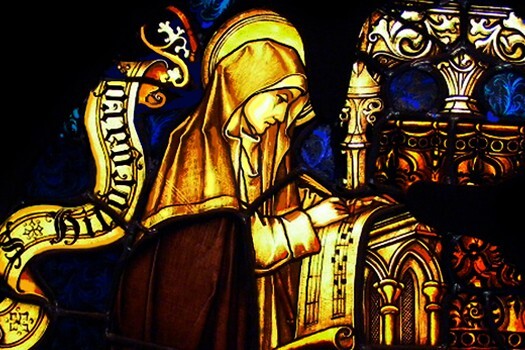
Román Iluminace vypráví neobyčejný příběh ženy, která byla v pouhých osmi letech věnována církvi jako desátek, dokázala vítězit nad zdánlivě nepřekonatelnými překážkami života a stala se snad nejproslulejší ženou své doby. Nejedná se o dokument ani životopis. Iluminace jsou šikovně namíchaným koktejlem beletrie, historických faktů i Hildegardiny vlastní filozofie, a tak vám nabízejí úchvatný portrét zbožné a mocné ženy mimořádného nadání, vizionářky v pravém slova smyslu.
Mary Sharratt is an American writer who lives with her Belgian husband in the Pendle region of Lancashire, England, the setting for her acclaimed 2010 novel, DAUGHTERS OF THE WITCHING HILL, which recasts the Pendle Witches of 1612 in their historical context as cunning folk and healers.
Previously she lived for twelve years in Germany. This, along with her interest in sacred music and herbal medicine, inspired her to write her most recent novel, ILLUMINATIONS: A NOVEL OF HILDEGARD VON BINGEN, which explores the dramatic life of the 12th century Benedictine abbess, composer, polymath, and powerfrau.
Winner of the 2005 WILLA Literary Award and a Minnesota Book Award Finalist, Mary has also written the acclaimed novels SUMMIT AVENUE (Coffee House 2000), THE REAL MINERVA (Houghton Mifflin 2004), THE VANISHING POINT (Houghton Mifflin 2006), and co-edited the subversive fiction anthology BITCH LIT (Crocus Books 2006), which celebrates female anti-heroes--strong women who break all the rules. Her short fiction has been published in TWIN CITIES NOIR (Akashic Books 2006).
Mary writes regular articles for Historical Novels Review and Solander on the theme of writing women back into history. When she isn't writing, she's usually riding her spirited Welsh mare through the Lancashire countryside.
Set in the Middle Ages (1098-1179), this is a true story of a fascinating woman Hildegard von Bingen also known as Saint Hildegard and Sibyl of the Rhine. She was a German Benedictine abbess, writer, composer, philosopher, Christian mystic, visionary, and polymath.
Hildegard von Bingen is promised to the church at the age of eight as a companion to a young woman, who chooses to be entombed in a small room. Cold and hungry young Hildegard, living the life she didn’t choose, dreams of roaming the forest and the happy times she spent with her brother. Through a screen she becomes a friend with a young monk, who tells her that she can find her happiness even here. One night she receives a vision from a Lady, who tells her, “You are here for a purpose, though you don’t understand it yet.” And that’s where she’s starting to see some meaning in her life, even though living behind the walls never makes sense to her.
After 30 years, when the sainted magistra dies, Hildegard sees an opportunity for ‘freedom’ and speaks up. Seen as not fit for an anchorite, she is allowed to live as a nun. A new chapter in her life starts. The knowledge she gained from studying herbs, now she applies to patients under guidance of a master physician. She even collects the herbs herself, which brings her the greatest joy.
I wished there was a bit more to the story about the time she spent at the last abbey. That was another chapter in her life, and the happiest.
Despite her harsh youth, she finds joy and true friendship. She achieves what only a handful of women had achieved at her time. She was a daring woman.
The thoughts and observations pouring out of the main character, make this story very real. A bit dark at some points, and yet making it a very interesting read.
Several years ago, my husband and I went to Chicago to see a play called "Late Nite Catechism." It is helpful if one is Catholic and even more helpful if one has gone to Catholic School (which I did, for too long in my opinion), to understand what is going on in this play. Anyway this was about the time when the Vatican decided to pare down it's list of saints and as we were told during this play, they had decided that having an eating disorder or being mentally ill did not qualify one for sainthood. Funny thing is the grade school I had gone to was named after one of the saints stripped of her sainthood. The point being that I approached this book with quite a bit of skepticism. This book brought out many emotions in me, from anger, to incredulity and finally admiration. Jutta, the anchorage, was in all likelihood mentally ill, but for me Hildegard was a source of amazement. At a time when the church was all powerful, when men in general had all the power, women, even well bred women, had very little control over their lives. That young girls, as young as five, were given a tithes to the churches and monasteries filled me with a deep disgust. When one realizes, however, that this was considered a sanctuary, a way to protect their daughters from marriages to old men, I am not sure what decision I would have made. Hildegard, who had visions, had a strength that was inspirational and she was considered a reformer and a forward thinker for her time period. This book was well researched, well written, and I came to care about Hildegard, with all her hopes and fears, greatly. Is she really a saint, were her visions real? I'm not sure, but for now I think that it just might be possible.
I'd had this book on a wishlist since the author announced its publication date months ago, and it was released a few days before my birthday. A friend purchased it for me as a gift, and by my birthday, I had read only a quarter of the book. Was it because I'm a slow reader that I didn't devour the text over a weekend? No.
Illuminations is a book to savor, like exquisite musical movements, for its descriptions of physical scenes and emotional climates, the development of characters in extreme circumstances, the wrenching emotions and unmet expectations of familial and collegial relationships, and the pure joy of the soul. The cast of characters did not lead neat, clean, perfect, saintly lives, but the author gave enough glimpses of back-story for the reader to fill in the gaps.
Hildegard's visions in context helped explain the motivation to her actions that would otherwise seem alien to us, 850 years later.
I was so pleased that author Mary Sharratt didn't portray Hildegard's spirituality as occultic, metaphysical, psychotic, or migraine hallucinations; neither was Hildegard preachy and pedantic. Rather, Hildegard came across as a woman who had an intimate relationship with God, a God who creatively revealed herself/himself (a spirit according to the Bible, who reveals itself with both male and female traits) in a way that Hildegard could understand and embrace--and worship devoutly despite the horribly negative examples and teachings she received as a child. Instead of being deformed and driven insane by her abuse, she was able to build a remarkable life on the rubble and ashes of that childhood death sentence.
Hildegard used her spiritual and intellectual gifts to build up her community, stone upon stone as a free-standing monument, in stark contrast to having been bricked into an anchorite grave.
When I finished the book, I felt both satisfied that I'd learned much about St. Hildegard of Bingen, and that woo-hoo, let's find out even more by listening to recordings of Hildegard's music, and reading a "straight" history (because Illuminations is historical fiction) about this amazing woman.
When I was fifteen, I discovered the beautiful music of Hildegard von Bingen. (Incidentally, the CD of her music that I discovered was a techno-trance interpretation created by Richard Souther. While I continue to love this work, it's much maligned by people with better taste than myself.) This was one of my first exposures to New-Agey, ambient type music, and also one of my first exposures to Hildegard, the Ultimate Uppity Woman.
It's just as well that von Bingen has an uppity personality; she needed it to get through many years of her life. At the age of 8, she was tithed to the Church and bricked up into two small monastery rooms to serve as a handmaiden to a mentally unstable anchorite, Jutta. Her life continued this way until Jutta's death, 30 years later--at which point, fate, God, debilitating visions, and a few political allies intervened. Hildegard was definitely a woman operating in a man's world, and it's to her credit that she did so successfully for many decades--and it's to Sharratt's credit that she keeps you interested as you learn about the Quintessential Uppity Woman of Medieval Times.
Also of note: An excellent read-alike would be Sacred Hearts, by Sarah Dunant.
A few years ago, I read Anne Lise Marstrand-Jørgensen's Hildegard and Hildegard II, IMHO two of the most remarkable books written this century but virtually unknown in the anglophone world. I have just finished rereading them, and once again wondered how it was possible that there is still no English translation. After a little research, I think Marstrand-Jørgensen was simply unlucky: Mary Sharratt's Illuminations came out at almost the same time, and people who believe they understand how these things work must have decided the world didn't need any more books inspired by the life of Hildegard von Bingen, that market was already saturated. I was curious to see what the competition was like, and Not was able to get hold of a copy.
Well, I don't want to be unkind to Sharratt. If I'd only read her book, I'm sure I'd have liked it more. But she's just created a moderately competent historical-feminist novel, and Marstrand-Jørgensen writes as though she's been divinely inspired. I can't quite figure out why God this time chose to speak to us in Danish. But inscrutable are His ways, who are we to question them?
I think there will be an English translation by and by.
I read one-third of this book and didn't want to finish. It has the tone of a YA novel and nothing of the mysticism of Hildegard von Bingen. One-third of the way through the book and she's only 15 years old. Not worth going on because it obviously won't deliver what I hoped for.
I love reading about the Saints and I love historical fiction, but typically putting the two together makes for a disappointing read, in my opinion. Good historical fiction authors are difficult to find in Catholic bookstores, so I was pleased to find Illuminations, a novel about the life of Hildegard von Bingen, written by a mainstream historical fiction author.
Hildegard von Bingen (1098-1179) was placed in an anchorage at the age of 8. An anchorage is much stricter than a typical convent, as in Hildegard's case, she was bricked in with her Magistra, Jutta, in one room with a small courtyard. Sharratt did a wonderful job of showing how Hildegard, as a small child, might have struggled with this imprisonment. It was Jutta who desired to be a great saint, but ultimately it was Hildegard, with her humility and self-sacrifice, who was given that place in history.
Throughout Hildegard's life, she experienced visions, which ultimately led to God's instructing her to write them down. The author rightly addresses the difficulties Hildegard must have faced with her male superiors in the Church, but there is something that strikes me as feminist leaning in the author's writing. I feel that Hildegard's true love for her God, nor a constancy in humility, did not adequately come through in this novel. Perhaps it was for the sake of an engaging novel, but I think the author should have made a better attempt to portray this woman as the saint she was. Still, I very much enjoyed this novel, and look forward to reading other books by Mary Sharratt.
In 2012, Pope Benedict XVI canonized Hildegard von Bingen and declared her a Doctor of the Church.
This was 4.5 stars for my enjoyment. The read captured Hildegard's personality. It's a gentle telling of her historical reality. This fiction by Sharratt succeeds because she grabbed the strength that was inherent in that girl from the beginning through all the changes and conditions she both endured and recorded.
The prayers, the songs, the poetry- they were exquisite. The Divine Love she describes considering the physical conditions and the mental barriers put into place as young as she was? Incredible to have such capacity. Hildegard (12th century Germany) is a mystic, Doctor of the Church for her writings, speeches, the abbey establishing work (Benedictine).
This is the 3rd or 4th book I've read about Hildegard and it's the most kind in the prose of the specifics for her first 10 years in anchorage with Jutta.
She must have been remarkable. Her visions and strength both mighty.
I became a fan of author Mary Sharratt when I read her novel, Daughters of the Witching Hill, so I've been anticipating the release of Illuminations with great excitement and when I was offered the opportunity to review it I jumped at the chance!
Illuminations tells the story of Hildegard von Bingen, who as a young girl was offered to the church as a companion to an anchorite nun, Jutta Von Sponheim. At the tender age of eight Hildegard was sealed in a small cell with Jutta where she would remain for over two decades. Once Jutta dies Hildegard works tirelessly to free her fellow nuns from the isolation of the anchorage and moves them to their own monastery at St. Rupertsberg where she serves as Prioress. Throughout her life Hildegard experienced religious visions and she would eventually record them into three works. She also wrote plays, music and books on natural medicine. Hildegard was recently canonized as a saint by Pope Benedict XVI. She is only one of four women to be named a Doctor of the Church by the Roman Catholic Church.
Mary Sharratt's writing is pure excellence! She has a way of pulling the reader in and keeping them hooked. Even though a majority of the book takes place in a tiny room there were never any slow or boring parts. Hildegard was truly an amazing and inspiring woman and Sharratt does a fabulous job at bringing her to life! Highly recommended!
This novel about Hildegard of Bingen steers between two extreme views of this important medieval figure that I have seen in biographies. Mary Sharratt doesn't take the psycho-medical view that because Hildegard had migraines, she never had any true visions. She also doesn't deny that Hildegard had migraines in an effort to portray her as the perfect New Age saint. Instead she takes the approach that it's possible to be a great visionary while still having migraines at times. It seemed to me that in Sharratt's version, not all of Hildegard's visions were accompanied by migraines, and that perhaps punishing migraines were a means of emphasizing the urgency of a vision. Mary Sharratt's novel also tells us that it's possible to be a great saint and a role model for women while still experiencing self-doubt. This is a complex, more nuanced portrayal of Hildegard.
I actually wasn't aware of the German view that Sharratt mentions in her Afterword that Hildegard was a sort of proto-Protestant who anticipated the Reformation. Thus she is claimed by both Catholics and Protestants.
This is a very good and well-researched novel that sees Hildegard afresh in a more clear-eyed fashion.
The portrayal of the ascetic Jutta von Sponheim isn't sympathetic, but it makes her more comprehensible. I was reminded of a book dealing with women ascetics that I read some time ago called Holy Anorexiaby Rudolph Bell which would also provide insight into Jutta's behavior.
Before reading this book, I would not have expected to enjoy a book about a cloistered nun in the Middle Ages. I had never heard of Hildegard von Bingen. I read this book because it was recommended to me by Goodreads based on my reviews of other books.
Based on a true story, this book provided a fascinating portrayal of a young girl sent away by her Mom to live in a monastery as a nun/servant. An older noble teen was electing to enter the monastery willingly and become a nun. Hildegard was offered to her and forced to become a nun and servant to the noble teen. In exchange, Hildegard's Mom received money for the dowries of her other older daughters. The noble woman decided to live the most severe form of existence - being walled into the monastery - never leaving. She lived a life of prayer and fasting and expected Hildegard to as well. Hildegard is forced to submit to the wishes of this depressed nun/noble woman until her death. After she passes away, Hildegard blossoms and finds her true calling in life. She is an early feminist. She also is bold enough to speak out against the injustices of the church - one of the first reformers.
It's an interesting work of historical fiction. I enjoyed it since it helped me understand a world I knew very little about. The author was very good at capturing the psychological effects of being held against your will in a captive environment.
I found Sharratt's book to stay true to many facets of Hildegard's life, except for her inner life.
I would have liked to see Sharratt give Hildegard a more authentic Christian and less secular inner life. I imagine she did rail against her plight and her early years in the Church as an anchorite (a hermit who leads a monastic life often times on church property in small cells). I imagine she had moments of bitterness, but she could not have gone on and become a pillar of the Christian mystic tradition if she did not have a strong faith and a rich inner life. We see evidence of her deep walk with God through her writings, music, and life's work. Sharratt does Hildegard a disservice by secularizing her to the point where readers can relate to her supposed thoughts. She was a strong woman who was ahead of her time in many ways. She sought the truth, unity of nature with humankind, and saw God in a new light so different from her Middle Age counterparts.
I expected the book to contain spiritual depth and less cattiness regarding Hildegard's private world, but it fell short of remaining true to Hildegard's spirit--at least in this way. Hildegard von Bingen exhibited strength of character and of faith--this is something that we need to see more of in the church: strong women role models. I hate to see such a powerful woman watered down.
Very little is known about Hildegard von Bingen's early life, and Mary Sharratt has chosen the most traumatic of the stories as the basis for her novel. In her version, young Hildegard is already seeing visions and her mother fears she will be branded a heretic. The girl is offered to the Church as an oblate and walled into the monastery at Disibodenberg with Jutta von Sponheim at the age of 8. (Some sources put the enclosure date later, when Hildegard was 14, but in the scheme of things that hardly seems to matter, they're still walled up in a church.)
The book is being released in time for Hildegard's elevation to Doctor of the Church, but I don't think Sharratt was writing for the devout. In her version of events, Jutta is clearly mentally ill, and Hildegard's pitying condescension for the monks who revere Jutta's lost beauty and supposed holiness overrides even her jealousy. In contrast, her own visions of Ecclesia, the mother church, are accepted as real. (Of course, we're reading from her perspective.) I didn't see the point of one of the sexual confessions or the romantic overtones in relationships later in the book. I wasn't expecting a whitewash, but since all the details had to be imagined, I'm just pondering the inclusion of those in particular.
wow . . . really wanted to like . . . really didn't. so over- and badly written. if she described the nuns' singing as "their voices rose up to the heavens . . ." or "their voices rose up, intertwining in beautiful harmonies . . . " or "their voices rose up . . ." -- dear lord, please find a new way to describe a bunch of people singing. or better yet, stop describing people singing every few pages. yes, we get it. they sing a lot. could they do some other stuff too?! i could list many other annoying and repetitive motifs but I'll spare you. spare yourself this book!
Sharratt constructed a very enjoyable imagining of what Hildegard von Bingen's life was like. With each turn of the page, I was really glad to not have lived her life. I might have had to kill myself. It was all I could do to make it through my catholic night classes I was forced to endure for most of grade school. In the 5th grade, I was asked to leave CCD before making my confirmation because I argued with the priest after he told us about the Widow's mite. She only had 2 mites (quarters) to her name and gave both to charity because she knew god would care for her. IMO, god had cared for her by giving her money and cared for her by endowing her with a brain enough to know that she needed charity and needed not to give away the last of her money to the church. The god I loved back then would never allow her to starve and suffer. The priest passed around the collection plate after guilting everyone about the charity of the Widow. The church was building marble steps at the time and I got it into my brain that they were using our collection money to do so, which was true. I argued that it was unchristian. My classmates agreed. I was escorted out to the parking lot and haded to my mother. The priest told her to never bring me back. I was terrified I would get in trouble. My mother looked shocked and mortified. Yet, when I got in the car and told her why I got kicked out, she told me how proud she was of me. That is how my story with the church ended. Sadly, things didn't go as well for Hildegard von Bingen.
A child prone to visions (probably epilepsy), she was given away to the church at 8 years old. What a strict and horrific life. Forced to be a handmaiden to Jutta, who in this retelling was a particularly cruel and self-loathing victim of sexual assault, Hildegard tried valiantly to navigate the minefield that was Jutta's brain. She tried lying about who she was because Jutta was not the forgiving or accepting type. She tried anticipating Jutta's needs, always making sure to never steal the limelight. Nothing worked.
Sharratt imagined that Hildegard loved one of the monks. This was particularly enjoyable to me because I could easily imagine a young teen falling for the only young man to which she has access. After all, Hildegard was forced to live as a nun. She did not seek that life. She was imprisoned. True to the rest of her life, her love life just never worked out, which made the story all the better.
As one day bled into another, she had to figure out how to assimilate to this new hell she found herself in. There were tiny moments that served as brief respites from the anguish of being held in captivity. A new novice would come into her life. Even these things seemed to fall apart. It was all so beautiful, devastating, and vivid. Life in the 11th century couldn't have been very easy on anyone, but having your entire life taken in this particular way seemed worse to me than if she had stayed with her family and placed in a bad marriage.
When Hildegard was eight, her mother gave her to a church to be bricked into a chamber in a monastery wall as involuntary handmaiden and student to an ascetic teenaged girl of noble birth, Jutta von Sponheim. Hildegard had visions, and was thus unmarriageable. Giving her daughter over to this purpose not only disposed of her honorably, but bought the favor of Jutta’s rich mother, enabling Hildegard’s sisters to meet wealthy mates. As Jutta slowly killed herself with anorexia and self punishment, Hildegard and the two other girls that joined them in their dark hell longed for sunlight and freedom for over thirty years before Jutta finally died and Hildegard demanded their freedom. Her time in that dark prison wasn’t wasted, though; a kindly monk brought her books from the monastery library and plants for her to grow in the tiny courtyard. By the time Jutta died, Hildegard was very educated, an able healer and a brilliant composer. She went on to found her own abbey and criticize the corruption of the church. She was an incredibly accomplished woman in a time when women were thought of as little more than breeding machines or servants.
‘Illuminations’ is the prefect title for this novel; illumination fills the story. The great illuminated texts that Hildegard learns from, the great visions of light that fill her, her illumination of the corruption in the church; light fills Hildegard’s life even at its darkest points. This is a triumphant story told in lyrical prose that brings the era and monastery life into brilliant, colorful focus. But it’s not a one sided glorification of Hildegard; she’s a living, breathing woman with the faults all humans share. It’s not a religious book at all; it’s a story of people and spirit. Whether you’re Catholic or not, or even Christian or not, Hildegard von Bingen was a fascinating woman. Sharratt’s writing held me suspended in Hildegard’s life throughout the novel, and it left me wishing the book was twice as long.
This is a fictionalized biography of the 12th century mystic, Hildegard von Bingen. Although the author was consistent with the outline of the historical facts, there were some places where I questioned if she got the details of the larger setting correct. For example, she referred to the religious vows of the anchoress as “taking Holy Orders” a term I have only seen used for the ordination of deacons, priests and bishops. The voice of Hildegard never quite felt authentic. In the early years, she neither sounded like an 8 year old nor a 70 year old remembering childhood. The voice and sensibilities of Hildegard could have more easily put her in 1980then in 1140. Older words were thrown in, such as verdantide and merriment, to suggest the ancient setting but we were also given current slang such as “shut his trap” when willing a man to stop speaking. But my greatest annoyance with this book was the author’s repetition of major details. Over and over we were told that the mystic Jutta was the bride of death, not of Christ, that Vulmar was Hildegard’s oldest and most faithful friend, etc. It is clear from early on that Jutta is running to the anchorage to flee the older brother who is molesting her, but the author can’t just point at it, she insists on a thousand hints until she has to say it outright. I want an author who can trust the reader enough not to have to be hit over the head 50 times before they can comprehend what is on the page. 2.5 stars
From the first to the last sentence, I was totally captivated. The book was thrilling and beautifully written. I read it in every spare moment.
In the 11th century, where men ruled both the countries and the church, women were basically nobodies. Girls at a tender age were turned over to men as wives with no rights or to the church to become nuns with no rights.
Hildegard at age 8 or perhaps 14 (history is not sure on this point) was given up by her mother fully knowing that she would become a submissive handmaiden to another young girl, who was deranged and sought a most austere life within the confines of an anchorage, basically a cell, cut off completely from the natural world. Hildegard, a child, didn't have a clue of what she was in for.
She was in the cell for 30 some years. She suffered, but also survived and flourished. With visions of the Blessed Mother and the true inner church, she gained wisdom, compassion and love. She challenged the men around her and eventually publically admonished the priests for their lust, fornication, adultery and corruption by buying and selling of holy offices. Back in the 11th century. Wow! It's only been in my lifetime that brave souls have come forth on sexual abuse by priests. She was a true champion for the church as well as women. One nun, who I never heard of, back in the 11th century. Amazing.
I thoroughly enjoyed this novel story of Hildegard von Bingen’s faith journey! It was apparent throughout that the author did her research on the practices of the time, both within the Church and without. This is a wonderful read for anyone interested in historical fiction, the lives of saints, and, of course, Hildegard of Bingen!
This was my introduction to Hildegard von Bingen. Why have I never heard of her? (And I attended a Catholic college.) I'm intrigued, and I want to learn more about this woman. Isn't that a sign of a well-written historical novel? It was a 'page-turner' but not in the usual meaning of the phrase. I never wanted to put down the book, so I kept reading 'just another few pages.' The story drooped once, about 4/5th into the story. I was wondering if the author really needed the last fifth of the book, but then it picked up and tied together all of the loose ends nicely.
There is a welcome afterword that reassures the reader that All major characters and events in this novel are drawn from recorded fact. Sometimes, however, historical accounts reveal discrepancies. ...
Anyone who likes historical fiction with a focus on the Middle Ages, will appreciate this story. While a nun is the central figure in this story, this is not Christian fiction.
I'm listening to this (audio form). Can I say: OMG! The story is completely fascinating, made even more so by the reader, Tavia Gilbert. I am only on the second cd and listening to the story and how it was told, made me cry! I need to just drive and drive, I guess, so I can listen to this book. It's been a week and can I say: I don't spend enough time in the car... I am still thoroughly enjoying the book.
I really liked this book ... a lot! I am definitely going to have to do some more research on Hildegard von Bingen. The audio is still the best one I have heard. The story line is great (drags a bit in one or two places) but overall, it is so well done. It's such a fascinating time period and the author does quite well in her description of the small bit of area the book takes place. I highly recommend this book.
What a fascinating woman Hildegarde von Bingen was; devout yet radical, both spiritual and spirited. I was enthralled by her story, from her forced confinement as an anchorite in childhood through to the revolutionary accomplishments of her later years. I relished her evolution from a powerless, frightened child into a mature woman with the courage to publicly call out the corrupt church hierarchy and endure the consequences. I had never before read of the anchorites who confined themselves to bricked-over cells from which they would never emerge, in effect a living entombment. I found this fascinating, and was horrified to know that at times young girls were forced into this life without a choice. This book has inspired me to read more about Saint Hildegarde.
Near the end of my fragmented career of a college education, I got it into my head to take a course called something along the lines of 'Hagiographies of Female Saints', a deep dive into the form and function of certain women who enriched the body of Catholic religion during life and even more upon death, as indelibly embedded in certain branches of doctrine as an insect is in amber. Given the need for certain forms of education credits and my experience with the whole "body of Christ," it was certainly a practical choice, and with my gender the way it was back then, it wasn't the worst thing to take on a paradigm with no small dose of "feminism" implied in its tenets. I added this book to my TBR about three years before taking that class, but I imagine I was working through similar concerns of a religious past, a marginalized present, and some desperate need for a future that was capable of resolving one in order to uplift the other. In terms of all that, the class likely did me more good than this did, as I did agree with one of the more negative reviews in thinking that the work leaned a tad too much on generic girl YA grows into generic/inoffensive female perspective with a dash of biographical details here and there to remind the reader why they were here in the first place. Still, there was something there that makes me think I'll have to do a proper read up on Hildegard of Bingen at some point in my life, or otherwise take up again that effort of interacting with what was forced upon my younger self through a medium that I have no small amount of professional accomplishment, and thus well earned personal pride, within. I'm in no rush to cleave myself to anything I was once made to know, but this read demonstrated, if nothing else, a deep and abiding interest that I shall have to satisfy, one way or another.
P.S. Yes, there were some queer moments. Sensationalized, perhaps. But also intensely human, and therefore welcome nonetheless.
The complete brutality of the Medieval times shines through here ALL in the name of Christianity! Hildegard von Bingen is one our first feminists. I learned so much from this historical fiction. The author did a great job of interpreting historical documents and giving us a story that was hard to put down. I had no idea about certain practices within the Benidictine Religion during the time covered in this book and it blew me away. I suggest you pick up and start reading the book without Googling who she was. Part way through look her up but don't spoil it for yourself. Great BOOK!
This is as disturbing a story as it is inspiring! At the age of 8 years old, in order to win dowries for Hildegard's sisters, her mother "tithes" her to a monk's monastery to become an anchorite. That means that she and another young girl will be placed in two rooms that are completely walled in except for a small grille through which their spiritual advisor can speak to them and through which food and drink of the coarsest nature will be passed at mealtimes. Jutta with whom Hildegard is imprisoned is pious beyond what one would ever expect in such a young girl, wearing a hair shirt one-piece garment and ultimately a metal belt with thorn-like prongs that she wears around her waist under her gown that already makes her bleed.
A young monk, Volmar, befriends Hildegard, supplying her with books on medicinal herbs and providing her with paper and books from which she learns to read and write. She is comforted by the mystical visions she has of The Blessed Virgin Mary, who appears in different forms but always with holy messages. The visions, however, are always accompanied by a form of illness, be it dizziness or headaches. Jutta eventually dies and now the real life of Hildegard begins. She has a definite gift of hearing beautiful music and divine verses that will eventually make her famous throughout the world. Life is so so painful with constant conflict from the Abbot and other monks.
Eventually she will win the support of other clergy. Other women will join her and soon she will found her own convent and move through relationships that show her clearly how worldly and sinfully proud she really is! But then her saintly behavior and words of healing wisdom begin to attract pilgrims. After her first very tough lessons, Hildegard must grow up and realize that "balance" is mandatory; favoritism and uniqueness is heresy, a sign of a traitor, even a sign perhaps of the devil working in her life!
Mary Sharratt paints a portrait of a woman whose emotions and thoughts are the epitome of saintly behavior and attitude and at the same time frail with undeveloped pride and selfishness. What else could a woman do who was shut away from the world for thirty years - an inconceivable tortured time, at least to this reviewer. Every step forward to greater holiness is fraught with temptation and even abuse. It's not pretty at all and yet Hildegard learns that service to others is more important than her own temporal desires. Mary Sharratt has fashioned a novel that is riddled with problems that make the reader ask innumerable questions and offers few responses except for those trustworthy souls sharing her journey. What a remarkable novel. Hildegard is a historical work of fiction that may leave you with more questions than answers. The line between insanity and saintly behavior, thought, and feeling is thin indeed! Stunning fiction!
3.5 rounded down. I've read The Anchoress so I was familiar with the idea of walling up living women to pray for a community. Doing it when a child is eight, and as a "tithe" from the family, though, is a whole other matter.
St. Hildegard, the patron saint of musicians and writers, is known for several things. According to the interwebs, Hildegard remains known as the originator of German alternative medicine and deserves recognition for her contributions to holistic health and wellness. She promoted the prevention of disease and illness by natural means of a moderate and healthy lifestyle and used the curative powers of natural objects for healing.
Since childhood she had seen visions, and a committee of theologians subsequently confirmed the authenticity of Hildegard’s visions. She wrote a book, Scivias (1141–52) that consists of 26 visions that are prophetic and apocalyptic in form and in their treatment of such topics as the church, the relationship between God and humanity, and redemption.
She also composed music and is one of the first identifiable composers in Western music. Nuns sang/prayed roughly every three hours during the course of a day.
Her feast day is September 17. Pope Benedict XVI declared her to be a saint through the process of “equivalent canonization,” in 2012. Later that year Benedict proclaimed Hildegard a doctor of the church, one of only four women to have been so named.
So, back to the book. I found it dragged a little near the end, once Jutta, the original anchoress died. And as I stated in my review of The Anchoress, because these were women of noble birth, they didn't really do much other than pray, advise other women and stitch. As a mother, what life would you choose for a daughter? A cloistered life or one married to an old man at 13, multiple pregnancies, no health care and constant work? Oh, and a dowry was required in either case--either to the husband or the nunnery/monastary.
All the other reviewers gave as synopsis, so I'm just going to say what I liked about this book - which was a good deal. I greatly appreciated how Mary Sharratt never condescendes to her readers. She accepted Hildegard's visions as described, rather than trying to explain them as some sort of mental illness or delusion. Descriptions of the anchorage are chilling, yet Sharratt paints such a horrific [and true] picture of an average woman's life in the 12th century - a subject I am quite well versed in as the author of Rashi's Daughters, Book I: Joheved: A Novel of Love and the Talmud in Medieval France - that it's easy to understand why so many flocked to convents when they had the opportunity.
Hildegard is such an important woman in history that I'm almost shocked it took so long for her story to be written; Sharratt deserves many kudos for bringing it to us. My one complaint [kind of like complaining that my piece of chocolate is too small] is that the book is too short, only 270 pages. There was so much more about Hildegard's life I wanted to know. After she escapes the anchorage, years, decades even, go by with only the slightest details given. I never tired of Sharratt's excellent writing; I really wanted more.
This book was about Hildegard von Bingen, an 11th-century German abbess who wrote books and music inspired by visions sent to her by God. This was an incredibly interesting read and I admire Sharratt immensely for attempting to dissect the life of a saint from a saint's point of view. I felt that the book really hit it's stride after she becomes an anchorage with Sister Jutta, the self-destructive and mad nun whose piety and insanity are incredibly vivid and wonderfully realistic. My one complaint was that there was quite simply not enough of Volmar. When he is there, he is incredible and one of my favorite characters. Hildegard maintains that he is a profound influence on her life but many of their interactions weren't there, the same with Richardis, the young girl who Hildegard describes as being the equivalent of her and Volmar's daughter, an embodiment of Christ's Divine Love on Earth, her sister, her special friend, never seemed fully-fleshed to me. Though, Hildegard waxes philosophical about the importance of Richardis and her love for her, Ricaradis never becomes real, truly real until near the end when she leaves the abbey and Hildegard tries to stop her the same way that Jutta might have done to her. Much more defined and clearer is the margravine, Richardis' domineering mother who cuts a relatable and sympathetic character. Overall, I did really like this book and will read more by the author.
What a book! If I would have read this book earlier in my life, I would have left the Catholic faith soon. Hildegard is a very strong Woman. Early in Her life She was forced to be a handmaid to an anchoress ( A Woman who wiling had herself walled up in a small room, attached to a church, to live a pious, poor life). What a beginning for a spirit like hers! She loved Nature. and She was gifted with visions, not of the suffering Christ, but of beautiful Women. At first, She wasn't belived. Then, when a visitor came to the walled-up cell to see the lady Hildegard was serving, The vistor told the lady that it was Hildegard who was the one who would be great and renowned for Her visions & gifts. The Prior of the monastery they lived under loved the Lady who gave up all to serve, suffer and be poor like Christ, not Hildegard. This book was one I could not put down. I read it in hours. How come my former Catholic faith failed to mention this Sainted Woman? I was feed on Virgin-Martyrs. This Woman's life should be read whether you are Catholic, Pagan or any other belief. The best book for 2012, so far.