

What do you think?
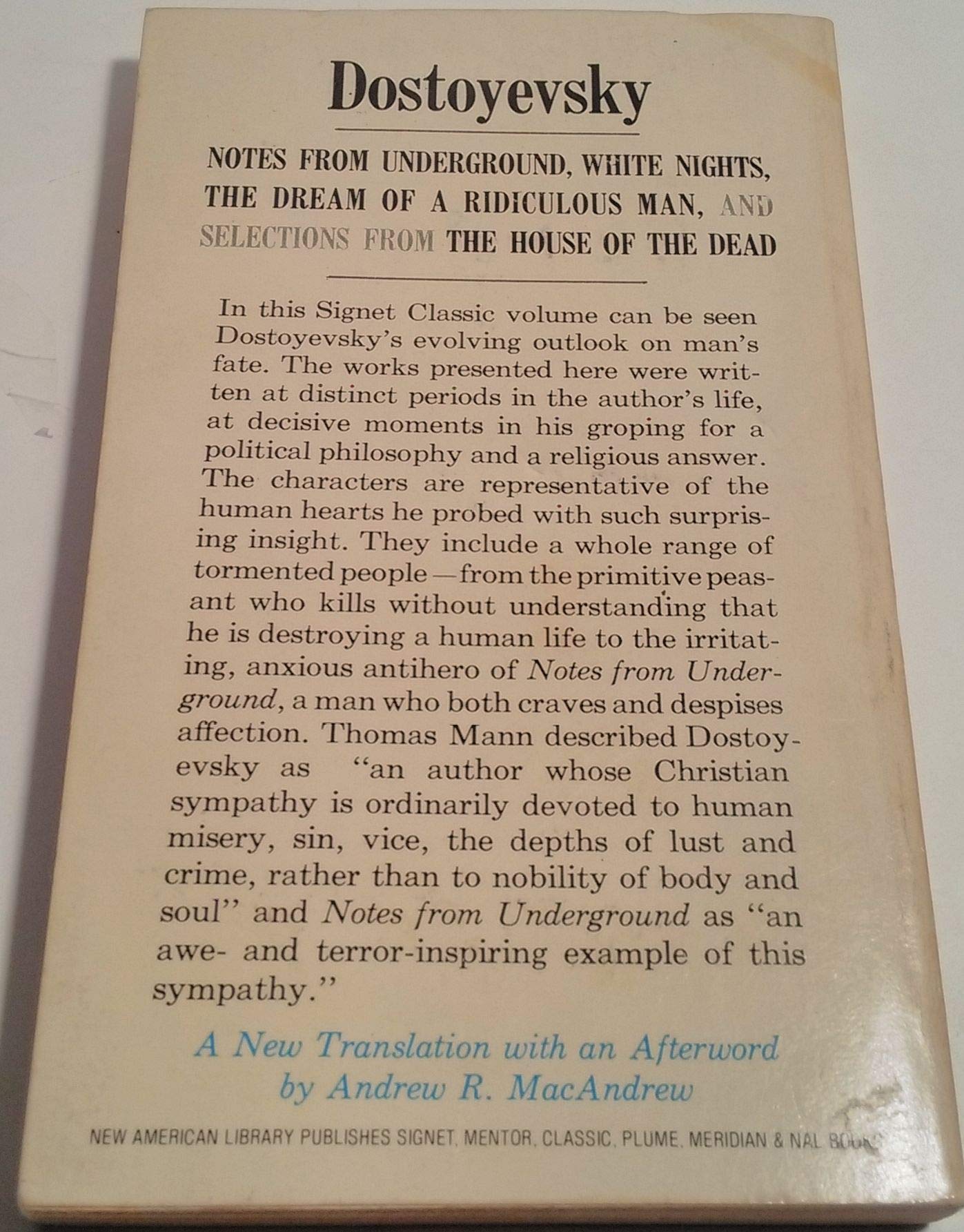
Notes from Underground: with White Nights, The Dreams of a Ridiculous Man, and selections from The House of the Dead
In this volume can be seen Dostoyevsky's evolving outlook on man's fate. The works presented here were written at distince periods in the authors life, at decisive moments in his groping for a political philosophy and a religious answer.
240 pages, Mass Market Paperback
First published January 1, 1864
About the author
Fyodor Dostoevsky
3,499 books79.4k followers
Фёдор Михайлович Достоевский
(Russian)
Works, such as the novels Crime and Punishment (1866), The Idiot (1869), and The Brothers Karamazov (1880), of Russian writer Feodor Mikhailovich Dostoyevsky or Dostoevski combine religious mysticism with profound psychological insight.
Very influential writings of Mikhail Mikhailovich Bakhtin included Problems of Dostoyevsky's Works (1929),
Fyodor Mikhailovich Dostoevsky composed short stories, essays, and journals. His literature explores humans in the troubled political, social, and spiritual atmospheres of 19th-century and engages with a variety of philosophies and themes. People most acclaimed his Demons(1872) .
Many literary critics rate him among the greatest authors of world literature and consider multiple books written by him to be highly influential masterpieces. They consider his Notes from Underground of the first existentialist literature. He is also well regarded as a philosopher and theologian.
See also:
Russian → Фёдор Михайлович Достоевский
French → Fédor Dostoïevski
French → Fiodor Dostoïevski
Spanish → Fiódor Dostoyevski
Portuguese → Fiódor Dostoiévski
Works, such as the novels Crime and Punishment (1866), The Idiot (1869), and The Brothers Karamazov (1880), of Russian writer Feodor Mikhailovich Dostoyevsky or Dostoevski combine religious mysticism with profound psychological insight.
Very influential writings of Mikhail Mikhailovich Bakhtin included Problems of Dostoyevsky's Works (1929),
Fyodor Mikhailovich Dostoevsky composed short stories, essays, and journals. His literature explores humans in the troubled political, social, and spiritual atmospheres of 19th-century and engages with a variety of philosophies and themes. People most acclaimed his Demons(1872) .
Many literary critics rate him among the greatest authors of world literature and consider multiple books written by him to be highly influential masterpieces. They consider his Notes from Underground of the first existentialist literature. He is also well regarded as a philosopher and theologian.
See also:
Russian → Фёдор Михайлович Достоевский
French → Fédor Dostoïevski
French → Fiodor Dostoïevski
Spanish → Fiódor Dostoyevski
Portuguese → Fiódor Dostoiévski
Ratings & Reviews
Friends & Following
Create a free account to discover what your friends think of this book!
Community Reviews
Displaying 1 - 30 of 2,159 reviews

December 26, 2012
I did two things after finishing with this book.
- 1)Strengthened my resolve to finish Crime and Punishment and read the rest of Dostoyevsky's works without any inner grumbling.
- 2)Looked up Albert Camus' background and profile on the internet.
Yes Dostoyevsky was one of Camus' influences. If you read Notes from Underground right after Camus' The Fall, it becomes all the more obvious.
Well anyway here's a word of advice.
Do not read this book on a cold, practical day. Do not read this on a day when your mind is too painstakingly slow to register the meaning of words. Do not read this on a day you're feeling cheerful either.
Read this on a day you want to sit in a corner of your room, have a few hours to yourself for contemplation without being interrupted every 2 minutes by a notification on whatsapp or a phone call. Better still switch off your phone, or put it off the grid before reading this book. Read this on a day when you seek intellectual nourishment.
Because most sentences in this book deserve a re-read, then another.
On a day when anything irrespective of how trifle it is, has the capability of setting you off, you might rubbish Notes from Underground as the ramblings of an unhinged mind, shallow self-justification of a social outcast.
But on a day when your mind is very receptive and free from most forms of negativity the narrator would appear to be a more or less balanced individual (somewhat conflicted maybe) voicing all our innermost thoughts - the undignified, blasphemous, befuddling thoughts that are carefully dissembled in the darkest nooks and crevices of our minds. The thoughts which are not even trendy enough to be glorified in literature.
The thoughts which we do not have time enough to entertain because we're always too busy grappling with the great predicament of 'life'. The thoughts all of us would even label 'immoral' at certain times.
We take refuge behind our 'busy schedule' excuse to never fully confront life or realize its many complexities.
We live with a terribly flawed understanding of what we really are, what we really aspire to achieve or what is it towards which we're running. We never stop to think of the alternatives believing quite blindly that they do not exist.
I would not be able to say anything more about the book for philosophical ramblings and anecdotal passages cannot be summarized. But what I can say with conviction is that Dostoyevsky's intention has been to make you think and introspect rather than recounting a tale.
So that is why read this book on a day you won't denounce or reject without giving the narrator's opinion a second thought.
And what you must certainly not do, is scoff at its length. Trust me it will take some time to actually get through its pages.
- 1)Strengthened my resolve to finish Crime and Punishment and read the rest of Dostoyevsky's works without any inner grumbling.
- 2)Looked up Albert Camus' background and profile on the internet.
Yes Dostoyevsky was one of Camus' influences. If you read Notes from Underground right after Camus' The Fall, it becomes all the more obvious.
Well anyway here's a word of advice.
Do not read this book on a cold, practical day. Do not read this on a day when your mind is too painstakingly slow to register the meaning of words. Do not read this on a day you're feeling cheerful either.
Read this on a day you want to sit in a corner of your room, have a few hours to yourself for contemplation without being interrupted every 2 minutes by a notification on whatsapp or a phone call. Better still switch off your phone, or put it off the grid before reading this book. Read this on a day when you seek intellectual nourishment.
Because most sentences in this book deserve a re-read, then another.
On a day when anything irrespective of how trifle it is, has the capability of setting you off, you might rubbish Notes from Underground as the ramblings of an unhinged mind, shallow self-justification of a social outcast.
But on a day when your mind is very receptive and free from most forms of negativity the narrator would appear to be a more or less balanced individual (somewhat conflicted maybe) voicing all our innermost thoughts - the undignified, blasphemous, befuddling thoughts that are carefully dissembled in the darkest nooks and crevices of our minds. The thoughts which are not even trendy enough to be glorified in literature.
The thoughts which we do not have time enough to entertain because we're always too busy grappling with the great predicament of 'life'. The thoughts all of us would even label 'immoral' at certain times.
We take refuge behind our 'busy schedule' excuse to never fully confront life or realize its many complexities.
We live with a terribly flawed understanding of what we really are, what we really aspire to achieve or what is it towards which we're running. We never stop to think of the alternatives believing quite blindly that they do not exist.
I would not be able to say anything more about the book for philosophical ramblings and anecdotal passages cannot be summarized. But what I can say with conviction is that Dostoyevsky's intention has been to make you think and introspect rather than recounting a tale.
So that is why read this book on a day you won't denounce or reject without giving the narrator's opinion a second thought.
And what you must certainly not do, is scoff at its length. Trust me it will take some time to actually get through its pages.

September 28, 2014
My edition of “Notes from Underground” includes a magisterial foreword by Richard Pevear that gives an extra dimension to the introspective musings of its sardonic anti-hero, bestowing them with the required intellectual authority to reproach the utopian socialism and the aesthetic utilitarianism prevalent in the Russia of the 1860s and offer responses to ideological, philosophical and moral paradoxes of a world in the threshold of progress and modernity.
The fact that Dostoevsky’s novella constitutes one of the founding pillars of the psychoanalysis theories and the existentialist reasoning didn’t come as a surprise. The protagonist establishes an inner dialogue with himself and engages the reader in an acerbic and self-mocking dialogue in which he reasserts his individual freethinking over the redemptive control imposed by totalitarian principles.
But as juicy as Pevear’s references and footnotes were, the cavernous voice that crawled from the netherworld and seeped into my conscience seemed atemporal and devoid of indoctrinating intention to me, and therefore, universal.
“I'm now asking an idle question of my own: which is better--cheap happiness, or lofty suffering? Well, which is better?”
I listened to a man’s introspective self-judgement, to the confession of a life dragged away by the currents of his deficiencies, his frustrations, his shame and infectious regrets that fester in the wound of his current existence.
Dostoevsky’s man from the underground is the embodiment of a decisive juncture that every human being will face at some point in his life: the crossroads between ignoble actions taken in the heat of the moment and virtuous resolves that never materialized, the split second when the mask of self-deception is dropped and lofty pride and steely detachment dissolve into smothering sadness and remorseful loneliness.
I listened and nodded in recognition.
“I am alone, I thought, and they are everybody.”
The hypocrisy of denouncing the perversity of the Western civilization, this “crystal palace” of rationality and hollow idealism and its despicable inhabitants, and the irrepressible craving to belong to it, to be accepted and praised by those who were adamantly ridiculized in order to cover one’s own failures and corroding envy.
The acrimonious humor and spiteful demeanor, mere rudimentary shields to conceal the resigned acquiescence to one’s insignificance and disguise the fear of losing with affected indifference.
Does it ring a bell? Yes, I know.
“To love is to suffer and there can be no love otherwise.”
Desire makes the man from the underground vulnerable.
Feigned hate, rocambolesque plans for revenge and mean-spirited humiliation become necessary tools to banish those who might offer unselfish love and the burden of happiness.
I listened to the cacophony of the paradoxical selves that give voice to this conflicted narrator who speaks from the underworld, from the fetid gutter in the obscure basement of mankind’s subconscious, and I joined him in polyphonic canon.
For this cantankerous misfit exposes the turpitudes of our human souls without reservation, sometimes with his head, others with his heart but mostly with a gut instinct that bleeds with the raw honesty only the unrepentant liar possesses.
There is no light that allows us to discern a clear image of the creature that inhabits the catacombs of our consciences but the man from the underground has learned to see in the dark. His voice comes from beyond. You just need to close your eyes and listen.
The fact that Dostoevsky’s novella constitutes one of the founding pillars of the psychoanalysis theories and the existentialist reasoning didn’t come as a surprise. The protagonist establishes an inner dialogue with himself and engages the reader in an acerbic and self-mocking dialogue in which he reasserts his individual freethinking over the redemptive control imposed by totalitarian principles.
But as juicy as Pevear’s references and footnotes were, the cavernous voice that crawled from the netherworld and seeped into my conscience seemed atemporal and devoid of indoctrinating intention to me, and therefore, universal.
“I'm now asking an idle question of my own: which is better--cheap happiness, or lofty suffering? Well, which is better?”
I listened to a man’s introspective self-judgement, to the confession of a life dragged away by the currents of his deficiencies, his frustrations, his shame and infectious regrets that fester in the wound of his current existence.
Dostoevsky’s man from the underground is the embodiment of a decisive juncture that every human being will face at some point in his life: the crossroads between ignoble actions taken in the heat of the moment and virtuous resolves that never materialized, the split second when the mask of self-deception is dropped and lofty pride and steely detachment dissolve into smothering sadness and remorseful loneliness.
I listened and nodded in recognition.
“I am alone, I thought, and they are everybody.”
The hypocrisy of denouncing the perversity of the Western civilization, this “crystal palace” of rationality and hollow idealism and its despicable inhabitants, and the irrepressible craving to belong to it, to be accepted and praised by those who were adamantly ridiculized in order to cover one’s own failures and corroding envy.
The acrimonious humor and spiteful demeanor, mere rudimentary shields to conceal the resigned acquiescence to one’s insignificance and disguise the fear of losing with affected indifference.
Does it ring a bell? Yes, I know.
“To love is to suffer and there can be no love otherwise.”
Desire makes the man from the underground vulnerable.
Feigned hate, rocambolesque plans for revenge and mean-spirited humiliation become necessary tools to banish those who might offer unselfish love and the burden of happiness.
I listened to the cacophony of the paradoxical selves that give voice to this conflicted narrator who speaks from the underworld, from the fetid gutter in the obscure basement of mankind’s subconscious, and I joined him in polyphonic canon.
For this cantankerous misfit exposes the turpitudes of our human souls without reservation, sometimes with his head, others with his heart but mostly with a gut instinct that bleeds with the raw honesty only the unrepentant liar possesses.
There is no light that allows us to discern a clear image of the creature that inhabits the catacombs of our consciences but the man from the underground has learned to see in the dark. His voice comes from beyond. You just need to close your eyes and listen.

September 13, 2012
I am writing this review because I have just finished and writing is the only thing I can do at this moment. The book has shaken me where reading any other book in the future has come into question. Maybe I should have waited till the heat simmered and collected my thoughts but this too would counter what I have just read, experienced and been shaken by. Let's start with the simple and easy and get it out of the way. The book is told in first person by a narrator who was not raised by parents or in a loving family. He has isolated himself, except for his man servant-also his greatest tormentor-from others, from what we call life. He lives off of little. This now being out of the way, the book starts with an unreliable narrator who goes through a world's breadth of feelings about himself. This is extreme. It is savage. This book is savage and meant to be. If you have a ,Savage, shelf this is the book to shelve there but alone, apart from others. On one level the story is about a man who was not loved, is not capable of love, friendship, and has shut himself away metaphorically underground. Who better to see the world through? These are not the eyes of an unreliable narrator. We are all to some degree unreliable narrators. I am. He is not. Without hesitation he faces within himself the onslaught of,fears, prejudices, envies, hostilities, brutalities,contradictions, the need for love, the need to protect against it, meanness, bitterness, hatred of himself and others. He finds safety only within his rooms. There he can fantasize himself as nobler and where he can act out his dreams of revenge. However, from the vantage point of his underground fortress he sees the dance of the world filled with its trite conventions and honors. The pathetic discourse taken for social life sickens him. He is no good at the game and has no interest in playing it. The problem sets in when he is snubbed, mocked for his poverty, lack of social standing, his poor job. At times he is compelled to act out his hostilities with wretched results. Outraged that those who threw their lives away at the trite, ridiculous party games could look down at one like himself who read, thought, led a higher, deeper life. He held a mirror up from his shabby rooms, not one that could be hung plumb on the back of a door, a wall, but one clearly at a precise angle that reflects the brutality of our species and the creatively refined ways we use to cover this over. We all act from a base, he says early on, and from that base,i.e; honor, an entire set of behaviors becomes justified. He acts from the base of reflection, intellectual perseverance, thought, and reason. These too are subject to the use of finery to cover the growls and animal snarls hissed within, underground. At the end he acknowledges he is a paradoxical character, too; that everything above ground is an attempt to become the average man and in essence is a defense. We would all like to be admired for our joinings, our costumes, the proper trainings of accepted behavior, the hopes for status and honors, and to be included. Possibly literature for its own sake is an answer. Also, he notes, this lover of paradoxes, cannot stop writing here, even though the story must end. Hopefully, he will continue from his underground sanctuary for all time to come. I am counting on it.

September 15, 2011
Short, brisk, Scathing and dark as dark can be. I hope you experience some of the uplifting depression this book gave me... It does pull you out in the end but around the middle of the book, it buries you deeper than you ever thought possible.

September 21, 2015
To all, who would like to read opinion or analysis of “Notes from the Underground”. Stop here. The following is something quite different. The only thing it has to do with the book itself is that the man I’m mentioning is a bit like the protagonist. Self loathing and incapable of real love, but much more malicious than Dotstoevsky’s creature.
You are supposed to be gone. I don’t know whether you really are, or you go on being here using again a false identity. Even if you are truly gone, maybe your protégées here tell you what goes on. Maybe you will read this or be told about it. Maybe not. I don’t care. This might be addressed to you, but it is about me. And why am I making it public? I’m leaving the answer to those who would read it. Everybody is free to interpret the following as they please. I’m not looking for sympathy. I have enough of that. Here I discovered amazing friends who support me constantly and I am so grateful to them. What I’m doing is facing my fear. I did tell you that I didn’t let anything to be stuck in me, didn't I? I am brave and sincere in a way you can only dream of, oh mighty reader/writer/reviewer. Once I used to call you like that with a pleasure. Now I do so with pity. Because I know that this is all you really have. That’s right. I feel pity for you. I didn’t know what a true psychopath was before having the misfortune/fortune to come across you. Yet, I feel sorry for you, in a way you have never felt sorry for me. Neither for me, nor for anyone else. You did not hesitate to use your own family members and their tragedies - and your own - to seduce me, to gain my sympathy. You had no problem to, albeit indirectly, involve the ones you claim to love in your dirty little hobby. You prayed on my weakness and misplaced affection. I was naïve and paid the price for that. But you are way more naïve believing that there is some sense in what you’re doing. You are naïve in your arrogance. And so you too paid your price. And you will go on paying. And so shall I, I suppose. I know that, if you come to know about this, you will most likely try to hurt me. I have no children for you to threaten, but you still have the means to hurt me. Maybe by revealing something of/about me. Maybe by attacking me virtually in some way. Maybe you are crazy enough to come to my country and city hunting for me. After all, you take trips to different parts of the world just so you could get laid. So why not for revenge as well? Am I afraid of you? Always. I am afraid of you and of the memories of you. Every time I remember the intimacy you and I shared, albeit only through internet, I feel not just like taking a shower. I feel like getting another skin. You were all too happy to tell me about the fantasies you had with my image. I feel sick that such a man like you has laid his eyes on me and knows so much about me and has seen so much of me. So yes, I am afraid of you. Of your past and future self, of what you did and might do to me. Yet, I am doing this. I was terribly hurt to find out how little I have meant to you and how others of your conquests have meant much more to you. But I know now that your indifference was one of the best things that could have happened to me. Because I came to know what you did to the women you find interesting enough. I feel sorry for all of them. Once you thought I was interesting too. While I was still a challenge. But once you got past my defenses, the thrill was gone, wasn’t it? It’s the chase you’re after, not the end result. Just like a hunter who is interested in his prey only as long as it moves and breathes. Once your arrows went through me and I was lying on the ground, defenseless and wholly in your power, you didn’t want me anymore. But you didn’t walk away instantly. You stuck around to make sure that I was no more than a corpse before leaving me. You broke me. You were determined to hurt me as much as possible before letting go of me. You even befriended me, pretending to be someone else. I will never know for sure why you never got as close to me as you did to your other women. Maybe you thought I was not as good as the rest of the list, maybe your conscience (if you actually have any) has kicked in, maybe something else. You told me in the end that I could never be good enough for you. Maybe you expect me to say now “No, you are the one who’s not good enough for me”. I won’t, because I know that this was addressed toward me only on a very superficial level. I know that the person you despise the most is you. You don’t realize it, but none of the women you lure, threaten, blackmail, harass, is half the victim you are. You violate mostly yourself. You think you’re super smart and strong? You, who are much older than me, with all your years of experience, education and talents, are as naïve and defenseless as a baby, because you are a victim of your hubris, your lack of self respect and genuine love and compassion. You told me, when you were still playing your poisonous game with me, that you felt sad that my self esteem was not high enough. You told me that you would like to rebuild it. You did. I didn’t know what a true psychopath was until I met you. And when I finally knew, I also came to know how strong I was. I didn’t know that I was brave, intelligent, creative and passionate before you broke me. You broke me, but you also rescued me from myself. From the self-pity I was drowning in. I didn’t know what I was capable of before you pushed me off the cliff and I discovered I had wings. Maybe you thought my willingness to do so much for you and the fact that you could always count on me, that I was so easy and amiable and ready to agree to almost anything, made me boring and pathetic. But this is me. I don’t need games. I would do anything for those I love. (Once I thought you were one of them). I am proud of my generosity. I possess love and passion you can only dream of. I am even good enough to forgive you, even though you don’t feel like you need my forgiveness. I asked you once about the nature of forgiveness. None of us found the exact answer. But whatever forgiveness is, I am bestowing it on you. Regardless of whether you feel you need it or not. I don’t need your attention and affection anymore, I certainly don’t need your lies. All I need is myself. And I discovered myself. I discovered that I am the person I have always dreamed of being. I told you once you were my teacher. And you were. You taught me well. Thank you.
•
You are supposed to be gone. I don’t know whether you really are, or you go on being here using again a false identity. Even if you are truly gone, maybe your protégées here tell you what goes on. Maybe you will read this or be told about it. Maybe not. I don’t care. This might be addressed to you, but it is about me. And why am I making it public? I’m leaving the answer to those who would read it. Everybody is free to interpret the following as they please. I’m not looking for sympathy. I have enough of that. Here I discovered amazing friends who support me constantly and I am so grateful to them. What I’m doing is facing my fear. I did tell you that I didn’t let anything to be stuck in me, didn't I? I am brave and sincere in a way you can only dream of, oh mighty reader/writer/reviewer. Once I used to call you like that with a pleasure. Now I do so with pity. Because I know that this is all you really have. That’s right. I feel pity for you. I didn’t know what a true psychopath was before having the misfortune/fortune to come across you. Yet, I feel sorry for you, in a way you have never felt sorry for me. Neither for me, nor for anyone else. You did not hesitate to use your own family members and their tragedies - and your own - to seduce me, to gain my sympathy. You had no problem to, albeit indirectly, involve the ones you claim to love in your dirty little hobby. You prayed on my weakness and misplaced affection. I was naïve and paid the price for that. But you are way more naïve believing that there is some sense in what you’re doing. You are naïve in your arrogance. And so you too paid your price. And you will go on paying. And so shall I, I suppose. I know that, if you come to know about this, you will most likely try to hurt me. I have no children for you to threaten, but you still have the means to hurt me. Maybe by revealing something of/about me. Maybe by attacking me virtually in some way. Maybe you are crazy enough to come to my country and city hunting for me. After all, you take trips to different parts of the world just so you could get laid. So why not for revenge as well? Am I afraid of you? Always. I am afraid of you and of the memories of you. Every time I remember the intimacy you and I shared, albeit only through internet, I feel not just like taking a shower. I feel like getting another skin. You were all too happy to tell me about the fantasies you had with my image. I feel sick that such a man like you has laid his eyes on me and knows so much about me and has seen so much of me. So yes, I am afraid of you. Of your past and future self, of what you did and might do to me. Yet, I am doing this. I was terribly hurt to find out how little I have meant to you and how others of your conquests have meant much more to you. But I know now that your indifference was one of the best things that could have happened to me. Because I came to know what you did to the women you find interesting enough. I feel sorry for all of them. Once you thought I was interesting too. While I was still a challenge. But once you got past my defenses, the thrill was gone, wasn’t it? It’s the chase you’re after, not the end result. Just like a hunter who is interested in his prey only as long as it moves and breathes. Once your arrows went through me and I was lying on the ground, defenseless and wholly in your power, you didn’t want me anymore. But you didn’t walk away instantly. You stuck around to make sure that I was no more than a corpse before leaving me. You broke me. You were determined to hurt me as much as possible before letting go of me. You even befriended me, pretending to be someone else. I will never know for sure why you never got as close to me as you did to your other women. Maybe you thought I was not as good as the rest of the list, maybe your conscience (if you actually have any) has kicked in, maybe something else. You told me in the end that I could never be good enough for you. Maybe you expect me to say now “No, you are the one who’s not good enough for me”. I won’t, because I know that this was addressed toward me only on a very superficial level. I know that the person you despise the most is you. You don’t realize it, but none of the women you lure, threaten, blackmail, harass, is half the victim you are. You violate mostly yourself. You think you’re super smart and strong? You, who are much older than me, with all your years of experience, education and talents, are as naïve and defenseless as a baby, because you are a victim of your hubris, your lack of self respect and genuine love and compassion. You told me, when you were still playing your poisonous game with me, that you felt sad that my self esteem was not high enough. You told me that you would like to rebuild it. You did. I didn’t know what a true psychopath was until I met you. And when I finally knew, I also came to know how strong I was. I didn’t know that I was brave, intelligent, creative and passionate before you broke me. You broke me, but you also rescued me from myself. From the self-pity I was drowning in. I didn’t know what I was capable of before you pushed me off the cliff and I discovered I had wings. Maybe you thought my willingness to do so much for you and the fact that you could always count on me, that I was so easy and amiable and ready to agree to almost anything, made me boring and pathetic. But this is me. I don’t need games. I would do anything for those I love. (Once I thought you were one of them). I am proud of my generosity. I possess love and passion you can only dream of. I am even good enough to forgive you, even though you don’t feel like you need my forgiveness. I asked you once about the nature of forgiveness. None of us found the exact answer. But whatever forgiveness is, I am bestowing it on you. Regardless of whether you feel you need it or not. I don’t need your attention and affection anymore, I certainly don’t need your lies. All I need is myself. And I discovered myself. I discovered that I am the person I have always dreamed of being. I told you once you were my teacher. And you were. You taught me well. Thank you.
•

June 19, 2011
Dostoyesky's anti-hero is the the first of a long line of existential anti-heroes who followed later in the 20th century. Clearly, here is an utterly loathsome man who is alienated from his brethren by virtue of his own worldview and is victimized by it. In his sublime genius Dostoyevsky sufficiently respects his readers to challenge them to find something, however dreadful it may be, to connect intellectually with a protagonist who is virtually impossible to admire. While so many novelists of his era present protagonists with whom it is hoped that you will connect at deeper levels, Dostoyevsky almost seems to care less whether you find something of yourself in the lonely man living in a wretched room beneath the boards of an apartment on the edge of St. Petersburg apropos of wet snow. The underground man has squandered his gifts to burrow impossibly deep within his interior life, so much so that he has abandoned all social graces and is unwilling or unable to connect with outsiders above-ground. This underground man finds himself "morbidly developed, as a man of our time ought to be developed... Every decent man of our time is and must be a coward and a slave." He is trapped by his superior intellect and his heightened consciousness showers him with agony to leave him without a clue as to how to relate to men and women of any social status. He is entirely, utterly and hopelessly alone living in a random world the sense of which eludes him with its futility. "I am now living out my life in my corner, taunting myself with the spiteful and utterly futile consolation that it is even impossible for an intelligent man seriously to become anything, and only fools become something. Yes, sir, an intelligent man of the twentieth century must be and is morally obliged to be primarily a characterless being: a man of character, an active figure -- primarily a limited character." He foreshadows the players in the dramas of Samuel Beckett and Sartre: "The final end, gentlemen: better to do nothing... And so, long live the underground." He is Nietszche and Kierkegaard in the ways in which they experienced their lives. He is "The Stranger" of Camus and a being straight out of "The Metamorphosis" of Kafka: "I'll tell you solemnly that I wanted many times to become an insect." Dostoyevsky anticipates the dreadful and perverse 20th century anti-hero Humbert of Nabokov in "Lolita" and utterly bewildered, shell-shocked protagonists like Billy Pilgrim in Dresden after its bombing in World War II in "Slaughterhouse Five" by Kurt Vonnegut. Honest to a fault, brilliant, alienated and articulate, the underground man asks and answers his own question: "What can a decent man speak about with the most pleasing? Answer: about himself. So then, I, too, will speak about myself." He finds it impossible to channel his intellect into positive action: he lives in a state of nearly total paralysis. Like all good existentialists he is plagued by his own haunting consciousness: "I am strongly convinced that not only too much consciousness but even any consciousness at all is a sickness... What is the result of heightened consciousness: it is simply to become a scoundrel." He wonders how a man of consciousness can have the slightest respect for himself as every primary cause drags with it another and so it goes infinitely. He deems that the express purpose of every intelligent man is "babble -- a deliberate outpouring from empty into void." But he blames himself because he is more intelligent than everyone around him. He scorns the "good and lofty" and considers such idealism as building a Crystal Palace, which only leads to getting stuck deeper in the mire underground. The underground man is highly in agreement with Heine who observed, rightly I suspect, in criticism of Rousseau who lied about his life for his vanity in his "Confessions." The educated and well developed man of his time challenges the notion of what is profitable in this "twopenny bustle" and scorns reason itself: "Gentlemen, why don't we reduce all this reasonableness to dust with one good kick?" But there's much more on this subject which is curious coming, as it does, from an intelligent man: "Reason, gentlemen, is a fine thing, that is unquestionable, but reason is only reason and satisfies only man's reasoning capacity, while wanting is a manifestation of the whole of life... I, for example, quite naturally want to live so as to satisfy my whole capacity for living and not so as to satisfy just my reasoning capacity alone." No magnanimity graces his soul as because of it he would be tormented by the consciousness of its utter futility as Nature does not ask your permission and doesn't care about your wishes or if you like its laws. He invited you to listen to the moaning of an educated 19th century man suffering from a toothache. Point well made and taken. Man is an animal damned by ingratitude and in a classical definition of our species he defines man as "the ungrateful biped" and is further distinguished among all other creatures as the only animal which curses. He finds that man is "comically arranged" and that somewhere in all of existence there is a joke and perhaps existence is simply a grand hoax foisted upon humanity. For example, he wonders why he has been so arranged with such desires as he possesses or which possess him utterly. When he encounters and seeks relief in a prostitute named Liza, he falls in love, an emotion which betrays and makes a fool of him. But he yields to his nature, as he feels he can do no other, and seeks to win her with his intelligent face and to liberate her from the life of the streets with his intellect: "I'll get you with these pictures!" He derides Liza by saying, "What are you putting in bondage? It's your soul, over which you have no power, that you put in bondage along with your body...And for the sake of what, one wonders, have you ruined your life here?... There is not and never has been any harder or harsher work in the world than this. One would think your heart alone would simply pour itself out in tears." On the subject of love in his underground dreams he describes it as "God's mystery" and later as the yielding right to become tyrannized by your lover. Most of all, the anti-hero is Dostoyesky, the author, penning immortal lines of literature from debtor's prison. "Our discussion is serious... I am not going to bow and scrape before you. I have the underground." He taunts his readers boldly, as few novelists before him have written, as to be "so gullible as to imagine I will publish all this and, what's more, give it to you to read... I shall never have any readers." Ultimately, what does the underground man want most of all? "I longed for 'peace,' I longed to be left alone in the underground. 'Living life' so crushed me, unaccustomed to it as I was, that it even became difficult for me to breathe." In the end he insults his readers by advising them that his notes are only his work to carry to an extreme what his readers, you and I, are too cowardly to carry and chides all of us for taking comfort in our morbid and possibly surreal self-deception, a major theme later developed by Sartre in "Existentialism Is a Humanism." "But enough: I don't want to write any more 'from Underground" with a capital "U" this time. However, in another paradox in the last lines his notes continue because the underground man can't help himself and went on scribbling his babble anyway. To understand clearly the influence of this Father of Existentialism in 20th century literature, one must first understand this germinal literary classic.

December 6, 2014
I first met the Russian on the loading docks. Filling trailers with freight out in the weather, in the humid heat and then again in the freezing cold was not a career, not a job anyone especially wanted, it was a job to fill in the gaps, work that paid a wage and filled a need as necessary as the empty trailers that backed into the dock one after the other.
I had seen him in the break room, out on the picnic tables - always alone. He scribbled incessantly in an old thesis book, would pause long moments staring into space, as still as a statue, and then would bend his head and write feverishly.
Sometimes he would sit quietly on his break, with a thin old paperback or a tattered library book in his lap. Passing once, I could not help glancing over his shoulder and saw that his book was a collection of poems.
Another time, in the cold of January, when we all dressed like astronauts in plump suits, or like Eskimos in thick woolen parkas, the Russian was dressed in a thin old ragged coat and cloth gloves with holes in several fingers. He looked ill, and little doubt, we still had hours to go on our shift and his only head covering was the sparse patch of thinning hair atop his sallow scalp. I remembered having an extra woolen cap in my locker, and fetched it and then offered it to him without a word, just held it out. It was a colorful winter toboggan hat with a bright red fluffy ball atop. He looked up at me and seemed to almost decline, he looked embarrassed to wear the warm cap, as if its incongruous color atop his sullen head would be a greater hindrance than the warmth it would provide. A dirty hand ventured up and took the cap and black eyes beneath scruffy brows looked into me, seeking to discover was this true kindness or a jest at his expense. I smiled and he seemed to relax, and a thickly accented “thanks” drifted up from his stringy mustache and beard.
The other dockworkers said of him that when they worked a trailer in tandem, he spoke very little or nothing at all, loading mechanically and only passing information as needed.
My first trailer with him was on a cold night in March and the brisk pace of the work kept us warm. I tried to spark a conversation, but he only answered in grunts and shrugs.
Another time I got him to speak a little, talked some about his origins and his life before this. At the end of the load, he smiled shyly, thanked me for the winter cap, reached from his back pocket, returned it and gave me a firm handshake. I returned the grip and looked at him and saw again those eyes that seemed to look into me.
“I’m Lyn,” I said. “Fyodor.”
After that we slowly began to talk, to share ideas. Working together, Fyodor told me about his writing, during breaks, he would read aloud.
“Talking nonsense is the sole privilege mankind possesses over the other organisms. It's by talking nonsense that one gets to the truth! I talk nonsense, therefore I'm human.”
“Man only likes to count his troubles; he doesn't calculate his happiness.”
“I say let the world go to hell, but I should always have my tea.”
“To love is to suffer and there can be no love otherwise.”
Fyodor was … insane. He was inspired, passionate, angry, hurt, a victim, a survivor, a damaged soul that had lived beyond torture and then had been able to describe the journey into hell and the ascent past.
There were days that I had to walk away from him, unable to meet the brutal honesty, the too focused intensity, I had to step away.
“I am alone, I thought, and they are everybody.”
And I would scream at him, but also screaming at myself, “It doesn’t have to be this way, damn you! Life is not this black and white, you are not the final judge and jury, you cannot cut down to our souls like a scalpel, it is not your place to examine us, you are ONE OF US!!”
And he answered: “I love, I can only love the one I've left behind, stained with my blood when, ungrateful wretch that I am, I extinguished myself and shot myself through the heart. But never, never have I ceased to love that one, and even on the night I parted from him I loved him perhaps more poignantly than ever. We can truly love only with suffering and through suffering! We know not how to love otherwise. We know no other love. I want suffering in order to love. I want and thirst this very minute to kiss , with tears streaming down my cheeks, this one and only I have left behind. I don't want and won't accept any other.”
And I had to get away. I quit, I left, and I separated myself from him. Who was he to say these things, who was he to judge me, to judge all of us??
Yet I could not forget, could not stop thinking of his words, could not get away from those eyes that delved into me.

I had seen him in the break room, out on the picnic tables - always alone. He scribbled incessantly in an old thesis book, would pause long moments staring into space, as still as a statue, and then would bend his head and write feverishly.
Sometimes he would sit quietly on his break, with a thin old paperback or a tattered library book in his lap. Passing once, I could not help glancing over his shoulder and saw that his book was a collection of poems.
Another time, in the cold of January, when we all dressed like astronauts in plump suits, or like Eskimos in thick woolen parkas, the Russian was dressed in a thin old ragged coat and cloth gloves with holes in several fingers. He looked ill, and little doubt, we still had hours to go on our shift and his only head covering was the sparse patch of thinning hair atop his sallow scalp. I remembered having an extra woolen cap in my locker, and fetched it and then offered it to him without a word, just held it out. It was a colorful winter toboggan hat with a bright red fluffy ball atop. He looked up at me and seemed to almost decline, he looked embarrassed to wear the warm cap, as if its incongruous color atop his sullen head would be a greater hindrance than the warmth it would provide. A dirty hand ventured up and took the cap and black eyes beneath scruffy brows looked into me, seeking to discover was this true kindness or a jest at his expense. I smiled and he seemed to relax, and a thickly accented “thanks” drifted up from his stringy mustache and beard.
The other dockworkers said of him that when they worked a trailer in tandem, he spoke very little or nothing at all, loading mechanically and only passing information as needed.
My first trailer with him was on a cold night in March and the brisk pace of the work kept us warm. I tried to spark a conversation, but he only answered in grunts and shrugs.
Another time I got him to speak a little, talked some about his origins and his life before this. At the end of the load, he smiled shyly, thanked me for the winter cap, reached from his back pocket, returned it and gave me a firm handshake. I returned the grip and looked at him and saw again those eyes that seemed to look into me.
“I’m Lyn,” I said. “Fyodor.”
After that we slowly began to talk, to share ideas. Working together, Fyodor told me about his writing, during breaks, he would read aloud.
“Talking nonsense is the sole privilege mankind possesses over the other organisms. It's by talking nonsense that one gets to the truth! I talk nonsense, therefore I'm human.”
“Man only likes to count his troubles; he doesn't calculate his happiness.”
“I say let the world go to hell, but I should always have my tea.”
“To love is to suffer and there can be no love otherwise.”
Fyodor was … insane. He was inspired, passionate, angry, hurt, a victim, a survivor, a damaged soul that had lived beyond torture and then had been able to describe the journey into hell and the ascent past.
There were days that I had to walk away from him, unable to meet the brutal honesty, the too focused intensity, I had to step away.
“I am alone, I thought, and they are everybody.”
And I would scream at him, but also screaming at myself, “It doesn’t have to be this way, damn you! Life is not this black and white, you are not the final judge and jury, you cannot cut down to our souls like a scalpel, it is not your place to examine us, you are ONE OF US!!”
And he answered: “I love, I can only love the one I've left behind, stained with my blood when, ungrateful wretch that I am, I extinguished myself and shot myself through the heart. But never, never have I ceased to love that one, and even on the night I parted from him I loved him perhaps more poignantly than ever. We can truly love only with suffering and through suffering! We know not how to love otherwise. We know no other love. I want suffering in order to love. I want and thirst this very minute to kiss , with tears streaming down my cheeks, this one and only I have left behind. I don't want and won't accept any other.”
And I had to get away. I quit, I left, and I separated myself from him. Who was he to say these things, who was he to judge me, to judge all of us??
Yet I could not forget, could not stop thinking of his words, could not get away from those eyes that delved into me.

May 12, 2013
يقول دوستويفسكي في أحد قصص هذا الكتاب متحدثاً عن أيامه في السجن :"أردت أن أدرك المستويات المختلفة من الأحكام والعقوبات, وكافة أشكال العقاب وموقف المساجين منها. حاولت أن أضع نفسي في في الحالة الذهنية للمساجين الذين ستُطبق عليهم العقوبة...".
من هذه المقولة وغيرها يمكننا الجزم بأن دوستويفسكي لم يحمل القلم ليعبر عن الربيع, عن المرح, عن مباهج الحياة. كلا, بل هي المعاناة البشرية التي شغلت ذهنه وسخر قلمه لوصفها واضعاً أياها تحت المجهر ليراها ويشعر بها أسعد القراء طراً. كما أن البؤس الموزع بسخاء في طيات كتبه ليس بالمتولد عن ظروف الكون كالحروب والكوارث وإنما نابع عن حيرة الفكر و لواعج النفس وشذوذ الطباع.
بطل هذه الرواية القصيرة هو بلا منازع أغرب شخصية روائية مررت بها. هو التناقض بعينه. فهو حساس مرهف, ولكنه لا يتوانى عن جرح البعض دون مبرر. وهو يحب العزلة, لكنه يفرض نفسه على الخلق فرضاً حينما يحلو له. ولا تتوقع أن تجد لتصرفاته مبرراً, إنما هو فعلاً صورة لعبثية بعض قرارتنا المتناقضة وتوجهاتنا -التي تشبهنا ولاتشبهنا- في هذه الحياة.
لا يتسع المكان هنا لتحليل شخصية بهذا العمق و الحمق والعبقرية. اعترف بأنني واجهت صعوبة في مستهل الرواية حيث أن الراوي شرع -عبر مونولج طويل- في تفصيل نظرته للحياة والناس. وبالطبع يقول شيئاً ثم يورد نقيضه بعد بضعة أسطر. ما أن ينتهي هذا الهذيان المحموم, حتى ترى كيف يعذب هذا الرجل نفسه و غيره بتصرفاته, تماماً كما عذبك بفلسفته السقيمة في بداية الرواية.
من هذه المقولة وغيرها يمكننا الجزم بأن دوستويفسكي لم يحمل القلم ليعبر عن الربيع, عن المرح, عن مباهج الحياة. كلا, بل هي المعاناة البشرية التي شغلت ذهنه وسخر قلمه لوصفها واضعاً أياها تحت المجهر ليراها ويشعر بها أسعد القراء طراً. كما أن البؤس الموزع بسخاء في طيات كتبه ليس بالمتولد عن ظروف الكون كالحروب والكوارث وإنما نابع عن حيرة الفكر و لواعج النفس وشذوذ الطباع.
بطل هذه الرواية القصيرة هو بلا منازع أغرب شخصية روائية مررت بها. هو التناقض بعينه. فهو حساس مرهف, ولكنه لا يتوانى عن جرح البعض دون مبرر. وهو يحب العزلة, لكنه يفرض نفسه على الخلق فرضاً حينما يحلو له. ولا تتوقع أن تجد لتصرفاته مبرراً, إنما هو فعلاً صورة لعبثية بعض قرارتنا المتناقضة وتوجهاتنا -التي تشبهنا ولاتشبهنا- في هذه الحياة.
لا يتسع المكان هنا لتحليل شخصية بهذا العمق و الحمق والعبقرية. اعترف بأنني واجهت صعوبة في مستهل الرواية حيث أن الراوي شرع -عبر مونولج طويل- في تفصيل نظرته للحياة والناس. وبالطبع يقول شيئاً ثم يورد نقيضه بعد بضعة أسطر. ما أن ينتهي هذا الهذيان المحموم, حتى ترى كيف يعذب هذا الرجل نفسه و غيره بتصرفاته, تماماً كما عذبك بفلسفته السقيمة في بداية الرواية.

February 25, 2013
Madness...This is madness, I tell you!
Or worse, it's philosophy, some sound, some twisted in counterintuitive logic.
In the first part of Notes for Underground the narration reads like the journal of a rambling genius or psychopath. It's difficult to decide. This section had my mind wandering in a whirl of amazement, boredom and confusion. If the entire book went on this way, as slim as it is, I doubt I would've finished it, or if I had, you'd not see a four star rating up there.
The second part of Notes... takes a standard, first person storytelling approach and felt more in the style of Crime and Punishment, only perhaps more personal. Perhaps too personal for my tastes, because I had the misfortune of hating the narrator. He is a coward, a coward who yearns to be courageous, but in all the wrong ways. He wishes to strike down those that have wronged him, but after listening to his self-absorption, imagined slights, and impossibly high and complicated morals, I myself wished to strike him down with a solid backhand, one I hope would wake him up to his own idiocy. Likely it would only get me added to his hate list.
Did you notice what happened there? I felt the urge to hit a fictional character. Well played, Dostoevsky, well played. That is the writer's genius, to craft a character I felt was real enough to touch. I don't know what he looks like other than being a small man, but I know the man's inner self, and that is knowing more about a man than anything I could glean from the outside. Ah, if only all characters were created equally well...
Or worse, it's philosophy, some sound, some twisted in counterintuitive logic.
In the first part of Notes for Underground the narration reads like the journal of a rambling genius or psychopath. It's difficult to decide. This section had my mind wandering in a whirl of amazement, boredom and confusion. If the entire book went on this way, as slim as it is, I doubt I would've finished it, or if I had, you'd not see a four star rating up there.
The second part of Notes... takes a standard, first person storytelling approach and felt more in the style of Crime and Punishment, only perhaps more personal. Perhaps too personal for my tastes, because I had the misfortune of hating the narrator. He is a coward, a coward who yearns to be courageous, but in all the wrong ways. He wishes to strike down those that have wronged him, but after listening to his self-absorption, imagined slights, and impossibly high and complicated morals, I myself wished to strike him down with a solid backhand, one I hope would wake him up to his own idiocy. Likely it would only get me added to his hate list.
Did you notice what happened there? I felt the urge to hit a fictional character. Well played, Dostoevsky, well played. That is the writer's genius, to craft a character I felt was real enough to touch. I don't know what he looks like other than being a small man, but I know the man's inner self, and that is knowing more about a man than anything I could glean from the outside. Ah, if only all characters were created equally well...

March 7, 2011
Original Review
Notes from Underground is a small but influential work.
In particular, it is the inspiration for the Howard Devoto (of Magazine fame) song "A Song from under the Floorboards" from "The Correct Use of Soap" (later covered by the solo artist Steven Patrick Morrissey).
The song begins, "I am angry, I am ill and I'm as ugly as sin", which is partly based on the first paragraph of the novel.
The name of the novel takes a bit of a liberty with the original Russian title.
In the English, it conveys the meaning of "The Underground" as in the counterculture of the 60's.
Apparently, the original Russian is closer to "Notes from under the Floorboards".
Devoto, one of my favourite songwriters, would also rhyme "Raskolnikov" with "ripped me off" in the song "Philadelphia" (which he rhymed with "healthier").
As far as I can tell, he never managed to rhyme anything with Dostoyevsky.
Neither have I.
March 7, 2011
Review after Re-Reading
See my review after a re-read:
https://www.goodreads.com/review/show...
Notes from Underground is a small but influential work.
In particular, it is the inspiration for the Howard Devoto (of Magazine fame) song "A Song from under the Floorboards" from "The Correct Use of Soap" (later covered by the solo artist Steven Patrick Morrissey).
The song begins, "I am angry, I am ill and I'm as ugly as sin", which is partly based on the first paragraph of the novel.
The name of the novel takes a bit of a liberty with the original Russian title.
In the English, it conveys the meaning of "The Underground" as in the counterculture of the 60's.
Apparently, the original Russian is closer to "Notes from under the Floorboards".
Devoto, one of my favourite songwriters, would also rhyme "Raskolnikov" with "ripped me off" in the song "Philadelphia" (which he rhymed with "healthier").
As far as I can tell, he never managed to rhyme anything with Dostoyevsky.
Neither have I.
March 7, 2011
Review after Re-Reading
See my review after a re-read:
https://www.goodreads.com/review/show...

February 20, 2015
I scribbled on my notepad, random words, stared at them, struck them and occasionally, tore the page to reveal a new one. The overcast sky was teetering at the rain’s behest and the drowning sun was not of much assistance either. I was wriggling my fingers between the spaces of the black wrought iron bench on which I had been sitting for over three hours now. My patience was about to surrender and I was in no mood to cajole it any further. I snapped shut my notepad, freed my fingers and was about to leave when….
I: Did you come from there ?
D: Did you not expect that?
I: Ah well, I was kind of…
D: You see, you ask questions for which you already know the answer.
I: Actually, it’s called confirmation.
D: No, it is deeper. It’s called consciousness.
I: What does that mean?
D: You are clearly conscious of a thing and yet you keep it groggy under the limp veils of confirmation and validity and other fancy words.
I: Consciousness comes with a lot of digging; consistent digging. It is not everyone’s cup of tea.
D: (mildly chortles)
I: What?
D: Nothing.
I: C’mon! You cannot smirk like that and shut up without explaining!
D: Okay. Let me ask you something. Why have you been waiting here for three hours?
I: Because I had a meeting with you.
D: That was timed three hours ago and you should have been long gone.
I: Well, yes. But I thought you might have gotten stuck somewhere and would be probably on your way.
D: Really? Think again.
I: Well, may be I wanted to meet you.
D: And waiting made you feel good!
I: Certainly not!
D: Oh very much, my lady. The waiting was a pain which during the first hour was scratching at your consciousness. But once it seeped in, you began enjoying it. Suffering is the sole origin of consciousness.
I: Rubbish. How can someone enjoy suffering?
D: Have you ever dabbed your nail over a dry cut on your skin? And with every dab, a shrill of pain running through your nerves bringing you a sense of enjoyment after a while? So much that you continue the activity?
I: Perhaps some moments were…
D: There! The enjoyment was just from too intense consciousness of one’s own degradation; it was from feeling oneself that one has reached the last barrier.
I: You might be right in some distorted way. But your fixation with darkness renders everything fair, meaningless.
D: You interpret wrong again, my lady. The darkness I talk about is already ingrained in you. You choose to be aware of it and pursue it too. You just stop short of accepting it.
I: I pursue darkness?
D: Your dark side, to be precise.
I: How can you say that?
D: Let us just take today’s instance. You could have easily walked at the strike of 3pm and kept your upright sense breathing with principle. But you chose to hover. Not for 1, 2, 3 but freaking 190 minutes! There was fun in waiting for the unknown visitor since that window gave you the independence to create the story the way you wished to. You could make me tall or short, contort my face to suit your image, sway the discussion to merge with your thoughts. But the moment I appeared, you had to banish your independence and cede the power in my favour. So, you see, you enjoyed the waiting, the suffering if you so choose to call it. That is the reason you waited - to appease your dark side, not to fulfill my flair; in the slightest.
I: (in a low voice) What you say might have some truth in it. But it may not be the entire truth. I think….
D: Ah….
And in a swoosh, he rose in thin air, flung towards the adjacent underground and disappeared into it before I could blink twice.
I kept sitting on the bench, at the risk of proving him right, hoping for another rendezvous with the mysterious D who made sense and muddled it, all the same. I looked up. The sky had turned dark after all.
I: Did you come from there ?
D: Did you not expect that?
I: Ah well, I was kind of…
D: You see, you ask questions for which you already know the answer.
I: Actually, it’s called confirmation.
D: No, it is deeper. It’s called consciousness.
I: What does that mean?
D: You are clearly conscious of a thing and yet you keep it groggy under the limp veils of confirmation and validity and other fancy words.
I: Consciousness comes with a lot of digging; consistent digging. It is not everyone’s cup of tea.
D: (mildly chortles)
I: What?
D: Nothing.
I: C’mon! You cannot smirk like that and shut up without explaining!
D: Okay. Let me ask you something. Why have you been waiting here for three hours?
I: Because I had a meeting with you.
D: That was timed three hours ago and you should have been long gone.
I: Well, yes. But I thought you might have gotten stuck somewhere and would be probably on your way.
D: Really? Think again.
I: Well, may be I wanted to meet you.
D: And waiting made you feel good!
I: Certainly not!
D: Oh very much, my lady. The waiting was a pain which during the first hour was scratching at your consciousness. But once it seeped in, you began enjoying it. Suffering is the sole origin of consciousness.
I: Rubbish. How can someone enjoy suffering?
D: Have you ever dabbed your nail over a dry cut on your skin? And with every dab, a shrill of pain running through your nerves bringing you a sense of enjoyment after a while? So much that you continue the activity?
I: Perhaps some moments were…
D: There! The enjoyment was just from too intense consciousness of one’s own degradation; it was from feeling oneself that one has reached the last barrier.
I: You might be right in some distorted way. But your fixation with darkness renders everything fair, meaningless.
D: You interpret wrong again, my lady. The darkness I talk about is already ingrained in you. You choose to be aware of it and pursue it too. You just stop short of accepting it.
I: I pursue darkness?
D: Your dark side, to be precise.
I: How can you say that?
D: Let us just take today’s instance. You could have easily walked at the strike of 3pm and kept your upright sense breathing with principle. But you chose to hover. Not for 1, 2, 3 but freaking 190 minutes! There was fun in waiting for the unknown visitor since that window gave you the independence to create the story the way you wished to. You could make me tall or short, contort my face to suit your image, sway the discussion to merge with your thoughts. But the moment I appeared, you had to banish your independence and cede the power in my favour. So, you see, you enjoyed the waiting, the suffering if you so choose to call it. That is the reason you waited - to appease your dark side, not to fulfill my flair; in the slightest.
I: (in a low voice) What you say might have some truth in it. But it may not be the entire truth. I think….
D: Ah….
And in a swoosh, he rose in thin air, flung towards the adjacent underground and disappeared into it before I could blink twice.
I kept sitting on the bench, at the risk of proving him right, hoping for another rendezvous with the mysterious D who made sense and muddled it, all the same. I looked up. The sky had turned dark after all.

August 8, 2007
Possibly my favorite book ever. Bitter, depressing, cynically hopefull and hopelessly ignorant, the Underground Man is every part of myself that I wish wasn't there. The first part is a dizzying philosophical meandering; the second a train wreck of a life captured in one devastating story. A must-read.

January 8, 2024
These are some of his compelling works included in this book:
• 𝘛𝘩𝘦 𝘋𝘳𝘦𝘢𝘮 𝘰𝘧 𝘢 𝘙𝘪𝘥𝘪𝘤𝘶𝘭𝘰𝘶𝘴 𝘔𝘢𝘯, 1877
This another nameless character, unlike the cunning and anti-heroic man from the previous novella, is already at his wit's end and was contemplating suicide when he saw a young girl beyond the mist, which had abruptly given him options to live. Even with a loaded gun on his desk as he was mere seconds and inches away from taking his own life, the Ridiculous Man dreamed a strange fantasy. In his slumber, he visited a different realm of Earth, where he was seen and greeted by people who were still untainted by sin and guilt. Little did he know and never intended that later on, he would bring suffering and destruction to that innocent world. Through his lenses, he witnessed and learned to embrace everything around him, as if being resolved that he would always carry faith with him anywhere.
The Dream of a Ridiculous Man felt like an immediate follow-up to Notes From Underground, with only twenty pages long. However concise it is, this short story is a wonderful conclusion to the selection of tales included in the book.
3.5 ⭐️ (1/8/24)
• 𝘕𝘰𝘵𝘦𝘴 𝘍𝘳𝘰𝘮 𝘜𝘯𝘥𝘦𝘳𝘨𝘳𝘰𝘶𝘯𝘥, 1864
Fast forward to the time when Notes From Underground further cemented and took shape the author's views of being in balance with chaos or destruction as an integral part of human living. Fyodor justified his pragmatist perspective through another nameless character who seemed to be evil and cunning in the surface because of his literary knowledge, yet was actually shy and withdrawn where he lived on the hole and deprived himself. This short story is where Dostoevsky has finally been effective in bringing into fruition his struggles and inconveniences as he saw the evolving landscape of humanity as a whole. Here, the Underground Man greeted us with sheer hatred for our blind reasoning and stupidity.
At first, I was a little conflicted by this anti-heroic character where he's like desperately trying to pull himself down from his decrepit lifestyle and sneering at us through his wit and intelligence. I thought him to be just mildly offensive and was rather performing a role not to show off, but to deliberately prove a point, which is actually his futile attempts to be persuasive. But thankfully, his character complexity was somehow justified from the moment he revisited his vivid past, which is contained in the novella's latter half. He wasn't inherently hideous, wrathful, and misforgiving as he might be supposed, but rather, there is also a rare soft side in him that shows love and compassion to those he is concerned.
Still, though, the ugly aspect dominated all throughout the Underground Man's life, and this was the primary reason why he was so quick to be written off as that person we hated but we never know we needed every once in a while. Not just to experience suffering but to be reminded us of life's biggest truths.
4 ⭐️ (1/7/24)
• 𝘞𝘩𝘪𝘵𝘦 𝘕𝘪𝘨𝘩𝘵𝘴, 1848
One of Fyodor Dostoevsky's earlier known works featuring a nameless dreamy man who wanders around Petersburg at night when he sees and commiserates a young woman grieving from a heartbreak. This protagonist was then brought as if to destiny as he would finally seek his long-time coming for love, dreaming it ever since. White Nights felt like a decent preamble to the author's showcase of brutal philosophy regarding human misery. On the other hand, this short story might have been Dostoevsky's most tamed expression of pain and struggle from his whole catalogue, but not in any way less tragic and lamentable, considering that it still touches upon love and affection.
The dialogues may be somewhat surreal at times, but for the dense character of the protagonist, I love how he still approaches conversations with realism and pragmatism. Meanwhile, without Nastenka, there wouldn't be some emotional attachments from the story as she contributed to the weight of guilt and suffering it has.
For a short story like White Nights, this might have been the gold standard for a tale about hopeless romanticism.
4.5 ⭐️ (1/1/24)
• 𝘚𝘦𝘭𝘦𝘤𝘵𝘪𝘰𝘯𝘴 𝘧𝘳𝘰𝘮 𝘛𝘩𝘦 𝘏𝘰𝘶𝘴𝘦 𝘰𝘧 𝘛𝘩𝘦 𝘋𝘦𝘢𝘥, 1862
After being sentenced to death and exiled to the harsh climate of Siberia's imprisonment, with some fresh recollections of the bleak experiences he had been in the hole, Dostoevsky explored the worst of human sufferings in The House of The Dead. This is just bereft of philosophical views, more like a depiction of prisoners succumbing to extreme situations, may it be from their vengeful past or in the present shock they were in. The selection of tales included here were jarring and dissonant, but sadly unto no extent. It is as if this person is being tormented to death, while he seems like he has already been hollowed for a long time. I felt detached while reading it rather than being captivated by the horrid scenes it displayed.
2.5 ⭐️ (1/2/24)
• 𝘛𝘩𝘦 𝘋𝘳𝘦𝘢𝘮 𝘰𝘧 𝘢 𝘙𝘪𝘥𝘪𝘤𝘶𝘭𝘰𝘶𝘴 𝘔𝘢𝘯, 1877
This another nameless character, unlike the cunning and anti-heroic man from the previous novella, is already at his wit's end and was contemplating suicide when he saw a young girl beyond the mist, which had abruptly given him options to live. Even with a loaded gun on his desk as he was mere seconds and inches away from taking his own life, the Ridiculous Man dreamed a strange fantasy. In his slumber, he visited a different realm of Earth, where he was seen and greeted by people who were still untainted by sin and guilt. Little did he know and never intended that later on, he would bring suffering and destruction to that innocent world. Through his lenses, he witnessed and learned to embrace everything around him, as if being resolved that he would always carry faith with him anywhere.
The Dream of a Ridiculous Man felt like an immediate follow-up to Notes From Underground, with only twenty pages long. However concise it is, this short story is a wonderful conclusion to the selection of tales included in the book.
3.5 ⭐️ (1/8/24)
• 𝘕𝘰𝘵𝘦𝘴 𝘍𝘳𝘰𝘮 𝘜𝘯𝘥𝘦𝘳𝘨𝘳𝘰𝘶𝘯𝘥, 1864
Fast forward to the time when Notes From Underground further cemented and took shape the author's views of being in balance with chaos or destruction as an integral part of human living. Fyodor justified his pragmatist perspective through another nameless character who seemed to be evil and cunning in the surface because of his literary knowledge, yet was actually shy and withdrawn where he lived on the hole and deprived himself. This short story is where Dostoevsky has finally been effective in bringing into fruition his struggles and inconveniences as he saw the evolving landscape of humanity as a whole. Here, the Underground Man greeted us with sheer hatred for our blind reasoning and stupidity.
At first, I was a little conflicted by this anti-heroic character where he's like desperately trying to pull himself down from his decrepit lifestyle and sneering at us through his wit and intelligence. I thought him to be just mildly offensive and was rather performing a role not to show off, but to deliberately prove a point, which is actually his futile attempts to be persuasive. But thankfully, his character complexity was somehow justified from the moment he revisited his vivid past, which is contained in the novella's latter half. He wasn't inherently hideous, wrathful, and misforgiving as he might be supposed, but rather, there is also a rare soft side in him that shows love and compassion to those he is concerned.
Still, though, the ugly aspect dominated all throughout the Underground Man's life, and this was the primary reason why he was so quick to be written off as that person we hated but we never know we needed every once in a while. Not just to experience suffering but to be reminded us of life's biggest truths.
4 ⭐️ (1/7/24)
• 𝘞𝘩𝘪𝘵𝘦 𝘕𝘪𝘨𝘩𝘵𝘴, 1848
One of Fyodor Dostoevsky's earlier known works featuring a nameless dreamy man who wanders around Petersburg at night when he sees and commiserates a young woman grieving from a heartbreak. This protagonist was then brought as if to destiny as he would finally seek his long-time coming for love, dreaming it ever since. White Nights felt like a decent preamble to the author's showcase of brutal philosophy regarding human misery. On the other hand, this short story might have been Dostoevsky's most tamed expression of pain and struggle from his whole catalogue, but not in any way less tragic and lamentable, considering that it still touches upon love and affection.
The dialogues may be somewhat surreal at times, but for the dense character of the protagonist, I love how he still approaches conversations with realism and pragmatism. Meanwhile, without Nastenka, there wouldn't be some emotional attachments from the story as she contributed to the weight of guilt and suffering it has.
For a short story like White Nights, this might have been the gold standard for a tale about hopeless romanticism.
4.5 ⭐️ (1/1/24)
• 𝘚𝘦𝘭𝘦𝘤𝘵𝘪𝘰𝘯𝘴 𝘧𝘳𝘰𝘮 𝘛𝘩𝘦 𝘏𝘰𝘶𝘴𝘦 𝘰𝘧 𝘛𝘩𝘦 𝘋𝘦𝘢𝘥, 1862
After being sentenced to death and exiled to the harsh climate of Siberia's imprisonment, with some fresh recollections of the bleak experiences he had been in the hole, Dostoevsky explored the worst of human sufferings in The House of The Dead. This is just bereft of philosophical views, more like a depiction of prisoners succumbing to extreme situations, may it be from their vengeful past or in the present shock they were in. The selection of tales included here were jarring and dissonant, but sadly unto no extent. It is as if this person is being tormented to death, while he seems like he has already been hollowed for a long time. I felt detached while reading it rather than being captivated by the horrid scenes it displayed.
2.5 ⭐️ (1/2/24)

February 2, 2014
I accidentally stumbled across Notes from the Underground in my early 20s and was stunned. I had never read anything like it before. I reread it about 30 years later and all the power was still there.
I believe the first part probably was a reaction to the spread of Western rationalism as exemplified by the Crystal Palace in London. Dostoevsky’s Underground Man argues (although inconsistently and contradictorily) for exercising free will or even whim, so therefore any planned utopia could never be possible.
The second part was a personal journey into the narrator’s disturbing world – a man with a deep seated inferiority complex masked by a presumed moral or intellectual superiority, a man unable to connect with others but obsessively concerned about their opinions, a man who feels he sees all sides of every issue and is therefore paralyzed into indecision, and a man whose heart is estranged from his head by ego fantasies.
He is given a shot at redemption, at personal salvation through the possibility of love with Liza, and he fails miserably.
How is this relevant to us today and why bother to read it? One hundred fifty years after Notes was published, we see countless examples of people making decisions (their personal choices) that psychologists and sociologists would say clearly go against their own long term self-interest.
And Dostoyevsky takes us inside the thinking of the Underground Man (or the alienated man) in a very personal way that Bloom says exposes our own crippling self-consciousness and causes us to worry how much he may be speaking for us.
A truly amazing novella by one of world's first great contributors to psychology. A very important read.
I believe the first part probably was a reaction to the spread of Western rationalism as exemplified by the Crystal Palace in London. Dostoevsky’s Underground Man argues (although inconsistently and contradictorily) for exercising free will or even whim, so therefore any planned utopia could never be possible.
The second part was a personal journey into the narrator’s disturbing world – a man with a deep seated inferiority complex masked by a presumed moral or intellectual superiority, a man unable to connect with others but obsessively concerned about their opinions, a man who feels he sees all sides of every issue and is therefore paralyzed into indecision, and a man whose heart is estranged from his head by ego fantasies.
He is given a shot at redemption, at personal salvation through the possibility of love with Liza, and he fails miserably.
How is this relevant to us today and why bother to read it? One hundred fifty years after Notes was published, we see countless examples of people making decisions (their personal choices) that psychologists and sociologists would say clearly go against their own long term self-interest.
And Dostoyevsky takes us inside the thinking of the Underground Man (or the alienated man) in a very personal way that Bloom says exposes our own crippling self-consciousness and causes us to worry how much he may be speaking for us.
A truly amazing novella by one of world's first great contributors to psychology. A very important read.

October 31, 2013
The more I read Dostoyevsky the more I am convinced that nobody on earth understood human nature and the labyrinth that a human mind is more than he did. Kafka said a book should be the axe for the frozen sea within us..Well Dostoyevsky's insight is a chainsaw, a bulldozer, an excavator at the same time. Like I always say, if somebody patiently reads his work he cannot, cannot NOT contemplate about life and its rather acrid ways.
It takes a lot to open up and expose the most gloomy terrains of ones heart. It takes courage to admit what most of us hide behind. The question is, does it serve any purpose? Of course it does. Once learned and acknowledged how much of it you yourself are guilty of, you start the healing process within, a rehab that must begin with realization. And that is what Dostoyevsky does, not in just Notes, but through out his body of work.
This is a must read existentialist novel for anybody interested in confronting the truth. This is for anybody seeking courage.
It takes a lot to open up and expose the most gloomy terrains of ones heart. It takes courage to admit what most of us hide behind. The question is, does it serve any purpose? Of course it does. Once learned and acknowledged how much of it you yourself are guilty of, you start the healing process within, a rehab that must begin with realization. And that is what Dostoyevsky does, not in just Notes, but through out his body of work.
This is a must read existentialist novel for anybody interested in confronting the truth. This is for anybody seeking courage.

Read
November 7, 2014I’m pretty sure this is my worst review ever, and I apologize in advance.
I’m tired. And I’m sure my liver is sick and rotten, because there is so much bile in my mouth and acid in my stomach that it can't be working properly.
Me, after reading NFU
With real sufferings and struggles of my own, no rage against the world, and each and every day searching for enlightenment and compassion, I was in a state of shocked disgust when I finished the book.
I have a tendency to get too emotionally invested in my reads and as I was reading NFU with my daughter I tried to maintain a bit of detachment so she could let her own feelings bloom. But I couldn’t. I almost told her to stop reading it, but as it was her choice, I let her finish it alone (and felt a horrible mother for that).
Dostoyevsky can be a master of words and NFU can be one of the greatest works by one of the greatest writers, one of the first existentialists novels, but, well, opposing the Underground Man’s arrogance, I have to say:
- I may have somehow missed all the intelligent, thoughtful musings on the condition of mankind;
- Maybe I misinterpreted everything the Underground Man had to say about the modern man, utopianism, rationalism, et cetera.
But maybe exactly because of my eternal faith in mankind — in spite of its nastiness —, I couldn’t see anything redeeming about the Underground Man (not about the literary work).
The character’s spite and his choice to remain with an untreated liver disease corroded not only his mind, but also his character — which he didn’t seem to have had any since I could find nothing to vouch for it in his early life.
The lack of medical treatment just because and his reasoning (?!) of masochism and sadism levels humans can achieve and perpetuate while enduring aches and pains of a sickness, well, made me sick.
The Underground Man is a misanthropic beyond redemption, albeit intelligent and educated he is the lowest form of humanity, frustrated, powerless and inert by his own laziness, with a disturbed mind, totally lacking in social skills and, unlike he affirms, not having an ounce of self-respect or self-love.
He deliberately punishes himself and everyone around him.
His thoughts and actions are paradoxical.
He is emotionally tough — even insensitive — then emotionally fragile.
He stands for great unequivocal moral virtue, then cowers further in his morally rotten state.
He needs love, but rejects it whenever it might be obtainable.
Either in penance for UM's irredeemably flawed human nature, or to drive out the cold void of life's existential nothingness with misery and pain, I found NFU to be a form of self-flagellation — maybe it was meant to — but I am not as masochist as the Underground Man.
Is everything so meaningless? Is human nature so rotten and awful?
Why reason? Why?!
Because.
Because there are other possibilities than inertia, than arrogance, than living in a dirty, dark and self-consuming underground.
Because while there is life, there is hope.
Just because.
The Underground Man took much from me and gave me nothing back that I felt like my soul has been sucked away from my body.
If the Underground Man was a part of FD’s psyche, all I can say is I’m glad he could get it out of his chest; perhaps he found a bit of hope and redemption for himself afterward.
All said and done, I’ll refrain from rating NFU - not only because I have none literary skills to rate Dostoyevsky - also because I’m sure it will please many other readers.
-- -- -- -- -- -- -- -- -- -- -- -- --
P.S. - I didn't find the Underground Man to be depressed or with any mental problem which could justify my lending him a hand.
He is extremely cognizant of the condition he has deliberately chosen to be in and remains so by his laziness, arrogance and utter discredit to a "lesser" society (and its integrants).
If I had detected any afflicting malady, my review would be completely different.
I’m tired. And I’m sure my liver is sick and rotten, because there is so much bile in my mouth and acid in my stomach that it can't be working properly.
Me, after reading NFU
With real sufferings and struggles of my own, no rage against the world, and each and every day searching for enlightenment and compassion, I was in a state of shocked disgust when I finished the book.
I have a tendency to get too emotionally invested in my reads and as I was reading NFU with my daughter I tried to maintain a bit of detachment so she could let her own feelings bloom. But I couldn’t. I almost told her to stop reading it, but as it was her choice, I let her finish it alone (and felt a horrible mother for that).
Dostoyevsky can be a master of words and NFU can be one of the greatest works by one of the greatest writers, one of the first existentialists novels, but, well, opposing the Underground Man’s arrogance, I have to say:
- I may have somehow missed all the intelligent, thoughtful musings on the condition of mankind;
- Maybe I misinterpreted everything the Underground Man had to say about the modern man, utopianism, rationalism, et cetera.
But maybe exactly because of my eternal faith in mankind — in spite of its nastiness —, I couldn’t see anything redeeming about the Underground Man (not about the literary work).
The character’s spite and his choice to remain with an untreated liver disease corroded not only his mind, but also his character — which he didn’t seem to have had any since I could find nothing to vouch for it in his early life.
The lack of medical treatment just because and his reasoning (?!) of masochism and sadism levels humans can achieve and perpetuate while enduring aches and pains of a sickness, well, made me sick.
The Underground Man is a misanthropic beyond redemption, albeit intelligent and educated he is the lowest form of humanity, frustrated, powerless and inert by his own laziness, with a disturbed mind, totally lacking in social skills and, unlike he affirms, not having an ounce of self-respect or self-love.
He deliberately punishes himself and everyone around him.
His thoughts and actions are paradoxical.
He is emotionally tough — even insensitive — then emotionally fragile.
He stands for great unequivocal moral virtue, then cowers further in his morally rotten state.
He needs love, but rejects it whenever it might be obtainable.
Either in penance for UM's irredeemably flawed human nature, or to drive out the cold void of life's existential nothingness with misery and pain, I found NFU to be a form of self-flagellation — maybe it was meant to — but I am not as masochist as the Underground Man.
Is everything so meaningless? Is human nature so rotten and awful?
“But, since nothing can be explained by reason, why reason?”
Why reason? Why?!
Because.
Because there are other possibilities than inertia, than arrogance, than living in a dirty, dark and self-consuming underground.
Because while there is life, there is hope.
Just because.
The Underground Man took much from me and gave me nothing back that I felt like my soul has been sucked away from my body.
If the Underground Man was a part of FD’s psyche, all I can say is I’m glad he could get it out of his chest; perhaps he found a bit of hope and redemption for himself afterward.
All said and done, I’ll refrain from rating NFU - not only because I have none literary skills to rate Dostoyevsky - also because I’m sure it will please many other readers.
-- -- -- -- -- -- -- -- -- -- -- -- --
P.S. - I didn't find the Underground Man to be depressed or with any mental problem which could justify my lending him a hand.
He is extremely cognizant of the condition he has deliberately chosen to be in and remains so by his laziness, arrogance and utter discredit to a "lesser" society (and its integrants).
If I had detected any afflicting malady, my review would be completely different.

January 25, 2025
বইটির পাঠের পর অনুভূতিটা হতে পারে আমার নিজেরই কোন এক সন্ধ্যায় লিখে ফেলা একটি প্রশ্নের মতো -
"জন্মান্তর পেরিয়ে মৃত্যুর মতো তীব্র অথচ স্বপ্নের মতো মোহময় একটি সন্ধ্যা পকেটে নিয়ে বিভ্রান্ত আমি হেঁটে যাই নতুন চাঁদের আলোতে দস্তয়েভস্কির নায়কের মতো উদ্ভ্রান্ত আত্মিক হয়ে শুধুমাত্র আত্মহত্যা কিংবা একটি খুনের স্বপ্ন দেখবো বলে?"
"জন্মান্তর পেরিয়ে মৃত্যুর মতো তীব্র অথচ স্বপ্নের মতো মোহময় একটি সন্ধ্যা পকেটে নিয়ে বিভ্রান্ত আমি হেঁটে যাই নতুন চাঁদের আলোতে দস্তয়েভস্কির নায়কের মতো উদ্ভ্রান্ত আত্মিক হয়ে শুধুমাত্র আত্মহত্যা কিংবা একটি খুনের স্বপ্ন দেখবো বলে?"

November 26, 2014
This is my first Dostoyevsky and I chose it because it is short, but that doesn't reduce it's value or place in the literary world. I want to read Crime and Punishment and I wanted to know what to expect. This was a tough read for me, that was a long 100 pages. It's not hard to understand, it's just unrelentingly bitter. It's the Underground Man's rant against Russian society, and he is determined to make himself and everyone around him miserable. He succeeds on both counts. In a Tolstoy novel he would have undoubtly flung himself under the metaphorical wheels of a moving train. It's well written though, no denying that, but it doesn't make me any more excited to read the next Dostoyevsky novel.
May 7, 2013
Update, as of Jan. 22, 2016: As I was sifting through my bookshelves, I realized that I still haven't written a proper review (if you can even call it that) for this one. I read this almost three years ago and since then it has been in my favorites. Since then I had fallen in love with Dostoyevsky's writing. I've read it more than once already--at least thrice--and it's a shame that I haven't written a better review (I mean, my current "review" is something I wrote years ago and is quite horrible). I love love love this one so much that I even wrote a 20-page critical essay about it for my literary theory class, although the required length was only 8-15 pages (but we had the option of extending it a bit, of course) because there really was so much to say about it... But oh, I'm ranting now. One of these days I'll hopefully be able to give Dostoyevsky the justice he is due.
* * *
Written on May 13, 2013:
Notes from Underground is my first Fyodor Dostoyevsky novel, and it certainly won’t be the last. While the book is not necessarily hard to understand, it is not an easy read. It required serious focus and attention for one to be able to fully grasp the depth of the words.
At the first part of the story, the narrator rattled off about consciousness, inertia, twice two equals four, sublime and beautiful, etcetera. Primarily it was where he laid off the groundwork of his thoughts about various things. It was easy to be pulled into this man’s mind—and while at the beginning I was having an idea of how mad he was, soon enough, I actually found myself agreeing to him. He was intelligent and his perceptions of things were very unconventional, and yet . . . one couldn’t just help realizing that there had to be some truth in what he was jotting down. And oddly enough, I would admit that I even felt some of what he had written, although I was just not brave enough myself to put it into writing or to ponder on it more. But certainly I had experienced it, but I was not fully aware how much those things matter to me until I have read this book.
The writing style was simply amazing: descriptive, concrete, and direct. It is reminiscent in a way of Virginia Woolf’s “stream-of-consciousness” still, but only very slightly. You would read exactly as the writer would formulate the thoughts. You would read about his uncertainty of himself, you would read about his conflicting thoughts and emotions. I was struck about how much I was able to relate to him as a writer, especially the part about writing to an audience, but not necessarily wanting to publish the writing in any way. He seemed to echo all the thoughts I had that I weren’t able to completely wield into words.
I don’t think I should be saying this: but I can strongly relate to this man. Does that mean I am going crazy as well? Sure enough he must be more superior to me, and definitely he was more eloquent and intelligent, but the narrator was able to awake my consciousness into thoughts that had always been in my mind but were still jumbled, as well as the fact that I felt the same way he did about many things. For some reasons, I feel slightly vulnerable that my unthinkable thoughts were put on paper and described precisely by someone else.
The second part of the book was more engaging and more of a page turner, mostly because in here the readers could finally see the protagonist in action and a part of the real world. Here we could see how his ideas—as presented in the first part—would influence his actions. We would have a glimpse of how very powerful and dark his thoughts were, and yet, in action he was somewhat weak and cowardly. At first we might have the notion that he had the capability to kill someone, but his paradoxical behavior would prove otherwise. This was illustrated strongly towards the end, when he said he was incapable of love, and yet he was devastated by the loss of Liza. This stark contrast is a potent symbolism for human nature and our society.
Notes from Underground is highly provocative and would definitely make you think about the intricacies of the human mind and the possible wrongness of our society and world as a whole. The writing style is sarcastic and hilarious. In a few instances one would just laugh at the wit of the protagonist. The darkly sinister thoughts and the ironic manner in which it was narrated is another image of the contrariness of the whole novel. The ending of the book would leave the readers thinking and wanting to see more of this antihero. I give this masterpiece five-stars, and this is definitely something that I would read again and again. I know that every time I finish it, I will see the book in a new light and I will as well be able to perceive my surroundings differently.
* * *
Written on May 13, 2013:
Notes from Underground is my first Fyodor Dostoyevsky novel, and it certainly won’t be the last. While the book is not necessarily hard to understand, it is not an easy read. It required serious focus and attention for one to be able to fully grasp the depth of the words.
At the first part of the story, the narrator rattled off about consciousness, inertia, twice two equals four, sublime and beautiful, etcetera. Primarily it was where he laid off the groundwork of his thoughts about various things. It was easy to be pulled into this man’s mind—and while at the beginning I was having an idea of how mad he was, soon enough, I actually found myself agreeing to him. He was intelligent and his perceptions of things were very unconventional, and yet . . . one couldn’t just help realizing that there had to be some truth in what he was jotting down. And oddly enough, I would admit that I even felt some of what he had written, although I was just not brave enough myself to put it into writing or to ponder on it more. But certainly I had experienced it, but I was not fully aware how much those things matter to me until I have read this book.
The writing style was simply amazing: descriptive, concrete, and direct. It is reminiscent in a way of Virginia Woolf’s “stream-of-consciousness” still, but only very slightly. You would read exactly as the writer would formulate the thoughts. You would read about his uncertainty of himself, you would read about his conflicting thoughts and emotions. I was struck about how much I was able to relate to him as a writer, especially the part about writing to an audience, but not necessarily wanting to publish the writing in any way. He seemed to echo all the thoughts I had that I weren’t able to completely wield into words.
I don’t think I should be saying this: but I can strongly relate to this man. Does that mean I am going crazy as well? Sure enough he must be more superior to me, and definitely he was more eloquent and intelligent, but the narrator was able to awake my consciousness into thoughts that had always been in my mind but were still jumbled, as well as the fact that I felt the same way he did about many things. For some reasons, I feel slightly vulnerable that my unthinkable thoughts were put on paper and described precisely by someone else.
The second part of the book was more engaging and more of a page turner, mostly because in here the readers could finally see the protagonist in action and a part of the real world. Here we could see how his ideas—as presented in the first part—would influence his actions. We would have a glimpse of how very powerful and dark his thoughts were, and yet, in action he was somewhat weak and cowardly. At first we might have the notion that he had the capability to kill someone, but his paradoxical behavior would prove otherwise. This was illustrated strongly towards the end, when he said he was incapable of love, and yet he was devastated by the loss of Liza. This stark contrast is a potent symbolism for human nature and our society.
Notes from Underground is highly provocative and would definitely make you think about the intricacies of the human mind and the possible wrongness of our society and world as a whole. The writing style is sarcastic and hilarious. In a few instances one would just laugh at the wit of the protagonist. The darkly sinister thoughts and the ironic manner in which it was narrated is another image of the contrariness of the whole novel. The ending of the book would leave the readers thinking and wanting to see more of this antihero. I give this masterpiece five-stars, and this is definitely something that I would read again and again. I know that every time I finish it, I will see the book in a new light and I will as well be able to perceive my surroundings differently.

December 28, 2015
في الجزء الاول يتحدث الكاتب عن النفس البشرية و تناقضاتها و دوافعها عن نظرة الانسان عن نفسه فهو يحس ان الناس الطبيعيين لا يفكرون في طرح الاسئلة يعيشون حياتهم ببساطة لذا يعتبر نفسه اكثر ذكاء فهو يملك ادراكا عاليا لما يدور حوله عن الحياة عن العذاب عن حرية الاختيار هو يطرح اسئلة وجودية و يعتبر ان الانسان ليس مجرد مفتاح بيانو لا يمكن فهم الطبيعة الانسانية بالعقل فقط فالعقل لا يستطيع ان يفسر لماذا يبحث الانسان دائما عن التجديد و حتى لو وفرت جميع ظروف العيش الكريم له فهو يبحث عن حريته لا يريد ان ينقاد لقواعد معينة يقوم باظهار الجانب السيء فينا لسنا ملائكة الحقد الانتقام جزء من الطبيعة البشرية فكيف نفسر الحروب ربما لا نريد الاعتراف بذلك نخجل هناك اشياء يمكن ان تقولها للاخرين و اشياء يمكن ان تقولها لنفسك و اشياء يصعب علينا ان نحدث بها انفسنا دستوفسكي قام بذلك بالنيابة عنا كشف عن كل ما يخالجنا عن ما نستطيع كتابته في مذكراتنا فقط لكن لا نستطيع اخبار الاخرين به
في الجزء الثاني يظهر مواقف عاشها وجدت في دستوفسكي ذلك الانسان الحساس و اللاجتماعي الذي يعتبر نفسه جديرا بالاحترام لديه كبرياء و عزة نفس يكره المنافقين و يعتبر الاخرين مجرد حمقى و تافهين و رغم ذلك لا يريد البقاء وحده لذا نجد انه يتناقض مع نفسه يعترف بكل المشاعر و الافكار التي تدور في ذهنه ربما لديه افكار شريرة لكن عندما ياتي وقت الانتقام لا يفعل شيئا لان لديه قلبا طيبا رغم كل شيء تعاطف مع ليزا الباغية و حاول اخراجها مما هي فيه لكن ما اسهل النصيحة ما اسهل ان تحس بالام الاخرين و ان تتعاطف معهم لكن مساعدتهم صعبة ربما نظن انفسنا افضل منهم لكن في نهاية الامر نحن اضعف مما نظن تتحكم فينا طبيعتنا البشرية و نحن في صراع دائم معها الطبيعة الانسانية تعمل ككل (الخير و الشر) بادراك او بلا ادراك دستويفسكي لقد قمت بفضحنا
الرواية فلسفية بالدرجة الاولى يطرح فيها اسئلة وجودية من نحن ما هي الطبيعة اليشرية هل العلم استطاع ان يعطي تفسيرا مقنعا
دستويفسكي رائع و هذا شيء لا نقاش فيه قرات له الاخوة كارامازوف و حلم رجل مضحك والموضوع واحد النفس البشرية و من اجل فهم الرواية بشكل اوضح و القضايا التي طرحت فيه انصح بمشاهدة هذا الفيديو
مائة سؤال حول مشاكل البشر
https://www.youtube.com/watch?v=U_Mm3...
بما ان الرواية فلسفية انصح بمشاهدة هذا قبل البدء في قراءتها
https://www.youtube.com/watch?v=OFVK4...
.
في الجزء الثاني يظهر مواقف عاشها وجدت في دستوفسكي ذلك الانسان الحساس و اللاجتماعي الذي يعتبر نفسه جديرا بالاحترام لديه كبرياء و عزة نفس يكره المنافقين و يعتبر الاخرين مجرد حمقى و تافهين و رغم ذلك لا يريد البقاء وحده لذا نجد انه يتناقض مع نفسه يعترف بكل المشاعر و الافكار التي تدور في ذهنه ربما لديه افكار شريرة لكن عندما ياتي وقت الانتقام لا يفعل شيئا لان لديه قلبا طيبا رغم كل شيء تعاطف مع ليزا الباغية و حاول اخراجها مما هي فيه لكن ما اسهل النصيحة ما اسهل ان تحس بالام الاخرين و ان تتعاطف معهم لكن مساعدتهم صعبة ربما نظن انفسنا افضل منهم لكن في نهاية الامر نحن اضعف مما نظن تتحكم فينا طبيعتنا البشرية و نحن في صراع دائم معها الطبيعة الانسانية تعمل ككل (الخير و الشر) بادراك او بلا ادراك دستويفسكي لقد قمت بفضحنا
الرواية فلسفية بالدرجة الاولى يطرح فيها اسئلة وجودية من نحن ما هي الطبيعة اليشرية هل العلم استطاع ان يعطي تفسيرا مقنعا
دستويفسكي رائع و هذا شيء لا نقاش فيه قرات له الاخوة كارامازوف و حلم رجل مضحك والموضوع واحد النفس البشرية و من اجل فهم الرواية بشكل اوضح و القضايا التي طرحت فيه انصح بمشاهدة هذا الفيديو
مائة سؤال حول مشاكل البشر
https://www.youtube.com/watch?v=U_Mm3...
بما ان الرواية فلسفية انصح بمشاهدة هذا قبل البدء في قراءتها
https://www.youtube.com/watch?v=OFVK4...
.

November 25, 2012

The general idea of this fascinating novella is about a man who is ashamed of everything in his life. He thinks that he's walking under a clouded sky and through a dark road in which he can't see anything clearly, but deep inside his soul he knows that it will end badly! He has a very complicated mind.
In the middle of that dark road he meets a girlish sad star that looks like him. He hopes he could find peace with her for company, but eventually he continued that dark full-of-shadows road alone.
The story is huge, and full of emotional battles and suffering.
The more I read Dostoyevsky, the deeper I sink in his ocean. He's definitely my favorite writer:)

June 9, 2015
" Gentlemen, you must excuse me for being over philosophical; it's the result of being 40 years underground. "
According to me,a novel starts once you finish it. I have every reason to believe NFU is not a one sitting read. It should be read in a piecemeal manner, and when you are in a trans-state devoid of all mental constraints ,to assimilate it wholly.
Notes from the Underground is a quagmire of thoughts and dreams accumulated by a socially inert person, who tries to creep out of the mire by justifying himself about his deeds through philosophical sophistry. NFU entranced me through dostoevesky's magical monologues. Something that you read, meditate upon it, and devour the enlightening sensation.
" I swear, gentlemen,that to be too conscious is an illness- a real thorough going illness "
The Underground man addresses his virtual audience as 'gentlemen' and expounds his thoughts which he had been accumulating for 40 years in the underground. He censures strongly the effect of 'laws of nature ' and how the lives of people became ' less adventurous ' ,and how their lives are fixated to a pattern. The author goes a long way in explaining the greatest advantage of man's life by scrutinizing the whole concept of civilization and how men distorted the truth, in order to justify his logic.
"He himself is something of the nature of a piano key or the stop of an organ,and,there are,things called laws of nature; so everything he does is not done by his willing it,but is done of itself ,by the laws of nature."
"And what is that civilization softens it? The only gain of civilization for mankind is the greater capacity for variety of sensations,and nothing more."
There were interesting thoughts too that impel us to ponder over them :
"Have man's advantages been reckoned up with certainty ?."
"You know the direct legitimate fruit of consciousness is inertia? that is,conscious sitting-with-the-hands folded."
"Reason only knows what it has succeeded in learning. "
Notes from the underground, according to me is the direct parent to 'crime and punishment '. Latter being former's offspring in many ways :
1.They expound the chasm between 'Ordinary people ( who dwells in the beaten track) ' and 'Extra -ordinary people (who deviates from the beaten track).
2.They very much reinforce the necessity of possessing 'free will', which according to the author is the most advantageous advantage in man.
3.Censuring Laws of nature for it's deteriorating effect it had on men ; laws of nature suppressed the quality of free will and made men to live a life of mathematical exactitude.
NFU is one of those challenging novels that tests your endurance level. You feel you are sinking into a mire of profound philosophy until dostoevesky himself pulls you out around in the middle, and where you will be gaping at the sheer ingenuity and intelligence of the alluring story teller.
" What man wants is simply INDEPENDENT choice,whatever that independence may cost, and wherever it may lead. And ,choice of course, the devil only knows what choice."
5 stars on 5!
-gautam
According to me,a novel starts once you finish it. I have every reason to believe NFU is not a one sitting read. It should be read in a piecemeal manner, and when you are in a trans-state devoid of all mental constraints ,to assimilate it wholly.
Notes from the Underground is a quagmire of thoughts and dreams accumulated by a socially inert person, who tries to creep out of the mire by justifying himself about his deeds through philosophical sophistry. NFU entranced me through dostoevesky's magical monologues. Something that you read, meditate upon it, and devour the enlightening sensation.
" I swear, gentlemen,that to be too conscious is an illness- a real thorough going illness "
The Underground man addresses his virtual audience as 'gentlemen' and expounds his thoughts which he had been accumulating for 40 years in the underground. He censures strongly the effect of 'laws of nature ' and how the lives of people became ' less adventurous ' ,and how their lives are fixated to a pattern. The author goes a long way in explaining the greatest advantage of man's life by scrutinizing the whole concept of civilization and how men distorted the truth, in order to justify his logic.
"He himself is something of the nature of a piano key or the stop of an organ,and,there are,things called laws of nature; so everything he does is not done by his willing it,but is done of itself ,by the laws of nature."
"And what is that civilization softens it? The only gain of civilization for mankind is the greater capacity for variety of sensations,and nothing more."
There were interesting thoughts too that impel us to ponder over them :
"Have man's advantages been reckoned up with certainty ?."
"You know the direct legitimate fruit of consciousness is inertia? that is,conscious sitting-with-the-hands folded."
"Reason only knows what it has succeeded in learning. "
Notes from the underground, according to me is the direct parent to 'crime and punishment '. Latter being former's offspring in many ways :
1.They expound the chasm between 'Ordinary people ( who dwells in the beaten track) ' and 'Extra -ordinary people (who deviates from the beaten track).
2.They very much reinforce the necessity of possessing 'free will', which according to the author is the most advantageous advantage in man.
3.Censuring Laws of nature for it's deteriorating effect it had on men ; laws of nature suppressed the quality of free will and made men to live a life of mathematical exactitude.
NFU is one of those challenging novels that tests your endurance level. You feel you are sinking into a mire of profound philosophy until dostoevesky himself pulls you out around in the middle, and where you will be gaping at the sheer ingenuity and intelligence of the alluring story teller.
" What man wants is simply INDEPENDENT choice,whatever that independence may cost, and wherever it may lead. And ,choice of course, the devil only knows what choice."
5 stars on 5!
-gautam

November 22, 2014
A DYNAMITE OF A BOOK
How much I loved the book?? How much?? I clutched the book to me for 15 - 20 minutes after turning the last page,then again leafed through to re-read the pages I marked or underlined and believe me the entire book is marked leaving only a meager percentage of unmarked portions. I could see the book and it's pages in my dreams as well like I was reading subconsciously. Whew!! such were the effects. Seriously,it got imprinted on me.
There are books which you love for entertaining you,for satisfying your discerning taste in language, plot, prose and character, for perfectly speaking your mind like the writer was a concoction of your thoughts, for perfectly suiting your situations and for pulling you out of your mundane existence.But here is a book you will love for its truth,for questioning your purpose,for giving you a thought,for asking you to dive in deep into yourself and scrutinize, for shaming you, for disturbing your comfort, for nourishing your soul and brain, for giving you a reason to love a book sans the hinge of your mood or situation and for giving you something intelligent to feed on for life.
I suggest read it with a mind thirsty for intelligence. Read it only when you can keep your practical self at bay.
IT IS A GEM !! DO READ IT !!
How much I loved the book?? How much?? I clutched the book to me for 15 - 20 minutes after turning the last page,then again leafed through to re-read the pages I marked or underlined and believe me the entire book is marked leaving only a meager percentage of unmarked portions. I could see the book and it's pages in my dreams as well like I was reading subconsciously. Whew!! such were the effects. Seriously,it got imprinted on me.
There are books which you love for entertaining you,for satisfying your discerning taste in language, plot, prose and character, for perfectly speaking your mind like the writer was a concoction of your thoughts, for perfectly suiting your situations and for pulling you out of your mundane existence.But here is a book you will love for its truth,for questioning your purpose,for giving you a thought,for asking you to dive in deep into yourself and scrutinize, for shaming you, for disturbing your comfort, for nourishing your soul and brain, for giving you a reason to love a book sans the hinge of your mood or situation and for giving you something intelligent to feed on for life.
I suggest read it with a mind thirsty for intelligence. Read it only when you can keep your practical self at bay.
IT IS A GEM !! DO READ IT !!

October 15, 2013
Dostoyevsky has described our own story with a better vocabulary, more honesty and sophisticated style. He has disseminated output of inner war of literature and philosophy by explaining with great intelligence about a certain structure of our instability. This book is an impressive look into humanity.
One of the top ten books I have ever read.
One of the top ten books I have ever read.

January 25, 2016
A 4* book but not a 4* experience for me.
I appreciated the book and the atmosphere. However, I read it at the wrong time and it was a battle to finish. I think I should have chosen another time for it.
I appreciated the book and the atmosphere. However, I read it at the wrong time and it was a battle to finish. I think I should have chosen another time for it.
December 9, 2015
Exceptional.

December 4, 2013

As I read through this book, I was imagining, which followed me as a motif until the end, the figure of Dostoevsky laughing heartily, with his heart filled with infuriation, and his eyes studying me, steadily and gracefully, at the way I got transfixed with his ideas and prose; the way I was shuddering and smattering to pieces, yet remaining hapless; the way he has made me go naked by telling the truth about myself(and everyone of us); and above all, how in spite of all his attacks and concrete blows, I am reeling inside under intense pain, yet finding pleasure in my own despair proving him once again true. If true liberation means not to be ashamed in front of oneself, then it is this book which liberated me.
'Notes from the Underground' is a thorough and a convincing argument against 'Rational egoism'. To be simple, it is against the philosophy of holding reason as the only absolute without taking into question the various other active forces like the fundamental individuality of human soul, complexity of human personality and the power of free will. To be simpler, it's a champion of Individualism, and is against all utopias, totalitarianism, any kind of dogmatism, and the evaluation of human beings on the basis of their intelligence alone(History says that Dostoevsky wrote this book as a response to the revolutionary novel titled 'What is to be done?' which was read by Lenin five times in one summer, and which eventually formed the emotional support of Russian Revolution and every blood shed that followed).
The Underground man is an extremely intelligent one, conscious and has a sense of "beautiful and lofty"(a term borrowed from Edmund Burke and Immanuel Kant)and considers himself a 'developed man'. Because of this exalted sense of his own self he considers the rest of the men around him with contempt, feeling of hatred although at the same time, paradoxically, he is also afraid of them and thinks that people around him are better than him. Throughout his life he remains in the dark cellar, day dreaming, spiteful, shameful, lazy, paranoiac and detached from every other human being around him. He tells us that, in his youth, he tried rather earnestly to live by the ideals he found in European literature and philosophy. He talks to us, or rather write to himself, after 40 years of underground life.
Full of monologues, confessions and ramblings he writes about the effects of the philosophy he chose in his early life. His problems are the problems of every thinking man; every intellectual; every individual who takes pride in his intelligence - his pettiness, his contempt for the people around him, his arrogance, his yearning for a recognition for his intelligence and moral goodness, his weakness, his doubts, ridiculousness, inaction, indecision. Is he a hero? Yes. Is he above ordinary folks? Definitely Yes. He is more self-aware, conscious, has literary merits in his writings and more articulate......Then why did he choose to stay in a corner, spiteful and contemptuous? Was he afraid? Yes. But afraid of what? His spite is a veil; a cover to protect himself; to protect his inner sanctity, purity, jaded innocence - above all his individuality, one of the few things he possess.
An individuality which he has grown around a philosophy(of course, its none other than but that of Kant) which takes reason as the only parameter to choose one's actions, and consequently led to him live a life of inaction. By holding reason alone as his standard he swept himself off to endless reflection for he came up with multiple motives to act and the sheer multiplicity drowned him in self-doubts. Action became impossible to him because he was unable to choose the best course of action. If reason alone be applied to the reality, what remains to us is just absurdity, vagueness and death.
I have never really realized the true meaning of these words of Bertrand Russell until I came to know of our underground man:
"Is not faith in reason alone a dangerous creed? No sensible man, however agnostic, has "faith in reason alone." Reason is concerned with matters of fact, some observed, some inferred. The question whether there is a future life and the question whether there is a God concern matters of fact, and the agnostic will hold that they should be investigated in the same way as the question, "Will there be an eclipse of the moon tomorrow?"
But matters of fact alone are not sufficient to determine action, since they do not tell us what ends we ought to pursue. In the realm of ends, we need something other than reason.....a realm which is not that of reason, though it should be in no degree contrary to it. The realm I mean is that of emotion and feeling and desire."
Man rebels as long as he remains conscious. Even our underground man is a rebel. He rebelled by staying in a corner protecting his individuality although it is already ruined by his philosophy he accepted long back."If you pretend, your whole body rebels", they say. Is that not true of him? Although he pretended himself a hero in front of the innocent whore giving long sermons on love, he later felt ashamed, trembled, agonized for them in his loneliness. And Is that not what we do? To think of ourselves as a hero, just because...just because we read books; not because we have understood life, but we understood books.
"...for we are all divorced from life, we are all cripples, every one of us, more or less. We are so divorced from it that we feel at once a sort of loathing for real life, and so cannot bear to be reminded of it. Why, we have come almost to looking upon real life as an effort, almost as hard work, and we are all privately agreed that it is better in books. And why do we fuss and fume sometimes? Why are we perverse and ask for something else? We don’t know what ourselves. It would be the worse for us if our petulant prayers were answered."
To act; to become a hero, man requires not only intelligence but something more - something more like courage, character, insight, sympathy. Not only to act but also to love. He could have fallen in love for the redeemed harlot but for his reasons; reasons he learnt from books alone. Reason is all enough to call a whore, a whore. But it requires something more to call a whore, a human.
Next time, when we choose our philosophy and ideals, lets remember our underground man. Lets remember that we are all human beings with a mind made of conscious, subconscious and unconscious layers. And that our consciousness is just one-third of our mind and the faculty of reason is just one-third of our consciousness.
Let us always remember these lines of Shakespeare(Hamlet),
"There are more things in heaven and earth, Horatio
Than are dreamt of in your philosophy"

February 1, 2015
فکر کنم دو ماه یا شایدم بیشتر این کتاب دستم بود :) 50 صفحۀ اولش رو پنج شش باری شروع کردم ولی کشش نداشت. هی منبر الکی میرفت و حوصلم نمیکشید. کلن هم فکر نمی کردم اصلا درگیرش بشم. ولی از نیمۀ دوم کتاب یک مسئلۀ زیستۀ خیلی ویژه یعنی مسئلۀ "حقارت" یا به تعبیر دیگه مسئلۀ "اعتبار اجتماعی" رو در عریان ترین صورتش گذاشت جلوی چشمهام؛(این دو تا واژۀ اعتبار اجتماعی و حقارت رو به عنوان اصطلاحاتی علمی بکار نمیبرم بلکه همون درکِ زیسته ای که هممون ازین دو تا داریم مد نظرم هست.)
عایدیِ این رمان برای من فقط آشناییِ نزدیک با شخصیتی که حس حقارت مهم ترین درگیریِ زندگیشه نبود؛ که اگه فقط همینم بود این کار ارزش خوندن داشت. اما دو تا عایدیِ خیلی مهم تر برام داشت. یکیش تأمل دوباره در بارۀ اهمیتِ اعتبارِ اجتماعی و حس حقارت به عنوان مقولاتی زیسته بود. گویا اعتبارِ اجتماعی بخشی از افقِ همیشه حاضرِ ادرکِ ما از خود و دیگری هاست. از طرفِ دیگه حسِ "درونیِ" گریز از حقارت از جمله نیرومندترین و بنیادی ترین حس هایی است که رفتار هوشمندانۀ ما رو شکل میده .
اعتبارِ اجتماعی قطعا مراتب گوناگونی میتونه داشته باشه ولی به نظر میرسه کَفِش همین به رسمیت شناخته شدن و تحقیر نشدن باشه. مفهومِ نیرومند دیگهای که هم با اعتبارِ اجتماعی و هم با حقارت ارتباط نزدیکی داره مفهومِ آبروئه. آبروریزی مثلِ تحقیر یک حسِ انفعالِ درونی در ما ایجاد میکند و ما از درون شدیدا به این سمت کشش داریم که این ضعیت رو تغییر بدیم.
به نظرم بعید نیست فهمِ هوشمندیِ انسانی ما منوط به فهمِ تشویشِ درونیِ حاصل از حسِ تحقیر باشه. مفاهیمی نظیرِ آبرو و حقارت مفاهیمی هستند که ما اونها رو زیست میکنیم یعنی شاکلۀ بدنِ اجتماعیشدۀ ما رو میسازند و این بدن در موقعیتهای تحقیرآمیز بهصورتی پیشاتأملی از درون دچار تشویش میشه و واکنش نشون میده. تأمل بر روی واکنش های ناخودآگاهِ ما در موقعیتهایی که حسِ تحقیرشدگی رو تجربه میکنیم همیشه برای من جالب بوده. به نظرم در این مرزها شاکلۀ کلیِ بدنیِ ما و بنیادی ترین کششهامون خودش رو نشون میده.
به عنوان یک نمونه چند وقت پیش یکی از فامیلای ما که من کمی باهاش رودرباسی هم دارم مهمون ما بود و ایشون داشت با آب و تاب از یکی تعریف میکرد که من اشتباها فکر کردم دارند از من تعریف میکنند خیلی رسمی گفتم خواهش میکنم نظر لطفتونه که خواهرم زد زیر خنده و گفت داداش با شما نیستند. اولین و ناخودآگاه ترین واکنشم به خواهرم خشمی بود که در نگاهم بهش پیدا بود. گرچه خیلی سریع این خشم رو در پوششِ طنز و شوخی پنهان کردم ولی این شوخی یک واکنش ثانویه و شاید بشه گفت یک تظاهر بود. به نظرم تجربۀ همۀ ماها نشون میده اگه گریز از تحقیر مهمترین مسئلۀ زندگی ما باشه خشم هم زیسته ترین رفتار ماست.
این تجربۀ ویژۀ گریز از تحقیرشدگی دست مایۀ خیلی از فیلسوفها برای فلسفه پردازی یا شایدم فلسفه بافی بوده. مثلا سارتر حسِ شرمِ حاصل از نگاهِ خیرۀ دیگری رو نمودِ پدیداری ابژه شدن توسط سوژۀ دیگر میدونست یا مثلا اگر درست یادم بیاد گویا لکان معتقد بوده که با همین نگاهِ خیرۀ دیگری بزرگ هستش که من خودم رو به عنوان به عنوان من ادراک میکنم و جای گرفتن درون نقشهای اجتماعیم هم از همین مسیر محقق میشه و عدول از اون نقشهای اجتماعی همون حسِ تشویشِ حاصل از تحقیر رو به همراه داره. من در اینجا با این نظامهای هستیشناختی(مثل سوژه-ابژه یا دیگری بزرگ-دیگری کوچک یا امثالهم) که این فیلسوفها باهاش این پدیده رو میفهمند کاری ندارم. ولی به نظرم هر دانشی اعم از فلسفه، پدیدارشناسی، روانشناسی، نوروساینس که مدعیه میتونه هوشمندی انسانی به ویژه هوش اجتماعیش رو توضیح بده باید این حسِ تشویش درونی حاصل از تحقیرشدگی رو برای ما توضیح بده.
اما عایدیِ دومم از این خوندنِ این رمان و طرحِ مسئلۀ اعتبارِ اجتماعی جنبۀ انسانیِ مسئله بود. اگر جامعه رو زمینِ رقابت بر سرِ کسبِ اعتبار اجتماعی و سعی در اثبات خود در مقابلِ دیگریها بدونیم اون جور که آقای گالیادکین میدونست اون موقع به نظرم وجهی از انسانیت از دست میره. یکی از مفاهیمی که با اعتبارِ اجتماعی هم در پیونده و من فکر میکنم ما خیلی وقتها در موردش دچار بدفهمی هستیم مفهومِ غروره. به نظرم بخشی از مشکلات آدمها توی رابطه هاشون به درکِ نادرست از غرور برمیگرده. برای اینکه یکم مسئله انضمامی تر باشه در مورد خودم بگم که من آدمی هستم که هم زیاد و هم خیلی زود معذرتخواهی میکنم. همچنین آدمی هستم که برای تصحیحِ رابطههای ضربهخوردهام منت میکشم. به خاطرِ این ویژگیها تا حالا از طرفِ دوستام "آدمِ ضعیف" یا حتی "خایهمال" هم خونده شدم. ولی باز من همیشه دنبالِ شیوهها و مهارتهایی بودم که بدونِ تجربۀ حسِ حقارت و بدون آدم ضعیفبودن بشه رابطههای ضربهخورده رو ترمیم کرد. به نظرم لااقل اگه کمی از اون درکِ نادرست از غرور فاصله بگیریم میتونیم دنبالِ همچین شیوهها و مهارتهایی باشیم.
یکی از مبانیِ این درکِ نادرست از غرور همون فردگراییِ ضداجتماعیه که اجتماعگراها نقدش کردند. به نظرم این تصویر از فرد با با اون تصویر از جامعه که آقای گالیادکین در ذهنش داشته کاملا همخوانه یعنی تصویری از جامعه که اون رو زمین رقابت بر سر سرمایۀ نمادین میدونه. به نظرم در این تصویر از فرد و جامعه، انسانیت نمیتونه محقق بشه. به نظرم برای دفاع از انسانیت باید در تجربههای زیستهمون در مقابلِ چنین تصویری از فرد و جامعه بایستیم و این به این معناست که بعضا در مرزِ شکستهشدنِ غرور و حسِ تحقیر حرکت کنیم و مسیر متفاوتی رو باز کنیم.
یادداشتهای زیرزمین از این جهت که مسئلۀ حقارت رو اینقدر پیش چشمِ من برجسته کرد برام رمان تلخی بود ولی از این جهت که دشواریِ گشودنِ مسیری برای تحقق انسان رو بهم متذکر شد عایدیِ ارزشمندی برام داشت.
عایدیِ این رمان برای من فقط آشناییِ نزدیک با شخصیتی که حس حقارت مهم ترین درگیریِ زندگیشه نبود؛ که اگه فقط همینم بود این کار ارزش خوندن داشت. اما دو تا عایدیِ خیلی مهم تر برام داشت. یکیش تأمل دوباره در بارۀ اهمیتِ اعتبارِ اجتماعی و حس حقارت به عنوان مقولاتی زیسته بود. گویا اعتبارِ اجتماعی بخشی از افقِ همیشه حاضرِ ادرکِ ما از خود و دیگری هاست. از طرفِ دیگه حسِ "درونیِ" گریز از حقارت از جمله نیرومندترین و بنیادی ترین حس هایی است که رفتار هوشمندانۀ ما رو شکل میده .
اعتبارِ اجتماعی قطعا مراتب گوناگونی میتونه داشته باشه ولی به نظر میرسه کَفِش همین به رسمیت شناخته شدن و تحقیر نشدن باشه. مفهومِ نیرومند دیگهای که هم با اعتبارِ اجتماعی و هم با حقارت ارتباط نزدیکی داره مفهومِ آبروئه. آبروریزی مثلِ تحقیر یک حسِ انفعالِ درونی در ما ایجاد میکند و ما از درون شدیدا به این سمت کشش داریم که این ضعیت رو تغییر بدیم.
به نظرم بعید نیست فهمِ هوشمندیِ انسانی ما منوط به فهمِ تشویشِ درونیِ حاصل از حسِ تحقیر باشه. مفاهیمی نظیرِ آبرو و حقارت مفاهیمی هستند که ما اونها رو زیست میکنیم یعنی شاکلۀ بدنِ اجتماعیشدۀ ما رو میسازند و این بدن در موقعیتهای تحقیرآمیز بهصورتی پیشاتأملی از درون دچار تشویش میشه و واکنش نشون میده. تأمل بر روی واکنش های ناخودآگاهِ ما در موقعیتهایی که حسِ تحقیرشدگی رو تجربه میکنیم همیشه برای من جالب بوده. به نظرم در این مرزها شاکلۀ کلیِ بدنیِ ما و بنیادی ترین کششهامون خودش رو نشون میده.
به عنوان یک نمونه چند وقت پیش یکی از فامیلای ما که من کمی باهاش رودرباسی هم دارم مهمون ما بود و ایشون داشت با آب و تاب از یکی تعریف میکرد که من اشتباها فکر کردم دارند از من تعریف میکنند خیلی رسمی گفتم خواهش میکنم نظر لطفتونه که خواهرم زد زیر خنده و گفت داداش با شما نیستند. اولین و ناخودآگاه ترین واکنشم به خواهرم خشمی بود که در نگاهم بهش پیدا بود. گرچه خیلی سریع این خشم رو در پوششِ طنز و شوخی پنهان کردم ولی این شوخی یک واکنش ثانویه و شاید بشه گفت یک تظاهر بود. به نظرم تجربۀ همۀ ماها نشون میده اگه گریز از تحقیر مهمترین مسئلۀ زندگی ما باشه خشم هم زیسته ترین رفتار ماست.
این تجربۀ ویژۀ گریز از تحقیرشدگی دست مایۀ خیلی از فیلسوفها برای فلسفه پردازی یا شایدم فلسفه بافی بوده. مثلا سارتر حسِ شرمِ حاصل از نگاهِ خیرۀ دیگری رو نمودِ پدیداری ابژه شدن توسط سوژۀ دیگر میدونست یا مثلا اگر درست یادم بیاد گویا لکان معتقد بوده که با همین نگاهِ خیرۀ دیگری بزرگ هستش که من خودم رو به عنوان به عنوان من ادراک میکنم و جای گرفتن درون نقشهای اجتماعیم هم از همین مسیر محقق میشه و عدول از اون نقشهای اجتماعی همون حسِ تشویشِ حاصل از تحقیر رو به همراه داره. من در اینجا با این نظامهای هستیشناختی(مثل سوژه-ابژه یا دیگری بزرگ-دیگری کوچک یا امثالهم) که این فیلسوفها باهاش این پدیده رو میفهمند کاری ندارم. ولی به نظرم هر دانشی اعم از فلسفه، پدیدارشناسی، روانشناسی، نوروساینس که مدعیه میتونه هوشمندی انسانی به ویژه هوش اجتماعیش رو توضیح بده باید این حسِ تشویش درونی حاصل از تحقیرشدگی رو برای ما توضیح بده.
اما عایدیِ دومم از این خوندنِ این رمان و طرحِ مسئلۀ اعتبارِ اجتماعی جنبۀ انسانیِ مسئله بود. اگر جامعه رو زمینِ رقابت بر سرِ کسبِ اعتبار اجتماعی و سعی در اثبات خود در مقابلِ دیگریها بدونیم اون جور که آقای گالیادکین میدونست اون موقع به نظرم وجهی از انسانیت از دست میره. یکی از مفاهیمی که با اعتبارِ اجتماعی هم در پیونده و من فکر میکنم ما خیلی وقتها در موردش دچار بدفهمی هستیم مفهومِ غروره. به نظرم بخشی از مشکلات آدمها توی رابطه هاشون به درکِ نادرست از غرور برمیگرده. برای اینکه یکم مسئله انضمامی تر باشه در مورد خودم بگم که من آدمی هستم که هم زیاد و هم خیلی زود معذرتخواهی میکنم. همچنین آدمی هستم که برای تصحیحِ رابطههای ضربهخوردهام منت میکشم. به خاطرِ این ویژگیها تا حالا از طرفِ دوستام "آدمِ ضعیف" یا حتی "خایهمال" هم خونده شدم. ولی باز من همیشه دنبالِ شیوهها و مهارتهایی بودم که بدونِ تجربۀ حسِ حقارت و بدون آدم ضعیفبودن بشه رابطههای ضربهخورده رو ترمیم کرد. به نظرم لااقل اگه کمی از اون درکِ نادرست از غرور فاصله بگیریم میتونیم دنبالِ همچین شیوهها و مهارتهایی باشیم.
یکی از مبانیِ این درکِ نادرست از غرور همون فردگراییِ ضداجتماعیه که اجتماعگراها نقدش کردند. به نظرم این تصویر از فرد با با اون تصویر از جامعه که آقای گالیادکین در ذهنش داشته کاملا همخوانه یعنی تصویری از جامعه که اون رو زمین رقابت بر سر سرمایۀ نمادین میدونه. به نظرم در این تصویر از فرد و جامعه، انسانیت نمیتونه محقق بشه. به نظرم برای دفاع از انسانیت باید در تجربههای زیستهمون در مقابلِ چنین تصویری از فرد و جامعه بایستیم و این به این معناست که بعضا در مرزِ شکستهشدنِ غرور و حسِ تحقیر حرکت کنیم و مسیر متفاوتی رو باز کنیم.
یادداشتهای زیرزمین از این جهت که مسئلۀ حقارت رو اینقدر پیش چشمِ من برجسته کرد برام رمان تلخی بود ولی از این جهت که دشواریِ گشودنِ مسیری برای تحقق انسان رو بهم متذکر شد عایدیِ ارزشمندی برام داشت.

November 19, 2007
I am a sick man. . . .I am a spiteful man. An unattractive man. I think that my liver hurts.
So it begins as many people know. Some might say this is a serious book, or that the main character is seriously screwed up. Some may say this book is a sad book. Some might say this is the first modernist existential book to hit the shelves. Some might think it is thin and spiteful. While I won't disagree, I will add that this book cracks me up, as in double over while chuckling. It's like a funny version of the movie Taxi Driver.
For instance, near the beginning the protagonist, or perhaps antagonist, writes of people that know how to avenge themselves (which is central to the plot), asking "How do they do it?", and goes on to say that "Such a man will push on straight toward his goal like a raging bull with lowered horns, and only a wall might stop him." Then he goes on talking all kinds of stuff about simple direct people and walls. At the end of that parenthetical rambling he says "...But more about walls later.", which somehow that cracks me up, foreshadowing talk about walls. Maybe it's the syntax that cracks me up. Maybe you had to be there.
Don't get me wrong, this is a crushing tale of inaction and indecision. The reader is directly addressed by this spiteful ex-government official and told things that will make almost any reader's face wrinkle up or go dead like a victim of Bell's Palsy. I mean this guy verbally abuses a prostitute, in part to feel better about himself. It is a Note of not being good enough in society, of a constant questioning and self-doubt, and as a result self abusive to the point of almost suicidal rage.
I know a lot of people may think that this book shows that this kind of spite for society and people like the main character who quit their jobs and say things like, "They-they won't let me–I–I can't be good!", are proven to be irrational and ultimately uncooperative, and that it is their own fault. I still say much of the book is a serious critique of society that this anti-hero raises his tiny mouse fists against.
By the way, I think I'll plagiarize those first lines and make a country song.
So it begins as many people know. Some might say this is a serious book, or that the main character is seriously screwed up. Some may say this book is a sad book. Some might say this is the first modernist existential book to hit the shelves. Some might think it is thin and spiteful. While I won't disagree, I will add that this book cracks me up, as in double over while chuckling. It's like a funny version of the movie Taxi Driver.
For instance, near the beginning the protagonist, or perhaps antagonist, writes of people that know how to avenge themselves (which is central to the plot), asking "How do they do it?", and goes on to say that "Such a man will push on straight toward his goal like a raging bull with lowered horns, and only a wall might stop him." Then he goes on talking all kinds of stuff about simple direct people and walls. At the end of that parenthetical rambling he says "...But more about walls later.", which somehow that cracks me up, foreshadowing talk about walls. Maybe it's the syntax that cracks me up. Maybe you had to be there.
Don't get me wrong, this is a crushing tale of inaction and indecision. The reader is directly addressed by this spiteful ex-government official and told things that will make almost any reader's face wrinkle up or go dead like a victim of Bell's Palsy. I mean this guy verbally abuses a prostitute, in part to feel better about himself. It is a Note of not being good enough in society, of a constant questioning and self-doubt, and as a result self abusive to the point of almost suicidal rage.
I know a lot of people may think that this book shows that this kind of spite for society and people like the main character who quit their jobs and say things like, "They-they won't let me–I–I can't be good!", are proven to be irrational and ultimately uncooperative, and that it is their own fault. I still say much of the book is a serious critique of society that this anti-hero raises his tiny mouse fists against.
By the way, I think I'll plagiarize those first lines and make a country song.

May 4, 2010
‘I’m a sick man… a mean man. There’s nothing attractive about me. I think there’s something wrong with my liver.’
From the first line in Dostoyevsky’s Notes From The Underground, the narrator exclaims his alienation from his fellow men. He is estranged from his society and feels like an insect. His suffering is mainly psychological, intellectual and emotional. He argues against conformity, and defends his need to remain unchanged by society.
‘you want to cure man of his bad old habits and reshape his will according to the requirements of science and common sense. But what makes you think that man either can or should be changed in this way?’
After making his case, the second part of the novel details certain major events in the narrator’s life that give an insight into his character. It is an existential novel that attacks the modernism and the emerging of the Western philosophy in the 19th century. He attacks rationalism and believes that it underestimates the human desire for free will. Absurdly, the Underground Man prefers to suffer in silence from his liver condition, rather than submit himself to the ‘law of reason’ that claims that only doctors can cure it. This example goes beyond its literal implication and elucidates the narrator’s philosophical point of view. He has purposefully alienated himself from a society that he dooms too cerebral and without a soul.
This novel consists of a first-person confession told by a hyper-conscious, hateful man. It explores absurdity, alienation, isolation, and radical personal freedom. Philosophers and writers would later be influenced by Dostoyevsky’s unique school of thought that would inspire existentialism.
From the first line in Dostoyevsky’s Notes From The Underground, the narrator exclaims his alienation from his fellow men. He is estranged from his society and feels like an insect. His suffering is mainly psychological, intellectual and emotional. He argues against conformity, and defends his need to remain unchanged by society.
‘you want to cure man of his bad old habits and reshape his will according to the requirements of science and common sense. But what makes you think that man either can or should be changed in this way?’
After making his case, the second part of the novel details certain major events in the narrator’s life that give an insight into his character. It is an existential novel that attacks the modernism and the emerging of the Western philosophy in the 19th century. He attacks rationalism and believes that it underestimates the human desire for free will. Absurdly, the Underground Man prefers to suffer in silence from his liver condition, rather than submit himself to the ‘law of reason’ that claims that only doctors can cure it. This example goes beyond its literal implication and elucidates the narrator’s philosophical point of view. He has purposefully alienated himself from a society that he dooms too cerebral and without a soul.
This novel consists of a first-person confession told by a hyper-conscious, hateful man. It explores absurdity, alienation, isolation, and radical personal freedom. Philosophers and writers would later be influenced by Dostoyevsky’s unique school of thought that would inspire existentialism.
Displaying 1 - 30 of 2,159 reviews