

What do you think?

33⅓ Main Series #110
Bitches Brew: Il capolavoro di Miles Davis che ha rivoluzionato il jazz
Bitches Brew, album doppio di Miles Davis, registrato nell’agosto del 1969 e pubblicato nel marzo del 1970, è un disco leggendario che da cinquant’anni disorienta e incanta gli appassionati di jazz e rock. George Grella, l’autore di questo libro-guida, lo ascoltò per la prima volta con un amico quando aveva quindici anni senza riuscire a capire cosa stesse succedendo. Grella e il suo compagno erano giovani ma non sprovveduti, suonavano già discretamente, conoscevano i meccanismi della musica jazz: «Sapevamo barcamenarci fra melodie e successioni di accordi e piazzare un assolo dove richiesto. Insomma, sapevamo strutturare la nostra musica. Ma la struttura di Bitches Brew ci sfuggiva completamente: non capivamo come ciascuna nota determinasse la successiva.» L’album è un misterioso monolito sonico e conquista Grella con l’oscura bellezza e le infinite promesse dalla sua musica inaudita – letteralmente: mai ascoltata prima.
In questo libro Grella sa trasmetterci tutto il suo entusiasmo giovanile, l’ebbrezza che si prova davanti a una rivoluzione musicale, ma soprattutto ci racconta la storia e svela i segreti di quell’oggetto magico che è Bitches Brew. Il disco è infatti il frutto della collaborazione tra due geniali sperimentatori: Miles e il produttore-compositore Teo Macero, e la loro visione viene sostanziata da un gruppo di musicisti fenomenali come Wayne Shorter, John McLaughlin, Joe Zawinul e Chick Corea che negli anni Settanta tracceranno nuovi percorsi del jazz.
In questo libro Grella sa trasmetterci tutto il suo entusiasmo giovanile, l’ebbrezza che si prova davanti a una rivoluzione musicale, ma soprattutto ci racconta la storia e svela i segreti di quell’oggetto magico che è Bitches Brew. Il disco è infatti il frutto della collaborazione tra due geniali sperimentatori: Miles e il produttore-compositore Teo Macero, e la loro visione viene sostanziata da un gruppo di musicisti fenomenali come Wayne Shorter, John McLaughlin, Joe Zawinul e Chick Corea che negli anni Settanta tracceranno nuovi percorsi del jazz.
138 pages, Paperback
First published October 22, 2015
About the author
George Grella Jr.
4 books18 followersGeorge Grella, Jr. is a composer, critic, and independent scholar. He has played jazz, classical, and improvised music from CBGB to Carnegie Hall, and makes acoustic and electronic music in the Western classical tradition. He has lived in Rochester, San Francisco, and Brooklyn, and has written about music and culture for almost thirty years. He is Music Editor at The Brooklyn Rail, publishes the Big City blog, and freelances, internationally, for numerous music publications.
Ratings & Reviews
Friends & Following
Create a free account to discover what your friends think of this book!
Community Reviews
Displaying 1 - 30 of 61 reviews

Read
October 24, 2015I wrote it, so I think it's great!
May 19, 2024
Miles and Miles to Go
Review of the Bloomsbury Academic 33 and 1/3 paperback (October 22, 2015), released simultaneously with the eBook.
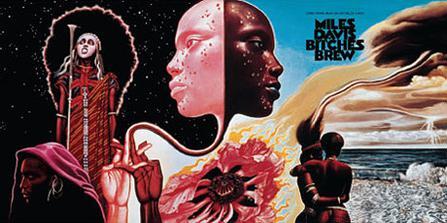
The full gate-fold cover for the original double LP edition of Miles Davis’ “Bitches Brew.” Painting by Mati Klarwein. Image sourced from Wikipedia.
With its rather stunning album cover, compelling liner notes and its mysterious, sometimes abstract sometimes funky music driving it along, the Bitches Brew album was a complete immersion into the future worlds of ambient and fusion music that were yet to come after its release in 1970.
George Grella Jr. provides a complete background to the assembly of the musicians by Miles Davis, the recording process in the studio and a track-by-track examination of the results. The value added element is the analysis of the amount of post-recording production work that was done by Teo Macero in piecing together huge amounts of the recording out of spliced fragments and edits. The opening track Pharoah's Dance has 19 edits for instance, something which I was completely oblivious to when I first heard it, imagining it as being played live in the studio as were most jazz albums back in the day.
Almost all of the musicians from this recording would go on to lead their own prominent jazz-rock or improv jazz ensembles: Wayne Shorter and Joe Zaminul with Weather Report, Chick Corea with Return to Forever, Herbie Hancock with the Headhunters, John McLaughlin with Mahavishnu Orchestra, Keith Jarrett with his solo concerts & the European Quartet & Standards Trio, Dave Holland and his various Quartets & Quintets, etc. But Miles had them all first together in the studio in August 1969 where magic was born.
Footnote
* Read the complete original liner notes by Ralph J. Gleason and the additional liner notes by Bob Belden for The Complete Bitches Brew Sessions at Album Liner Notes.com.
Soundtrack
Listen to the expanded (1 hour 45:54 minutes) Sony Columbia Legacy Edition 7-track edition (which includes 1 bonus track) of the Bitches Brew album on YouTube here or on Spotify here.
Listen to the 21-track edition of The Complete Bitches Brew Sessions (4 hours 24 minutes) at a YouTube playlist which begins here or on Spotify here.
Trivia and Links
Miles Davis’ Bitches Brew is part of the Bloomsbury Academic 33 1/3 series of books surveying significant record albums, primarily in the rock and pop genres with a few that are jazz and classical related. The GR Listopia for the 33 1/3 series is incomplete with only 38 books listed as of May 2024. For an up-to-date list see Bloomsbury Publishing with 193 books listed as of May 2024.
Bonus Tracks
I don't think this is a story from the Bitches Brew sessions, but pianist Keith Jarrett tells a funny story and performs an excellent mimic of Miles Davis' raspy voice in Miles Davis and the Very Slow Beat.
Wayne Shorter talks about first performing and then recording with Miles Davis on the "E.S.P." album , again imitating Miles' voice at Wayne Shorter recalls recording with Miles Davis.
John McLaughlin talks about recording the album "In A Silent Way" and tells the now infamous story of Miles telling him to play as if "he doesn't know how to play the guitar" at Miles and In A Silent Way.
Review of the Bloomsbury Academic 33 and 1/3 paperback (October 22, 2015), released simultaneously with the eBook.
The full gate-fold cover for the original double LP edition of Miles Davis’ “Bitches Brew.” Painting by Mati Klarwein. Image sourced from Wikipedia.
it will never be the same again now, after in a silent way and after BITCHES BREW. listen to this. how can it ever be the same? i don't mean you can't listen to ben. how silly. we can always listen to ben play funny valentine, until the end of the world it will be beautiful and how can anything be more beautiful than hodges playing passion flower? he never made a mistake in 40 years. it's not more beautiful, just different. a new beauty. a different beauty. the other beauty is still beauty. this is new and right now it has the edge of newness and that snapping fire you sense when you go out there from the spaceship where nobody has ever been before. - excerpted from Ralph J. Gleason’s liner notes* for the original double LP edition of Bitches Brew. These were intentionally written in lower case letters.
With its rather stunning album cover, compelling liner notes and its mysterious, sometimes abstract sometimes funky music driving it along, the Bitches Brew album was a complete immersion into the future worlds of ambient and fusion music that were yet to come after its release in 1970.
George Grella Jr. provides a complete background to the assembly of the musicians by Miles Davis, the recording process in the studio and a track-by-track examination of the results. The value added element is the analysis of the amount of post-recording production work that was done by Teo Macero in piecing together huge amounts of the recording out of spliced fragments and edits. The opening track Pharoah's Dance has 19 edits for instance, something which I was completely oblivious to when I first heard it, imagining it as being played live in the studio as were most jazz albums back in the day.
Almost all of the musicians from this recording would go on to lead their own prominent jazz-rock or improv jazz ensembles: Wayne Shorter and Joe Zaminul with Weather Report, Chick Corea with Return to Forever, Herbie Hancock with the Headhunters, John McLaughlin with Mahavishnu Orchestra, Keith Jarrett with his solo concerts & the European Quartet & Standards Trio, Dave Holland and his various Quartets & Quintets, etc. But Miles had them all first together in the studio in August 1969 where magic was born.
Footnote
* Read the complete original liner notes by Ralph J. Gleason and the additional liner notes by Bob Belden for The Complete Bitches Brew Sessions at Album Liner Notes.com.
Soundtrack
Listen to the expanded (1 hour 45:54 minutes) Sony Columbia Legacy Edition 7-track edition (which includes 1 bonus track) of the Bitches Brew album on YouTube here or on Spotify here.
Listen to the 21-track edition of The Complete Bitches Brew Sessions (4 hours 24 minutes) at a YouTube playlist which begins here or on Spotify here.
Trivia and Links
Miles Davis’ Bitches Brew is part of the Bloomsbury Academic 33 1/3 series of books surveying significant record albums, primarily in the rock and pop genres with a few that are jazz and classical related. The GR Listopia for the 33 1/3 series is incomplete with only 38 books listed as of May 2024. For an up-to-date list see Bloomsbury Publishing with 193 books listed as of May 2024.
Bonus Tracks
I don't think this is a story from the Bitches Brew sessions, but pianist Keith Jarrett tells a funny story and performs an excellent mimic of Miles Davis' raspy voice in Miles Davis and the Very Slow Beat.
Wayne Shorter talks about first performing and then recording with Miles Davis on the "E.S.P." album , again imitating Miles' voice at Wayne Shorter recalls recording with Miles Davis.
John McLaughlin talks about recording the album "In A Silent Way" and tells the now infamous story of Miles telling him to play as if "he doesn't know how to play the guitar" at Miles and In A Silent Way.

January 28, 2018
If you listen to Bitches Brew for the first time, be warned: it is a heady mass of new sounds and weird time signatures it's disorientating and yet, it is an intelligent album that is momentous and is unforgettable. Despite the avant garde clothing, the more you listen, the more it makes sense.
Now I know practically nothing when it comes to jazz and I'm glad that Grella does as well. This volume in the series focuses on Miles' role in the jazz scene, his evolution and love for pop music and his attempt to combine both jazz and rock in order to create Bitches Brew, the end result being a totally unique style of fusion.
Grella then dedicates a part of the book on the actual recording, which is fascinating and then the influence of Bitches Brew on non jazz musicians, namely Radiohead's Thom Yorke.
This volume is another worthy addition to the superb 33 1/3 canon ( this last batch have been nothing short of excellent) and, at least, it helped me understand the importance of Davis outside of Bitches Brew.

May 21, 2022
I love Bitches Brew and now I know more about it. Thats the power of reading.

June 17, 2017
A few blemishes don't ruin the overall impact of this slight volume. (Some editorial lapses, and, at times, an over-reliance on strings of superlatives that verge on nonsensical.) The big point of the book is made well, with plenty of evidence for anybody with ears and a critical musical mind: that Miles Davis knew exactly what we was doing during the creation of this crucial document, and in no way was it a "sell out." Composition doesn't have to stay imprisoned in the lines on a page. Nor do big sales equate to a vacuous product. (The irony in the non-ability of critics like Stanley Crouch and Albert Murray to appreciate Miles' deep Afrological approach to making art – employing superpolyphony (maybe I mean METApolyphony?!), the oral transmission of ideas and a 'storyline,' and a HUGE emphasis on community-based improvisatory music-making – this irony would be tragic if not for the lingering belligerence and success of Crouch, et al to score their points in the critical discourse of the last 40 years.) As any book of this kind should, it drove me straight back into listening, with new ears.
Read
August 18, 2025Part of me thinks that Bitches Brew doesn't need the kind of spirited defense offered here - it's a stone-cold classic, respected today by all but a few pedestrian dorks (name-checked here as Stanley Crouch and Wynton Marsalis (and perhaps by extension, Ken Burns?)), even by those who don't much enjoy this extremely difficult, boundary-smashing work of art. The dust of the fusion wars has settled, and the fusionists have won. The bittersweetness of that fact is that the era of fusion also marks the end of jazz's golden age and mainstream appeal. Fusion, if anything, prolonged its life as it dwindled into the domain of aficionados. But while the controversy over fusion may seem antiquated, it speaks to jazz's underlying relevance in new forms, not jazz-as-jazz but jazz-in and as-popular music - adapting to the times, new styles and sounds like a chameleon, emerging originally AS a popular fusion music and surviving today in hip-hop, electronic, and more. The decline of jazz-as-jazz has as much to do with broader socioeconomic trends as changing tastes, and that's far beyond the bounds of music criticism. Sadly, I don't think today's jazz/fusion artists really stack up to the classics, but I'm biased. Still, Bitches Brew and its contemporaries are as timeless as ever, and remain innovative even in the light of 50+ years of music. Bitches Brew in particular is an album one can get lost in, explore for hours and keep finding something new - it remains a puzzle, maybe for everyone except Miles Davis and a few trusted collaborators. This slim volume may help guide you along.
October 18, 2021
Can't get enough of the 33 1/3 series. If yer interested in the story of how some famous albums where recorded, then these are the books for you. I thought Mr. Grella went on maybe a little too long about how much he knew about Miles Davis, but once he finally got around to telling the story of making the album, it all fit together nicely. And he did have some very interesting insights into Miles music, and career, and his impact on our culture.
May 3, 2020
Far too hyperbolic- Miles was the most _____, etc. - but this book does eventually settle in for some interesting analysis of the final cuts on the finished album, including the extensive use of edits to make the first two sides of the album.

January 30, 2026
A bit too much “jazz is this” and “jazz means that…” that came across as posturing (at least for this reader) and not as much as I had hoped for about Miles Davis and the making of this recording. When the author did turn directly to the recording process, the work was fascinating.
December 4, 2024
Bara en jävligt välskriven och läsvärd essä om denna vansinnigt intressanta skiva. Precis lagom mycket jazzteori och historielektion för att underhålla mig.
January 7, 2025
Bitches Brew is one of those albums that stands out so definitively as a turning point in music history that any writing on it is inevitably going to get lost in the weeds a little, get a little pretentious, and perhaps a bit muddled. This book definitely suffers from some of that, as it spends a lot of time describing Miles Davis the icon, and the weight that the album holds, without really giving an emphatic why. The first two sections, in particular, suffer from this, I feel like points get repeated, and the true message gets muddled. But when actually discussing the album's minutia, it does an excellent job of detailing what everything in the album is (which, if you've ever heard it, you know is a very difficult task), what it represents, and what it all means put together. It's a great reminder of just how brilliant and forward-thinking Bitches Brew was, and still is, and how it represents a culmination of everything Miles was working towards throughout the 60s. A pretty good book for a fantastic album, and a great academic introduction to Miles, and what he would achieve during his electric period.

November 18, 2016
Bitches Brew was my first encounter with Electric Miles, a very long time ago. This book is erudite, informative, short and correct about almost everything. Grella not only understands music as a musician, he also understands studio recording, editing and mixing - which is a vital part of this story - and he understands the cultural context and aesthetic stakes.
Sets the standard for what a book about a long-playing record can achieve while diligently pursuing a feud with Stanley Crouch.
Sets the standard for what a book about a long-playing record can achieve while diligently pursuing a feud with Stanley Crouch.

March 1, 2022
“…the music just stopped, it didn’t finish” (107).
I loved Bitches Brew the very first time I heard it. I had never heard anything like it. I’ve since listened the album a zillion times. I’ve never bothered to study the music or tried to figure out what in the world is going on. I’ve simply enjoyed the queer sounds, the thrilling movement, the images and shapes the music conjures. Reading Grella’s 33 1/3 entry on this album was enlightening and accessible. He does a remarkable job of explaining what the hell is going on on this album, and it adds to, rather than subtracts from, my enjoyment of it.
For me, one of the most helpful explanations Grella provides is a discussion of the album’s time, or more accurately, timelessness.
“But listening to the album creates expectations that are never fulfilled, because underneath what it seems to sound like, and how many units it moved, there’s so much more. The album regards the idea of musical resolution—reaching a final point—as irrelevant” (104).
“Miles was, among other things, specifically making funk: he wanted the rhythms to drive everything. The melodies and harmonies are not determined by rhythm, so much as rhythm is unusually prominent, while melody and harmony seem secondary—which is actually an illusion. Bitches Brew places everything on the same sonic level, and Western music of almost every kind, especially popular music, is made almost entirely with a hierarchy of values between soloist (or lead voice of some kind) and ensemble that came to be seen as a de facto requirement” (104).
“The rhythms also have no explicit relationship to African music: they are the sound of African-American rhythms mediated through history and geography by Cuba, the West Indies, New Orleans, the Midwest, and New York City. However, the group concept is closer to African music, with the rhythms built by adding beats on top of each other rather than subdividing in the Western manner.” What is more subtle, but profound, is that by using rhythm, pulse, and harmonies—and tape composition—that by design did not resolve, Miles was organizing time: and both form and time are conjoined in the music. Miles’ push to move form away from the demands of resolution and finality was a push into a different, and for American listeners, unfamiliar concept about time” (104-105).
“Time does not fly off into the future: it marks cyclical events…Non-Western harmonies change through the duration of a piece of music, but they are not made to function as a device that gets the piece from the beginning to the end. Instead they stay steady—drone—or cycle until the event is finished… The experience of non-timeline music is that of timelessness. Time is passing, as always, but the music is not marking that passage. It moves in a circle, returning to the same point over and over again. There is no implicit logic that what you are hearing in the moment will, structurally and inevitably, lead to something else. The listener’s experience of passing time is separate from the music’s measured duration” (106-107).
I loved Bitches Brew the very first time I heard it. I had never heard anything like it. I’ve since listened the album a zillion times. I’ve never bothered to study the music or tried to figure out what in the world is going on. I’ve simply enjoyed the queer sounds, the thrilling movement, the images and shapes the music conjures. Reading Grella’s 33 1/3 entry on this album was enlightening and accessible. He does a remarkable job of explaining what the hell is going on on this album, and it adds to, rather than subtracts from, my enjoyment of it.
For me, one of the most helpful explanations Grella provides is a discussion of the album’s time, or more accurately, timelessness.
“But listening to the album creates expectations that are never fulfilled, because underneath what it seems to sound like, and how many units it moved, there’s so much more. The album regards the idea of musical resolution—reaching a final point—as irrelevant” (104).
“Miles was, among other things, specifically making funk: he wanted the rhythms to drive everything. The melodies and harmonies are not determined by rhythm, so much as rhythm is unusually prominent, while melody and harmony seem secondary—which is actually an illusion. Bitches Brew places everything on the same sonic level, and Western music of almost every kind, especially popular music, is made almost entirely with a hierarchy of values between soloist (or lead voice of some kind) and ensemble that came to be seen as a de facto requirement” (104).
“The rhythms also have no explicit relationship to African music: they are the sound of African-American rhythms mediated through history and geography by Cuba, the West Indies, New Orleans, the Midwest, and New York City. However, the group concept is closer to African music, with the rhythms built by adding beats on top of each other rather than subdividing in the Western manner.” What is more subtle, but profound, is that by using rhythm, pulse, and harmonies—and tape composition—that by design did not resolve, Miles was organizing time: and both form and time are conjoined in the music. Miles’ push to move form away from the demands of resolution and finality was a push into a different, and for American listeners, unfamiliar concept about time” (104-105).
“Time does not fly off into the future: it marks cyclical events…Non-Western harmonies change through the duration of a piece of music, but they are not made to function as a device that gets the piece from the beginning to the end. Instead they stay steady—drone—or cycle until the event is finished… The experience of non-timeline music is that of timelessness. Time is passing, as always, but the music is not marking that passage. It moves in a circle, returning to the same point over and over again. There is no implicit logic that what you are hearing in the moment will, structurally and inevitably, lead to something else. The listener’s experience of passing time is separate from the music’s measured duration” (106-107).

November 15, 2016
Miles Davis’ 1969 double album “Bitches Brew” is a personal favorite that made a startling first impression. Part of the surprise came from distorted expectations: I had read so much about the album before I heard it that my mind’s ear was anticipating a very different experience. Therein lies the danger of music criticism, which is no surrogate for sonic realities. I had been fooled, in conspiracy with my own imagination, by prose (mostly from the infamously slim Rolling Stone Jazz Guide) that attempted the impossible task of describing a sprawling jazz-rock album that sounds like neither genre, nor possibly anything else on earth.
If I had read George Grella, Jr’s book-length analysis of “Bitches Brew” before my initial listening, I would have been armed with more precise detail and expectations. But it’s debatable whether this worthy but often overheated study really exposes the dark heart of Davis’ highly unusual jazz milestone.
Grella’s volume is an entry in Bloomsbury’s 33 1/3 series, which is mostly dedicated to a lineup of hipster music-head staples (Big Star, Radiohead, the Smiths, Velvet Underground), with an occasional entry (Celine Dion, Slayer) shoehorned into the program either by irony or the transforming power of academic theory. Grella has an alt-rock critic’s rabid eagerness to justify the greatness of his topic, favoring superlatives, generalities, and animated turns of phrase. A head-scratching introduction pummels the reader with a tribute to the (supposedly equal) achievements of Miles, Picasso and Stravinsky.
Fortunately, Grella gets down to more earthbound realities in the following pages, breaking down Davis’ dense music with admirable critical rigor. Of course, the album’s structure owes a great deal to the post-production of Teo Macero, who shaped a large group’s surging abstraction with almost symphonic logic, a fact that’s either a practical requirement of music production or a bombshell flash of post-modernism, depending on your perspective. As a critic with a literary bent, Grella opts for the latter.
In the end, this is a detailed critical study and a comprehensive survey of its topic. But are the 33 1/3 series’ lengthy tributes worthwhile? The long-form approach must pose critical challenges to even the most knowledgeable writer who, like Grella, is bound to feel compelled to layer theoretical flights of fancy upon more straightforward and useful analysis.
If I had read George Grella, Jr’s book-length analysis of “Bitches Brew” before my initial listening, I would have been armed with more precise detail and expectations. But it’s debatable whether this worthy but often overheated study really exposes the dark heart of Davis’ highly unusual jazz milestone.
Grella’s volume is an entry in Bloomsbury’s 33 1/3 series, which is mostly dedicated to a lineup of hipster music-head staples (Big Star, Radiohead, the Smiths, Velvet Underground), with an occasional entry (Celine Dion, Slayer) shoehorned into the program either by irony or the transforming power of academic theory. Grella has an alt-rock critic’s rabid eagerness to justify the greatness of his topic, favoring superlatives, generalities, and animated turns of phrase. A head-scratching introduction pummels the reader with a tribute to the (supposedly equal) achievements of Miles, Picasso and Stravinsky.
Fortunately, Grella gets down to more earthbound realities in the following pages, breaking down Davis’ dense music with admirable critical rigor. Of course, the album’s structure owes a great deal to the post-production of Teo Macero, who shaped a large group’s surging abstraction with almost symphonic logic, a fact that’s either a practical requirement of music production or a bombshell flash of post-modernism, depending on your perspective. As a critic with a literary bent, Grella opts for the latter.
In the end, this is a detailed critical study and a comprehensive survey of its topic. But are the 33 1/3 series’ lengthy tributes worthwhile? The long-form approach must pose critical challenges to even the most knowledgeable writer who, like Grella, is bound to feel compelled to layer theoretical flights of fancy upon more straightforward and useful analysis.

March 31, 2022
The 33 1/3 book on “Bitches Brew” is quite a ride. It reads itself with its smart narrative, contemporary language, and in-depth subject matter. Very good book! I read quite a few books in the series, and this one is easily the most captivating.
Unsurprisingly, George is a huge fan of the record, and his book is singing praises of it, with descriptions like “carries astonishing force and weight of expression” or “Bitches Brew was unprecedented”. Really, unprecedented? Sun Ra and Carla Bley would like a word. Steve Reich would object as well, I believe.
Grella also calls “Bitches Brew” the first fusion album, to which I can only ask: what about Larry Coryell and his records with Gary Burton as well as with the Free Spirits? What of David Axelrod’s “Song of Innocence”, which inspired the term “jazz fusion” in the first place? In fact, in his footnotes, Grella contradicts himself by pointing at “Emergency!” as the generally accepted first fusion album.
As for the album itself, I'm not really a fan. I read the book partially in the hope that George will help me dig the record. He did all he could but I have to admit I'm still left untouched by the music in this case. I wrote more about it here:
https://lukasz.langa.pl/275c46e6-06bc...
While I don’t share his enthusiasm, I liked Grella’s other upbeat words of praise like:
> [Miles’ music] centered around one organizing idea that is open to a myriad valid interpretations.
or:
> “Bitches Brew” is deep thinking without high concept, high art with the low appeal of abstract funk, and it seals the artificial division between jazz as popular entertainment and jazz as art music, and makes an abstract art music with the sounds of the streets.
He also seems to agree with me on the entire “jazz-rock” misnomer:
> There is so little rock beat on the album that when it appears, it’s accidental.
Unsurprisingly, George is a huge fan of the record, and his book is singing praises of it, with descriptions like “carries astonishing force and weight of expression” or “Bitches Brew was unprecedented”. Really, unprecedented? Sun Ra and Carla Bley would like a word. Steve Reich would object as well, I believe.
Grella also calls “Bitches Brew” the first fusion album, to which I can only ask: what about Larry Coryell and his records with Gary Burton as well as with the Free Spirits? What of David Axelrod’s “Song of Innocence”, which inspired the term “jazz fusion” in the first place? In fact, in his footnotes, Grella contradicts himself by pointing at “Emergency!” as the generally accepted first fusion album.
As for the album itself, I'm not really a fan. I read the book partially in the hope that George will help me dig the record. He did all he could but I have to admit I'm still left untouched by the music in this case. I wrote more about it here:
https://lukasz.langa.pl/275c46e6-06bc...
While I don’t share his enthusiasm, I liked Grella’s other upbeat words of praise like:
> [Miles’ music] centered around one organizing idea that is open to a myriad valid interpretations.
or:
> “Bitches Brew” is deep thinking without high concept, high art with the low appeal of abstract funk, and it seals the artificial division between jazz as popular entertainment and jazz as art music, and makes an abstract art music with the sounds of the streets.
He also seems to agree with me on the entire “jazz-rock” misnomer:
> There is so little rock beat on the album that when it appears, it’s accidental.

February 21, 2026
When Miles Davis' Bitches Brew by George Grella Jr. examines the album Bitches Brew, it shows that the record was not just another jazz release. It was a turning point in music history. According to Grella, Miles Davis was not trying to create chaos. He was carefully reshaping jazz by using electric instruments, strong rhythms, and new recording techniques.
One of the most important ideas in the book is that the recording studio itself became part of the creative process. Producer Teo Macero edited and spliced together long jam sessions, shaping the final sound after the musicians had finished playing. In this way, the album was built both during the performance and during the editing process.
Grella also explains that Davis did not abandon jazz tradition. Instead, he expanded it. Influenced by rock and funk artists like Jimi Hendrix and Sly Stone, Davis focused more on groove and rhythm than on complex chord changes. Multiple drummers and bass players created thick, layered rhythms that felt powerful and new.
The album also reflected the social changes of 1969, a time of protest and cultural upheaval. Its restless, open sound matched the uncertainty of the era. Rather than offering neat endings, the music unfolds in long, shifting textures that feel unpredictable.
Finally, Grella shows that Bitches Brew changed jazz’s audience and influenced many later styles, including fusion, rock, and even hip-hop production. The album proved that jazz could evolve and connect with a new generation. In the end, Bitches Brew was not just an album — it was a bold step into the future of music.
I would love to read about your initial reactions to hearing this album and what place it occupies in our list of favorite albums.
One of the most important ideas in the book is that the recording studio itself became part of the creative process. Producer Teo Macero edited and spliced together long jam sessions, shaping the final sound after the musicians had finished playing. In this way, the album was built both during the performance and during the editing process.
Grella also explains that Davis did not abandon jazz tradition. Instead, he expanded it. Influenced by rock and funk artists like Jimi Hendrix and Sly Stone, Davis focused more on groove and rhythm than on complex chord changes. Multiple drummers and bass players created thick, layered rhythms that felt powerful and new.
The album also reflected the social changes of 1969, a time of protest and cultural upheaval. Its restless, open sound matched the uncertainty of the era. Rather than offering neat endings, the music unfolds in long, shifting textures that feel unpredictable.
Finally, Grella shows that Bitches Brew changed jazz’s audience and influenced many later styles, including fusion, rock, and even hip-hop production. The album proved that jazz could evolve and connect with a new generation. In the end, Bitches Brew was not just an album — it was a bold step into the future of music.
I would love to read about your initial reactions to hearing this album and what place it occupies in our list of favorite albums.

January 10, 2025
I adore these 33 1/3 books. The previous ones I've read have been very well informed, well put together, and incredibly interesting. This one is absolutely no different, and this particular author might have been my favorite so far.
When I was younger I struggled to understand what made Bitches Brew so impactful and influential in the history of music. It had little sense of time, form, or popular appeal. But what this book has illuminated for me is that, in some odd sort of way, that is the point? Firstly, I assumed like many other people, I imagine, that these songs were performed and recorded with very little editing as I've been accustomed to in most other jazz. Coming to learn that this album was actually a product of extensive chopping and combining by Miles' producer, makes the way this album sounds make so so much more sense. There are distinct edits and cuts in the music, and even deliberate repeated tracks. Secondly, the lack of melody and abundance of space in the music didn't make much sense to me. But Grella is able to expertly trace the evolution of Miles' music that brought him to the recording of Bitches Brew that makes the listening experience so much more natural thanks to an understanding of the progression of his composition to this point. And the track by track breakdown of the album begs for a relisten because of the detail
These are really tight, really informative reads and I will absolutely be getting and reading more in the future.
When I was younger I struggled to understand what made Bitches Brew so impactful and influential in the history of music. It had little sense of time, form, or popular appeal. But what this book has illuminated for me is that, in some odd sort of way, that is the point? Firstly, I assumed like many other people, I imagine, that these songs were performed and recorded with very little editing as I've been accustomed to in most other jazz. Coming to learn that this album was actually a product of extensive chopping and combining by Miles' producer, makes the way this album sounds make so so much more sense. There are distinct edits and cuts in the music, and even deliberate repeated tracks. Secondly, the lack of melody and abundance of space in the music didn't make much sense to me. But Grella is able to expertly trace the evolution of Miles' music that brought him to the recording of Bitches Brew that makes the listening experience so much more natural thanks to an understanding of the progression of his composition to this point. And the track by track breakdown of the album begs for a relisten because of the detail
These are really tight, really informative reads and I will absolutely be getting and reading more in the future.
September 5, 2024
This gives a good summary of Miles Davis's career and its trajectory. It's a bit of the 20,000 foot view, but does a good job of summarizing and contextualizing him. I liked the comparison with him and Picasso and Stravinsky. However, there was a bit too much of fawning for the subject (a fault sometimes of this series generally). But on the plus sides (and there are many), the author elucidates this period of Davis's career well--what came close in time before and close after this recording. The track-by-track analysis was excellent, capturing Davis's and the group's contributions. The author's keen analysis of all of the splicing and cuts on these tracks worked really well. I found it interesting how the band recorded this music and what Davis and the musicians had been playing live before and after this recording (and how they had been playing it)! The author has a deep understanding of this music that really shines through for me. As an aside, he gave me a new appreciation for Davis's "Oleo" and some of Davis's other work from this same time. I felt like viscerally (probably the only way to really process this music), I felt and knew this recording well, but the book made me understand it better.
August 27, 2025
Great book that explains the history of Miles Davis, his approach, and restless need to constantly innovate. There's a lot of good info about the earlier records before Grella gets to the electric period, Teo Macero, and the splicing that made Bitches Brew so damn unique. That context adds value to his other records too.
When he gets to the album itself he walks through every song moment by moment, and it's fascinating how he gives some form and insight into music that is formless, improvised, and spliced. That the musicians didn't know it was them playing when they first heard the record on the radio is mindboggling and shows how much Teo Macero added after Miles was done directing 3 days of sessions with musicians who had largely not played with one another.
It's also just magic in a bottle that can't be explained bc it's the output of incredible musicians coming up with ideas on the fly and playing off of each other in ways that might not be immediately apparent. Very cool insight into an album that seems to get better with each listen (although maybe nothing can top listening to Pharoah's Dance for the first time and having no idea what the fuck you're listening to).
When he gets to the album itself he walks through every song moment by moment, and it's fascinating how he gives some form and insight into music that is formless, improvised, and spliced. That the musicians didn't know it was them playing when they first heard the record on the radio is mindboggling and shows how much Teo Macero added after Miles was done directing 3 days of sessions with musicians who had largely not played with one another.
It's also just magic in a bottle that can't be explained bc it's the output of incredible musicians coming up with ideas on the fly and playing off of each other in ways that might not be immediately apparent. Very cool insight into an album that seems to get better with each listen (although maybe nothing can top listening to Pharoah's Dance for the first time and having no idea what the fuck you're listening to).

August 31, 2023
Grella's unwillingness to tackle or even acknowledge race + racism in a book about Miles Davis renders his credibility null + void. i got less than a full chapter in + knew the author was a white man from the writing alone. couldn't confirm it immediately since i was on a plane w|o internet but, turns out Grella is exactly who i thought. which is a massive disappointment.
white Jazz fans want, so desperately, to erase + ignore Davis' race + refuse to contend w| just how much his Blackness + dark skin impacted his career + accomplishments. without that there's no honest context for this analysis.
this falls flat and hard. i couldn't even finish it. the way he danced around the issue while refusing to just name it is gross + infuriating.
he thinks he knows + understands more than he does. he thinks he gets it. he does not.
skip this one.
+ for the love of god, get someone adequately + appropriately qualified to write a 33⅓ book on one of Davis' albums. he deserves better.
if you want an actually good 33⅓ book, go for The Velvet Rope x Ayanna Dozier.
white Jazz fans want, so desperately, to erase + ignore Davis' race + refuse to contend w| just how much his Blackness + dark skin impacted his career + accomplishments. without that there's no honest context for this analysis.
this falls flat and hard. i couldn't even finish it. the way he danced around the issue while refusing to just name it is gross + infuriating.
he thinks he knows + understands more than he does. he thinks he gets it. he does not.
skip this one.
+ for the love of god, get someone adequately + appropriately qualified to write a 33⅓ book on one of Davis' albums. he deserves better.
if you want an actually good 33⅓ book, go for The Velvet Rope x Ayanna Dozier.

April 12, 2024
Really a perfect little encapsulation of music journalism, a critical analysis of the music in form and in context. Some standout work from the jump such as:
“Long before the rise of materialistic hipsterism (a faux-oppositional consumerist subculture that aspired to monetary enrichment through buying things with a culturally accepted brand) in the twenty-first century, Americans identified their socio-economic status and affiliations, racial and otherwise, by what they acquired-it's the American way. The tendency for those who find things they like in pop culture-James Bond movies, vintage lunch boxes, barware, vinyl, taxidermy—is to want to keep acquiring those things as long as they stay true to the same formula. Variation breeds contempt.”
I don’t know shit about music theory & terminology, really, but got plenty out of some of the “drier” sections as well.
“Long before the rise of materialistic hipsterism (a faux-oppositional consumerist subculture that aspired to monetary enrichment through buying things with a culturally accepted brand) in the twenty-first century, Americans identified their socio-economic status and affiliations, racial and otherwise, by what they acquired-it's the American way. The tendency for those who find things they like in pop culture-James Bond movies, vintage lunch boxes, barware, vinyl, taxidermy—is to want to keep acquiring those things as long as they stay true to the same formula. Variation breeds contempt.”
I don’t know shit about music theory & terminology, really, but got plenty out of some of the “drier” sections as well.

December 18, 2021
This was an album that transcended everything that I had been introduced to in 2000 when I heard it for the first time. I thought it was only introduced to me as a seduction tool in my ex Scorpio's 10-year pursuit, but it was also brought to my attention chiefly as an album that everyone who loves music should listen to. I hadn't listened to it in a long time, but once I did, I had to dive into this book on it. Imagine my joy at finding it at Half Ass Books for $3. The joy was in rediscovering this masterpiece again and this look at its inception and long-lasting effect on the masses was perfect synchronicity. I dig. You'll dig it as well.
July 9, 2019
Any book that can paint one of my favorite musical experiences in a new light is worth the price of admission alone. Particularly poignant is Grella Jr.'s ability to really place this enigma of a record within the context of its time. For me, Bitches Brew has always been an escapist fantasy, but this short and poignant book does a fantastic job of reconnecting the seminal album to its era in paradoxical fashion. Highly recommended for anyone who is a fan of electric era Davis, Bitches Brew or not.
July 11, 2024
Most of the book builds up Miles Davis as the voyager of Jazz and it tells the story well. But the climactic chapters later, the ones that go into a second-by-second analysis of Bitches Brew, just aren't rewarding. The book is a great medium for the story of Miles and Jazz, but not very good at playing a record.
I finished it feeling that I understand Miles Davis, Jazz, and this album's place in the histories of each, so I'm happy. But I think a documentary is a better way to get this kind of story across.
I finished it feeling that I understand Miles Davis, Jazz, and this album's place in the histories of each, so I'm happy. But I think a documentary is a better way to get this kind of story across.
May 29, 2026
This book is extremely informative regarding both the creative process of the singular album it focuses on as well as Davis’ general approach and musical evolution. It does a great job contextualizing jazz and the place that the album has within, or rather, outside of, the genre. More than this, you can tell that the author has a true passion for music and the history of Jazz. However, someways into the novel, when the book is analyzing the songs on the album themselves, I found the analysis somewhat repetitive and boring compared to the rest of the book.

June 26, 2026
Two points for talking about the artist instead of himself (not always the case with this series). But the first 55 pages barely mention Bitches Brew. That’s a crime. I understand his intent behind “to understand how different the recording process was, you have to understand how it used to be done” but that could’ve been a 2-page prologue. Get to the meat of it. Most people will know not rehearsing the songs and cutting them up later isn’t the norm.
That said, I enjoyed the few pages that dissect the track list. Another half point for that.
The rest was repetitive and hard to get through.
2.5
That said, I enjoyed the few pages that dissect the track list. Another half point for that.
The rest was repetitive and hard to get through.
2.5

August 12, 2018
This is how these books should be written...at least for my two cents..brief commentary on historical meaning of album/artist, info on recording/history that led to recording, commentary on tracks and closing with a final statement. I appreciate the concept of Miles constantly evolving jazz on his own terms.
September 8, 2017
This was another fantastic entry in the 33 1/3 series. Bitches Brew isn't an easy album to write about, but I think Grella really did a nice job of covering both the album and the larger context of Davis' career.

September 6, 2018
Quite an academic study of the jazz masterpiece, interesting if a little over my head at times. Nonetheless it’s left me with future music to explore and a fascination for how the record was recorded and produced.

December 29, 2018
Of the series 33 1/3, this one is about the revolutionary album that Miles Davis recorded in 1969, using studio editing to recreate the tracks, in a way that produced music on the record that was actually never played live. Interesting.
Displaying 1 - 30 of 61 reviews